At a glance
The paper extends a library-learning model of Chinese characters in two directions: discovering reusable links between graphical parts and pronunciation, and predicting distributional meaning vectors from a character’s learned components. Characters are represented as programs over strokes; compression discovers reusable functions rather than starting from a hand-labeled radical inventory.
The learned sound associations identify phonetic parts in selected two-part compounds with 72.9% accuracy. Learned decompositions also predict meaning vectors better than random decompositions, although exact character retrieval remains low. A comparison of classical and modern text corpora finds stronger form–meaning predictability for the classical corpus; this is a model-based corpus comparison, not a controlled causal test of writing reform.
Introduction
Writing can encode pronunciation and meaning simultaneously. Chinese provides a useful setting because its characters contain recurring graphical components whose contributions are often irregular. The earlier study [17] modeled reuse in written forms; this companion study asks whether the same compression principle can expose relationships to sound and meaning.
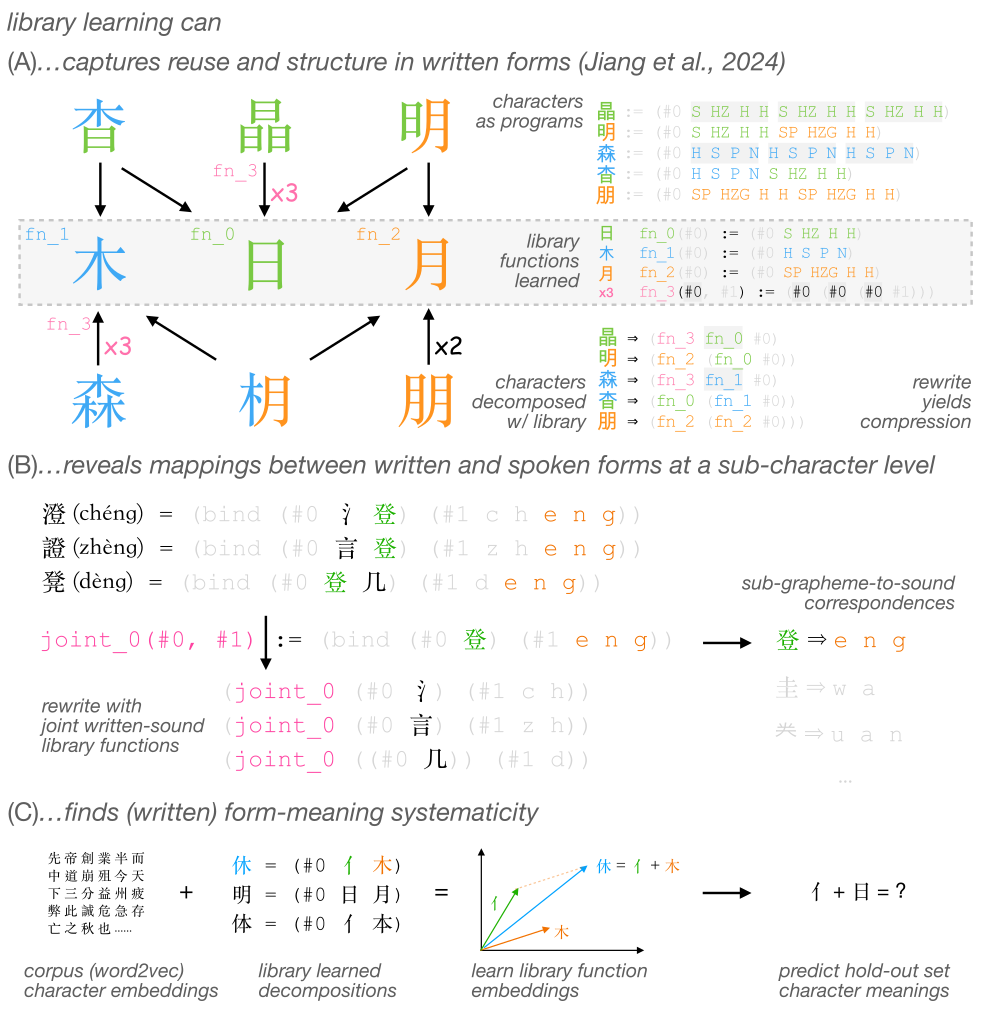
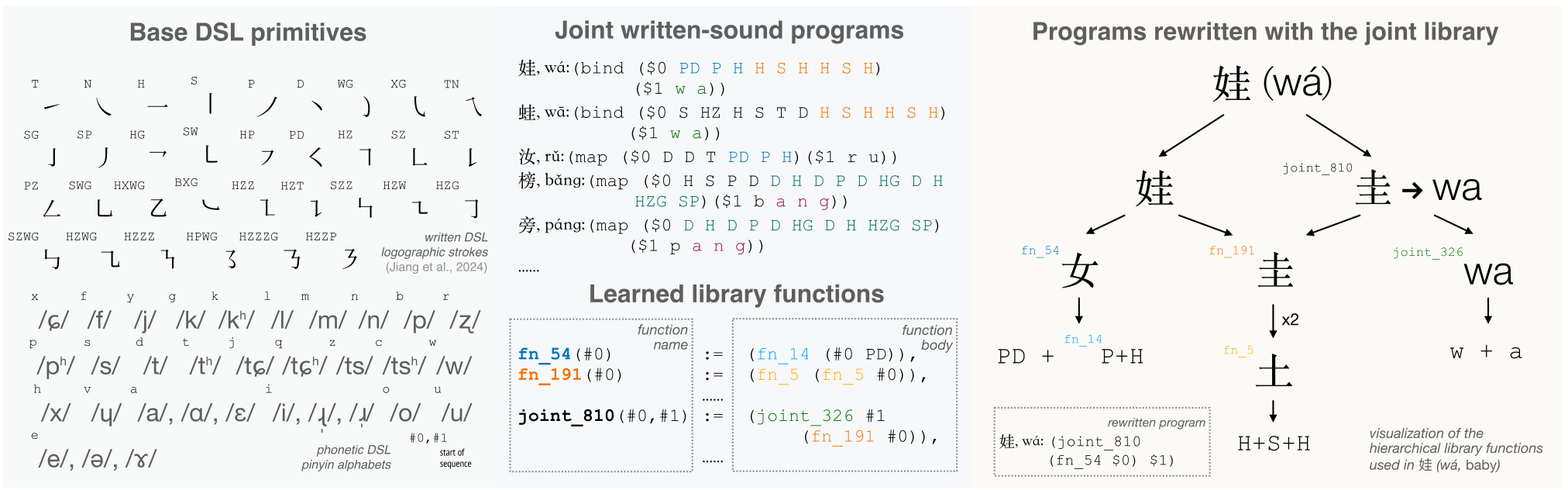
Library learning, as developed in program-synthesis research [3], replaces recurring program fragments with reusable functions. Figure 1 connects this mechanism to joint sound compression and compositional meaning prediction. The model describes statistical structure in a writing system; it does not directly measure how individual people learn or read characters.
Part I: Sound
The first analysis jointly represents written stroke sequences and pronunciation sequences. It tests whether compression discovers phonetic regularities, including components whose sound contribution depends on the character in which they appear.
Library learning on logographic forms
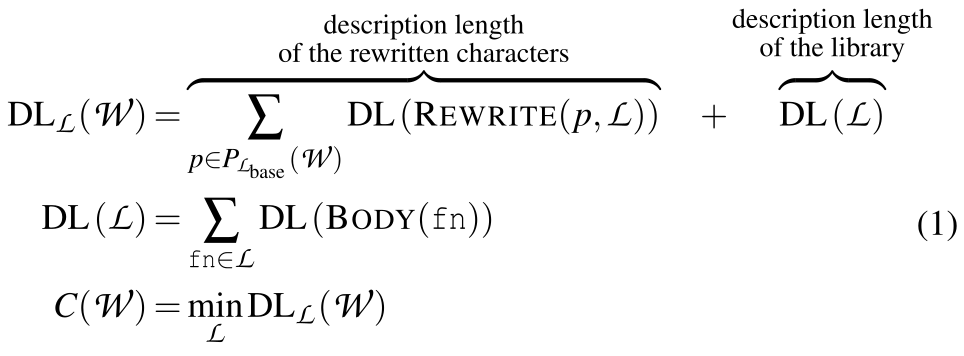
A domain-specific language (DSL) encodes each character as an ordered sequence of stroke primitives. Library functions capture recurring fragments, and rewriting can reuse functions inside other functions. Equation 1 minimizes the combined description length of all rewritten character programs and the library itself; this penalizes adding arbitrary one-off functions.
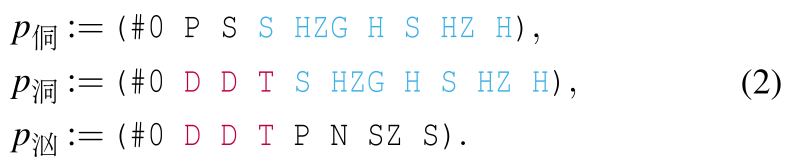
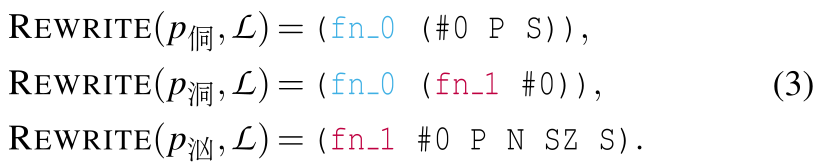
Equations 2–3 preserve the original colored examples for 侗, 洞, and 汹. Repeated sequences can become abstractions corresponding to components such as 同 or 氵. These are learned from supplied stroke programs: the experiment does not begin with raw character images or infer stroke order from pixels.
Equations
Joint compression of written and sound forms
Pronunciations are encoded as Pinyin symbol sequences using the same program representation. A bind operation pairs the written and sound programs, and the compression objective then discovers shared written–sound functions. Equations 4–5 retain the joint examples and their rewritten forms; Figure 2 retains the primitive inventories and hierarchical decomposition.
The representation omits tones. For a character with multiple pronunciations, the objective selects the most compressive written–sound mapping, rather than conditioning pronunciation on sentence context. A learned function can capture a sound fragment alone, or connect a graphical component to a sound fragment. These abstractions describe regularities rather than exception-free pronunciation rules.
Equations


Learned mappings between written forms and sounds
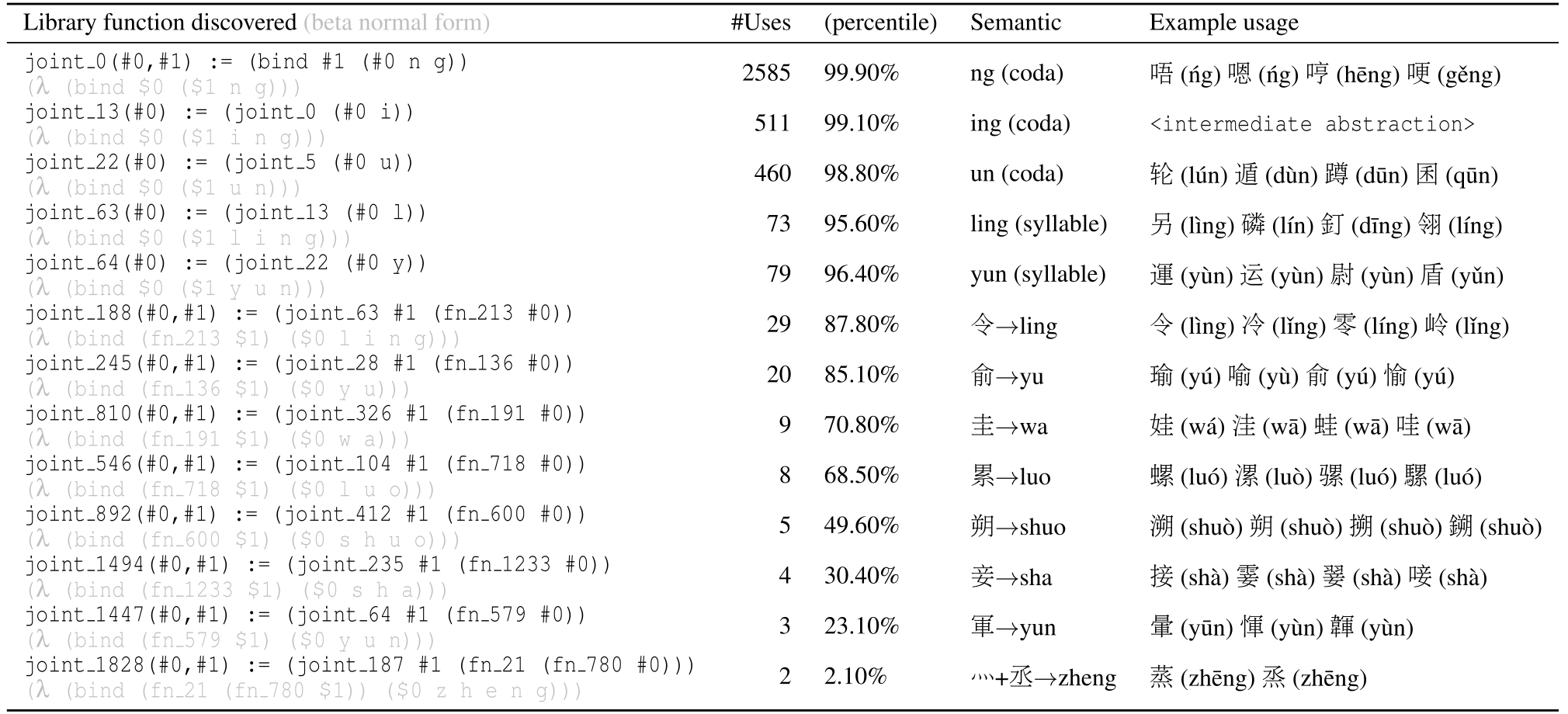
The sound experiment reports 16,316 written–sound programs, 1,825 written-form functions, and 1,923 sound-related functions. Of the latter, 376 describe sound fragments or syllables and 1,547 connect graphical components with sounds. Table 1 retains examples, use counts, percentile ranks, hierarchical definitions, and flattened lambda expressions.
The source gives inconsistent character totals: 12,085 at the start of the results paragraph but 12,805 in the following coverage sentences. Later cross-validation counts sum to 12,085. The edition preserves this discrepancy rather than selecting a corrected total without evidence.
One learned mapping links 圭 to wa in characters such as 娃 and 蛙. The same graphical part also occurs with other pronunciations, such as 佳 and 卦. The learned library therefore captures recurring associations amid irregularity, rather than assigning every component one fixed sound.
Identifying phonetic parts in compounds
Evaluation uses Hanzipy [30] to identify characters decomposable into two graphical parts by both that library and the learned model. This yields 3,598 selected phono-semantic compounds. A component participating in a sound-related function is labeled phonetic; the other component is treated as semantic.
The model matches the reference attribution on 2,624 of 3,598 characters, or 72.9%. The result supports identifying phonetic parts within this selected set. It does not establish pronunciation accuracy on arbitrary unseen characters, and the selection excludes characters whose decompositions do not agree between the two systems.
Part II: Meaning
The second analysis asks whether a character’s graphical decomposition predicts its distributional semantic representation. Meaning is operationalized as a corpus-trained vector, and systematicity is measured through prediction of that vector from component functions.
Modeling meanings of characters and library functions
A continuous bag-of-words (CBOW) model [21], implemented with fastText [18], learns 300-dimensional character vectors from traditional Chinese Wikipedia. The corpus contains 863 million character tokens and 14,710 distinct characters.
Each library function receives a learned embedding. Equation 6 normalizes the sum of a character’s constituent-function vectors to predict its character vector. Gradient descent minimizes mean squared error (MSE) between predictions and corpus-derived targets. Character programs are split 80% for fitting component embeddings and 20% for evaluation.
This holds out semantic supervision for the test characters; it does not mean their stroke structures or corpus-derived target vectors were absent from all earlier stages. The additive model tests a particular form of compositionality rather than recovering a complete dictionary meaning.
Equation

Measuring form–meaning systematicity
Evaluation reports mean cosine similarity between the predicted vector and its target, plus P@1, P@10, and P@100: the fraction of held-out characters whose own target vector ranks among the closest 1, 10, or 100 candidates. The original hit-rate definition is retained below. Candidate rankings are over the test-character set.
These scores measure recovery of distributional representations. Nearby vectors can reflect corpus usage and related meanings, so retrieval should not be read as a direct human judgment of semantic understanding.
Equation

Predicting character meanings
Five-fold evaluation uses 9,668 training characters and 2,417 test characters per reported split. Learned decompositions obtain cosine similarity 0.169 and exact retrieval 3.81%, versus 0.022 and 0.02% for random decompositions. Top-100 retrieval is 36.31% versus 4.27%. Table 2 keeps all metrics.
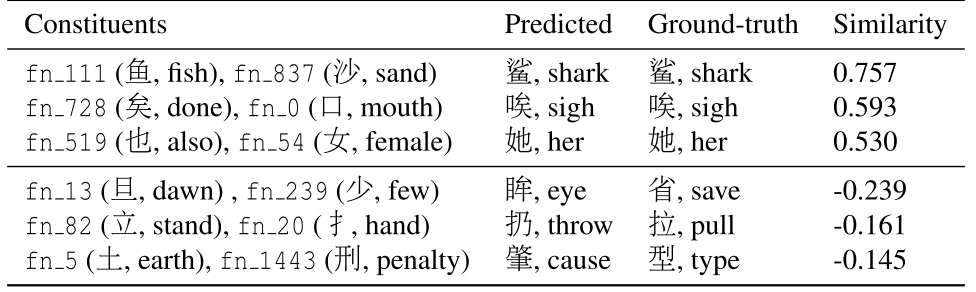
The improvement supports nonrandom form–meaning regularity, but most characters are still not recovered exactly. Table 3 retains three successes and three failures, including negative cosine similarities. Semantically informative components such as the fish radical can help; plausible-looking decomposition alone does not ensure correct meaning prediction.

Removing phonetic radicals
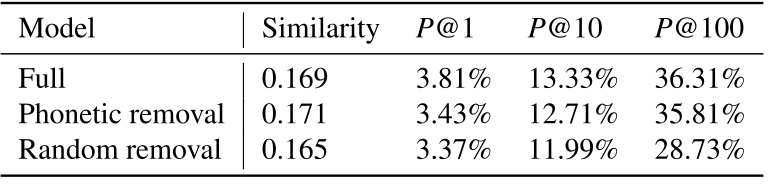
The ablation replaces 225 sound-associated written-form functions with one placeholder, retrains their meaning model, and compares this with removing the same number of random functions. Table 4 retains all results.
Removing phonetic functions leaves cosine similarity nearly unchanged (0.171 versus 0.169) and reduces exact retrieval to 3.43%. Random removal gives 0.165 and 3.37%, with a larger top-100 drop. This supports a smaller average semantic contribution from the identified phonetic functions, not the claim that phonetic components never contribute meaning.
Classical and modern Chinese
The authors hypothesize that changes in written language can weaken alignment between inherited character forms and meanings. They compare character embeddings from the classical Siku Quanshu corpus [10] with modern Wikipedia, using the same 10,037 shared traditional characters and 1,625 learned functions. The corpora contain about 690 million and 863 million character tokens, respectively.
Classical-corpus vectors are more predictable from the shared forms: cosine similarity 0.2259 and exact retrieval 9.75%, compared with 0.1423 and 2.30% for modern-corpus vectors. Table 5 preserves the top-10 and top-100 results too.
The authors interpret this difference in relation to vernacular writing reform. Because the corpora also differ in period, genre, content, and usage distributions, the experiment does not isolate reform as the cause. It supports a difference in these corpus-based measurements.

Discussion
Compression-based abstractions connect reusable written components with both pronunciation patterns and predictable semantic vectors. The two analyses complement the earlier written-form study, providing a computational account of several regularities in Chinese orthography.
The evidence depends on supplied stroke representations, tone-free Pinyin, selected compound annotations, additive semantic modeling, and particular corpora. It motivates efficiency as a possible organizing principle, while leaving cognitive mechanisms, other languages, context-sensitive pronunciation, and causal historical explanations for further study.
Acknowledgments
The authors thank Maddy Bowers and Hongjie Li and acknowledge support from MIT Quest for Intelligence, the Air Force Office of Scientific Research, the MIT–IBM Watson AI Lab, the Office of Naval Research, and the Simons Center for the Social Brain.