At a glance
i-MOGIC integrates motion generation and impedance control into one autonomous force policy. A global spring–damper and state-weighted local components jointly shape the path and the response to contact. Explicit parameter conditions give the stated free-space convergence and force–velocity passivity results. Two simulated KUKA-arm examples illustrate gain shaping and primitive sequencing; this paper does not report hardware experiments or a learned policy benchmark.
1. Introduction
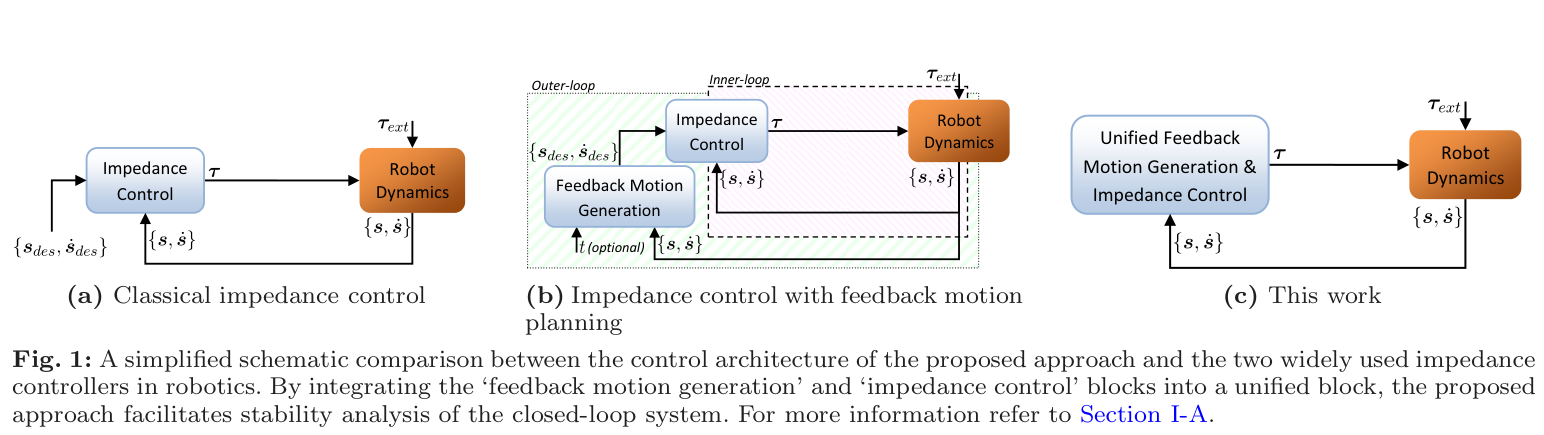
Motion planning specifies where a robot should move, while impedance control determines how it responds to contact. A separately stable planner and controller can still form an unstable combined system. Integrating them makes their joint energy analysis explicit. [1], [2]
1.1 Problem statement
Classical impedance control tracks a reference using spring and damping gains plus gravity compensation. State-varying gains and feedback-updated references make stability harder to establish than the fixed-gain case. Earlier imitation and reinforcement approaches often evaluated the combined behavior empirically. i-MOGIC instead builds a force policy with sufficient stability constraints. [8], [11]
The main formulation retains the robot’s physical inertia. Operational-space application needs the usual care at kinematic singularities; the result does not by itself remove actuator, workspace, or model limitations.
Equations 1–3



2. Dynamical-system robot motions
A continuous, time-invariant function of position and velocity directly commands generalized force. The paper considers discrete movements ending at one stationary attractor; the task may be accomplished along the route, as in a polishing stroke. There is no independent clock-indexed reference trajectory to track. This work develops the representation and sufficient conditions; learning its parameters from demonstrations is a proposed extension.
Equation 4

3. Encoding state-varying stiffness and damping
The starting point is the algebraic structure of GMR: a nonlinear weighted combination of local linear input–output maps. This offers a physical interpretation and a possible connection to demonstration learning.
3.1 Gaussian mixture regression
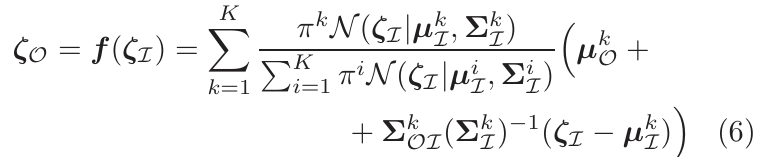
A joint GMM over inputs and outputs produces a conditional mean by averaging local affine predictions. With position and velocity as input and force as output, the covariance blocks determine each local stiffness and damping matrix. The original mixture and regression equations are retained.
Equations 5–6

3.2 A dynamical-system interpretation
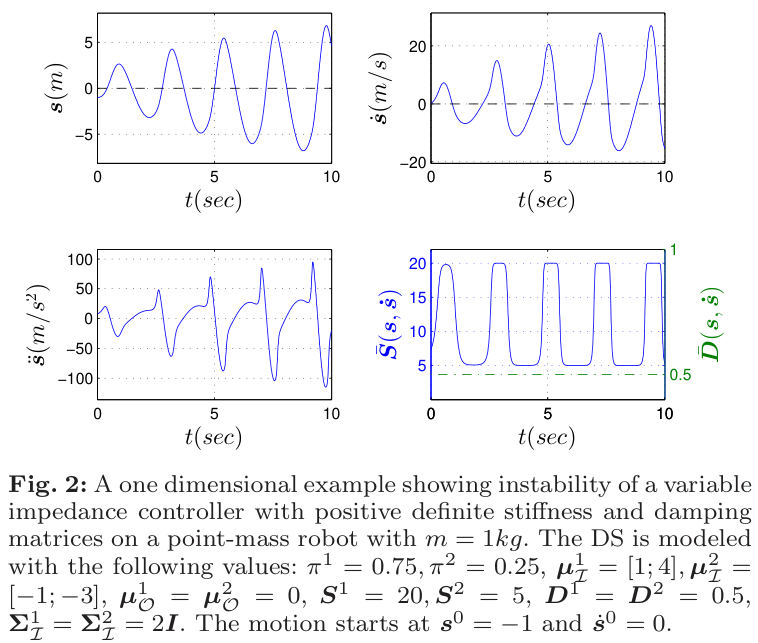
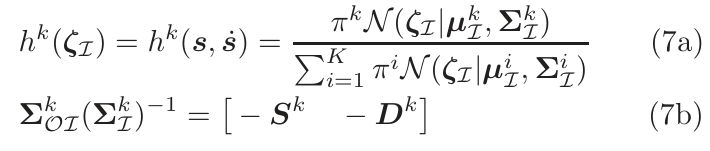
Positive-definite local gains make each affine component a preloaded spring and a damper. Their nonlinear mixture yields effective stiffness, damping, equilibrium position, undamped velocity, and preload that vary with state. Positive gains alone do not make this variable-impedance system stable: the one-dimensional counterexample in Figure 2 develops growing oscillations.
Equations 7–10


4. Stability analysis
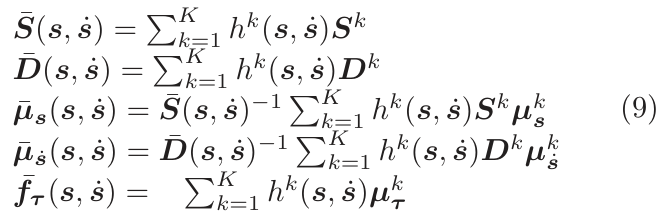
For a stationary target translated to the origin, i-MOGIC replaces ordinary normalized Gaussian weights with specially constructed nonnegative spatial weights. The proof conditions concern the integrated robot/controller dynamics in free space, with gravity compensation and the stated mechanical model.
4.1 Candidate energy function
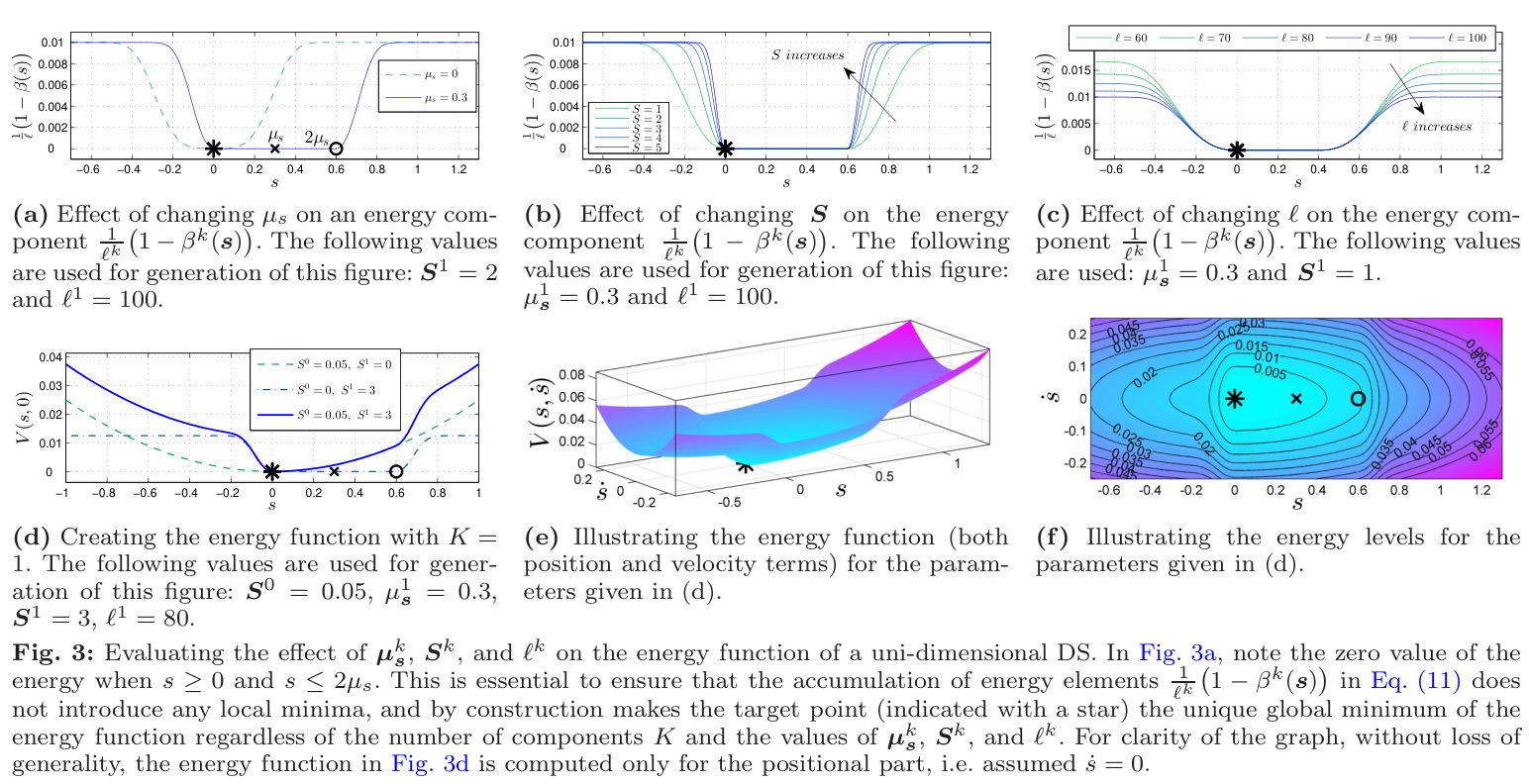
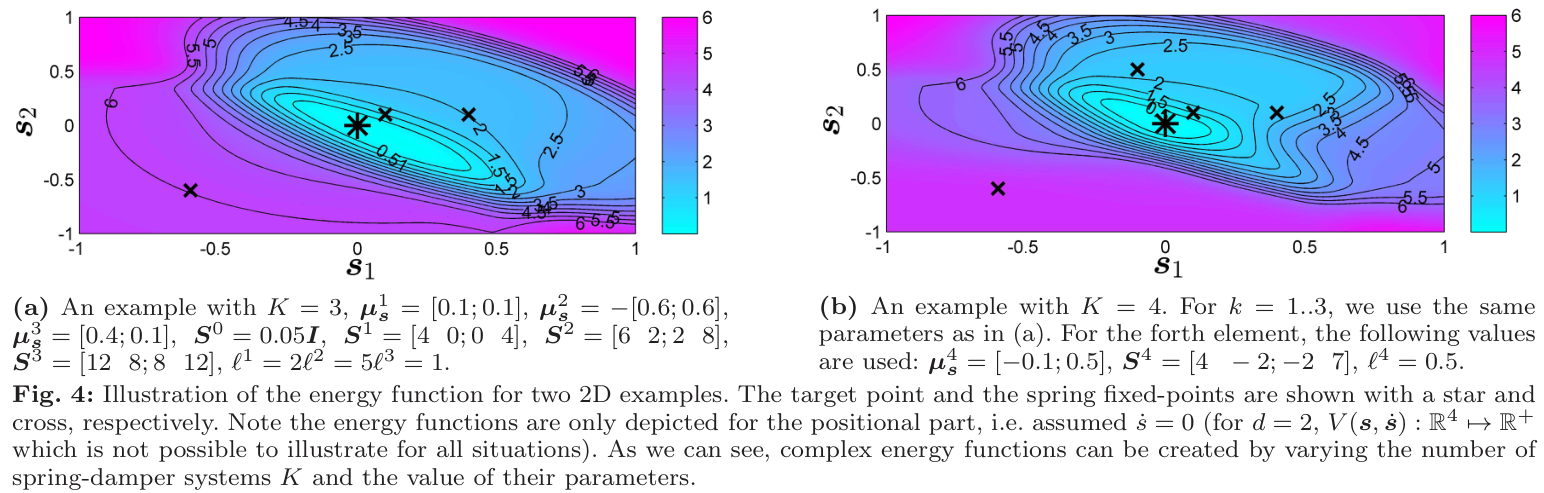
The candidate energy combines a global quadratic spring, robot kinetic energy, and bounded local spring contributions. Each local contribution uses a clipped quadratic form inside an exponential. This construction is continuously differentiable, has a unique minimum at the target under the stated conditions, and makes each added spring act locally. Figures 3 and 4 show how spring centers, stiffness, and scale shape the energy without adding undesired minima.
Equations 11–13



4.2 Sufficient stability and passivity conditions
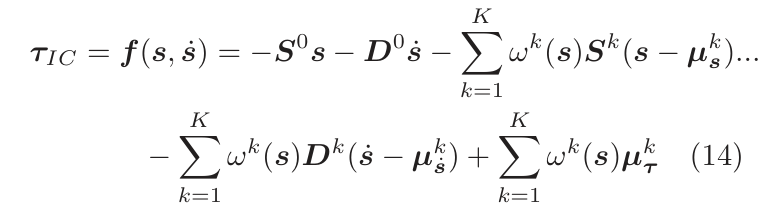
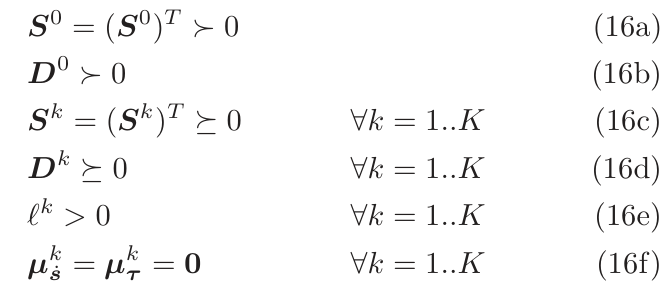
Theorem 1 requires symmetric positive-definite base stiffness and positive-definite base damping, symmetric positive-semidefinite local stiffness, nonnegative local damping, positive scale parameters, and zero local undamped-velocity and preload offsets. For nonsymmetric damping, its symmetric part supplies dissipation; the skew part is gyroscopic. The weights are the product of the clipped spatial factor and its exponential factor, rather than generic GMR responsibilities.
These conditions yield the stated global asymptotic convergence to the fixed target in free space and a passive map from external generalized force to robot velocity. Contact with a passive environment need not converge to the original target. The proceedings PDF refers to separate stability and passivity appendices but does not include them; the theorem and conditions present in the supplied paper are retained.
Equations 14–16

5. Simulation results
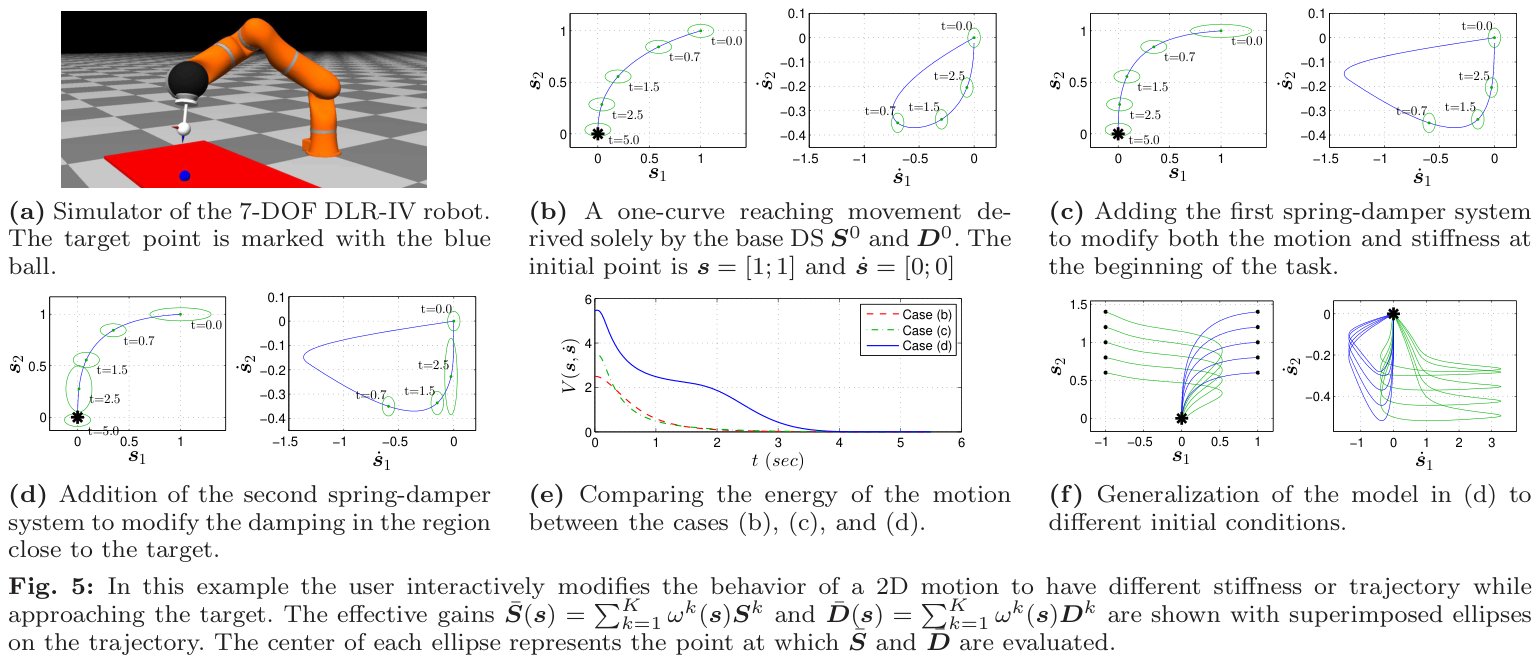
A simulated seven-joint KUKA LWR arm is controlled in operational space. In the first example, a base spring–damper generates a curved two-dimensional reach. Adding one component raises initial horizontal speed to about 1.4 m/s; another increases vertical damping near the table while approximately preserving that speed profile. Energy decreases along each fixed policy, and trajectories adapt to different starts. Changing stiffness also changes motion, so independent tuning is only approximate.
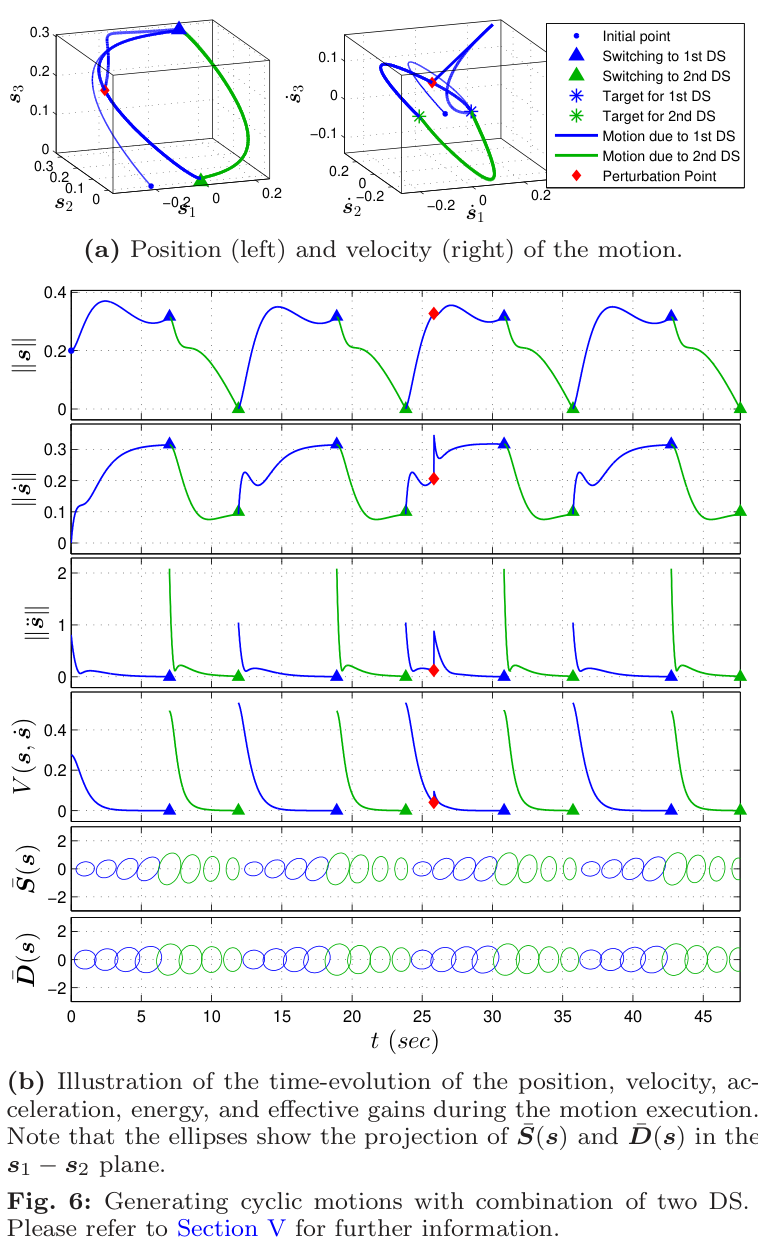
The second example switches between two three-dimensional policies to form a cycle. Moving targets and a Coriolis correction provide desired crossing velocities. Position and velocity remain continuous, while acceleration and the chosen energy jump at switches. A velocity perturbation at 26 seconds is followed by recovery in simulation. This demonstrates the selected sequence; the stationary single-policy theorem alone does not establish stability of arbitrary switching.
6. Conclusions and limitations
A shared physical parameterization makes motion generation and compliant interaction amenable to one stability analysis. The same coupling makes it harder to specify their behaviors independently and restricts the range of learnable motions compared with unconstrained architectures. Time invariance helps with execution delays, while inherently timed tasks may need another formulation. Learning from demonstrations and broader empirical validation remain further work.
Acknowledgments
The work acknowledges support from the European AMARSI project and the Swiss National Center of Competence in Research Robotics.