At a glance
Intuition. Think of matrix entries as shipment amounts from suppliers to customers. Row normalization gives every supplier a total of one; column normalization gives every customer a total of one. Fixing columns can disturb rows, so the algorithm alternates these simple divisions until both sets of totals approach one.
Reading the math. A doubly stochastic matrix has nonnegative entries and unit row and column sums. Multiplying by positive diagonal matrices just rescales rows or columns. Zeros remain zero, so missing routes matter. Support means the routes permit pairing every supplier with a different customer: a perfect matching. Total support means every positive entry belongs to some perfect matching, the stronger condition needed for finite positive scaling factors.
Alternating row and column normalization has three distinct questions: does the iteration converge to a doubly stochastic matrix, can its limit be written using finite positive diagonal scalings of the original matrix, and are those scaling factors unique? This paper supplies exact support conditions for each question. It treats square nonnegative matrices and proves the result rather than evaluating a neural-network architecture.
Support and total support
A positive diagonal means one positive entry in each row and column selected by a permutation. A matrix has support if at least one such diagonal exists. It has total support if it is nonzero and every positive entry belongs to a positive diagonal. These notions describe the zero pattern, not a numerical lower bound on entries. Total support is stronger than simply having no zero row or column.
Existence, convergence and uniqueness
There is a doubly stochastic matrix B = D₁AD₂ with finite positive diagonal factors exactly when A has total support; B is unique. The factors themselves are unique up to reciprocal scalar rescaling exactly when A is fully indecomposable. Independently, alternating normalization converges to a doubly stochastic limit exactly when A has support. With support but not total support, some original positive entries vanish in the limit, so that limit is not representable with finite positive diagonal factors.
The uniqueness argument
Compare two alleged doubly stochastic scalings through the ratios of their diagonal factors. Choose a minimal row ratio and maximal column ratio. Equality in the normalization inequalities forces corresponding rows and columns into matching closed blocks. On each such block the two scaled matrices agree. Repeating on the smaller complement proves uniqueness of the resulting matrix; full indecomposability prevents nontrivial blocks and therefore leaves only a common scalar freedom in the factors.
Equations p.344-a–p.344-b


Lemma 1: a product bound
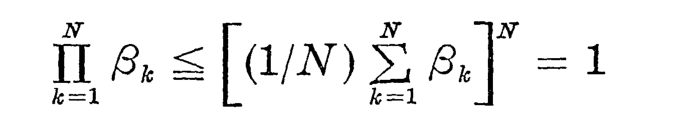
For a row-stochastic matrix, its column sums add to the matrix order. Their product is at most one by the arithmetic–geometric mean inequality, with equality only when every column sum is one. This elementary bound supplies a monotone quantity for the convergence proof; it is not an assertion about a uniform convergence rate.
Equation p.345-a
Lemma 2: convergent factors
Suppose the products of positive row/column factors converge to positive limits wherever A has a positive entry. Under total support, factors can be renormalized without changing those products so that each individual factor converges positively. For a fully indecomposable matrix, propagation through its connected support reaches every row and column. In the general case, permutation into fully indecomposable supported blocks lets the same construction run separately on each block.
Constructing and controlling the iteration
Start with column normalization and alternate reciprocal row/column corrections. The paper writes the running scaling factors and their normalization sums explicitly. A minimal positive entry bounds certain factor products above. Products along one positive diagonal form bounded monotone sequences; Lemma 1 then forces the row and column normalization sums toward one. Consequently every subsequential limit is doubly stochastic.
Equations p.346-a–p.346-b


Why the limit is unique
Two subsequential limits have the same support and positive-diagonal products. Lemma 2 gives positive diagonal factors taking one limit to the other. The uniqueness argument makes them equal, proving convergence of the whole sequence. With total support, the same lemma produces finite positive factors for the original matrix. Without a positive diagonal, Birkhoff’s permutation-matrix characterization rules out a doubly stochastic limit.
Equation p.347-a

The boundary case and implications
When support is not total, every positive entry outside all positive diagonals must tend to zero. Finite positive diagonal factors could not erase those entries while preserving valid row and column sums. This explains how iteration can converge even though a finite diagonal representation fails. For applications, distinguish existence from conditioning and iteration count: this paper does not promise geometric convergence uniformly over arbitrary nonnegative inputs. A doubly stochastic matrix is nonexpansive in Euclidean norm and preserves the all-ones mode; it is not a strict contraction in every direction.