Overview
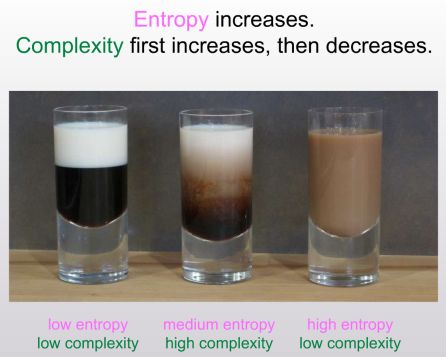
Why does mixing milk into coffee create intricate patterns before producing a uniform mixture? Motivated by Sean Carroll’s question, Aaronson proposes distinguishing entropy from structured complexity. Random strings can have high Kolmogorov complexity—the length of their shortest description—while lacking the organized patterns that make intermediate mixing states interesting. [4] [8]
The notion of sophistication instead measures the description length of a simple model in which the observed string is typical. In the essay’s set-based formulation, choose a set S containing x such that describing x given S still takes approximately log₂|S| bits, then minimize the description length K(S). Simple strings fit a simple singleton model; uniformly random strings fit the simple model of all strings of their length. Algorithmic statistics formalizes related distinctions between useful structure and residual randomness. [7] [9]
Unrestricted descriptions do not yet explain physical mixing. A deterministic system’s state can be specified by its initial condition, transition rule, and elapsed time t, keeping its description length near log(t) plus a constant. A probabilistic system has a related shortcut through the set of reachable states. Aaronson therefore imposes computational limits on two algorithms: the model must efficiently sample candidate states, and the observation must remain difficult to reconstruct efficiently using that sampling oracle. The illustrative time bound is n log(n); it is a proposed modeling choice, not an established physical constant.
The conjecture is that this resource-bounded measure starts small, becomes large while structure develops, and falls again after mixing. No proof is given. Testing it requires choosing concrete dynamics and resource limits, then dealing with the likely intractability of the proposed quantity; practical compression measures are suggested as imperfect proxies. As later reading, the 2014 Coffee Automaton paper investigates a discretized mixing system. [11]