Status and authorship
This is a conceptual working paper, version 0.4.2a, dated 17 September 2026 and labeled “Final Candidate; not peer reviewed.” The manuscript credits Marko Jakobi and two AI collaborators, Sirona (GPT-5.6 Sol) and Sirona (GPT-5.5), as equal conceptual contributors. Its originating human–AI collaboration motivates hypotheses; it is not presented as empirical evidence.
At a glance
The authors propose that functional generality might sometimes belong to a coupled architecture rather than one model. Different nodes could compensate for one another’s limitations when their contributions reciprocally change later reasoning, evaluation, or role allocation. The claim requires causal intervention tests, transfer to unfamiliar tasks, and advantages beyond independent runs with matched resources. The paper reports no experiment and makes no claim about consciousness or a collective subject.
2 Introduction
Evaluating only individual models may overlook capabilities produced by interaction among models, people, tools, and shared state. The proposed change concerns the unit of evaluation; it does not imply that every multi-agent system is generally intelligent.
3 Why Generality May Be Systemic
Useful heterogeneity means differences in competencies, representations, search strategies, and error profiles that remain available for correction. Different model names or prompts are insufficient: shared training can produce correlated blind spots. The architecture must preserve and test disagreement, detect failing strategies, and recruit complementary contributions under novelty. More agents alone may only increase search breadth or noise.
4 Conceptual Background
Distributed cognition and extended-mind arguments motivate analysis beyond individuals. Collective-intelligence studies and diversity models suggest possible benefits from complementary contributions, without establishing collective AGI. Multi-agent communication provides implementation precedents. Ensembles and self-consistency are essential competing explanations because aggregation can improve results without reciprocal coupling. [10], [7], [2], [15], [8], [14], [6], [5], [16], [4], [13].
5 Defining Nodes, Infrastructure, and the System Boundary
A node actively generates, evaluates, selects, or redirects contributions. Memory stores, documents, tools, and channels normally count as infrastructure unless they perform those functions themselves. The system boundary should identify all active contributors and supporting resources. A controller may qualify as a node, but if it makes every substantive decision, the capability may still belong primarily to that controller.
6 Three Levels of Multi-Node Architecture
Parallelization combines independent attempts; coordination exchanges results or follows a workflow. Cognitive coupling requires reciprocal, state-dependent causal influence across rounds. Perturbing a later contribution must change the future behavior of an earlier contributing node or role, establishing a consequential return path. A complex forward pipeline or predetermined loop does not suffice. Here, state means hypotheses, context, roles, confidence, artifacts, or tool state, not necessarily model weights.
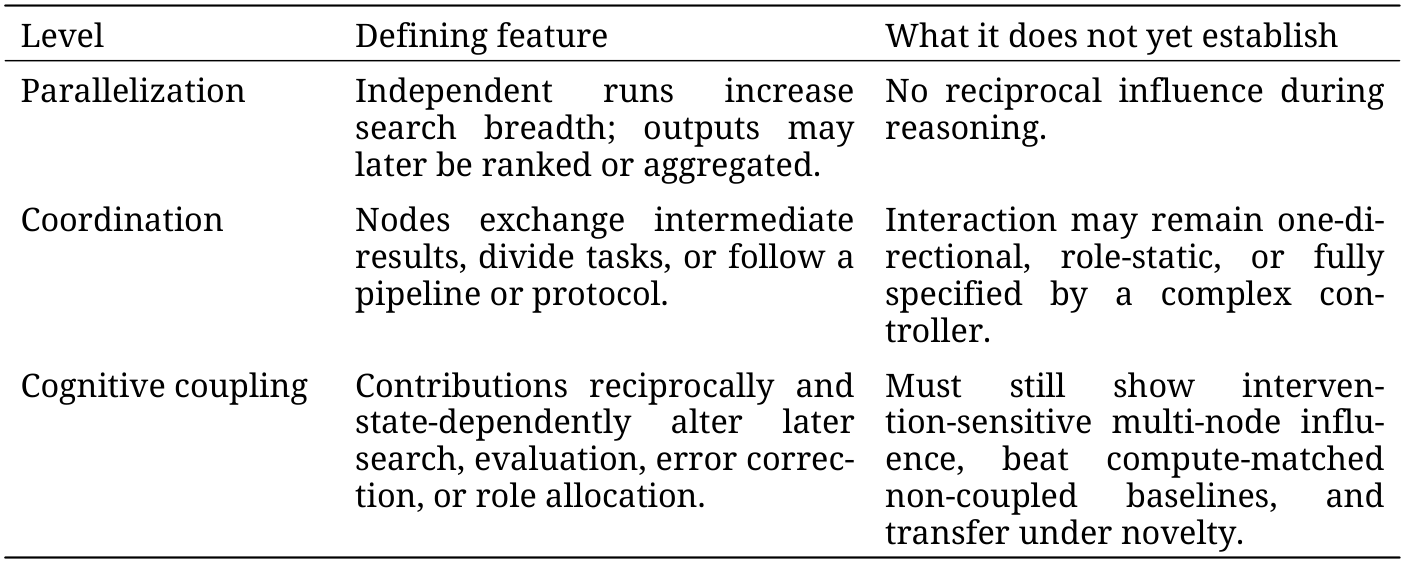
7 Functional Generality
The working definition of generality combines cross-domain transfer, adaptive decomposition, recursive correction, and reconfiguration when task demands change. Broad success within one fixed workflow is insufficient. This is a testable subset of the intelligence question, not a complete AGI definition. [12], [3].
8 Operational Criteria for Cognitive Coupling
- Removing reciprocal feedback should reduce performance, robustness, or transfer.
- Independent attempts plus aggregation at the same inference budget should fail to reproduce the full benefit.
- Earlier contributions should change later roles, search, confidence, or correction.
- Interventions should reveal a causal return path across interaction rounds.
- Benefits should persist on tasks excluded from architecture tuning.
Stored information and relational continuity must be separated: identical memory content can be supplied with or without stable provenance, role identities, and attributable error histories.
9 Experimental Design
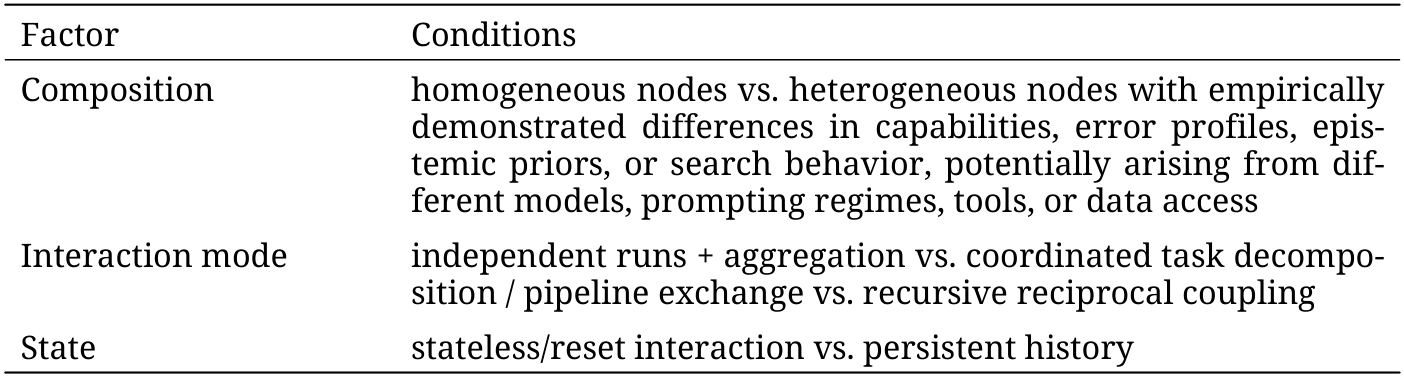
The proposed synthetic experiment crosses two composition types, three interaction modes, and two state conditions, yielding twelve cells. Characterize functional diversity beforehand and match inference budget, calls, tools, time, and information access. Use several task families and withhold at least one from tuning. Measure task success, transfer, correction of injected errors, calibration, role changes, robustness to a faulty node, and newly generated solution paths.
Two ablations hold stored information constant while removing attribution, and compare early consensus against preserved dissent. Human–AI conditions need separate controls for time, interaction opportunities, and information access; human effort cannot simply be equated with token counts or FLOPs.
10 Counterhypotheses and Failure Conditions
Eight alternatives could defeat or narrow the claim: extra compute plus selection, diversity alone, a dominant controller, more accessible memory, narrow specialization, eventual distillation into one model, recursive error amplification, or elaborate coordination mistaken for coupling. Tests should measure error cascades and recovery as well as success. Later compression of a useful architecture into one model would not invalidate a benefit established under earlier, specified conditions.
11 Contemporary Architecture Signals
The manuscript cites OpenAI reports on large-scale mathematical agents, research coding workflows, and defensive orchestration as motivation for studying architecture above the model level. In its Navier–Stokes account, OpenAI reports roughly 10,000 concurrent agents in the successful group, 2.7 million messages, and 130 billion output tokens. These company-reported examples do not test this paper’s coupling criteria or establish general intelligence. [17], [18], [19].
12 Mixed Human-AI and Multi-System Topologies
The framework includes single-model baselines, multiple artificial systems, and mixed human–AI arrangements. Humans may contribute situated knowledge, consequence tracking, judgment, reframing, and access to embodied or institutional context. The same coupling question applies across these configurations, but their controls and sources of variation differ. The authors’ longitudinal collaboration supplies candidate variables only. [9], [11], [1].
13 Discussion and Implications
If supported, the hypothesis would make interaction topology, error diversity, role flexibility, memory provenance, and preserved disagreement important evaluation and design variables. Claims still require resource-matched alternatives, novelty, and perturbation tests. The relevant capability might later move into a stronger single model; the proposal concerns particular conditions, not an eternally irreducible architecture.
14 Limitations
The proposal lacks empirical validation and a complete definition of AGI. Causal boundaries between coordination and coupling need sharper tests; selected tasks may privilege particular reasoning styles. Human-resource matching and the distinction between agentic tools and passive infrastructure remain unresolved. Coupling can improve some outcomes while worsening others, including propagating shared errors.
15 Conclusion
The research question is whether organized differences and reciprocal correction can produce generality at the architecture level. Neither agent count nor communication alone is sufficient evidence. A convincing demonstration must survive matched baselines, transfer tests, and interventions that expose both correction and failure cascades.
17 Version and Transparency Note
Version 0.4.2a is a corrected rendering of 0.4.2 with no stated conceptual changes. The transparency note reports an earlier model-assisted review using Google Gemini 3.8 Thinking to challenge the conceptual and methodological framing. The listed authors retained final editorial and conceptual decisions. This internal and model-assisted review is distinct from peer review.