Overview
This annotated implementation makes the Transformer concrete, from attention and masking through optimization and translation. The edition follows the 2022 notebook revision by Huang, Subramanian, Sum, Almubarak, and Biderman, building on Rush’s original 2018 tutorial. Reported WMT scores belong to the original Transformer experiments; the notebook demonstrates a smaller Multi30k translation setup. [1] [3] [18]

Prelims
The notebook imports PyTorch and its data utilities, tokenizers, plotting tools, and helper functions. These code cells record the original software environment and are retained as historical implementation examples.
# !pip install -r requirements.txt# # Uncomment for colab
# #
# !pip install -q torchdata==0.3.0 torchtext==0.12 spacy==3.2 altair GPUtil
# !python -m spacy download de_core_news_sm
# !python -m spacy download en_core_web_smimport os
from os.path import exists
import torch
import torch.nn as nn
from torch.nn.functional import log_softmax, pad
import math
import copy
import time
from torch.optim.lr_scheduler import LambdaLR
import pandas as pd
import altair as alt
from torchtext.data.functional import to_map_style_dataset
from torch.utils.data import DataLoader
from torchtext.vocab import build_vocab_from_iterator
import torchtext.datasets as datasets
import spacy
import GPUtil
import warnings
from torch.utils.data.distributed import DistributedSampler
import torch.distributed as dist
import torch.multiprocessing as mp
from torch.nn.parallel import DistributedDataParallel as DDP
# Set to False to skip notebook execution (e.g. for debugging)
warnings.filterwarnings("ignore")
RUN_EXAMPLES = True# Some convenience helper functions used throughout the notebook
def is_interactive_notebook():
return __name__ == "__main__"
def show_example(fn, args=[]):
if __name__ == "__main__" and RUN_EXAMPLES:
return fn(*args)
def execute_example(fn, args=[]):
if __name__ == "__main__" and RUN_EXAMPLES:
fn(*args)
class DummyOptimizer(torch.optim.Optimizer):
def __init__(self):
self.param_groups = [{"lr": 0}]
None
def step(self):
None
def zero_grad(self, set_to_none=False):
None
class DummyScheduler:
def step(self):
NoneBackground
Self-attention directly connects distant positions and permits parallel processing of a sequence. Multiple heads retain different relationships that would otherwise be mixed into one attention-weighted average.
Part 1: Model Architecture
Model Architecture
An encoder represents the input sequence; an autoregressive decoder predicts output tokens conditioned on those representations and previously generated tokens. [4] [5]
class EncoderDecoder(nn.Module):
    """
    A standard Encoder-Decoder architecture. Base for this and many
    other models.
    """

    def __init__(self, encoder, decoder, src_embed, tgt_embed, generator):
        super(EncoderDecoder, self).__init__()
        self.encoder = encoder
        self.decoder = decoder
        self.src_embed = src_embed
        self.tgt_embed = tgt_embed
        self.generator = generator

    def forward(self, src, tgt, src_mask, tgt_mask):
        "Take in and process masked src and target sequences."
        return self.decode(self.encode(src, src_mask), src_mask, tgt, tgt_mask)

    def encode(self, src, src_mask):
        return self.encoder(self.src_embed(src), src_mask)

    def decode(self, memory, src_mask, tgt, tgt_mask):
        return self.decoder(self.tgt_embed(tgt), memory, src_mask, tgt_mask)
class Generator(nn.Module):
"Define standard linear + softmax generation step."
def __init__(self, d_model, vocab):
super(Generator, self).__init__()
self.proj = nn.Linear(d_model, vocab)
def forward(self, x):
return log_softmax(self.proj(x), dim=-1)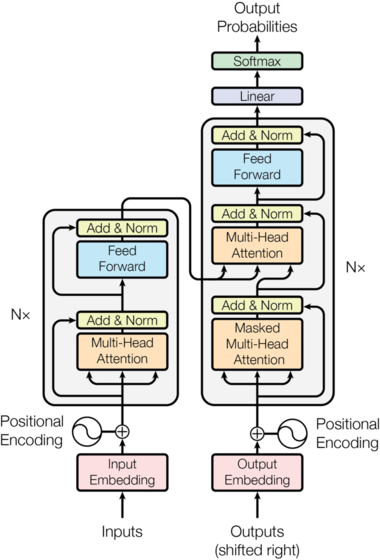
Encoder and Decoder Stacks
Encoder
Each encoder layer combines multi-head self-attention with a position-wise feed-forward network and residual connections. Read the code’s normalization placement carefully: this implementation applies normalization before its sublayer, while the accompanying paper prose describes the original post-normalization form. [6] [7] [8]
def clones(module, N):
    "Produce N identical layers."
    return nn.ModuleList([copy.deepcopy(module) for _ in range(N)])
class Encoder(nn.Module):
"Core encoder is a stack of N layers"
def __init__(self, layer, N):
super(Encoder, self).__init__()
self.layers = clones(layer, N)
self.norm = LayerNorm(layer.size)
def forward(self, x, mask):
"Pass the input (and mask) through each layer in turn."
for layer in self.layers:
x = layer(x, mask)
return self.norm(x)class LayerNorm(nn.Module):
"Construct a layernorm module (See citation for details)."
def __init__(self, features, eps=1e-6):
super(LayerNorm, self).__init__()
self.a_2 = nn.Parameter(torch.ones(features))
self.b_2 = nn.Parameter(torch.zeros(features))
self.eps = eps
def forward(self, x):
mean = x.mean(-1, keepdim=True)
std = x.std(-1, keepdim=True)
return self.a_2 * (x - mean) / (std + self.eps) + self.b_2class SublayerConnection(nn.Module):
"""
A residual connection followed by a layer norm.
Note for code simplicity the norm is first as opposed to last.
"""
def __init__(self, size, dropout):
super(SublayerConnection, self).__init__()
self.norm = LayerNorm(size)
self.dropout = nn.Dropout(dropout)
def forward(self, x, sublayer):
"Apply residual connection to any sublayer with the same size."
return x + self.dropout(sublayer(self.norm(x)))class EncoderLayer(nn.Module):
"Encoder is made up of self-attn and feed forward (defined below)"
def __init__(self, size, self_attn, feed_forward, dropout):
super(EncoderLayer, self).__init__()
self.self_attn = self_attn
self.feed_forward = feed_forward
self.sublayer = clones(SublayerConnection(size, dropout), 2)
self.size = size
def forward(self, x, mask):
"Follow Figure 1 (left) for connections."
x = self.sublayer[0](x, lambda x: self.self_attn(x, x, x, mask))
return self.sublayer[1](x, self.feed_forward)Decoder
The decoder adds cross-attention to encoder outputs. A causal mask blocks future target positions, and shifted targets ensure that a prediction cannot inspect its own answer.
class Decoder(nn.Module):
    "Generic N layer decoder with masking."

    def __init__(self, layer, N):
        super(Decoder, self).__init__()
        self.layers = clones(layer, N)
        self.norm = LayerNorm(layer.size)

    def forward(self, x, memory, src_mask, tgt_mask):
        for layer in self.layers:
            x = layer(x, memory, src_mask, tgt_mask)
        return self.norm(x)
class DecoderLayer(nn.Module):
"Decoder is made of self-attn, src-attn, and feed forward (defined below)"
def __init__(self, size, self_attn, src_attn, feed_forward, dropout):
super(DecoderLayer, self).__init__()
self.size = size
self.self_attn = self_attn
self.src_attn = src_attn
self.feed_forward = feed_forward
self.sublayer = clones(SublayerConnection(size, dropout), 3)
def forward(self, x, memory, src_mask, tgt_mask):
"Follow Figure 1 (right) for connections."
m = memory
x = self.sublayer[0](x, lambda x: self.self_attn(x, x, x, tgt_mask))
x = self.sublayer[1](x, lambda x: self.src_attn(x, m, m, src_mask))
return self.sublayer[2](x, self.feed_forward)def subsequent_mask(size):
"Mask out subsequent positions."
attn_shape = (1, size, size)
subsequent_mask = torch.triu(torch.ones(attn_shape), diagonal=1).type(
torch.uint8
)
return subsequent_mask == 0def example_mask():
LS_data = pd.concat(
[
pd.DataFrame(
{
"Subsequent Mask": subsequent_mask(20)[0][x, y].flatten(),
"Window": y,
"Masking": x,
}
)
for y in range(20)
for x in range(20)
]
)
return (
alt.Chart(LS_data)
.mark_rect()
.properties(height=250, width=250)
.encode(
alt.X("Window:O"),
alt.Y("Masking:O"),
alt.Color("Subsequent Mask:Q", scale=alt.Scale(scheme="viridis")),
)
.interactive()
)
show_example(example_mask)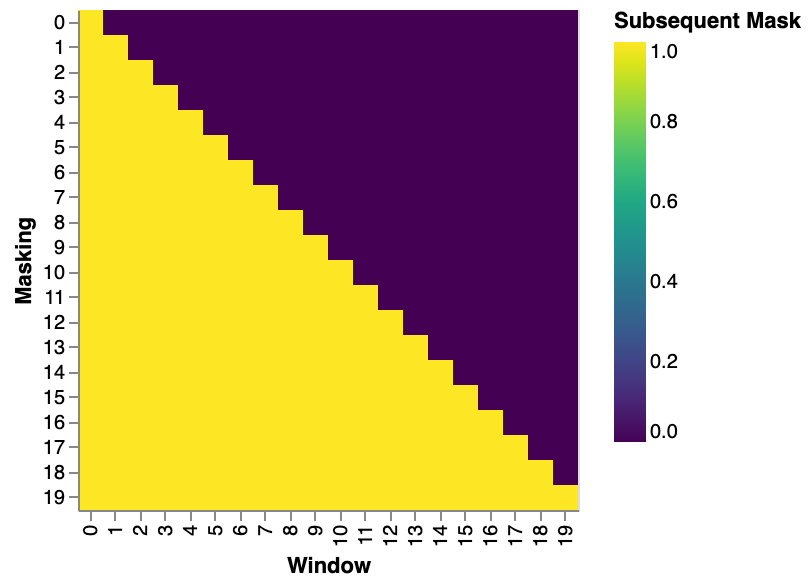
Attention
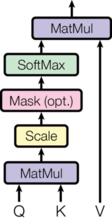
Scaled dot products compare queries with keys, softmax converts scores into weights, and the weighted values form an output. Dividing by the square root of key dimension moderates large logits. Independent projections let multiple heads attend to different representations. [4] [9]
Equation
def attention(query, key, value, mask=None, dropout=None):
    "Compute 'Scaled Dot Product Attention'"
    d_k = query.size(-1)
    scores = torch.matmul(query, key.transpose(-2, -1)) / math.sqrt(d_k)
    if mask is not None:
        scores = scores.masked_fill(mask == 0, -1e9)
    p_attn = scores.softmax(dim=-1)
    if dropout is not None:
        p_attn = dropout(p_attn)
    return torch.matmul(p_attn, value), p_attn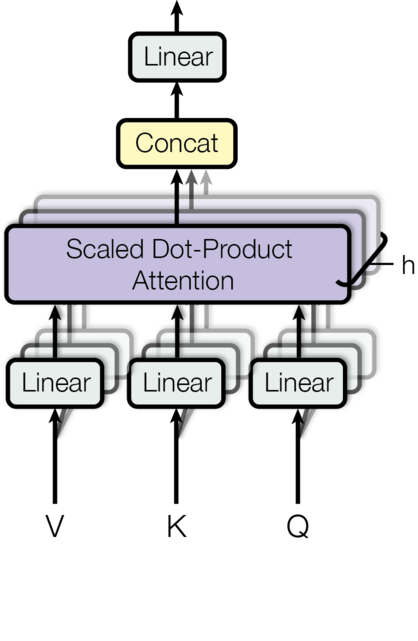
Equation
class MultiHeadedAttention(nn.Module):
    def __init__(self, h, d_model, dropout=0.1):
        "Take in model size and number of heads."
        super(MultiHeadedAttention, self).__init__()
        assert d_model % h == 0
        # We assume d_v always equals d_k
        self.d_k = d_model // h
        self.h = h
        self.linears = clones(nn.Linear(d_model, d_model), 4)
        self.attn = None
        self.dropout = nn.Dropout(p=dropout)

    def forward(self, query, key, value, mask=None):
        "Implements Figure 2"
        if mask is not None:
            # Same mask applied to all h heads.
            mask = mask.unsqueeze(1)
        nbatches = query.size(0)

        # 1) Do all the linear projections in batch from d_model => h x d_k
        query, key, value = [
            lin(x).view(nbatches, -1, self.h, self.d_k).transpose(1, 2)
            for lin, x in zip(self.linears, (query, key, value))
        ]

        # 2) Apply attention on all the projected vectors in batch.
        x, self.attn = attention(
            query, key, value, mask=mask, dropout=self.dropout
        )

        # 3) "Concat" using a view and apply a final linear.
        x = (
            x.transpose(1, 2)
            .contiguous()
            .view(nbatches, -1, self.h * self.d_k)
        )
        del query
        del key
        del value
        return self.linears[-1](x)
Applications of Attention in our Model
Encoder self-attention reads the source; decoder self-attention reads the available target prefix; cross-attention queries the encoder’s source representations. Masking is applied before the softmax.
Position-wise Feed-Forward Networks
A shared two-layer nonlinear transformation acts separately on every position within a layer. Its hidden dimension is larger than the residual-stream dimension.
Equation
class PositionwiseFeedForward(nn.Module):
    "Implements FFN equation."

    def __init__(self, d_model, d_ff, dropout=0.1):
        super(PositionwiseFeedForward, self).__init__()
        self.w_1 = nn.Linear(d_model, d_ff)
        self.w_2 = nn.Linear(d_ff, d_model)
        self.dropout = nn.Dropout(dropout)

    def forward(self, x):
        return self.w_2(self.dropout(self.w_1(x).relu()))
Embeddings and Softmax
Token embeddings map discrete symbols into vectors, and a linear output projection produces vocabulary logits. The tutorial describes weight sharing and embedding scaling used in the original architecture. [10] [11]
class Embeddings(nn.Module):
    def __init__(self, d_model, vocab):
        super(Embeddings, self).__init__()
        self.lut = nn.Embedding(vocab, d_model)
        self.d_model = d_model

    def forward(self, x):
        return self.lut(x) * math.sqrt(self.d_model)
Positional Encoding
Sine and cosine features supply token position without recurrence. Their different frequencies expose both short and long positional patterns; learned position embeddings are an alternative. [12]
Equations
class PositionalEncoding(nn.Module):
    "Implement the PE function."

    def __init__(self, d_model, dropout, max_len=5000):
        super(PositionalEncoding, self).__init__()
        self.dropout = nn.Dropout(p=dropout)

        # Compute the positional encodings once in log space.
        pe = torch.zeros(max_len, d_model)
        position = torch.arange(0, max_len).unsqueeze(1)
        div_term = torch.exp(
            torch.arange(0, d_model, 2) * -(math.log(10000.0) / d_model)
        )
        pe[:, 0::2] = torch.sin(position * div_term)
        pe[:, 1::2] = torch.cos(position * div_term)
        pe = pe.unsqueeze(0)
        self.register_buffer("pe", pe)

    def forward(self, x):
        x = x + self.pe[:, : x.size(1)].requires_grad_(False)
        return self.dropout(x)
def example_positional():
pe = PositionalEncoding(20, 0)
y = pe.forward(torch.zeros(1, 100, 20))
data = pd.concat(
[
pd.DataFrame(
{
"embedding": y[0, :, dim],
"dimension": dim,
"position": list(range(100)),
}
)
for dim in [4, 5, 6, 7]
]
)
return (
alt.Chart(data)
.mark_line()
.properties(width=800)
.encode(x="position", y="embedding", color="dimension:N")
.interactive()
)
show_example(example_positional)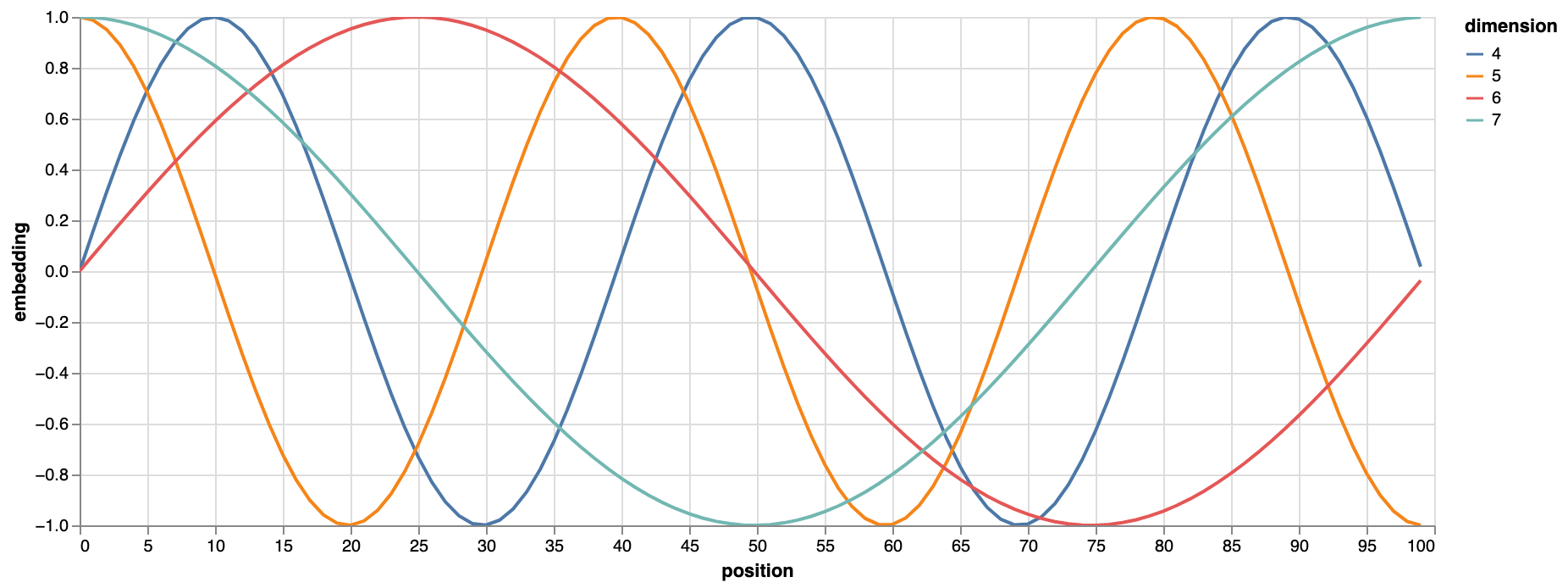
Full Model
The factory function assembles cloned attention and feed-forward blocks, embeddings, positional encodings, and the output generator, then initializes matrix parameters.
def make_model(
    src_vocab, tgt_vocab, N=6, d_model=512, d_ff=2048, h=8, dropout=0.1
):
    "Helper: Construct a model from hyperparameters."
    c = copy.deepcopy
    attn = MultiHeadedAttention(h, d_model)
    ff = PositionwiseFeedForward(d_model, d_ff, dropout)
    position = PositionalEncoding(d_model, dropout)
    model = EncoderDecoder(
        Encoder(EncoderLayer(d_model, c(attn), c(ff), dropout), N),
        Decoder(DecoderLayer(d_model, c(attn), c(attn), c(ff), dropout), N),
        nn.Sequential(Embeddings(d_model, src_vocab), c(position)),
        nn.Sequential(Embeddings(d_model, tgt_vocab), c(position)),
        Generator(d_model, tgt_vocab),
    )

    # This was important from their code.
    # Initialize parameters with Glorot / fan_avg.
    for p in model.parameters():
        if p.dim() > 1:
            nn.init.xavier_uniform_(p)
    return model
Inference:
An untrained inference example checks shapes and the autoregressive loop: encode once, repeatedly decode the growing prefix, and append the selected next token.
def inference_test():
    test_model = make_model(11, 11, 2)
    test_model.eval()
    src = torch.LongTensor([[1, 2, 3, 4, 5, 6, 7, 8, 9, 10]])
    src_mask = torch.ones(1, 1, 10)

    memory = test_model.encode(src, src_mask)
    ys = torch.zeros(1, 1).type_as(src)

    for i in range(9):
        out = test_model.decode(
            memory, src_mask, ys, subsequent_mask(ys.size(1)).type_as(src.data)
        )
        prob = test_model.generator(out[:, -1])
        _, next_word = torch.max(prob, dim=1)
        next_word = next_word.data[0]
        ys = torch.cat(
            [ys, torch.empty(1, 1).type_as(src.data).fill_(next_word)], dim=1
        )

    print("Example Untrained Model Prediction:", ys)


def run_tests():
    for _ in range(10):
        inference_test()


show_example(run_tests)
Example Untrained Model Prediction: tensor([[0, 0, 0, 0, 0, 0, 0, 0, 0, 0]])
Example Untrained Model Prediction: tensor([[0, 3, 4, 4, 4, 4, 4, 4, 4, 4]])
Example Untrained Model Prediction: tensor([[ 0, 10, 10, 10, 3, 2, 5, 7, 9, 6]])
Example Untrained Model Prediction: tensor([[ 0, 4, 3, 6, 10, 10, 2, 6, 2, 2]])
Example Untrained Model Prediction: tensor([[ 0, 9, 0, 1, 5, 10, 1, 5, 10, 6]])
Example Untrained Model Prediction: tensor([[ 0, 1, 5, 1, 10, 1, 10, 10, 10, 10]])
Example Untrained Model Prediction: tensor([[ 0, 1, 10, 9, 9, 9, 9, 9, 1, 5]])
Example Untrained Model Prediction: tensor([[ 0, 3, 1, 5, 10, 10, 10, 10, 10, 10]])
Example Untrained Model Prediction: tensor([[ 0, 3, 5, 10, 5, 10, 4, 2, 4, 2]])
Example Untrained Model Prediction: tensor([[0, 5, 6, 2, 5, 6, 2, 6, 2, 2]])Part 2: Model Training
Training
Training needs padding masks, target shifts, loss computation, and synchronized optimizer and learning-rate updates. The next cells separate these responsibilities.
Batches and Masking
The batch wrapper creates source padding masks and combines target padding with the causal mask. It also counts valid target tokens for normalized loss.
class Batch:
    """Object for holding a batch of data with mask during training."""

    def __init__(self, src, tgt=None, pad=2):  # 2 = <blank>
        self.src = src
        self.src_mask = (src != pad).unsqueeze(-2)
        if tgt is not None:
            self.tgt = tgt[:, :-1]
            self.tgt_y = tgt[:, 1:]
            self.tgt_mask = self.make_std_mask(self.tgt, pad)
            self.ntokens = (self.tgt_y != pad).data.sum()

    @staticmethod
    def make_std_mask(tgt, pad):
        "Create a mask to hide padding and future words."
        tgt_mask = (tgt != pad).unsqueeze(-2)
        tgt_mask = tgt_mask & subsequent_mask(tgt.size(-1)).type_as(
            tgt_mask.data
        )
        return tgt_mask
Training Loop
The loop supports training and evaluation, gradient accumulation, throughput tracking, and scheduled optimizer steps. Evaluation disables parameter updates.
class TrainState:
    """Track number of steps, examples, and tokens processed"""

    step: int = 0  # Steps in the current epoch
    accum_step: int = 0  # Number of gradient accumulation steps
    samples: int = 0  # total # of examples used
    tokens: int = 0  # total # of tokens processed
def run_epoch(
data_iter,
model,
loss_compute,
optimizer,
scheduler,
mode="train",
accum_iter=1,
train_state=TrainState(),
):
"""Train a single epoch"""
start = time.time()
total_tokens = 0
total_loss = 0
tokens = 0
n_accum = 0
for i, batch in enumerate(data_iter):
out = model.forward(
batch.src, batch.tgt, batch.src_mask, batch.tgt_mask
)
loss, loss_node = loss_compute(out, batch.tgt_y, batch.ntokens)
# loss_node = loss_node / accum_iter
if mode == "train" or mode == "train+log":
loss_node.backward()
train_state.step += 1
train_state.samples += batch.src.shape[0]
train_state.tokens += batch.ntokens
if i % accum_iter == 0:
optimizer.step()
optimizer.zero_grad(set_to_none=True)
n_accum += 1
train_state.accum_step += 1
scheduler.step()
total_loss += loss
total_tokens += batch.ntokens
tokens += batch.ntokens
if i % 40 == 1 and (mode == "train" or mode == "train+log"):
lr = optimizer.param_groups[0]["lr"]
elapsed = time.time() - start
print(
(
"Epoch Step: %6d | Accumulation Step: %3d | Loss: %6.2f "
+ "| Tokens / Sec: %7.1f | Learning Rate: %6.1e"
)
% (i, n_accum, loss / batch.ntokens, tokens / elapsed, lr)
)
start = time.time()
tokens = 0
del loss
del loss_node
return total_loss / total_tokens, train_stateTraining Data and Batching
The original Transformer used WMT translation data and subword vocabularies. Batching similar sequence lengths reduces padding work; the later notebook example uses a smaller dataset.
Hardware and Schedule
The original paper reports training on eight P100 GPUs with different schedules for base and large models. Those measurements describe that experiment and should not be read as current hardware requirements.
Optimizer
Adam uses a learning rate that first increases linearly during warmup and then decays with the inverse square root of step count. Model width scales the schedule; the supplied plot compares choices. [13]
Equation
def rate(step, model_size, factor, warmup):
    """
    we have to default the step to 1 for LambdaLR function
    to avoid zero raising to negative power.
    """
    if step == 0:
        step = 1
    return factor * (
        model_size ** (-0.5) * min(step ** (-0.5), step * warmup ** (-1.5))
    )
def example_learning_schedule():
opts = [
[512, 1, 4000], # example 1
[512, 1, 8000], # example 2
[256, 1, 4000], # example 3
]
dummy_model = torch.nn.Linear(1, 1)
learning_rates = []
# we have 3 examples in opts list.
for idx, example in enumerate(opts):
# run 20000 epoch for each example
optimizer = torch.optim.Adam(
dummy_model.parameters(), lr=1, betas=(0.9, 0.98), eps=1e-9
)
lr_scheduler = LambdaLR(
optimizer=optimizer, lr_lambda=lambda step: rate(step, *example)
)
tmp = []
# take 20K dummy training steps, save the learning rate at each step
for step in range(20000):
tmp.append(optimizer.param_groups[0]["lr"])
optimizer.step()
lr_scheduler.step()
learning_rates.append(tmp)
learning_rates = torch.tensor(learning_rates)
# Enable altair to handle more than 5000 rows
alt.data_transformers.disable_max_rows()
opts_data = pd.concat(
[
pd.DataFrame(
{
"Learning Rate": learning_rates[warmup_idx, :],
"model_size:warmup": ["512:4000", "512:8000", "256:4000"][
warmup_idx
],
"step": range(20000),
}
)
for warmup_idx in [0, 1, 2]
]
)
return (
alt.Chart(opts_data)
.mark_line()
.properties(width=600)
.encode(x="step", y="Learning Rate", color="model_size:warmup:N")
.interactive()
)
example_learning_schedule()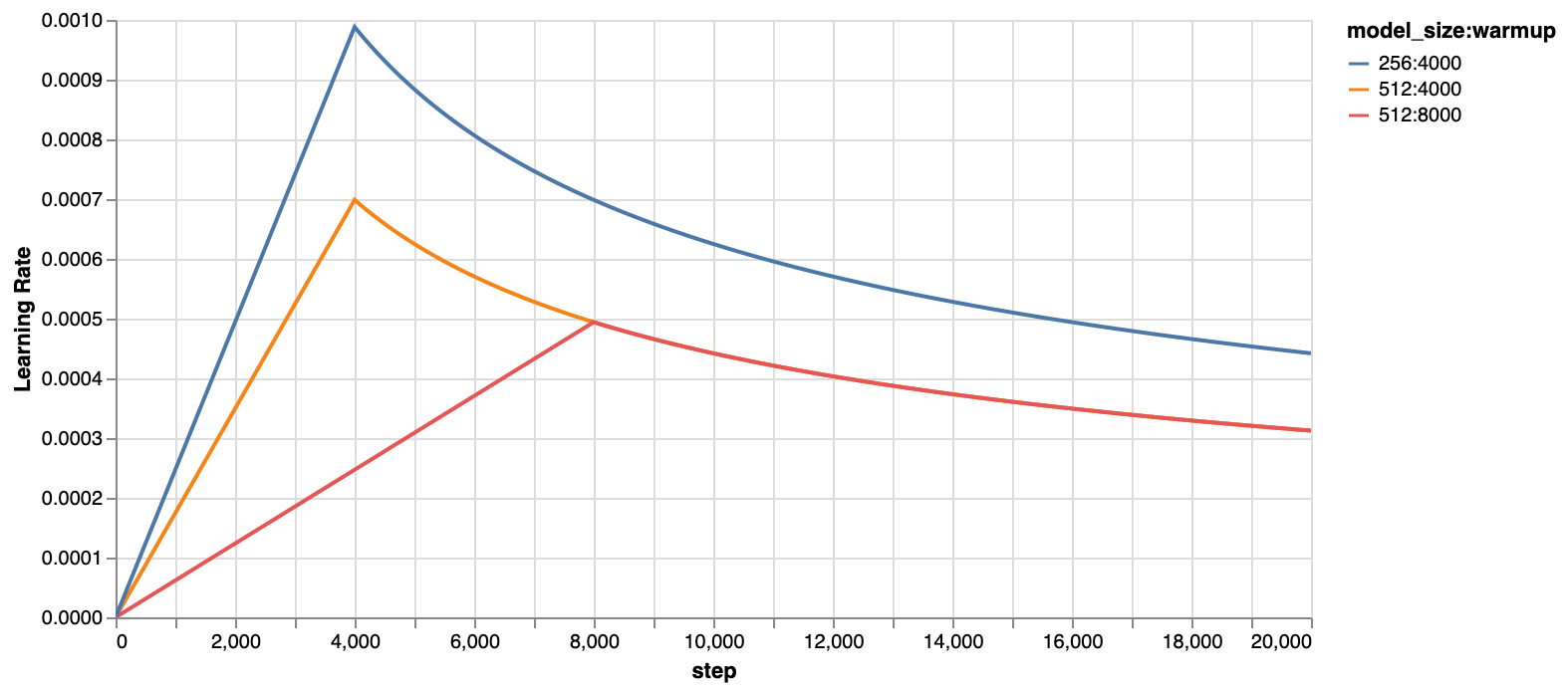
Regularization
Label Smoothing
Label smoothing spreads some target probability across incorrect classes. It discourages extreme confidence and can improve translation scores even while worsening perplexity. [14]
class LabelSmoothing(nn.Module):
    "Implement label smoothing."

    def __init__(self, size, padding_idx, smoothing=0.0):
        super(LabelSmoothing, self).__init__()
        self.criterion = nn.KLDivLoss(reduction="sum")
        self.padding_idx = padding_idx
        self.confidence = 1.0 - smoothing
        self.smoothing = smoothing
        self.size = size
        self.true_dist = None

    def forward(self, x, target):
        assert x.size(1) == self.size
        true_dist = x.data.clone()
        true_dist.fill_(self.smoothing / (self.size - 2))
        true_dist.scatter_(1, target.data.unsqueeze(1), self.confidence)
        true_dist[:, self.padding_idx] = 0
        mask = torch.nonzero(target.data == self.padding_idx)
        if mask.dim() > 0:
            true_dist.index_fill_(0, mask.squeeze(), 0.0)
        self.true_dist = true_dist
        return self.criterion(x, true_dist.clone().detach())
# Example of label smoothing.
def example_label_smoothing():
crit = LabelSmoothing(5, 0, 0.4)
predict = torch.FloatTensor(
[
[0, 0.2, 0.7, 0.1, 0],
[0, 0.2, 0.7, 0.1, 0],
[0, 0.2, 0.7, 0.1, 0],
[0, 0.2, 0.7, 0.1, 0],
[0, 0.2, 0.7, 0.1, 0],
]
)
crit(x=predict.log(), target=torch.LongTensor([2, 1, 0, 3, 3]))
LS_data = pd.concat(
[
pd.DataFrame(
{
"target distribution": crit.true_dist[x, y].flatten(),
"columns": y,
"rows": x,
}
)
for y in range(5)
for x in range(5)
]
)
return (
alt.Chart(LS_data)
.mark_rect(color="Blue", opacity=1)
.properties(height=200, width=200)
.encode(
alt.X("columns:O", title=None),
alt.Y("rows:O", title=None),
alt.Color(
"target distribution:Q", scale=alt.Scale(scheme="viridis")
),
)
.interactive()
)
show_example(example_label_smoothing)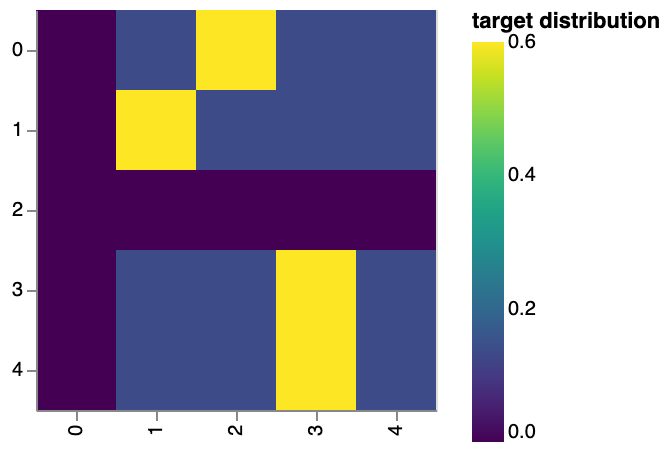
def loss(x, crit):
    d = x + 3 * 1
    predict = torch.FloatTensor([[0, x / d, 1 / d, 1 / d, 1 / d]])
    return crit(predict.log(), torch.LongTensor([1])).data


def penalization_visualization():
    crit = LabelSmoothing(5, 0, 0.1)
    loss_data = pd.DataFrame(
        {
            "Loss": [loss(x, crit) for x in range(1, 100)],
            "Steps": list(range(99)),
        }
    ).astype("float")

    return (
        alt.Chart(loss_data)
        .mark_line()
        .properties(width=350)
        .encode(
            x="Steps",
            y="Loss",
        )
        .interactive()
    )


show_example(penalization_visualization)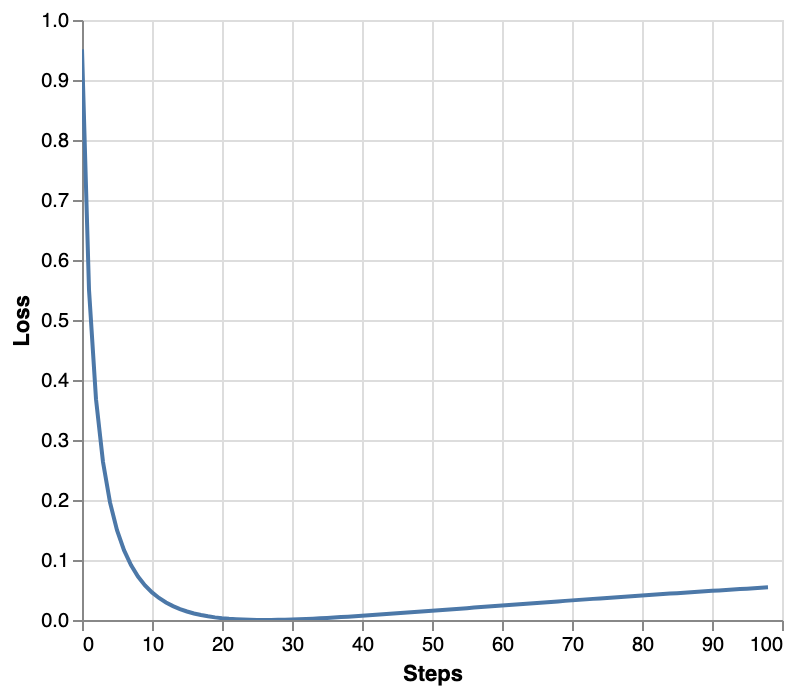
A First Example
A synthetic copying task tests whether the implementation can learn a simple sequence transformation before using real translation data.
Synthetic Data
Generate random token sequences, reserve the start symbol, and pair each sequence with itself as the target.
def data_gen(V, batch_size, nbatches):
    "Generate random data for a src-tgt copy task."
    for i in range(nbatches):
        data = torch.randint(1, V, size=(batch_size, 10))
        data[:, 0] = 1
        src = data.requires_grad_(False).clone().detach()
        tgt = data.requires_grad_(False).clone().detach()
        yield Batch(src, tgt, 0)
Loss Computation
The generator maps decoder states to vocabulary log probabilities, and the criterion normalizes the loss by valid tokens.
class SimpleLossCompute:
    "A simple loss compute and train function."

    def __init__(self, generator, criterion):
        self.generator = generator
        self.criterion = criterion

    def __call__(self, x, y, norm):
        x = self.generator(x)
        sloss = (
            self.criterion(
                x.contiguous().view(-1, x.size(-1)), y.contiguous().view(-1)
            )
            / norm
        )
        return sloss.data * norm, sloss
Greedy Decoding
Choose the highest-probability next token at each step and append it to the prefix. This demonstrates inference but does not perform beam search.
def greedy_decode(model, src, src_mask, max_len, start_symbol):
    memory = model.encode(src, src_mask)
    ys = torch.zeros(1, 1).fill_(start_symbol).type_as(src.data)
    for i in range(max_len - 1):
        out = model.decode(
            memory, src_mask, ys, subsequent_mask(ys.size(1)).type_as(src.data)
        )
        prob = model.generator(out[:, -1])
        _, next_word = torch.max(prob, dim=1)
        next_word = next_word.data[0]
        ys = torch.cat(
            [ys, torch.zeros(1, 1).type_as(src.data).fill_(next_word)], dim=1
        )
    return ys
# Train the simple copy task.
def example_simple_model():
V = 11
criterion = LabelSmoothing(size=V, padding_idx=0, smoothing=0.0)
model = make_model(V, V, N=2)
optimizer = torch.optim.Adam(
model.parameters(), lr=0.5, betas=(0.9, 0.98), eps=1e-9
)
lr_scheduler = LambdaLR(
optimizer=optimizer,
lr_lambda=lambda step: rate(
step, model_size=model.src_embed[0].d_model, factor=1.0, warmup=400
),
)
batch_size = 80
for epoch in range(20):
model.train()
run_epoch(
data_gen(V, batch_size, 20),
model,
SimpleLossCompute(model.generator, criterion),
optimizer,
lr_scheduler,
mode="train",
)
model.eval()
run_epoch(
data_gen(V, batch_size, 5),
model,
SimpleLossCompute(model.generator, criterion),
DummyOptimizer(),
DummyScheduler(),
mode="eval",
)[0]
model.eval()
src = torch.LongTensor([[0, 1, 2, 3, 4, 5, 6, 7, 8, 9]])
max_len = src.shape[1]
src_mask = torch.ones(1, 1, max_len)
print(greedy_decode(model, src, src_mask, max_len=max_len, start_symbol=0))
# execute_example(example_simple_model)Part 3: A Real World Example
The Multi30k German–English example adds tokenization, vocabulary construction, padding, distributed data loading, and model training.
Data Loading
Tokenize each language, build vocabularies with special symbols, and convert text examples into tensors. The supplied cells retain the full preprocessing code.
# Load spacy tokenizer models, download them if they haven't been
# downloaded already


def load_tokenizers():

    try:
        spacy_de = spacy.load("de_core_news_sm")
    except IOError:
        os.system("python -m spacy download de_core_news_sm")
        spacy_de = spacy.load("de_core_news_sm")

    try:
        spacy_en = spacy.load("en_core_web_sm")
    except IOError:
        os.system("python -m spacy download en_core_web_sm")
        spacy_en = spacy.load("en_core_web_sm")

    return spacy_de, spacy_en
def tokenize(text, tokenizer):
return [tok.text for tok in tokenizer.tokenizer(text)]
def yield_tokens(data_iter, tokenizer, index):
for from_to_tuple in data_iter:
yield tokenizer(from_to_tuple[index])
def build_vocabulary(spacy_de, spacy_en):
    def tokenize_de(text):
        return tokenize(text, spacy_de)

    def tokenize_en(text):
        return tokenize(text, spacy_en)

    print("Building German Vocabulary ...")
    train, val, test = datasets.Multi30k(language_pair=("de", "en"))
    vocab_src = build_vocab_from_iterator(
        yield_tokens(train + val + test, tokenize_de, index=0),
        min_freq=2,
        specials=["<s>", "</s>", "<blank>", "<unk>"],
    )

    print("Building English Vocabulary ...")
    train, val, test = datasets.Multi30k(language_pair=("de", "en"))
    vocab_tgt = build_vocab_from_iterator(
        yield_tokens(train + val + test, tokenize_en, index=1),
        min_freq=2,
        specials=["<s>", "</s>", "<blank>", "<unk>"],
    )

    vocab_src.set_default_index(vocab_src["<unk>"])
    vocab_tgt.set_default_index(vocab_tgt["<unk>"])

    return vocab_src, vocab_tgt


def load_vocab(spacy_de, spacy_en):
    if not exists("vocab.pt"):
        vocab_src, vocab_tgt = build_vocabulary(spacy_de, spacy_en)
        torch.save((vocab_src, vocab_tgt), "vocab.pt")
    else:
        vocab_src, vocab_tgt = torch.load("vocab.pt")
    print("Finished.\nVocabulary sizes:")
    print(len(vocab_src))
    print(len(vocab_tgt))
    return vocab_src, vocab_tgt


if is_interactive_notebook():
    # global variables used later in the script
    spacy_de, spacy_en = show_example(load_tokenizers)
    vocab_src, vocab_tgt = show_example(load_vocab, args=[spacy_de, spacy_en])
Finished.
Vocabulary sizes:
59981
36745Iterators
Data loaders collate examples, pad sequences, and distribute batches across workers or devices. Consistent special-token indices are needed by masks and loss computation.
def collate_batch(
    batch,
    src_pipeline,
    tgt_pipeline,
    src_vocab,
    tgt_vocab,
    device,
    max_padding=128,
    pad_id=2,
):
    bs_id = torch.tensor([0], device=device)  # <s> token id
    eos_id = torch.tensor([1], device=device)  # </s> token id
    src_list, tgt_list = [], []
    for (_src, _tgt) in batch:
        processed_src = torch.cat(
            [
                bs_id,
                torch.tensor(
                    src_vocab(src_pipeline(_src)),
                    dtype=torch.int64,
                    device=device,
                ),
                eos_id,
            ],
            0,
        )
        processed_tgt = torch.cat(
            [
                bs_id,
                torch.tensor(
                    tgt_vocab(tgt_pipeline(_tgt)),
                    dtype=torch.int64,
                    device=device,
                ),
                eos_id,
            ],
            0,
        )
        src_list.append(
            # warning - overwrites values for negative values of padding - len
            pad(
                processed_src,
                (
                    0,
                    max_padding - len(processed_src),
                ),
                value=pad_id,
            )
        )
        tgt_list.append(
            pad(
                processed_tgt,
                (0, max_padding - len(processed_tgt)),
                value=pad_id,
            )
        )

    src = torch.stack(src_list)
    tgt = torch.stack(tgt_list)
    return (src, tgt)
def create_dataloaders(
device,
vocab_src,
vocab_tgt,
spacy_de,
spacy_en,
batch_size=12000,
max_padding=128,
is_distributed=True,
):
# def create_dataloaders(batch_size=12000):
def tokenize_de(text):
return tokenize(text, spacy_de)
def tokenize_en(text):
return tokenize(text, spacy_en)
def collate_fn(batch):
return collate_batch(
batch,
tokenize_de,
tokenize_en,
vocab_src,
vocab_tgt,
device,
max_padding=max_padding,
pad_id=vocab_src.get_stoi()["<blank>"],
)
train_iter, valid_iter, test_iter = datasets.Multi30k(
language_pair=("de", "en")
)
train_iter_map = to_map_style_dataset(
train_iter
) # DistributedSampler needs a dataset len()
train_sampler = (
DistributedSampler(train_iter_map) if is_distributed else None
)
valid_iter_map = to_map_style_dataset(valid_iter)
valid_sampler = (
DistributedSampler(valid_iter_map) if is_distributed else None
)
train_dataloader = DataLoader(
train_iter_map,
batch_size=batch_size,
shuffle=(train_sampler is None),
sampler=train_sampler,
collate_fn=collate_fn,
)
valid_dataloader = DataLoader(
valid_iter_map,
batch_size=batch_size,
shuffle=(valid_sampler is None),
sampler=valid_sampler,
collate_fn=collate_fn,
)
return train_dataloader, valid_dataloaderTraining the System
The training code combines the model, label-smoothed loss, optimizer, scheduler, and checkpointing. A validation translation then exercises the trained model.
def train_worker(
    gpu,
    ngpus_per_node,
    vocab_src,
    vocab_tgt,
    spacy_de,
    spacy_en,
    config,
    is_distributed=False,
):
    print(f"Train worker process using GPU: {gpu} for training", flush=True)
    torch.cuda.set_device(gpu)

    pad_idx = vocab_tgt["<blank>"]
    d_model = 512
    model = make_model(len(vocab_src), len(vocab_tgt), N=6)
    model.cuda(gpu)
    module = model
    is_main_process = True
    if is_distributed:
        dist.init_process_group(
            "nccl", init_method="env://", rank=gpu, world_size=ngpus_per_node
        )
        model = DDP(model, device_ids=[gpu])
        module = model.module
        is_main_process = gpu == 0

    criterion = LabelSmoothing(
        size=len(vocab_tgt), padding_idx=pad_idx, smoothing=0.1
    )
    criterion.cuda(gpu)

    train_dataloader, valid_dataloader = create_dataloaders(
        gpu,
        vocab_src,
        vocab_tgt,
        spacy_de,
        spacy_en,
        batch_size=config["batch_size"] // ngpus_per_node,
        max_padding=config["max_padding"],
        is_distributed=is_distributed,
    )

    optimizer = torch.optim.Adam(
        model.parameters(), lr=config["base_lr"], betas=(0.9, 0.98), eps=1e-9
    )
    lr_scheduler = LambdaLR(
        optimizer=optimizer,
        lr_lambda=lambda step: rate(
            step, d_model, factor=1, warmup=config["warmup"]
        ),
    )
    train_state = TrainState()

    for epoch in range(config["num_epochs"]):
        if is_distributed:
            train_dataloader.sampler.set_epoch(epoch)
            valid_dataloader.sampler.set_epoch(epoch)

        model.train()
        print(f"[GPU{gpu}] Epoch {epoch} Training ====", flush=True)
        _, train_state = run_epoch(
            (Batch(b[0], b[1], pad_idx) for b in train_dataloader),
            model,
            SimpleLossCompute(module.generator, criterion),
            optimizer,
            lr_scheduler,
            mode="train+log",
            accum_iter=config["accum_iter"],
            train_state=train_state,
        )

        GPUtil.showUtilization()
        if is_main_process:
            file_path = "%s%.2d.pt" % (config["file_prefix"], epoch)
            torch.save(module.state_dict(), file_path)
        torch.cuda.empty_cache()

        print(f"[GPU{gpu}] Epoch {epoch} Validation ====", flush=True)
        model.eval()
        sloss = run_epoch(
            (Batch(b[0], b[1], pad_idx) for b in valid_dataloader),
            model,
            SimpleLossCompute(module.generator, criterion),
            DummyOptimizer(),
            DummyScheduler(),
            mode="eval",
        )
        print(sloss)
        torch.cuda.empty_cache()

    if is_main_process:
        file_path = "%sfinal.pt" % config["file_prefix"]
        torch.save(module.state_dict(), file_path)
def train_distributed_model(vocab_src, vocab_tgt, spacy_de, spacy_en, config):
from the_annotated_transformer import train_worker
ngpus = torch.cuda.device_count()
os.environ["MASTER_ADDR"] = "localhost"
os.environ["MASTER_PORT"] = "12356"
print(f"Number of GPUs detected: {ngpus}")
print("Spawning training processes ...")
mp.spawn(
train_worker,
nprocs=ngpus,
args=(ngpus, vocab_src, vocab_tgt, spacy_de, spacy_en, config, True),
)
def train_model(vocab_src, vocab_tgt, spacy_de, spacy_en, config):
if config["distributed"]:
train_distributed_model(
vocab_src, vocab_tgt, spacy_de, spacy_en, config
)
else:
train_worker(
0, 1, vocab_src, vocab_tgt, spacy_de, spacy_en, config, False
)
def load_trained_model():
config = {
"batch_size": 32,
"distributed": False,
"num_epochs": 8,
"accum_iter": 10,
"base_lr": 1.0,
"max_padding": 72,
"warmup": 3000,
"file_prefix": "multi30k_model_",
}
model_path = "multi30k_model_final.pt"
if not exists(model_path):
train_model(vocab_src, vocab_tgt, spacy_de, spacy_en, config)
model = make_model(len(vocab_src), len(vocab_tgt), N=6)
model.load_state_dict(torch.load("multi30k_model_final.pt"))
return model
if is_interactive_notebook():
model = load_trained_model()Additional Components: BPE, Search, Averaging
Subword tokenization, shared embeddings, beam search, and checkpoint averaging are additional ingredients for strong translation. The notebook sketches or links these components rather than implementing every production detail. [11] [15] [16] [17]
if False:
    model.src_embed[0].lut.weight = model.tgt_embeddings[0].lut.weight
    model.generator.lut.weight = model.tgt_embed[0].lut.weight
def average(model, models):
"Average models into model"
for ps in zip(*[m.params() for m in [model] + models]):
ps[0].copy_(torch.sum(*ps[1:]) / len(ps[1:]))Results
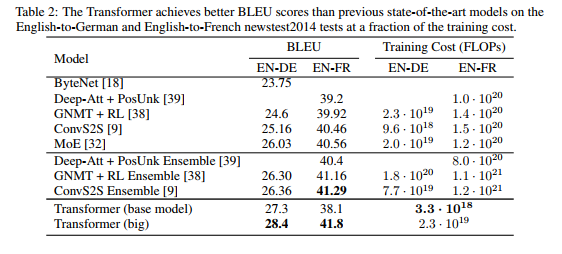
The tutorial quotes 28.4 BLEU for English–German and 41.0 for English–French WMT 2014 from the original large Transformer’s results prose. The final paper’s abstract and table instead report 41.8 for English–French, an inconsistency in the source. The notebook also describes an OpenNMT reproduction at 26.9 English–German BLEU; these historical results are distinct from its smaller illustrative training run. [17] [18]
# Load data and model for output checksdef check_outputs(
valid_dataloader,
model,
vocab_src,
vocab_tgt,
n_examples=15,
pad_idx=2,
eos_string="</s>",
):
results = [()] * n_examples
for idx in range(n_examples):
print("\nExample %d ========\n" % idx)
b = next(iter(valid_dataloader))
rb = Batch(b[0], b[1], pad_idx)
greedy_decode(model, rb.src, rb.src_mask, 64, 0)[0]
src_tokens = [
vocab_src.get_itos()[x] for x in rb.src[0] if x != pad_idx
]
tgt_tokens = [
vocab_tgt.get_itos()[x] for x in rb.tgt[0] if x != pad_idx
]
print(
"Source Text (Input) : "
+ " ".join(src_tokens).replace("\n", "")
)
print(
"Target Text (Ground Truth) : "
+ " ".join(tgt_tokens).replace("\n", "")
)
model_out = greedy_decode(model, rb.src, rb.src_mask, 72, 0)[0]
model_txt = (
" ".join(
[vocab_tgt.get_itos()[x] for x in model_out if x != pad_idx]
).split(eos_string, 1)[0]
+ eos_string
)
print("Model Output : " + model_txt.replace("\n", ""))
results[idx] = (rb, src_tokens, tgt_tokens, model_out, model_txt)
return results
def run_model_example(n_examples=5):
global vocab_src, vocab_tgt, spacy_de, spacy_en
print("Preparing Data ...")
_, valid_dataloader = create_dataloaders(
torch.device("cpu"),
vocab_src,
vocab_tgt,
spacy_de,
spacy_en,
batch_size=1,
is_distributed=False,
)
print("Loading Trained Model ...")
model = make_model(len(vocab_src), len(vocab_tgt), N=6)
model.load_state_dict(
torch.load("multi30k_model_final.pt", map_location=torch.device("cpu"))
)
print("Checking Model Outputs:")
example_data = check_outputs(
valid_dataloader, model, vocab_src, vocab_tgt, n_examples=n_examples
)
return model, example_data
# execute_example(run_model_example)Attention Visualization
The following plots show attention weights for a translation example across encoder self-attention, decoder self-attention, and source attention. Attention patterns describe routing weights, not a complete causal explanation of a prediction.
def mtx2df(m, max_row, max_col, row_tokens, col_tokens):
    "convert a dense matrix to a data frame with row and column indices"
    return pd.DataFrame(
        [
            (
                r,
                c,
                float(m[r, c]),
                "%.3d %s"
                % (r, row_tokens[r] if len(row_tokens) > r else "<blank>"),
                "%.3d %s"
                % (c, col_tokens[c] if len(col_tokens) > c else "<blank>"),
            )
            for r in range(m.shape[0])
            for c in range(m.shape[1])
            if r < max_row and c < max_col
        ],
        # if float(m[r,c]) != 0 and r < max_row and c < max_col],
        columns=["row", "column", "value", "row_token", "col_token"],
    )


def attn_map(attn, layer, head, row_tokens, col_tokens, max_dim=30):
    df = mtx2df(
        attn[0, head].data,
        max_dim,
        max_dim,
        row_tokens,
        col_tokens,
    )
    return (
        alt.Chart(data=df)
        .mark_rect()
        .encode(
            x=alt.X("col_token", axis=alt.Axis(title="")),
            y=alt.Y("row_token", axis=alt.Axis(title="")),
            color="value",
            tooltip=["row", "column", "value", "row_token", "col_token"],
        )
        .properties(height=400, width=400)
        .interactive()
    )
def get_encoder(model, layer):
return model.encoder.layers[layer].self_attn.attn
def get_decoder_self(model, layer):
return model.decoder.layers[layer].self_attn.attn
def get_decoder_src(model, layer):
return model.decoder.layers[layer].src_attn.attn
def visualize_layer(model, layer, getter_fn, ntokens, row_tokens, col_tokens):
# ntokens = last_example[0].ntokens
attn = getter_fn(model, layer)
n_heads = attn.shape[1]
charts = [
attn_map(
attn,
0,
h,
row_tokens=row_tokens,
col_tokens=col_tokens,
max_dim=ntokens,
)
for h in range(n_heads)
]
assert n_heads == 8
return alt.vconcat(
charts[0]
# | charts[1]
| charts[2]
# | charts[3]
| charts[4]
# | charts[5]
| charts[6]
# | charts[7]
# layer + 1 due to 0-indexing
).properties(title="Layer %d" % (layer + 1))Encoder Self Attention
Compare the four displayed encoder heads in each of three shown layers. All twelve source heatmaps and their shared scale are retained.
def viz_encoder_self():
    model, example_data = run_model_example(n_examples=1)
    example = example_data[
        len(example_data) - 1
    ]  # batch object for the final example

    layer_viz = [
        visualize_layer(
            model, layer, get_encoder, len(example[1]), example[1], example[1]
        )
        for layer in range(6)
    ]
    return alt.hconcat(
        layer_viz[0]
        # & layer_viz[1]
        & layer_viz[2]
        # & layer_viz[3]
        & layer_viz[4]
        # & layer_viz[5]
    )


show_example(viz_encoder_self)
Preparing Data ...
Loading Trained Model ...
Checking Model Outputs:
Example 0 ========
Source Text (Input) : <s> Zwei Frauen in pinkfarbenen T-Shirts und <unk> unterhalten sich vor einem <unk> . </s>
Target Text (Ground Truth) : <s> Two women wearing pink T - shirts and blue jeans converse outside clothing store . </s>
Model Output : <s> Two women in pink shirts and face are talking in front of a <unk> . </s>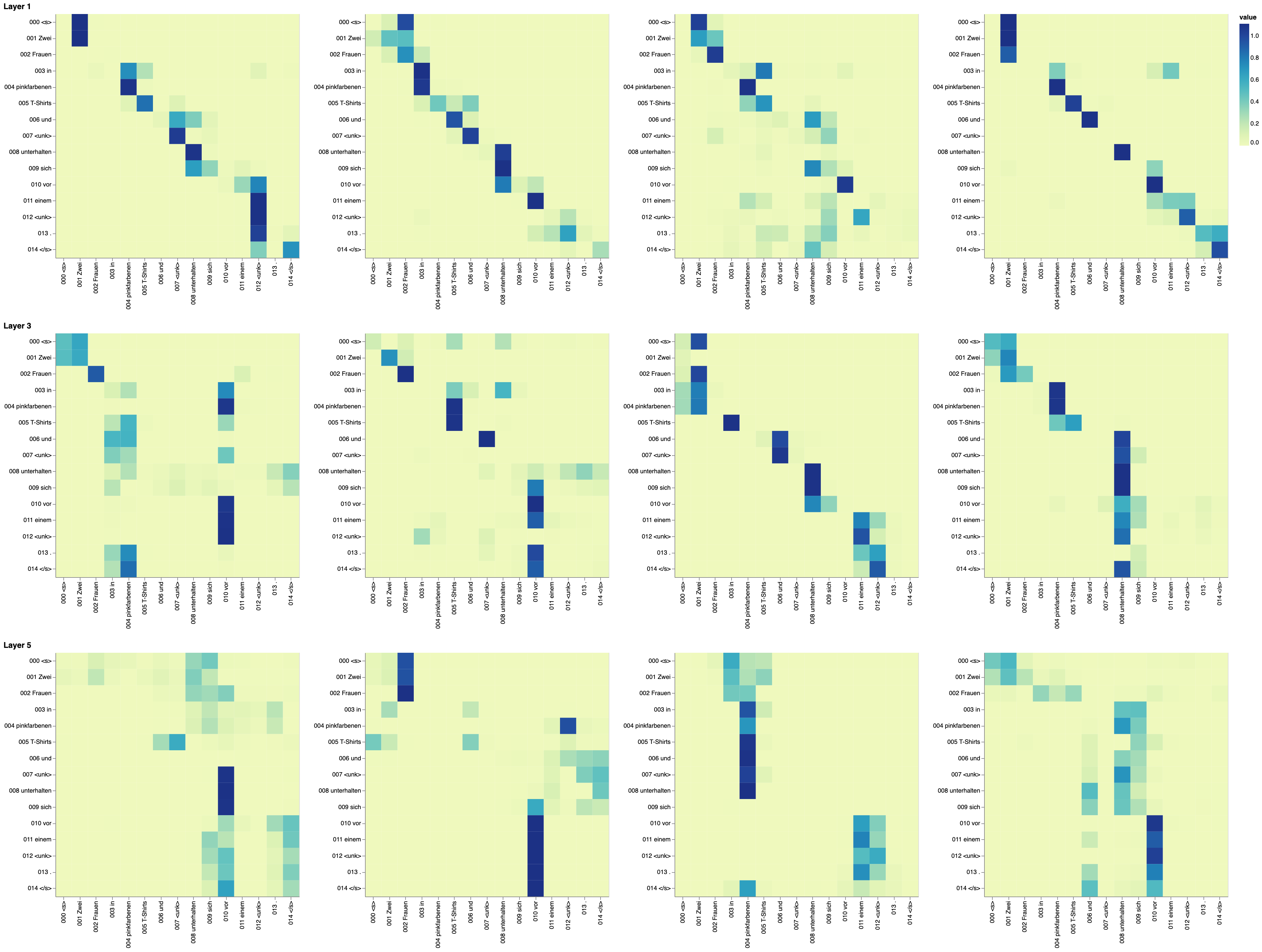
Decoder Self Attention
Inspect target-prefix relationships under causal masking. The source displays four heads in each of six layers, giving twenty-four heatmaps; future tokens remain unavailable.
def viz_decoder_self():
    model, example_data = run_model_example(n_examples=1)
    example = example_data[len(example_data) - 1]

    layer_viz = [
        visualize_layer(
            model,
            layer,
            get_decoder_self,
            len(example[1]),
            example[1],
            example[1],
        )
        for layer in range(6)
    ]
    return alt.hconcat(
        layer_viz[0]
        & layer_viz[1]
        & layer_viz[2]
        & layer_viz[3]
        & layer_viz[4]
        & layer_viz[5]
    )


show_example(viz_decoder_self)
Preparing Data ...
Loading Trained Model ...
Checking Model Outputs:
Example 0 ========
Source Text (Input) : <s> Eine Gruppe von Männern in Kostümen spielt Musik . </s>
Target Text (Ground Truth) : <s> A group of men in costume play music . </s>
Model Output : <s> A group of men in costumes playing music . </s>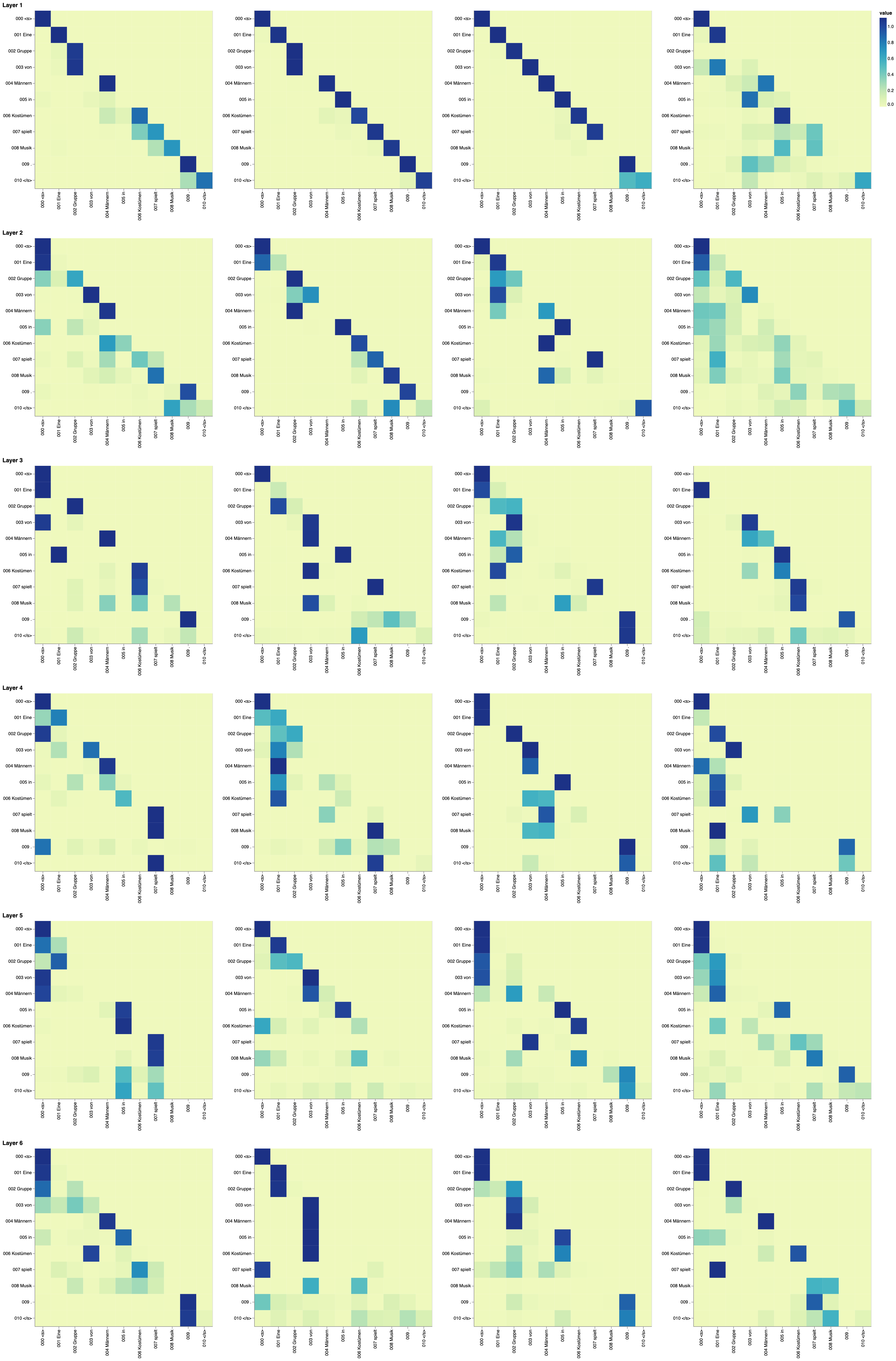
Decoder Src Attention
Compare source-token weights selected while producing each target token. All twenty-four source heatmaps, four displayed heads across six layers, are retained.
def viz_decoder_src():
    model, example_data = run_model_example(n_examples=1)
    example = example_data[len(example_data) - 1]

    layer_viz = [
        visualize_layer(
            model,
            layer,
            get_decoder_src,
            max(len(example[1]), len(example[2])),
            example[1],
            example[2],
        )
        for layer in range(6)
    ]
    return alt.hconcat(
        layer_viz[0]
        & layer_viz[1]
        & layer_viz[2]
        & layer_viz[3]
        & layer_viz[4]
        & layer_viz[5]
    )


show_example(viz_decoder_src)
Preparing Data ...
Loading Trained Model ...
Checking Model Outputs:
Example 0 ========
Source Text (Input) : <s> Ein kleiner Junge verwendet einen Bohrer , um ein Loch in ein Holzstück zu machen . </s>
Target Text (Ground Truth) : <s> A little boy using a drill to make a hole in a piece of wood . </s>
Model Output : <s> A little boy uses a machine to be working in a hole in a log . </s>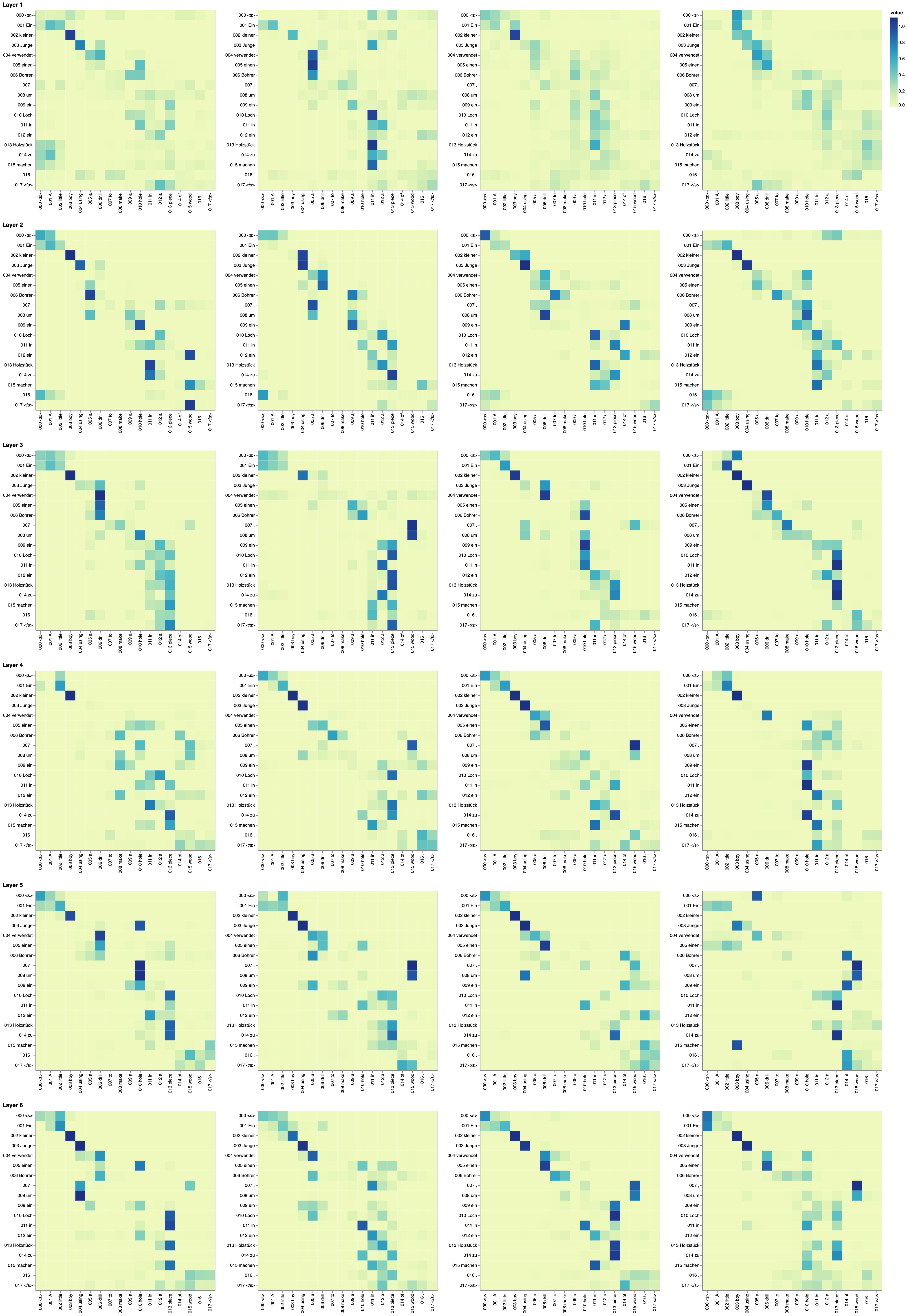
Conclusion
The notebook connects the Transformer’s mathematical components to an executable training pipeline. Its retained plots and code allow individual implementation decisions to be inspected alongside the explanation.