At a glance
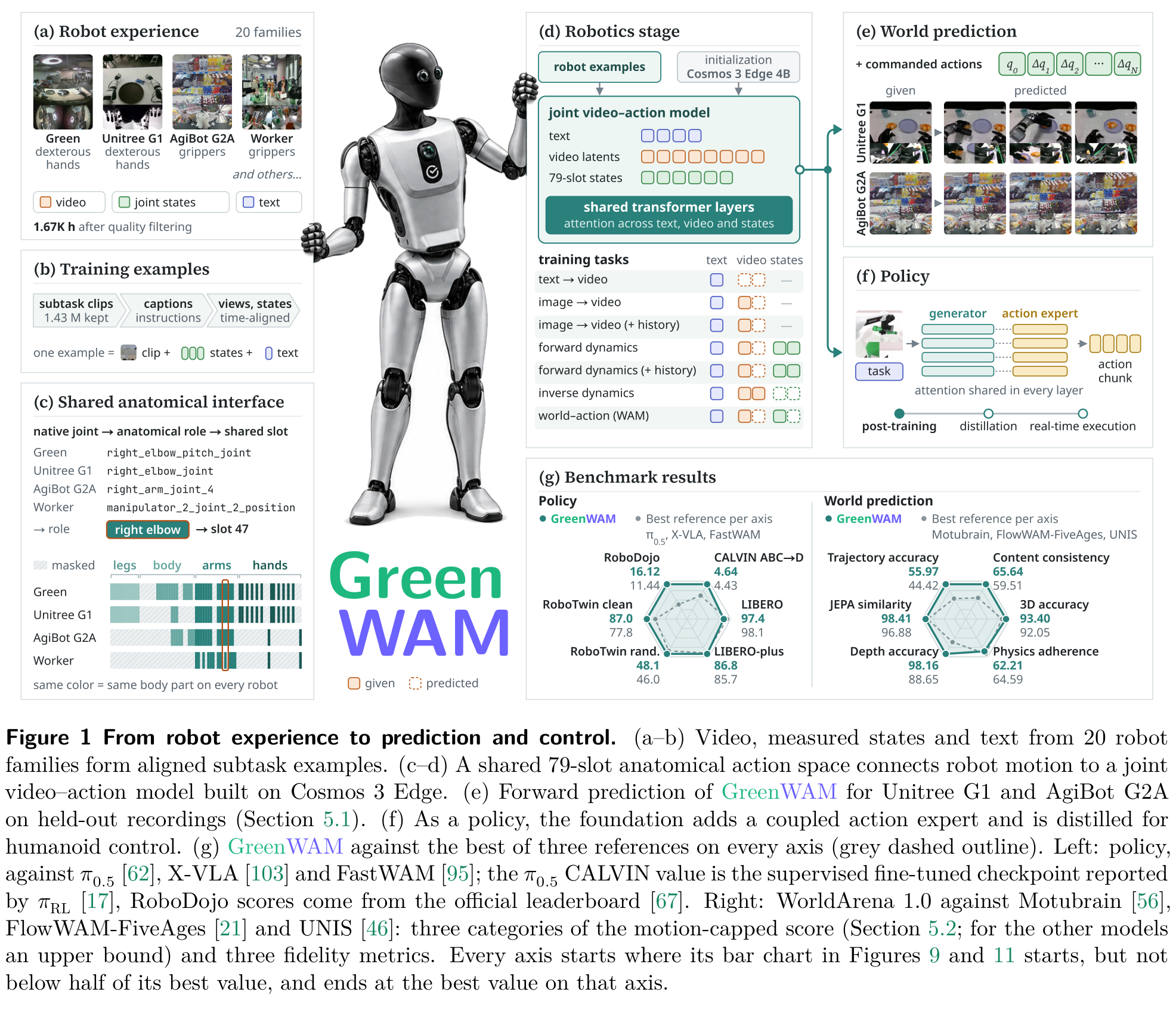
GreenWAM adapts Cosmos 3 Edge to 20 robot families using a shared anatomical action interface and joint video–action training. The resulting foundation supports action-conditioned prediction and, after benchmark-specific adaptation, robot policies. A copied action expert and retained world-model training modes improve control in controlled comparisons. Results include 86.98% clean/48.10% randomized RoboTwin success, 97.4% LIBERO and 86.8% zero-shot LIBERO-plus success, and 95.6%/84.0% instruction success on one humanoid packing task under familiar/changed conditions. These are separate adapted checkpoints, not one unchanged policy for every benchmark. A distilled student runs at 35.4 ms per call on an RTX 4090, with some success loss.
1 Introduction
World prediction and control share a problem: action coordinates have different meanings across robots. GreenWAM addresses this by mapping native states into common anatomical slots, training seven prediction modes, and deriving policies through an action expert. The robotics stage starts from the action-trained Cosmos 3 Edge [58], broadens its robot coverage, and retains one shared projector. Evaluation separates the unchanged foundation’s predictions on held-out recordings from benchmark-adapted prediction and control. Controlled experiments examine the value of robot specialization, expert separation and continued world-model training; robot-specific execution still requires a codec and downstream adaptation.
2 Related Work
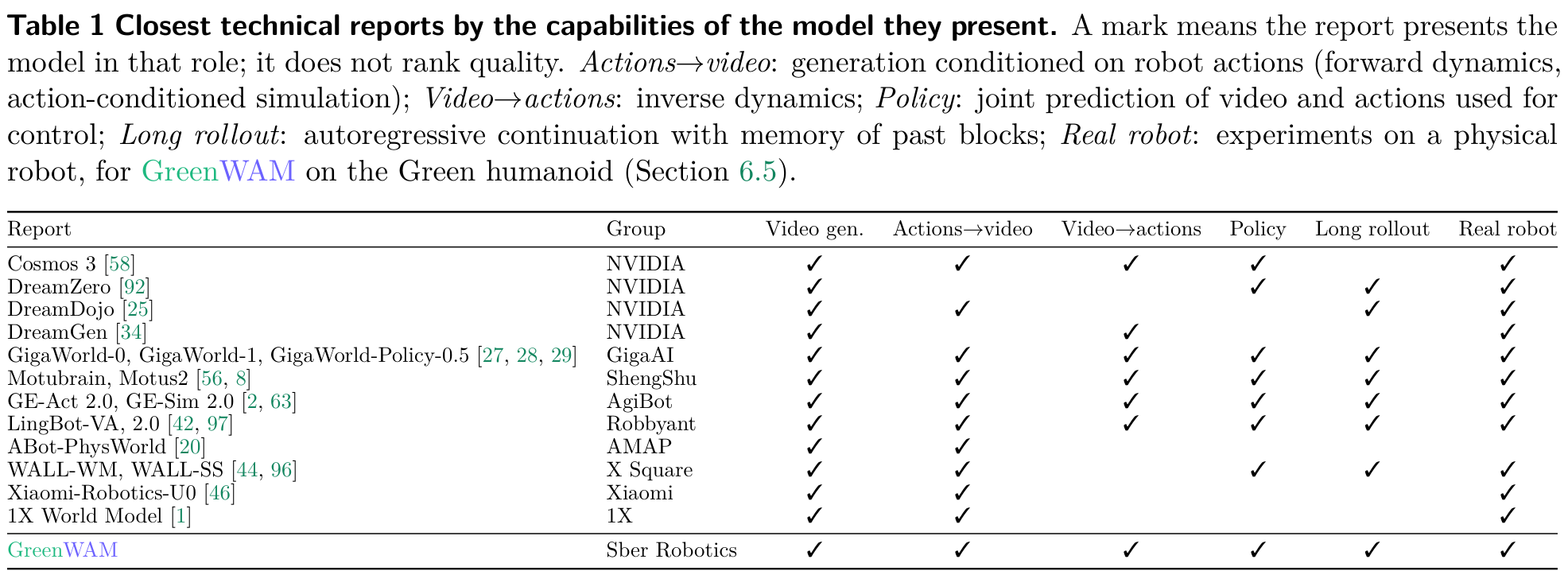
Related approaches specialize video foundations for robotics [58, 25, 27], share experience across embodiments [60, 59, 22], or generate both video and actions [104, 92, 42]. GreenWAM makes anatomical correspondence explicit before projection; unlike image-space action maps [63], joint slots can describe fingers and moving-camera robots without rendering calibrated markers. Its action expert begins as a copy of the generator, preserving the initial function. Four fixed history anchors enable continuation, while training uses recorded history. Table 1 compares reported capabilities rather than ranking model quality.
3 GreenWAM
Layout-specific codecs map robot states into common coordinates. A shared generator predicts video, motion, or both; downstream policies add a coupled action expert.
3.1 Model Overview
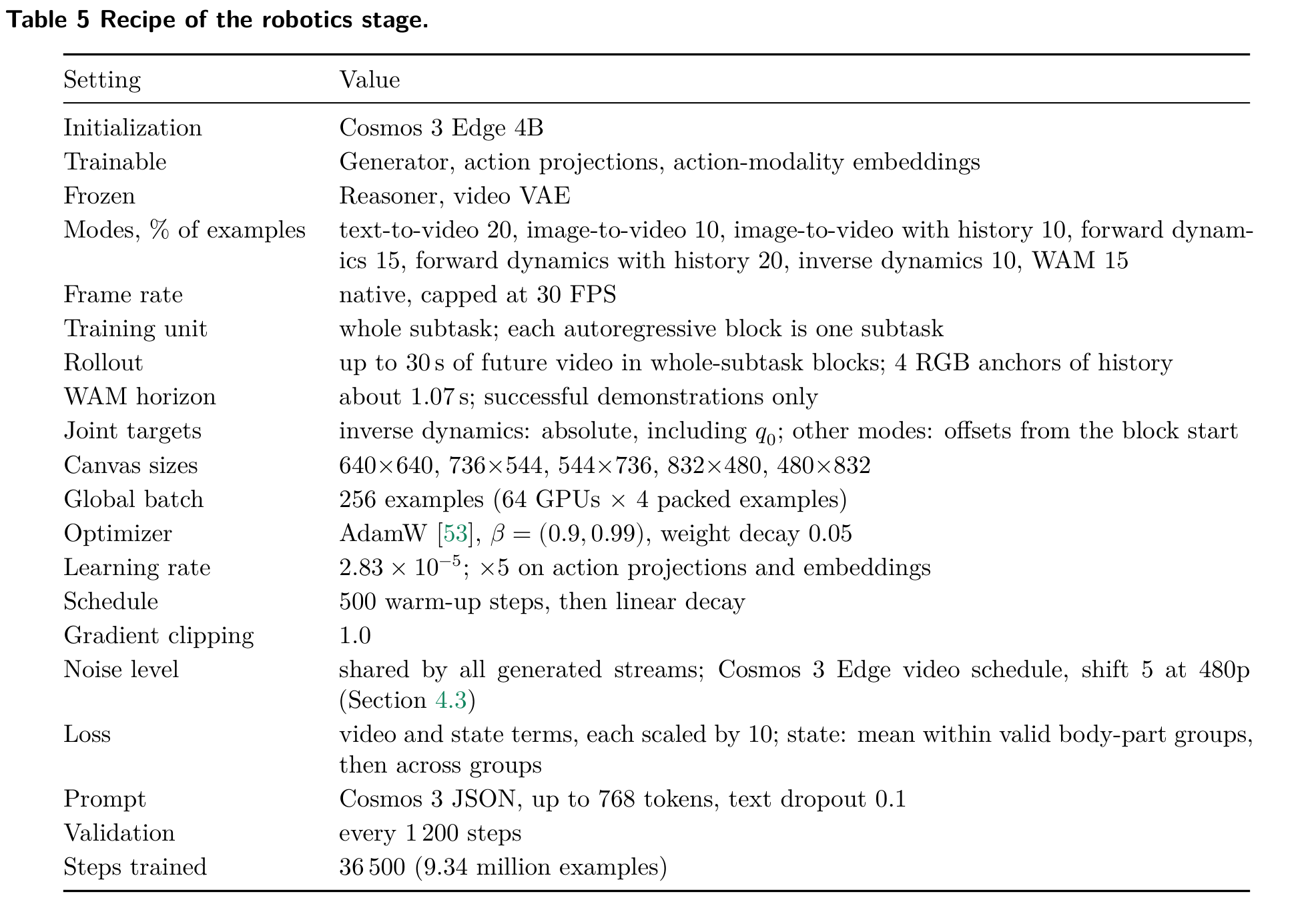
The model starts from Cosmos 3 Edge 4B [58]: a mixture-of-transformers reasoner/generator with a causal video VAE and rectified flow [50]. During robotics training, the reasoner and VAE remain frozen; the generator, shared action projections and modality embeddings train. State and video tokens share the generator until policy adaptation introduces an action expert. Prompts retain the parent’s JSON structure.
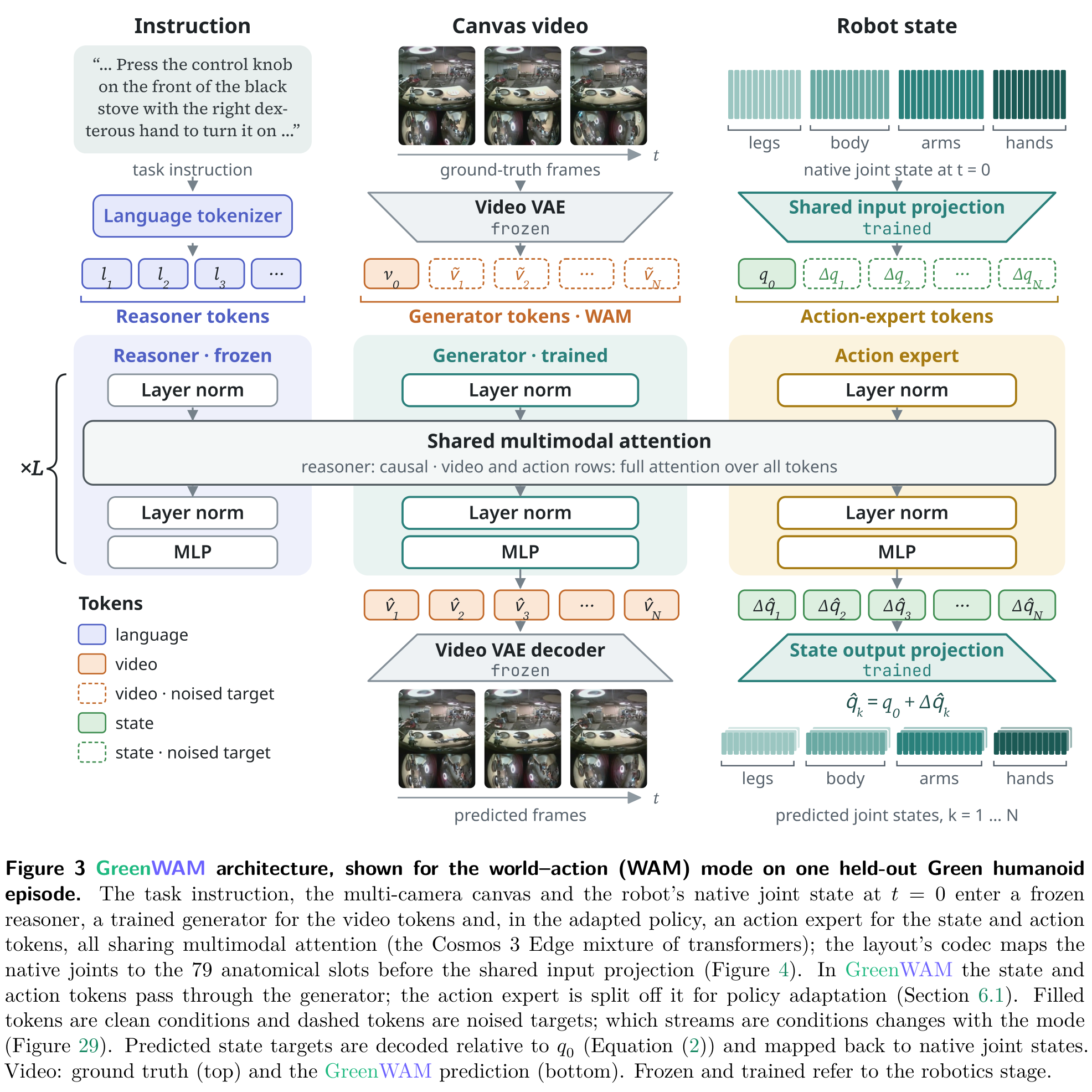
3.2 Shared Anatomical Action Space
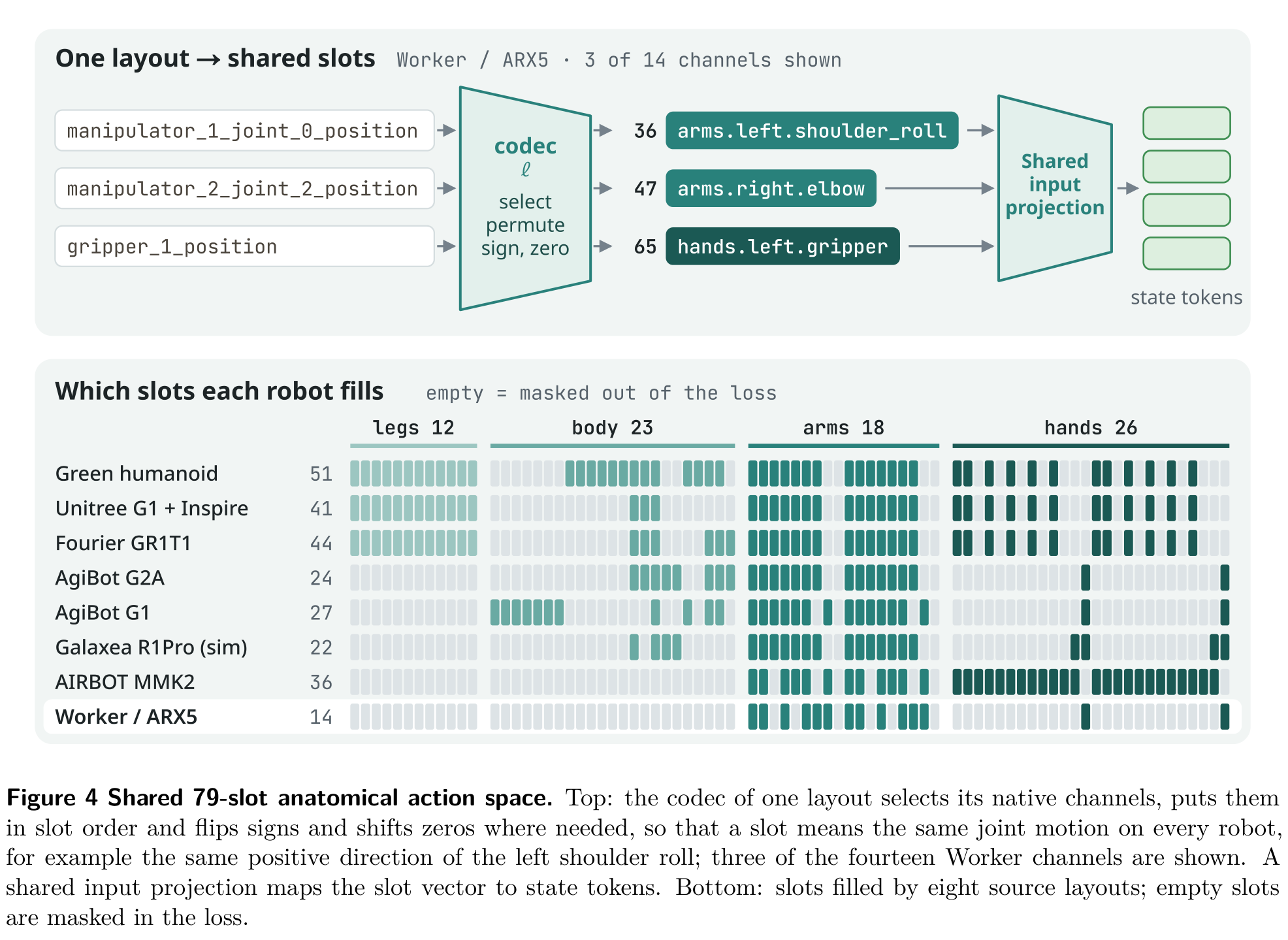
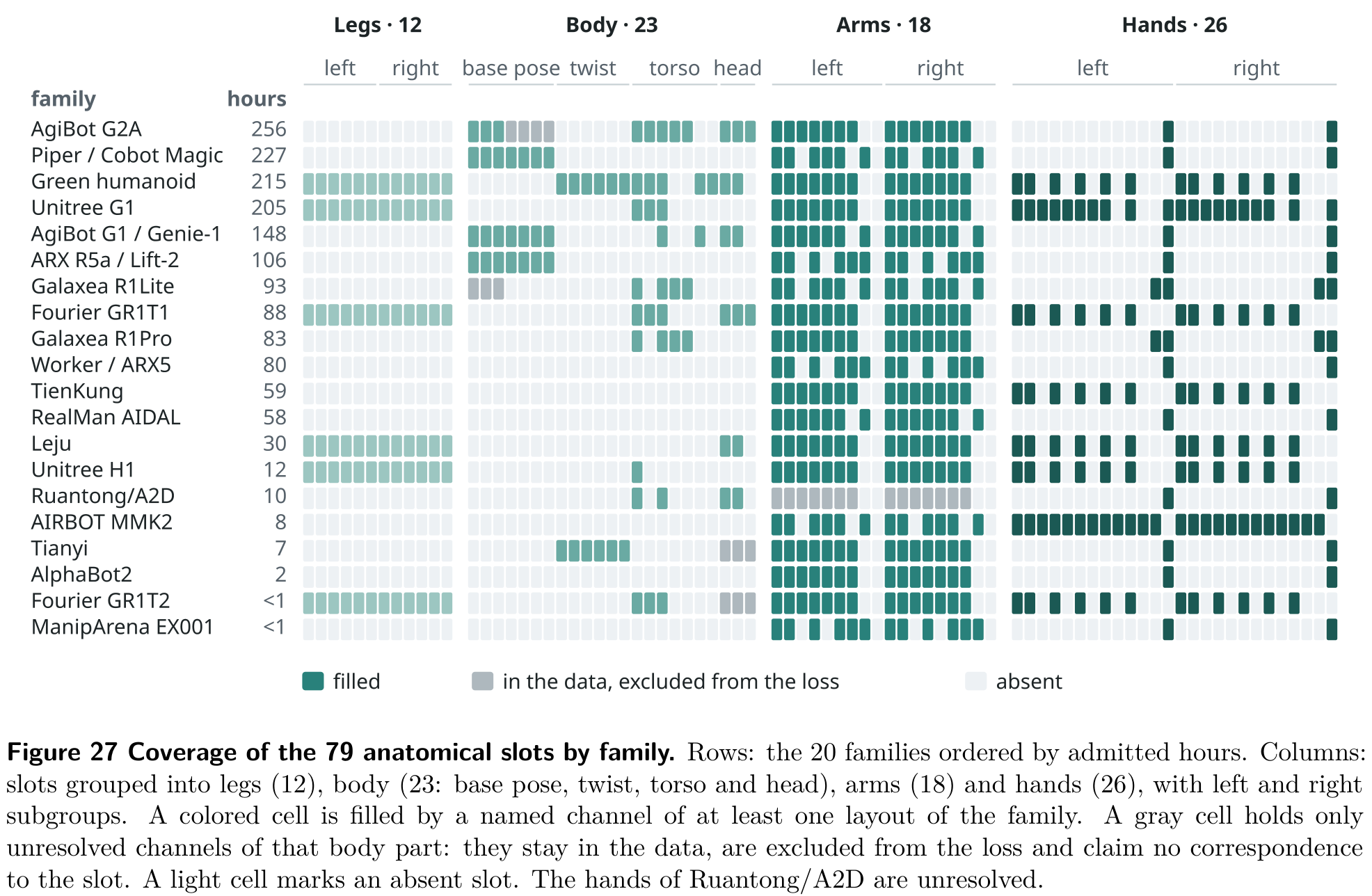
A codec selects, reorders, signs and normalizes native channels into 79 anatomical slots: 12 legs, 23 body, 18 arms and 26 hands. Missing or unresolved coordinates are masked out of the loss. Matching tensor positions therefore mean matching anatomical motions rather than padded native indices; all families use shared projectors.
Inverse dynamics predicts absolute states, including the initial state. Forward dynamics and WAM usually express major joints relative to the block’s initial state while keeping hands/grippers absolute; these offsets are neither velocities nor accumulated increments. The Green layout makes its whole state relative. When reliable Cartesian end-effector data exist, the sampler chooses joint or EEF views equally without duplicating the window’s probability. Cartesian poses use separate slots and SE(3) composition; the additive equations apply to joints, and the projector performs no kinematics.
Equations 1–2


3.3 Joint Video–Action Modeling
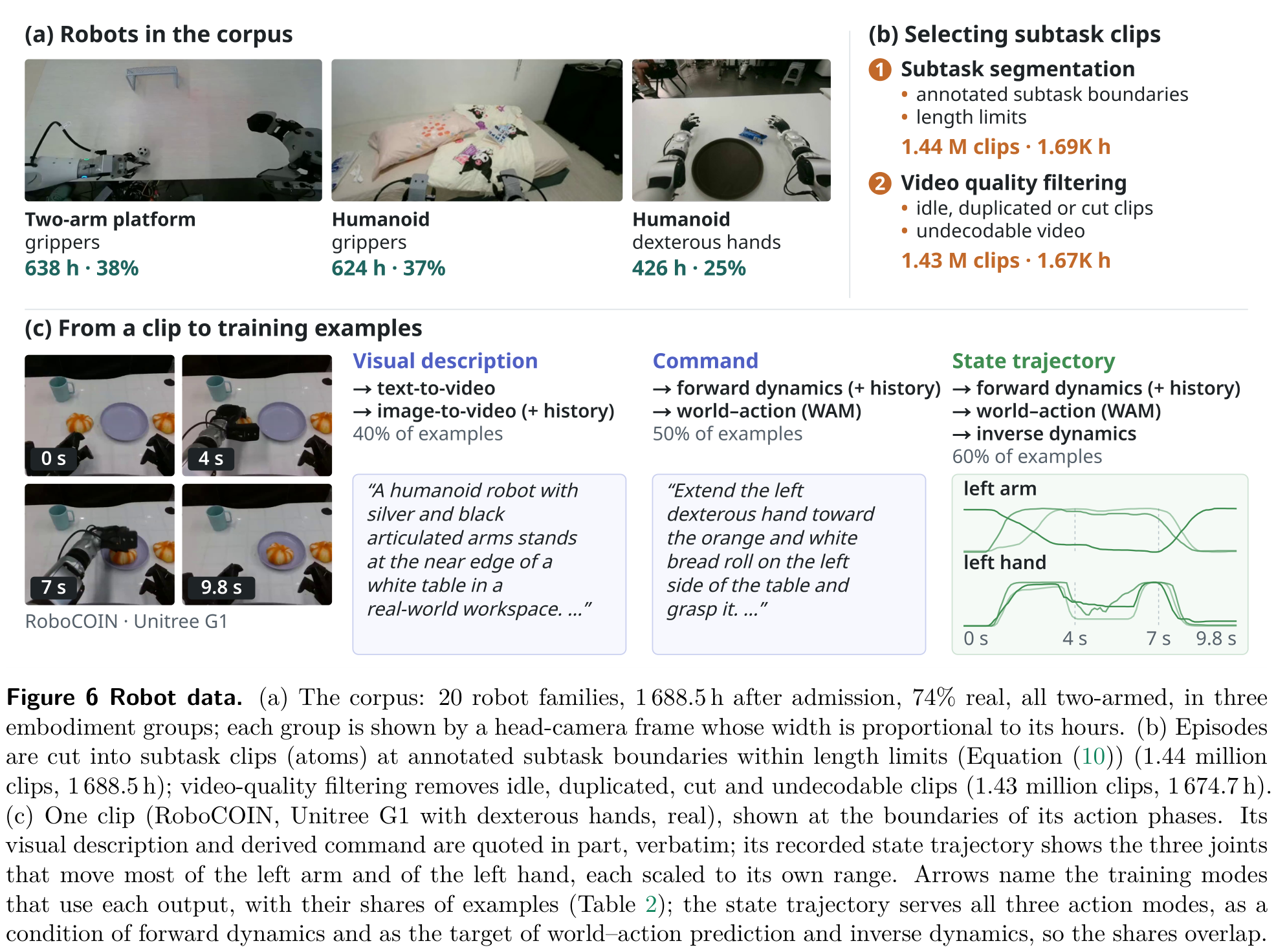
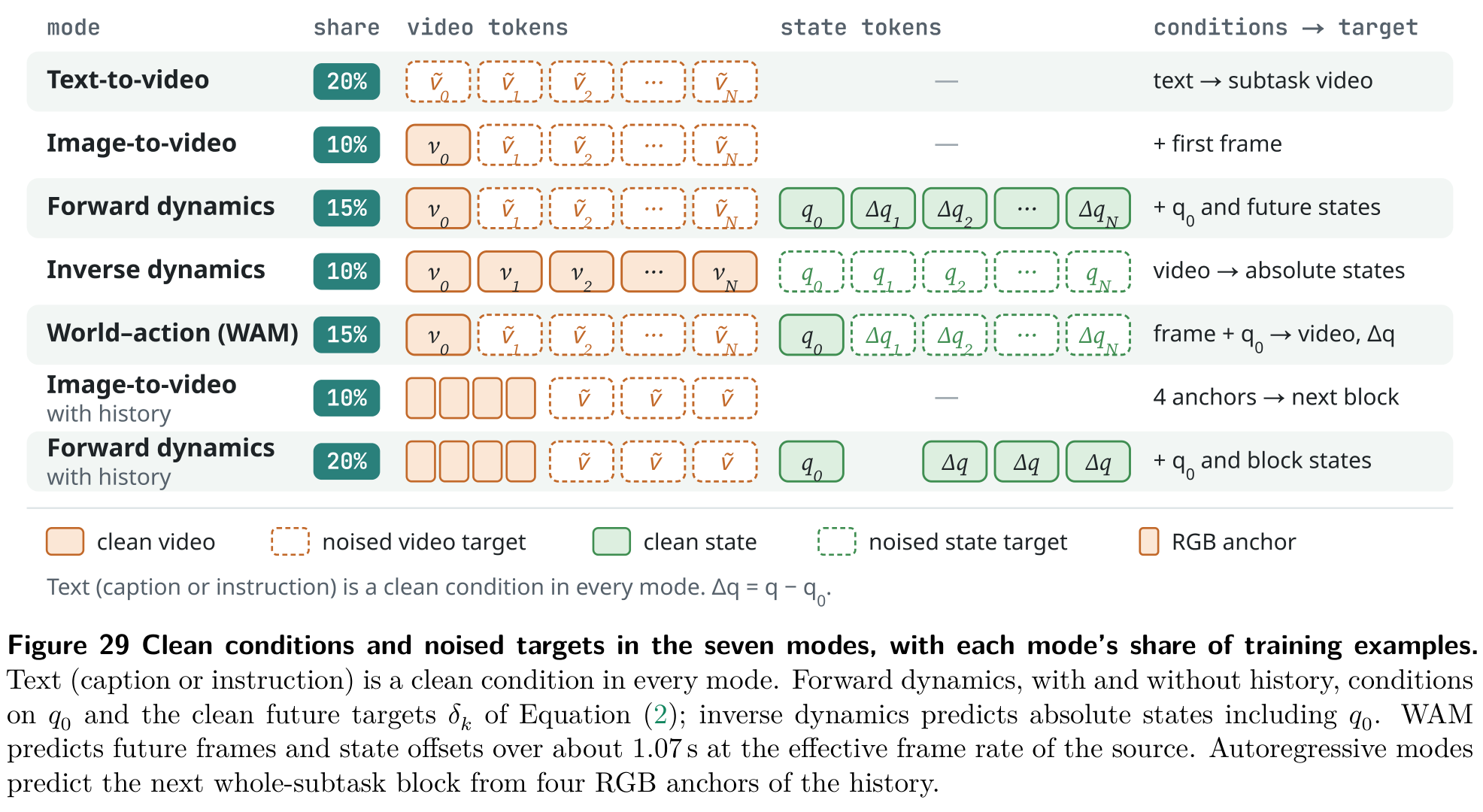
Seven modes differ in which streams are clean conditions and which are generated targets. Every generated stream in an example shares a noise level and masked rectified-flow velocity objective. WAM jointly predicts video and state offsets from initial video/state and instructions. History modes continue video from four anchors, optionally conditioned on commanded states. Table 2 gives the exact mixture: 75% of examples predict video without generating actions; 25% generate states through inverse dynamics or WAM. Eligibility depends on available modalities, accepted text and outcome labels. Visual/dynamics modes use complete subtasks, while WAM uses short windows inside successful demonstrations.
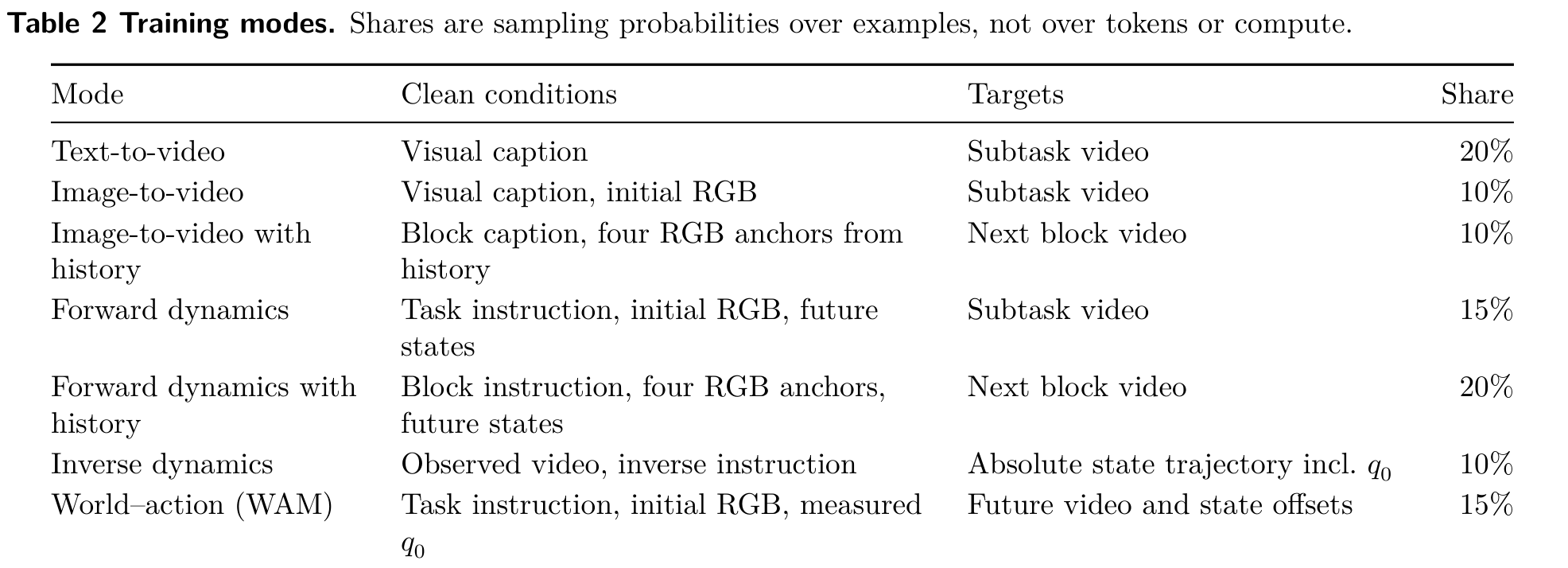
Equations 3–4


3.4 Multi-View Observations and Temporal Context
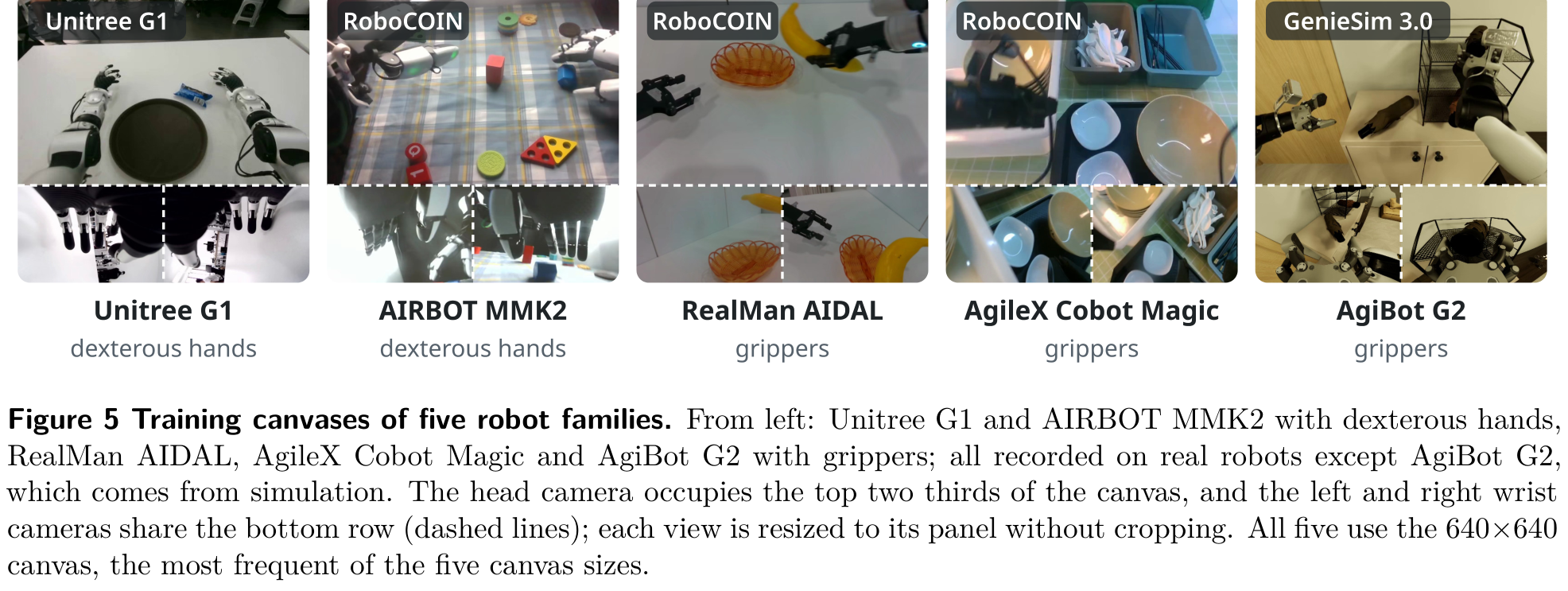
Three-camera recordings become a single canvas with the head view above left/right wrist views; five resolution buckets limit distortion without cropping. Source-specific motion checks establish camera roles. Autoregressive prediction uses independently encoded anchors at the start, one-third, two-thirds and end of available history, repeating the initial frame when necessary. Training uses recorded history, but inference feeds back generated frames. History crosses adjacent accepted subtasks and resets at rejected gaps or episode boundaries.
4 Robot Experience and Training
The data pipeline aligns video, measured states and language within complete annotated subtasks, filters unusable clips, and derives separate visual descriptions and prospective commands.
4.1 Cross-Embodiment Corpus
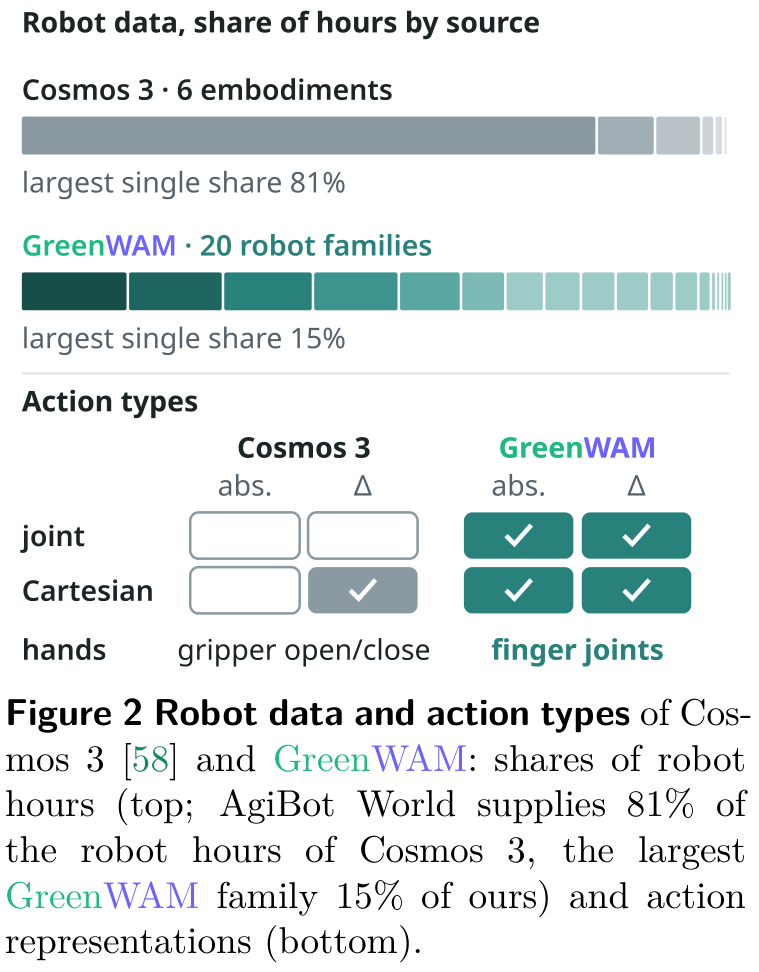
The corpus contains 20 two-armed robot families, including humanoids, gripper platforms and dexterous hands, across real and simulated data. Public and internal datasets are converted to LeRobot format [13]. Its training unit is a provenance-tracked subtask “atom” with synchronized views, states and text.
4.2 Data Curation and Training Mixture
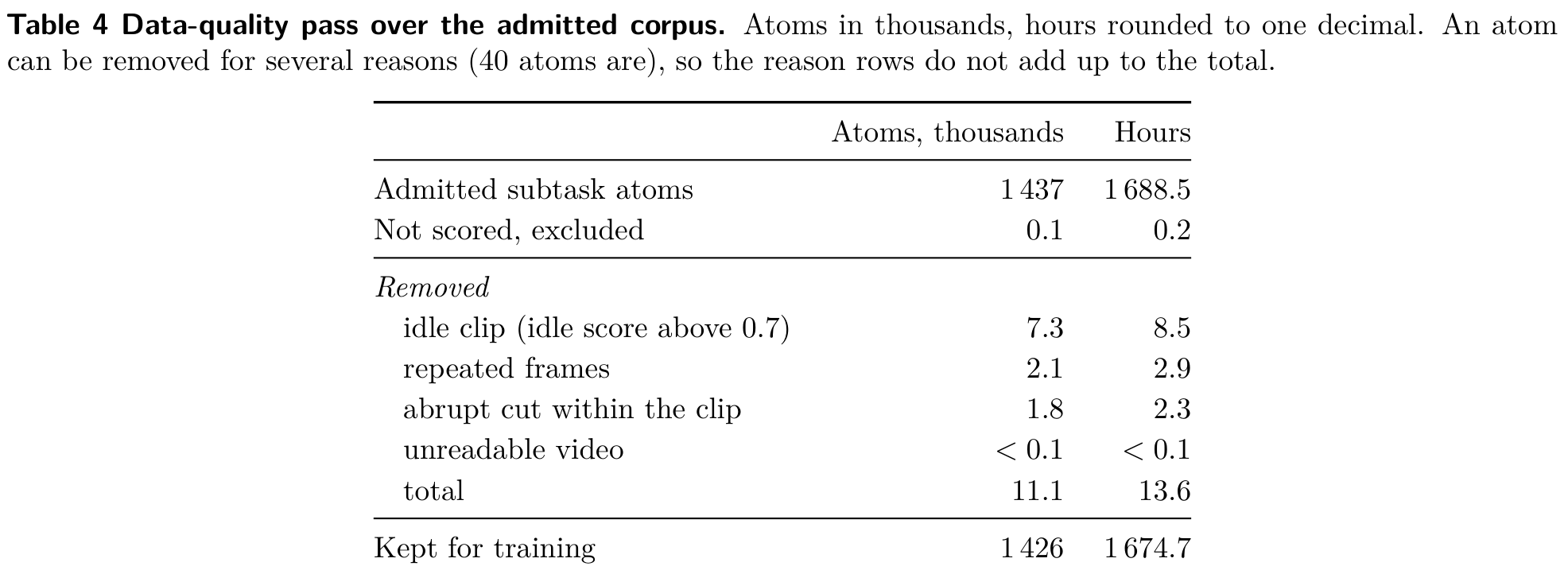
Registration fixes camera roles, state semantics and robot properties. Annotation-based segmentation admits 1.44 million atoms/1,688.5 hours; quality filtering retains 1.43 million/1,674.7 hours. Captioning accepts 1.24 million visual descriptions, and command derivation accepts 1.19 million commands. Ambiguous boundaries and overlong atoms are rejected rather than arbitrarily clipped.
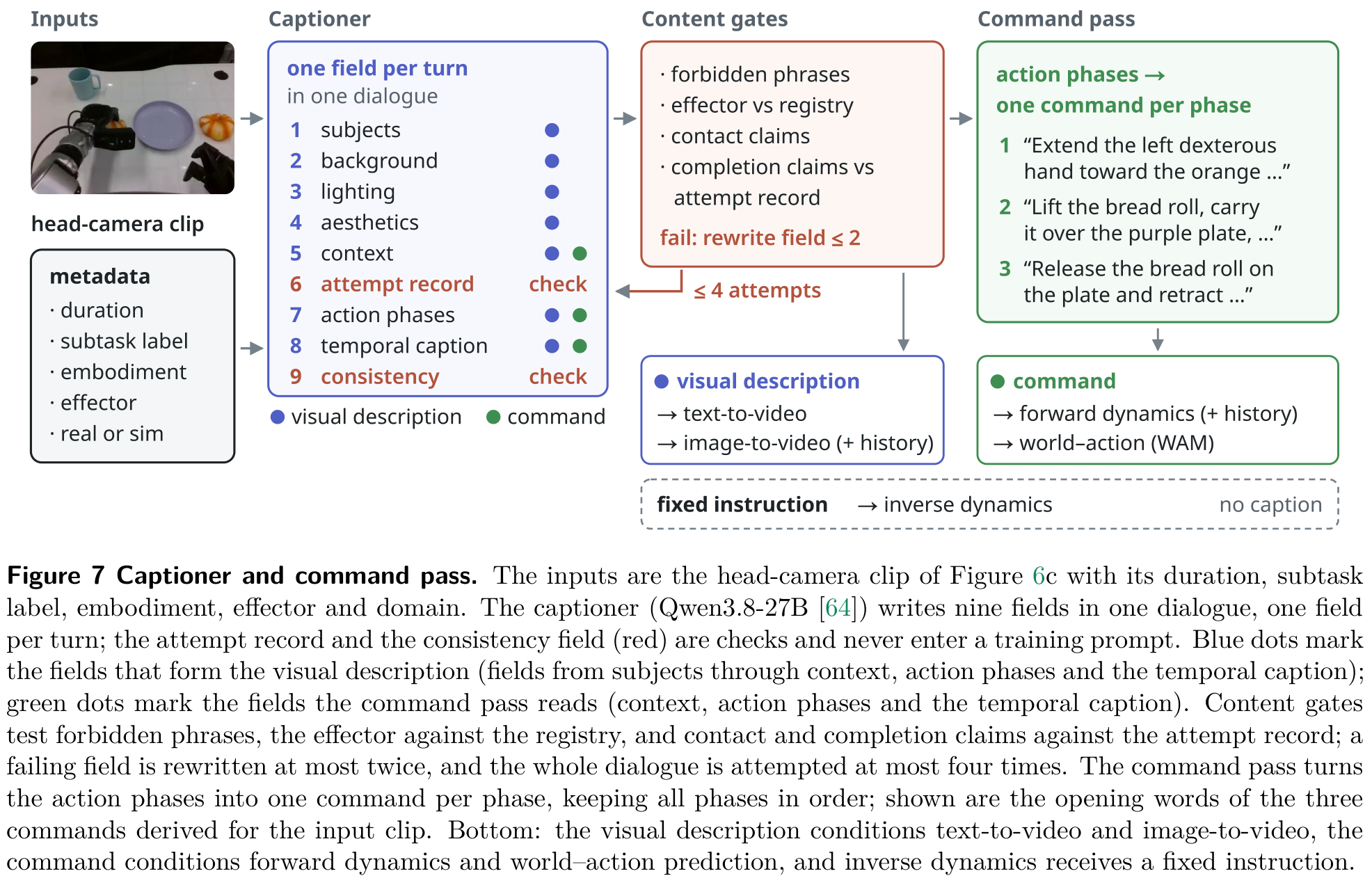
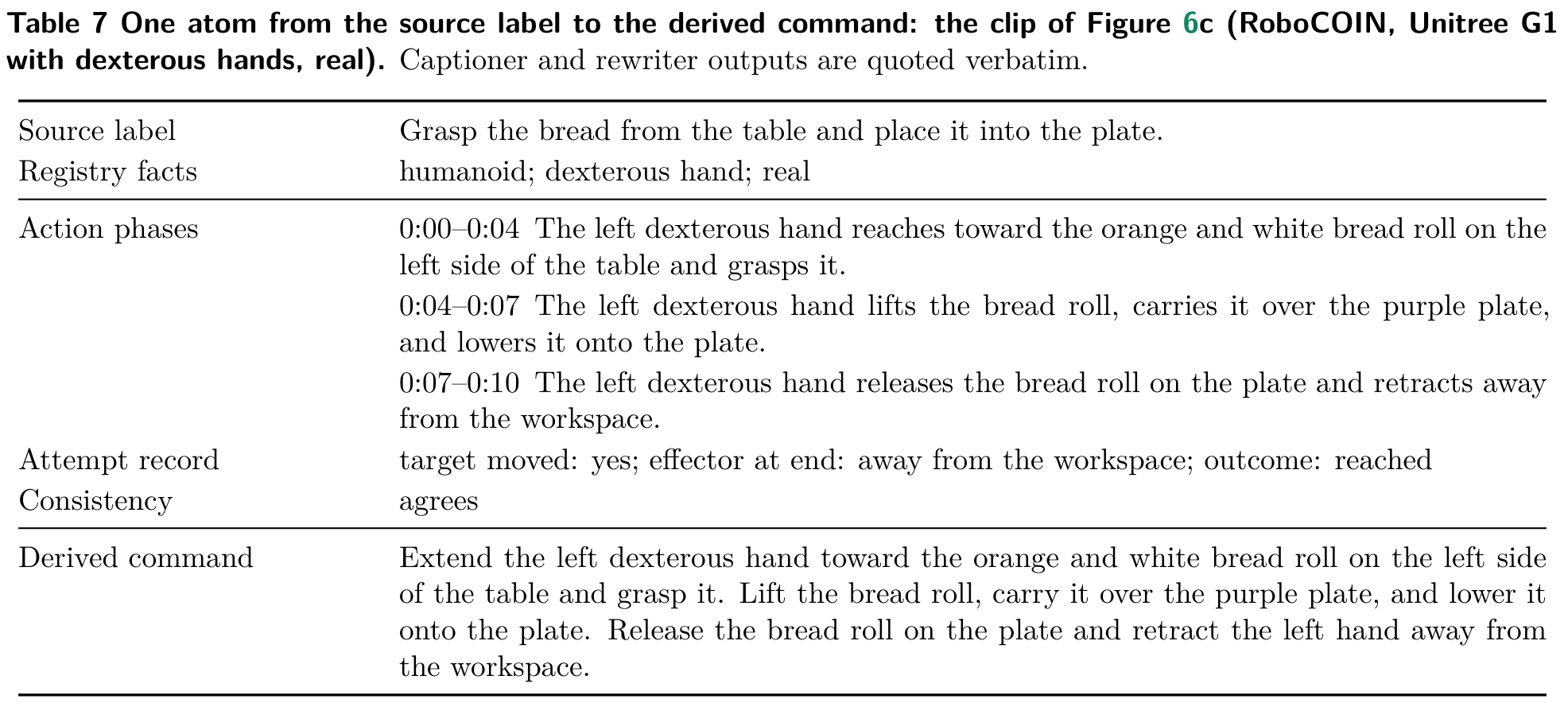
Qwen3.8-27B [64] writes a structured, field-by-field visual record. An attempt check describes the actual ending before action phases are written, preventing incomplete demonstrations from becoming claimed successes. A text-only pass converts those phases into prospective commands without seeing native operator instructions. Video modes use descriptions; forward dynamics/WAM use commands; inverse dynamics uses a fixed instruction. WAM requires positive success labels, whereas other eligible modes can use failures. Action targets come from measured states, not heterogeneous recorded command columns. Sampling chooses mode, robot cluster, dataset and window, with boosted shares for Worker/ARX5 and Green.
Equation 5

4.3 GreenWAM Training
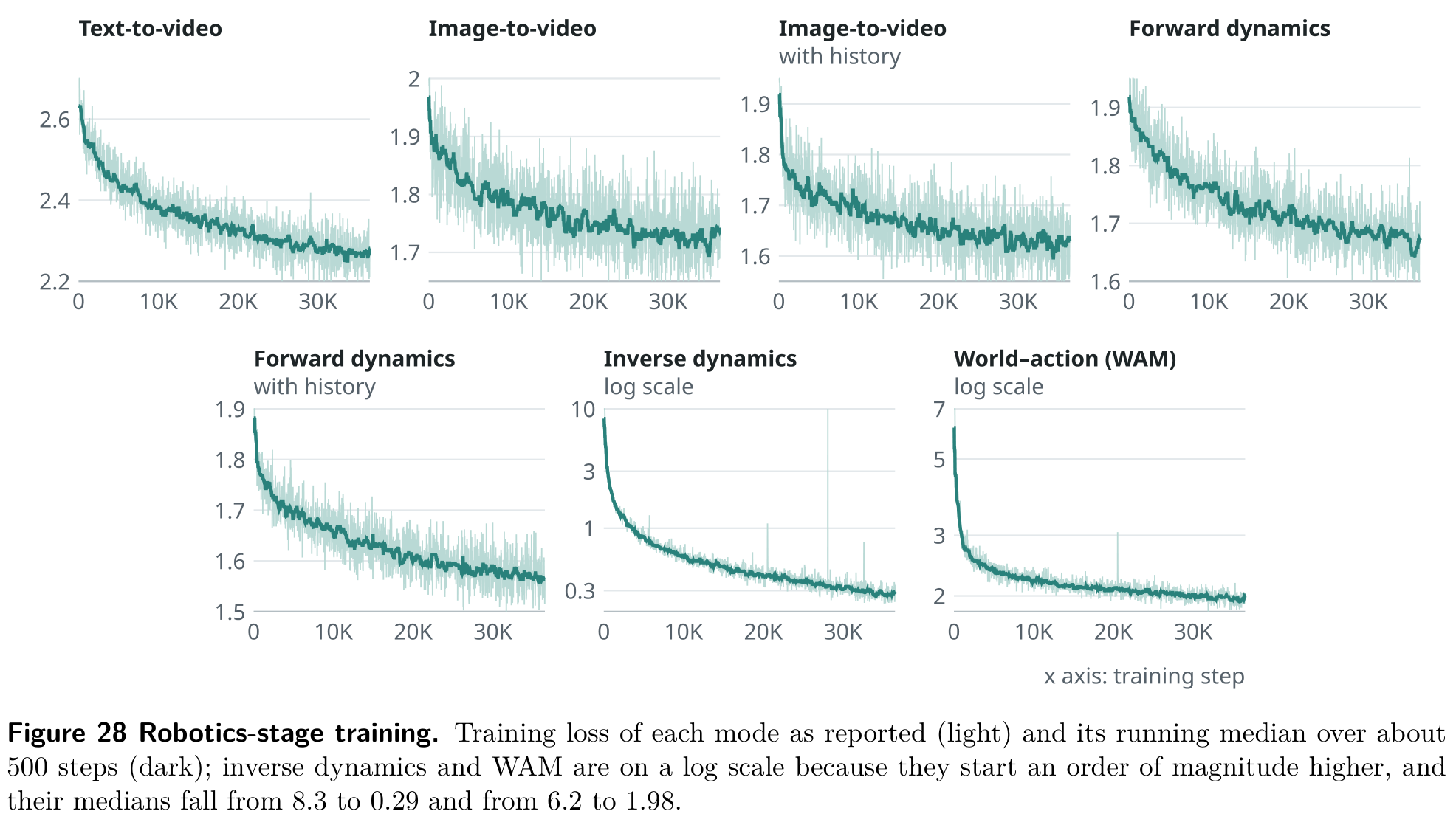
Rectified-flow training averages video errors over valid elements. State errors average within anatomical groups and then across present groups, preventing high-dimensional hands from dominating solely by coordinate count. Video and state losses have equal weights, scaled by 10; clean conditions and missing coordinates receive no loss. Text drops with probability 0.1 for classifier-free guidance [32]. The frozen-reasoner/VAE setup trains on 64 H100 GPUs with batch 256. The released foundation is the 36,500-step checkpoint, representing 9.34 million sampled examples; downstream adaptations start from it.
Equation 6

5 GreenWAM as a World Model
World-model tests use the generator without the action expert. The first experiment uses the unchanged robotics checkpoint; the WorldArena comparison uses an adapted checkpoint.
5.1 The Robotics Checkpoint on Held-Out Recordings
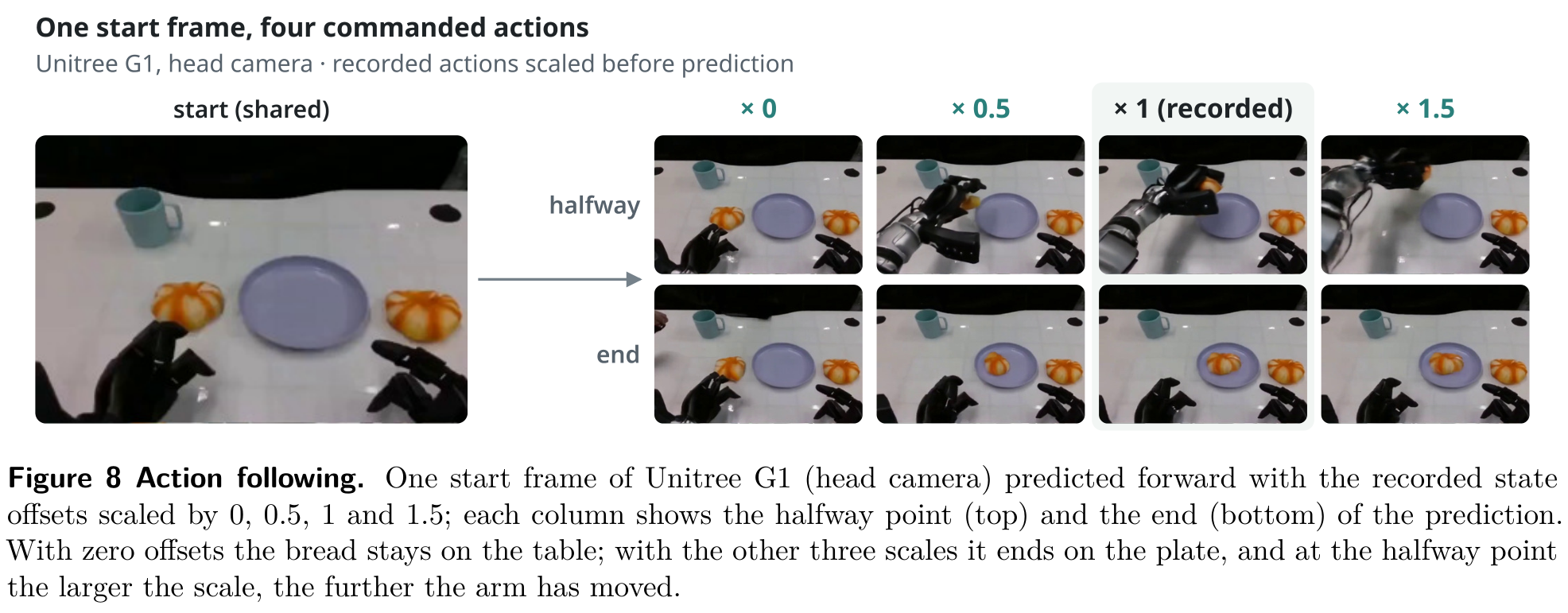
Qualitative prediction uses one held-out recording for each of six families, with the Green humanoid shown in both simulation and reality. The model conditions on an initial frame and recorded states. Scaling displacement by 0, 0.5, 1 or 1.5 scales generated motion: zero commands retain under one-fifth of normal frame-to-frame motion; 1.5× commands increase it by roughly one-quarter. These examples demonstrate action following within represented families, not zero-shot control of unseen bodies.
5.2 WorldArena Adaptation and Results
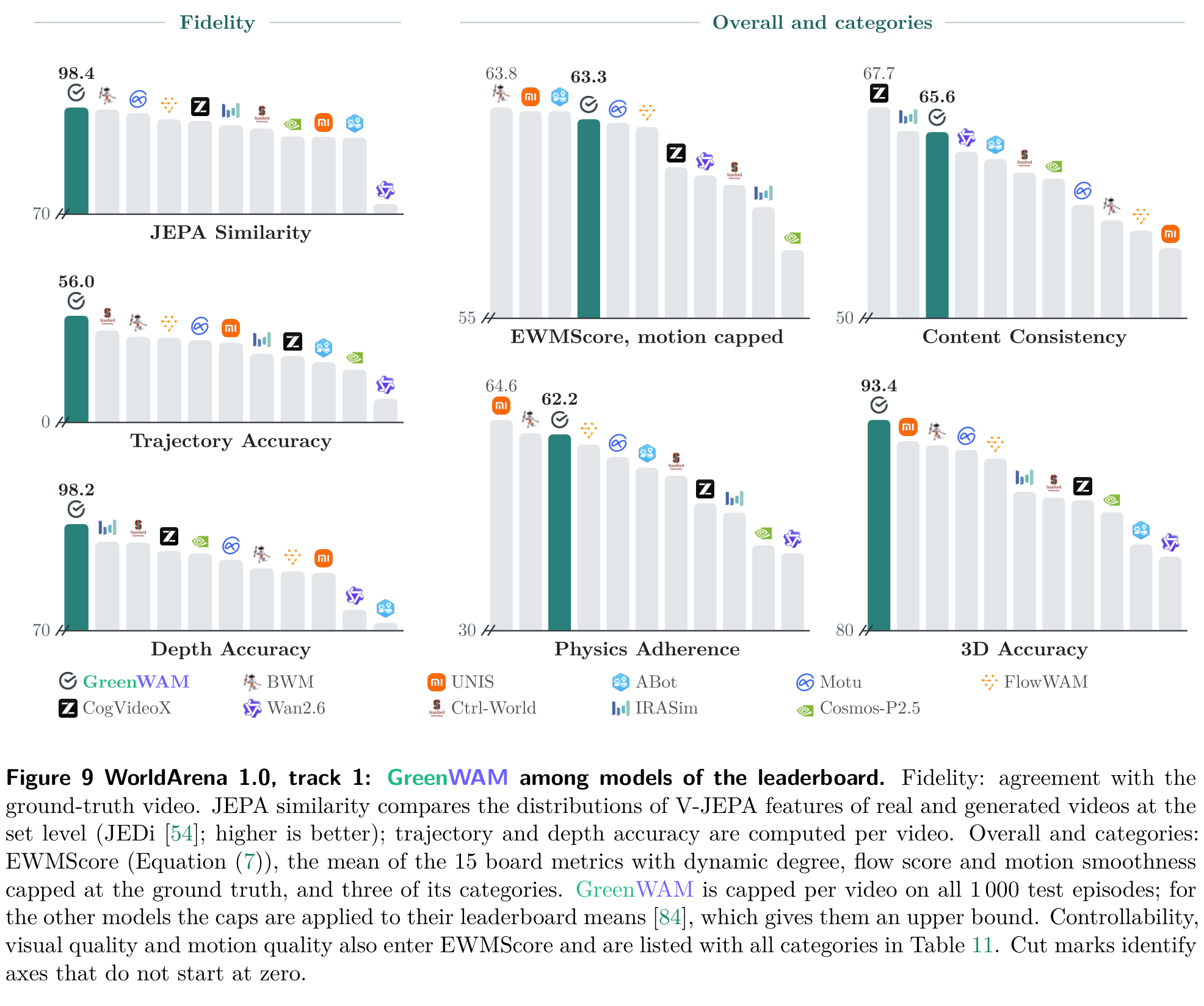
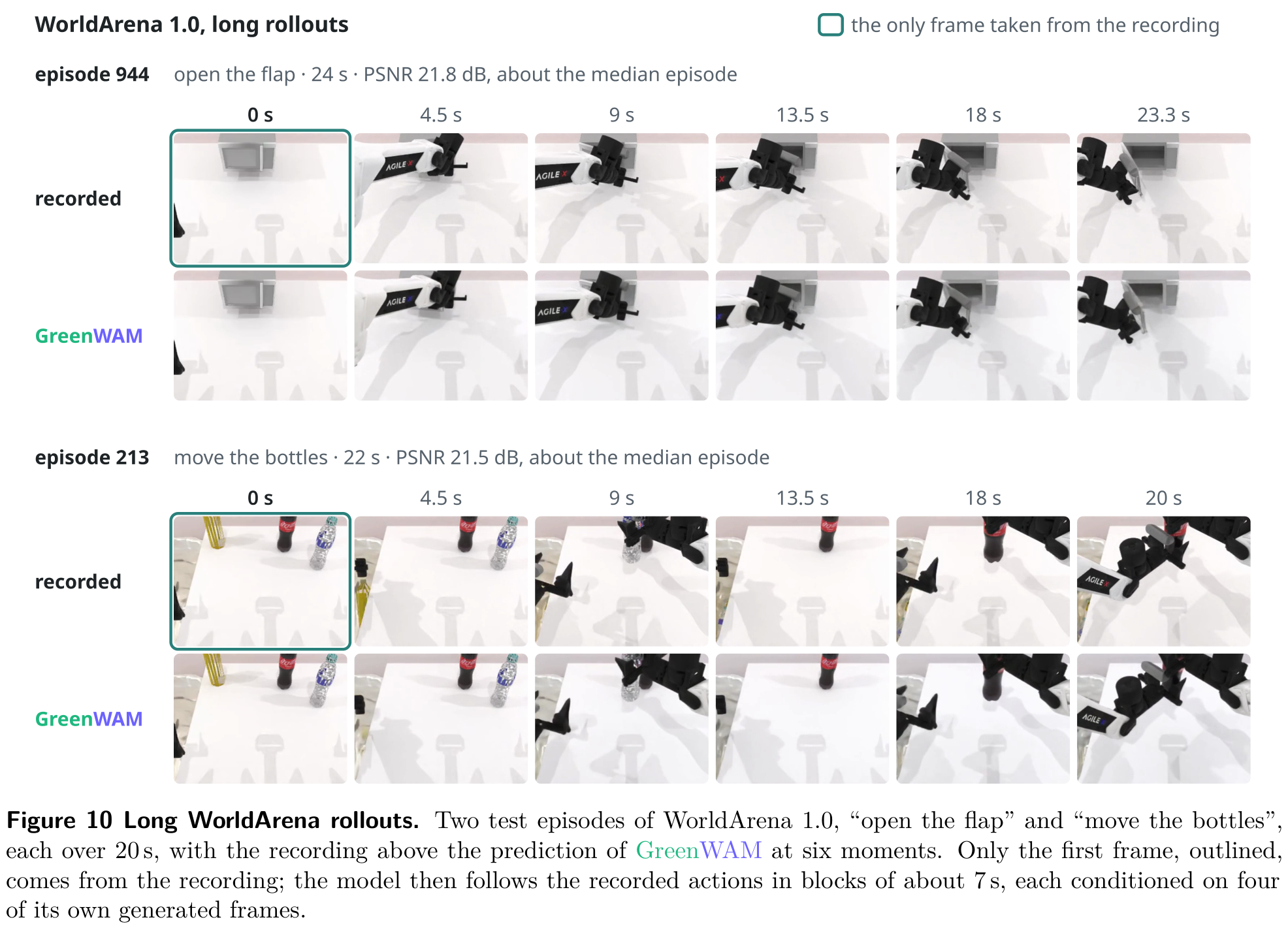
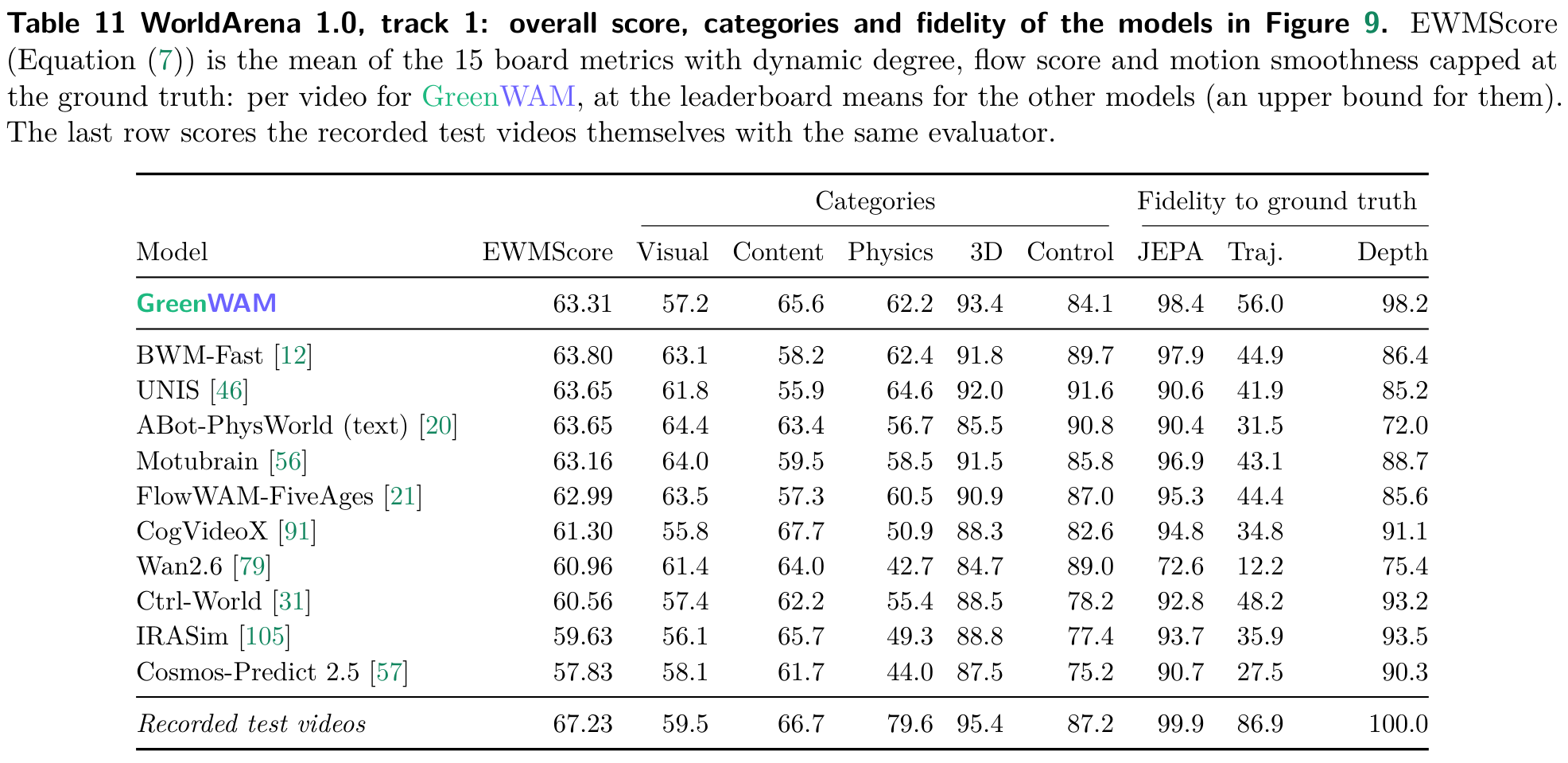
After adaptation on permitted clean RoboTwin demonstrations, GreenWAM predicts 1,000 WorldArena 1.0 test episodes using recorded actions and history, an empty text prompt and 35 sampling steps. Reported trajectory, depth and 3D accuracies are 56.0, 98.2 and 93.4, strongest among the selected compared world–action/video generators. JEPA similarity is second among all 127 listed entries.
The authors recompute an aggregate that caps dynamic degree, flow and motion smoothness at recorded-video values. GreenWAM receives per-video caps; competitors receive caps applied to published metric means, which yield upper bounds for their scores. The resulting 63.31 is not the official WorldArena 1.0 leaderboard score and is below some selected models. Several appearance/judge metrics reward generated videos above recordings themselves; high scores on those axes need not mean better agreement with actual motion. Appendix C states omitted comparisons and evaluator details.
Equation 7

6 GreenWAM as a Policy
Control predicts future states together with video, executes a decoded action chunk and replans. Each benchmark has its own adaptation data, command interface and inference settings.
6.1 Policy Architecture
For policy adaptation, action tokens move into a transformer copied exactly from the generator. Video and action streams retain shared attention at every layer but develop separate feed-forward parameters. The copy preserves initial predictions, then specializes through training. It adds one generator-sized tower and roughly 8% training-step time; the comparison isolates this parameterization change at a fixed adaptation budget.
Equation 8

6.2 Policy Post-Training
Policies learn from target-robot demonstrations, conditioning on instruction, camera canvas and measured state. Predicted offsets decode into native commands; a robot-specific controller executes a prefix before observing again. RoboTwin background replacement uses simulator segmentation and preserves original shading, while independent camera color augmentation changes appearance without altering state/action targets. These augmentations create no new trajectories or geometric corrections.
6.3 Simulation Benchmarks
RoboTwin, CALVIN, RoboDojo and LIBERO are absent from the robotics-stage corpus, then used for benchmark-specific adaptation. Baselines are published reports/leaderboard values, with differing pretraining noted in the tables. The results therefore compare complete methods, not uniformly matched pretraining budgets.
6.3.1 RoboTwin 2.0
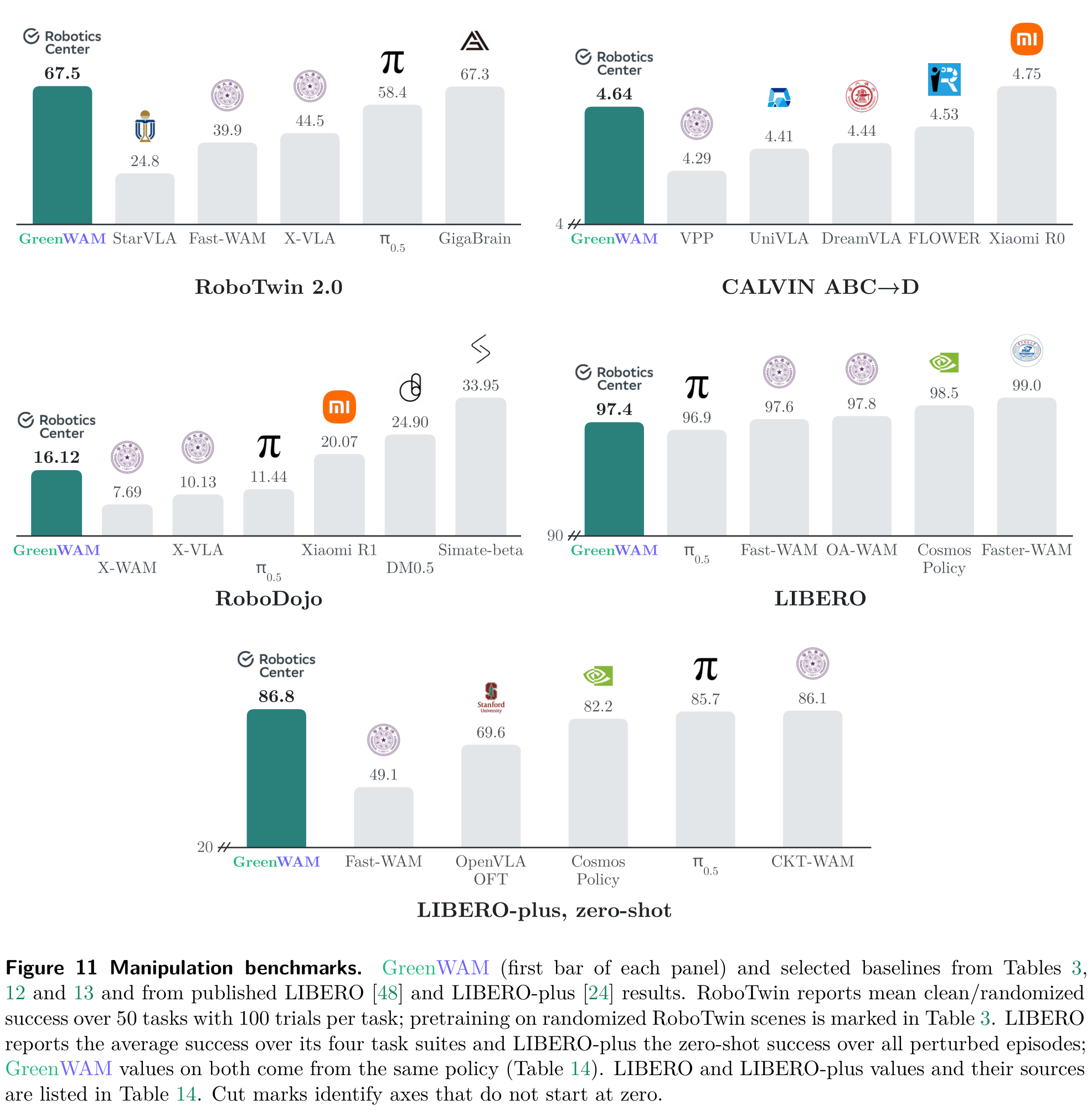
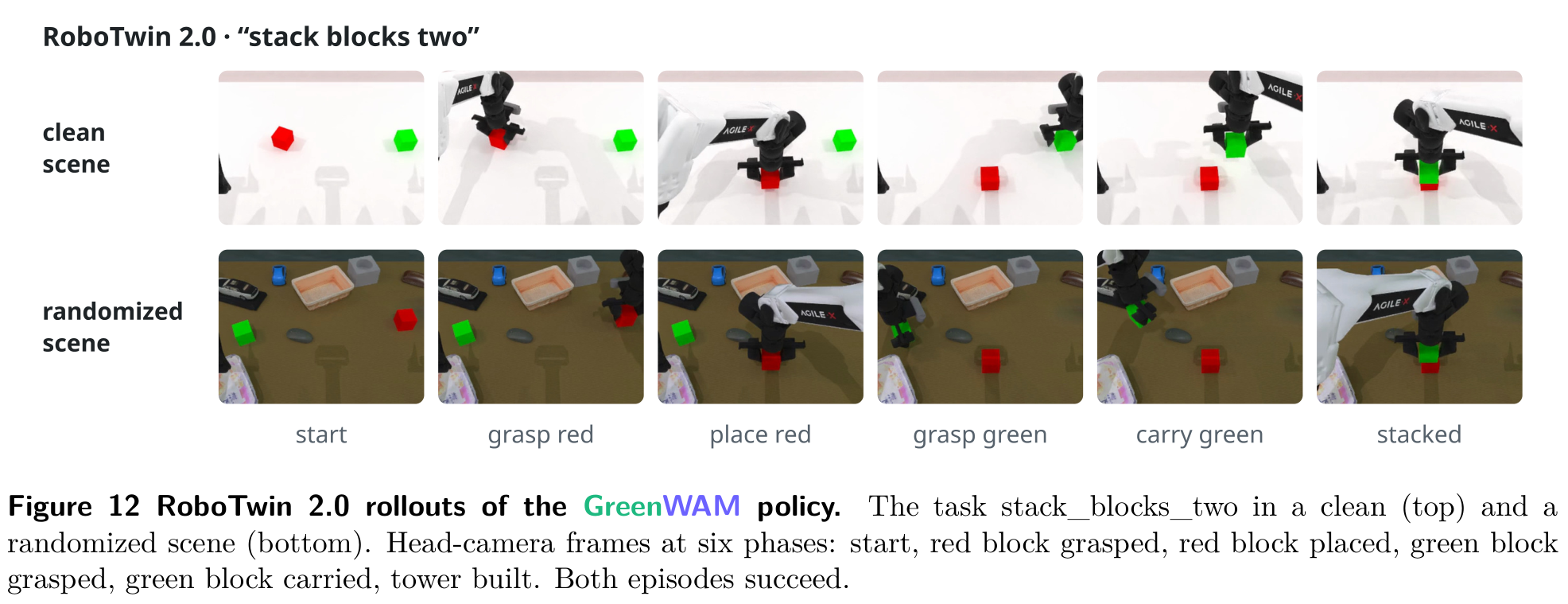
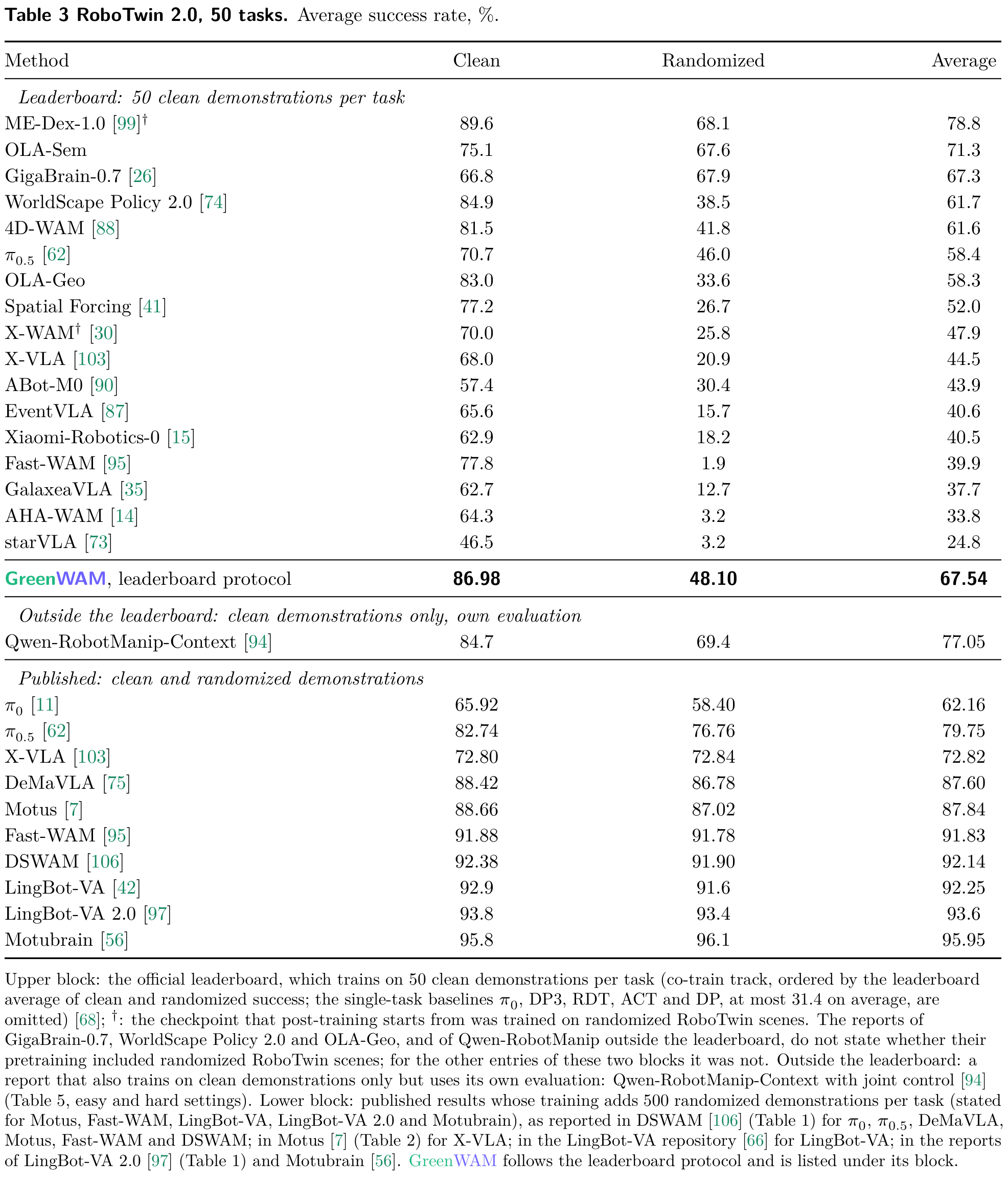
Training uses 50 clean demonstrations per task across 50 tasks. On 100 official-seed trials per task and condition, GreenWAM reaches 86.98% clean and 48.10% randomized success, averaging 67.54%. Some baseline pretrained checkpoints include randomized RoboTwin demonstrations; Table 3 marks this difference. Controlled 3,000-step comparisons attribute gains to the specialized initialization and expert architecture, separately from the final leaderboard recipe.
6.3.2 CALVIN
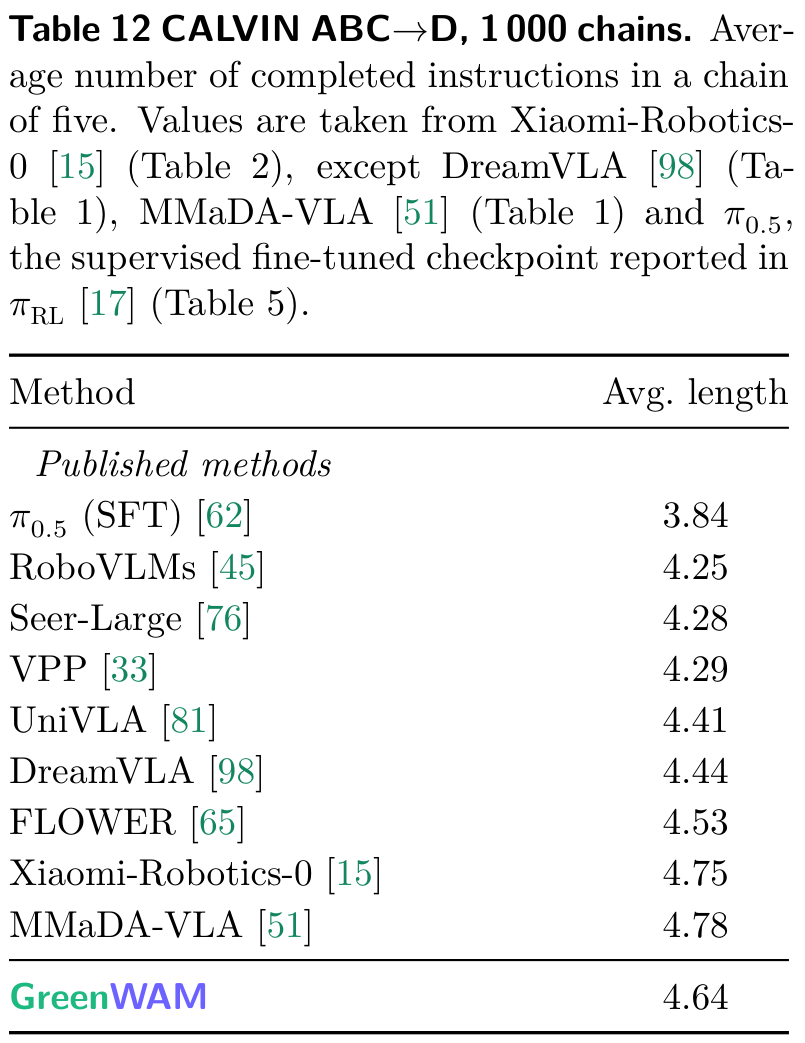
Training uses environments A–C only; evaluation uses 1,000 five-instruction chains in unseen D. GreenWAM averages 4.64 completed instructions, with an approximately 0.03 standard error. It exceeds several reported baselines but not the strongest entries in Table 12.
6.3.3 RoboDojo
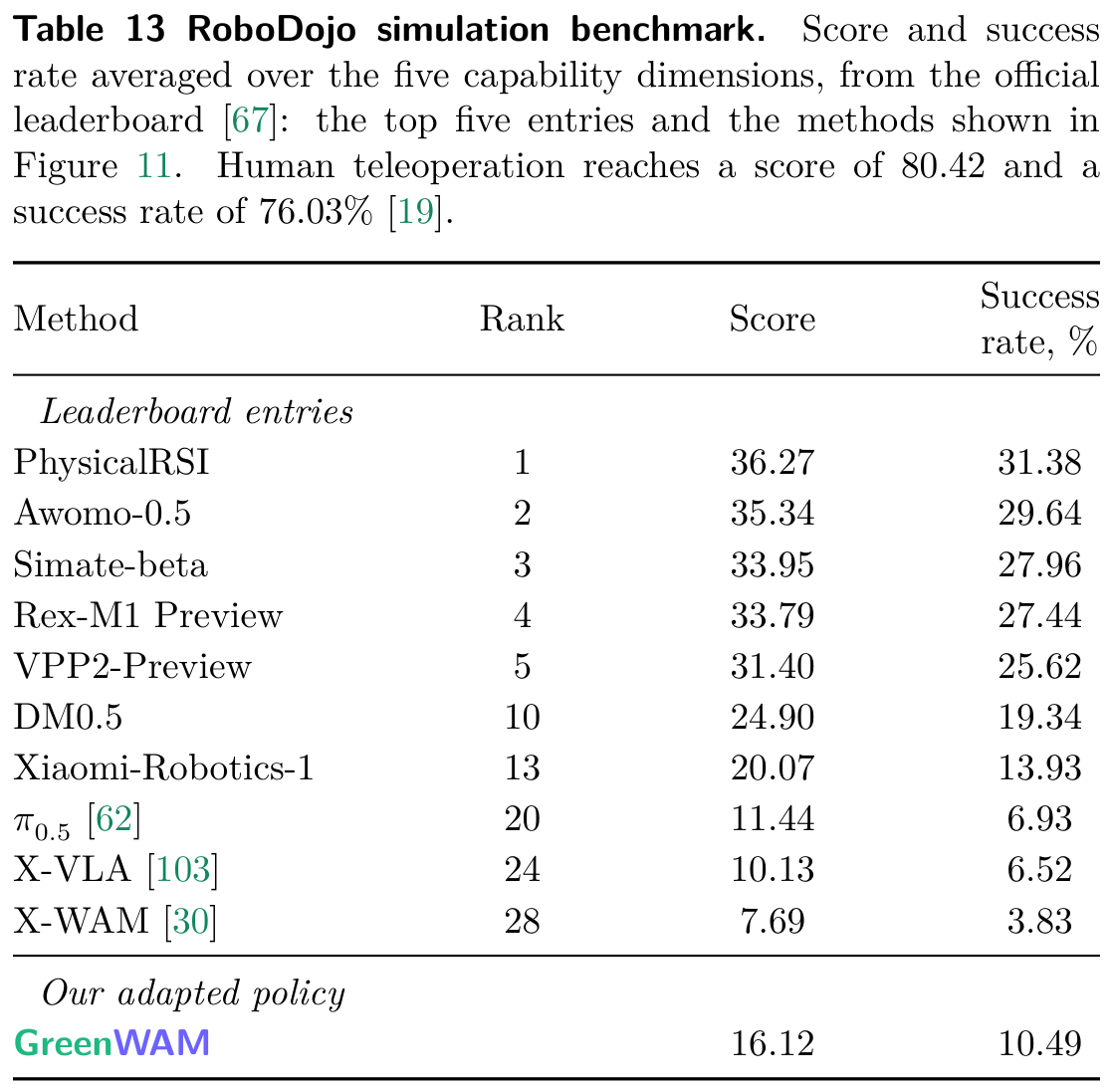
RoboDojo weights five capability dimensions equally. Following its official training protocol, GreenWAM scores 16.12 and reaches 10.49% success, above the displayed π0.5, X-VLA and X-WAM entries but below leading leaderboard methods. These are simulation benchmark results; the broader benchmark also contains real-world tasks.
6.3.4 LIBERO and LIBERO-plus
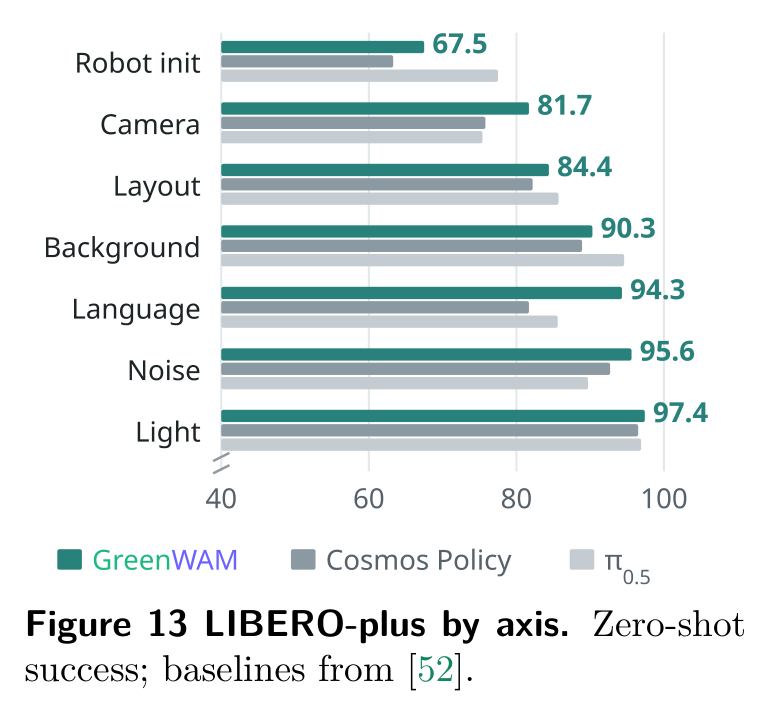
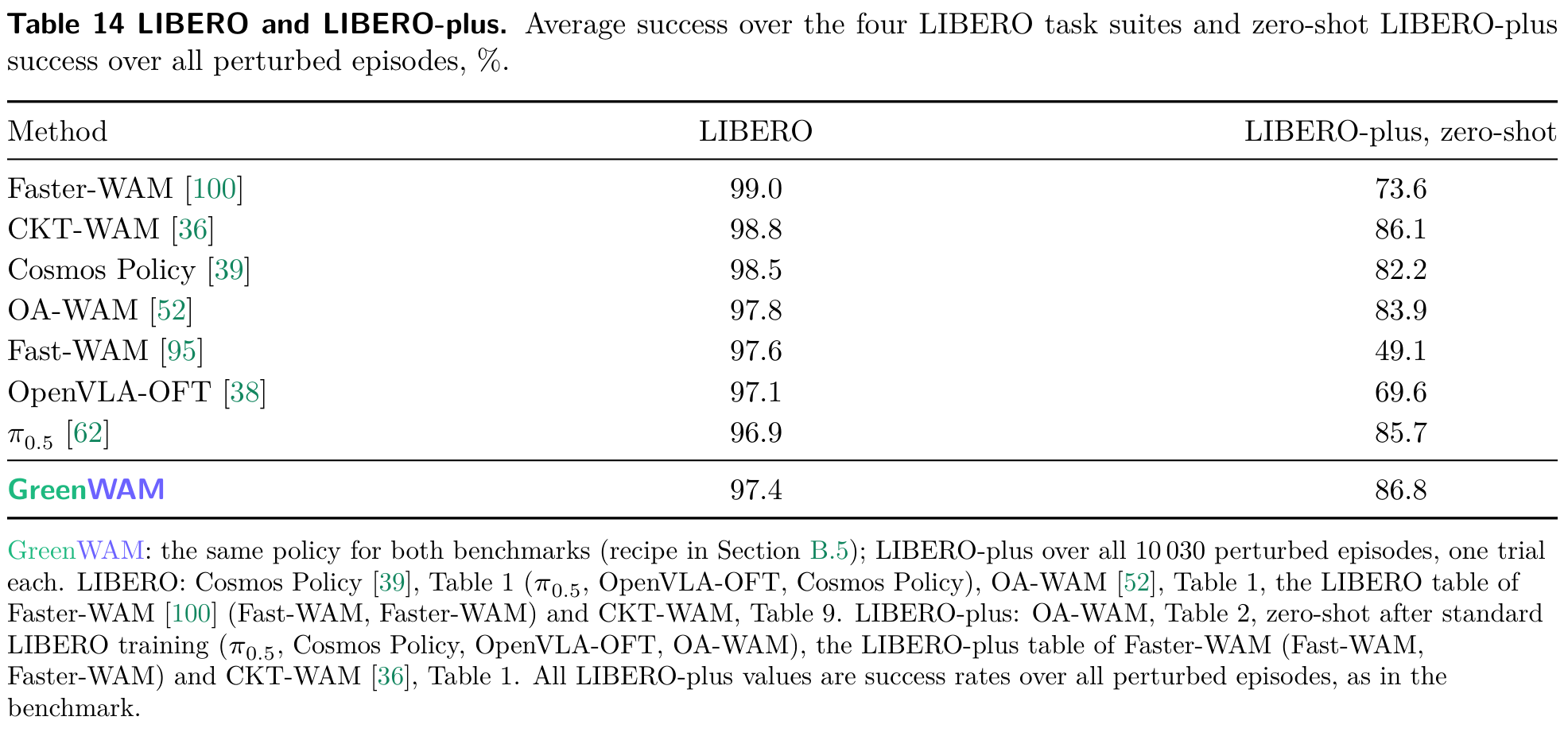
One LIBERO-adapted policy reaches 97.4% on the four standard suites and 86.8% on all 10,030 LIBERO-plus perturbed episodes, the highest zero-shot perturbation result in Table 14. “Zero-shot” means no LIBERO-plus training, not no LIBERO adaptation. The single-arm Franka is absent from the two-armed robotics corpus but uses the shared interface during adaptation. Success is strongest for lighting/noise/language; initial robot state remains hardest at 67.5%. Viewpoint changes yield 81.7%.
6.4 Distillation for Real-Time Control
Following Flash-WAM [4], a frozen teacher, online student and EMA target train a one-step joint video/action policy. Both modalities share a four-level noise schedule; teacher guidance applies to video, not actions. Separate consistency losses plus a small action flow-matching term keep predictions anchored to demonstrations.
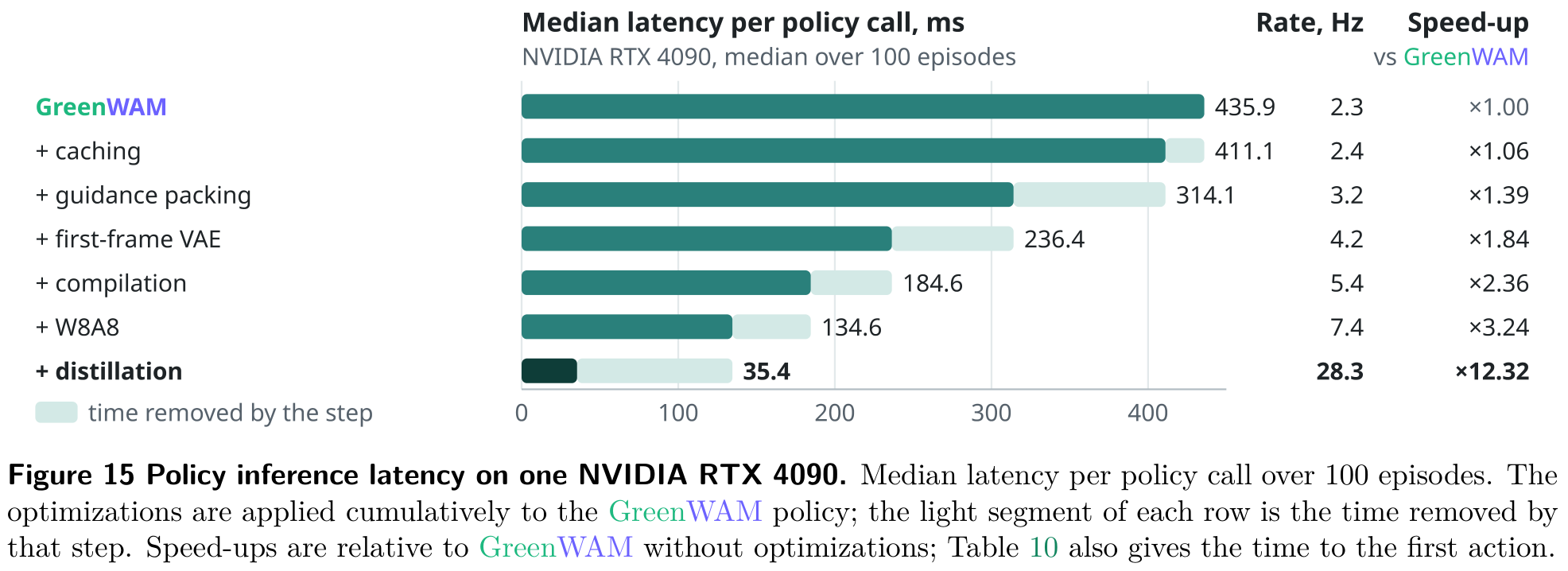
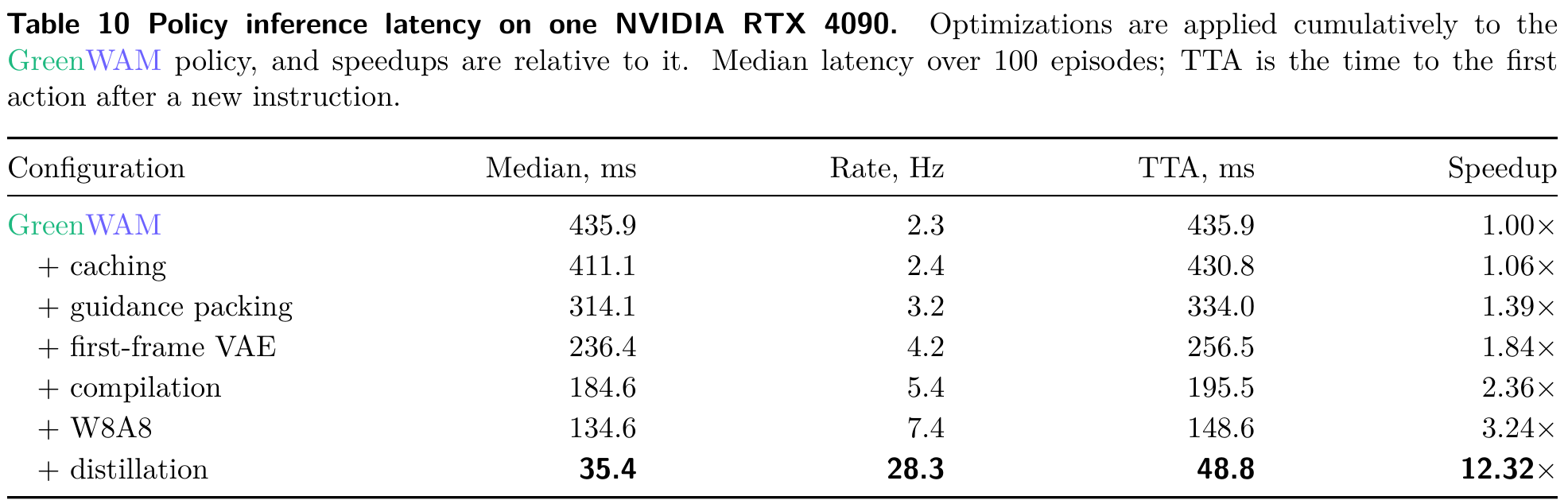
Caching, packed guidance, first-frame VAE encoding, compilation and W8A8 quantization reduce latency from 435.9 to 134.6 ms. Distillation then reaches 35.4 ms/28.3 Hz: 3.8× faster than that optimized teacher, or 12.3× faster than the unoptimized baseline. These are RTX 4090 measurements; onboard deployment remains future work. Faster inference comes with reduced humanoid instruction success.
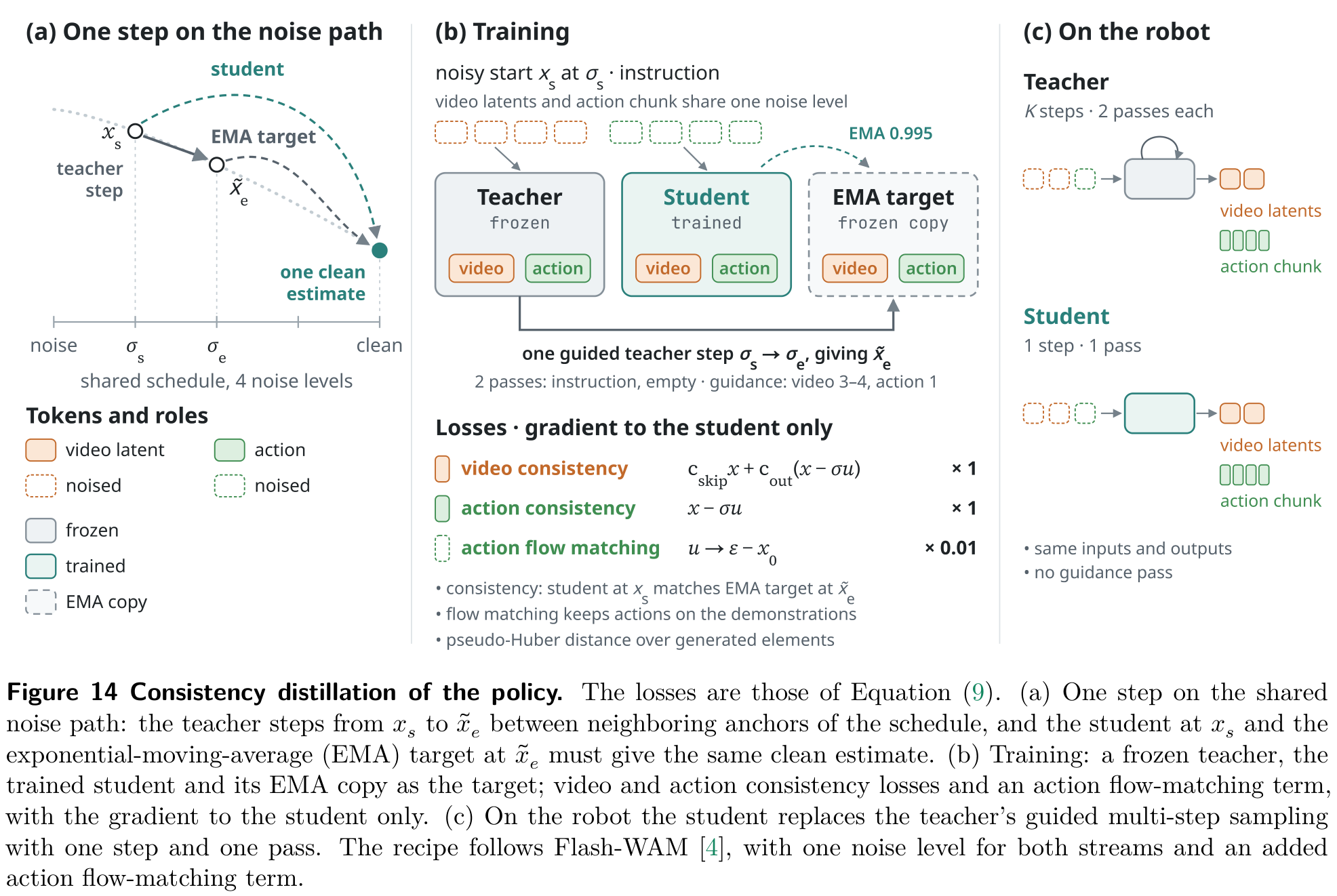
Equation 9

6.5 Real-World Humanoid Evaluation
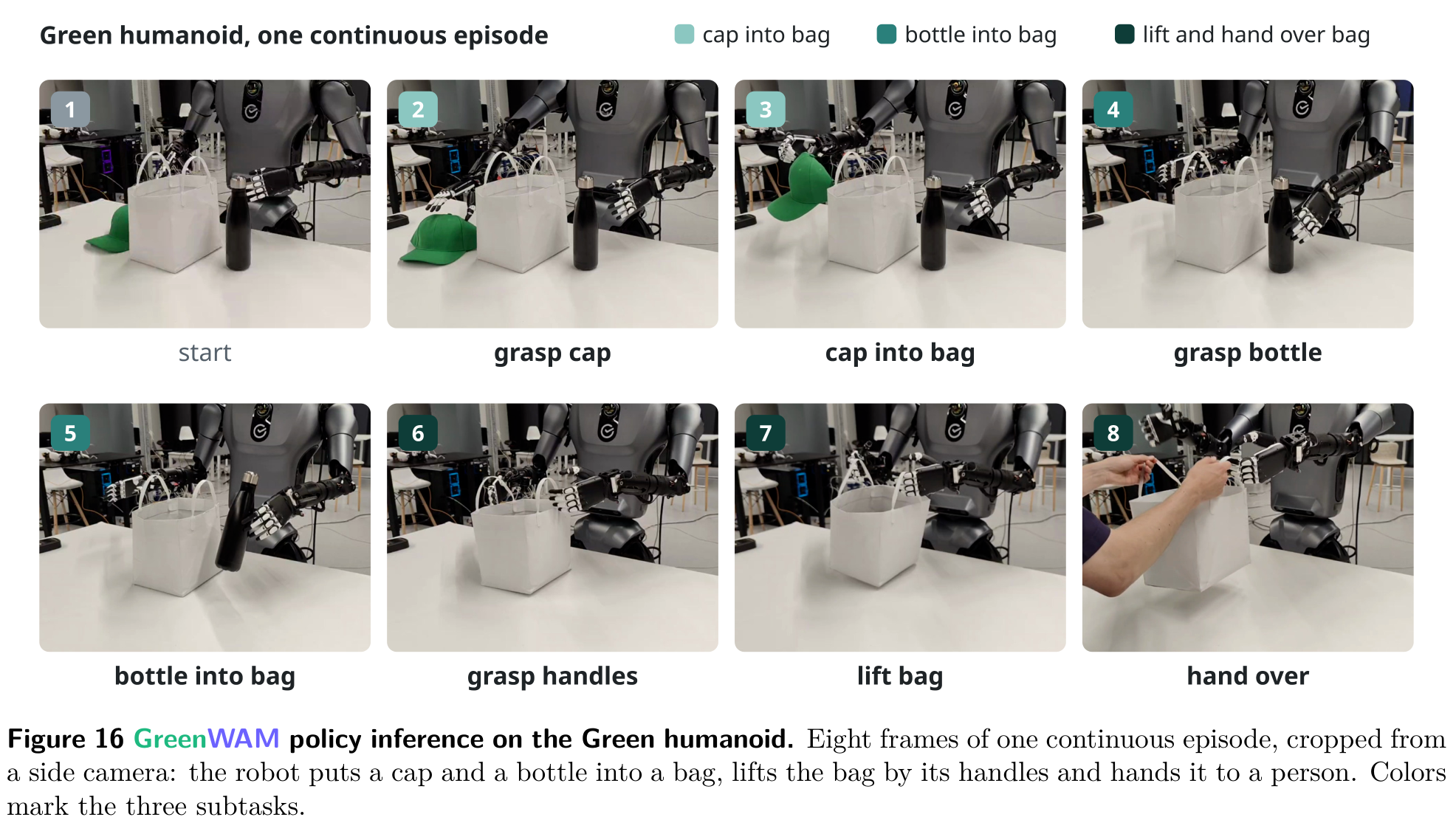
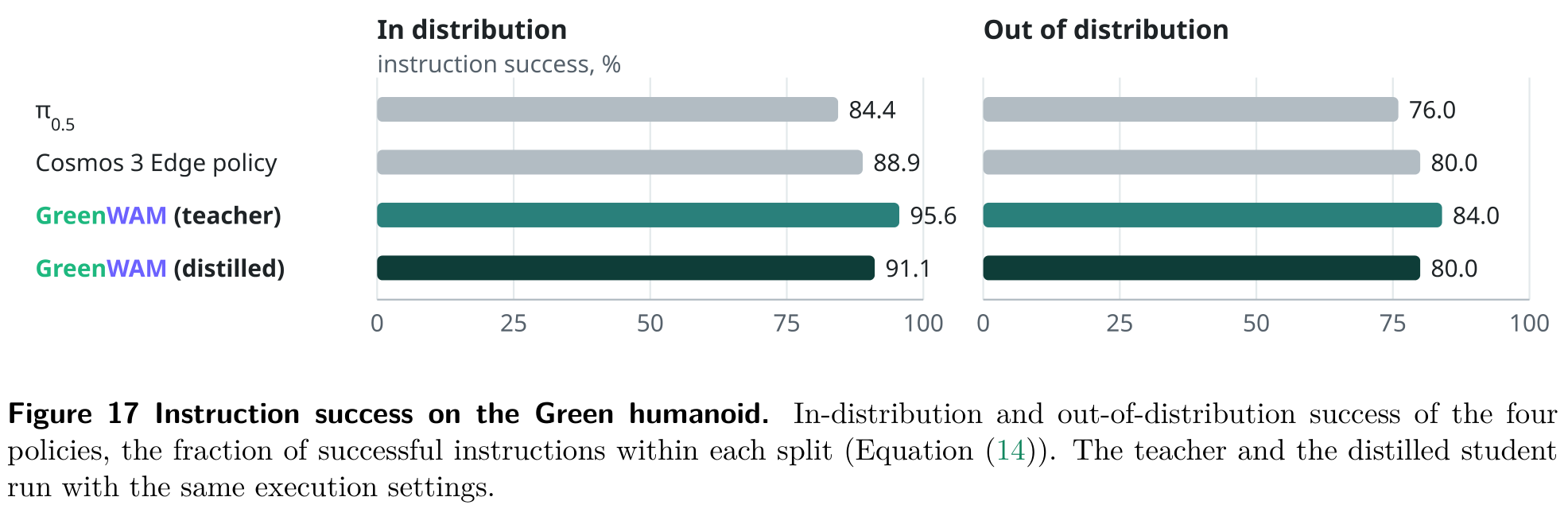
Four policies adapt on the same demonstration split for a Green humanoid packing task, with common cameras and controlled joints but model-specific preprocessing and action recipes. Five consecutive instructions grasp/place a cap and bottle and lift the bag, without scene resets between instructions. Each policy gets 45 ID and 25 OOD instructions across 14 configurations, one attempt each; OOD changes objects or scene conditions.
GreenWAM reaches 95.6% ID/84.0% OOD instruction success, versus Cosmos 3 Edge’s 88.9%/80.0% and π0.5’s 84.4%/76.0%. The distilled student reaches 91.1%/80.0%. These small, single-task results measure individual instructions rather than whole five-step task completion; the illustrative handover is not an extra evaluated instruction.
7 Empirical Analysis
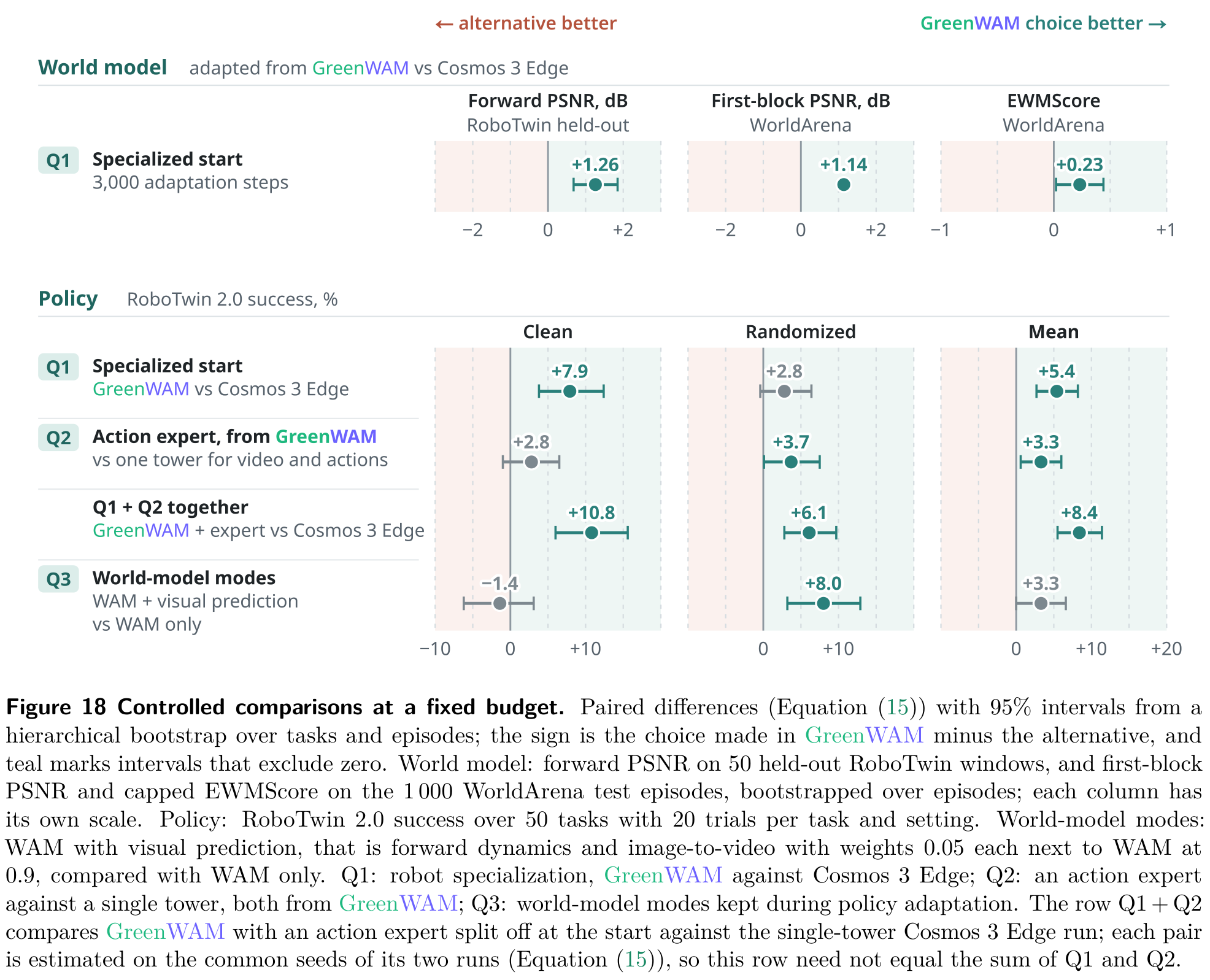
Paired comparisons hold downstream data, adaptation budget, sampler and evaluation seeds fixed. Robot specialization and expert comparisons train for 3,000 steps; retained-mode comparisons continue the same checkpoint for 2,500. Task/episode hierarchical bootstrap intervals quantify evaluation uncertainty for the chosen checkpoints, not variation across independent training runs.
7.1 What Robot Specialization Brings to Each Role
Compared with adapting Cosmos 3 Edge, the robot-specialized initialization improves WorldArena prediction: 87.1% of episodes are closer to the recording, PSNR rises about 1.1–1.2 dB, trajectory accuracy rises from 44.4 to 47.4 and depth accuracy from 96.65 to 97.12. Those fixed-budget values differ from the final adapted model’s scores. The parent must learn joint-space projections from scratch.
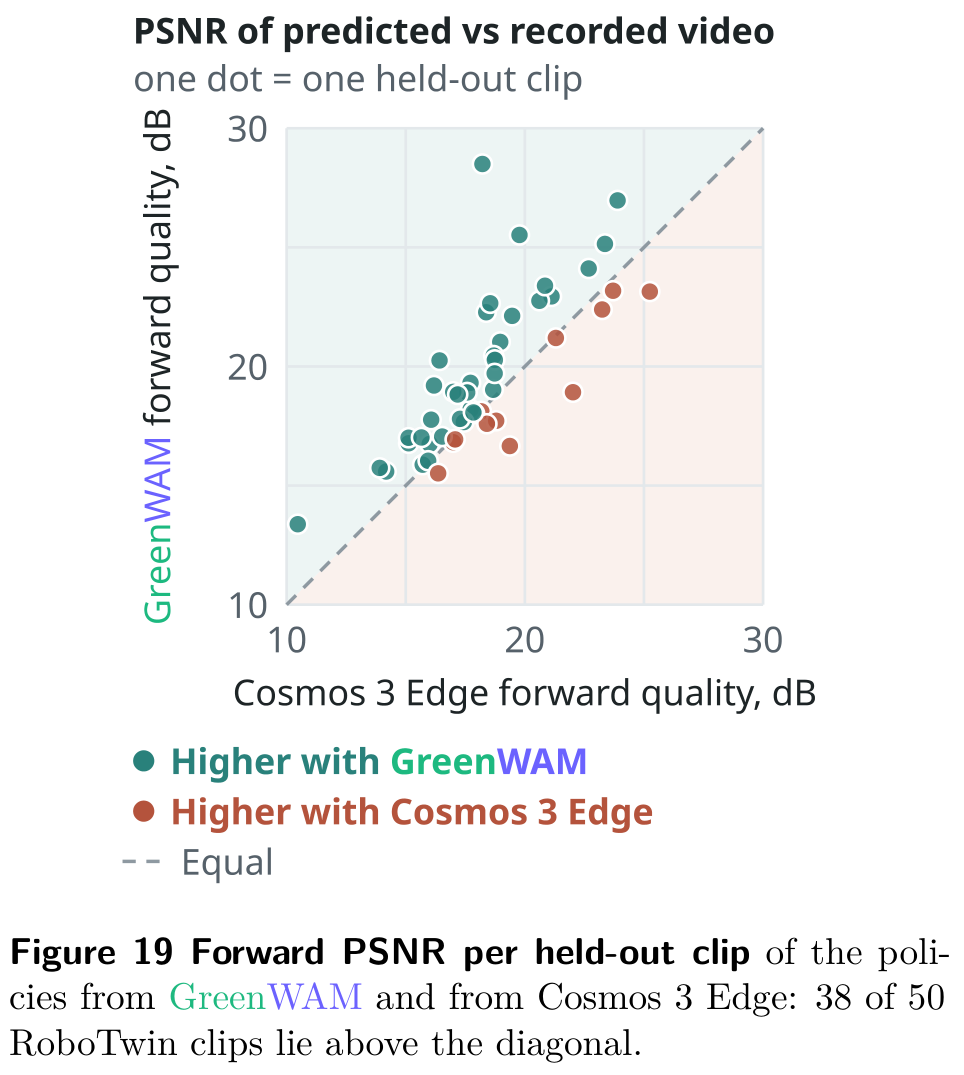
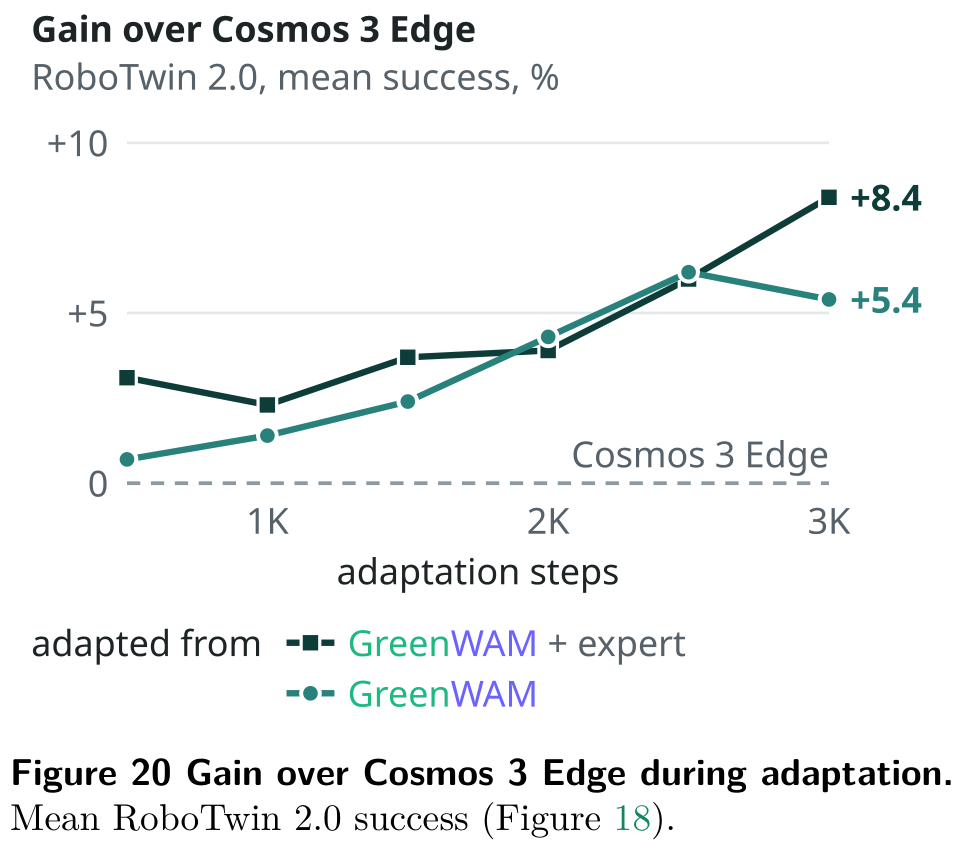
On RoboTwin, specialization raises mean policy success by 5.4 percentage points at 3,000 steps and improves prediction on 38/50 held-out clips. Adding the expert widens the mean advantage to 8.4 points. Similar final validation losses do not erase the closed-loop success gap; the extra robotics-stage cost is not matched in this comparison.
7.2 Coupling the World Model to Action
Copying an action expert at adaptation start improves mean success by 3.3 percentage points over the shared tower, with 2.8 clean/3.7 randomized points. Both start with identical predictions and nearly match final validation loss. The expert trades extra parameters and modest per-step cost for improved control.
7.3 Retaining World-Model Modes during Policy Adaptation
Continuing with 90% WAM, 5% forward dynamics and 5% image-to-video improves randomized success by 8.0 percentage points versus WAM alone, without a significant clean-scene change. Both variants already predict video in WAM; the gain concerns retaining separate world-model modes. It improves 31/50 randomized tasks and worsens nine.
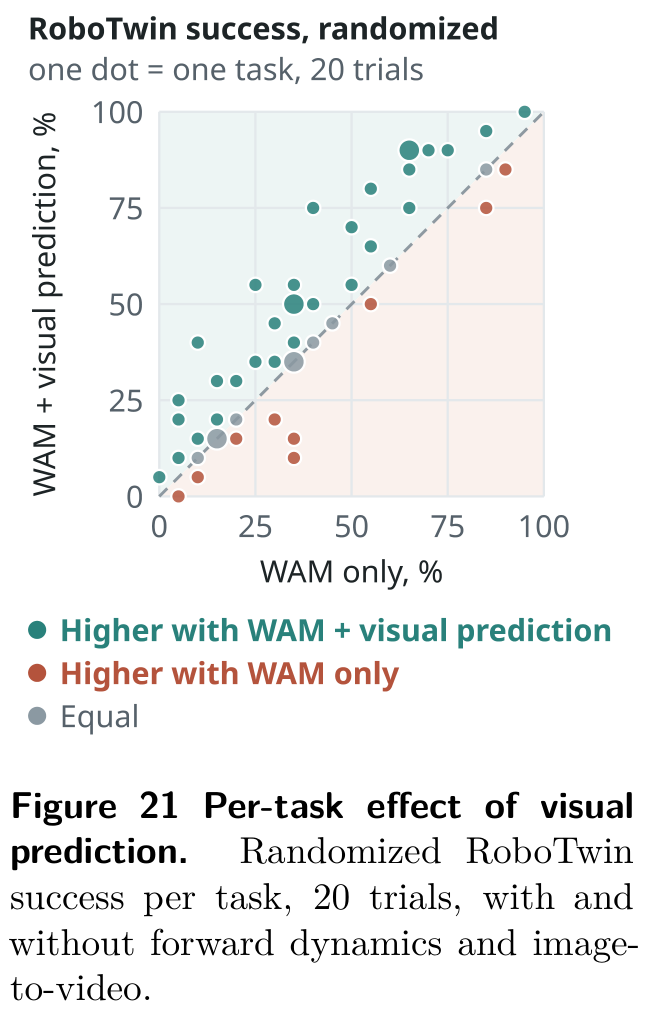
7.4 What the Policy Imagines
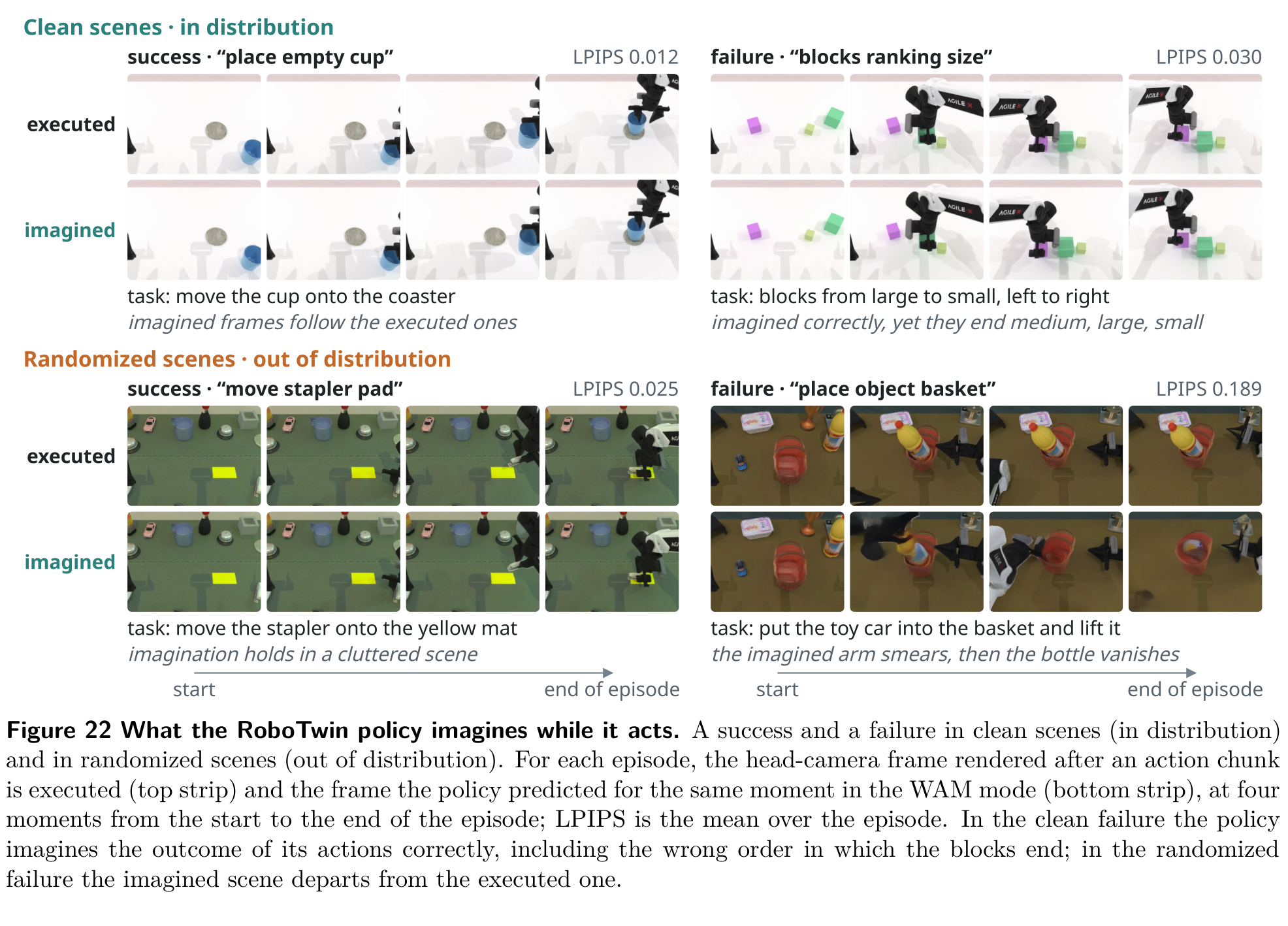
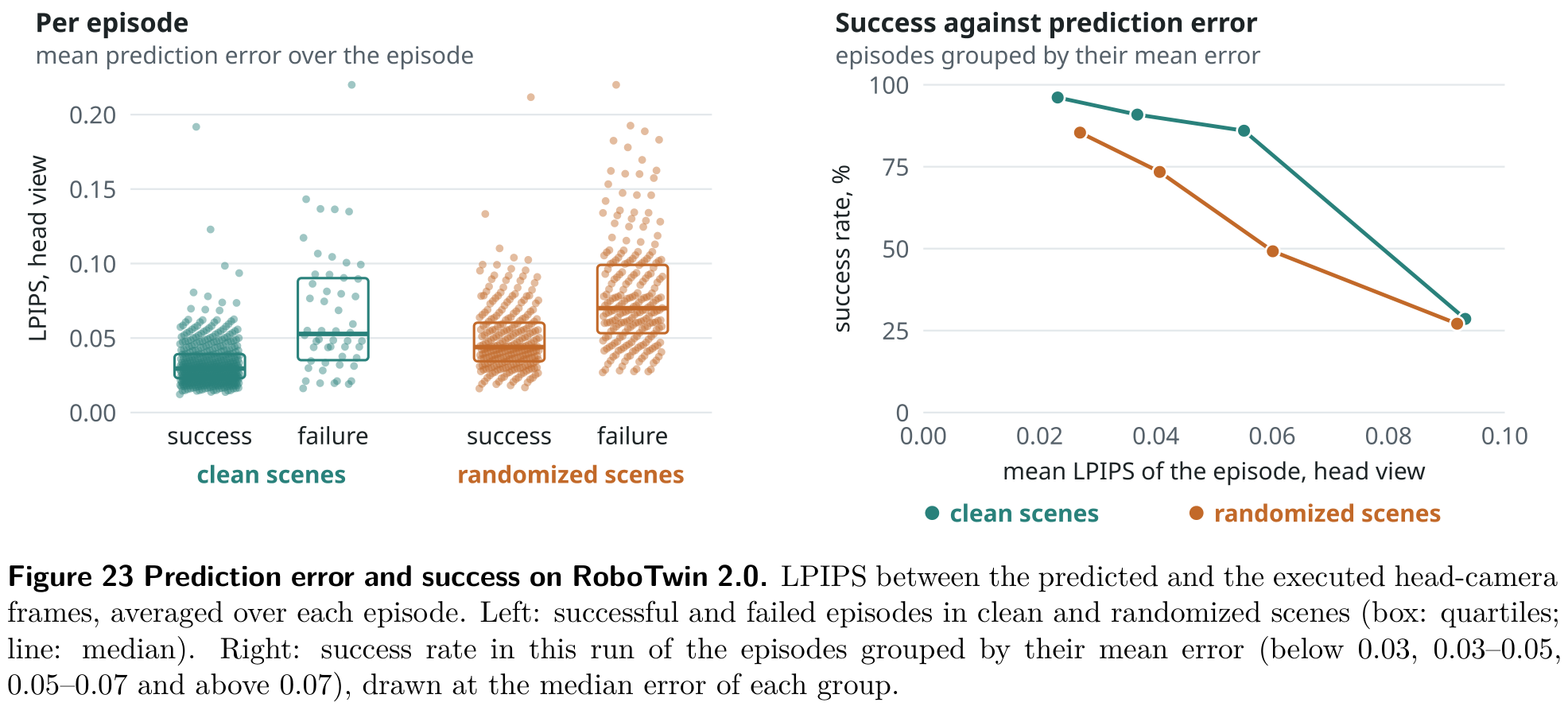
Decoded video predictions reveal different failure patterns. In clean scenes, a review finds 19/20 sampled failures accurately predict the wrong action’s outcome: knowing what will happen does not ensure choosing a successful action. Under randomization, 13/20 failures involve distorted prediction or mistaking distractors for targets. Randomized success falls from 85% to 27% across increasing prediction-error groups; early prediction accuracy also correlates with eventual success. These observations support, but do not independently establish causation for, the benefit of retained world-model training.
7.5 Robustness to Scene Randomization
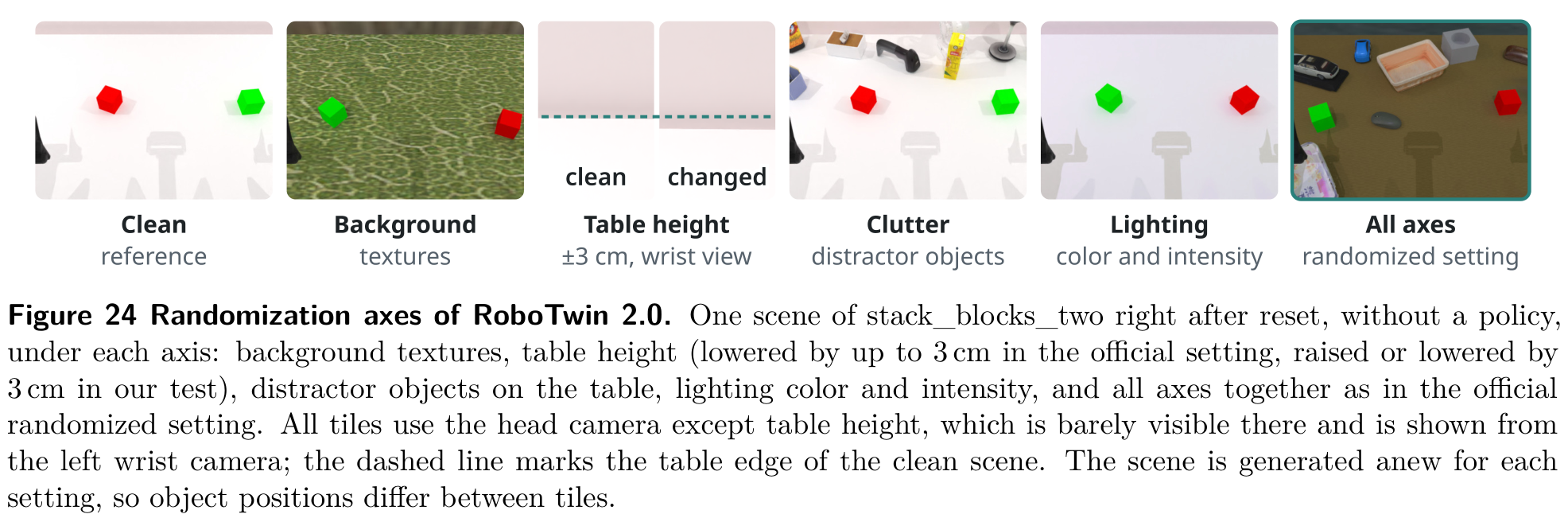
Single-axis tests on nonofficial seeds find background textures and table-height changes cause the largest drops, 12 and eight percentage points; distractors/lighting change success by under one point. Appearance augmentation cannot teach the different motions required by altered geometry. Small joint errors strongly reduce expert replay success, and replanning after eight rather than 16 steps lowers clean success by 14.8 points. Background replacement improves randomized success by 13.1 points in the selected paired comparison without changing clean success.
8 Discussion and Limitations
The evidence supports one foundation for multiple adapted prediction/control roles and a shared action interface across bodies. It does not demonstrate one universally deployed policy. Geometry shifts, initial-state changes and accumulating autoregressive errors remain weaknesses. Benchmark-specific post-training is required, and physical evaluation covers one humanoid and one packing task. Future work includes onboard distilled inference, bodies unseen by both parent and robotics stages, motion-level augmentation, and reliable imagined-rollout policy evaluation.
9 Conclusion
Shared anatomical coordinates, robot-specialized joint prediction, a copied action expert and retained world-model modes form the proposed recipe. Released benchmark weights and evaluation code support replication. Strong selected benchmark results coexist with unresolved geometry robustness, physical evaluation breadth and long-horizon reliability.
A Data Inventory and Anatomical Mappings
A.1 Family and Source Inventory
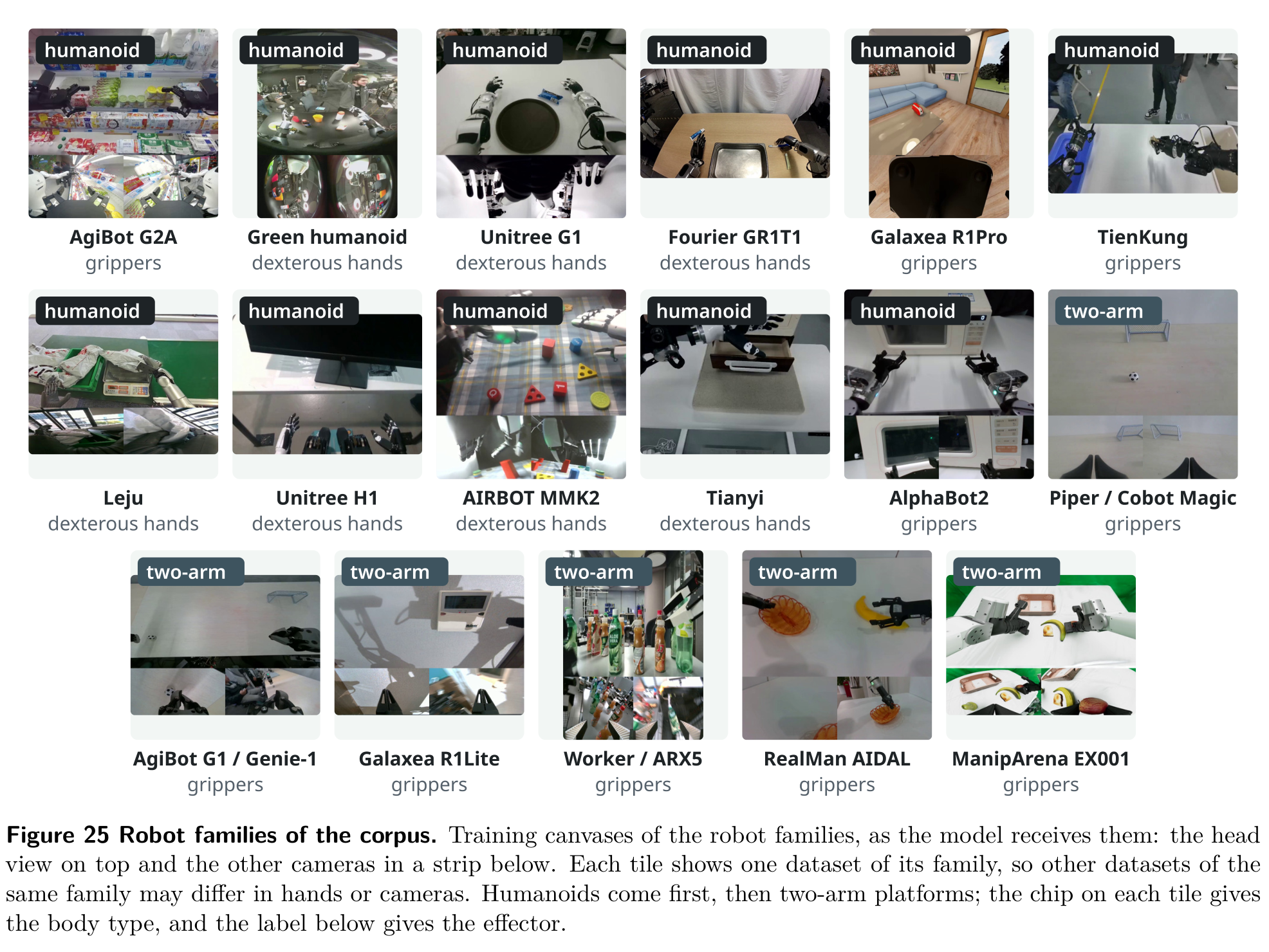
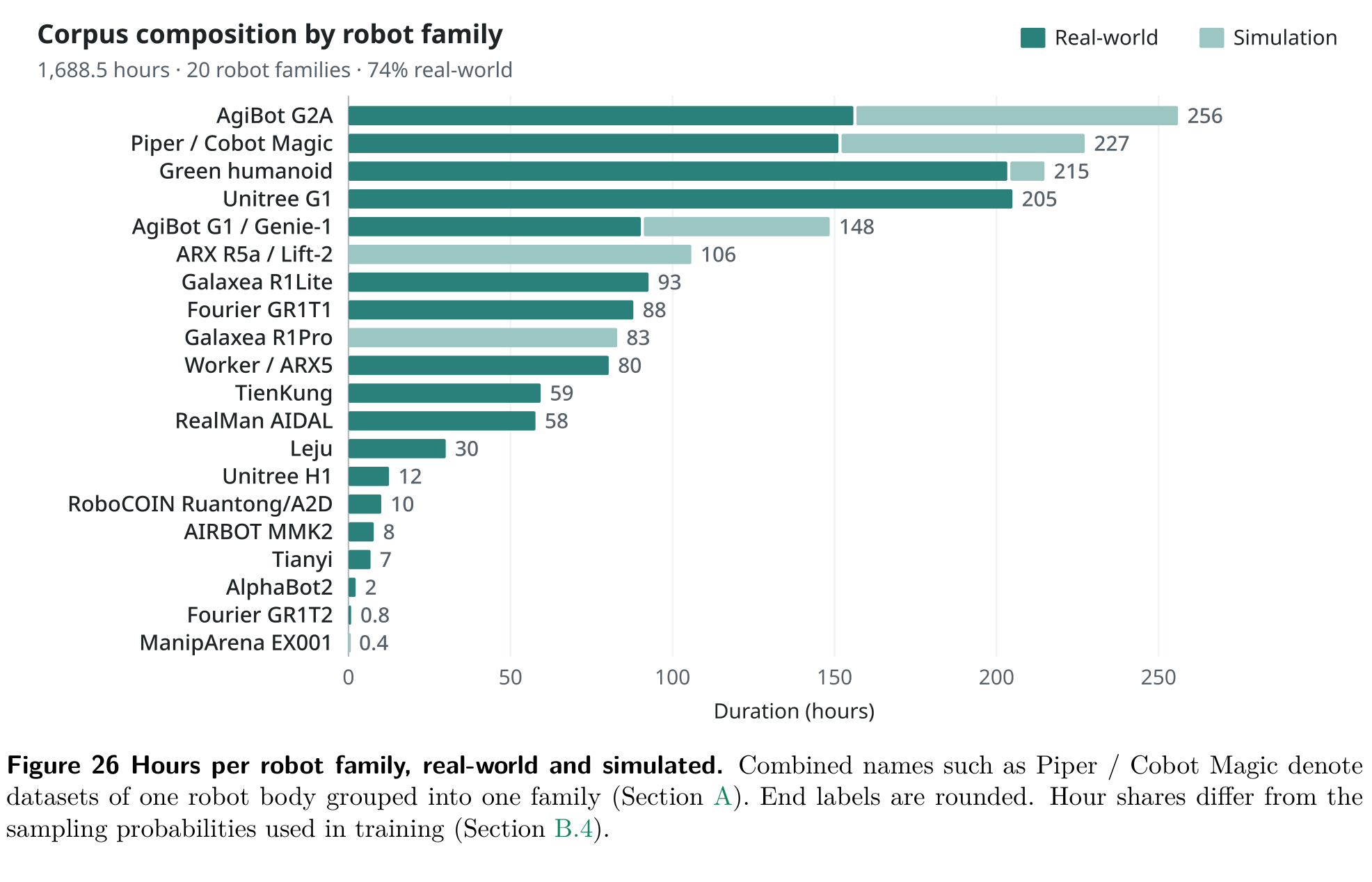
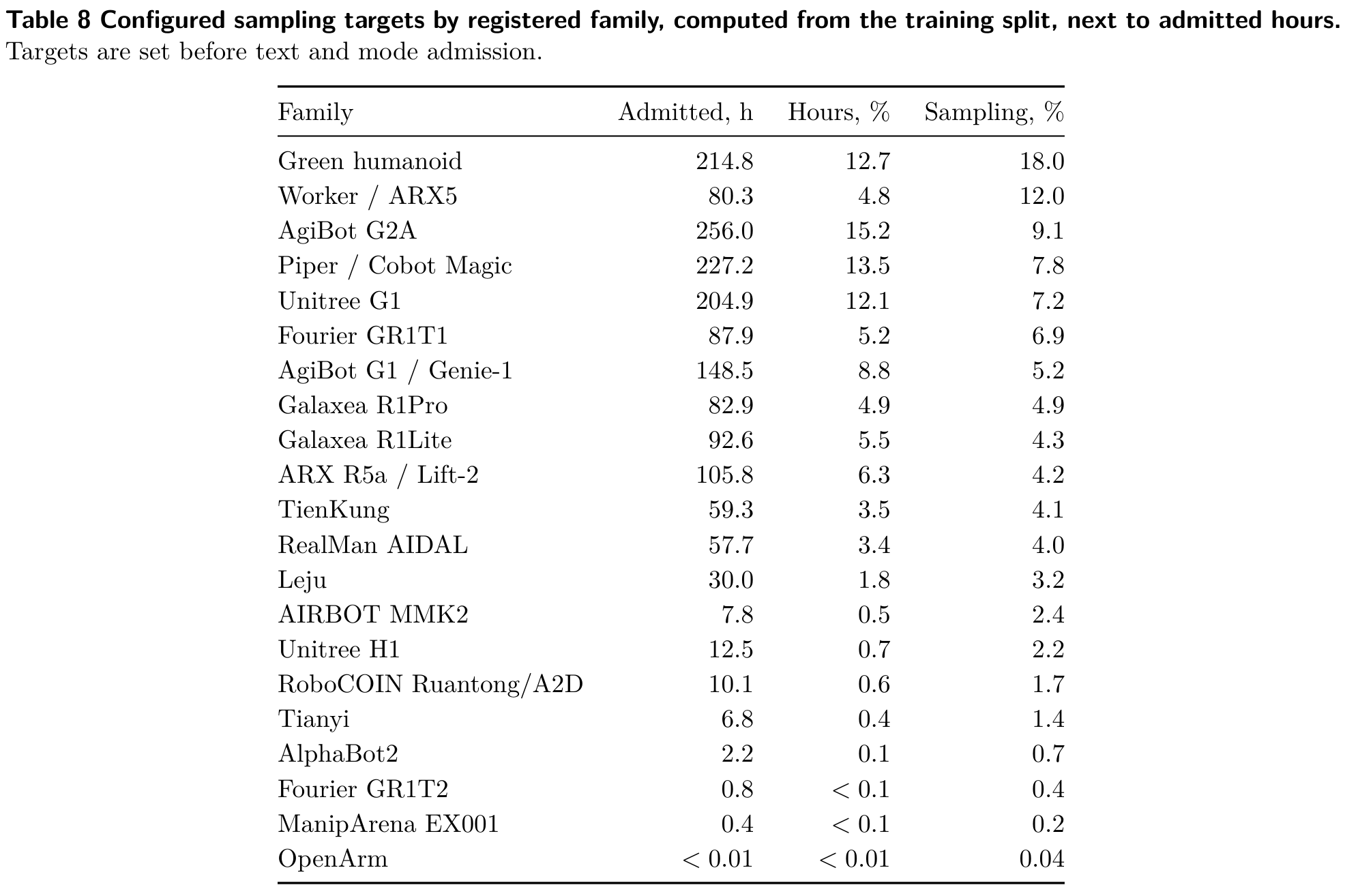
The 1,217-dataset inventory groups variant layouts into 20 main robot families: twelve Unitree G1 layouts share a family, as do real/simulated Green and the two Worker datasets. The largest admitted contributions are AgiBot G2A 256.0 h, Piper/Cobot Magic 227.2 h, Green 214.8 h, Unitree G1 204.9 h and AgiBot G1/Genie-1 148.5 h. Figures 25–26 retain the full family canvases and volume breakdown.
A.2 Corpus Admission and Quality Filtering
Admission requires a head/ego video above 10 FPS and at least 448 pixels on its short side. Annotated subtasks remain whole; ambiguous boundaries and clips above the duration/resolution limit are rejected. Quality gates detect idle intervals, repeated runs, cuts and decoding failures. Failed/recovery demonstrations remain valid physical data. Episode-level splitting yields about 1.40 million training and 28.6 thousand held-out atoms before text exclusions. Missing accepted captions/commands disqualify text-dependent modes rather than trigger a native-instruction fallback.
Equation 10

A.3 Anatomical Mappings
Forty-three source layouts map documented channels to anatomical roles using URDF/manufacturer information and measured trajectories; major mappings are checked with forward kinematics. Uncertain channels stay masked. Post-training layouts extend the codecs, while shared projectors retain their form. RoboTwin reuses the Worker/ARX5 correspondence, with reported path errors of 5.2/7.1 mm; CALVIN’s Franka uses Cartesian slots. Training-only statistics distinguish absolute/offset encodings, and WAM normalization uses successful demonstrations.
B Training and Adaptation Recipes
B.1 Robotics Training Recipe
The robotics recipe uses the parent’s shifted flow-noise schedule, mode-homogeneous microbatches of four, and square-root batch scaling from a 2×10⁻⁵ learning rate at batch 128. Newly initialized action projections and modality embeddings use five times the base rate. Figure 28 and Table 5 retain all mode losses, optimizer settings, noise scheduling and checkpoint details.
B.2 Temporal Sampling and Prediction Targets
Native timestamps are preserved while video rate is capped at 30 FPS; states follow the same selected grid, without rescaling positions. Five canvas buckets preserve view proportions. Whole-subtask modes avoid truncated actions; autoregressive blocks cover up to 30 seconds of future video. Equation 11 fixes four historical anchors, all before the target block. WAM predicts about 1.07 seconds inside positively labeled successful subtasks, keeping the enclosing command and adding no action targets through video padding.
Equation 11

B.3 Structured Captions and Commands
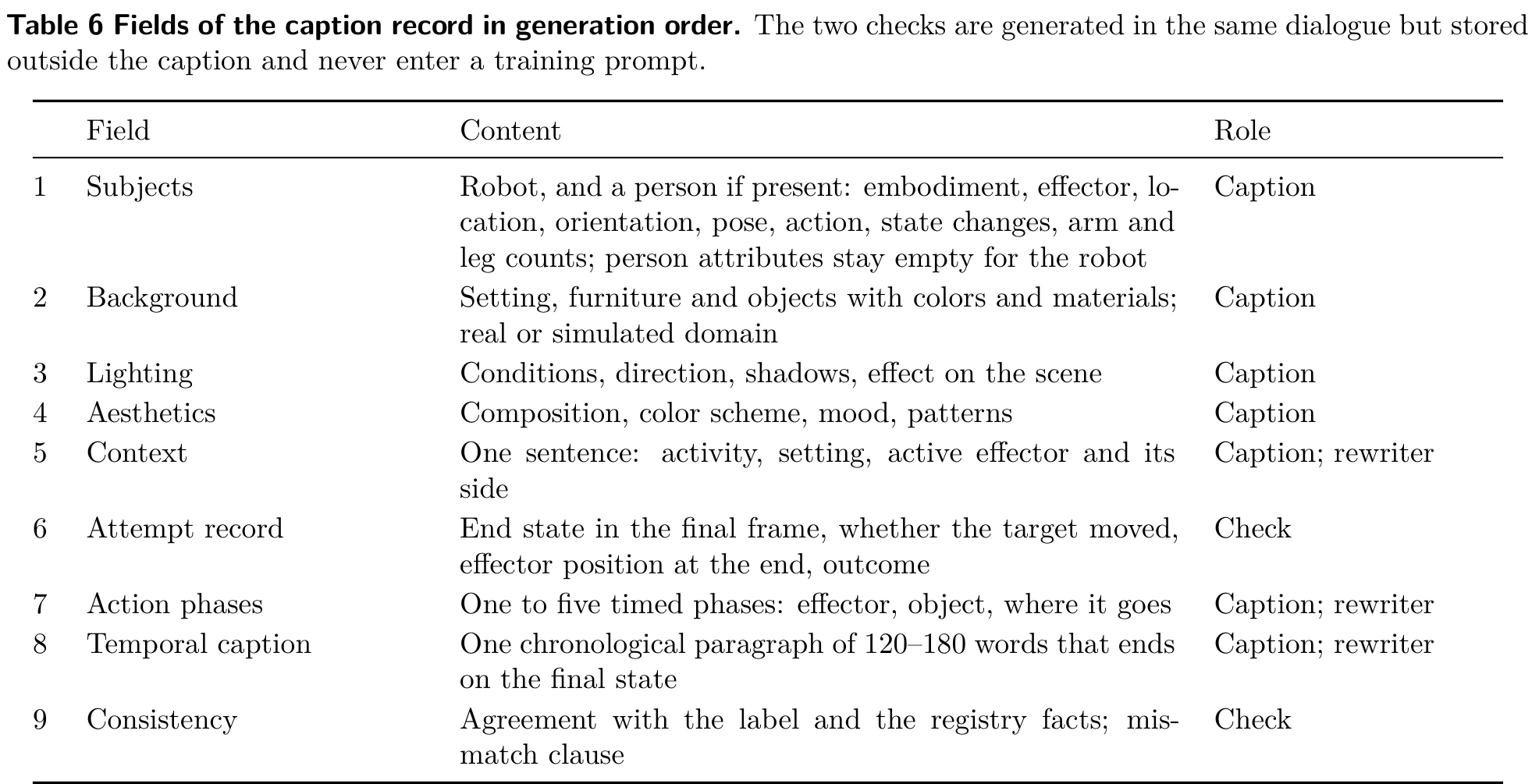
The captioner receives video, duration, source goal and registered embodiment/effector/domain facts. Nine fields are generated in one dialogue; attempt and consistency checks are withheld from training prompts. Content gates enforce consistent object names, ordered phases, supported contact claims and actual completion. A field can be rewritten twice and an atom retried four times. A second pass turns every accepted phase into an ordered command without truncation. Tables 6–7 preserve the full schema and worked example, including the difference between the original label and derived instruction.
B.4 Training Mixture
Sampling first selects mode and cluster, then dataset, subtask and window. Worker/ARX5 receives 12%, Green 18%, and the remaining configured clusters share 70% proportional to the square root of eligible unique-subtask counts. A maximum-entropy joint table preserves both mode and cluster marginals subject to support. Dataset selection likewise uses square-root counts. Extra windows or joint/EEF alternatives do not increase an atom’s probability. Table 8 preserves exact configured shares; small datasets repeat more than their hour totals alone would imply.
Equations 12–13


B.5 Policy Adaptation Recipes
RoboTwin adaptation uses 2,500 clean demonstrations, physically correct 16.67 Hz timing, dense eligible windows and the 0.9/0.05/0.05 mode mixture. It predicts/executes 16 steps with eight denoising steps. WorldArena adaptation runs 10,000 steps on clean RoboTwin video using forward dynamics with history and no text. LIBERO adds appearance/perspective augmentation and paraphrases, then evaluates the same policy on LIBERO-plus without its training episodes.
RoboDojo uses its official data, stream-restricted attention, 60,000 steps and 20% image-to-video examples. CALVIN uses ABC only, predicts 20 steps with four UniPC steps and executes ten. Humanoid policies share the demonstration split but retain their own preprocessing/action recipes. Student consistency uses masked pseudo-Huber losses with weights 1/1/0.01 and EMA decay 0.995. Validation selects checkpoints/settings; neither ID test episodes nor OOD trials enter selection.
C Evaluation Protocols
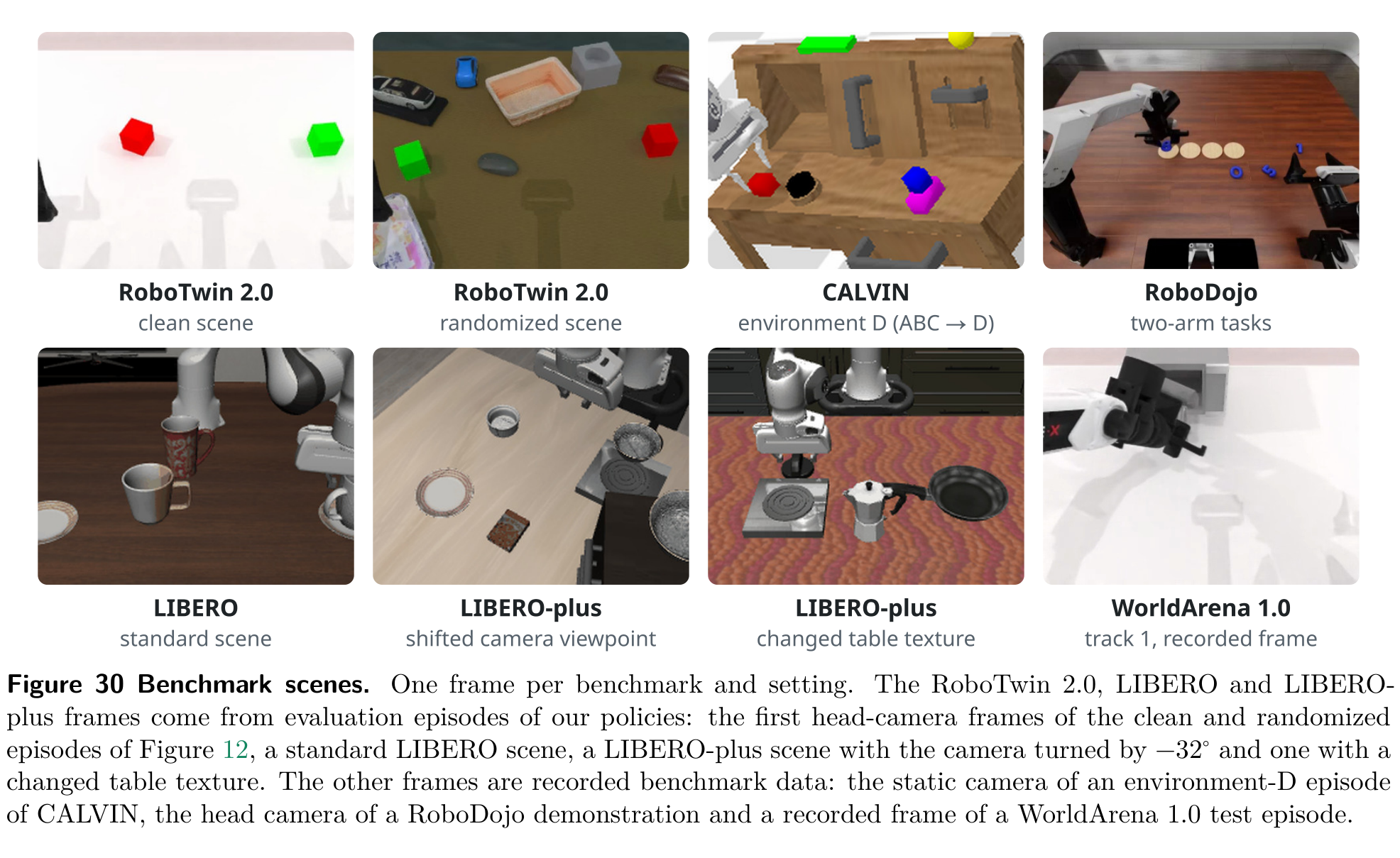
The following protocols distinguish prediction, simulated control, physical instruction success and inference latency. Figure 30 shows the evaluation settings.
C.1 Public Benchmarks
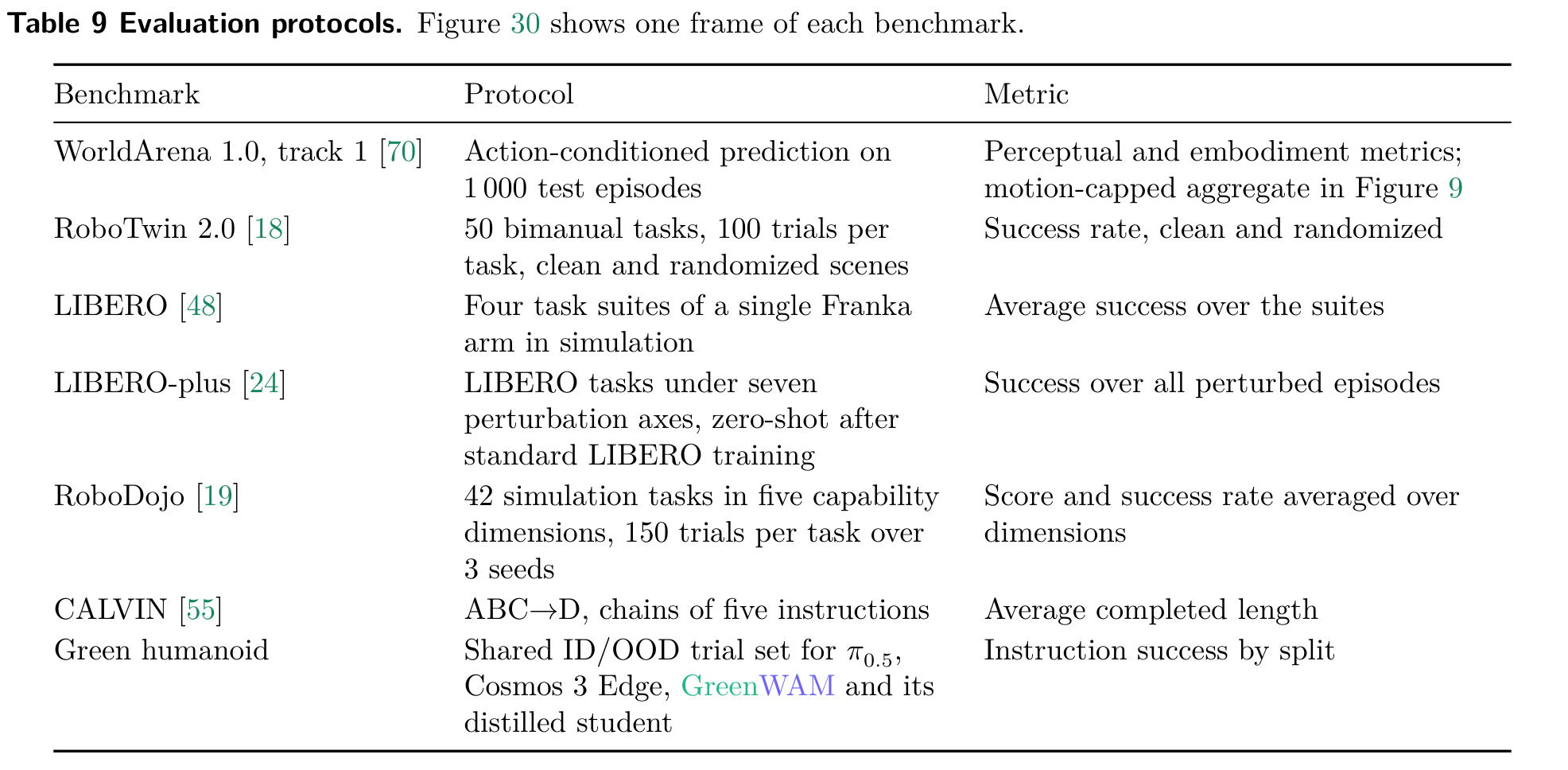
RoboTwin evaluates 50 tasks with 100 trials per task in both clean and randomized scenes. WorldArena uses all 1,000 track-1 episodes and reports an author-recomputed motion-capped score, not its official leaderboard aggregate. Competitor mean-based caps are upper bounds; selected figures omit BLM, WorldScape v0.2, GigaWorld-1, GE-Sim 2.0 and SisyphusWorld. Appearance/judge metrics sometimes score generated videos above recordings and correlate weakly with trajectory accuracy.
RoboDojo averages across five dimensions, with 150 trials per task across three seeds. LIBERO averages four suites; LIBERO-plus uses one trial per perturbed episode after standard-only training. CALVIN reports 1,000 five-instruction chains in D, excluding all D data from training.
C.2 Real-Humanoid Comparison Protocol
Each humanoid policy receives the same 14 scene configurations, split into nine ID and five OOD, with five consecutive instructions each. Every instruction is attempted once. Success requires completion before timeout without human assistance; failures, policy-induced stops and timeouts count as failures. Scores are separately normalized over 45 ID and 25 OOD instructions.
Equation 14

C.3 Latency Benchmark
Latency is measured on one RTX 4090 with FlashAttention-2, over 100 episodes. Requests condition on a fixed observation/state and 128-token instruction; three latent frames comprise one conditioning frame and two generated frames. Median steady-state latency reuses instruction caches; first-action latency includes cache construction. Table 10 reports cumulative optimizations. The distilled policy reaches 35.4 ms steady state and 48.8 ms after a new instruction; these measurements isolate model inference rather than full robot-loop latency.
C.4 Paired Comparisons
Paired outcomes are averaged over episodes within tasks, then over tasks. A hierarchical bootstrap resamples tasks and paired episodes 5,000 times; the central 95% interval reflects evaluation uncertainty of the two fixed checkpoints. It does not capture training-run variability. Forward prediction substitutes per-clip PSNR for binary success.
Equation 15

C.5 Evaluation Details
Empty-prompt WorldArena inference omits ineffective classifier-free guidance. CALVIN test instructions stay outside paraphrase pools. RoboTwin final results use 100 trials per task/setting; controlled comparisons share seeds.
D Additional Results and Qualitative Examples
D.1 Benchmark Tables
Tables 11–14 preserve the complete selected WorldArena, CALVIN, RoboDojo and LIBERO comparisons with their provenance. They distinguish best individual axes from overall ranking and standard LIBERO performance from zero-shot perturbation robustness.
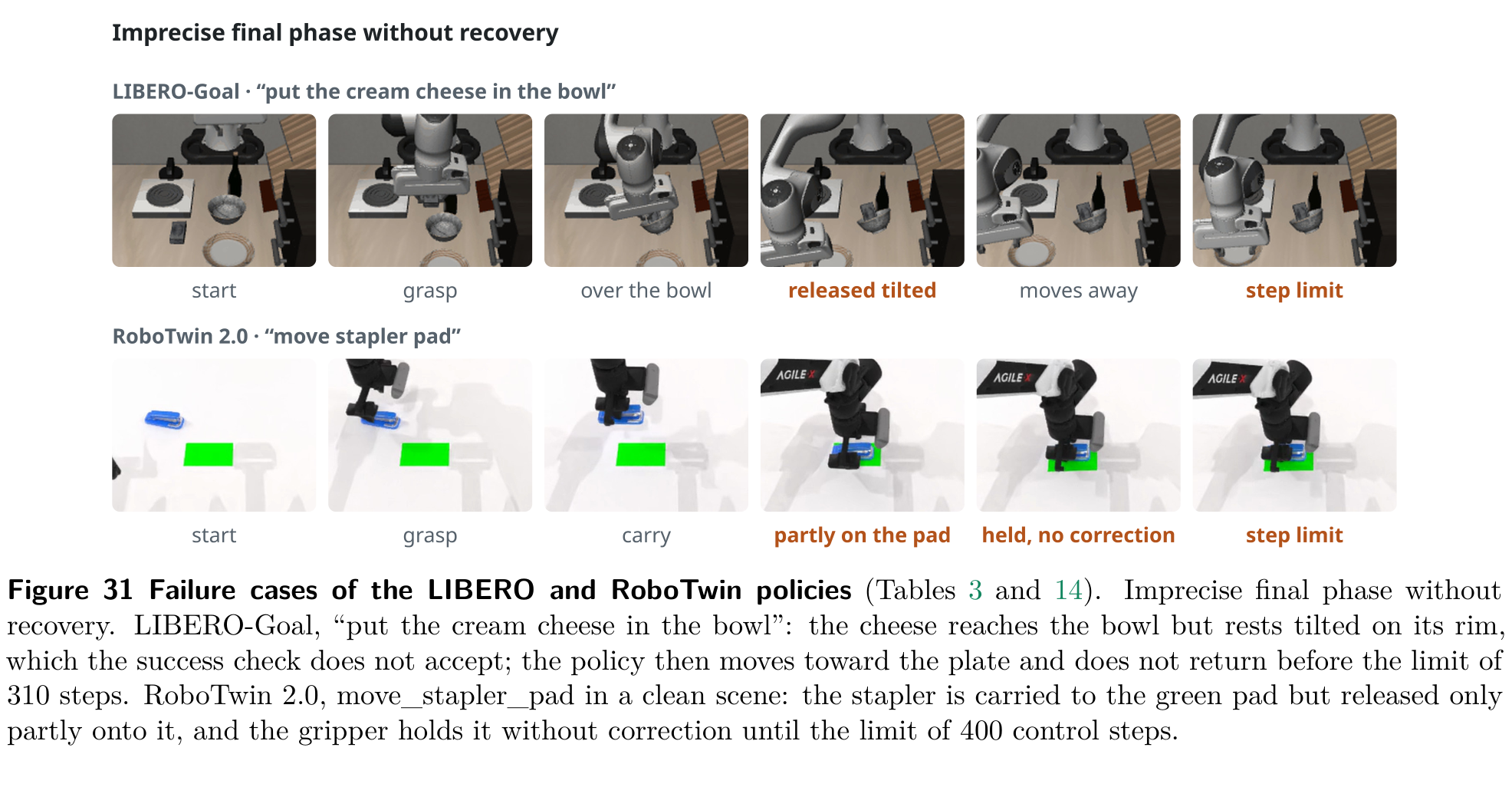
D.2 Failure Cases
The two illustrated failures reach the target but miss precise final placement: cheese rests tilted on a bowl rim; a stapler is released only partly onto its pad. Neither policy corrects the error before the step limit, exposing placement and recovery weaknesses.