Overview
This edition follows the complete 17-page v1, retaining all ten numbered figures, eleven tables, four displayed equation blocks and 45 references. Figures 6 and 7 share an HTML container in the source; they are separated here so both original captions and all panels remain visible.
At a glance
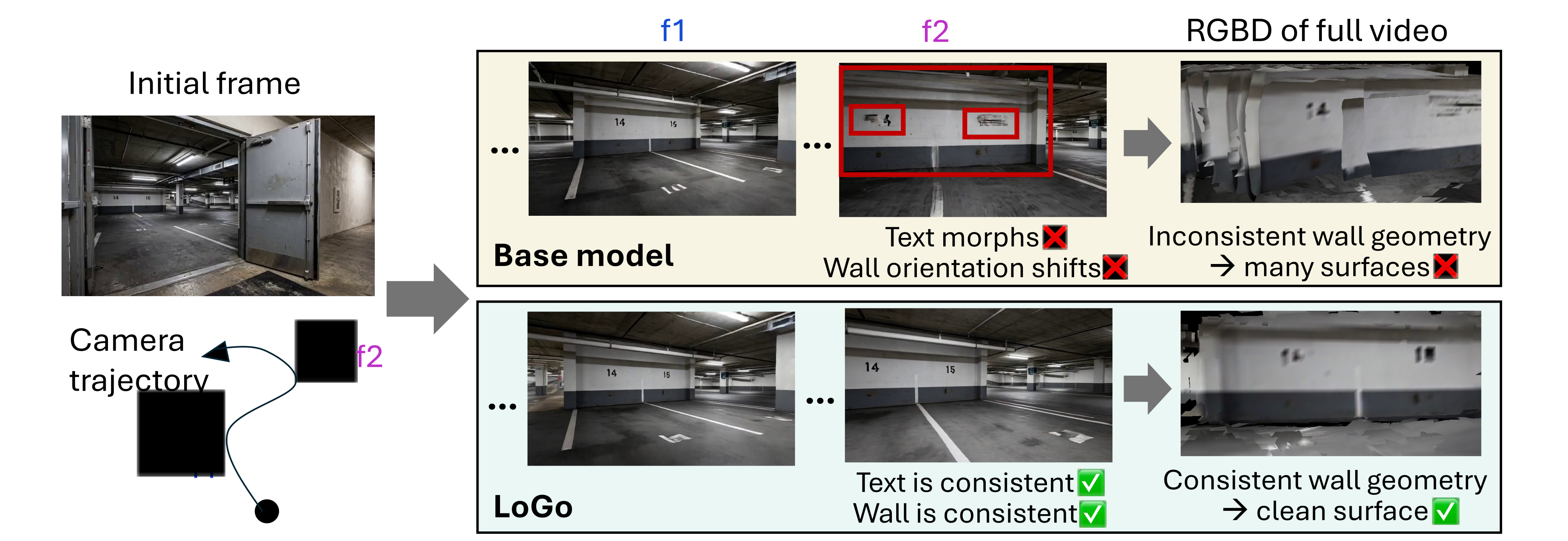
LoGo post-trains camera-controlled video generators with a combination of voxel-localized and whole-video geometry rewards. Local feedback gives individual scene regions their own training weight; global feedback and interleaved aesthetic/camera rewards counter the quality losses observed with local geometry alone.
The experiments span three 14B generators, two benchmarks and three optimization methods. The main evidence is improved reconstruction-based consistency on static scenes. Very long videos, dynamic worlds and uniform gains across every camera or quality metric are not established.
1 Introduction
A stable generated world needs both a persistent scene layout and objects that retain their geometry and appearance when revisited. Longer paths expose local hallucinations, disappearing objects and structural changes that a whole-video average can dilute. LoGo tests whether assigning feedback to 3D regions improves this credit assignment.
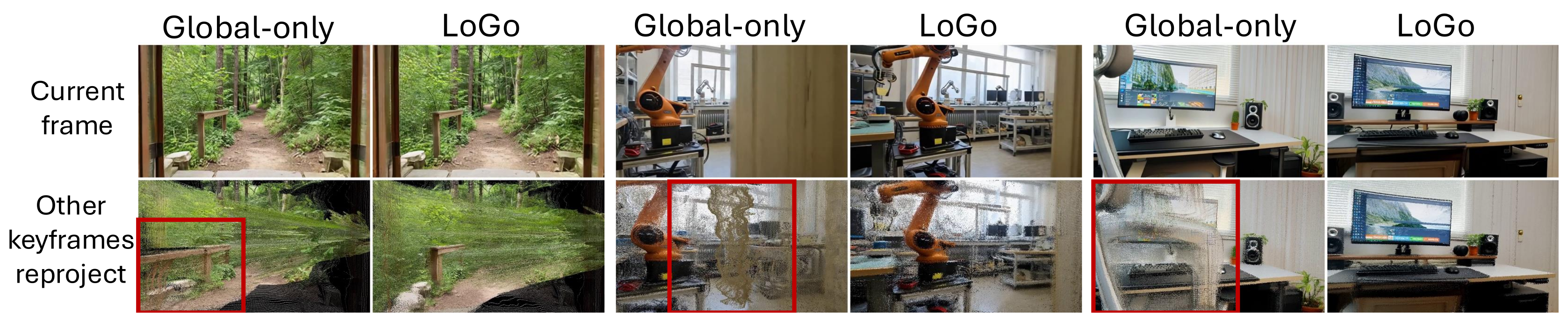
The scalar-reward failure in Figure 2 is an empirical limitation of the tested global average, not a theorem that every possible scalar objective cannot penalize a local error. The contribution is a practical local/global weighting recipe and a benchmark with longer, more varied camera paths.

2 Related Work
Earlier geometry-based post-training uses epipolar consistency, depth reprojection or Gaussian reconstruction. Architectural geometry, memory and joint geometry/video modeling offer complementary approaches. Many prior reward experiments concern short, 80-frame generators.
Spatial reward or loss masking also appears in image editing and robotic video generation. LoGo focuses on matching training credit to persistent 3D regions over longer trajectories. Camera-following or action-reversal objectives address related properties but do not by themselves establish scene consistency.
3 Method
The method has three components: aggregate reconstruction errors in voxels, blend normalized local and global feedback, and alternate geometry updates with aesthetic and camera updates. The recipe changes post-training supervision rather than adding a new persistent world representation to the generator.
3.1 Reward localization in 3D
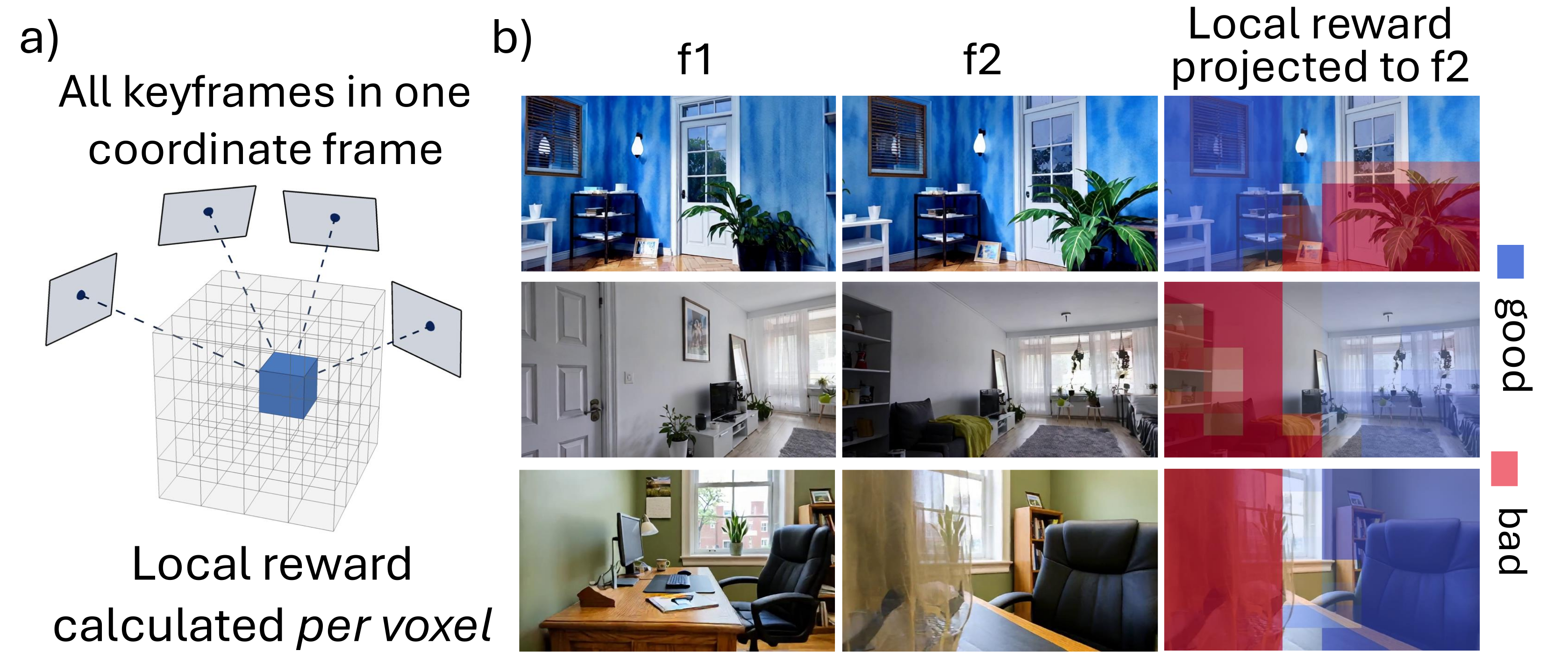
Keyframes pass through VGGT to estimate depth and camera geometry. Pixels are unprojected into a common scene cloud and grouped into voxels. Equation 1 averages a weighted squared RGB reprojection error and an absolute depth reprojection error over the pixels assigned to each voxel. The depth term is absolute, not squared.
The default voxel edge length is 0.1 times the scene-depth 90th percentile. A 240-frame video yields about 3,000 voxels per scene and 200 points per voxel at the reported medians. Optional cross-voxel normalization is mentioned for small rollout groups. The predicted geometry and correspondence quality limit the reliability of this local feedback.
The heatmaps highlight changing plant appearance, a newly appearing bookshelf and a local artifact. These examples show where the estimated reward places credit; they do not independently prove that the reconstruction has recovered the true scene.
Equation 1
| (1) |
3.2 LoGo: Blending local and global reward
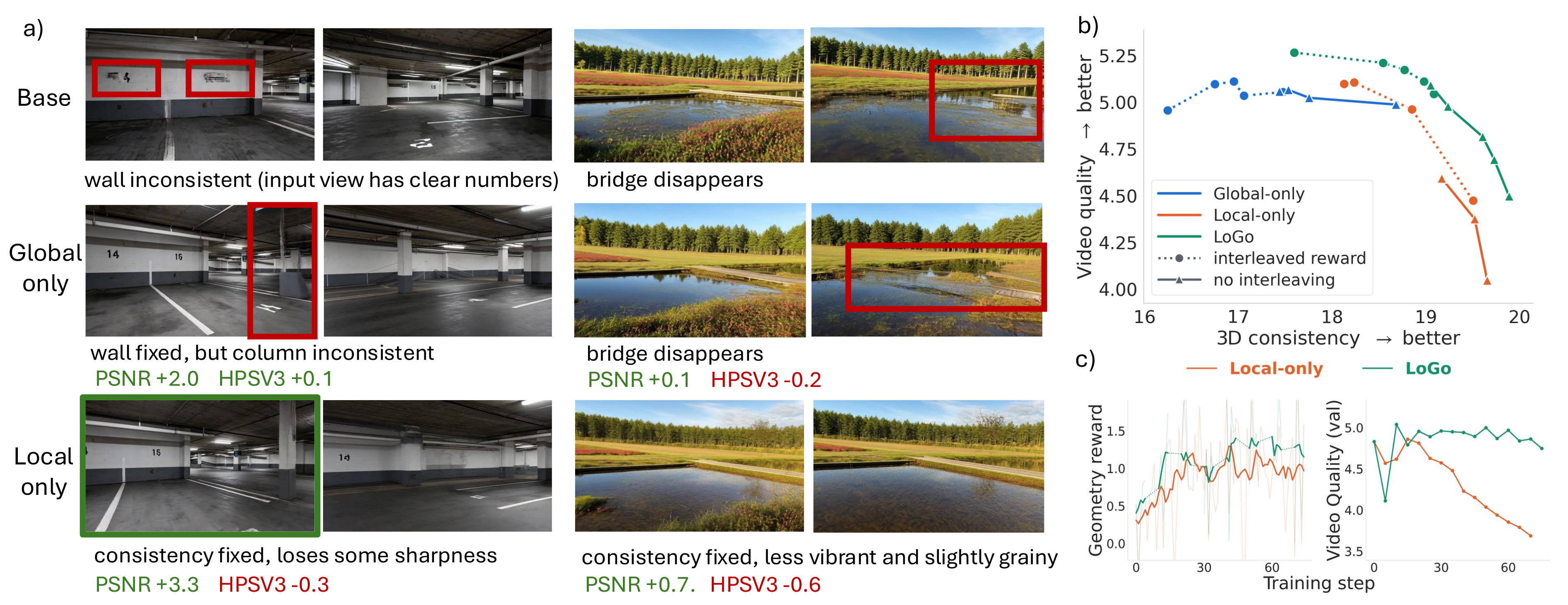
Local-only training improves measured consistency but can produce blur and muted colors. The authors interpret this as reward hacking: smoother edges and less color variation can reduce reconstruction error without preserving visual quality. Whole-video reward empirically suffers less of this degradation.
Equation 2 blends clipped, normalized improvements over local and global mean errors. Each contribution has coefficient 1/4 around a 1/2 offset, keeping the resulting optimality probability in [0,1]. This mixes normalized feedback rather than simply adding raw RGB/depth errors. The observed Pareto curves motivate the blend; the paper does not prove that it prevents all reward hacking.
The normalization symbols Z and group-comparison conventions are not fully specified in the text. Their exact implementation should not be inferred to be a particular standard-deviation formula.
Equation 2
| (2) |
3.3 Reward interleaving
Training cycles through k geometry steps, m HPSv3 aesthetic steps and n camera-reward steps. The camera objective combines rotation and translation errors with equal weights. Exact k:m:n values and the conversion/normalization between those errors are not supplied in this version.
The main optimizer is DiffusionNFT, with Flow-GRPO and DRaFT ablations. Computing pixel-to-voxel correspondence adds about 9 seconds to a 1,920-second training step on 64 H100 GPUs: roughly 0.5% of step time and 2.1% of reward time. This is incremental overhead, not the full cost of generating videos, reconstruction and backpropagation.
4 Experiments
Evaluation combines the new TrajectoryBench camera paths with a camera-conditioned adaptation of DL3DV. Comparisons include original generators, two adapted prior post-training methods and a global-only version of the authors’ reward.
4.1 Benchmarks
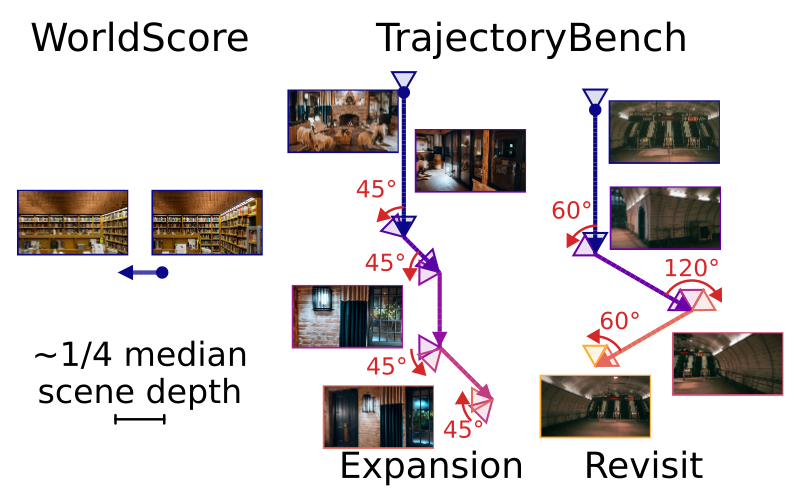
TrajectoryBench has 2,000 initial-image/trajectory tasks across easy, medium and hard levels, covering indoor, outdoor and doorway-transition scenes. Easy uses one motion over 80 frames from WorldScore; medium combines three motions in a continuous 240-frame sequence; hard uses seven or eight motions over up to 240 frames. Paths test expansion, revisits and entry into new spaces.
The DL3DV evaluation uses the prior 100-scene holdout but adds the original camera trajectories as conditioning. Results therefore concern this camera-controlled protocol and should not be equated directly with earlier image/text-only evaluation.
4.2 Training and evaluation settings
All three base models have 14B parameters. Lingbot-world-v2 generates 12-frame autoregressive chunks with cached attention; Lyra-2 generates 80-frame chunks with a sparse 3D cache; UniWorld is bidirectional and trained for 80-frame clips. Longer UniWorld trajectories are subsampled into 80 generated frames, so its path difficulty does not imply an equally long output horizon.
Post-training uses 1,700 DL3DV scenes and 16–36 hours on 64 H100s. VideoGPA’s scalar reprojection DPO and World-R1’s Gaussian/VLM Flow-GRPO are adapted from a different, shorter generator setting; the paper’s strongest credit-assignment comparison is its own global-only variant.
Geometry metrics include RGBD reprojection PSNR using VGGT or Depth Anything 3, depth consistency MVCS, Gaussian reconstruction PSNR and epipolar error. Camera RPE compares estimated motion to the commanded motion. VideoReward VQ is a separate evaluation score from the HPSv3 training reward. These are estimated proxy measures, not direct ground-truth geometry or human success judgments.
4.3 Results
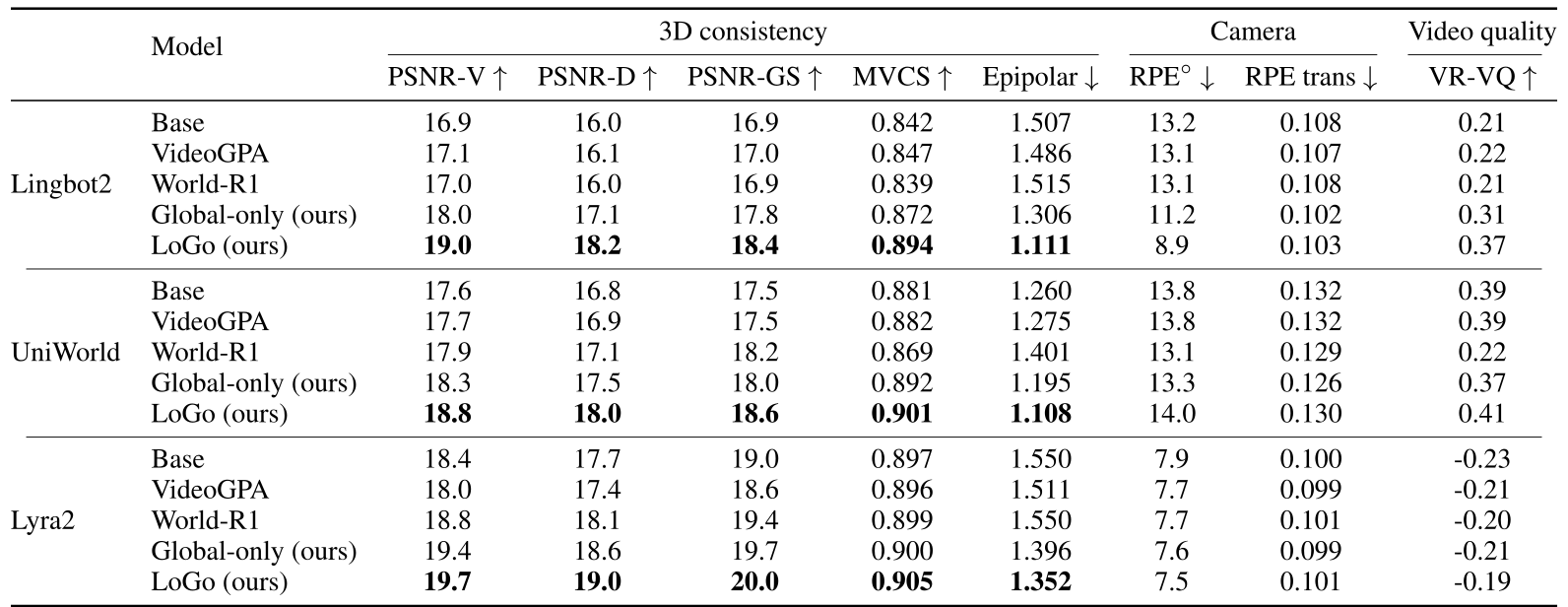
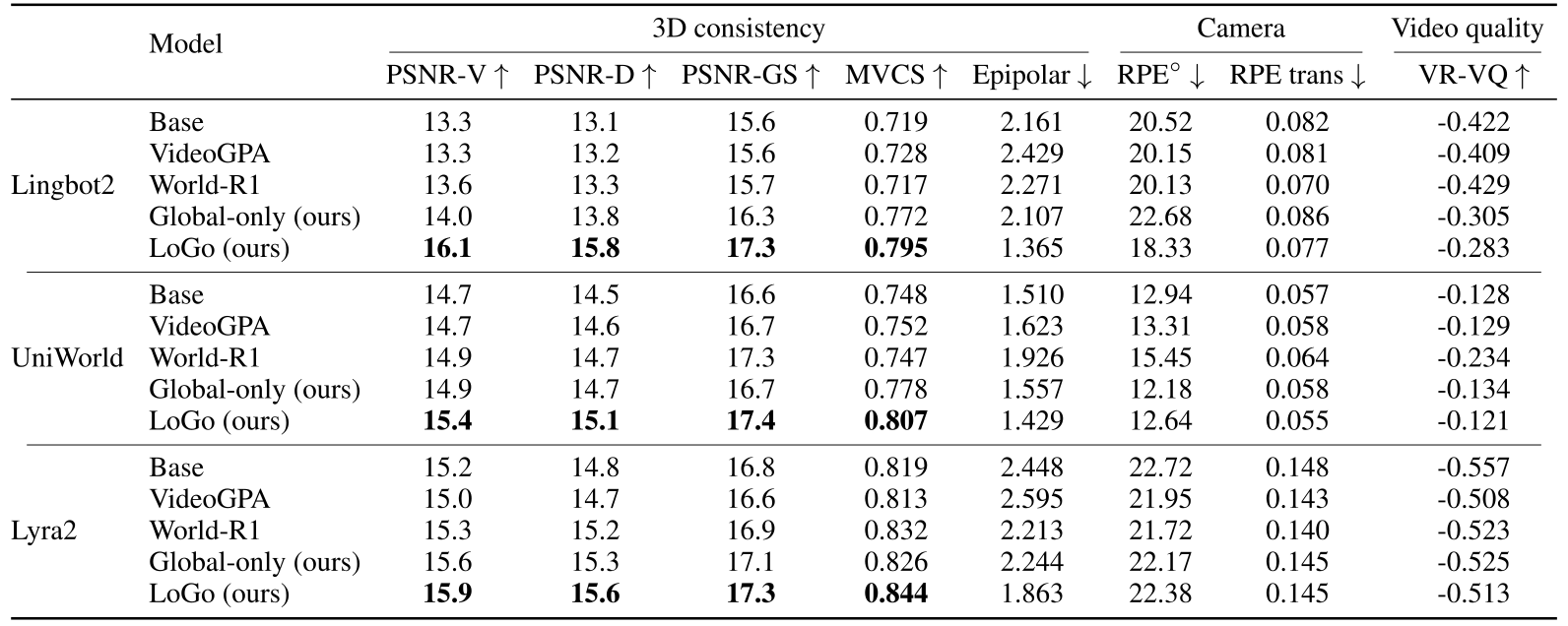
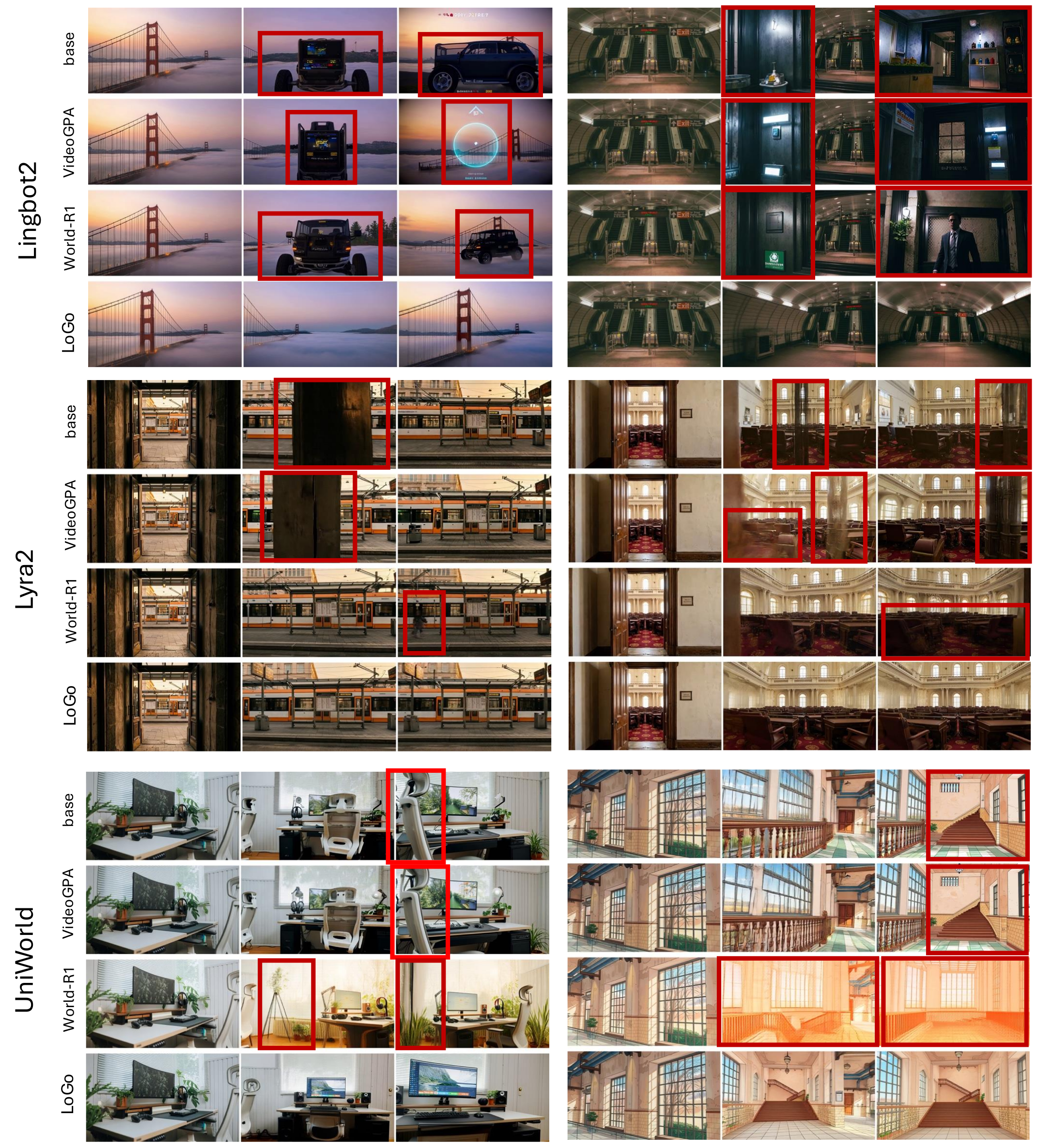
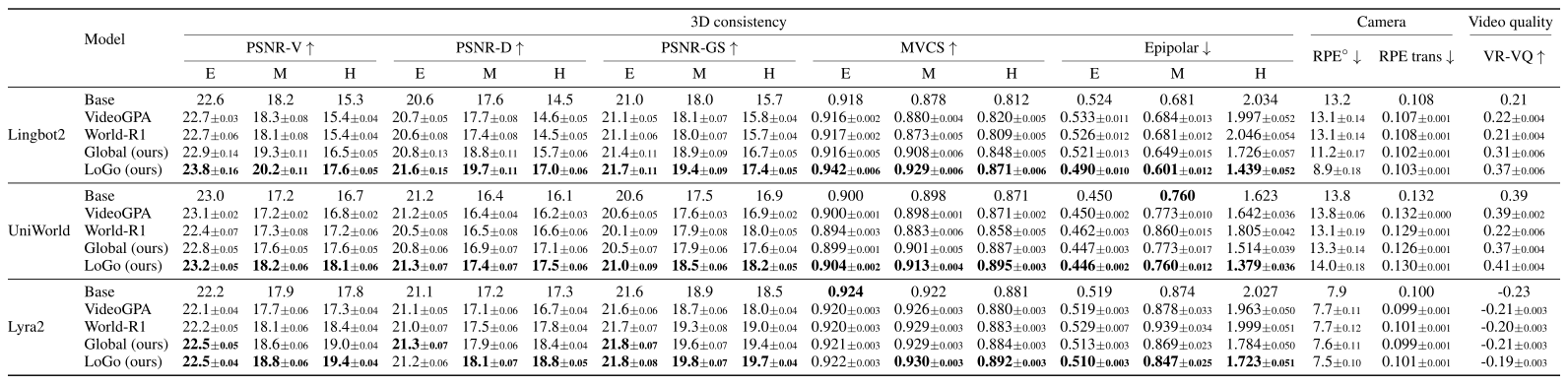
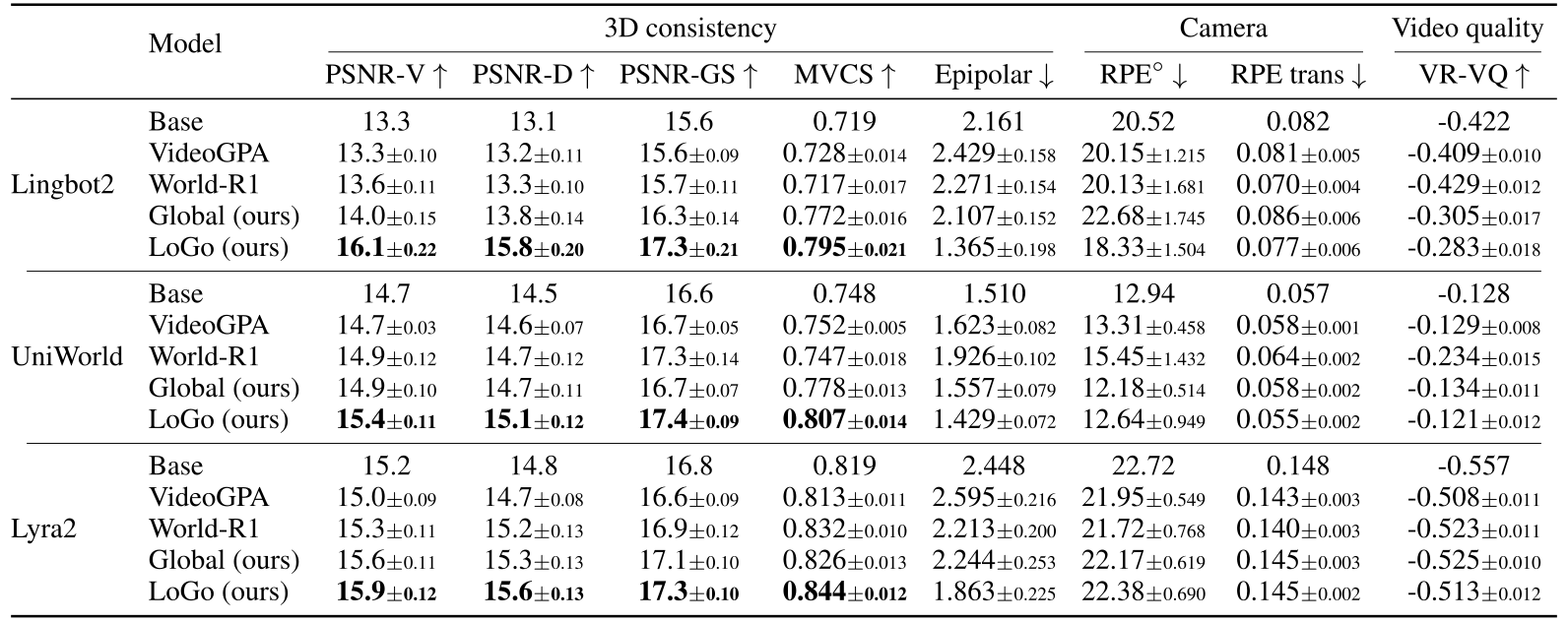
On TrajectoryBench, Lingbot2’s PSNR-D rises 16.0→18.2 dB and epipolar error falls 1.507→1.111, about 26%. On DL3DV the corresponding changes are 13.1→15.8 dB and 2.161→1.365, about 37%. The three models improve the overall geometry columns, and native figures retain the examples of repaired objects, floaters and scene changes.
Camera and visual-quality improvements are not universal. UniWorld’s TrajectoryBench rotation error changes 13.8→14.0 degrees; Lyra2’s translation error changes .100→.101. On DL3DV, Lyra2’s LoGo VQ score −.513 is below VideoGPA’s −.508, and some baseline camera scores are stronger. These exceptions qualify broad preservation or best-result language.
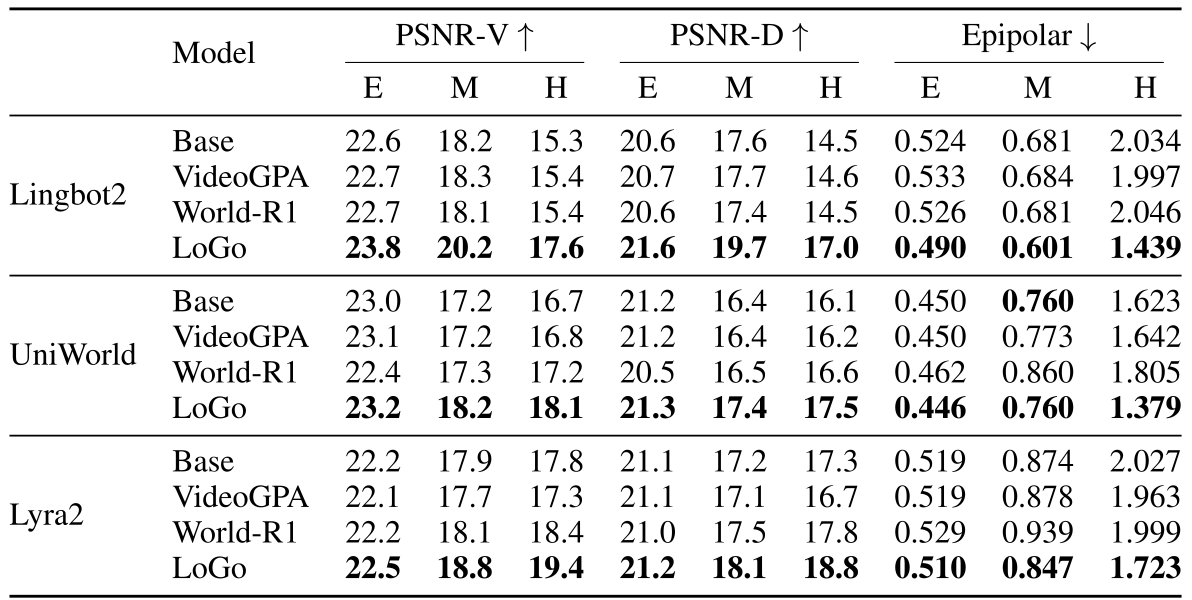
The hard split often benefits more: Lingbot2 PSNR-D gains 1.0 dB on easy and 2.5 dB on hard. Appendix Table 6 provides the full breakdown and paired standard errors. Its claim of better performance in every metric is broader than the cells: Lyra2 easy MVCS is .922 versus the base .924, for example. Qualitative examples support the proposed mechanism without showing that every such failure is eliminated.
Original selectable table
| Model | 3D consistency | Camera | Video quality | ||||||
| PSNR-V | PSNR-D | PSNR-GS | MVCS | Epipolar | RPE∘ | RPE trans | VR-VQ | ||
| Lingbot2 | Base | 16.9 | 16.0 | 16.9 | 0.842 | 1.507 | 13.2 | 0.108 | 0.21 |
| VideoGPA | 17.1 | 16.1 | 17.0 | 0.847 | 1.486 | 13.1 | 0.107 | 0.22 | |
| World-R1 | 17.0 | 16.0 | 16.9 | 0.839 | 1.515 | 13.1 | 0.108 | 0.21 | |
| Global-only (ours) | 18.0 | 17.1 | 17.8 | 0.872 | 1.306 | 11.2 | 0.102 | 0.31 | |
| LoGo (ours) | 19.0 | 18.2 | 18.4 | 0.894 | 1.111 | 8.9 | 0.103 | 0.37 | |
| UniWorld | Base | 17.6 | 16.8 | 17.5 | 0.881 | 1.260 | 13.8 | 0.132 | 0.39 |
| VideoGPA | 17.7 | 16.9 | 17.5 | 0.882 | 1.275 | 13.8 | 0.132 | 0.39 | |
| World-R1 | 17.9 | 17.1 | 18.2 | 0.869 | 1.401 | 13.1 | 0.129 | 0.22 | |
| Global-only (ours) | 18.3 | 17.5 | 18.0 | 0.892 | 1.195 | 13.3 | 0.126 | 0.37 | |
| LoGo (ours) | 18.8 | 18.0 | 18.6 | 0.901 | 1.108 | 14.0 | 0.130 | 0.41 | |
| Lyra2 | Base | 18.4 | 17.7 | 19.0 | 0.897 | 1.550 | 7.9 | 0.100 | -0.23 |
| VideoGPA | 18.0 | 17.4 | 18.6 | 0.896 | 1.511 | 7.7 | 0.099 | -0.21 | |
| World-R1 | 18.8 | 18.1 | 19.4 | 0.899 | 1.550 | 7.7 | 0.101 | -0.20 | |
| Global-only (ours) | 19.4 | 18.6 | 19.7 | 0.900 | 1.396 | 7.6 | 0.099 | -0.21 | |
| LoGo (ours) | 19.7 | 19.0 | 20.0 | 0.905 | 1.352 | 7.5 | 0.101 | -0.19 | |
Original selectable table
| Model | 3D consistency | Camera | Video quality | ||||||
| PSNR-V | PSNR-D | PSNR-GS | MVCS | Epipolar | RPE∘ | RPE trans | VR-VQ | ||
| Lingbot2 | Base | 13.3 | 13.1 | 15.6 | 0.719 | 2.161 | 20.52 | 0.082 | -0.422 |
| VideoGPA | 13.3 | 13.2 | 15.6 | 0.728 | 2.429 | 20.15 | 0.081 | -0.409 | |
| World-R1 | 13.6 | 13.3 | 15.7 | 0.717 | 2.271 | 20.13 | 0.070 | -0.429 | |
| Global-only (ours) | 14.0 | 13.8 | 16.3 | 0.772 | 2.107 | 22.68 | 0.086 | -0.305 | |
| LoGo (ours) | 16.1 | 15.8 | 17.3 | 0.795 | 1.365 | 18.33 | 0.077 | -0.283 | |
| UniWorld | Base | 14.7 | 14.5 | 16.6 | 0.748 | 1.510 | 12.94 | 0.057 | -0.128 |
| VideoGPA | 14.7 | 14.6 | 16.7 | 0.752 | 1.623 | 13.31 | 0.058 | -0.129 | |
| World-R1 | 14.9 | 14.7 | 17.3 | 0.747 | 1.926 | 15.45 | 0.064 | -0.234 | |
| Global-only (ours) | 14.9 | 14.7 | 16.7 | 0.778 | 1.557 | 12.18 | 0.058 | -0.134 | |
| LoGo (ours) | 15.4 | 15.1 | 17.4 | 0.807 | 1.429 | 12.64 | 0.055 | -0.121 | |
| Lyra2 | Base | 15.2 | 14.8 | 16.8 | 0.819 | 2.448 | 22.72 | 0.148 | -0.557 |
| VideoGPA | 15.0 | 14.7 | 16.6 | 0.813 | 2.595 | 21.95 | 0.143 | -0.508 | |
| World-R1 | 15.3 | 15.2 | 16.9 | 0.832 | 2.213 | 21.72 | 0.140 | -0.523 | |
| Global-only (ours) | 15.6 | 15.3 | 17.1 | 0.826 | 2.244 | 22.17 | 0.145 | -0.525 | |
| LoGo (ours) | 15.9 | 15.6 | 17.3 | 0.844 | 1.863 | 22.38 | 0.145 | -0.513 | |
Original selectable table
| Model | PSNR-V | PSNR-D | Epipolar | |||||||
| E | M | H | E | M | H | E | M | H | ||
| Lingbot2 | Base | 22.6 | 18.2 | 15.3 | 20.6 | 17.6 | 14.5 | 0.524 | 0.681 | 2.034 |
| VideoGPA | 22.7 | 18.3 | 15.4 | 20.7 | 17.7 | 14.6 | 0.533 | 0.684 | 1.997 | |
| World-R1 | 22.7 | 18.1 | 15.4 | 20.6 | 17.4 | 14.5 | 0.526 | 0.681 | 2.046 | |
| LoGo | 23.8 | 20.2 | 17.6 | 21.6 | 19.7 | 17.0 | 0.490 | 0.601 | 1.439 | |
| UniWorld | Base | 23.0 | 17.2 | 16.7 | 21.2 | 16.4 | 16.1 | 0.450 | 0.760 | 1.623 |
| VideoGPA | 23.1 | 17.2 | 16.8 | 21.2 | 16.4 | 16.2 | 0.450 | 0.773 | 1.642 | |
| World-R1 | 22.4 | 17.3 | 17.2 | 20.5 | 16.5 | 16.6 | 0.462 | 0.860 | 1.805 | |
| LoGo | 23.2 | 18.2 | 18.1 | 21.3 | 17.4 | 17.5 | 0.446 | 0.760 | 1.379 | |
| Lyra2 | Base | 22.2 | 17.9 | 17.8 | 21.1 | 17.2 | 17.3 | 0.519 | 0.874 | 2.027 |
| VideoGPA | 22.1 | 17.7 | 17.3 | 21.1 | 17.1 | 16.7 | 0.519 | 0.878 | 1.963 | |
| World-R1 | 22.2 | 18.1 | 18.4 | 21.0 | 17.5 | 17.8 | 0.529 | 0.939 | 1.999 | |
| LoGo | 22.5 | 18.8 | 19.4 | 21.2 | 18.1 | 18.8 | 0.510 | 0.847 | 1.723 | |
5 Ablations and Analyses
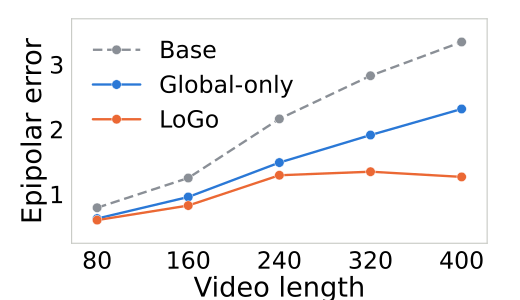
For Lingbot2, the reported epipolar-error reduction grows from 24% at 80 frames to 62% at 400 frames. This extends the test horizon beyond the main 240-frame benchmark but does not establish reliable generation beyond 400 frames.
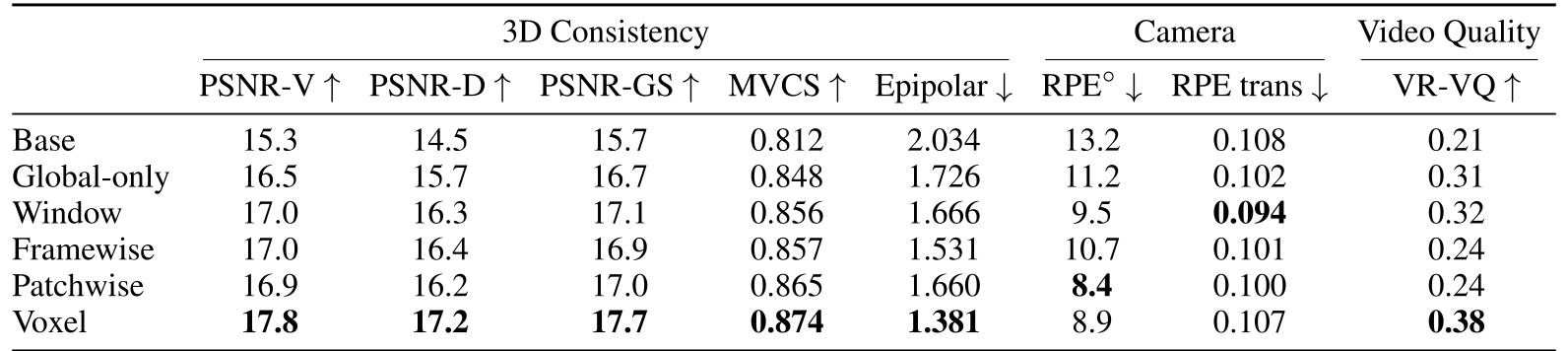
Voxel credit beats 40-frame windows, framewise and 2D-patch alternatives on the hard-split geometry columns. Table 4’s geometry values are the hard-split values from Table 8, while its camera and quality columns are the aggregate values. Voxel feedback does not win every camera column: window-based translation error is .094 versus voxel .107.
Tables 5 and 11 expose the tradeoff. Local-only training raises geometry scores but lowers HPSv3 from 5.09 to 4.47. Interleaving restores it to 4.94; adding the global component reaches 5.18 and improves translation error. Some geometry measures peak at the interleaved or local-only stages rather than the final recipe, so “best overall” reflects a balance of objectives.
The appendix tests other optimizers and voxel sizes. Improvements often persist, but not in every cell: under Flow-GRPO the hard epipolar error worsens from global-only 1.500 to local/global 1.553. These ablations support useful transfer across algorithms rather than a universal dominance claim.
Original selectable table
| 3D Consistency | Camera | Video Quality | ||||||
| PSNR-V | PSNR-D | PSNR-GS | MVCS | Epipolar | RPE∘ | RPE trans | VR-VQ | |
| Base | 15.3 | 14.5 | 15.7 | 0.812 | 2.034 | 13.2 | 0.108 | 0.21 |
| Global-only | 16.5 | 15.7 | 16.7 | 0.848 | 1.726 | 11.2 | 0.102 | 0.31 |
| Window | 17.0 | 16.3 | 17.1 | 0.856 | 1.666 | 9.5 | 0.094 | 0.32 |
| Framewise | 17.0 | 16.4 | 16.9 | 0.857 | 1.531 | 10.7 | 0.101 | 0.24 |
| Patchwise | 16.9 | 16.2 | 17.0 | 0.865 | 1.660 | 8.4 | 0.100 | 0.24 |
| Voxel | 17.8 | 17.2 | 17.7 | 0.874 | 1.381 | 8.9 | 0.107 | 0.38 |

Original selectable table
| 3D Consistency | Camera | Video Quality | |||||||
| PSNR-V | PSNR-D | PSNR-GS | MVCS | Epipolar | RPE∘ | RPE trans | VR-VQ | HPSv3 | |
| Base | 16.9 | 16.0 | 16.9 | 0.842 | 1.507 | 13.2 | 0.108 | 0.21 | 5.09 |
| Local-only | 19.2 | 18.2 | 18.7 | 0.893 | 1.078 | 11.2 | 0.116 | 0.32 | 4.47 |
| + interleave | 19.2 | 18.3 | 18.6 | 0.897 | 1.072 | 8.9 | 0.107 | 0.38 | 4.94 |
| + global (final) | 19.0 | 18.2 | 18.4 | 0.894 | 1.111 | 8.9 | 0.103 | 0.37 | 5.18 |
6 Conclusion and Limitations
LoGo provides a practical reward design for static, camera-controlled scene generation and a benchmark that reveals long-path consistency problems. It is not a new guarantee of a physically persistent world. Reconstruction bias, reward exploitation and incomplete implementation details remain relevant when reproducing it.
The authors explicitly leave dynamic scenes and horizons beyond 400 frames unresolved. They suggest stronger memory for longer videos and dynamic 4D reconstruction for moving scenes; neither extension is demonstrated here.
7 AI use statement
The authors disclose using language models for sentence polishing, schematic illustrations and routine implementation assistance. They state that generative tools did not supply the core research idea or paper content.
8 Acknowledgments
The work acknowledges the World Labs team for discussion and feedback.
Appendix A Appendix
The supplement supplies the patch-level training objective, six detailed numerical tables, training and evaluation settings, benchmark construction and additional reward/voxel visualizations. All remain available below.
A.1 RL reward formulation with LoGo
The original DiffusionNFT objective mixes positive and negative velocity-target losses with one sample-level optimality probability. Equation 3 averages voxel probabilities over the set of voxels whose projected pixels intersect a latent space-time patch, then applies that patch-specific weighting to its two squared-error terms.
This is an unweighted average over intersecting voxels as written, not an average proportional to each voxel’s pixel count. It provides different credit to different patches within the same video. Empty-intersection handling and other numerical details are not specified here; the source states that Flow-GRPO can be decomposed similarly.
Equations 3
| (3) |
A.2 Additional experiment results
Tables 6 and 7 retain all model/baseline means and paired standard errors. The errors are reported as paired evaluation errors; the text does not give a repeated-training-seed study or a universal significance test for every comparison. Small differences and ties should be read at their displayed precision.
Table 8 expands the localization comparison: its geometry columns split easy/medium/hard, while camera and VQ remain aggregate. Voxel geometry is usually strongest, but some easy epipolar or tied PSNR cells favor another readout. Its voxel row is not numerically identical to the final main-recipe row and should be read as a separate ablation.
Table 9 compares global-only versus local/global rewards under three optimizers on UniWorld. The paired cells show mostly favorable reconstruction changes with exceptions in epipolar, camera, VQ and some tied geometry entries. The DiffusionNFT ablation values also differ from the main UniWorld row; the paper does not establish that all are the same checkpoint.
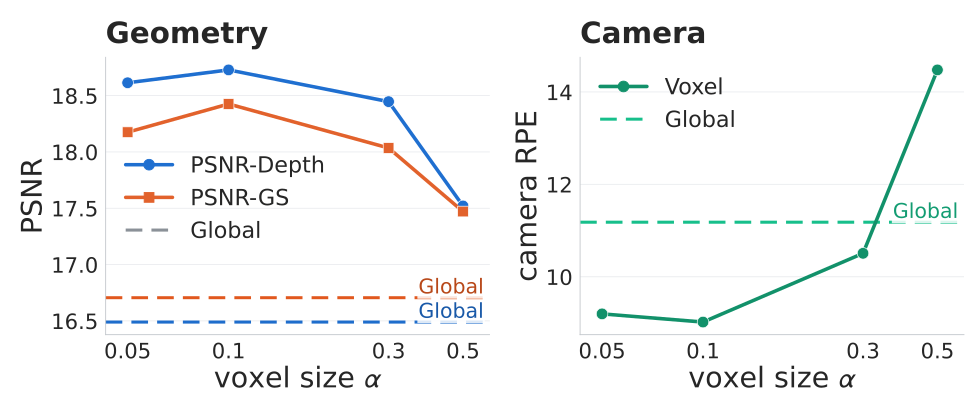
Table 10 gives voxel sizes .05, .1, .3, .5 and .7. The caption says median scene depth, whereas the method and Figure 10 use the 90th percentile; this discrepancy is preserved. The .1 choice is a useful operating point, not the maximum of every column. Table 11 retains the full geometry/quality tradeoff and uncertainty for the recipe components.
Original selectable table
| Model | 3D consistency | Camera | Video quality | ||||||||||||||||
| PSNR-V | PSNR-D | PSNR-GS | MVCS | Epipolar | RPE∘ | RPE trans | VR-VQ | ||||||||||||
| E | M | H | E | M | H | E | M | H | E | M | H | E | M | H | |||||
| Lingbot2 | Base | 22.6 | 18.2 | 15.3 | 20.6 | 17.6 | 14.5 | 21.0 | 18.0 | 15.7 | 0.918 | 0.878 | 0.812 | 0.524 | 0.681 | 2.034 | 13.2 | 0.108 | 0.21 |
| VideoGPA | 22.70.03 | 18.30.08 | 15.40.04 | 20.70.05 | 17.70.08 | 14.60.05 | 21.10.05 | 18.10.07 | 15.80.04 | 0.9160.002 | 0.8800.004 | 0.8200.005 | 0.5330.011 | 0.6840.013 | 1.9970.052 | 13.10.14 | 0.1070.001 | 0.220.004 | |
| World-R1 | 22.70.06 | 18.10.08 | 15.40.04 | 20.60.08 | 17.40.08 | 14.50.05 | 21.10.06 | 18.00.07 | 15.70.04 | 0.9170.002 | 0.8730.005 | 0.8090.005 | 0.5260.012 | 0.6810.012 | 2.0460.054 | 13.10.14 | 0.1080.001 | 0.210.004 | |
| Global (ours) | 22.90.14 | 19.30.11 | 16.50.05 | 20.80.13 | 18.80.11 | 15.70.06 | 21.40.11 | 18.90.09 | 16.70.05 | 0.9160.005 | 0.9080.006 | 0.8480.005 | 0.5210.013 | 0.6490.015 | 1.7260.057 | 11.20.17 | 0.1020.001 | 0.310.006 | |
| LoGo (ours) | 23.80.16 | 20.20.11 | 17.60.05 | 21.60.15 | 19.70.11 | 17.00.06 | 21.70.11 | 19.40.09 | 17.40.05 | 0.9420.006 | 0.9290.006 | 0.8710.006 | 0.4900.010 | 0.6010.012 | 1.4390.052 | 8.90.18 | 0.1030.001 | 0.370.006 | |
| UniWorld | Base | 23.0 | 17.2 | 16.7 | 21.2 | 16.4 | 16.1 | 20.6 | 17.5 | 16.9 | 0.900 | 0.898 | 0.871 | 0.450 | 0.760 | 1.623 | 13.8 | 0.132 | 0.39 |
| VideoGPA | 23.10.02 | 17.20.02 | 16.80.02 | 21.20.05 | 16.40.04 | 16.20.03 | 20.60.05 | 17.60.03 | 16.90.02 | 0.9000.001 | 0.8980.001 | 0.8710.002 | 0.4500.002 | 0.7730.010 | 1.6420.036 | 13.80.06 | 0.1320.000 | 0.390.002 | |
| World-R1 | 22.40.07 | 17.30.08 | 17.20.06 | 20.50.08 | 16.50.08 | 16.60.06 | 20.10.09 | 17.90.08 | 18.00.05 | 0.8940.003 | 0.8830.006 | 0.8580.005 | 0.4620.003 | 0.8600.015 | 1.8050.042 | 13.10.19 | 0.1290.001 | 0.220.006 | |
| Global (ours) | 22.80.05 | 17.60.05 | 17.60.05 | 20.80.06 | 16.90.07 | 17.10.06 | 20.50.07 | 17.90.06 | 17.60.04 | 0.8990.001 | 0.9010.005 | 0.8870.003 | 0.4470.003 | 0.7730.017 | 1.5140.039 | 13.30.14 | 0.1260.001 | 0.370.004 | |
| LoGo (ours) | 23.20.05 | 18.20.06 | 18.10.06 | 21.30.07 | 17.40.07 | 17.50.06 | 21.00.09 | 18.50.06 | 18.20.05 | 0.9040.002 | 0.9130.004 | 0.8950.003 | 0.4460.002 | 0.7600.012 | 1.3790.036 | 14.00.18 | 0.1300.001 | 0.410.004 | |
| Lyra2 | Base | 22.2 | 17.9 | 17.8 | 21.1 | 17.2 | 17.3 | 21.6 | 18.9 | 18.5 | 0.924 | 0.922 | 0.881 | 0.519 | 0.874 | 2.027 | 7.9 | 0.100 | -0.23 |
| VideoGPA | 22.10.04 | 17.70.06 | 17.30.04 | 21.10.05 | 17.10.06 | 16.70.04 | 21.60.06 | 18.70.06 | 18.00.04 | 0.9200.003 | 0.9260.003 | 0.8800.003 | 0.5190.003 | 0.8780.033 | 1.9630.050 | 7.70.11 | 0.0990.001 | -0.210.003 | |
| World-R1 | 22.20.05 | 18.10.06 | 18.40.04 | 21.00.07 | 17.50.06 | 17.80.04 | 21.70.07 | 19.30.08 | 19.00.04 | 0.9200.003 | 0.9290.003 | 0.8830.003 | 0.5290.007 | 0.9390.034 | 1.9990.051 | 7.70.12 | 0.1010.001 | -0.200.003 | |
| Global (ours) | 22.50.05 | 18.60.06 | 19.00.04 | 21.30.07 | 17.90.06 | 18.40.04 | 21.80.07 | 19.60.07 | 19.40.04 | 0.9210.003 | 0.9290.003 | 0.8840.003 | 0.5130.003 | 0.8690.023 | 1.7840.050 | 7.60.11 | 0.0990.001 | -0.210.003 | |
| LoGo (ours) | 22.50.04 | 18.80.06 | 19.40.04 | 21.20.06 | 18.10.07 | 18.80.05 | 21.80.08 | 19.80.07 | 19.70.04 | 0.9220.003 | 0.9300.003 | 0.8920.003 | 0.5100.003 | 0.8470.025 | 1.7230.051 | 7.50.10 | 0.1010.001 | -0.190.003 | |
Original selectable table
| Model | 3D consistency | Camera | Video quality | ||||||
| PSNR-V | PSNR-D | PSNR-GS | MVCS | Epipolar | RPE∘ | RPE trans | VR-VQ | ||
| Lingbot2 | Base | 13.3 | 13.1 | 15.6 | 0.719 | 2.161 | 20.52 | 0.082 | -0.422 |
| VideoGPA | 13.30.10 | 13.20.11 | 15.60.09 | 0.7280.014 | 2.4290.158 | 20.151.215 | 0.0810.005 | -0.4090.010 | |
| World-R1 | 13.60.11 | 13.30.10 | 15.70.11 | 0.7170.017 | 2.2710.154 | 20.131.681 | 0.0700.004 | -0.4290.012 | |
| Global (ours) | 14.00.15 | 13.80.14 | 16.30.14 | 0.7720.016 | 2.1070.152 | 22.681.745 | 0.0860.006 | -0.3050.017 | |
| LoGo (ours) | 16.10.22 | 15.80.20 | 17.30.21 | 0.7950.021 | 1.3650.198 | 18.331.504 | 0.0770.006 | -0.2830.018 | |
| UniWorld | Base | 14.7 | 14.5 | 16.6 | 0.748 | 1.510 | 12.94 | 0.057 | -0.128 |
| VideoGPA | 14.70.03 | 14.60.07 | 16.70.05 | 0.7520.005 | 1.6230.082 | 13.310.458 | 0.0580.001 | -0.1290.008 | |
| World-R1 | 14.90.12 | 14.70.12 | 17.30.14 | 0.7470.018 | 1.9260.102 | 15.451.432 | 0.0640.002 | -0.2340.015 | |
| Global (ours) | 14.90.10 | 14.70.11 | 16.70.07 | 0.7780.013 | 1.5570.079 | 12.180.514 | 0.0580.002 | -0.1340.011 | |
| LoGo (ours) | 15.40.11 | 15.10.12 | 17.40.09 | 0.8070.014 | 1.4290.072 | 12.640.949 | 0.0550.002 | -0.1210.012 | |
| Lyra2 | Base | 15.2 | 14.8 | 16.8 | 0.819 | 2.448 | 22.72 | 0.148 | -0.557 |
| VideoGPA | 15.00.09 | 14.70.08 | 16.60.09 | 0.8130.011 | 2.5950.216 | 21.950.549 | 0.1430.003 | -0.5080.011 | |
| World-R1 | 15.30.11 | 15.20.13 | 16.90.12 | 0.8320.010 | 2.2130.200 | 21.720.768 | 0.1400.003 | -0.5230.011 | |
| Global (ours) | 15.60.11 | 15.30.13 | 17.10.10 | 0.8260.013 | 2.2440.253 | 22.170.619 | 0.1450.003 | -0.5250.010 | |
| LoGo (ours) | 15.90.12 | 15.60.13 | 17.30.10 | 0.8440.012 | 1.8630.225 | 22.380.690 | 0.1450.002 | -0.5130.012 | |

Original selectable table
| Reward readout | 3D consistency | Camera | Video quality | |||||||||||||||
| PSNR-V | PSNR-D | PSNR-GS | MVCS | Epipolar | RPE∘ | RPE trans | VR-VQ | |||||||||||
| E | M | H | E | M | H | E | M | H | E | M | H | E | M | H | ||||
| Base | 22.6 | 18.2 | 15.3 | 20.6 | 17.6 | 14.5 | 21.0 | 18.0 | 15.7 | 0.918 | 0.878 | 0.812 | 0.524 | 0.681 | 2.034 | 13.2 | 0.108 | 0.21 |
| Global | 22.90.14 | 19.30.11 | 16.50.05 | 20.80.13 | 18.80.11 | 15.70.06 | 21.40.11 | 18.90.09 | 16.70.05 | 0.9160.005 | 0.9080.006 | 0.8480.005 | 0.5210.013 | 0.6490.015 | 1.7260.057 | 11.20.17 | 0.1020.001 | 0.310.006 |
| Window | 23.30.17 | 19.90.11 | 17.00.05 | 21.20.15 | 19.30.11 | 16.30.06 | 21.60.12 | 19.40.09 | 17.10.05 | 0.9180.005 | 0.9140.006 | 0.8560.005 | 0.5390.020 | 0.6350.014 | 1.6660.053 | 9.50.17 | 0.0940.001 | 0.320.006 |
| Framewise | 23.50.17 | 19.70.11 | 17.00.05 | 21.30.16 | 19.00.11 | 16.40.06 | 21.50.11 | 19.00.09 | 16.90.05 | 0.9290.005 | 0.9180.006 | 0.8570.005 | 0.5310.021 | 0.6170.013 | 1.5310.053 | 10.70.17 | 0.1010.001 | 0.240.006 |
| Patchwise | 23.40.16 | 19.60.11 | 16.90.06 | 21.20.15 | 18.80.11 | 16.20.06 | 21.50.12 | 19.00.09 | 17.00.05 | 0.9300.005 | 0.9180.006 | 0.8650.005 | 0.5090.010 | 0.6210.013 | 1.6600.054 | 8.40.18 | 0.1000.001 | 0.240.006 |
| Voxel | 23.90.14 | 20.30.11 | 17.80.05 | 21.60.14 | 19.70.11 | 17.20.06 | 21.70.11 | 19.40.09 | 17.70.05 | 0.9370.005 | 0.9340.006 | 0.8740.005 | 0.4990.029 | 0.5870.013 | 1.3810.053 | 8.90.18 | 0.1070.001 | 0.380.006 |

Original selectable table
| RL algorithm | 3D consistency | Camera | Video quality | ||||||||||||||||
| PSNR-V | PSNR-D | PSNR-GS | MVCS | Epipolar | RPE∘ | RPE trans | VR-VQ | ||||||||||||
| E | M | H | E | M | H | E | M | H | E | M | H | E | M | H | |||||
| Base | 23.0 | 17.2 | 16.7 | 21.2 | 16.4 | 16.1 | 20.6 | 17.5 | 16.9 | 0.900 | 0.898 | 0.871 | 0.450 | 0.760 | 1.623 | 13.8 | 0.132 | 0.39 | |
| DiffusionNFT | Ours-global | 22.80.05 | 17.60.05 | 17.60.05 | 20.80.06 | 16.90.07 | 17.10.06 | 20.50.07 | 17.90.06 | 17.60.04 | 0.8990.001 | 0.9010.005 | 0.8870.003 | 0.4470.003 | 0.7730.017 | 1.5140.039 | 13.30.14 | 0.1260.001 | 0.370.004 |
| LoGlo | 23.10.05 | 17.90.06 | 17.90.06 | 21.20.07 | 17.20.07 | 17.40.06 | 20.90.08 | 18.40.07 | 18.00.05 | 0.9030.002 | 0.9120.004 | 0.8950.003 | 0.4460.003 | 0.7810.017 | 1.4360.037 | 13.90.18 | 0.1300.001 | 0.400.004 | |
| FlowGRPO | Ours-global | 23.20.03 | 17.70.03 | 17.50.03 | 21.30.06 | 16.80.04 | 16.80.04 | 20.90.10 | 18.00.04 | 17.50.03 | 0.9010.001 | 0.9020.002 | 0.8800.002 | 0.4560.001 | 0.7880.014 | 1.5000.035 | 13.80.07 | 0.1320.000 | 0.370.003 |
| LoGlo | 23.30.03 | 17.80.03 | 17.60.03 | 21.50.05 | 17.00.04 | 16.90.04 | 21.00.08 | 18.10.04 | 17.60.03 | 0.9020.001 | 0.9020.002 | 0.8830.002 | 0.4540.002 | 0.7640.008 | 1.5530.039 | 13.70.10 | 0.1320.000 | 0.360.003 | |
| DRaFT | Ours-global | 23.00.02 | 17.10.02 | 16.60.02 | 21.10.05 | 16.20.04 | 16.00.03 | 20.60.07 | 17.40.03 | 16.70.02 | 0.8990.000 | 0.8940.001 | 0.8690.002 | 0.4530.004 | 0.7680.011 | 1.7260.037 | 14.00.07 | 0.1320.000 | 0.390.003 |
| LoGlo | 23.00.02 | 17.20.02 | 16.80.02 | 21.10.04 | 16.30.04 | 16.20.03 | 20.60.06 | 17.50.03 | 16.80.02 | 0.8990.001 | 0.8930.002 | 0.8710.002 | 0.4490.002 | 0.7650.013 | 1.6700.038 | 14.00.08 | 0.1320.000 | 0.390.003 | |

Original selectable table
| Voxel size | 3D consistency | Camera | Video quality | ||||||||||||||||
| PSNR-V | PSNR-D | PSNR-GS | MVCS | Epipolar | RPE∘ | RPE trans | VR-VQ | ||||||||||||
| E | M | H | E | M | H | E | M | H | E | M | H | E | M | H | |||||
| Base | 22.6 | 18.2 | 15.3 | 20.6 | 17.6 | 14.5 | 21.0 | 18.0 | 15.7 | 0.918 | 0.878 | 0.812 | 0.524 | 0.681 | 2.034 | 13.2 | 0.108 | 0.21 | |
| 0.05 | 24.10.16 | 20.70.11 | 18.60.06 | 21.80.16 | 20.10.11 | 17.80.06 | 21.70.13 | 19.70.09 | 18.20.06 | 0.9320.005 | 0.9350.007 | 0.8800.005 | 0.4660.010 | 0.5790.014 | 1.2290.051 | 9.20.17 | 0.1080.001 | 0.420.006 | |
| 0.1 | 24.30.15 | 20.50.11 | 18.70.06 | 21.80.15 | 19.90.11 | 17.90.07 | 21.80.10 | 19.60.09 | 18.40.06 | 0.9410.005 | 0.9390.007 | 0.8850.006 | 0.4860.014 | 0.5770.014 | 1.2350.051 | 9.00.19 | 0.1110.001 | 0.420.006 | |
| 0.3 | 24.60.16 | 20.70.11 | 18.40.06 | 22.20.16 | 20.20.11 | 17.60.07 | 21.70.11 | 19.60.09 | 18.00.06 | 0.9470.006 | 0.9400.007 | 0.8930.006 | 0.4670.012 | 0.5810.013 | 1.2460.051 | 10.50.18 | 0.1170.001 | 0.420.006 | |
| 0.5 | 23.60.12 | 19.90.11 | 17.50.06 | 21.40.12 | 19.30.11 | 16.60.06 | 21.60.10 | 19.20.09 | 17.50.05 | 0.9330.004 | 0.9230.006 | 0.8650.005 | 0.4840.016 | 0.5950.013 | 1.4500.053 | 14.50.18 | 0.1190.001 | 0.390.006 | |
| 0.7 | 24.20.17 | 20.30.11 | 17.70.06 | 21.80.16 | 19.70.11 | 17.00.06 | 21.80.11 | 19.40.09 | 17.60.05 | 0.9350.005 | 0.9290.006 | 0.8820.005 | 0.4890.014 | 0.5880.013 | 1.3210.052 | 10.30.19 | 0.1070.001 | 0.430.006 | |

Original selectable table
| 3D consistency | Camera | Video quality | |||||||
| PSNR-V | PSNR-D | PSNR-GS | MVCS | Epipolar | RPE∘ | RPE trans | VR-VQ | HPSv3 | |
| Base | 16.9 | 16.0 | 16.9 | 0.842 | 1.507 | 13.2 | 0.108 | 0.21 | 5.09 |
| Local reward | 19.20.05 | 18.20.05 | 18.70.04 | 0.8930.004 | 1.0780.034 | 11.20.12 | 0.1160.001 | 0.320.004 | 4.470.019 |
| + interleave | 19.20.05 | 18.30.05 | 18.60.04 | 0.8970.004 | 1.0720.034 | 8.90.13 | 0.1070.001 | 0.380.004 | 4.940.013 |
| + global (final) | 19.00.05 | 18.20.05 | 18.40.04 | 0.8940.004 | 1.1110.033 | 8.90.13 | 0.1030.001 | 0.370.004 | 5.180.010 |
A.3 Additional training details
The first half of each training camera trajectory is subsampled to 240 frames. COLMAP translations are scaled by .4 for Lyra2 and 1 for UniWorld; Lingbot2 normalizes by each scene’s largest step. Batch size is eight and rollout-group size sixteen. Learning rates are 3×10⁻⁴ for Lingbot2/UniWorld and 3.33×10⁻⁵ for Lyra2.
RGB/depth reward weights are .5/.5 for Lingbot2 and UniWorld, and .3/.7 for Lyra2 to reduce reward exploitation. UniWorld uses BLIP-2 captions during both training and inference; the other two models do not use captions. Training stops around reward convergence, taking 16–36 hours on 64 H100s. Exact update counts, schedule ratios and training-seed uncertainty are not fully reported.
A.4 Additional evaluation details
Reprojection evaluation fuses keyframes sampled every twentieth frame while excluding the frame being scored. This leave-one-out construction prevents a frame’s own points from dominating its reprojection score when distant keyframes have sparse spatial overlap. Sparse coverage and estimated depth/poses still limit interpretation.
A.5 Additional details on TrajectoryBench construction
Easy tasks reuse a WorldScore subset. Medium tasks combine three motions in one generation rather than WorldScore’s separate single-motion clips, and add doorway transitions. Hard indoor/outdoor initial images come from Pexels; doorway images use Nano Banana to control door placement while varying scene types.
Human-designed motion primitives are mapped to paths and tried on base generators to adjust translation and rotation so views cover substantial space without apparent wall/object collisions. The benchmark is therefore deliberately constructed and tuned, not an independently sampled collision-certified trajectory distribution.
Twenty percent of tasks are stylized with Nano Banana into eight visual styles, from anime and oil painting to low-poly, cyberpunk and steampunk. The paper lists the scene/style coverage but does not give every split count, random seed or a formal scene-overlap audit against foundation-model training.
A.6 Additional Analyses and Ablations
The final analyses show how voxel-local feedback highlights a transient object and how the spatial grouping scale affects reconstruction and camera behavior.
A.6.1 Additional visualization of LoGo’s local reward.
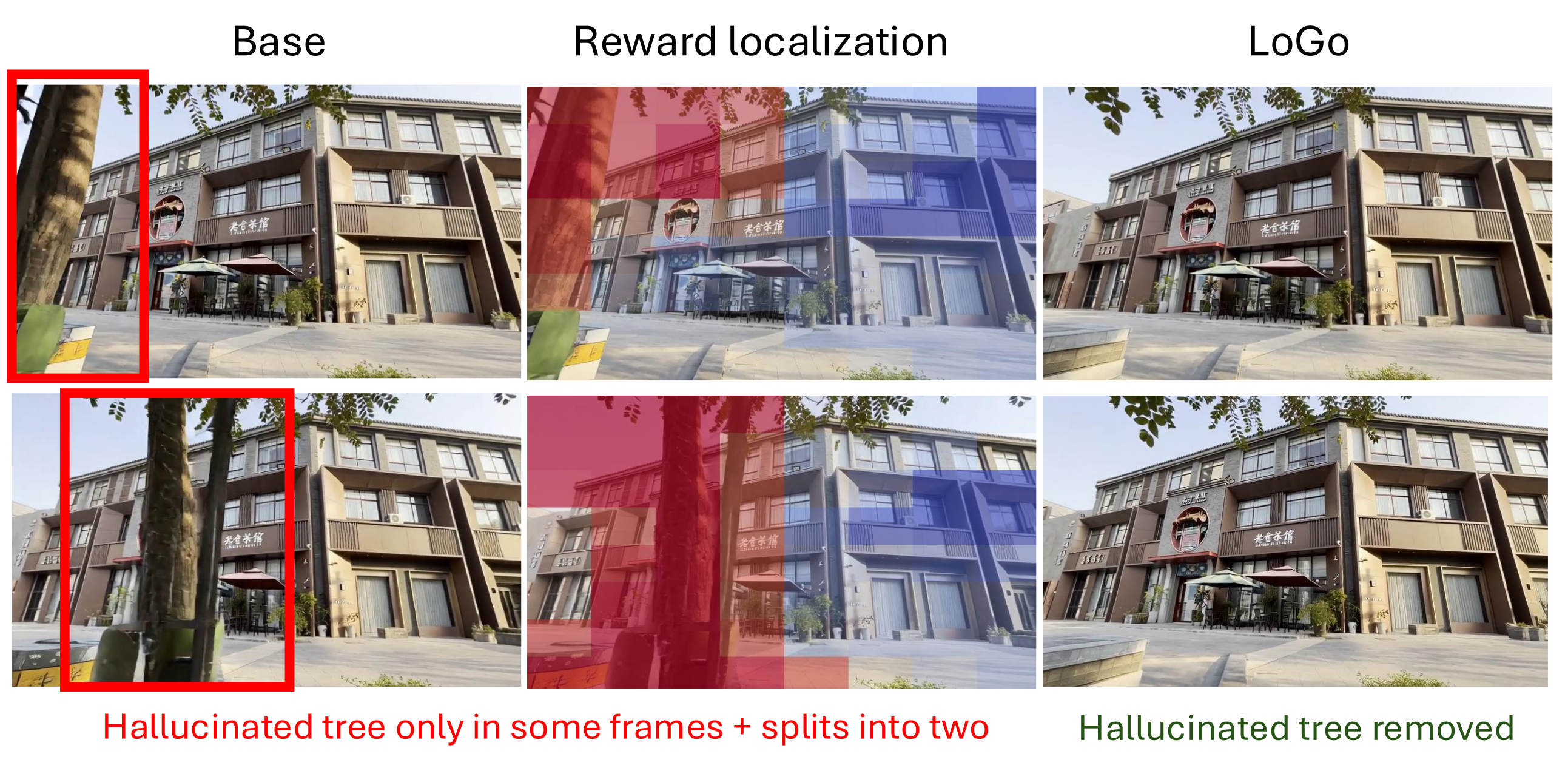
Figure 9 projects normalized voxel scores back to image patches. Red feedback concentrates on a hallucinated tree that later splits into two; the LoGo example removes it. This is an illustrative localized correction, not a frequency estimate over all possible hallucinations.
A.6.2 Voxel granularity ablation.
Figure 10 and Table 10 test coarser and finer voxels around the .1×depth operating point. Finer grouping can isolate an inconsistent region more precisely, but results are not monotonic across all metrics or difficulty splits. The .05 setting already beats .1 on some geometry cells, while .3 is stronger on some easy/medium measures.
The proposed camera explanation is that a coarse penalty can encourage turning away from a large region, whereas a small voxel makes avoidance less attractive. This is a hypothesis about the optimization incentive, not an isolated causal experiment. Use the body’s stated P90 convention while retaining the conflicting median-depth table caption.