At a glance
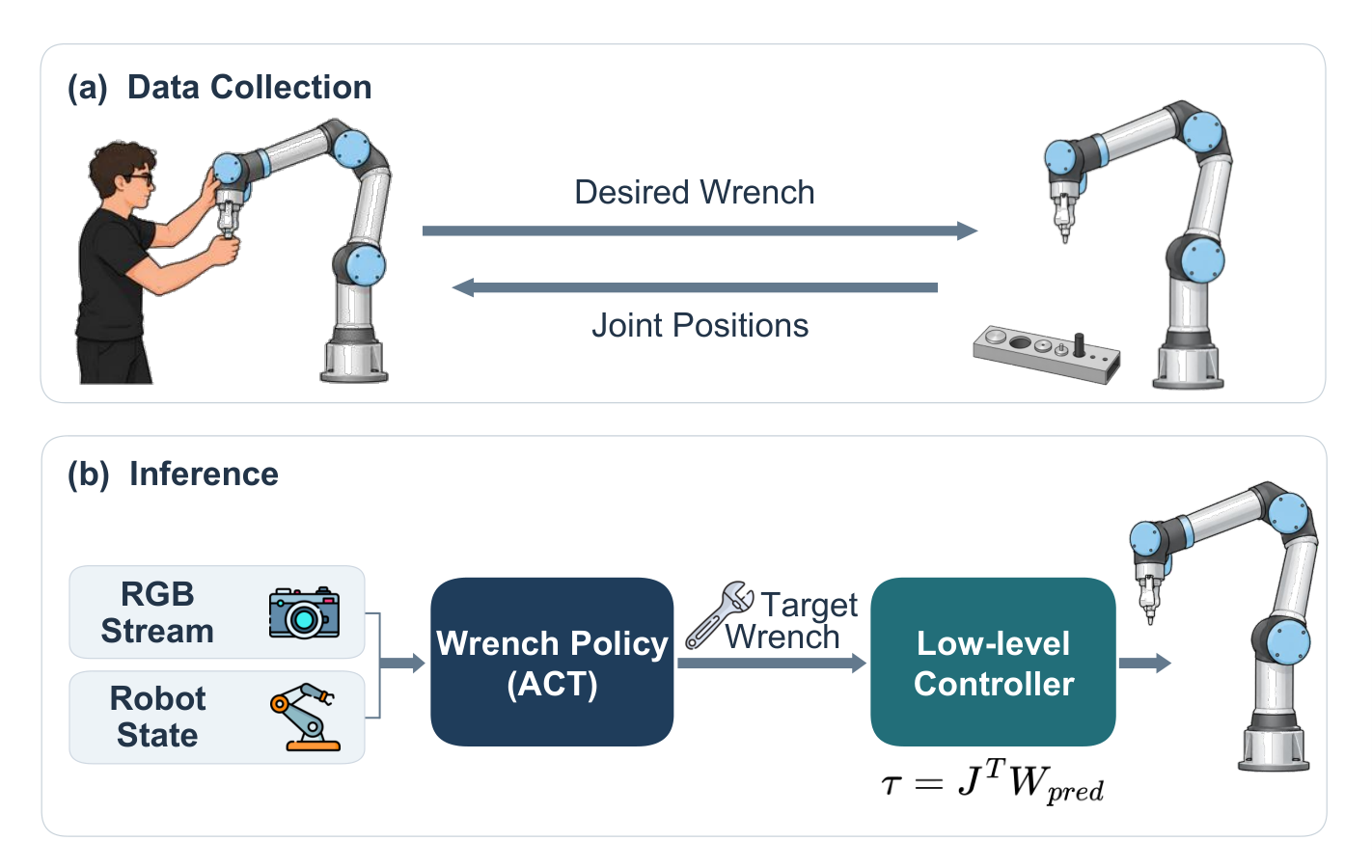
Wrench-ACT predicts the force and torque to apply, rather than a target pose. An ACT policy learns from bilateral teleoperation, where an operator deliberately commands forces and feels the follower robot’s response.
Across five contact-rich tasks, the matching bilateral-data/wrench-action policy averages 76.8% success versus 40% for the position baseline. Gains depend on the task and on how demonstrations are collected: changing the action representation alone is insufficient. These are separately trained single-task policies, not a general manipulation model.
I Introduction
Insertion, clipping, and writing need controlled interaction forces. A position policy produces force indirectly through pose-tracking error; a wrench policy commands the desired interaction directly. The central question is whether that action space works when the demonstrations also encode deliberate force regulation.
The study combines ACT [1], bilateral force-feedback demonstrations, and a direct wrench controller. Cross-condition experiments separate the data-collection interface from the learned action representation. The authors announce over 1,000 wrench-action demonstrations for release upon publication.
II Related Work
The comparison distinguishes sensing contact, adapting compliance, collecting force-aware demonstrations, and commanding forces directly.
II-A Force and Torque as Policy Input
Prior policies add torque, wrist force, tactile, or acoustic observations while continuing to output motion commands. Examples include ForceVLA [3], FoAR [4], and ManiWAV [8]. Better contact observations do not themselves make force a commanded action.
II-B Compliance and Impedance Parameter Prediction
Variable-impedance methods learn when a robot should be stiff or compliant. Recent policies jointly predict poses and stiffness or switch between contact modes [16]. Such approaches can require task-specific bounds, damping, or mode definitions. Wrench-ACT removes the desired pose and stiffness output, while retaining fixed damping for stability.
II-C Teleoperation for Data Collection
Position-based interfaces capture geometric trajectories, but their measured forces arise from tracking those trajectories. Bilateral teleoperation instead sends the operator’s measured wrench to the follower and reflects follower motion to the leader. The demonstration therefore records an intentional force command, which is the target the wrench policy will later predict.
II-D Direct Force and Wrench Prediction
Hybrid force-position policies combine force targets with motion targets, controller switches, or interaction-frame estimates. Bi-ACT uses bilateral demonstrations with joint-space position and force outputs [36]. This study uses the full six-dimensional task-space wrench as its only arm action, plus a separate gripper-opening command.
III Method
III-A Direct Wrench Control
Cartesian impedance normally converts desired-pose error into a restoring wrench and adds damping and optional feedforward force. Wrench-ACT sets stiffness to zero, removes the target pose, and directly predicts the feedforward wrench. Fixed velocity damping remains; the same action space is used in free motion and contact. Equation (1) retains the general controller from which this choice is derived.
Equation 1
| (1) | ||||
III-B Policy Architecture
The policy uses ACT without architectural changes and trains a separate model per task. Inputs are three synchronized RGB views, end-effector position and velocity, the follower’s measured six-dimensional wrench, and gripper position. The seven-dimensional output contains target force, target torque, and gripper opening. Policy inference runs at approximately 50 Hz.
III-C Data Collection
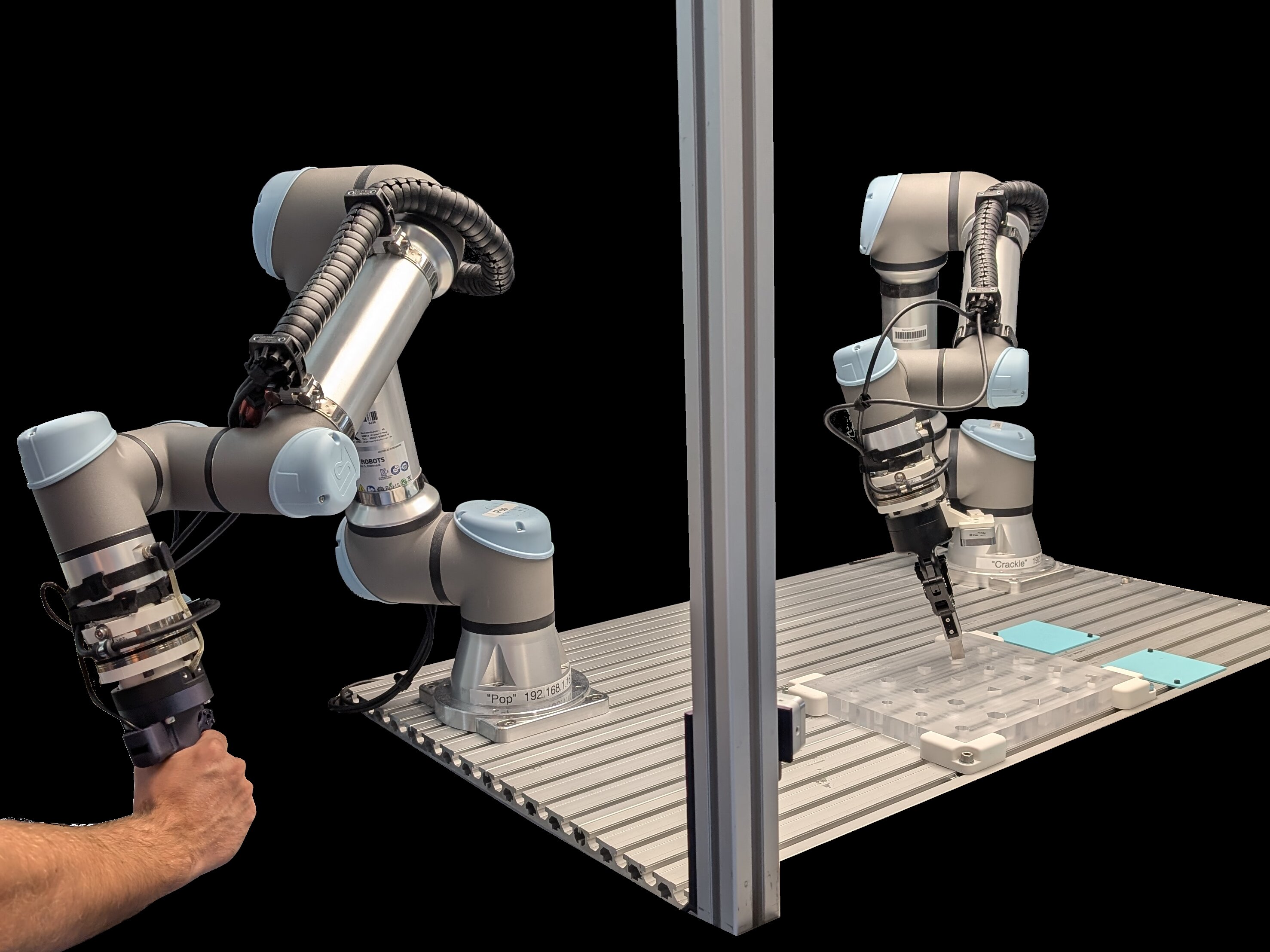
Two UR5e arms form the bilateral interface. A sensor measures the wrench applied by the operator to the leader; the follower executes it, and follower position is mirrored back to the leader. The dataset records commanded and measured wrenches, follower position, and velocity. Execution uses the UR5e’s built-in force mode.
III-D Inference
Observations arrive at 60 Hz, the learned policy runs near 50 Hz, and the robot/force loop runs at 500 Hz. The most recent predicted wrench is held between policy updates. End-effector inertia and added velocity-proportional damping help stabilize execution; equation (2) gives the final command. A slow learned policy does not replace the fast inner control loop.
Equation 2
| (2) |
IV Experimental Evaluation
IV-A Tasks and Setup
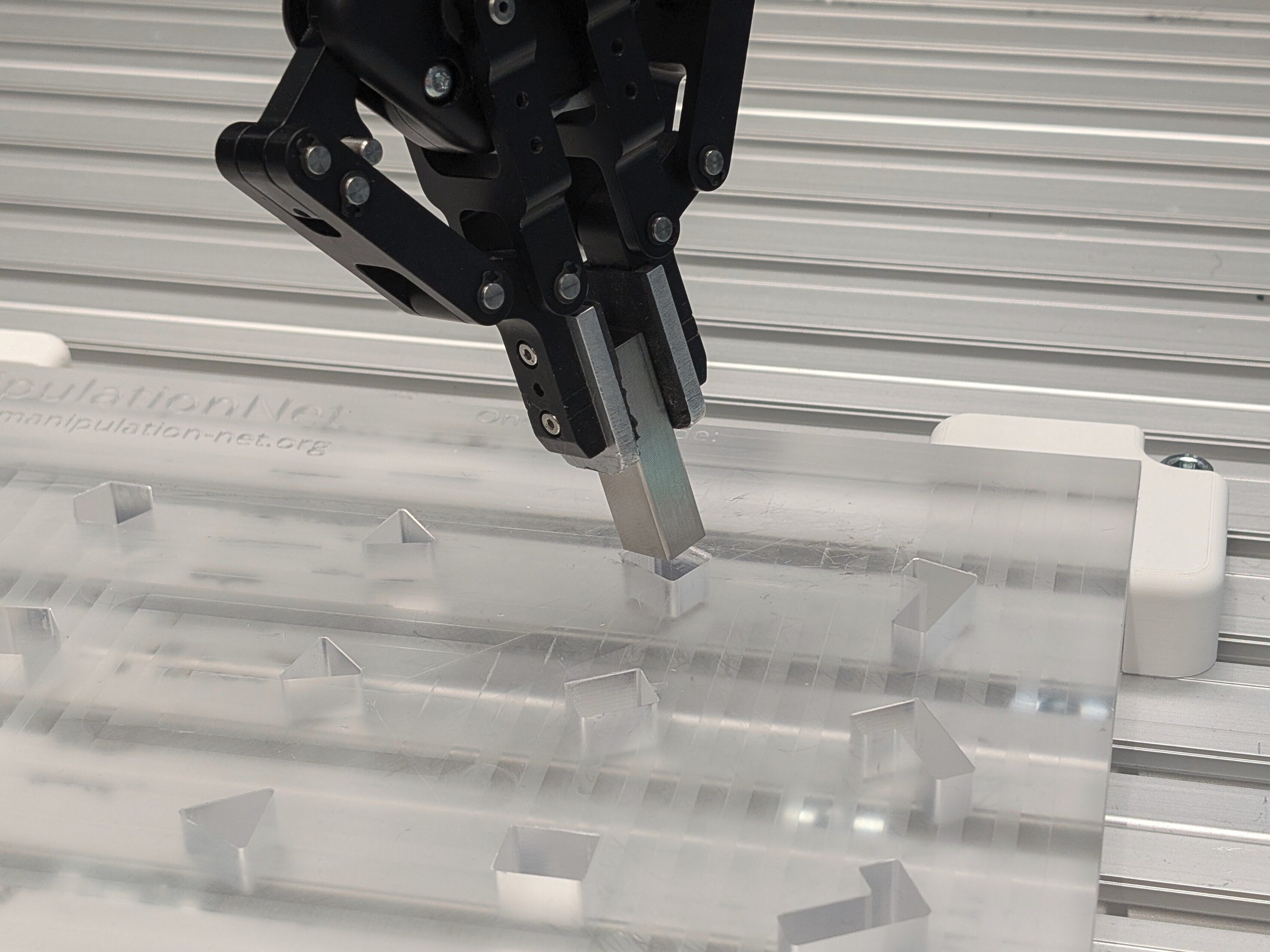
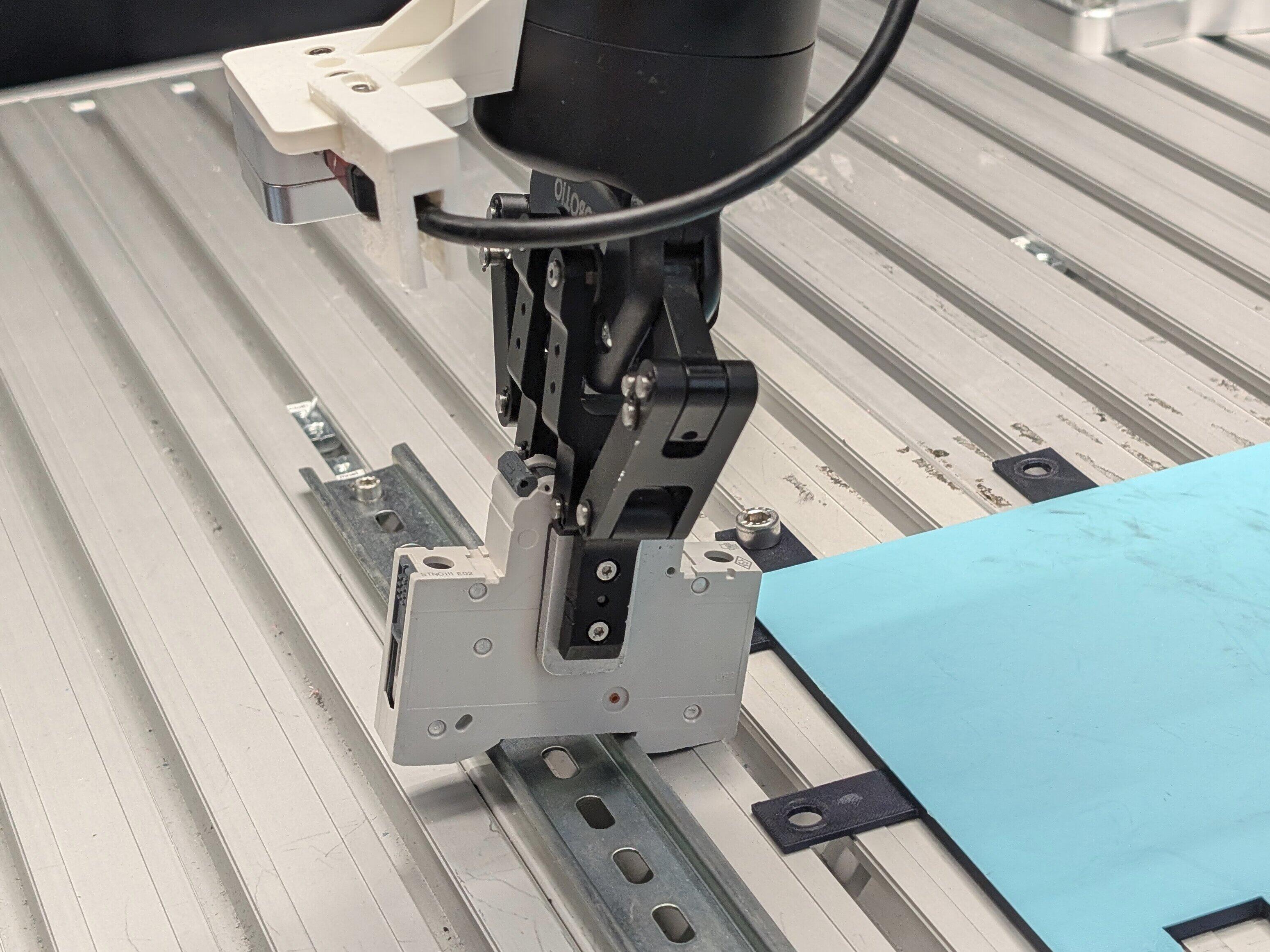
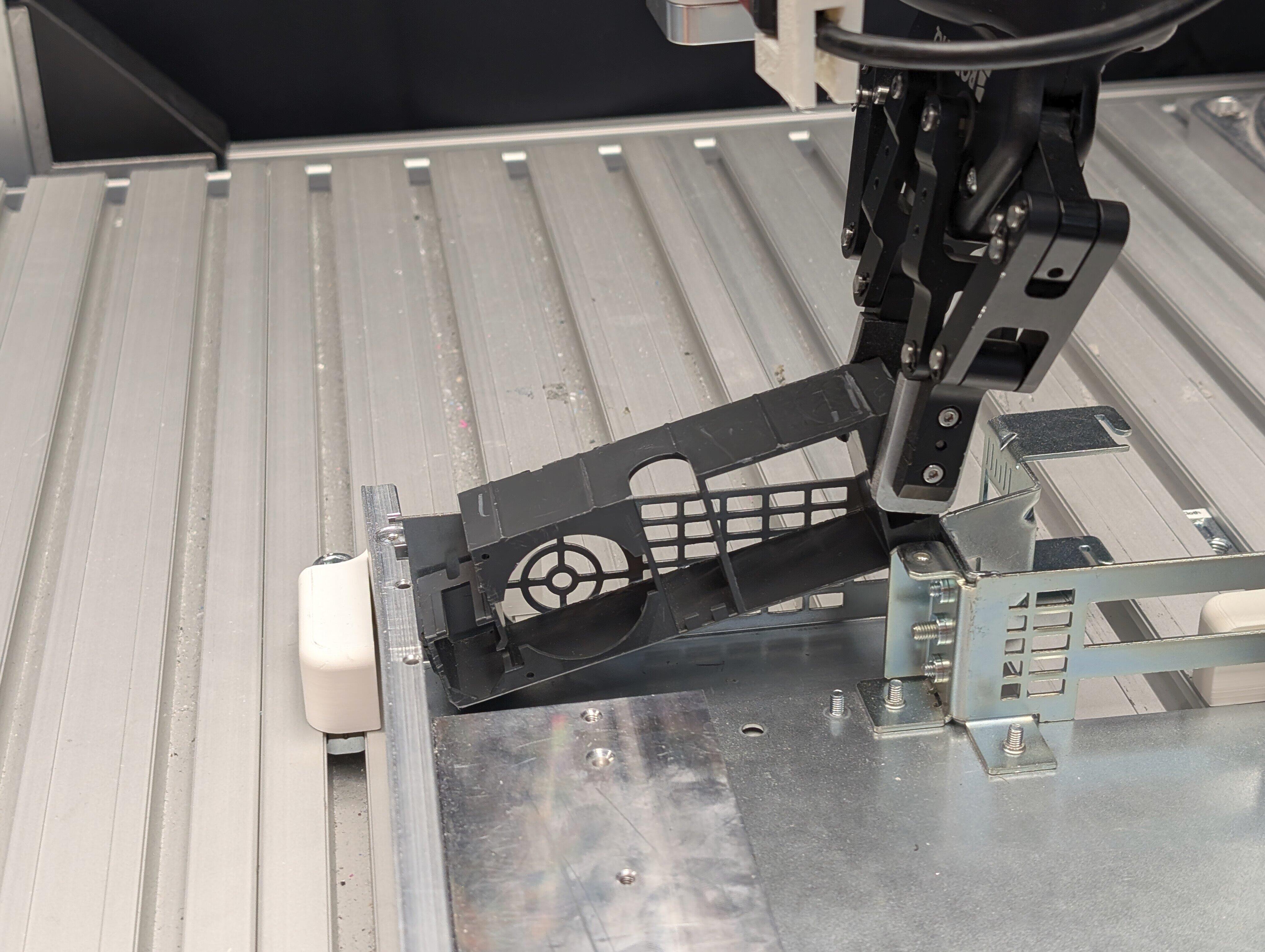
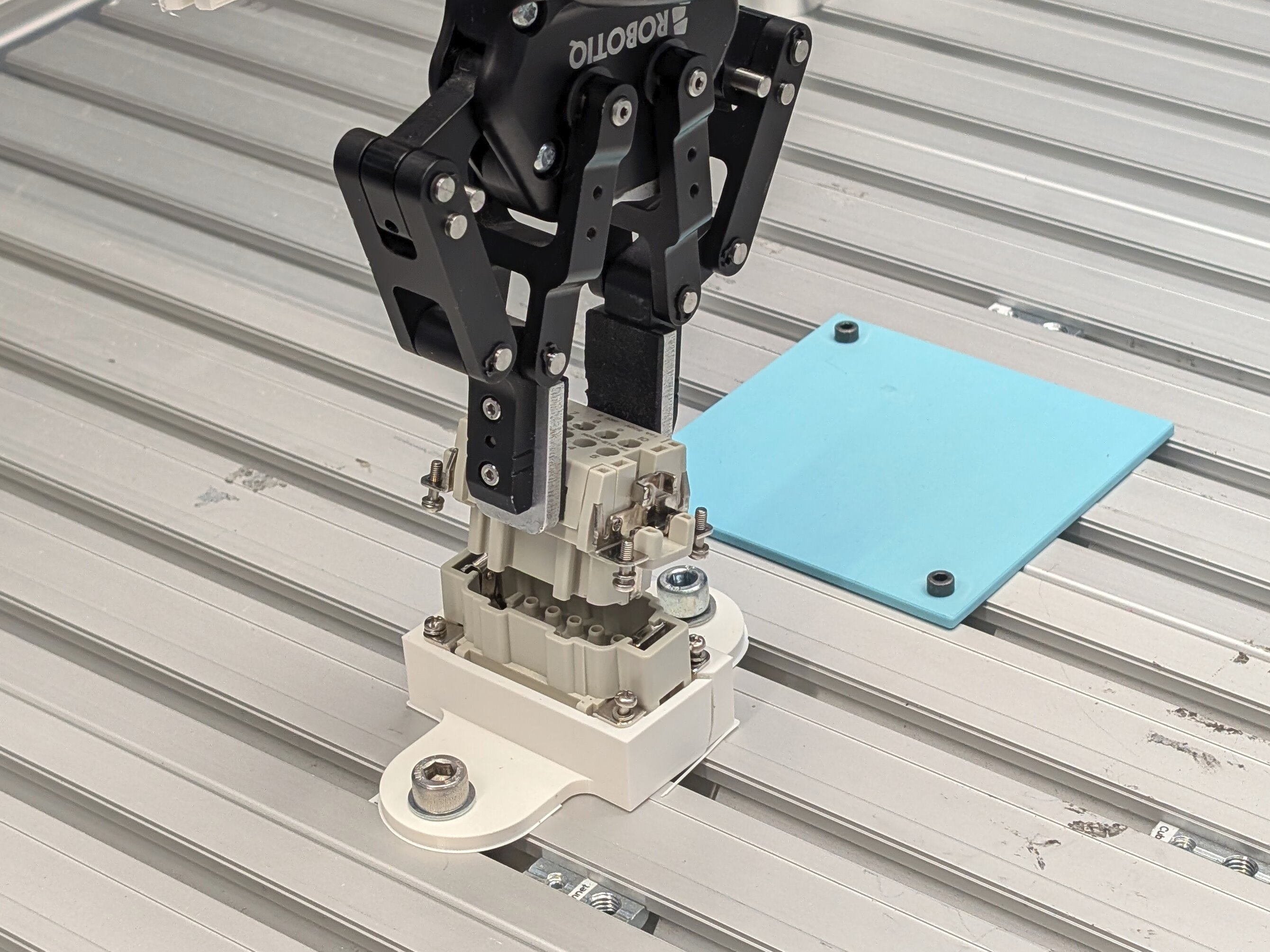
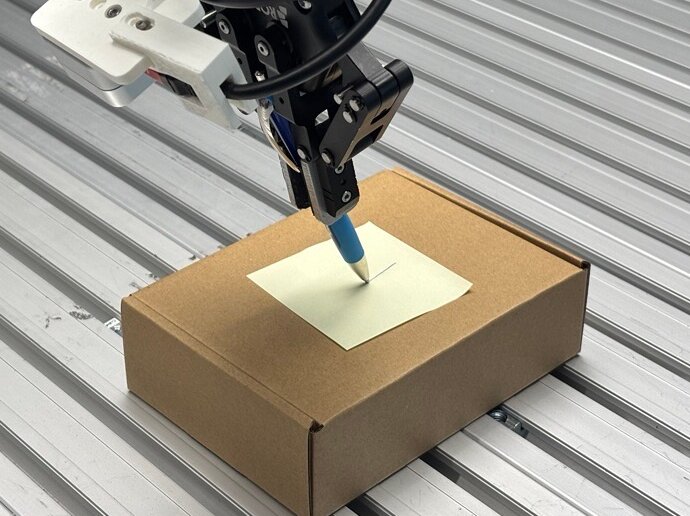
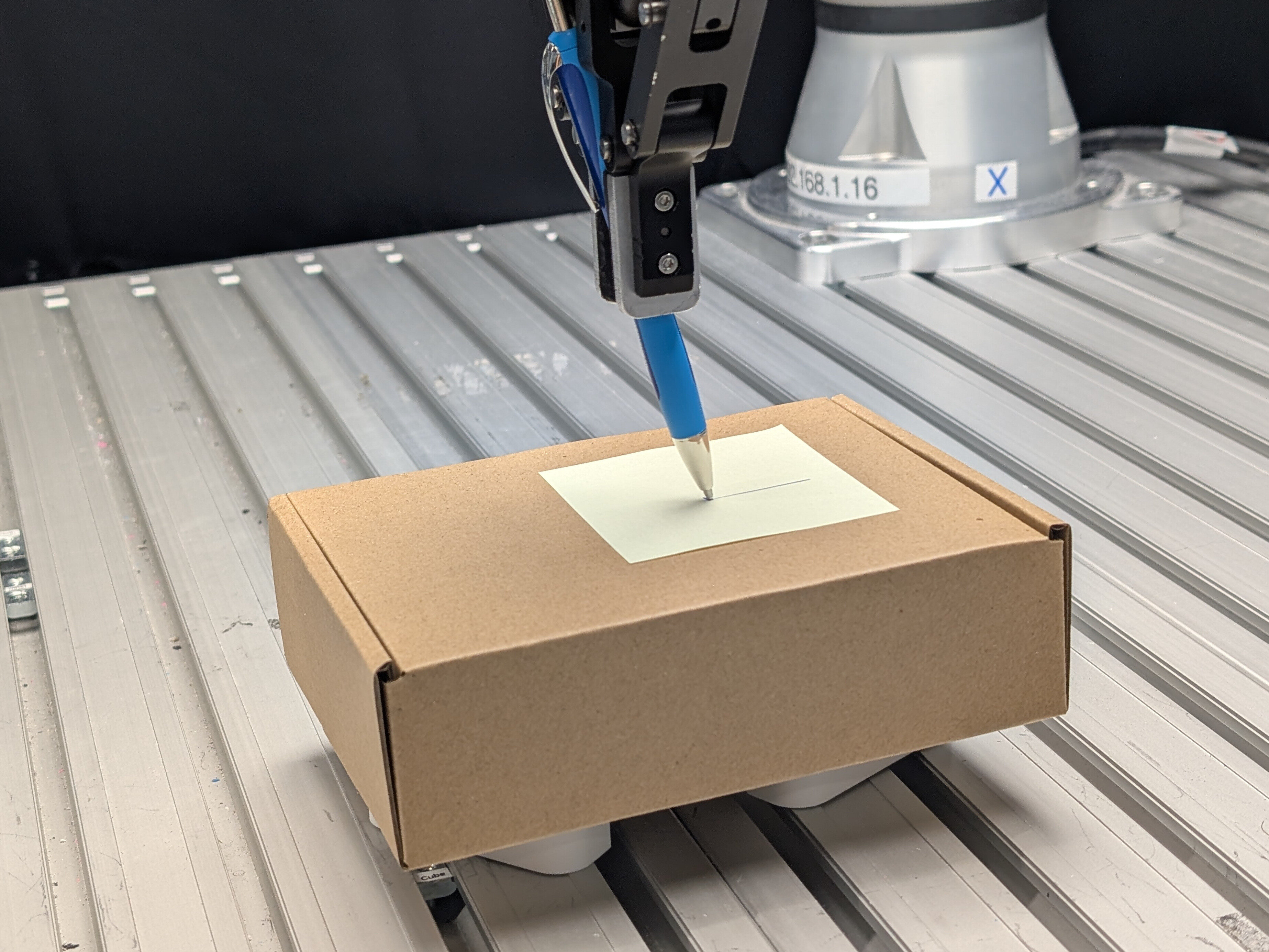
Five tasks test deliberate contact: peg insertion with 0.02 mm tolerance, fuse clipping, fan insertion, industrial connector insertion, and pen writing. The peg trial includes operator assistance to ensure a good grasp; only transfer and insertion are autonomous. The study does not claim benefits for tasks where contact force is incidental.
The bilateral setup uses two UR5e arms with external force/torque sensors; position demonstrations use one arm and a Meta Quest 3 VR interface. The UR5e force mode implements admittance control using the external sensor. Three cameras observe the workspace and wrist; an RTX5090 workstation runs inference.
IV-B Datasets and Policies
Each task has two matched datasets: bilateral wrench demonstrations and position-based VR demonstrations, with 200–300 episodes per interface. Converting each dataset into the other action space yields four policies: bilateral/wrench, bilateral/position, VR/wrench, and VR/position. The conversion uses the impedance model; inferred wrenches are not equivalent to deliberately commanded ones.
The position baseline uses low, tuned stiffness subject to usable teleoperation. All policies train for 150,000 steps with batch size 32. Table I preserves the four conditions and equation (3) the inverse conversion.
Equation 3
| (3) |
| Action Space | Wrench | Position | |
|---|---|---|---|
| Dataset | Bilateral | ||
| VR data | |||
IV-C Results
Each policy receives 50 rollouts per task. Bilateral/wrench averages 76.8% success; bilateral/position reaches 34.8%, VR/wrench 28.8%, and VR/position 40%. Against VR/position, bilateral/wrench achieves 74% versus 6% on peg insertion, 58% versus 8% on fan insertion, and 80% versus 12% on the connector. These three differences pass the reported task-wise statistical test with Bonferroni correction. Fuse clipping and writing differences are not significant; fuse success is numerically lower, 88% versus 96%.
The cross-condition results support matching the demonstration interface to the action space. Bilateral data is not universally better for position policies, and converting VR recordings into wrench targets does not reproduce the gain. Table II retains every task/condition result.
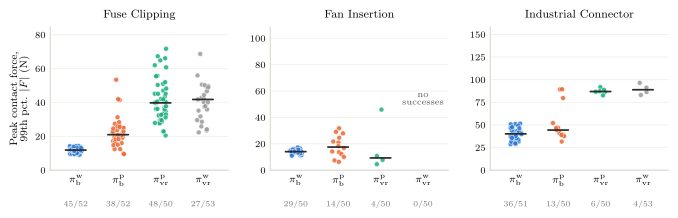
Figure 4 measures each rollout’s 99th-percentile force magnitude. Successful bilateral/wrench conditions tend to show lower near-peak loading or tighter distributions. The force plot labels include trial totals from 50 to 53, whereas the success-rate text specifies 50 rollouts per condition; those counts should not be treated as identical. Low force alone is not evidence of better control: unsuccessful fan insertions can also exert less force.
| Task | ||||
|---|---|---|---|---|
| Peg Insertion | 74% | 2% | 2% | 6% |
| Fuse Clipping | 88% | 72% | 52% | 96% |
| Fan Insertion | 58% | 28% | 0% | 8% |
| Industrial Connector | 80% | 26% | 4% | 12% |
| Pen Writing | 84% | 46% | 86% | 78% |
| Average | 76.8% | 34.8% | 28.8% | 40% |
IV-D Inference Frequency Analysis
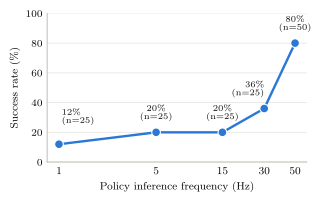
On industrial connector insertion, success falls from 80% at 50 Hz to 36% at 30 Hz, 20% at 15 Hz, 20% at 5 Hz, and 12% at 1 Hz. The nominal rate uses 50 rollouts; reduced rates use 25 each. Stable execution below the 500 Hz inner loop is possible, but precise insertion still depends strongly on policy update frequency. Figure 5 preserves the complete comparison.
IV-E Robustness to Box-Height Variation
Raising the writing surface by 2.5 cm reduces success in all four conditions. Bilateral/wrench drops from 84% to 76%, compared with 78% to 24% for VR/position. VR/wrench falls from 86% to 56%, and bilateral/position from 46% to 8%. Wrench actions are more robust in this particular height-shift test; the suggested explanation is that force targets depend less directly on the contact plane’s height.
| Task | ||||
|---|---|---|---|---|
| Pen Writing, Nominal Height | 84 % | 46% | 86% | 78% |
| Pen Writing, Box Raised | 76% | 8% | 56% | 24% |
V Conclusions
Direct wrench prediction is viable for the studied contact-rich tasks when paired with intentional force demonstrations. Its advantage is conditional: single-task training, specialized sensing and bilateral hardware, a tuned controller, and a narrow task suite limit generalization claims. Peg evaluation also includes grasp assistance.
Multi-task learning, simulation-generated wrench demonstrations, and transfer from existing positional datasets remain future work. The conversion ablations caution against treating incidental measured forces as interchangeable with deliberate wrench commands.
Acknowledgment
The authors disclose using ChatGPT and Claude Code for debugging and limited boilerplate/data-processing code, with author review. ChatGPT also assisted with the illustrations in Figure 1. Research design, analysis, and interpretation are attributed to the authors.