At a glance
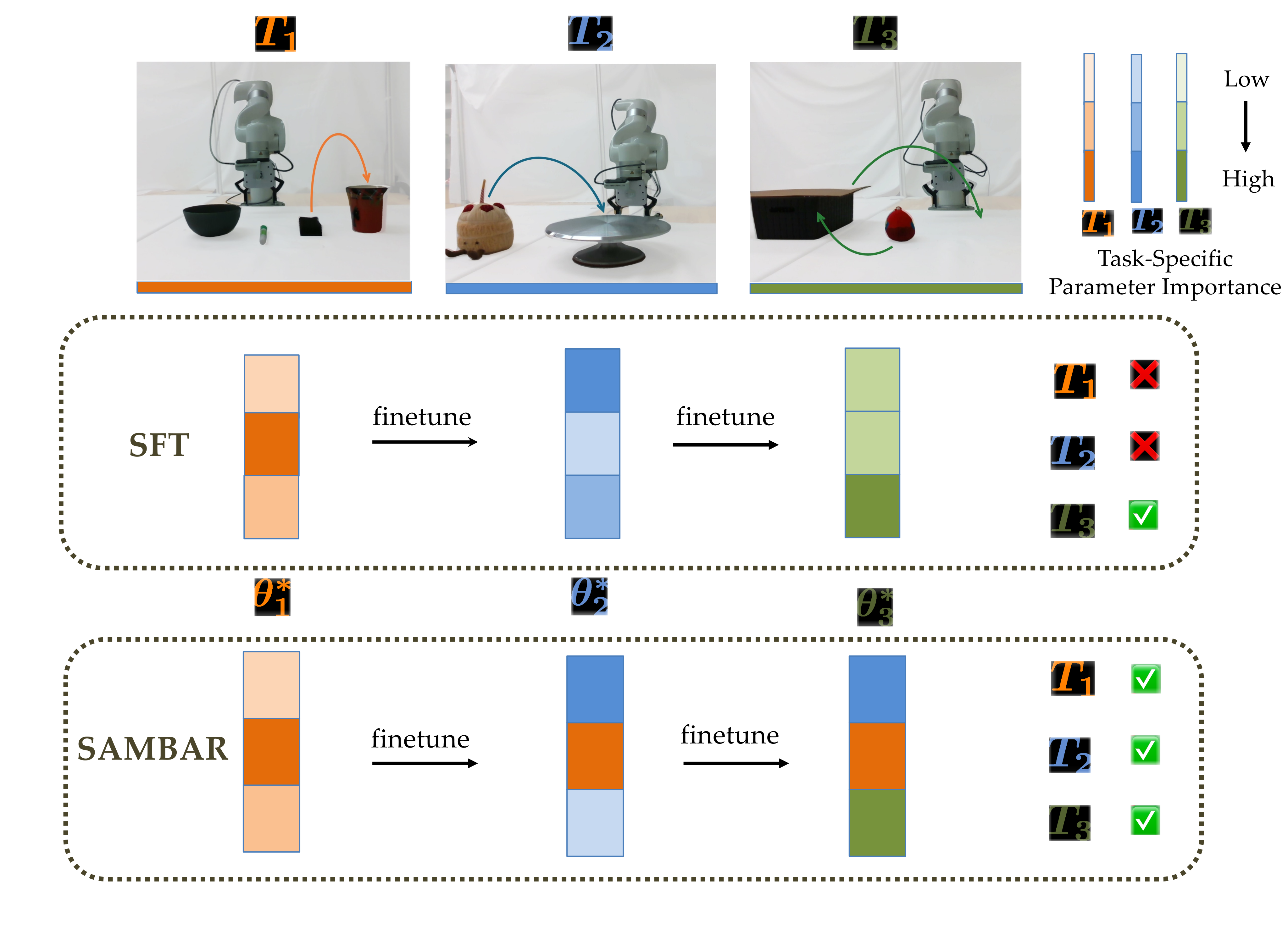
SAMBAR finetunes a vision-language-action policy on new tasks while anchoring parameters important to older tasks. It combines diagonal gradient-based importance estimates with a method-of-multipliers update that accumulates parameter drift.
Sequential LIBERO experiments retain 88.2% pretraining success and 78.7% mean success on three new tasks. In a small hardware study, final success is 20/20 on old-task trials and 4/5 on each of two new tasks. The method reduces forgetting in these settings, with a practical trade-off between retention, acquisition and training budget.
I INTRODUCTION
Finetuning a deployed robot for a new manipulation task can degrade earlier skills. Replay addresses this using old demonstrations; SAMBAR instead retains checkpoints and compact parameter-importance statistics.
The model provider must supply an initial importance estimate for the pretrained tasks, as assumed in this paper. A checkpoint alone does not contain the additional statistic required by the method. The experiments construct pretrained LIBERO policies on which that statistic can be computed.
II RELATED WORKS
The paper compares replay, parameter isolation, model merging and regularization. Replay stores historical examples; adapters restrict the update space; merging blends models; importance-weighted regularization penalizes changes to selected parameters.
SAMBAR adds a signed dual accumulator to an importance-weighted moving anchor. EWC [5] supplies the related Fisher-diagonal motivation, while the anchor and dual update distinguish the proposed training procedure.
III Problem Formulation
Tasks arrive sequentially as language-conditioned demonstration datasets. Each stage starts from the previous policy and uses only the current task’s demonstrations. The generic behavioral-cloning objective is the mean negative log likelihood of demonstrated actions.
The goal is performance on both the original pretraining tasks and all subsequently learned tasks. Retention, current-task acquisition and a task-count-weighted average are therefore evaluated separately.
Equation 1
| (1) |
IV Preliminaries
An augmented Lagrangian adds a linear dual term and a quadratic constraint penalty to the task loss. The dual variable accumulates signed constraint violations and feeds them into later updates; the penalty coefficient remains fixed.
The displayed method-of-multipliers equations use a primal minimization. Algorithm 1 implements an optimizer step at each iteration. The general optimization framework does not itself prove convergence or zero forgetting for this nonconvex neural training procedure [12].
Equations 2–4b
| (2) |
| (3) |
| (4a) | ||||
| (4b) | ||||
V SAMBAR
SAMBAR first writes parameter preservation as a constrained training problem, then replaces uniform preservation with a per-parameter importance-weighted anchor. All original equations and the complete algorithm remain below.
V-A Continual Learning as Constrained Optimization Problem
The initial equality constraint fixes every parameter to its previous value. Applied exactly, this would prevent adaptation. Its practical uniform-anchor ablation strongly retains old performance but often fails to acquire new skills.
Finite primal/dual updates provide an optimization mechanism for penalizing drift. Importance weighting is introduced to make that anchoring selective.
Equations 5–6b
| (5) |
| (6a) | ||||
| (6b) | ||||
V-B Importance Weighted Anchor
The anchor blends the current and previous parameters according to new-task and accumulated old-task importance. Old-task-sensitive parameters remain close to their previous values; parameters important primarily to the new task can move further.
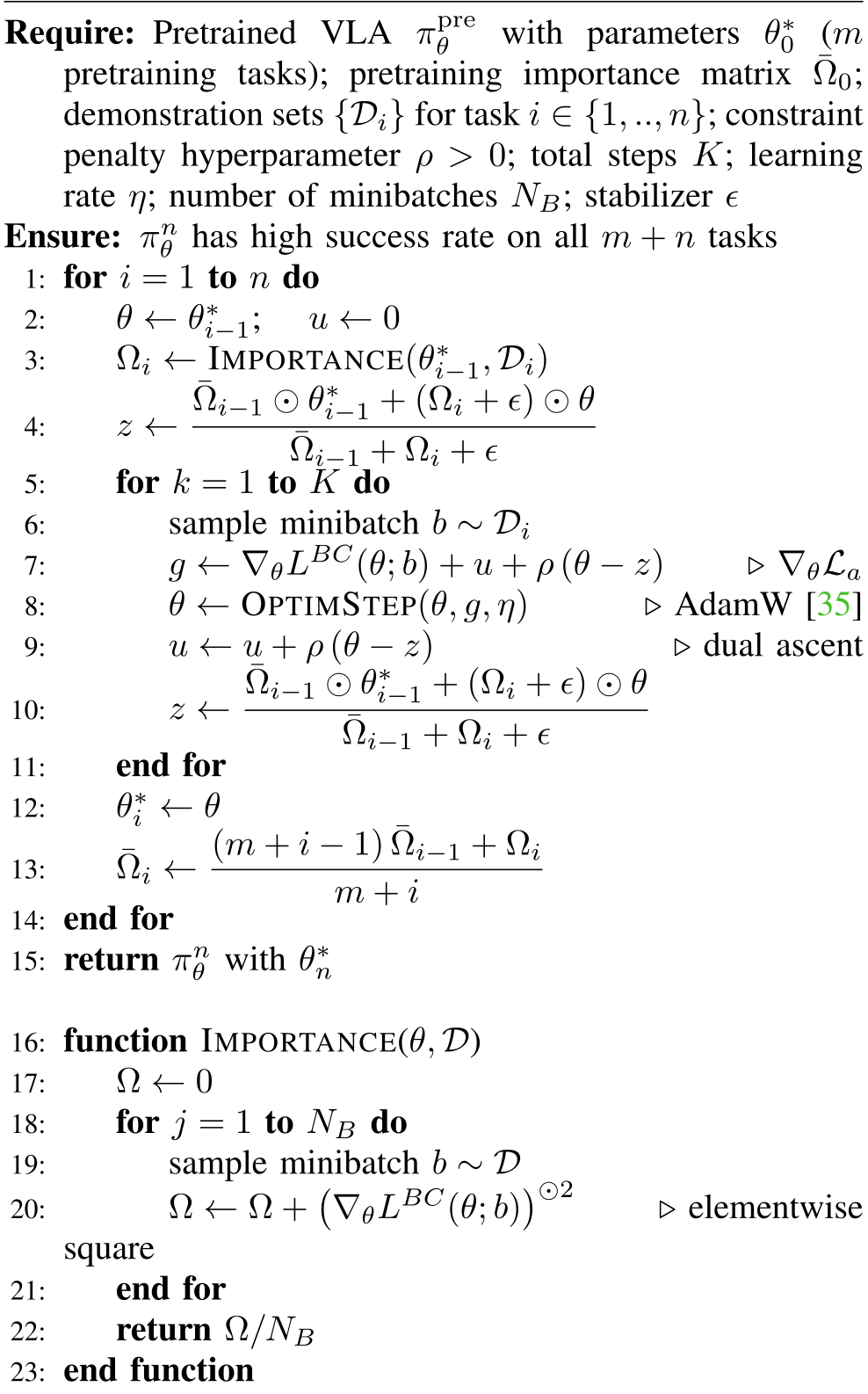
New-task importance is estimated once at the start of a stage and then averaged into the stored statistic using task counts. The archive is diagonal, so its size grows linearly with parameter count and remains fixed as more tasks arrive. Training also needs the current/old parameters, anchor, dual values and optimizer state.
Equation 8 describes an average of individual-sample squared gradients, whereas Algorithm 1 squares minibatch gradients and averages over sampled batches. These estimators can differ. The algorithm also includes a numerical stabilizer in the elementwise anchor formula that the main matrix equation omits.
The selectable algorithm preserves all 23 original numbered steps, Require/Ensure headers, optimizer update, dual ascent, stabilized anchor and importance subroutine. Its output success statement describes the intended result.
Equations 7–10
| (7) |
| (8) |
| (9) | ||||
| (10) |
Selectable algorithm with original mathematics
VI Simulation Results
The base model isπ0.5. Because it initially performs poorly in LIBERO, it is first pretrained within the benchmark; continual adaptation is then tested from those constructed policies.
Single-task experiments isolate one adaptation, followed by a three-task sequence that tests accumulating skills [13].
VI-A Experimental setup
The broad regime pretrains on 117 tasks and separately adapts to pot-on-stove, items-into-basket or mugs-on-plates. The narrow regime uses 32 tasks, eight per suite, and adapts to pot-on-stove or bowl-in-drawer.
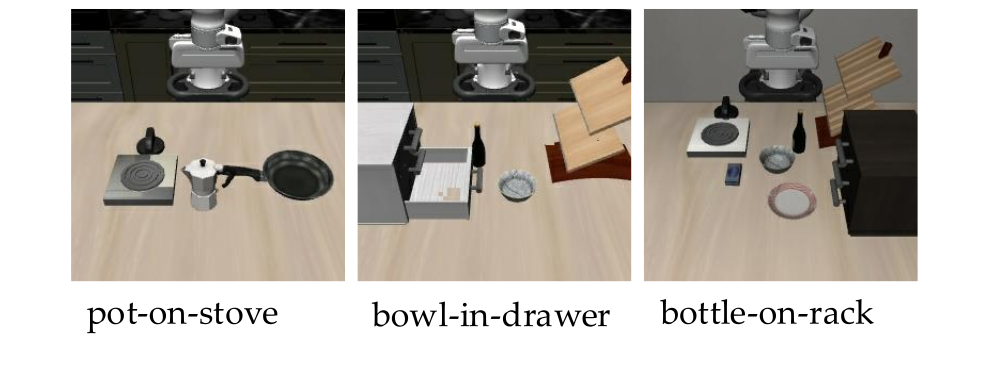
Sequential training starts from 32 tasks and learns pot-on-stove, then bowl-in-drawer, then bottle-on-rack. The final policy is evaluated on all 35 tasks. The experiments use one fixed sequence rather than testing arbitrary task orders.
VI-B Evaluation Metric
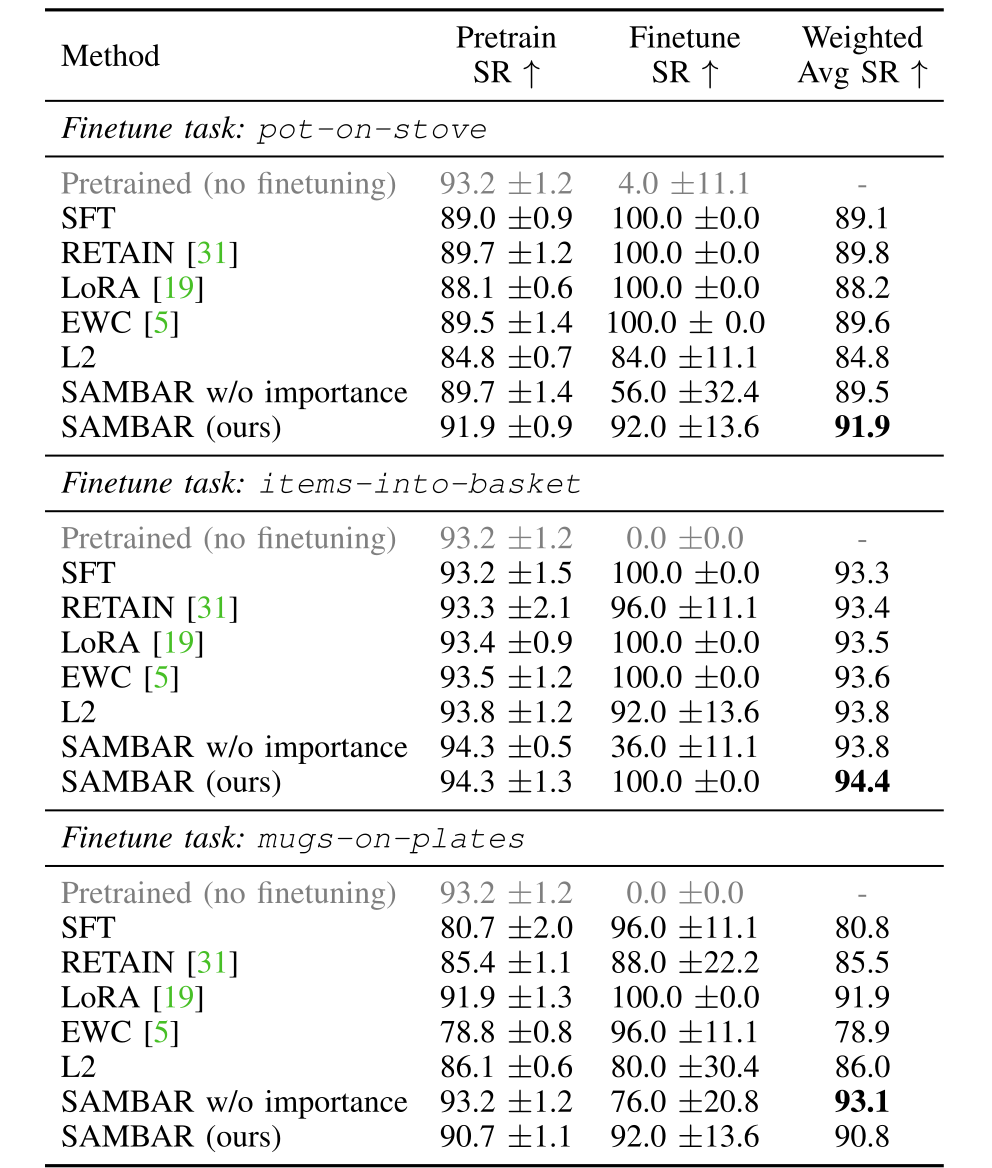
Pretrain SR measures old-task performance; Finetune SR measures acquisition. Weighted Avg SR averages by task count, so 117 old tasks dominate one new task in the broad setting. A high weighted score can coexist with poor new-task learning.
Simulation reports five seeds, with five episodes per seed in the broad setting and ten in the narrow/sequential setting. The paper reports 95% confidence intervals. Hardware uses successful rollout counts out of five per task.
VI-C Baselines
Replay-free supervised baselines include SFT, RETAIN, LoRA, EWC and uniform L2 anchoring. A SAMBAR ablation removes importance weighting. Simple Recipe Works uses reinforcement-learning interaction and a short demonstration warm-up; co-training has access to old demonstrations.
Those additional methods use different information and optimization resources. Co-training is a useful replay reference, rather than a proven upper bound on achievable performance [25].
VI-D Training details
Broad adaptation uses batch 64, learning rate 2.5×10⁻⁵ and 500 or 1,000 iterations depending on task. Narrow/sequential baselines use batch 16, learning rate 10⁻⁵ and 10,000 iterations per task; SAMBAR receives 20,000 to let dual updates develop.
The penalty coefficient is 0.02, and importance is estimated from 50 minibatches at each stage’s start. The RL baseline additionally uses a 100-iteration LoRA behavioral-cloning warm-up before environment training.
Results use each method’s best-performing checkpoint. The selection criterion is not fully specified. Comparisons include different training budgets and do not provide a matched wall-clock or memory-cost benchmark.
VI-E Learning from a broadly pretrained policy
For the broadly pretrained policy, forgetting is relatively mild. SAMBAR gives the highest reported weighted mean on pot-on-stove and items-into-basket, with 91.9% and 94.3% old-task success and 92% and 100% new-task success, respectively.
LoRA is stronger on mugs-on-plates:91.9% old-task and 100% new-task success, versus SAMBAR’s 90.7% and 92%. The results do not establish uniform superiority across all tasks.
Accessible table and original citation links
| Method |
Pretrain SR |
Finetune SR |
Weighted Avg SR |
| Finetune task: pot-on-stove | |||
| Pretrained (no finetuning) | 93.2 1.2 | 4.0 11.1 | - |
| SFT | 89.0 0.9 | 100.0 0.0 | 89.1 |
| RETAIN [31] | 89.7 1.2 | 100.0 0.0 | 89.8 |
| LoRA [19] | 88.1 0.6 | 100.0 0.0 | 88.2 |
| EWC [5] | 89.5 1.4 | 100.0 0.0 | 89.6 |
| L2 | 84.8 0.7 | 84.0 11.1 | 84.8 |
| SAMBAR w/o importance | 89.7 1.4 | 56.0 32.4 | 89.5 |
| SAMBAR (ours) | 91.9 0.9 | 92.0 13.6 | 91.9 |
| Finetune task: items-into-basket | |||
| Pretrained (no finetuning) | 93.2 1.2 | 0.0 0.0 | - |
| SFT | 93.2 1.5 | 100.0 0.0 | 93.3 |
| RETAIN [31] | 93.3 2.1 | 96.0 11.1 | 93.4 |
| LoRA [19] | 93.4 0.9 | 100.0 0.0 | 93.5 |
| EWC [5] | 93.5 1.2 | 100.0 0.0 | 93.6 |
| L2 | 93.8 1.2 | 92.0 13.6 | 93.8 |
| SAMBAR w/o importance | 94.3 0.5 | 36.0 11.1 | 93.8 |
| SAMBAR (ours) | 94.3 1.3 | 100.0 0.0 | 94.4 |
| Finetune task: mugs-on-plates | |||
| Pretrained (no finetuning) | 93.2 1.2 | 0.0 0.0 | - |
| SFT | 80.7 2.0 | 96.0 11.1 | 80.8 |
| RETAIN [31] | 85.4 1.1 | 88.0 22.2 | 85.5 |
| LoRA [19] | 91.9 1.3 | 100.0 0.0 | 91.9 |
| EWC [5] | 78.8 0.8 | 96.0 11.1 | 78.9 |
| L2 | 86.1 0.6 | 80.0 30.4 | 86.0 |
| SAMBAR w/o importance | 93.2 1.2 | 76.0 20.8 | 93.1 |
| SAMBAR (ours) | 90.7 1.1 | 92.0 13.6 | 90.8 |
VI-F Learning from a narrowly pretrained policy
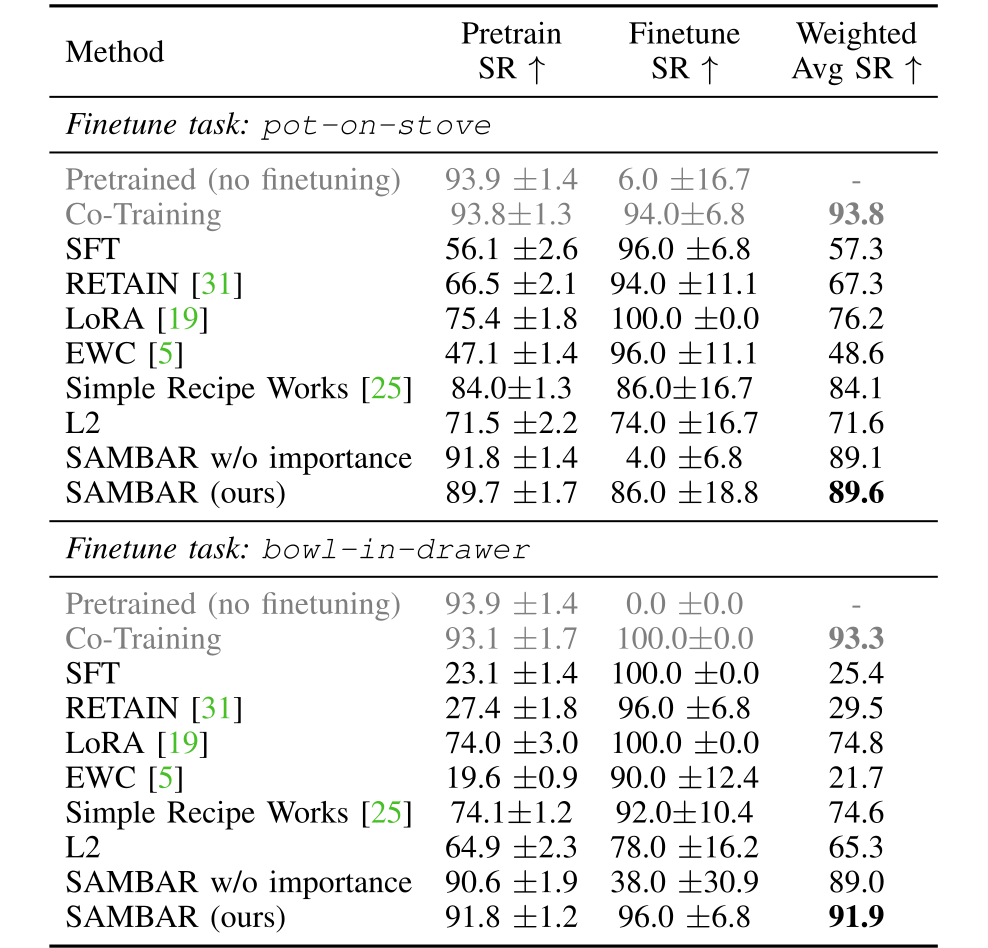
With narrow pretraining, SAMBAR retains 89.7/91.8% old-task success and learns pot-on-stove/bowl-in-drawer at 86/96%. Uniform SAMBAR retains 91.8/90.6% but acquires those tasks at only 4/38%, illustrating over-anchoring.
The source’s statement that every other baseline falls below 80% old-task success has an exception: the RL baseline retains 84% on pot-on-stove. Replay co-training also retains more than 93% on both comparisons, using historical demonstrations.
Accessible table and original citation links
| Method |
Pretrain SR |
Finetune SR |
Weighted Avg SR |
| Finetune task: pot-on-stove | |||
| Pretrained (no finetuning) | 93.9 1.4 | 6.0 16.7 | - |
| Co-Training | 93.81.3 | 94.06.8 | 93.8 |
| SFT | 56.1 2.6 | 96.0 6.8 | 57.3 |
| RETAIN [31] | 66.5 2.1 | 94.0 11.1 | 67.3 |
| LoRA [19] | 75.4 1.8 | 100.0 0.0 | 76.2 |
| EWC [5] | 47.1 1.4 | 96.0 11.1 | 48.6 |
| Simple Recipe Works [25] | 84.01.3 | 86.016.7 | 84.1 |
| L2 | 71.5 2.2 | 74.0 16.7 | 71.6 |
| SAMBAR w/o importance | 91.8 1.4 | 4.0 6.8 | 89.1 |
| SAMBAR (ours) | 89.7 1.7 | 86.0 18.8 | 89.6 |
| Finetune task: bowl-in-drawer | |||
| Pretrained (no finetuning) | 93.9 1.4 | 0.0 0.0 | - |
| Co-Training | 93.1 1.7 | 100.00.0 | 93.3 |
| SFT | 23.1 1.4 | 100.0 0.0 | 25.4 |
| RETAIN [31] | 27.4 1.8 | 96.0 6.8 | 29.5 |
| LoRA [19] | 74.0 3.0 | 100.0 0.0 | 74.8 |
| EWC [5] | 19.6 0.9 | 90.0 12.4 | 21.7 |
| Simple Recipe Works [25] | 74.11.2 | 92.010.4 | 74.6 |
| L2 | 64.9 2.3 | 78.0 16.2 | 65.3 |
| SAMBAR w/o importance | 90.6 1.9 | 38.0 30.9 | 89.0 |
| SAMBAR (ours) | 91.8 1.2 | 96.0 6.8 | 91.9 |
VI-G Sequential Continual Learning
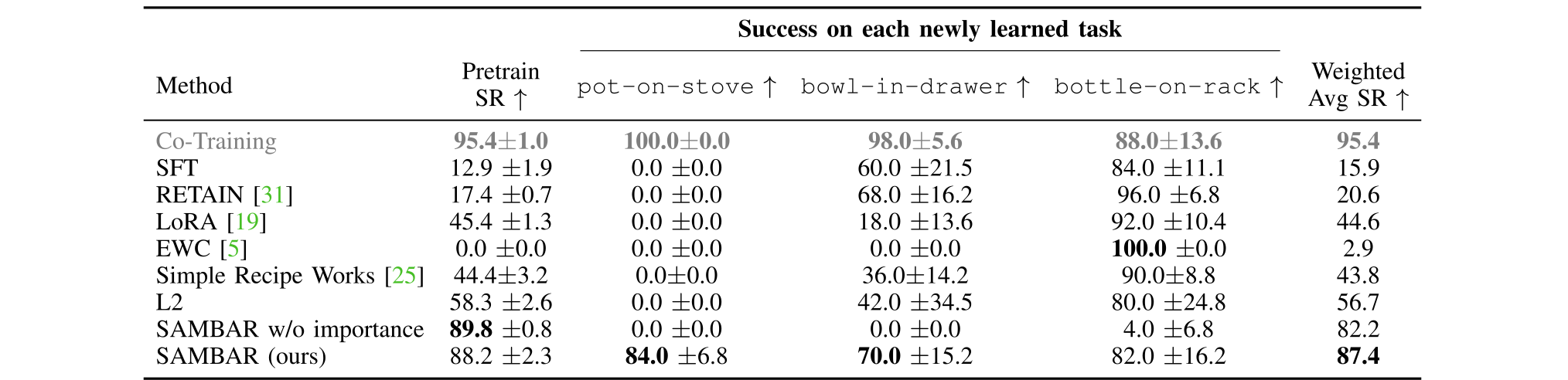
After all three new tasks, SAMBAR scores 88.2% on old tasks and 84%,70%,82% on the learned tasks, for 87.4% weighted success. Every listed replay-free baseline scores zero on the first new task.
Replay co-training retains 100% on that first task and reaches 95.4% weighted success. Thus the paper’s broad “every baseline forgets” claim should be scoped to the replay-free comparison. SAMBAR still shows some old-task degradation relative to its starting policy.
Accessible table and original citation links
| Success on each newly learned task | |||||
| Method |
Pretrain SR |
pot-on-stove | bowl-in-drawer | bottle-on-rack |
Weighted Avg SR |
| Co-Training | 95.41.0 | 100.00.0 | 98.05.6 | 88.013.6 | 95.4 |
| SFT | 12.9 1.9 | 0.0 0.0 | 60.0 21.5 | 84.0 11.1 | 15.9 |
| RETAIN [31] | 17.4 0.7 | 0.0 0.0 | 68.0 16.2 | 96.0 6.8 | 20.6 |
| LoRA [19] | 45.4 1.3 | 0.0 0.0 | 18.0 13.6 | 92.0 10.4 | 44.6 |
| EWC [5] | 0.0 0.0 | 0.0 0.0 | 0.0 0.0 | 100.0 0.0 | 2.9 |
| Simple Recipe Works [25] | 44.43.2 | 0.00.0 | 36.014.2 | 90.08.8 | 43.8 |
| L2 | 58.3 2.6 | 0.0 0.0 | 42.0 34.5 | 80.0 24.8 | 56.7 |
| SAMBAR w/o importance | 89.8 0.8 | 0.0 0.0 | 0.0 0.0 | 4.0 6.8 | 82.2 |
| SAMBAR (ours) | 88.2 2.3 | 84.0 6.8 | 70.0 15.2 | 82.0 16.2 | 87.4 |
VI-H Ablation Studies
The uniform dual-anchor ablation improves retention over fixed L2 but reduces acquisition. Adding importance to fixed L2 in EWC produces the opposite failure in these experiments: new-task learning remains strong while retention degrades.
Combining importance with dual updates recovers acquisition with modest retention changes relative to uniform SAMBAR. This supports the two components empirically, while the longer SAMBAR schedule remains part of the experimental comparison.
VII Hardware Results
Hardware experiments test four original tabletop tasks and two adaptation tasks on an xArm7. The full tables retain all rollout counts, including methods that preserve old skills but fail the new long-horizon task.
Accessible table and original citation links
| Pretraining tasks | |||||||
| Method | bird-in-bin | two-birds-in-bin | eraser-in-mug | eraser-in-bowl |
Pretrain SR |
Finetune SR |
Weighted Avg SR |
| Finetune task: cake-on-cake-tray | |||||||
| SFT | 4/5 | 1/5 | 5/5 | 2/5 | 60.0 | 5/5 | 68.0 |
| RETAIN () | 5/5 | 4/5 | 3/5 | 5/5 | 85.0 | 5/5 | 88.0 |
| EWC | 5/5 | 4/5 | 5/5 | 2/5 | 80.0 | 4/5 | 80.0 |
| SAMBAR (ours) | 5/5 | 5/5 | 5/5 | 5/5 | 100.0 | 5/5 | 100.0 |
| Finetune task: remove-lid-and-place-bird | |||||||
| SFT | 5/5 | 4/5 | 4/5 | 3/5 | 80.0 | 5/5 | 84.0 |
| RETAIN () | 5/5 | 5/5 | 3/5 | 5/5 | 90.0 | 0/5 | 72.0 |
| EWC | 5/5 | 5/5 | 3/5 | 5/5 | 90.0 | 0/5 | 72.0 |
| SAMBAR (ours) | 5/5 | 5/5 | 5/5 | 5/5 | 100.0 | 4/5 | 96.0 |

Accessible table and original citation links
| Pretraining tasks | Finetune tasks | |||||||
| Method |
bird-in- bin |
two-birds- in-bin |
eraser-in- mug |
eraser-in- bowl |
Pretrain SR |
cake-on- cake-tray |
remove-lid-and- place-bird |
Weighted Avg SR |
| SFT | 5/5 | 5/5 | 5/5 | 3/5 | 90.0 | 4/5 | 3/5 | 83.3 |
| RETAIN () | 5/5 | 5/5 | 4/5 | 4/5 | 90.0 | 5/5 | 0/5 | 76.7 |
| EWC | 5/5 | 5/5 | 5/5 | 5/5 | 100.0 | 4/5 | 2/5 | 86.7 |
| SAMBAR (ours) | 5/5 | 5/5 | 5/5 | 5/5 | 100.0 | 4/5 | 4/5 | 93.3 |
VII-A Experiment Setup
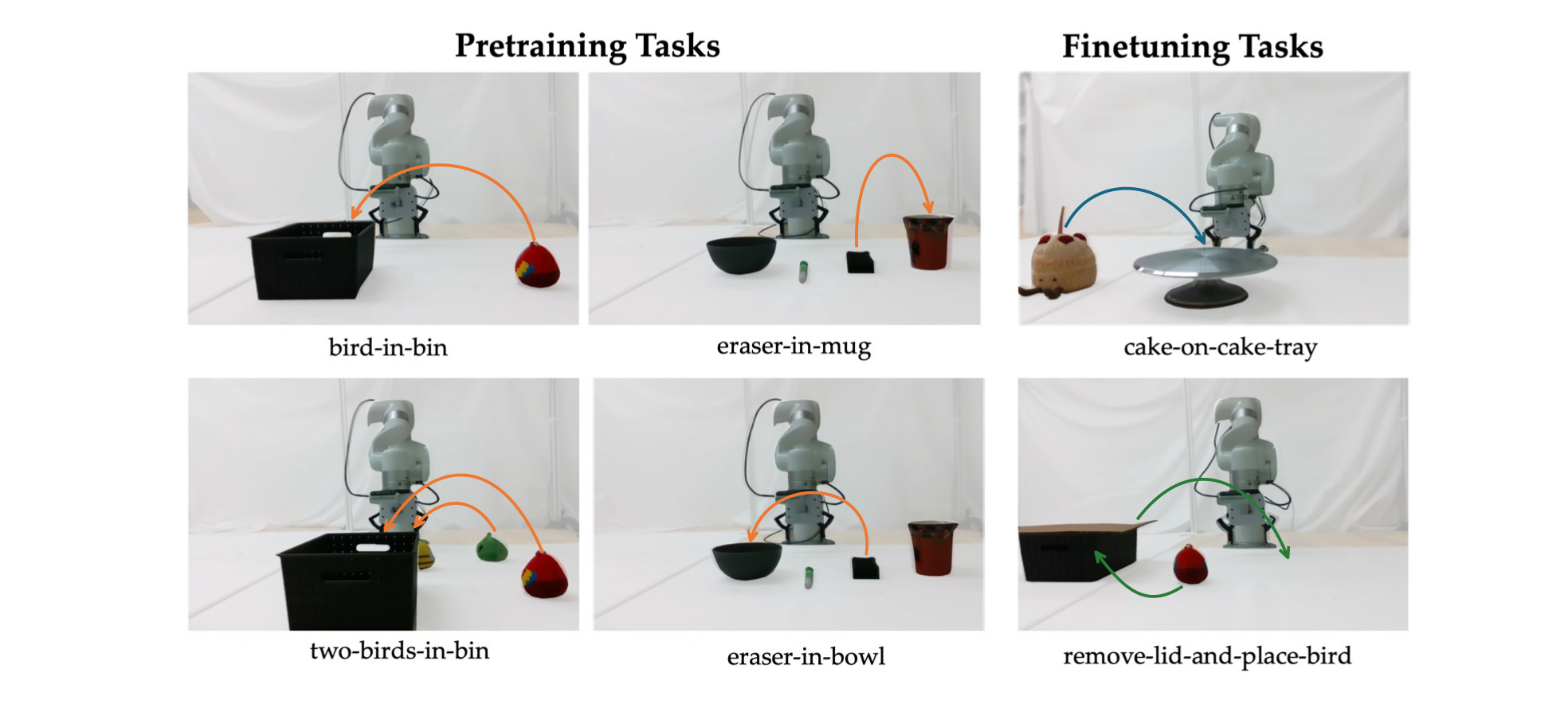
The authors collect 50 teleoperated demonstrations for each of six tasks. Four train the base policy; cake placement and removing a lid before placing a bird are held out for adaptation.
Hardware training uses batch 18 and learning rate 10⁻⁵. Single-task runs use 10,000 iterations; sequential SAMBAR receives 20,000 per task while baselines receive 10,000. Each task is tested with five complete-success rollouts, without partial credit. RETAIN uses α=0.5 here, versus 0.9 in simulation.
VII-B Finetuning on a single task
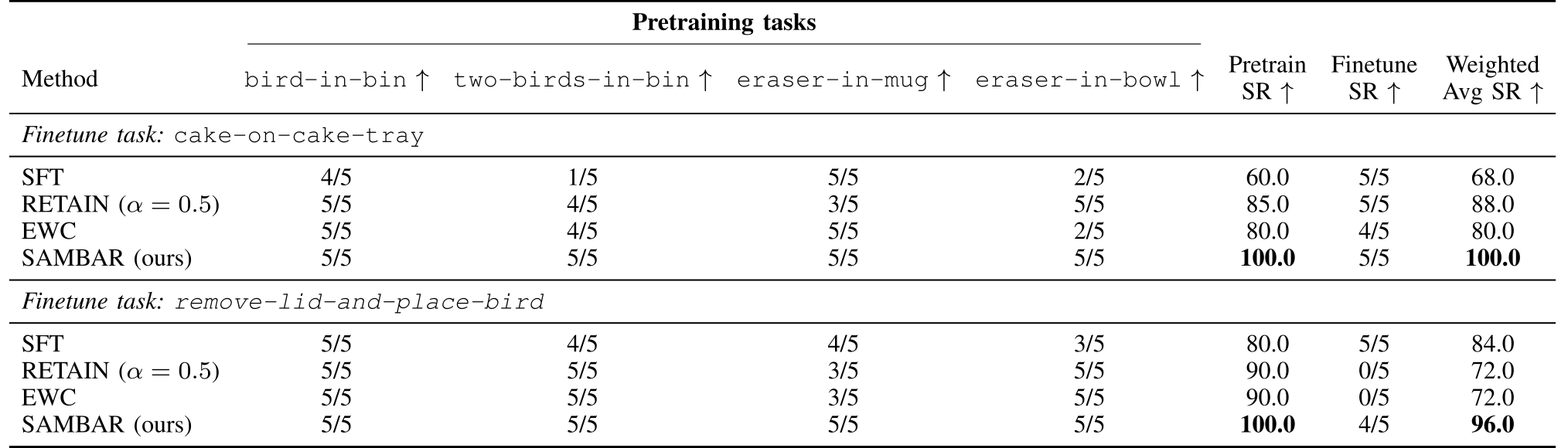
For cake placement, SAMBAR succeeds in all 25 evaluated old/new-task rollouts. For lid removal and bird placement, it succeeds on all 20 old-task trials and four of five new-task trials, or 24/25 overall.
SFT learns the new task while losing some old performance. RETAIN and EWC retain many old successes but score 0/5 on the new lid task. These small rollout sets illustrate the trade-off without establishing broad hardware reliability.
VII-C Sequential Continual Learning
After learning both hardware tasks in sequence, SAMBAR succeeds on 20/20 old-task trials and 4/5 for each new task, totaling 28/30 or 93.3%. EWC also retains 20/20 old-task successes but achieves 4/5 and 2/5 on the new tasks, totaling 86.7%.
The advantage concerns the combined retention/acquisition balance. Hardware retention alone is not unique to SAMBAR in this final comparison, and five trials per task leave substantial uncertainty.
VIII CONCLUSIONS and FUTURE WORK
The main contribution is a practical replay-free anchoring procedure combining compressed importance statistics and signed dual updates. Its evidence is strongest in the tested narrow-pretraining and sequential settings.
Dependencies include initial old-task importance metadata, checkpoint selection and extra optimization steps. Learning from the robot’s own rollouts is proposed future work.
Original project demonstrations
The authors’ project page provides 19 unique overview, hardware and simulation videos. All original files are retained unchanged with local preview frames. The page reuses the lid-task clips in two comparison galleries; they are archived once each.
The public code repository remains linked. Selected rollouts illustrate behavior alongside the complete quantitative tables.