Overview
Project and released resources: WROP data, exam, model weights, code, answers, and leaderboard. The original figures and complete task inventory are retained below.
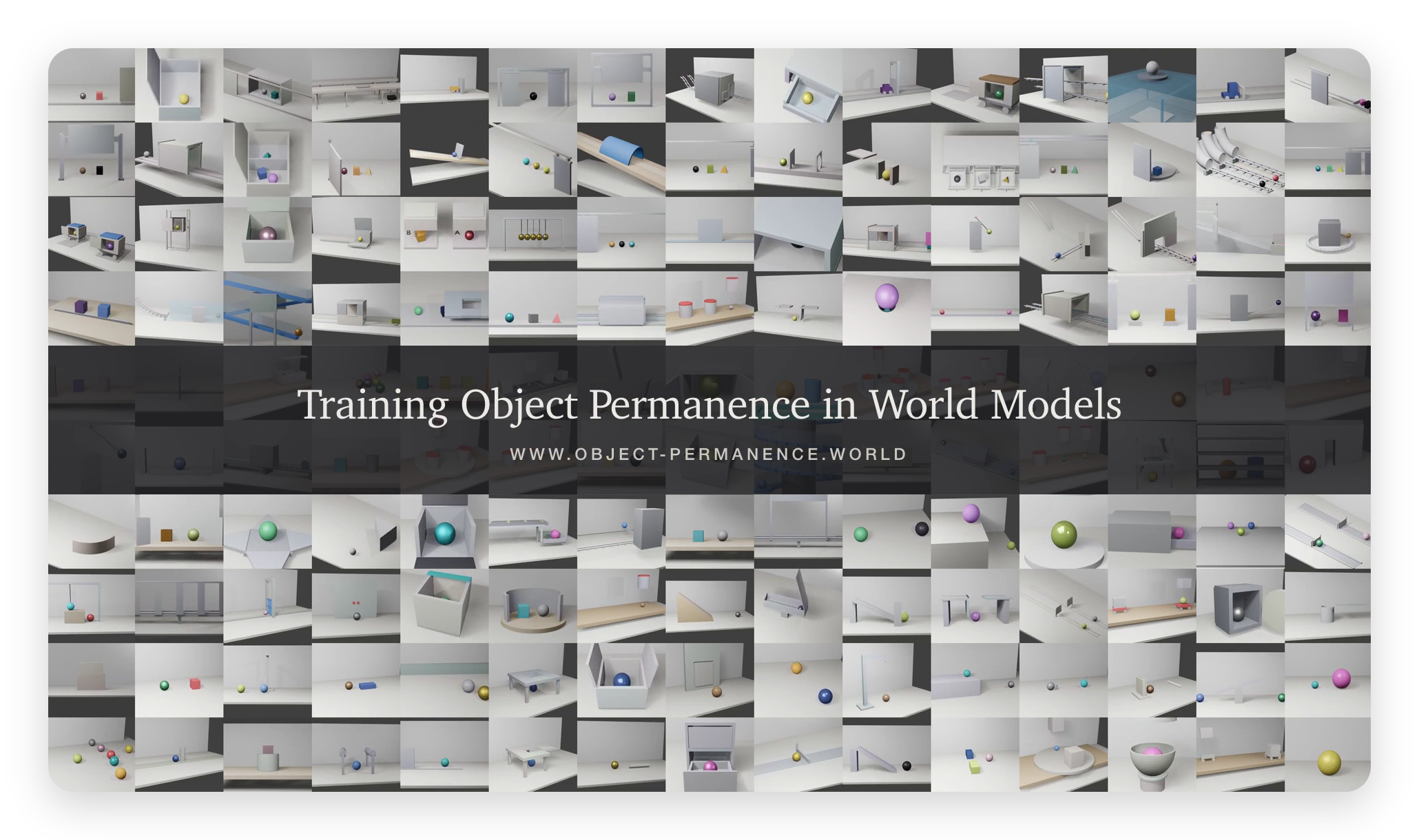
At a glance
Can video models keep track of objects when they disappear from view and respect solid boundaries? WROP supplies 150 hand-designed Blender generators across six task families, a 1.5-million-sample training set, and a 300-question exam. PWM-WROP, a 16-billion-parameter continuation model fine-tuned on this data, ranks first among four continuation systems and third across fourteen models in a blind human-preference study. The result supports targeted synthetic training, but different architectures and video interfaces prevent attributing the advantage to training alone.
1 Introduction
Realistic video can still violate object permanence (OP) and object solidity (OS): objects vanish during occlusion, change identity, or cross impenetrable barriers. Developmental studies treat these expectations as early foundations of physical cognition [2] [35]. WROP turns them into controlled three-dimensional video-continuation tasks, with ground-truth clips, prompts, object trajectories, and scene metadata.
The study combines a large training corpus with human judgments rather than relying on vision-language judges whose physical reasoning is itself unreliable [21]. PWM-WROP achieves Elo 1679.5 despite a native resolution of only 320 × 192. Two reference-to-video systems lead the overall ranking; their ability to regenerate an event on a new timeline makes their task different from faithfully extending the input.
2 Related Works
Video Models as World Models.
Diffusion and transformer-based generators have advanced visual fidelity, and benchmarks now probe maze solving, temporal induction, and visual rules [15] [30] [40]. WROP emphasizes a complementary gap: three-dimensional physical constraints, video-to-video conditioning, substantial training data, and human evaluation. Image similarity and automated language-model judgments can miss precisely the permanence and solidity failures under test.
Object Permanence and Solidity: Cognitive and Philosophical Foundations.
Piaget emphasized object permanence as a developmental achievement; later violation-of-expectation studies found that young infants already track hidden objects and expect containment and solid surfaces to constrain movement [31] [2] [13]. Adult visual cognition also exhibits automatic physical expectations [8]. These findings motivate the task design; success on the synthetic benchmark would not by itself establish a human-like internal representation.
3 Dataset
The dataset separates persistent object identity from the consequences of solid contact. All six families use a common input-video, prompt, and target-video format.
3.1 Cognitive Taxonomy
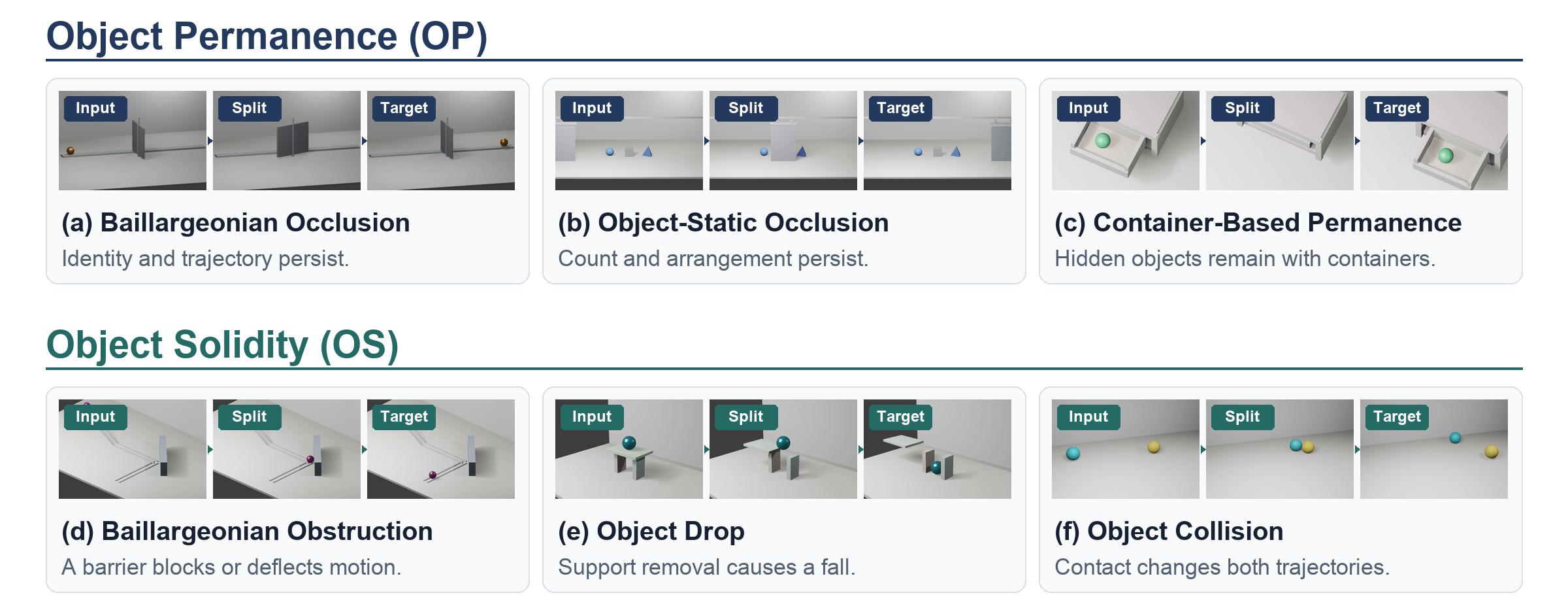
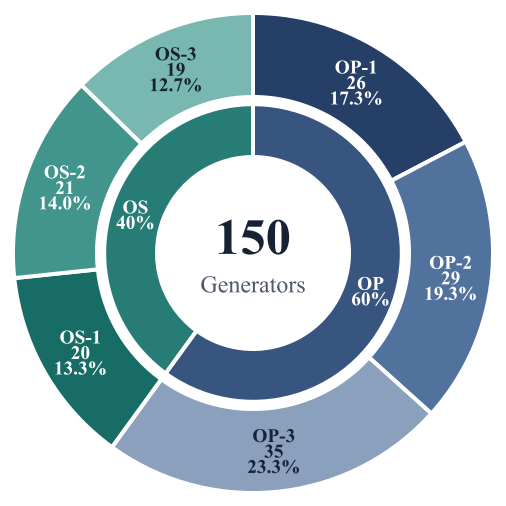
The 150 generators divide into 90 OP and 60 OS tasks. Structural variation changes the physical problem; surface variation changes appearance without changing the intended outcome. The event normally begins at the midpoint, after the conditioning clip.
- OP-1, dynamic occlusion: a moving object must reappear with its identity, size, and direction preserved.
- OP-2, static occlusion: a moving screen must reveal the same hidden objects in the same arrangement.
- OP-3, containment: hidden contents must follow their container through displacement, rotation, or swaps.
- OS-1, obstruction: aperture size determines whether a moving object passes or stops.
- OS-2, support removal: an unsupported object must fall, with subsequent passage or support determined by geometry.
- OS-3, collision: contact must produce plausible separate trajectories while conserving object identity and count.
3.2 Data Statistics
Each generator contributes 10,000 training samples and two exam questions: 1,500,000 training examples and 300 evaluation items. The standard sample is 120 frames at 1280 × 720 and 24 frames per second, divided into 60 conditioning and 60 target frames. It includes a prompt, per-frame object poses, and scene metadata. Motion is manually specified with Blender keyframes, rather than generated by a physics solver. The inference section separately identifies two 90-frame exam items.
3.3 Data Generation Pipeline
Generator design.
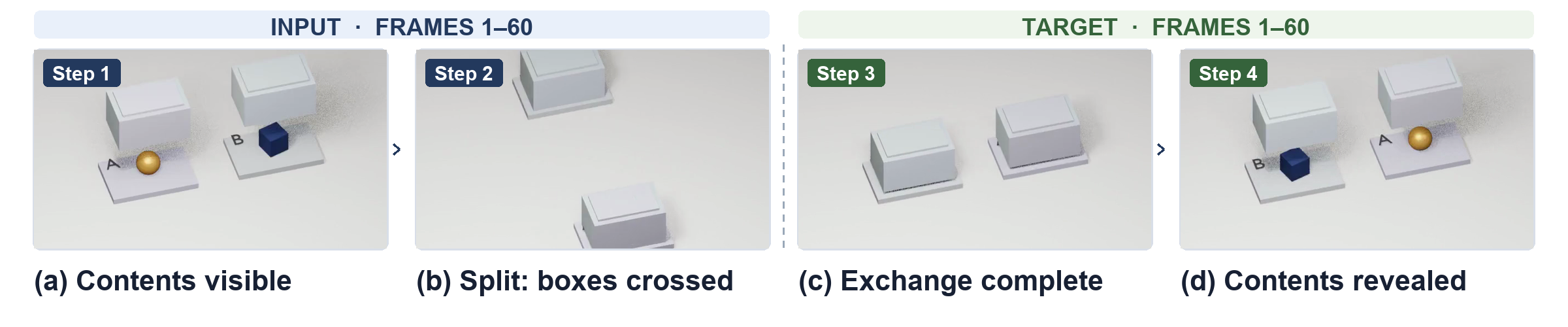
Each self-contained generator specifies objects, geometry, trajectories, contact timing, camera, prompt, and intended physical outcome. For example, marked boxes swap positions while retaining their original contents, requiring identity tracking rather than a fixed final-position rule. Authors inspect and revise scenes when collisions or occlusions look physically inconsistent.
A shared Blender 4.4.3 / EEVEE Next renderer records the random seed and packages input, target, prompt, trajectory, and metadata. Automated validation checks readable files, schemas, frame rate, clip lengths, and a continuous split; failures are regenerated. Representative samples from every generator receive manual inspection. Physical plausibility ultimately depends on the authored animation, not a rigid-body solver.
4 Evaluation
Fourteen systems receive the conditioning video and unchanged prompt; the target remains hidden. Human pairwise preference is the primary measure. Full-reference video metrics provide secondary diagnostics of similarity to the target.
4.1 PWM-WROP
PWM-WROP fine-tunes Cosmos3-Nano for one epoch on 1.5 million earlier renders of the same 150 generators [28]. Architecture and tokenizer remain unchanged. Training uses only the clip and natural-language prompt, without task labels: 57 conditioning frames plus 60 predicted frames at 320 × 192. It is the only evaluated model trained on WROP.
The released PWM stack implements native PyTorch training on AWS Trainium2. A tensor-parallel × FSDP2 mesh spans 64 NeuronCores. At the separate 288 × 512 throughput-test geometry, engineering changes reduce batch-16 training steps from 15.1 to 5.71 seconds; these measurements are not the evaluation-video resolution.
4.2 Models Evaluated
Interface class changes what a system can do. True continuation extends the original clip: PWM-WROP, MAGI-1, LTX-2.3 Extend, and Grok Imagine. Reference-to-video regenerates an event from the source and prompt on its own timeline: Seedance 2.5, Wan 3.0 Prime, and MiniMax H3. Seven edit/transfer systems chiefly transform the source span, making events after the input boundary a poor match for their interface. Table 1 preserves access routes and output geometries; rankings should be interpreted within these differing contracts.
| Model | Access | Interface class | Native output (res / fps / frames) |
| Ours | |||
| PWM-WROP | Trainium2 48XL | True continuation | / 24 / 60 predicted† |
| Open-weight | |||
| MAGI-1 24B | Local, multi-GPU | True continuation | / 24 / 77 |
| LTX-2.3 Dev | Local, multi-GPU | Edit / transfer (IC-LoRA) | / 24 / 121 |
| Wan-VACE 14B | Local, multi-GPU | Edit / transfer (repaint) | / 16 / 57 |
| HY-OmniWeaving | Local, multi-GPU | Edit / transfer (editing) | / 24 / 57 |
| Cosmos3 Super | Local, multi-GPU | Edit / transfer (edge control) | / 24 / 60 |
| Proprietary | |||
| LTX-2.3 Extend | FAL API | True continuation | / 24 / 145‡ |
| Grok Imagine (video extend) | FAL API | True continuation | / 24 / 132‡ |
| Seedance 2.5 | FAL API | Reference-to-video | / 24 / 97 |
| Wan 3.0 Prime | FAL API | Reference-to-video | / 30 / 90 |
| MiniMax H3 | FAL API | Reference-to-video | / 24 / 124 |
| Kling O3 Pro | FAL API | Edit / transfer (frame-wise) | / 24 / 73‡ |
| Gemini Omni Flash 1.1 | FAL API | Edit / transfer (frame-wise) | / 24 / 60 |
| Runway Aleph 2 | Runway API | Edit / transfer (frame-wise) | / 24 / 60 |
4.3 Inference Protocol
The harness passes prompts verbatim, disables provider prompt expansion where possible, and validates returned videos. Open-weight systems use upstream-recommended settings; hosted requests adapt duration to each target. Short inputs are front-padded when required, and stitched source footage is removed before scoring.
PWM-WROP reads the last 57 input frames and predicts 60 with UniPC, 35 sampling steps, guidance 6.0, shift 10.0, and a fixed seed. For two 90-frame items it cannot see the first 33 conditioning frames. Provider-specific padding, trimming, request payloads, and returned geometry are logged; this normalization does not remove the fundamental interface differences.
4.4 Human Judgment
Twenty qualified raters see the input, prompt, and two anonymized continuations, then choose A, B, or a tie using prompt alignment, natural motion, and physical/object consistency jointly. Clips are normalized to silent 720p at 24 frames per second. Raters pass 90.0% of attention checks and agree with themselves on 93.5% of repeats; no significant left-position preference is detected.
The analysis uses 361 judgments between distinct models, about 50–52 per model. Bradley–Terry strengths are mapped to Elo with mean 1500; ties count as half-wins, with a small virtual-draw regularizer described in Table 2. Confidence intervals use 1,000 rater-clustered bootstrap resamples. These are pooled preferences over sampled comparisons, not a physical-correctness percentage across all 300 questions. The source also reports 476 completed judgments and 120 scheduled candidate pairs without fully reconciling that scheduling count with fourteen distinct models.
4.5 Automatic Metrics
Automatic measures include pixel error, PSNR, SSIM, MS-SSIM, LPIPS, temporal differences, final-frame metrics, CLIP similarity, and FID. Predicted clips are temporally resampled and generally compared at 320 × 192; additional metrics use their own specified resolutions. A static repaint can resemble the reference while failing to show the physical event, and a correct continuation can differ in timing. These scores measure target agreement, not physical understanding.
5 Results
5.1 Human Preference
5.1.1 Overall Results
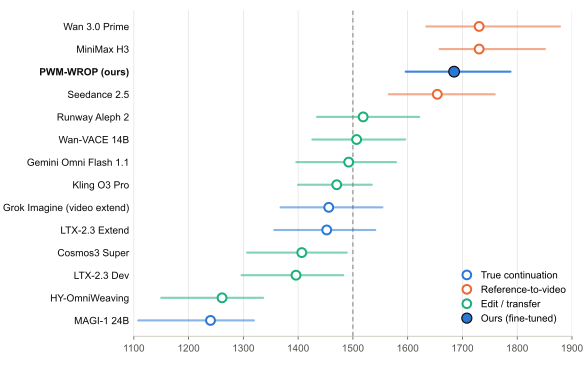
Using the original Table 2 values, Wan 3.0 Prime and MiniMax H3 tie at Elo 1723.6; PWM-WROP is third at 1679.5 (95% interval 1603.5–1781.5), and Seedance 2.5 is fourth at 1649.6. PWM-WROP leads the next continuation model, Grok Imagine, by 222.5 Elo points. Wide overlapping intervals make adjacent ranks uncertain; bootstrap first-place frequencies are 46.8%, 36.4%, 12.3%, and 4.5% for these top four.
Reference-to-video systems can redraw a physically coherent event but may change identities or spatial layout. Editors cluster lower on this continuation task. PWM-WROP shows promising performance after targeted training, but different architectures and the lack of a matched untrained-base comparison prevent isolating a causal training effect. Some source prose values differ slightly from the retained numerical table; this summary follows the table.
| Rank | Model | Class | Elo | 95% CI | Score rate | Games |
| 1 | Wan 3.0 Prime | Reference-to-video | 1723.6 | [1629.2, 1864.9] | 77.9% | 52 |
| 2 | MiniMax H3 | Reference-to-video | 1723.6 | [1644.5, 1837.6] | 77.9% | 52 |
| 3 | PWM-WROP (ours) | True continuation | 1679.5 | [1603.5, 1781.5] | 73.1% | 52 |
| 4 | Seedance 2.5 | Reference-to-video | 1649.6 | [1554.2, 1751.5] | 69.6% | 51 |
| 5 | Runway Aleph 2 | Edit / transfer | 1518.3 | [1425.1, 1621.6] | 52.9% | 51 |
| 6 | Wan-VACE 14B | Edit / transfer | 1506.7 | [1429.9, 1590.8] | 51.0% | 52 |
| 7 | Gemini Omni Flash 1.1 | Edit / transfer | 1492.5 | [1404.1, 1572.9] | 49.0% | 52 |
| 8 | Kling O3 Pro | Edit / transfer | 1471.3 | [1404.0, 1534.0] | 46.2% | 52 |
| 9 | Grok Imagine (video extend) | True continuation | 1457.0 | [1362.7, 1555.1] | 44.2% | 52 |
| 10 | LTX-2.3 Extend | True continuation | 1453.4 | [1363.6, 1545.8] | 43.1% | 51 |
| 11 | Cosmos3 Super | Edit / transfer | 1409.2 | [1318.2, 1488.7] | 37.3% | 51 |
| 12 | LTX-2.3 Dev | Edit / transfer | 1398.9 | [1297.7, 1482.3] | 36.5% | 52 |
| 13 | HY-OmniWeaving | Edit / transfer | 1268.5 | [1159.4, 1344.2] | 21.0% | 50 |
| 14 | MAGI-1 24B | True continuation | 1248.0 | [1137.2, 1315.6] | 19.2% | 52 |
5.1.2 Performance by Task Family
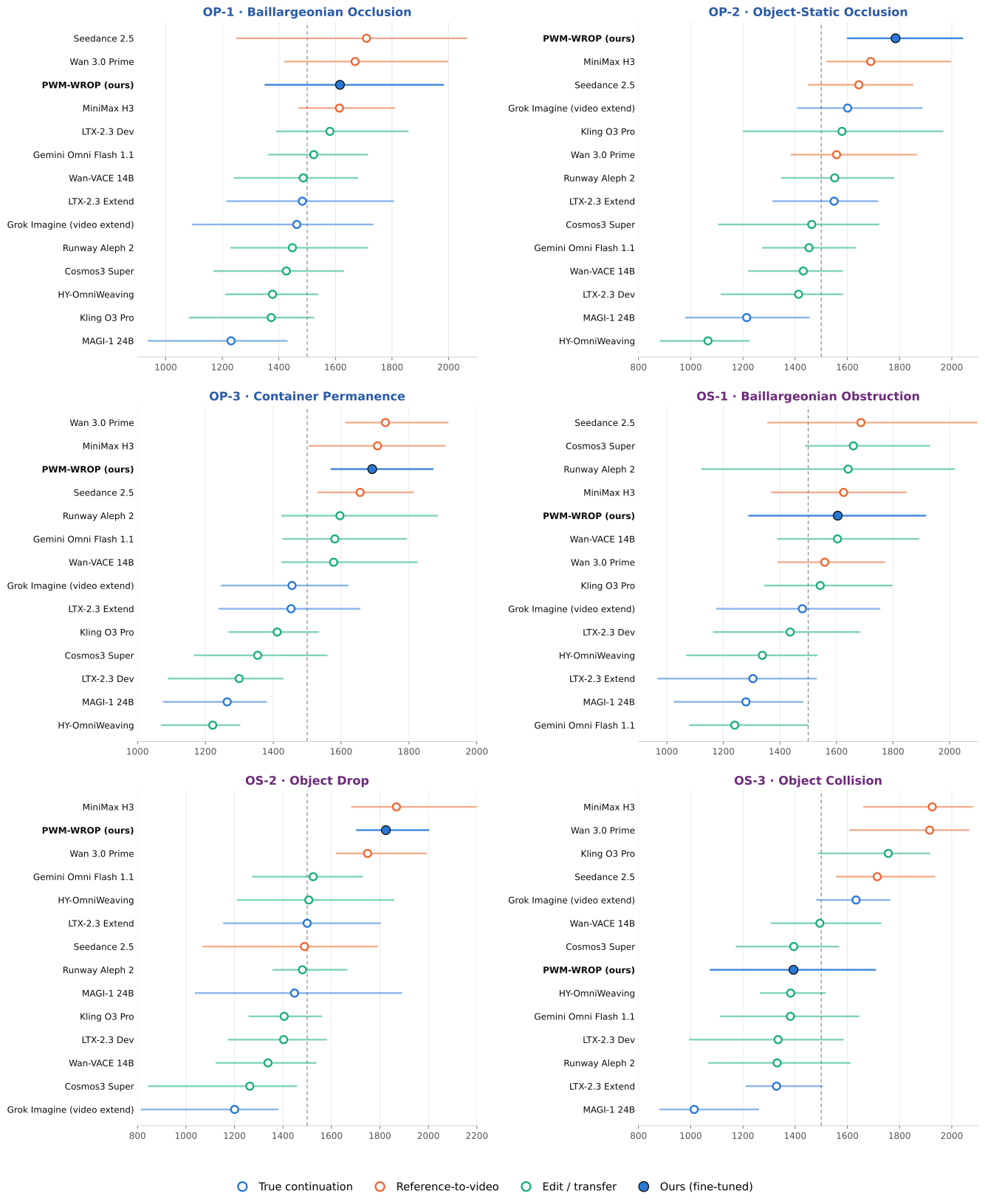
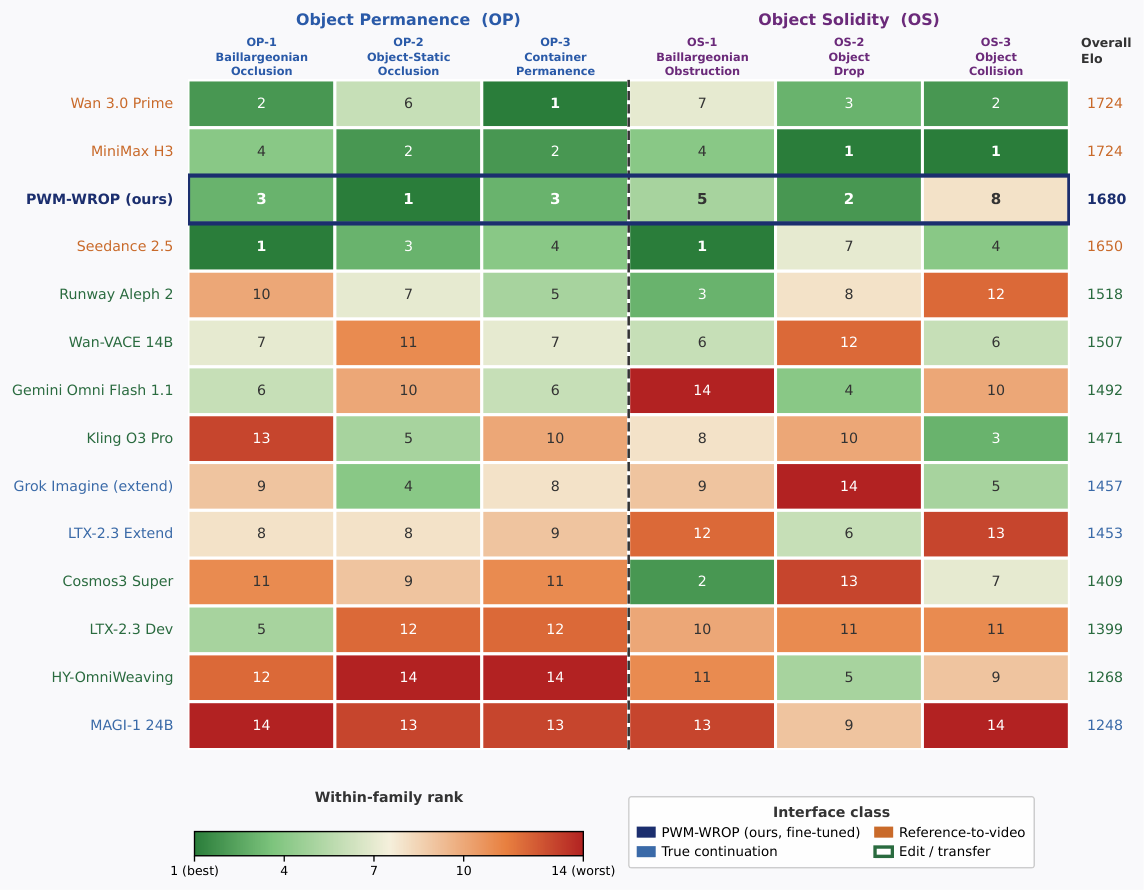
PWM-WROP ranks first on static-scene occlusion, third on dynamic occlusion and containment, second on support removal, fifth on obstruction, and eighth on collision. Its strength is therefore more consistent for hidden-object tracking than contact dynamics. MiniMax H3 leads support removal and collision; Wan 3.0 Prime leads containment. Per-family comparisons are sparse, especially for solidity tasks, so these ranks suggest patterns rather than establish statistically distinct abilities.
5.2 Qualitative Analysis
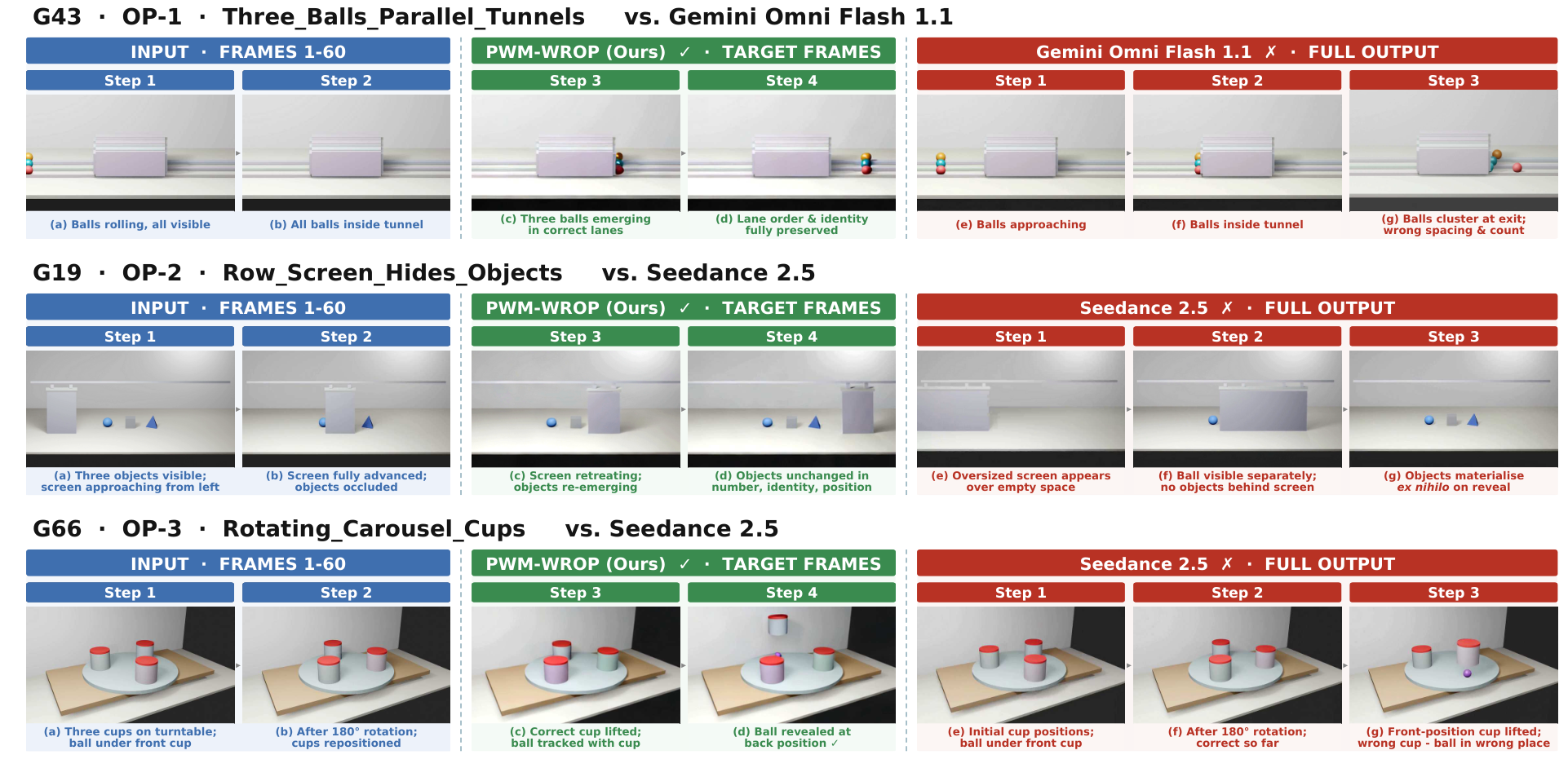
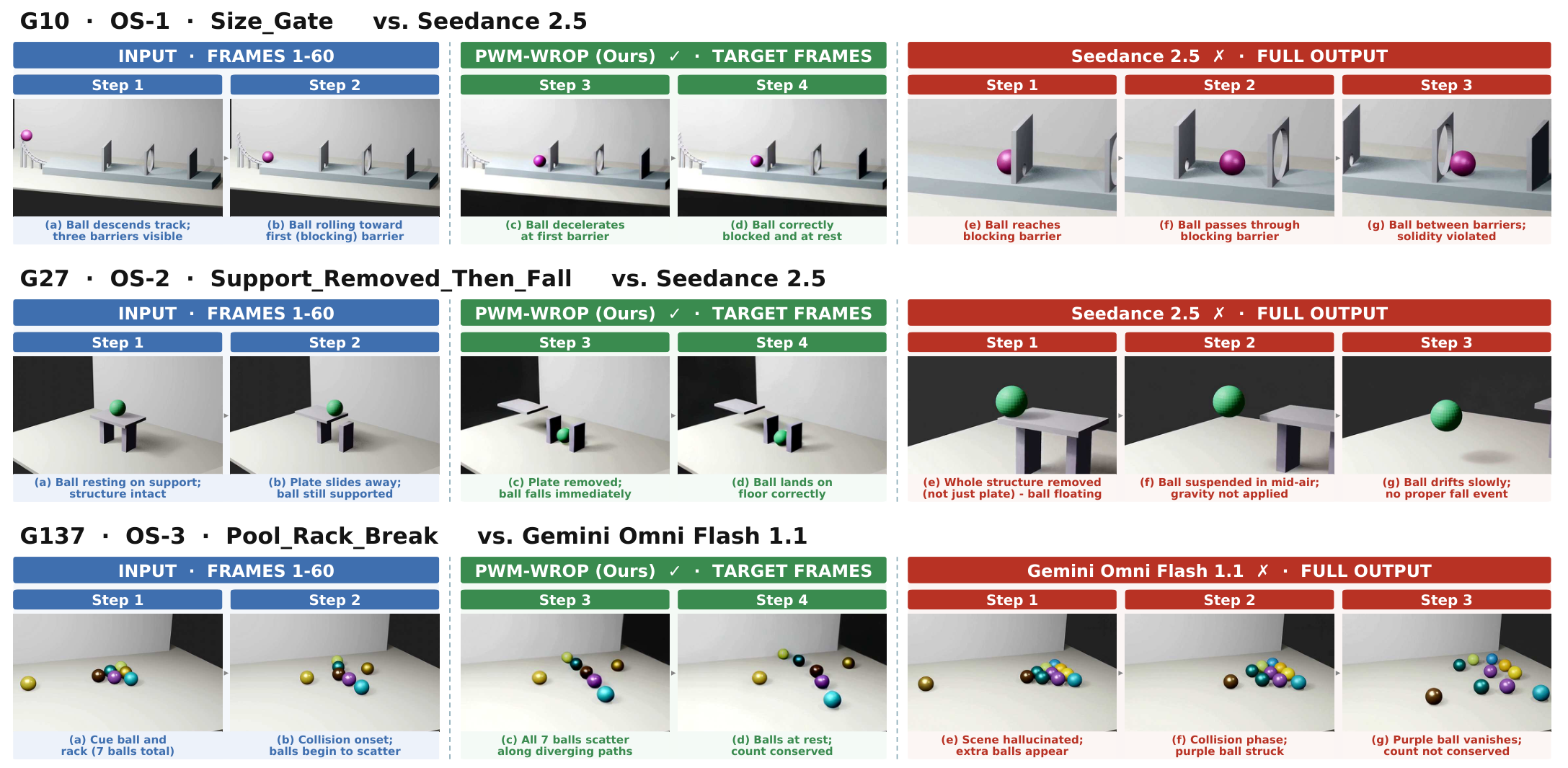
Six selected examples illustrate the failure mechanisms rather than estimate their frequency. PWM-WROP preserves three balls through parallel tunnels and restores three objects after a moving screen; the shown Gemini and Seedance outputs instead add objects or relocate the hidden scene. In a rotating-cup example, PWM-WROP follows the original container while Seedance reveals the ball at its original screen position.
In the solidity examples, PWM-WROP stops a ball at an undersized aperture, makes it fall after support removal, and preserves seven balls through a pool break. Selected baselines pass through the barrier, delay the unsupported fall, or add/remove balls. The authors distinguish losing persistent object representations from generating events without their correct causal connections. These successful PWM-WROP examples coexist with its eighth-place aggregate collision ranking.
5.3 Automatic Metrics
At 320 × 192, PWM-WROP has the best LPIPS (0.081), MS-SSIM (0.921), and MSE (0.00297) in Table 3. Other systems lead SSIM, PSNR, CLIP, or FID, confirming that no single similarity score captures physical correctness. Runway has 297 scored items because its API rejects three long prompts; other models have 300. Resolution changes and different output timelines further limit cross-model comparisons.
The table caption specifies CLIP at 224 × 224 and FID at 299 × 299, while the surrounding prose groups FID with 720p diagnostics. The original material is preserved; interpret the quantitative metric table using its stated evaluation settings.
| Model | LPIPS | MS-SSIM | SSIM | PSNR | MSE () | CLIP | FID |
| Wan 3.0 Prime | 0.115 | 0.861 | 0.942 | 27.15 | 4.48 | 0.948 | 15.1 |
| MiniMax H3 | 0.105 | 0.877 | 0.938 | 27.51 | 9.09 | 0.962 | 14.8 |
| PWM-WROP (ours) | 0.081 | 0.921 | 0.917 | 26.45 | 2.97 | 0.956 | 20.4 |
| Seedance 2.5 | 0.282 | 0.616 | 0.770 | 18.37 | 28.55 | 0.928 | 24.6 |
| Runway Aleph 2† | 0.181 | 0.789 | 0.918 | 24.98 | 9.71 | 0.918 | 19.7 |
| Wan-VACE 14B | 0.349 | 0.744 | 0.842 | 17.88 | 24.21 | 0.872 | 33.0 |
| Gemini Omni Flash 1.1 | 0.151 | 0.830 | 0.937 | 26.81 | 3.88 | 0.943 | 17.0 |
| Kling O3 Pro | 0.163 | 0.818 | 0.933 | 26.10 | 4.73 | 0.932 | 18.0 |
| Grok Imagine (video extend) | 0.125 | 0.852 | 0.932 | 26.98 | 5.52 | 0.956 | 13.6 |
| LTX-2.3 Extend | 0.183 | 0.789 | 0.886 | 23.14 | 11.08 | 0.931 | 21.5 |
| Cosmos3 Super | 0.340 | 0.594 | 0.768 | 15.03 | 40.59 | 0.853 | 46.3 |
| LTX-2.3 Dev | 0.289 | 0.726 | 0.824 | 21.09 | 10.06 | 0.869 | 73.7 |
| HY-OmniWeaving | 0.247 | 0.716 | 0.874 | 22.41 | 17.61 | 0.875 | 43.8 |
| MAGI-1 24B | 0.260 | 0.681 | 0.853 | 21.59 | 20.66 | 0.923 | 26.6 |
| † : the Runway API refused three prompts longer than 1,000 characters; all other models . | |||||||
6 Conclusion
WROP offers controllable synthetic physical-reasoning data, a shared continuation exam, human judgments, and a reproducible model/training stack. PWM-WROP provides preliminary evidence that focused training can improve useful behavior, especially occlusion tracking.
Scope: training and evaluation use the same generator families, so this is not evidence of generalization to unseen physical tasks or real scenes. Hand-authored motion, unequal interfaces, absent matched-base ablations, and sparse human comparisons constrain broader claims. The work does not establish human-like cognition or reliable collision reasoning.
Acknowledgements
The authors acknowledge Amazon Web Services support through the AWS Trainium for Research program.
Appendix
Appendix A Task Inventory
The full 150-generator inventory is retained in Table 4, with task IDs, names, and physical scenarios for all six families.
| ID | Name | Description |
|---|---|---|
| OP-1: Baillargeonian_Occlusion (26 tasks) | ||
| G02 | ramp_tunnel | An object rolls down a ramp, passes through an opaque tunnel, reappears … |
| G04 | high_low_cover | Objects pass behind high/low covers on crossing or straight paths; identity is preserved. |
| G14 | u_tube_three_lanes | Three coloured balls travel parallel U-tube lanes, preserve identity … |
| G17 | moving_tray | A moving tray carries objects behind a fixed screen (one or two lanes). |
| G28 | open_ended_tunnel | An object travels through an open-ended tunnel, hidden in the middle. |
| G29 | container_entry_left_u | One or two variably sized balls roll on two parallel left-U tracks. |
| G31 | two_lane_tunnel | Objects travel two-lane tunnels; identity is preserved. |
| G33 | partial_window_parallel_cars | Parallel wheeled cars pass behind a partial window. |
| G35 | single_low_window | An object passes behind a low window. |
| G36 | rollercoaster_u_track_glassbox | An object rolls a continuous U-track into a glass box. |
| G37 | u_track_occluded_ball | A ball travels a U-track behind an occluder. |
| G38 | pendulum_occluded_by_screen | A swinging pendulum is periodically occluded by a screen. |
| G39 | lidded_box_ball_enters | A ball enters a lidded box and is hidden. |
| G42 | ring_track_behind_center_block | A ball on a ring track passes behind a center block. |
| G43 | three_balls_parallel_tunnels | Three balls travel parallel tunnels; identity is preserved. |
| G54 | serpentine_ramp_tunnel | A ball rolls down a blue S-shaped serpentine ramp with three switchback segments … |
| G61 | spiral_ramp_behind_column | A ball rolls down a helical ramp that spirals around an opaque vertical column. |
| G62 | two_balls_cross_tunnel | A red ball on the left and a blue ball on the right roll toward each other and both … |
| G75 | ball_behind_rotating_billboard | A ball rolls from left to right at a steady speed while remaining in contact with the … |
| G76 | pendulum_behind_post | An opaque post stands in front of the lowest point of its arc … |
| G77 | three_balls_one_wide_tunnel | Three balls — red, green, blue, in that order — roll one behind another along a … |
| G78 | rolling_disc_tunnel | An upright disc (a coin standing on its edge) rolls along a straight flat track and … |
| G101 | picket_fence_flicker | A ball rolls at a steady speed along a straight rail behind a row of evenly spaced … |
| G102 | drop_screen_occluder | A ball rolls at a constant speed along a straight rail from left to right. |
| G103 | corner_turn_occlusion | A ball rolls along an L-shaped track. |
| G122 | ball_behind_box_stack | A ball rolls horizontally across the table at a steady speed and passes behind a tall … |
| OP-2: Object_Static_Occlusion (29 tasks) | ||
| G15 | ramp_panel_occludes_objects | Objects roll down a ramp behind a screen or panel and reappear. |
| G16 | window_slit_mask_reveals | A window or slit mask scans across the scene, revealing objects piece by piece. |
| G18 | turntable_behind_screen | An object on a rotating turntable is partially occluded by a fixed screen and must … |
| G19 | row_screen_hides_objects | A sliding foreground screen hides a row of objects. |
| G20 | connected_vertical_panel | A connected vertical guide panel hides objects behind it. |
| G21 | connected_sliding_doors | Connected sliding doors close over a center object and reopen. |
| G22 | top_rail_screen | A top-rail-mounted screen slides across to hide objects. |
| G23 | cabinet | A display cabinet’s cover or doors hide the objects inside. |
| G24 | pivoting_occluder | A pivoting sign or hinged page swings shut to hide objects. |
| G25 | no_top_side_post_panel | A side-post-mounted panel hides objects behind it. |
| G26 | bottom_rail_screen | A bottom-rail-mounted screen slides across to hide objects. |
| G47 | theater_curtain | A theater curtain closes over stage objects. |
| G48 | sliding_window_row | A sliding window reveals a row of objects. |
| G49 | two_supported_screens_close | Two supported screens close and reopen over objects. |
| G51 | vertical_panel_two_objects | A vertical rail panel hides two objects. |
| G53 | no_gap_top_rail_curtain | A no-gap top-rail curtain hides three balls. |
| G55 | rising_floor_screen | Two colored blocks rest side by side on a table. |
| G63 | comb_occluder_sweep | Three coloured blocks sit in a row on a table. |
| G64 | flipboard_occluder | A flat board, hinged along its bottom edge in front of them … |
| G79 | venetian_blinds | The slats all rotate to lie flat and fully occlude the objects, hold … |
| G80 | sliding_double_doors | Two opaque doors slide in from the left and right until they meet and fully cover the … |
| G81 | rolling_shutter | A segmented rolling shutter descends from above in front of them … |
| G82 | accordion_fold_screen | A folded accordion screen at one side unfolds sideways across in front of them until … |
| G104 | bifold_concertina_doors | A pair of bi-fold doors, hinged in the middle, unfold from the left and right until … |
| G105 | descending_dome_cover | A dome-shaped cover lowers straight down from above to fully enclose and hide them … |
| G106 | rotating_drum_occluder | The drum rotates about its vertical axis until its solid wall faces the camera … |
| G121 | wiper_screen_occlusion | A tall vertical screen, hinged at its base on one side … |
| G123 | sliding_cover_panel | A flat upright cover panel standing on a low track slides sideways in front of the … |
| G124 | rising_sleeve_cover | An open cylindrical sleeve, visibly wider than the pedestal … |
| OP-3: Container_Permanence (35 tasks) | ||
| G08 | drawer_moves_hidden_object | A closing drawer carries a hidden object as it slides. |
| G11 | box_holds_N_objects | A lidded box hides one to three objects through a rotation. |
| G12 | partition_box | A partitioned box hides several objects in a fixed order. |
| G13 | three_drawers | Three drawers hide objects in a fixed order. |
| G30 | hidden_object_moves_with_cart | A moving cart carries a hidden object. |
| G32 | cart_swap | Two carts swap positions while carrying hidden objects. |
| G40 | guided_elevator_hidden_ball | A guided elevator carries a hidden ball upward. |
| G45 | opaque_lid_front_panel_drops | An opaque lid or front panel drops over a center ball. |
| G46 | marked_boxes_swap | Marked boxes swap positions while hiding their objects. |
| G56 | three_cup_shell_game | Three identical opaque cups upside-down on a table … |
| G59 | hinged_lid_box_opens | A closed gray box whose top lid, hinged at the back edge … |
| G65 | box_two_balls_relocate | A lid closes over the box, hiding the balls; the box then slides across the table to a … |
| G66 | rotating_carousel_cups | The turntable rotates 180 degrees, carrying all three cups around with it. |
| G71 | double_doors_swing_open | The two doors swing open outward on their side hinges — the left door to the left … |
| G72 | sliding_lid_box | Its flat top lid slides off horizontally to one side … |
| G83 | four_cup_three_swaps | The cups slide through three sequential position swaps. |
| G84 | two_balls_three_cups | The cups slide through two position swaps. |
| G85 | nested_cup_transfer | A ball is shown, then a small opaque cup lowers over it. |
| G86 | conveyor_covered_boxes | Four identical opaque covers sit in a row on a conveyor belt … |
| G87 | four_cup_carousel | The turntable rotates 180 degrees, carrying all four cups around. |
| G88 | shell_game_fakeout_reveal | The cups slide through two position swaps. |
| G96 | clamshell_box | Its top half and bottom-front half swing open about a rear hinge — the top lifting up … |
| G97 | rolltop_tambour | A box with a curved roll-top (tambour) cover sits on a table. |
| G98 | liftoff_dome_lid | The dome lifts straight up, clearing the object, to reveal it resting on the base. |
| G107 | sliding_cup_relocate | A ball rests on a table; a single opaque cup is lowered over it … |
| G108 | two_carts_cross_swap | Two identical covered carts sit at opposite ends of a table … |
| G109 | tilting_tray_relocate | A lid closes over it; the tray then tilts so the hidden object slides under the cover … |
| G116 | vault_swing_door | A heavy round vault door on a side hinge is closed over the front of a safe. |
| G117 | blooming_petal_box | Four triangular flaps are folded up and inward to form a closed pyramid over an object. |
| G118 | matchbox_drawer | The inner tray then slides straight back INTO the sleeve horizontally … |
| G125 | two_carts_reveal_empty | Two identical covered carts sit at opposite ends of a table. |
| G126 | turntable_two_boxes | The front box’s cover lifts to show a ball under it, then lowers to hide it. |
| G131 | stacked_drawers_reveal | The lower drawer slides out toward the viewer, carrying the ball … |
| G132 | twist_open_capsule | The top half lifts straight up and off with a slight twist to reveal the ball resting … |
| G144 | double_flap_top_box | Starting open, both flaps swing down together and close over the ball … |
| OS-1: Baillargeonian_Obstruction (20 tasks) | ||
| G03 | ramp_ball_blocked_by_wall | An object rolls down a ramp into a solid or transparent wall and is blocked without … |
| G05 | car_vs_barrier | A vehicle meets a wall, hole, gate, or door — passing through an opening or being blocked. |
| G07 | guillotine_gate_stops | A vehicle or ball is stopped by a descending guillotine gate. |
| G09 | low_beam_car_height | A tall vehicle is blocked by a low beam while a short one passes underneath. |
| G10 | size_gate | A small object passes through an aperture; a larger one is blocked, rebounds slightly … |
| G34 | occ_small_ball_behind_screen | A small ball passes behind a foreground screen. |
| G50 | ramp_ball_slotted_screen | A ramp ball passes a slotted screen. |
| G52 | ramp_open_right_gated_box | A ball rolls down a right-opening ramp into a gated catch-box. |
| G57 | ramp_ball_deflected_angled_wall | A ball rolls down a ramp toward a fixed gray wall angled at 45 degrees and deflects … |
| G67 | double_deflector_zigzag | A ball is released and falls onto a left-leaning angled wall … |
| G68 | width_slot_wall_two_balls | A standing wall blocks a flat track, but it has a narrow vertical slot cut through its … |
| G89 | limbo_height_bar | A short object rolls along the track and passes cleanly UNDER the bar to the far side … |
| G90 | funnel_size_sorter | A small ball dropped into the funnel rolls down to the apex and passes through the … |
| G91 | turnstile_timed_gate | A ball rolls toward it and arrives when a gap between two arms is aligned with the … |
| G92 | bumper_carom | A ball rolls across a flat surface toward a fixed round bumper post (a cylinder). |
| G110 | one_way_flap_gate | A ball rolling in from the open side pushes the flap open and passes through … |
| G111 | portcullis_drop_gate | One ball rolls under it while it is up and passes through. |
| G112 | banked_quarter_pipe_redirect | A ball rolls toward a curved banked wall (a quarter-pipe). |
| G127 | rising_bollard_stop | A ball rolls along the table toward a spot at constant speed. |
| G128 | swing_arm_barrier_stop | A ball rolls up to the closed arm and is stopped – it decelerates to rest against the … |
| OS-2: Object_Drop (21 tasks) | ||
| G01 | hole_box_drop | An object drops onto a box with a covered or open center hole — it rests on the cap or … |
| G06 | car_on_bridge | A vehicle crosses a bridge that has a hole or a solid span; it falls through or passes. |
| G27 | support_removed_then_fall | A support is removed and the object falls. |
| G41 | trapdoor_opens_ball_falls | A trapdoor opens, the ball falls through to the floor … |
| G58 | two_ball_trapdoor_size_filter | A small ball and a large ball roll onto a gray platform with a circular hole in the … |
| G69 | two_tier_trapdoor_cascade | The trapdoor opens and the ball falls through onto a lower platform below … |
| G70 | popaway_support_columns | The two columns slide out sideways from under the slab … |
| G93 | tipping_shelf_drop | The prop slides out; with that end unsupported the shelf tips down … |
| G94 | trapdoor_drop | The trapdoor swings open downward on its hinge, removing the support … |
| G95 | conveyor_edge_fall | When it reaches the edge, it rolls off and falls into a bin (a lower catch floor) below. |
| G113 | whipped_away_card | The card is flicked out sideways fast; the ball, left unsupported … |
| G114 | retractable_support_pins | The two pins retract sideways into the wall, removing all support … |
| G115 | steep_slope_slide | It slides and rolls down the slope, accelerating under gravity, reaches the bottom … |
| G129 | sliding_hatch_drop | The hatch slides sideways fully clear of the hole, removing the support … |
| G130 | bomb_bay_doors_drop | The two doors swing downward and apart on their outer hinges (like bomb-bay doors) … |
| G145 | tilt_platform_rolloff | The platform tilts down on one side; the ball rolls to the low edge, rolls off … |
| G146 | hanging_ball_release_drop | The hook releases and the string goes slack, so the ball drops straight down to the … |
| G147 | drop_leaf_shelf | A ball rests on a shelf hinged at the back wall, held out horizontally like a … |
| G148 | latch_release_flap_drop | The pin is pulled out sideways; released, the flap flips down about its hinge and the … |
| G149 | snap_pillar_topple | Losing its support, the ball drops nearly straight down to the floor and bounces to rest. |
| G150 | rollers_part_drop | A ball rests nestled in the valley between two parallel horizontal rollers. |
| OS-3: Object_Collision (19 tasks) | ||
| G44 | two_balls_collide_and_bounce | Two balls collide and bounce apart. |
| G60 | newtons_cradle | The leftmost ball is raised and released; it strikes the row and the rightmost ball … |
| G73 | break_scatter_cluster | A cue ball rolls across a flat surface into a tight triangular cluster of stationary … |
| G74 | glancing_oblique_collision | A moving ball rolls across a flat surface and strikes a stationary ball off-centre (a … |
| G99 | headon_velocity_exchange | A ball rolls straight along a line into a second, identical stationary ball. |
| G100 | heavy_light_collision | A large heavy ball rolls into a small light stationary ball. |
| G119 | offcenter_break_vsplit | A ball rolls into the seam of two touching balls at rest, striking them off-center. |
| G120 | pendulum_strike_projectile | A heavy metal ball hangs as a pendulum, is raised and released … |
| G133 | ball_topples_block | A ball rolls across the flat floor and strikes a single standing block. |
| G134 | knock_ball_off_tee | A second ball rolls across the flat surface and strikes the resting ball. |
| G135 | lever_launch_transfer | A ball drops onto the raised end of a see-saw lever resting on a fulcrum. |
| G136 | ball_strikes_pendulum | A second ball rolls in along the table and strikes the hanging ball at the bottom of … |
| G137 | pool_rack_break | A ball rolls across a flat surface and strikes a triangular rack of six resting balls. |
| G138 | bank_shot_carom | A ball rolls across a flat surface, banks off a straight cushion at an angle (a clean … |
| G139 | ball_shoves_block_slide | A ball rolls across a flat surface toward a block resting upright on the table. |
| G140 | light_ball_rebounds_off_heavy | A small light ball rolls into a large heavy stationary ball. |
| G141 | glancing_billiard_split | A ball rolls across a flat surface and strikes a resting ball off-centre. |
| G142 | knock_ball_off_ledge | A ball rolls along the top of a raised platform toward a second ball resting at the … |
| G143 | topple_two_blocks_apart | Two tall blocks stand upright side by side on the table with a small gap between them. |
Appendix B PWM on Trainium2
This appendix documents the native-PyTorch port, measured training throughput, and correctness checks for the released PWM stack.
Overview.
PWM loads public Cosmos3-Nano weights, shards them with DTensor over tensor parallelism and FSDP2, and compiles each transformer block once at fixed shapes. Training retains fp32 master weights with bf16 computation. Per-rank checkpoints support exact resumption and conversion back to the public layout. A YAML configuration controls geometry and parallel layout; invalid shapes, mesh sizes, precision, data, or resume settings fail before training.
Hardware.
A trn2.48xlarge supplies sixteen Trainium2 chips and 64 logical NeuronCores. The 36-layer model uses tensor-parallel degree four and FSDP degree sixteen. Inference needs only the four-core tensor-parallel group, with about 29 GB of bf16 weights, or 7.3 GB per core.
Throughput.
At 288 × 512, 117 video frames, batch sixteen, and 4,448 tokens per example, successive optimizations reduce step time from 15.1 to 6.74 to 5.71 seconds. Reported timings are medians of ten measured steps after three warm-ups; loss trajectories remain unchanged across configurations.
| Configuration | s/step | tokens/s |
| First working 64-core run | 15.1 | 4,705 |
| + reduce-scatter copy-in rewritten (row concatenation) | 6.74 | 10,564 |
| + multi-tensor AdamW, one sync per step; FSDP2 prefetch depth 2 | 5.71 | 12,454 |
Step time breakdown.
At the intermediate 6.74-second configuration, block forward/backward takes 3.4 seconds; communication, root-unit work, optimization, and clipping account for the remaining overlapping work. Collective latency dominates, so removing transfers helps more than shrinking their payload by reducing the FSDP degree.
Engineering findings.
- Interleave loading and sharding to avoid memory fragmentation before the first backward pass.
- Replace reduce-scatter chunk concatenation with row concatenation; the paper reports identical buffers and unchanged losses.
- Batch AdamW updates with one synchronization per step, reducing optimizer time from 1,324 to 126 milliseconds.
- The replicated vocabulary embedding still prevents a further memory optimization; vocabulary sharding or freezing the embedding remain proposed fixes.
- An experimental fused attention backward path supports at most 8,192 tokens and has not received an end-to-end comparison; the compiled scaled-dot-product path remains the default.
- Keep compiled blocks on the accelerator and pad/mask prompts to one static shape to avoid expensive host fallbacks and recompilation.
Correctness validation.
Validation includes bitwise CPU forward agreement, two-layer real-weight agreement within 7 × 10⁻⁷, exact 64-rank checkpoint resumption, and small-set overfitting under the continuation protocol. Generated-latent cosine similarity to an independent port is 0.88–0.97 across five same-seed prompts; numerical differences accumulate during 35 sampling steps. A complete 64-rank checkpoint occupies 162 GiB. These are implementation checks, separate from benchmark evidence about physical reasoning.
Appendix C Detailed Per-family Human Preference Data and Leaderboards
Table 6 retains every model’s family-specific Elo and rank, and Figure 9 shows bootstrap intervals. Solidity families have only 36–44 total comparison games each, leaving wide uncertainty. Prefer patterns repeated across families and supported by qualitative examples over small differences between neighboring ranks.
| Model | Class | Overall | Object Permanence | Object Solidity | ||||
| Elo | OP-1 | OP-2 | OP-3 | OS-1 | OS-2 | OS-3 | ||
| Wan 3.0 Prime | Ref.-to-video | 1723.6 | 16702 | 15596 | 17301 | 15587 | 17493 | 19152 |
| MiniMax H3 | Ref.-to-video | 1723.6 | 16144 | 16892 | 17072 | 16254 | 18681 | 19251 |
| PWM-WROP (ours) | True cont. | 1679.5 | 16163 | 17851 | 16923 | 16045 | 18252 | 13948 |
| Seedance 2.5 | Ref.-to-video | 1649.6 | 17101 | 16443 | 16564 | 16871 | 14897 | 17144 |
| Runway Aleph 2 | Edit/transfer | 1518.3 | 144810 | 15527 | 15965 | 16413 | 14808 | 133112 |
| Wan-VACE 14B | Edit/transfer | 1506.7 | 14867 | 143111 | 15787 | 16046 | 133812 | 14956 |
| Gemini Omni Flash 1.1 | Edit/transfer | 1492.5 | 15236 | 145310 | 15826 | 124014 | 15254 | 138210 |
| Kling O3 Pro | Edit/transfer | 1471.3 | 137313 | 15805 | 141210 | 15438 | 140510 | 17573 |
| Grok Imagine (extend) | True cont. | 1457.0 | 14639 | 16014 | 14558 | 14799 | 120114 | 16335 |
| LTX-2.3 Extend | True cont. | 1453.4 | 14838 | 15498 | 14529 | 130512 | 15006 | 132913 |
| Cosmos3 Super | Edit/transfer | 1409.2 | 142611 | 14649 | 135411 | 16602 | 126313 | 13957 |
| LTX-2.3 Dev | Edit/transfer | 1398.9 | 15805 | 141312 | 130012 | 143610 | 140311 | 133511 |
| HY-OmniWeaving | Edit/transfer | 1268.5 | 137812 | 106614 | 122214 | 133811 | 15075 | 13839 |
| MAGI-1 24B | True cont. | 1248.0 | 123114 | 121413 | 126413 | 128013 | 14489 | 101314 |