Overview
This edition follows the 35-page arXiv v1 dated 22 September 2026, retaining all 15 figures, 18 tables, 44 displayed equations and 127 references. The common benchmark has 22 tasks; only four reward-based baselines run the complete suite. Agentic tuning, action filtering, imitation and residual adaptation are focused studies with their own protocols. Success, robustness and agreement with human muscle signals answer different questions. Two figures use native PDF vector artwork and seven use larger original PDF rasters to restore detail lost in HTML copies.
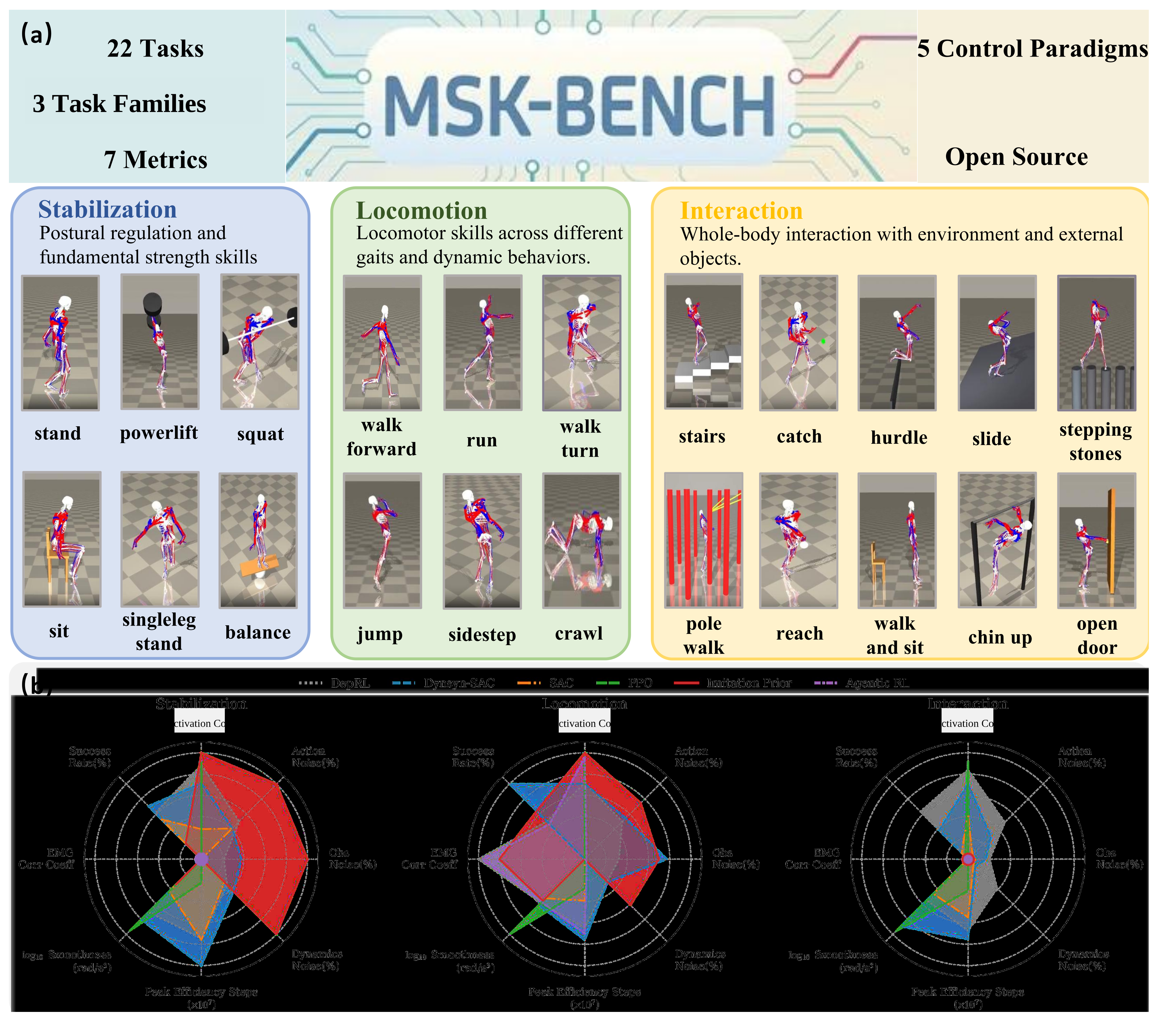
At a glance
MSK-Bench standardizes full-body muscle control around one 416-muscle humanoid, task-specific success criteria and separate behavioral/physiological diagnostics. Structured exploration and action representations improve coverage, while motion priors work unevenly across tasks. Residual adaptation recovers stair navigation in the tested setting, but the corresponding human-signal correlation changes little. The evidence therefore favors evaluating task achievement and physiological agreement jointly rather than treating either as a substitute for the other.
I Introduction
Muscle excitation produces motion through delayed activation, contraction and tendon transmission, creating redundant control channels unlike directly commanded joint torques. Existing musculoskeletal benchmarks cover fragments of this problem. MSK-Bench supplies a shared model, task definitions, perturbation sweeps and interpretable diagnostics so that a controller’s strengths and failures can be compared under explicit conditions.
II Related Work
The benchmark connects torque-controlled humanoid learning, musculoskeletal simulation, imitation priors and human locomotion datasets. PPO and SAC provide generic baselines; DepRL adds structured embodied exploration, while DynSyn learns a lower-dimensional synergistic action representation [PPO], [SAC], [DepRL], [DynSyn]. Table I contrasts existing task coverage and physiology-related evaluation. Human EMG data provide limited matched references, not a comprehensive biological ground truth.
| Benchmark / Framework | Embodiment | Environment | Task Design | Evaluation | Main Focus | ||||
| Actuation (Dim.) | Full Body | 3D Scene / Terrain | Contact Rich | Task Hierarchy | Tasks / Data Scale | Physio. Eval. Metrics | Control Families | ||
| Torque-Driven Humanoid Benchmarks | |||||||||
| HumanoidBench [88] | Torque (19/61) | ✓ | ✓ | ✓ | ✓ | 27 tasks | ✗ | 1 | Loco-manipulation |
| SkillBench / SkillBlender [50] | Torque (19) | ✓ | ✓ | ✓ | 4 skills / 8 tasks | ✗ | 1 | Skill Blending | |
| Mimicking-Bench [61] | Torque (19) | ✓ | ✓ | ✓ | ✗ | 6 tasks | ✗ | 1 | Scene Interaction |
| Musculoskeletal Benchmarks | |||||||||
| LocoMuJoCo [2] | Mixed | ✓ | ✗ | ✗ | 12 envs / 27 tasks | ✗ | 2 | Locomotion Imitation | |
| MyoSuite [15] | Muscle () | ✗ | ✗ | ✓ | 204 tasks | ✗ | 1 | Dexterity and Agility | |
| MyoDex [12] | Muscle (39) | ✗ | ✗ | ✓ | ✗ | 14 train / 34 eval. | ✗ | 1 | Hand Manipulation |
| MS-Human-700 / MsGym [127] | Muscle (700) | ✓ | ✗ | ✗ | 3 tasks | ✓ | 1 | MSK Locomotion | |
| MyoChallenge 2024 [108] | Muscle () | ✓ | ✓ | 2 tracks | ✗ | 1 | Prosthetics | ||
| MyoChallenge 2025 [14] | Muscle () | ✓ | 2 tasks / 4 tracks | ✗ | 1 | Athletic Control | |||
| MSK-Bench (ours) | Muscle (416) | ✓ | ✓ | ✓ | ✓ | 22 tasks | ✓ | 5 | Full-body Terrain MSK |
III MSK-Bench
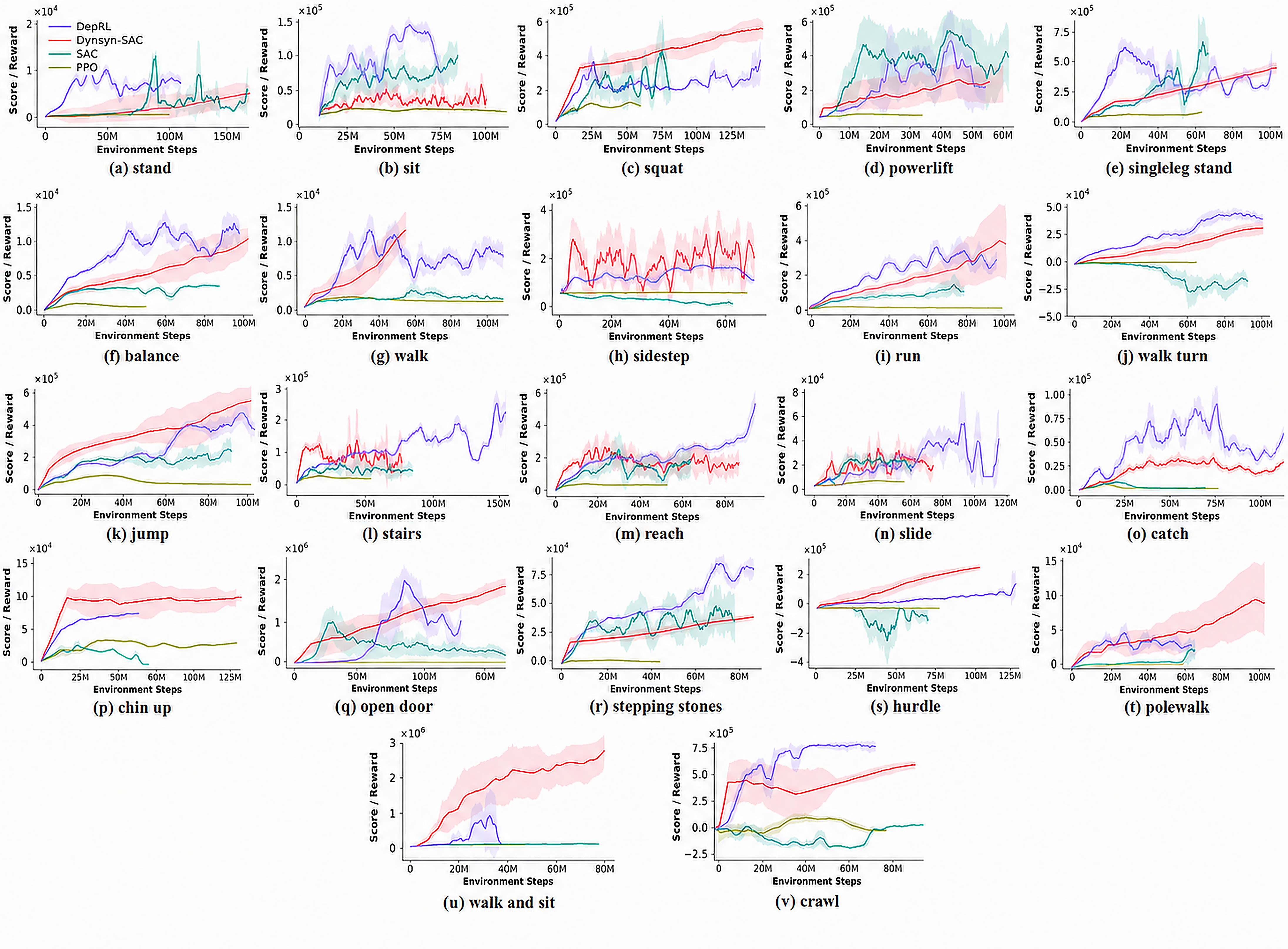
The suite has six stabilization tasks, six locomotion tasks and ten terrain/object-interaction tasks. Each uses the same 416-muscle elastic-tendon body with shared proprioceptive/muscle state plus task-specific information. Policies are trained separately per task. PPO, SAC, DepRL and DynSyn-SAC share task observations, rewards, termination and evaluation within the full-suite comparison; focused studies must be read separately.
Full-suite train-environment success averages 52.00% for DynSyn-SAC, 48.36% for DepRL, 12.82% for SAC and 3.36% for PPO. DynSyn-SAC is strongest in locomotion (81.33%), whereas DepRL is strongest in interaction (51.40%) and has nonzero success on all 22 tasks versus 16 for DynSyn-SAC. The average normalized perturbation-area score reverses their ranking: 43.67% versus 41.59%. Coverage means at least one successful outcome, not reliable mastery. Native training noise remains in the success evaluation, so these rates need not equal the separately configured zero-perturbation sweep points.
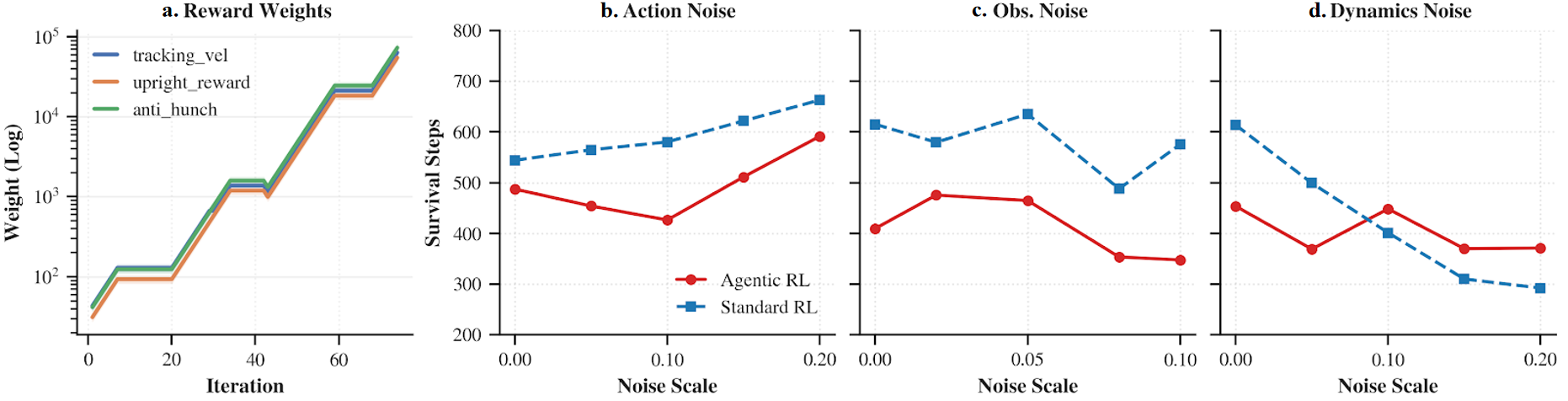
Agentic reward updates show trade-offs rather than a uniform improvement. The original unnormalized study permits each nonzero weight to change by at most 20% every 20,000 steps, which still allows cumulative growth. The matched reasoner study instead fixes the weight L1 norm at 40: GPT-6 Astra outperforms DeepSeek-V4-Flash on the reported survival, tracking and activation point estimates, but both survive fewer steps than fixed weights. Direct GPT-6 control is a separate diagnostic: one seed-zero rollout per task, 354 action values at 5 Hz held by a 100-Hz controller, no learned low-level policy, and a three-second maximum. Walk, run and stairs fall at 0.75, 2.02 and 0.80 seconds; these outcomes describe this interface and protocol.
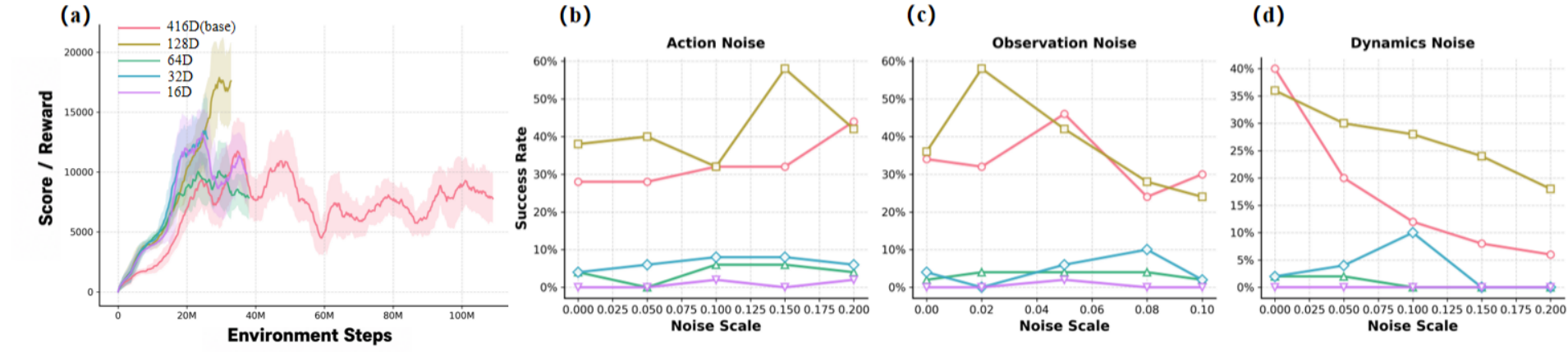
A 128-dimensional action representation improves selected learning/perturbation results over 416 actions; stronger compression degrades them. MuscleMimic exceeds DepRL on several reference-compatible tasks, but fails the focused stair test even without added perturbation. Its five-task comparison uses matched conditions within that study, including a less stringent Jump criterion than the full suite. Increasing stair-tracking error is a diagnostic, not an isolated causal explanation.
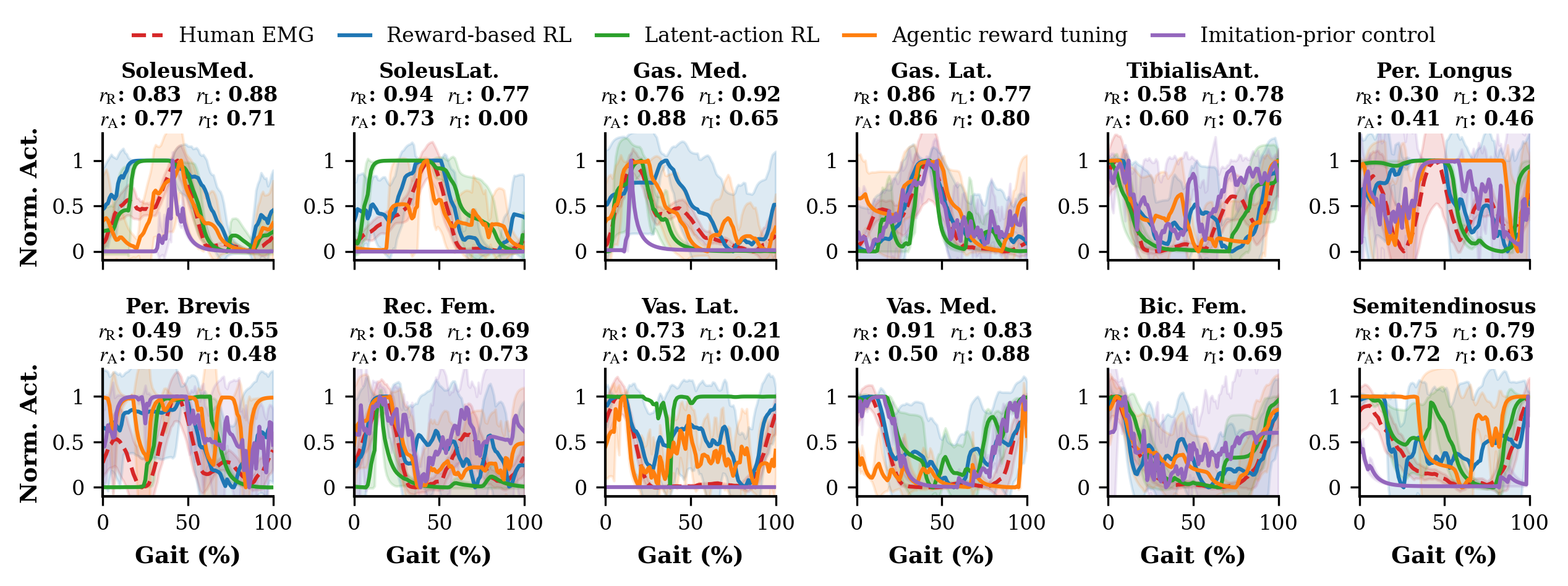
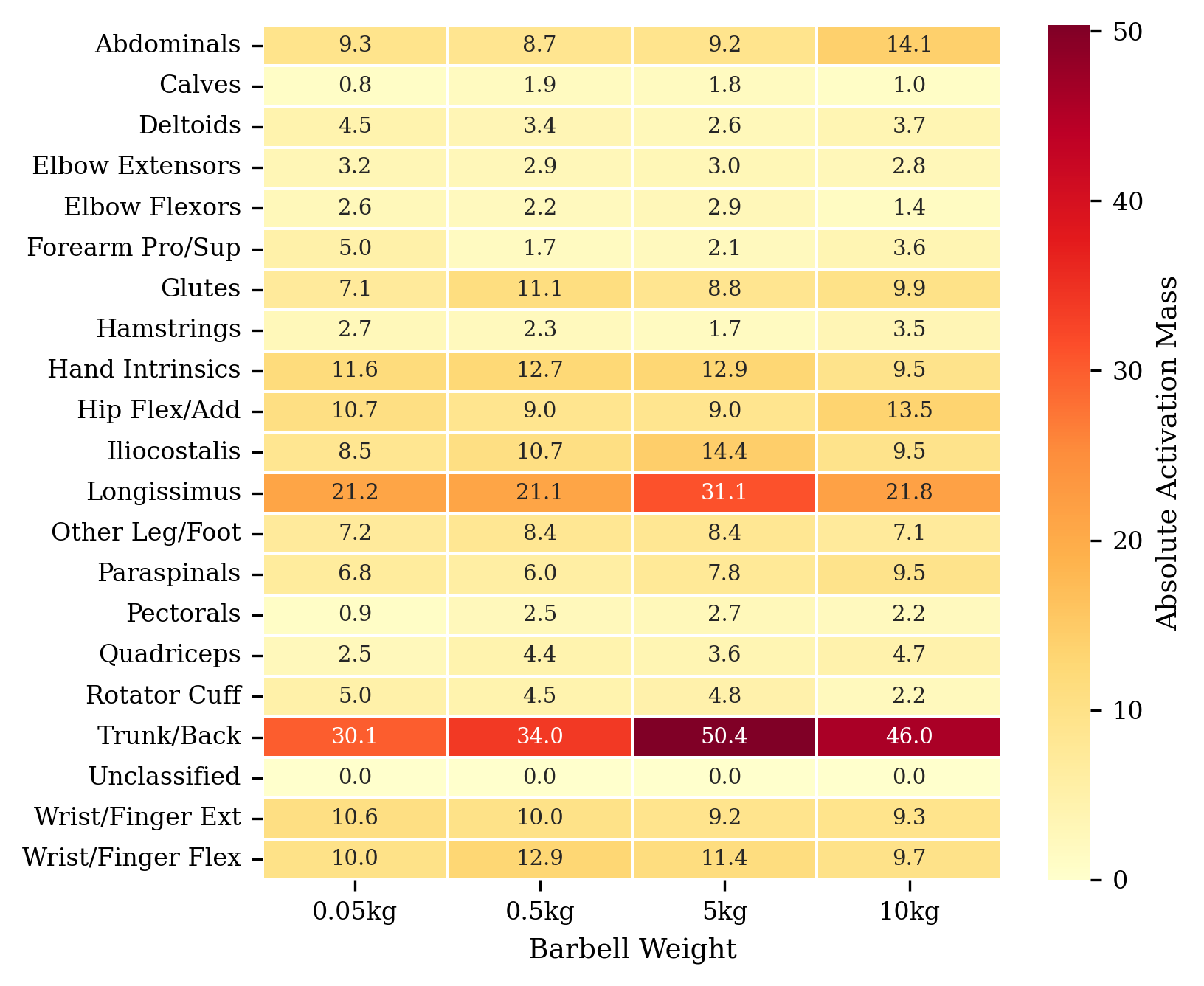
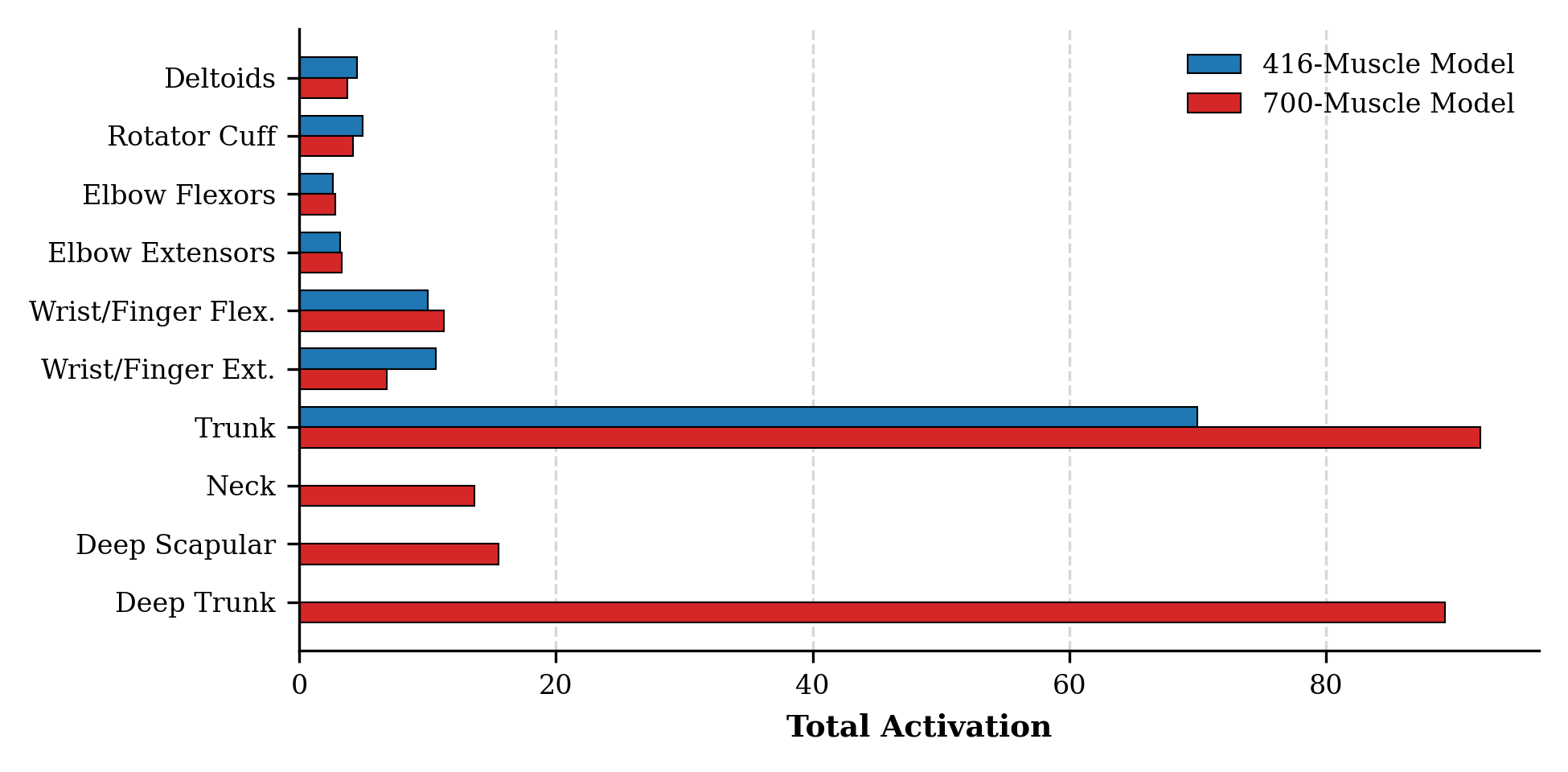
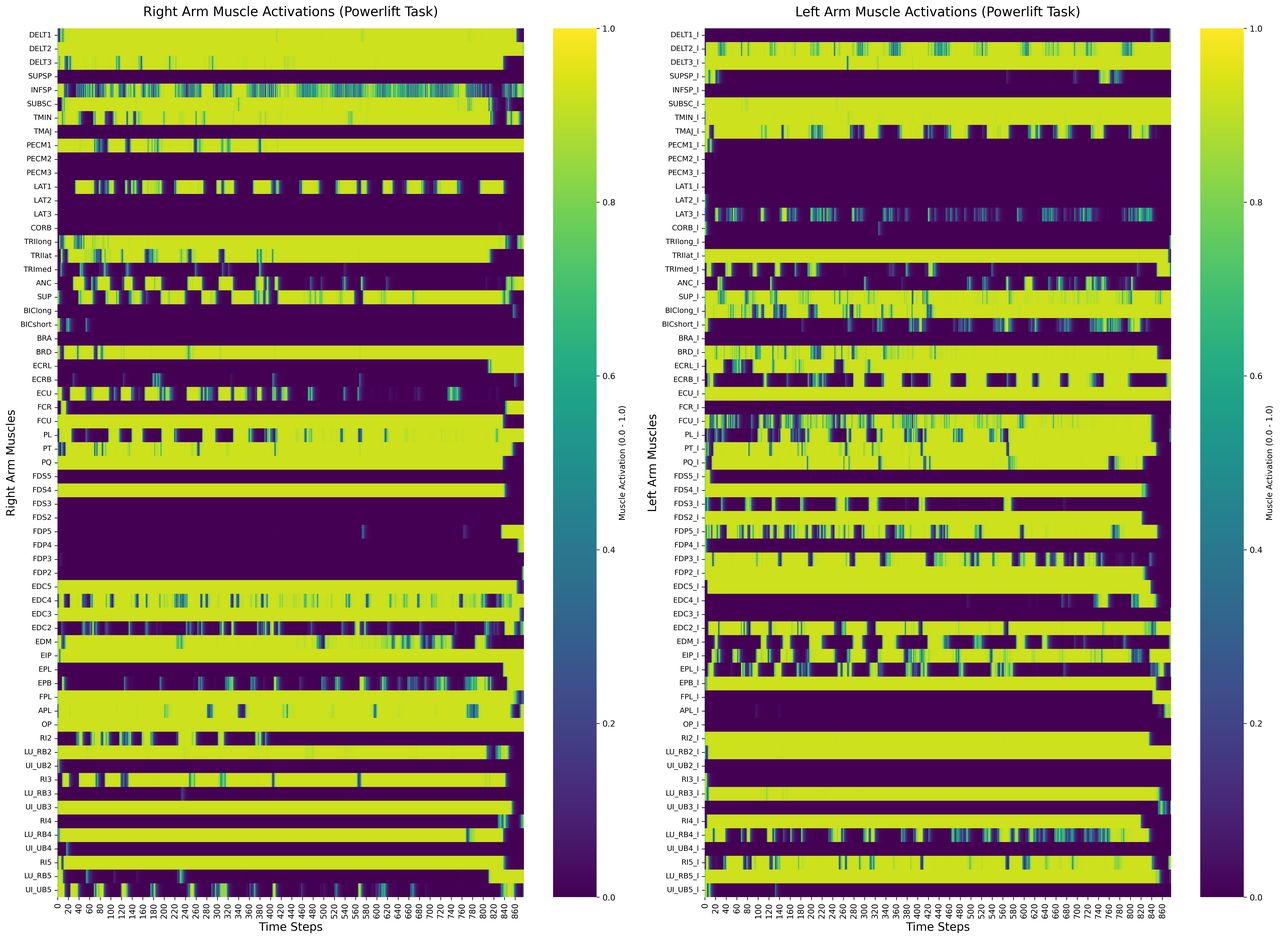
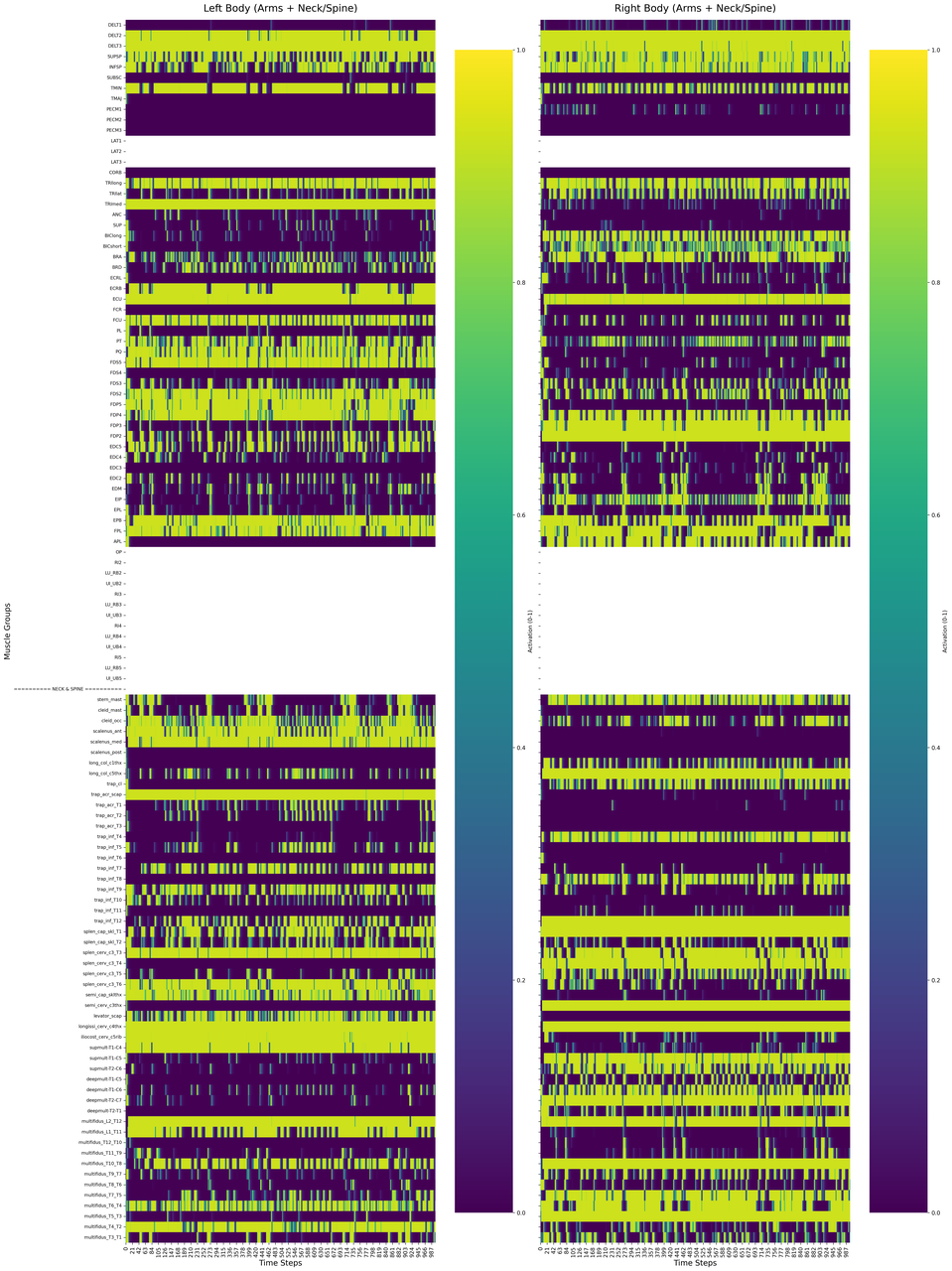
Activation cost is a mean-square effort proxy, joint smoothness is based on angular jerk, and EMG correlation compares normalized, optimally phase-shifted envelope shapes. None alone measures biological realism. Walking results show muscle-level reversals between controllers. Powerlift recruitment changes with load, but trunk/back activation masses of 30.1, 50.4 and 46.0 at 0.05, 5 and 10 kg are not monotonic. The 700-muscle anatomy adds recruitment pathways for analysis without establishing greater human similarity.
Equations 1–2
| (1) | ||||
| (2) |
| Group | Metric | DynSyn-SAC | DepRL | SAC | PPO |
| SR (%) | Stabilization (6) | 57.33 | 50.33 | 42.33 | 0.00 |
| Locomotion (6) | 81.33 | 41.33 | 0.00 | 0.00 | |
| Interaction (10) | 31.20 | 51.40 | 2.80 | 7.40 | |
| Average (22) | 52.00 | 48.36 | 12.82 | 3.36 | |
| Robust. | Action | 46.66 | 53.06 | 15.36 | 3.10 |
| Observation | 43.37 | 38.10 | 4.26 | 3.40 | |
| Dynamics | 34.75 | 39.84 | 14.50 | 2.92 | |
| Average | 41.59 | 43.67 | 11.37 | 3.14 | |
| Coverage | SR | 16/22 | 22/22 | 4/22 | 1/22 |
| Task | Duration (s) | Div. (s) | Tracking RMSE | Outcome |
| Walk | 0.75 | 0.53 | 0.158 | Fall |
| Run | 2.02 | 0.94 | 0.653 | Fall |
| Stairs | 0.80 | N/A | 0.173 | Fall |

IV Residual Adaptation Case Study
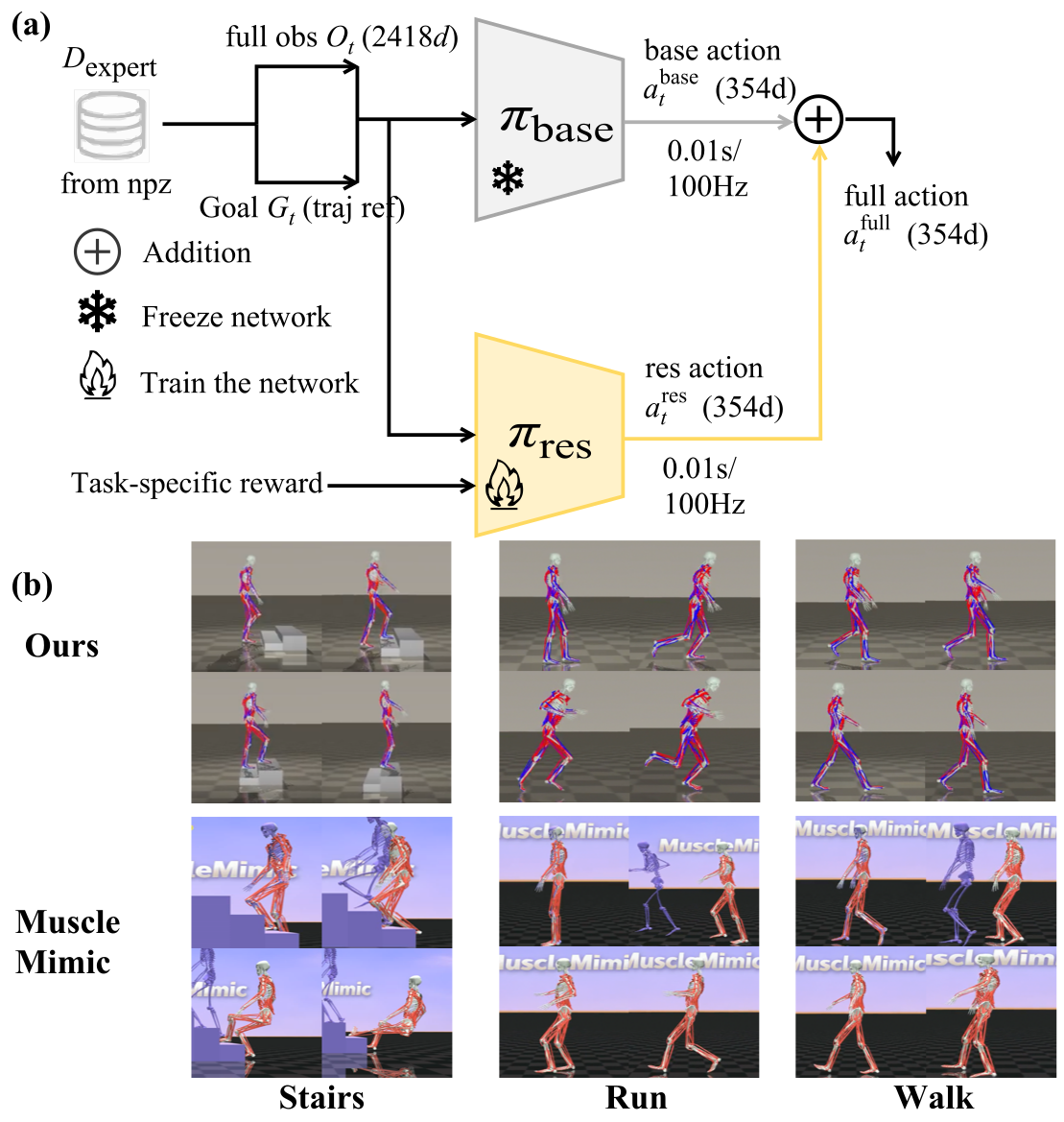
A frozen MuscleMimic prior receives a trainable residual correction together with task-specific reward and timing changes. Stairs ignore vertical root mismatch, slow reference advancement when planar error exceeds 0.4 m and reward progress toward a reference one second ahead. Walking grants more correction during swing and penalizes activation magnitude/change. Running relaxes tracking during flight, rewards propulsion and softly penalizes vertical ground-reaction force above 2.5 body weights. This is a combined adaptation pipeline, not an ablation of residual actions alone.
Table V reports walking success unchanged at 100%, running increasing from 90% to 100%, and stairs from 0% to 100%. Selected walking correlations improve; mean running correlation increases from 0.43 to 0.77. Stair correlation changes only from 0.51 to 0.52 and remains below DepRL’s 0.56. Stair height and tracking improve, while running peak ground force falls from 6.40 to 6.07 body weights. Recovering a task therefore does not guarantee a matching physiological gain.
| SR (%) | EMG | ||||
| Task | MM | Residual | MM | DepRL | Residual |
| Walking | 100 | 100 | 0.71/0.69/0.63 | – | 0.75/0.80/0.67 |
| Running | 90 | 100 | 0.43 | 0.70 | 0.77 |
| Stairs | 0 | 100 | 0.51 | 0.56 | 0.52 |
V Limitations and Future Work
Results are point estimates on a fixed simulated morphology and do not establish statistical dominance or transfer to other bodies. EMG validation covers only walking, running and stairs with different matched muscle sets. Residual learning, objective changes and reference pacing are combined, so their individual contributions are unresolved. Dexterity, longer compositions, broader physiological measurements and physical hardware remain outside the demonstrated scope.
VI Conclusion
MSK-Bench makes the task–method–metric relationship explicit: structured exploration helps some high-dimensional control problems, priors help reference-compatible motions, and adaptation can recover a failure while leaving physiological agreement largely unchanged. Its contribution is a reproducible comparison framework with diagnostic detail, not a universally best controller.
Appendix A Appendix
The appendix gives exact task rewards and termination rules, code-level success criteria, perturbation definitions, training defaults, controller interfaces, recruitment grouping and adaptation details. These tables and formulas are retained because they determine what the headline results mean.
A-A Task Specification
The task definitions use joint states, body positions/velocities, center-of-mass and foot geometry, torso/chest/pelvis directions, phase, terrain grids and obstacle features. Leg extension helps distinguish standing from kneeling shortcuts. Reward terms combine task progress, posture/contact constraints, survival, activation cost and penalties. Tables VI–VIII preserve every reward formula/weight; Tables IX–XI preserve initialization, task observations and termination. Figures 11–13 retain the full visual task descriptions. These are designed benchmark objectives, not evidence that learned recruitment reproduces the biomechanics motivating them.
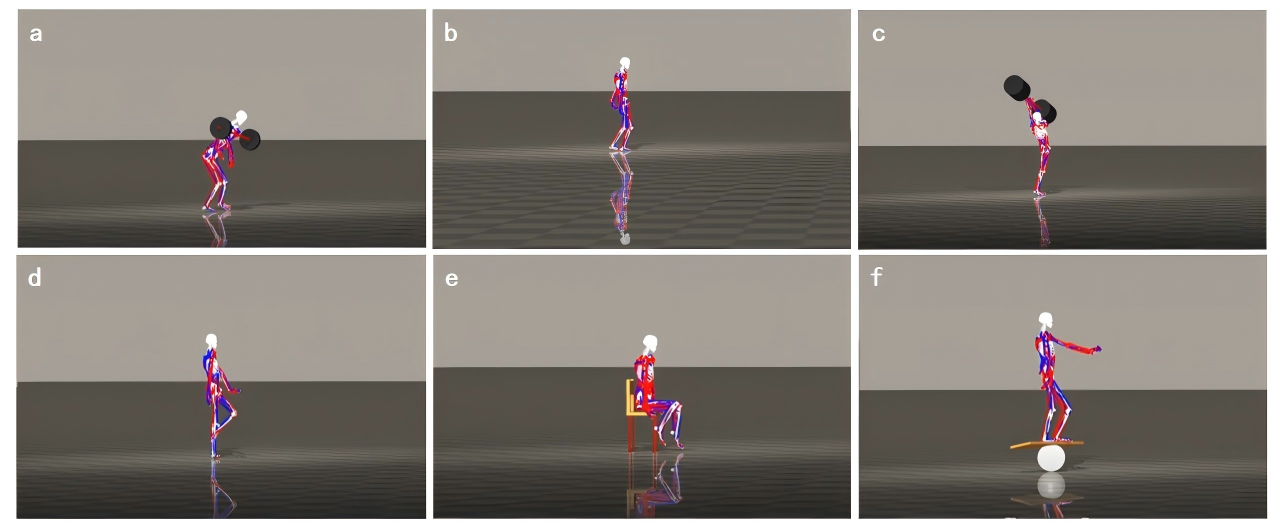
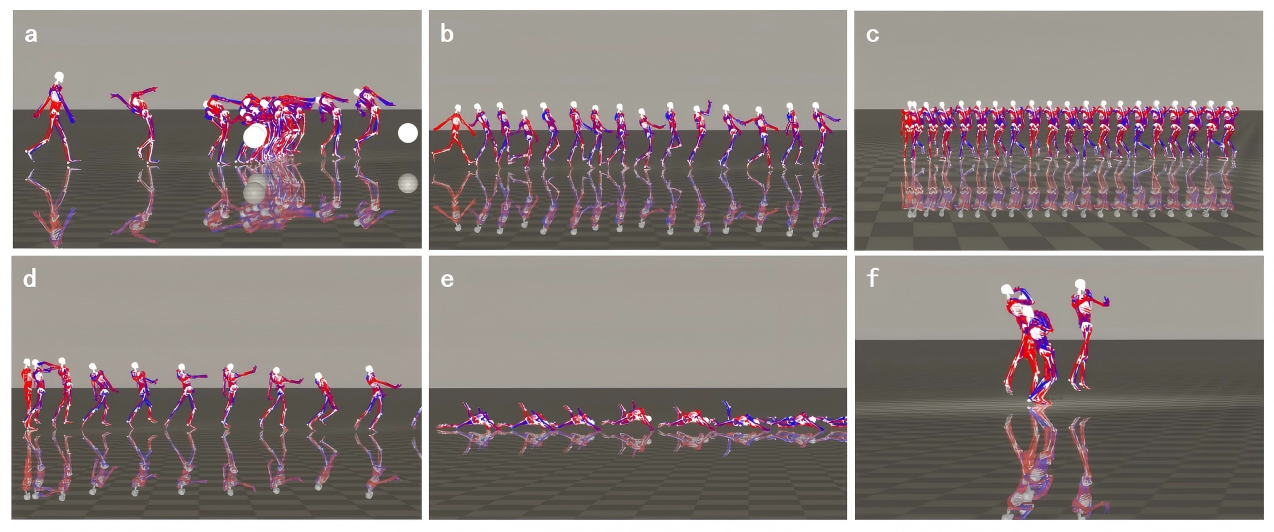
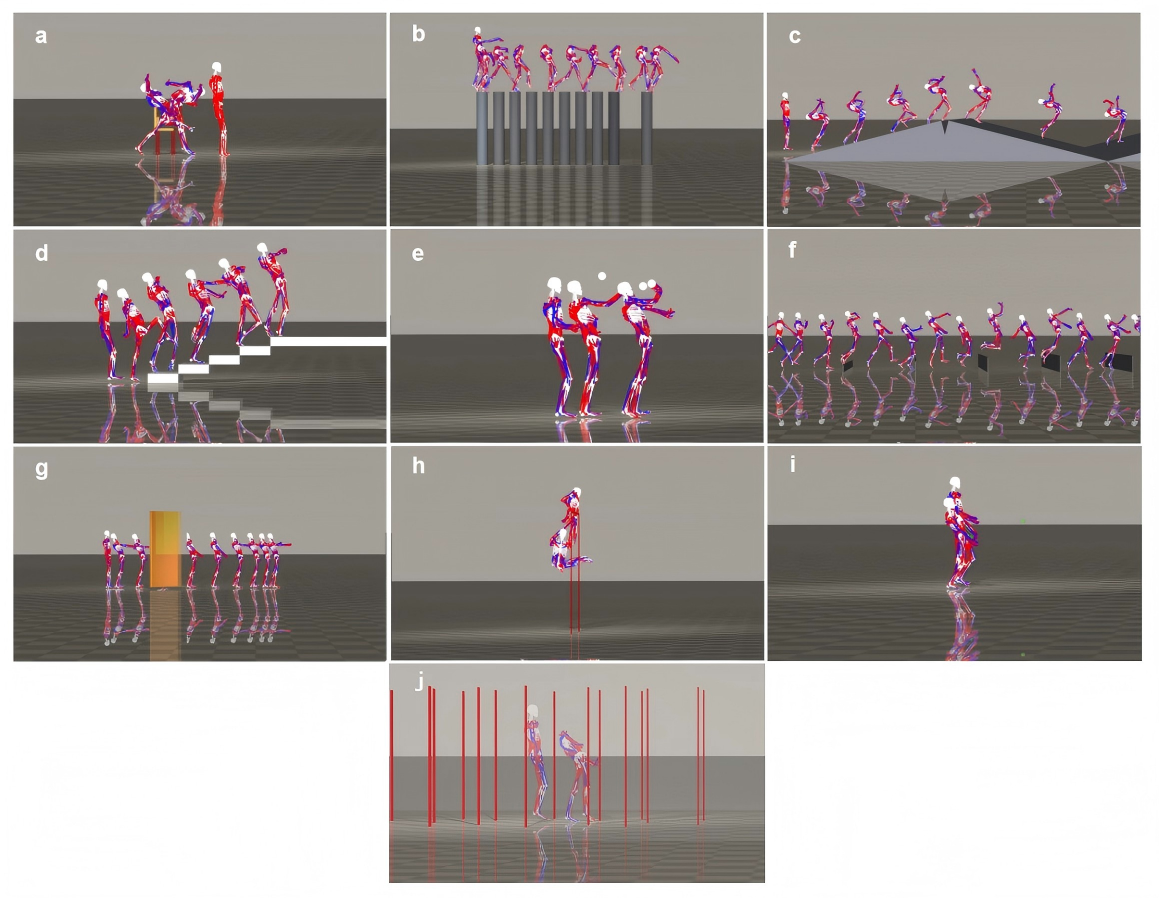
| Task | Term | Formula | Weight |
| 1. Stand | Pose preservation | ||
| Absolute stillness | |||
| Feet planted | |||
| Torso balance | |||
| Survival | |||
| 2. Powerlift | Hold stability | ||
| Height threshold | |||
| Upright alignment | |||
| Lumbar spine safety | |||
| Muscular effort | |||
| Hip hinge posture | |||
| 3. Singleleg | Balance (CoM) | ||
| Lifted foot clear | |||
| Absolute stillness | |||
| Upright alignment | |||
| Foot touch penalty | |||
| Lateral lean penalty | |||
| 4. Sit | Chair approach | ||
| 3D Contact docking | |||
| Lateral centering | |||
| Seated leg geometry | |||
| Feet tucked under | |||
| Soft landing | |||
| 5. Balance | Forward lean stance | (gated) | |
| CoM over board | |||
| Board over ball | |||
| Board level | |||
| Stand tall | if | ||
| 6. Squat | Height tracking | ||
| Joint tracking | |||
| Vertical vel tracking | |||
| CoM centered | |||
| Kneeling penalty |
| Task | Term | Formula | Weight |
| 1. Walk | Velocity tracking | ||
| Kinematic imitation | |||
| Upright / No hunch | , | ||
| Forward face | |||
| 2. Crawl | Backwards velocity | ||
| Prone posture | |||
| Alternating stride | (diag gait) | ||
| Drift penalty | |||
| 3. Run | High velocity | , bonus if | |
| Asymmetric stride | |||
| Knee flexion (swing) | |||
| Scissor penalty | |||
| Kangaroo penalty | Penalize | ||
| 4. Jump | Flight gradient | ||
| Upward explosion | |||
| Feet separation pen. | |||
| Desync jump pen. | |||
| 5. Walk turn | Targeted velocity | ||
| Waypoint approach | |||
| Target facing | |||
| Waypoint reached | |||
| Wall collision | |||
| 6. Sidestep | Lateral velocity | ||
| Phase sync | |||
| CoM mid-feet lock | |||
| Rubber band splits |
| Task | Term | Formula | Weight |
| 1. Stairs | Fwd trajectory | ||
| Upward trajectory | |||
| Vertical stable | |||
| Lateral stable | |||
| Anticipatory lift | |||
| 2. Hurdle | Forward velocity | ||
| Clearance (Flight) | |||
| Sparse clear bonus | |||
| Crane hopping pen. | |||
| 3. Step stones | Target stone progress | Bonus when crossing stone X-coord | |
| Magnetic reaching | |||
| Stand tall | |||
| Overbend knee pen. | |||
| 4. Slide | Pitch balance | ||
| Stand tall | |||
| Slope forward lean | |||
| Backward lean pen. | |||
| 5. Open door | Hand attractor field | ||
| Open hinge | |||
| Pass threshold | Sparse bonuses for | ||
| Dive/Split penalties | Penalize pelvis lead or wide feet | ||
| 6. Reach | Dense reach dist | ||
| Target velocity proj | |||
| Target touch bonus | |||
| 7. Walk & sit | Backwards precision | ||
| Fast descent bonus | |||
| Relaxed recline | (once seated) | ||
| 90-degree pose | |||
| 8. Chin up | Spatial gradient | ||
| Muscle force filter | |||
| Explosive accel | |||
| Anti-kipping wiggle | |||
| 9. Catch | Hand-object reach | ||
| Interception bonus | |||
| Drop penalty | |||
| 10. Pole walk | Target feet phases | ||
| Dynamic radar gap | E.g., if left gap | ||
| Fatal collision | (head/torso to pole) |
| Task | Specific Obs () | Initialization (Brief) | Termination Criteria |
| 1. Stand | Torso quat, feet height | Default neutral, zero vel. | or tilt |
| 2. Powerlift | Dumbbell , , tilt | High CoM, pre-loaded lumbar | or |
| 3. Singleleg | Torso quat, feet/CoM | Flamingo pose, noise | , dropped foot |
| 4. Sit | Chair relative | In front of chair, hips pre-flexed | , invalid contact |
| 5. Balance | Board , CoM/Ball | Drop m, guard stance | , pitch fall |
| 6. Squat | Phase , target | Squat start pose, barbell hold | , kneeling |
| Task | Specific Obs () | Initialization (Brief) | Termination Criteria |
| 1. Walk | Phase , error | Sampled from synthetic walk | or tilt |
| 2. Crawl | Torso quat, feet height | Prone quadruped, ground | Fwd move, twist, flip |
| 3. Run | Torso angle, feet height | Standard standing | , fall backward |
| 4. Jump | Torso angle, | Micro-squat, pre-flexed | , wide split |
| 5. Walk turn | Target , ID, facing | Stand, 20-step novice protection | , |
| 6. Sidestep | Phase , lat dist | Crab guard stance, hips wide | , split m |
| Task | Specific Obs () | Initialization (Brief) | Termination Criteria |
| 1. Stairs | Phase , radar | Walk posture, initial fwd vel | , lat drift |
| 2. Hurdle | Phase , nearest | Standing, scan dynamic hurdles | , heavy yaw |
| 3. Step stones | Phase , stones | Elevated platform m | Fall from height, |
| 4. Slide | Phase , normal | Elevated over wave terrain | Backwards fall, split m |
| 5. Open door | Handle , door , target | Stand front of closed door | , head |
| 6. Reach | Phase , reach | Quarter-squat, hands raised | Knee drop m |
| 7. Walk & sit | Chair , phase | Face away, inject backward vel | Ground contact (head/knees) |
| 8. Chin up | Phase (0), bar dist | Hanging, flexed shoulders | Fall off bar () |
| 9. Catch | Cube , dist | Anticipatory basket, cube spawn | Drop cube () |
| 10. Pole walk | Phase , radar | Elevated m, high core gain | Fatal upper-body collision |
A-B Evaluation Details
Full-suite success and robustness use Table XII’s common code-level criteria for the four reward-based baselines. The focused MuscleMimic–DepRL study has its own matched protocol and is excluded from the aggregate robustness scores. Task rewards are never pooled across tasks. Tables XIII–XV expose per-task success, perturbation response, activation and smoothness, including cases where a good aggregate hides a failure.
A-B 1 Success Rate
Success is evaluated separately from environment termination. A positive native solved signal counts; otherwise the evaluator checks the task-specific condition over the recorded history. Survival-horizon tasks explicitly require reaching the horizon without early termination. For other tasks, early termination prevents further progress but is not an additional universal veto. The reported family and overall rates average tasks equally; coverage counts tasks with observed success above zero.
Equation 3
| (3) |
| Task | Success criterion | Task | Success criterion |
| Stand | Reach 1,000 evaluation steps without earlier termination. | Sidestep | Maximum absolute lateral pelvis displacement from the start is at least m. |
| Powerlift | Reach 900 steps and attain a maximum dumbbell height of at least m. | Stairs | Maximum pelvis height is at least m. |
| Single-leg stand | Reach 1,000 evaluation steps without earlier termination. | Hurdle | The recorded number of cleared hurdles reaches the environment’s total (five if unavailable). |
| Sit | The environment’s has_sat_down flag becomes true. | Step stones | current_stone_idx reaches the final stone index. |
| Balance | Run for more than 350 steps and attain a board–ball horizontal separation below m. | Slide | Maximum forward pelvis displacement from the start is at least m. |
| Squat | Pelvis height first falls below m and subsequently rises above m. | Door open | Forward displacement is at least m, the door-open flag is true, or maximum door angle exceeds rad. |
| Walk | Reach 1,000 evaluation steps without earlier termination. | Reach | Accumulate at least two target touches. |
| Crawl | Maximum backward pelvis displacement from the start is at least m. | Walk and sit | The sit flag becomes true and the rollout reaches 500 steps. |
| Run | Maximum forward pelvis displacement from the start is at least m. | Chin-up | Keep the head more than m above the bar for at least 25 consecutive steps. |
| Jump | Complete at least 10 hops; a hop is counted after pelvis height crosses above m and then below m. | Catch | The catch flag becomes true and the rollout reaches 200 steps. |
| Walk turn | current_target_idx reaches at least 2. | Pole walk | Maximum forward pelvis displacement from the start is at least m. |
A-B 2 Robustness
Action and observation tests add Gaussian noise, then clip to their valid ranges. Dynamics tests independently scale each muscle’s force gain by a uniform factor in [1−σ, 1+σ], fixed throughout an episode. Action/dynamics scales are 0, 0.05, 0.10, 0.15 and 0.20; observation scales are 0, 0.02, 0.05, 0.08 and 0.10. Robustness is trapezoidal area under success versus scale, normalized by the tested range and averaged equally across tasks and perturbation types. These separate sweeps characterize tested disturbances, not unrestricted robustness.
Equations 4–6
| (4) | ||||
| (5) | ||||
| (6) | ||||
A-B 3 Activation Cost
Activation cost averages squared actuator activation over muscles and time. Lower values indicate less activation effort only for successful, behaviorally comparable policies. This proxy does not directly measure metabolic energy, fatigue or physiological fidelity.
Equation 7
| (7) |
A-B 4 Joint Smoothness
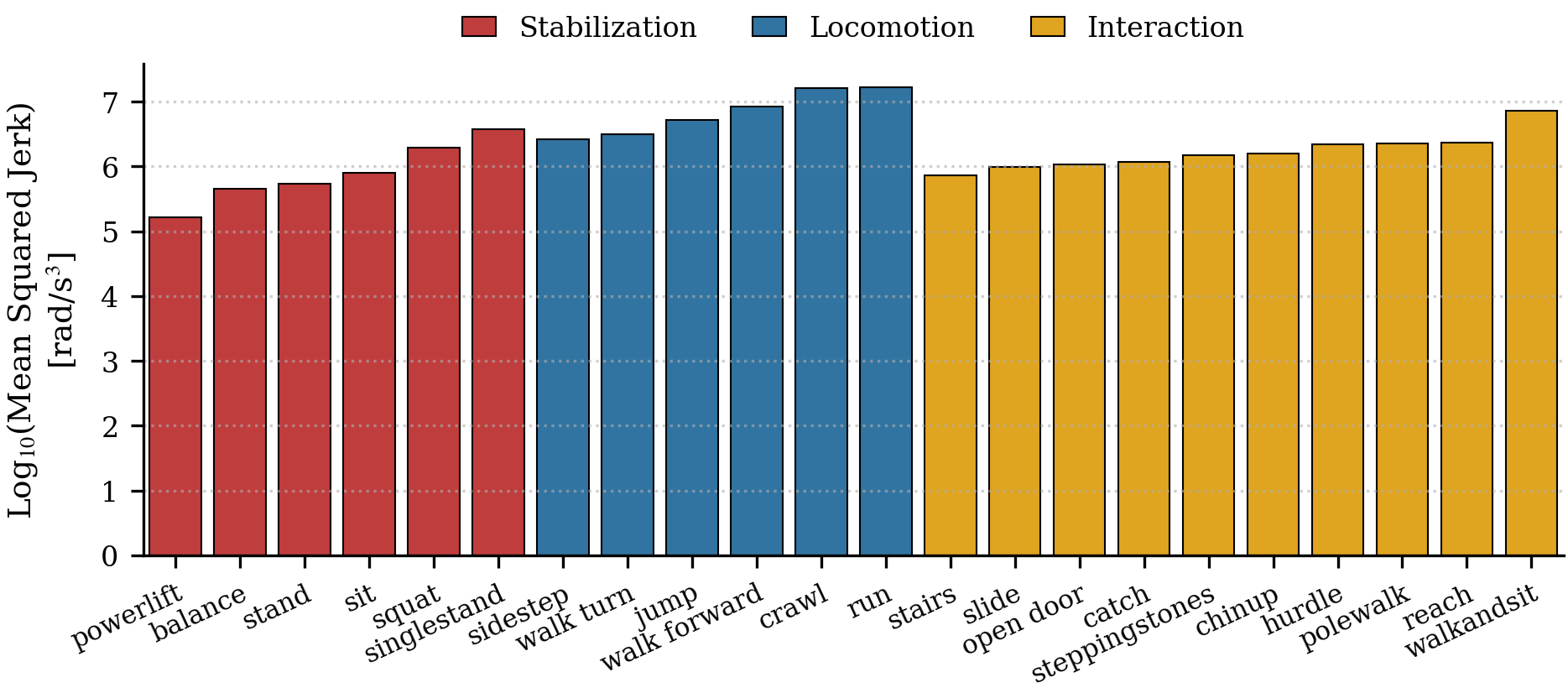
The implementation takes a second finite difference of joint angular velocity divided by the squared timestep, yielding angular jerk. It then averages the squared quantity over joints/time and reports its base-ten logarithm. The pre-log units are rad²/s⁶. Interpret it within successful comparable behaviors; a failed or motionless controller can appear smooth without solving the task.
Equations 8–10
| (8) | ||||
| (9) |
| (10) |
A-B 5 Peak Efficiency Steps
Peak efficiency steps are the evaluated training step attaining maximum mean return over the complete training horizon, paired with that return. This retrospective argmax is not a first-success threshold or a general sample-complexity guarantee. Different horizons, checkpoint schedules and task reward scales affect its interpretation.
Equations 11–12
| (11) |
| (12) |
A-B 6 EMG Similarity
Walking and stairs use Gait120; running uses 3-m/s recordings from Van Hooren and Meijer [Gait120], [running dataset]. Table V reports three selected walking muscles individually, eleven running channels averaged and twelve stair muscles averaged. Profiles are resampled, normalized and cyclically shifted to maximize correlation. The score measures phase-optimized envelope shape, not absolute activation amplitude or event timing.
Equations 13–14
| (13) | ||||
| (14) |
| Task | Algorithm | Activation | Robustness (%) | Max | Train-env. | smooth | ||||||||||||||
| Cost | Action | Observation | Dynamic | Steps () | SR (%) | (rad2/s6) | ||||||||||||||
| 0 | 0.05 | 0.1 | 0.15 | 0.2 | 0 | 0.02 | 0.05 | 0.08 | 0.10 | 0 | 0.05 | 0.1 | 0.15 | 0.2 | ||||||
| stand | DepRL | 0.4488 | 94 | 94 | 90 | 96 | 98 | 100 | 12 | 0 | 0 | 0 | 98 | 48 | 28 | 12 | 4 | 3.74 | 86 | 3.152 |
| SAC | 0.0484 | 100 | 100 | 100 | 100 | 96 | 100 | 0 | 0 | 0 | 0 | 100 | 100 | 100 | 100 | 100 | 7.13 | 100 | 1.875 | |
| PPO | 0.3691 | 0 | 0 | 0 | 0 | 0 | 0 | 0 | 0 | 0 | 0 | 0 | 0 | 0 | 0 | 0 | 1.97 | 0 | 5.479 | |
| DynSyn-SAC | 0.2859 | 52 | 42 | 56 | 46 | 36 | 46 | 46 | 22 | 30 | 14 | 40 | 32 | 40 | 30 | 30 | 5.44 | 52 | 2.104 | |
| powerlift | DepRL | 0.3356 | 68 | 68 | 64 | 56 | 52 | 62 | 62 | 38 | 4 | 0 | 66 | 70 | 52 | 42 | 38 | 4.14 | 38 | 2.631 |
| SAC | 0.2106 | 98 | 94 | 94 | 88 | 80 | 96 | 0 | 0 | 0 | 0 | 98 | 94 | 88 | 64 | 2 | 6.78 | 90 | 2.825 | |
| PPO | 0.3955 | 0 | 0 | 0 | 0 | 0 | 0 | 0 | 0 | 0 | 0 | 0 | 0 | 0 | 0 | 0 | 1.76 | 0 | 5.042 | |
| DynSyn-SAC | 0.3631 | 100 | 100 | 100 | 98 | 92 | 100 | 100 | 96 | 94 | 90 | 100 | 98 | 94 | 90 | 82 | 8.50 | 100 | 5.781 | |
| squat | DepRL | 0.3781 | 44 | 46 | 38 | 32 | 30 | 24 | 56 | 34 | 62 | 26 | 46 | 38 | 12 | 20 | 10 | 14.02 | 42 | 2.984 |
| SAC | 0.1184 | 0 | 0 | 0 | 4 | 0 | 0 | 0 | 0 | 0 | 0 | 4 | 0 | 0 | 0 | 0 | 4.79 | 0 | 1.708 | |
| PPO | 0.3455 | 0 | 0 | 0 | 0 | 0 | 0 | 0 | 0 | 0 | 0 | 0 | 0 | 0 | 0 | 0 | 2.01 | 0 | 5.390 | |
| DynSyn-SAC | 0.1955 | 48 | 38 | 32 | 26 | 22 | 50 | 44 | 38 | 36 | 30 | 48 | 42 | 32 | 26 | 18 | 7.00 | 42 | 6.503 | |
| sit | DepRL | 0.3327 | 96 | 100 | 100 | 98 | 92 | 92 | 100 | 100 | 100 | 94 | 100 | 92 | 96 | 100 | 90 | 4.88 | 96 | 2.872 |
| SAC | 0.1164 | 80 | 80 | 74 | 70 | 64 | 84 | 0 | 0 | 0 | 0 | 78 | 100 | 76 | 70 | 52 | 7.39 | 64 | 3.204 | |
| PPO | 0.4517 | 0 | 0 | 0 | 0 | 0 | 0 | 0 | 0 | 0 | 0 | 0 | 0 | 0 | 0 | 0 | 2.37 | 0 | 5.350 | |
| DynSyn-SAC | 0.3302 | 80 | 72 | 70 | 68 | 60 | 80 | 80 | 84 | 82 | 78 | 92 | 84 | 78 | 60 | 26 | 9.27 | 82 | 3.145 | |
| singlestand | DepRL | 0.3977 | 14 | 16 | 28 | 18 | 10 | 24 | 30 | 8 | 0 | 0 | 12 | 28 | 6 | 8 | 12 | 2.10 | 14 | 2.854 |
| SAC | 0.0849 | 0 | 0 | 0 | 0 | 0 | 0 | 0 | 0 | 0 | 0 | 0 | 0 | 0 | 0 | 0 | 4.33 | 0 | 1.954 | |
| PPO | 0.3981 | 0 | 0 | 0 | 0 | 0 | 0 | 0 | 0 | 0 | 0 | 0 | 0 | 0 | 0 | 0 | 1.84 | 0 | 5.436 | |
| DynSyn-SAC | 0.3845 | 24 | 28 | 24 | 20 | 18 | 26 | 22 | 16 | 0 | 0 | 22 | 18 | 8 | 0 | 0 | 10.00 | 24 | 2.931 | |
| balance | DepRL | 0.3775 | 60 | 40 | 26 | 20 | 14 | 56 | 0 | 0 | 0 | 0 | 46 | 12 | 36 | 22 | 18 | 8.86 | 26 | 2.822 |
| SAC | 0.1459 | 0 | 0 | 0 | 0 | 0 | 0 | 0 | 0 | 0 | 0 | 0 | 0 | 0 | 0 | 0 | 8.11 | 0 | 2.547 | |
| PPO | 0.3859 | 0 | 0 | 0 | 0 | 0 | 0 | 0 | 0 | 0 | 0 | 0 | 0 | 0 | 0 | 0 | 1.25 | 0 | 4.861 | |
| DynSyn-SAC | 0.2735 | 40 | 38 | 20 | 16 | 14 | 54 | 40 | 8 | 2 | 0 | 52 | 8 | 0 | 0 | 0 | 10.50 | 44 | 6.066 | |
| Task | Algorithm | Activation | Robustness(%) | Max | Train-env. | smooth | ||||||||||||||
| Cost | Action | Observation | Dynamic | Steps() | SR (%) | (rad2/s6) | ||||||||||||||
| 0 | 0.05 | 0.1 | 0.15 | 0.2 | 0 | 0.02 | 0.05 | 0.08 | 0.10 | 0 | 0.05 | 0.1 | 0.15 | 0.2 | ||||||
| walk forward | DepRL | 0.4206 | 28 | 28 | 32 | 32 | 44 | 34 | 32 | 46 | 24 | 30 | 40 | 20 | 12 | 8 | 6 | 3.32 | 64 | 3.151 |
| SAC | 0.1427 | 0 | 0 | 0 | 0 | 0 | 0 | 0 | 0 | 0 | 0 | 0 | 0 | 0 | 0 | 0 | 9.88 | 0 | 3.262 | |
| PPO | 0.3940 | 0 | 0 | 0 | 0 | 0 | 0 | 0 | 0 | 0 | 0 | 0 | 0 | 0 | 0 | 0 | 2.42 | 0 | 5.558 | |
| DynSyn-SAC | 0.2771 | 82 | 88 | 68 | 60 | 48 | 82 | 82 | 80 | 76 | 76 | 82 | 76 | 76 | 64 | 8 | 5.00 | 76 | 3.417 | |
| run | DepRL | 0.3354 | 30 | 22 | 32 | 36 | 42 | 18 | 18 | 30 | 32 | 26 | 32 | 16 | 12 | 8 | 2 | 6.72 | 18 | 3.343 |
| SAC | 0.0940 | 0 | 0 | 0 | 0 | 0 | 0 | 0 | 0 | 0 | 0 | 0 | 0 | 0 | 0 | 0 | 2.13 | 0 | 2.854 | |
| PPO | 0.3696 | 0 | 0 | 0 | 0 | 0 | 0 | 0 | 0 | 0 | 0 | 0 | 0 | 0 | 0 | 0 | 2.16 | 0 | 5.524 | |
| DynSyn-SAC | 0.3221 | 96 | 94 | 84 | 70 | 68 | 96 | 94 | 90 | 86 | 80 | 96 | 88 | 2 | 2 | 0 | 10.00 | 96 | 3.435 | |
| walk turn | DepRL | 0.3385 | 46 | 60 | 62 | 66 | 68 | 34 | 40 | 58 | 40 | 26 | 48 | 46 | 40 | 36 | 36 | 6.38 | 42 | 3.057 |
| SAC | 0.1571 | 0 | 0 | 0 | 0 | 0 | 0 | 0 | 0 | 0 | 0 | 0 | 0 | 0 | 0 | 0 | 0.99 | 0 | 2.610 | |
| PPO | 0.3747 | 0 | 0 | 0 | 0 | 0 | 0 | 0 | 0 | 0 | 0 | 0 | 0 | 0 | 0 | 0 | 1.05 | 0 | 5.331 | |
| DynSyn-SAC | 0.3112 | 96 | 88 | 84 | 78 | 74 | 94 | 90 | 90 | 88 | 84 | 92 | 24 | 0 | 0 | 6 | 8.00 | 86 | 3.248 | |
| jump | DepRL | 0.3616 | 8 | 24 | 20 | 12 | 10 | 18 | 18 | 8 | 4 | 0 | 14 | 10 | 12 | 6 | 0 | 6.89 | 10 | 3.188 |
| SAC | 0.1342 | 0 | 0 | 0 | 0 | 0 | 0 | 0 | 0 | 0 | 0 | 0 | 0 | 0 | 0 | 0 | 3.92 | 0 | 2.853 | |
| PPO | 0.3880 | 0 | 0 | 0 | 0 | 0 | 0 | 0 | 0 | 0 | 0 | 0 | 0 | 0 | 0 | 0 | 2.07 | 0 | 5.640 | |
| DynSyn-SAC | 0.2700 | 70 | 40 | 8 | 0 | 0 | 62 | 54 | 50 | 48 | 42 | 42 | 30 | 2 | 2 | 0 | 8.00 | 54 | 3.449 | |
| sidestep | DepRL | 0.3888 | 40 | 38 | 62 | 56 | 32 | 34 | 12 | 2 | 0 | 0 | 24 | 22 | 18 | 10 | 6 | 4.38 | 28 | 3.349 |
| SAC | 0.1045 | 0 | 0 | 0 | 0 | 0 | 0 | 0 | 0 | 0 | 0 | 0 | 0 | 0 | 0 | 0 | 0.000032 | 0 | 3.166 | |
| PPO | 0.3729 | 0 | 0 | 0 | 0 | 0 | 0 | 0 | 0 | 0 | 0 | 0 | 0 | 0 | 0 | 0 | 4.92 | 0 | 5.408 | |
| DynSyn-SAC | 0.3630 | 74 | 66 | 54 | 42 | 30 | 74 | 78 | 74 | 78 | 54 | 64 | 72 | 60 | 40 | 40 | 5.58 | 76 | 3.223 | |
| crawl | DepRL | 0.3540 | 100 | 100 | 100 | 100 | 98 | 96 | 100 | 100 | 100 | 100 | 100 | 100 | 98 | 100 | 100 | 5.12 | 86 | 3.158 |
| SAC | 0.0338 | 0 | 0 | 0 | 0 | 0 | 0 | 0 | 0 | 0 | 0 | 0 | 0 | 0 | 0 | 0 | 2.87 | 0 | 2.516 | |
| PPO | 0.4036 | 0 | 0 | 0 | 0 | 0 | 0 | 0 | 0 | 0 | 0 | 0 | 0 | 0 | 0 | 0 | 1.34 | 0 | 5.674 | |
| DynSyn-SAC | 0.2766 | 100 | 100 | 100 | 100 | 100 | 100 | 100 | 100 | 100 | 100 | 100 | 100 | 100 | 100 | 100 | 10.00 | 100 | 3.444 | |
| Task | Algorithm | Activation | Robustness (%) | Max | Train-env. | smooth | ||||||||||||||
| Cost | Action | Observation | Dynamic | Steps () | SR (%) | (rad2/s6) | ||||||||||||||
| 0 | 0.05 | 0.1 | 0.15 | 0.2 | 0 | 0.02 | 0.05 | 0.08 | 0.10 | 0 | 0.05 | 0.1 | 0.15 | 0.2 | ||||||
| stair | DepRL | 0.3499 | 52 | 54 | 38 | 42 | 40 | 34 | 38 | 2 | 0 | 0 | 32 | 40 | 24 | 14 | 4 | 1.42 | 36 | 2.982 |
| SAC | 0.1993 | 0 | 0 | 0 | 0 | 0 | 0 | 0 | 0 | 0 | 0 | 0 | 0 | 0 | 0 | 0 | 6.98 | 0 | 2.459 | |
| PPO | 0.3854 | 0 | 0 | 0 | 0 | 0 | 0 | 0 | 0 | 0 | 0 | 0 | 0 | 0 | 0 | 0 | 1.57 | 0 | 5.303 | |
| DynSyn-SAC | 0.2759 | 0 | 0 | 0 | 0 | 0 | 0 | 0 | 0 | 0 | 0 | 0 | 0 | 0 | 0 | 0 | 5.92 | 0 | 2.854 | |
| catch | DepRL | 0.3247 | 80 | 80 | 76 | 76 | 84 | 62 | 48 | 80 | 72 | 46 | 78 | 40 | 42 | 38 | 56 | 7.23 | 28 | 2.919 |
| SAC | 0.1384 | 0 | 0 | 0 | 0 | 0 | 0 | 0 | 0 | 0 | 0 | 0 | 0 | 0 | 0 | 0 | 1.37 | 0 | 2.899 | |
| PPO | 0.3964 | 0 | 0 | 0 | 0 | 0 | 0 | 0 | 0 | 0 | 0 | 0 | 0 | 0 | 0 | 0 | 3.12 | 0 | 5.300 | |
| DynSyn-SAC | 0.3109 | 70 | 64 | 60 | 60 | 58 | 60 | 40 | 34 | 26 | 22 | 68 | 68 | 60 | 54 | 50 | 7.38 | 66 | 3.134 | |
| hurdle | DepRL | 0.3715 | 48 | 48 | 56 | 50 | 40 | 64 | 44 | 48 | 28 | 0 | 62 | 44 | 40 | 32 | 20 | 1.26 | 50 | 3.212 |
| SAC | 0.1852 | 0 | 0 | 0 | 0 | 0 | 0 | 0 | 0 | 0 | 0 | 0 | 0 | 0 | 0 | 0 | 4.12 | 0 | 2.816 | |
| PPO | 0.3668 | 0 | 0 | 0 | 0 | 0 | 0 | 0 | 0 | 0 | 0 | 0 | 0 | 0 | 0 | 0 | 2.46 | 0 | 5.398 | |
| DynSyn-SAC | 0.3717 | 0 | 0 | 0 | 0 | 0 | 0 | 0 | 0 | 0 | 0 | 0 | 0 | 0 | 0 | 0 | 5.50 | 0 | 7.102 | |
| slide | DepRL | 0.3330 | 100 | 22 | 22 | 16 | 12 | 100 | 16 | 4 | 4 | 0 | 100 | 8 | 14 | 4 | 6 | 11.32 | 100 | 3.106 |
| SAC | 0.0925 | 0 | 0 | 0 | 0 | 0 | 0 | 0 | 0 | 0 | 0 | 0 | 0 | 0 | 0 | 0 | 4.66 | 0 | 2.752 | |
| PPO | 0.3934 | 0 | 0 | 0 | 0 | 0 | 0 | 0 | 0 | 0 | 0 | 0 | 0 | 0 | 0 | 0 | 4.13 | 0 | 5.345 | |
| DynSyn-SAC | 0.2649 | 0 | 2 | 2 | 0 | 0 | 0 | 0 | 0 | 0 | 0 | 0 | 2 | 2 | 0 | 0 | 3.83 | 0 | 2.864 | |
| steppingstones | DepRL | 0.3606 | 42 | 46 | 44 | 40 | 38 | 46 | 42 | 10 | 20 | 2 | 54 | 38 | 24 | 18 | 18 | 8.32 | 58 | 2.985 |
| SAC | 0.1647 | 0 | 0 | 0 | 0 | 0 | 0 | 0 | 0 | 0 | 0 | 0 | 0 | 0 | 0 | 0 | 7.33 | 0 | 2.140 | |
| PPO | 0.4020 | 0 | 0 | 0 | 0 | 0 | 0 | 0 | 0 | 0 | 0 | 0 | 0 | 0 | 0 | 0 | 1.27 | 0 | 5.211 | |
| DynSyn-SAC | 0.3569 | 0 | 0 | 0 | 0 | 0 | 0 | 0 | 0 | 0 | 0 | 0 | 0 | 0 | 0 | 0 | 10.00 | 0 | 6.764 | |
| polewalk | DepRL | 0.4080 | 22 | 38 | 16 | 40 | 20 | 42 | 26 | 6 | 0 | 0 | 30 | 26 | 20 | 16 | 16 | 5.14 | 12 | 2.876 |
| SAC | 0.1504 | 0 | 0 | 0 | 0 | 0 | 0 | 0 | 0 | 0 | 0 | 0 | 0 | 0 | 0 | 0 | 6.10 | 0 | 1.724 | |
| PPO | 0.4274 | 0 | 0 | 0 | 0 | 0 | 0 | 0 | 0 | 0 | 0 | 0 | 0 | 0 | 0 | 0 | 2.87 | 0 | 5.377 | |
| DynSyn-SAC | 0.2909 | 98 | 96 | 98 | 92 | 90 | 98 | 0 | 0 | 0 | 0 | 96 | 94 | 94 | 76 | 16 | 9.00 | 88 | 3.242 | |
| reach | DepRL | 0.3410 | 84 | 86 | 84 | 94 | 82 | 94 | 82 | 90 | 62 | 34 | 92 | 88 | 82 | 82 | 74 | 9.34 | 84 | 2.975 |
| SAC | 0.1705 | 0 | 0 | 0 | 0 | 0 | 0 | 0 | 0 | 0 | 0 | 0 | 0 | 0 | 0 | 0 | 5.85 | 0 | 2.677 | |
| PPO | 0.3965 | 0 | 0 | 0 | 0 | 0 | 0 | 0 | 0 | 0 | 0 | 0 | 0 | 0 | 0 | 0 | 2.87 | 0 | 5.152 | |
| DynSyn-SAC | 0.2556 | 4 | 14 | 0 | 4 | 4 | 2 | 6 | 6 | 2 | 4 | 10 | 8 | 6 | 4 | 0 | 2.10 | 0 | 2.840 | |
| walkandsit | DepRL | 0.3648 | 30 | 26 | 28 | 14 | 10 | 28 | 36 | 32 | 18 | 10 | 22 | 28 | 22 | 14 | 12 | 2.68 | 16 | 3.365 |
| SAC | 0.1180 | 0 | 0 | 0 | 0 | 0 | 0 | 0 | 0 | 0 | 0 | 0 | 0 | 0 | 0 | 0 | 6.54 | 0 | 2.410 | |
| PPO | 0.3951 | 0 | 0 | 0 | 0 | 0 | 0 | 0 | 0 | 0 | 0 | 0 | 0 | 0 | 0 | 0 | 3.03 | 0 | 5.636 | |
| DynSyn-SAC | 0.3391 | 48 | 58 | 66 | 60 | 52 | 48 | 54 | 40 | 36 | 34 | 42 | 48 | 40 | 36 | 18 | 0.45 | 58 | 7.145 | |
| chinup | DepRL | 0.3998 | 50 | 59 | 50 | 62 | 54 | 46 | 72 | 64 | 62 | 56 | 70 | 62 | 64 | 60 | 52 | 5.46 | 32 | 2.862 |
| SAC | 0.4618 | 64 | 86 | 76 | 66 | 58 | 64 | 50 | 74 | 72 | 66 | 70 | 70 | 68 | 64 | 60 | 1.37 | 28 | 2.703 | |
| PPO | 0.3620 | 62 | 74 | 72 | 66 | 60 | 64 | 66 | 82 | 80 | 72 | 74 | 66 | 56 | 60 | 76 | 1.97 | 74 | 4.710 | |
| DynSyn-SAC | 0.2797 | 0 | 0 | 0 | 0 | 0 | 0 | 0 | 0 | 0 | 0 | 0 | 0 | 0 | 0 | 0 | 10.00 | 0 | 6.989 | |
| open door | DepRL | 0.3304 | 96 | 100 | 100 | 100 | 98 | 100 | 94 | 74 | 62 | 42 | 100 | 96 | 96 | 78 | 66 | 4.71 | 98 | 3.030 |
| SAC | 0.0962 | 0 | 0 | 0 | 0 | 0 | 0 | 0 | 0 | 0 | 0 | 0 | 0 | 0 | 0 | 0 | 1.97 | 0 | 2.836 | |
| PPO | 0.4112 | 0 | 0 | 0 | 0 | 0 | 0 | 0 | 0 | 0 | 0 | 0 | 0 | 0 | 0 | 0 | 1.77 | 0 | 5.327 | |
| DynSyn-SAC | 0.2784 | 100 | 98 | 98 | 96 | 92 | 100 | 100 | 100 | 98 | 98 | 100 | 100 | 14 | 4 | 0 | 9.50 | 100 | 6.461 | |
A-C Detailed Descriptions of Reward-Based RL Baselines
PPO uses clipped on-policy updates; SAC uses off-policy maximum-entropy learning. DepRL combines the policy with Differential Extrinsic Plasticity exploration driven by temporal sensorimotor relationships. DynSyn-SAC learns group-level synergistic actions plus state-dependent muscle-level corrections, with a schedule controlling their strength. The reported benefits depend on these embodiments and training settings; the descriptions do not themselves establish convergence or physiological correctness.
A-C 1 Training and Checkpoint Protocol
Table XVI records released defaults, all with seed zero. PPO/SAC use eight parallel training environments, DepRL sixteen and DynSyn-SAC sixty-four. PPO/SAC budgets are 200 million steps, DepRL 100 million and DynSyn-SAC 50 million; checkpoint rules also differ. Off-policy updates per vectorized collection step must not be confused with updates per scalar transition. The success scripts evaluate the selected checkpoint for fifty episodes per task by default, rather than choosing checkpoints by success. These details limit claims of a fully compute-matched algorithm comparison.
| Method | Actor / critic MLP | Learning rate | Batch | Collection, rollout, and update/data cadence | Budget | Checkpoint used for reporting |
| PPO | / | 256 | 2,048 steps per environment and eight environments ( transitions per rollout); 10 epochs, i.e., 10 passes over each rollout. | steps | Highest mean evaluation return; 10 det. episodes every training steps. | |
| SAC | / twin Q networks | 256 | Continuous off-policy collection; one vectorized step (eight new transitions) followed by one gradient step. The configured gradient_steps/train_freq ratio is 1. | steps | Highest mean evaluation return; 10 det. episodes every training steps. | |
| DepRL | / | Actor ; critic ; dual | 256 | Continuous replay with 3-step returns; after warm-up transitions, 30 minibatch updates per 1,000 new transitions (0.03 update iterations per transition). | steps | Last step-numbered checkpoint (the completed run ends at ); saved every steps. A best-return checkpoint is also written, but is not the evaluator default. |
| DynSyn-SAC | / twin Q networks, plus DynSyn layer | Linear to | 256* | Continuous off-policy collection; one vectorized step (64 new transitions) followed by one gradient step. The configured gradient_steps/train_freq ratio is 1. | steps | Highest mean evaluation return; 3 det. episodes every training steps. |
A-D Detailed Muscle Activation Analysis: 416 vs. 700 Muscle Models
The complete 416- and 700-muscle powerlift heatmaps show model-specific recruitment. Additional neck, deep-trunk and scapular actuators in the expanded anatomy alter the available pathways and diagnostic resolution. Their activation patterns do not prove more accurate human force transfer or isolate why recruitment changes.
A-E Agentic Reward Tuning
An external reasoner periodically receives recent performance statistics and returns reward weights. The original setup uses forward speed and torso pitch every 20,000 steps, with relative coefficient changes bounded by 20% but no global normalization. A shared file synchronizes workers; locking avoids duplicate calls and exception handling lets learning continue after a failed request. The matched DeepSeek/GPT comparison instead fixes the L1 norm at 40 under the same learner and budget. Its metric trade-offs should not be merged with the original unnormalized study.
Equations 15–17
| (15) |
| (16) |
| (17) |
A-F Direct GPT-6 Control: Experimental Details
At each paused decision, the controller sees static metadata and a lossless JSON restructuring of the 2,418-D policy observation: root pose, joints/velocities, 354 muscles with five state values each, contact sensors and a 469-D goal/reference block. It cannot inspect privileged diagnostics, rendered frames or reference-controller actions. A response must contain exactly 354 finite numeric values within [−1,1]; it is applied directly without clipping, smoothing or baseline addition.
The runner resets seed zero and deterministically replays committed actions before extending the rollout. Physics runs at 1 ms, native control at 10 ms and each language-model action is held for 0.2 seconds. The environment pauses during reasoning, so wall-clock delay is not simulated inference latency. Fall checks occur at every native step: nonfinite state, root height below 0.6 m or tilt above 70°. Analysis includes the first fallen sample and excludes later states; the original Walk log contains post-fall states that are explicitly discarded.
Tracking error uses sixteen sites and all native samples in the truncated prefix. Divergence requires five consecutive samples above both the time-aligned frozen-prior reference error and its 95th percentile. The reference is used to define this diagnostic, not as another reported baseline. N/A means the sustained threshold was not reached before the analyzed rollout ended.
| Observation block | Dimension |
| Root pose without global – | 5 |
| Joint positions | 82 |
| Root velocity | 6 |
| Joint velocities | 82 |
| Muscle state ( length, velocity, force, excitation, activation) | 1,770 |
| Foot/toe touch sensors | 4 |
| Goal and reference features | 469 |
| Total | 2,418 |
Equations 18–20
| (18) |
| (19) |
| (20) |
A-G Latent-Action RL
A teacher encoder–decoder is pretrained by behavior cloning on expert muscle actions and anatomical features. The decoder conditions on latent intent, physical priors, muscle state and muscle–joint moment information. In hard mode, a raw policy action is normalized to [0,1], passed through the teacher and clipped to a radius-δ tube around the reconstructed action before mapping back to [−1,1]. A decaying deviation penalty discourages raw commands outside that tube. Transformer attention captures inter-muscle dependencies. The tube constrains exploration around a learned prior; it is not an independently verified guarantee of physiological plausibility.
Equations 21–28
| (21) |
| (22) |
| (23) |
| (24) |
| (25) |
| (26) |
| (27) |
| (28) |
A-H EMG Data Processing and Comparative Analysis
Each human gait cycle is interpolated to 101 samples and min–max normalized. Multiple cycles yield a mean profile and normalized variability. The simulated profile is cyclically shifted to maximize Pearson correlation with the human mean, and the same shift is applied to its variability. This deliberately removes absolute scale and phase; the resulting agreement should be reported as envelope-shape similarity rather than faithful muscle timing or force.
Equations 29–32
| (29) |
| (30) |
| (31) |
| (32) |
A-I Muscle Recruitment Categorization
Average each actuator’s activation over the rollout, then sum those means within name-keyword anatomical groups. Divide each group’s activation mass by the total to obtain the relative share. This is neither a time integral nor an average per actuator, so group size and actuator definitions affect comparisons. Table XVIII preserves the exact keyword grouping, including unclassified muscles. Its categories are implementation rules, not a newly validated anatomical decomposition.
Equations 33–37
| (33) |
| (34) |
| (35) |
| (36) |
| (37) |
| Body Region | Muscle Category | Actuator Name Keywords |
| Core and Back | Paraspinals (Deep) | Ps_ |
| Iliocostalis | IL_ | |
| Longissimus (Erector Spinae) | LTpT, LTpL | |
| Abdominals | rect_abd, EO, IO | |
| Other Trunk/Back | LAT, LD, QL, MF_m, TRAP, RHOM | |
| Pectorals | PEC | |
| Upper Extremity | Deltoids | DELT |
| Rotator Cuff | SUPSP, INFSP, SUBSC, TMIN, TMAJ, CORB | |
| Elbow Flexors | BIC, BRA, BRD | |
| Elbow Extensors | TRI, ANC | |
| Forearm Pronators/Supinators | SUP, PT, PQ | |
| Wrist/Finger Flexors | FCR, FCU, PL, FDS, FDP, FPL | |
| Wrist/Finger Extensors | ECR, ECU, EDC, EDM, EIP, EPL, EPB, APL | |
| Hand Intrinsics | OP, RI2, RI3, RI4, RI5, LU_, UI_ | |
| Lower Extremity | Glutes (Hip Extensors) | GMAX, GMED, GMIN, PIR, GEM, OINT, QFM, glmax, glmed, glmin, piri |
| Quadriceps (Knee Extensors) | VAS, RF, VI, VL, VM, vasint, vaslat, vasmed, recfem | |
| Hip Flexors/Adductors | ILIACUS, PSOAS, ADD, PECT, GRAC, TFL, iliacus, psoas, add, grac, tfl, sart | |
| Hamstrings (Knee Flexors) | BFLH, BFSH, SEMIM, SEMIT, bflh, bfsh, semiten, semimem | |
| Calves (Plantar Flexors) | GAS, SOL, soleus, gaslat, gasmed | |
| Other Leg/Foot | TA, EDL, EHL, FDL, FHL, TP, PER, edl, ehl, fdl, fhl, perbrev, tibant, tibpost, perlong |
A-J Detailed Descriptions of Residual RL Policy
The residual study adapts an imitation prior through a combination of bounded corrections, task objectives and reference timing. Increasing stair-tracking error motivates the intervention but does not identify which component causes failure or recovery.
A-J 1 Action Space and Residual Scaling
Clip the residual output, scale it, add it to the frozen base action and clip the sum to valid action bounds. Generic action-rate and activation-cost penalties are disabled in the shared adaptation setup; a small residual L2 cost with coefficient −0.02 remains. Walking separately reinstates task-specific activation regularization below.
Equation 38
| (38) |
A-J 2 Adaptations for Stair Navigation
Stair tracking uses planar root error, omitting vertical mismatch so height changes do not automatically destroy imitation reward. Reference time advances normally below 0.4 m planar error and at half speed otherwise. A progress reward combines velocity toward a reference pelvis one second ahead with upward velocity. These objective and pacing changes accompany residual learning.
Equations 39–40
| (39) |
| (40) | ||||
A-J 3 Walking Adaptation
Walking uses residual authority 0.2 in stance and 0.6 in swing, gated by foot contact. An activation penalty sums squared activation magnitude and temporal changes with weight 0.05 and smoothing coefficient 0.1 over 416 muscles. This encourages quieter commands without turning activation cost into a direct metabolic measure.
Equations 41–42
| (41) |
| (42) |
A-J 4 Adaptations for High-Impact Locomotion (Run Task)
During running flight, tracking penalties are halved and a forward propulsive reward is enabled. A linear soft penalty applies to vertical ground force beyond 2.5 body weights. This threshold is a training cost, not a hard impact limit: reported peak force after adaptation remains 6.07 body weights.
Equations 43–44
| (43) |
| (44) |
A-K Extended Discussion on Limitations and Future Directions
The extended limitations separate missing task coverage, missing physiological evidence and untested transfer to physical systems.
A-K 1 Absence of Dexterous Manipulation
The tasks emphasize gross movement and basic interactions. Fine grasping, tool use and in-hand manipulation require more detailed hand/tendon modeling and coordinated arm–finger control that this benchmark does not yet evaluate.
A-K 2 Transitioning to Compositional and Long-Horizon Tasks
Most evaluations isolate atomic objectives. Longer sequences require reliable skill transitions, balance management and potentially fatigue modeling. The present results do not establish those compositional capabilities.
A-K 3 Constraints in Comprehensive Physiological Validation
Matched human recordings cover only selected muscles in walking, running and stairs. Normalized phase-optimized correlations cannot validate comprehensive biological similarity. Broader synchronized motion/EMG datasets would be needed for dynamic or unconventional tasks.
A-K 4 Sim-to-Real Gap and Hardware Validation
All results are simulated. Physical tendon-driven bodies introduce uncertain actuation, sensing and communication effects, and transfer to electric humanoids would require another mapping from muscle activity to motor control. Neither deployment route is validated here.