Overview
The author states that only the opening page was human-written; most of the remaining manuscript was produced with AI assistance. The author takes responsibility for its reported evidence and conclusions.
At a glance
Lean Pool collects completed mathematical formalizations and maintains them in a shared Lean/Mathlib environment. AI agents propose imports, dependency repairs, proof optimizations, and reviews; maintainers oversee acceptance. The September 21, 2026 census contains 211 projects and about 3.23 million source lines. Its operational history demonstrates maintenance and reuse, but does not independently establish the accuracy of its mathematical reviewers.
1 Lean Pool
A proof archive must remain usable as its language and libraries change. Lean checks formal proofs, while Lean Pool adds project admission rules, maintenance agents, and documentation around independently developed mathematics [57] [207]. Kernel acceptance checks the stated proposition under permitted axioms; it does not establish that the proposition faithfully expresses the advertised mathematical result.
Growth.
Agents discover eligible upstream projects, and people can submit their own. Pooling preserves attribution, updates dependencies, passes compilation and quality checks, and addresses costly compilation hotspots. Only completed formalizations with Apache-2.0 or MIT licenses qualify.
Maintenance.
Scheduled agents repair projects when Lean or Mathlib changes and propose ongoing reductions in proof length, compilation time, and memory use.
Documentation.
Readers can use the API index, the Exposition site, and attributed project announcements on Zulip.
Statistics.
The observed archive has 211 projects, 3,228,485 physical Lean lines, 18 commit contributors, and six dependency upgrades. These counts describe the paper’s dated snapshot.
Vision.
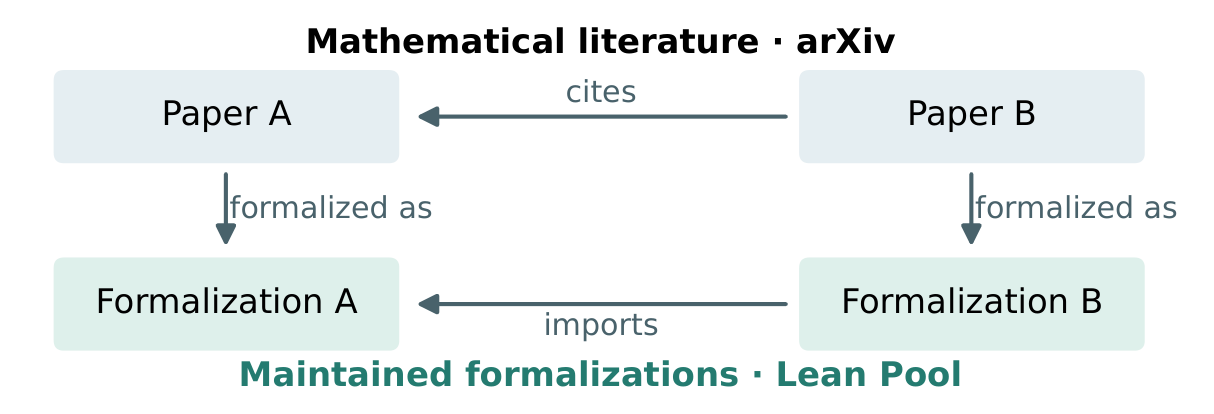
The proposed role is an arXiv-like home for maintained formalizations that accompany mathematical papers and can be imported into subsequent work.
Extended summary
The evidence combines source censuses, upgrade histories, accepted optimization changes, retained review reports, and an external reuse audit. Follow-up integration remained necessary after some automated repairs; reusable interfaces and shorter proofs did not always make compilation faster.
2 Motivation and scope
Preserving source files is insufficient for reuse: later researchers need compatible dependencies, discoverable statements, and visible assumptions. Lean Pool keeps independently attributed projects together so results can be inspected and imported in a common environment.
Admission rules.
Completed projects cannot contain sorry, admit, unchecked declarations, or extra axioms beyond Classical.choice, propext, and Quot.sound. Project cards record authors, source, proof provenance, and informal/formal main results. Open challenges are stored separately.
A formal counterpart to the mathematical literature.
The proposed relationship links a paper’s citations to imports between maintained formalizations. This paper evaluates existing maintenance operations and reuse evidence; universal adoption of that model remains a vision [15].
3 Contributing to and maintaining the archive
Contributions pass through attribution, automated checks, and maintainer decisions. The following subsections distinguish the workflow from the evidence about its past operation.
Community contributions.
A submitter need not be the original formalization author. Cards preserve upstream credit and distinguish human, AI, and mixed proof provenance. GitHub account counts do not measure how much work people versus agents performed.
Recurring work.
Daily jobs discover projects, inspect open PRs, address issues, optimize proofs, and announce accepted work. A separate dependency workflow tests new releases, assigns failures to repair agents, and assembles patches for review.
Continuous integration.
CI builds the whole archive and checks warnings, Mathlib linters, attribution, axioms, and resource rules. Lean Pool’s compilation profiling is advisory; the compared Tau Ceti workflow requires a performance check before merging [132] [205].
Evidence and scope.
Results use dated source snapshots and retained public records. Upgrade replays, production logs, accepted changes, and newly measured builds have different scopes; they are not a controlled estimate of overall agent productivity or operating cost.
4 The archive and evidence of reuse
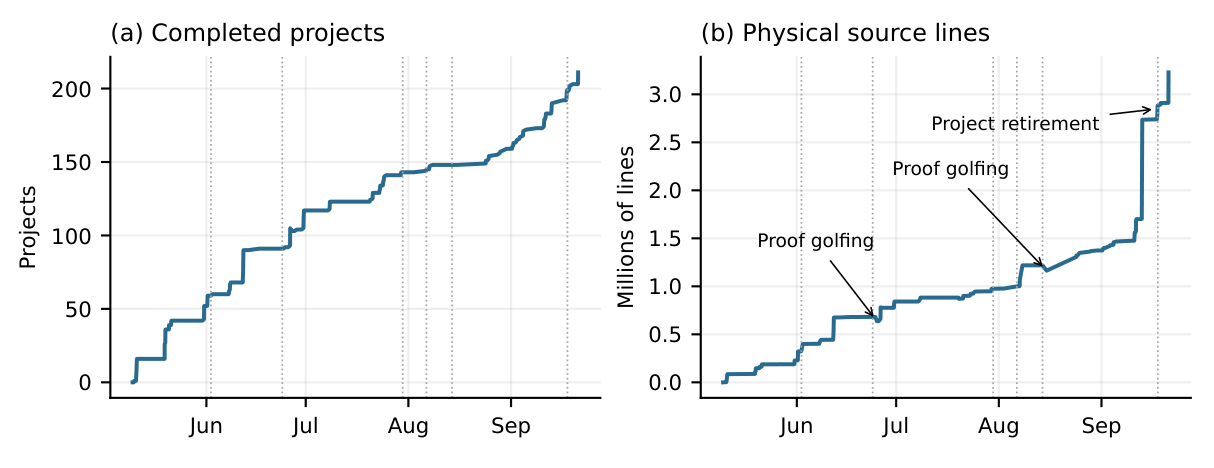
The archive covers analysis, logic, algebra, geometry, probability, and computer science. Its 211 projects contain 837 registered main results; provenance labels identify 70 human, 102 AI, and 39 mixed projects. Source-line totals include comments and blank lines, and do not measure mathematical significance. The figures and tables retain the detailed census and growth history.
| Archive property | Count |
|---|---|
| Completed projects | 211 |
| Lean source files | 7,043 |
| Physical source lines | 3,228,485 |
| Source declaration commands | 193,862 |
| Registered main results | 837 |
| Human / AI / mixed projects | 70 / 102 / 39 |
| Commit contributors | 18 |
| Contributors with merged PRs | 17 |
| Community PRs merged | 63 |
Reuse in research-level mathematics.
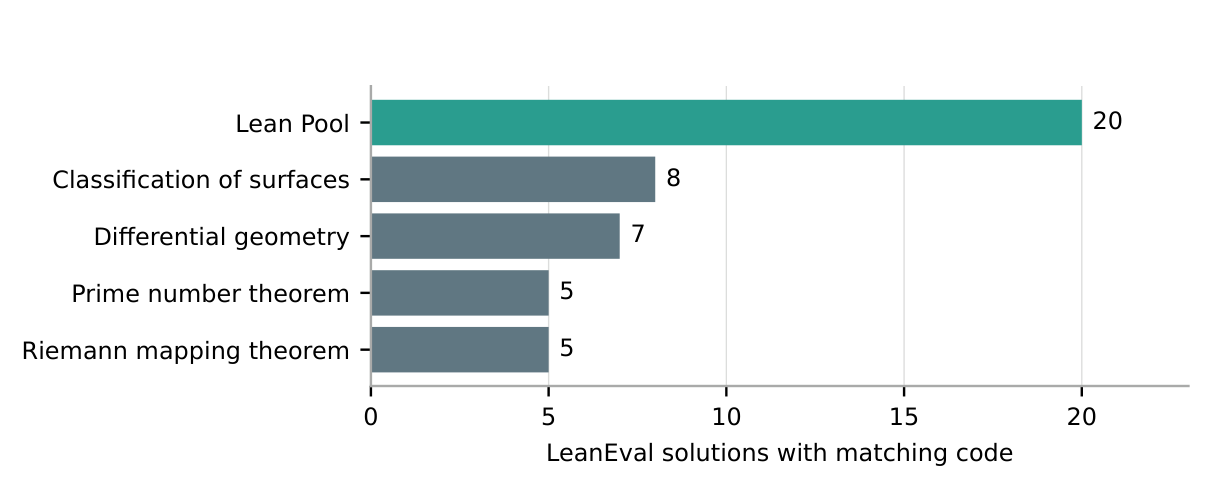
Lean Pool appears in more solutions than other repositories in the LeanEval declaration-matching comparison. Matching includes copied code and excludes ordinary package imports, so this is a specific measure of reuse, not a general ranking of library importance [15].
Build resources.
The clean-build comparison uses one shared Azure host with dependencies prepared before timing. The matching-release Mathlib comparison shares Lean Pool’s compiler and pinned Mathlib revision.
5 Maintaining compatibility as dependencies evolve
Six upgrades affected different snapshots of the archive. The stable 4.34.0 probe found compiler failures in 97 of 191 projects; 95 initial repair jobs succeeded and two failed. Additional integration produced a passing combined archive. Job success alone did not prove that an individual patch completed the migration, and some auxiliary hypotheses changed during repair.
| From Lean | To Lean | Projects at probe | Compiler failures |
|---|---|---|---|
| 4.30.0-rc2 | 4.31.0-rc1 | 59 | 44 |
| 4.31.0-rc1 | 4.32.0-rc1 | 91 | 58 |
| 4.32.0-rc1 | 4.33.0-rc1 | 143 | 100 |
| 4.33.0-rc1 | 4.33.0-rc2 | 145 | 19 |
| 4.33.0-rc2 | 4.34.0-rc1 | 148 | 3 |
| 4.34.0-rc1 | 4.34.0 | 191 | 97 |
6 Proof shortening and compilation speed
Shorter source does not reliably mean faster compilation. Five paired whole-library measurements ranged from a 5.4% slowdown after contributor proof golfing to a 5.8% speedup after elaboration-cost reduction. Each is one clean before/after pair at its own historical revision. Project-level measurements use different workloads and protocols; the reusable Navier–Stokes interfaces slightly increased project compilation time.
| Accepted change | Lines removed | Build min before after | RAM GiB before after |
|---|---|---|---|
| 117 Proof-search simplification | 511 | 5.30 5.25 (+1.1%) | 15.6 15.6 |
| 187 Library-wide compression | 45,217 | 16.11 15.59 (+3.3%) | 26.1 26.9 |
| 246 Contributor proof golfing | 12,515 | 21.83 23.01 (-5.4%) | 25.9 24.6 |
| 338 Certificate simplification | 513 | 30.22 29.13 (+3.6%) | 21.0 20.9 |
| 339 Elaboration-cost reduction | 54,965 | 28.46 26.82 (+5.8%) | 19.8 19.6 |
| Accepted change | Net lines removed | Project seconds |
|---|---|---|
| Tactic-import cleanup | 735 | — |
| Restricted-sum proofs | 65 | 20.01 18.45 |
| Navier–Stokes reusable APIs | — | 879.67 887.78 |
| Infinite Connes rigidity | -31 | 118.00 93.70 |
| Burkholder majorant proofs | 1,064 | 23.84 19.35 |
| Quantum parallel repetition | 32 | 141.85 86.08 |
| Interior-point LP proofs | 249 | 13.98 10.69 |
7 Mathematical review in operation
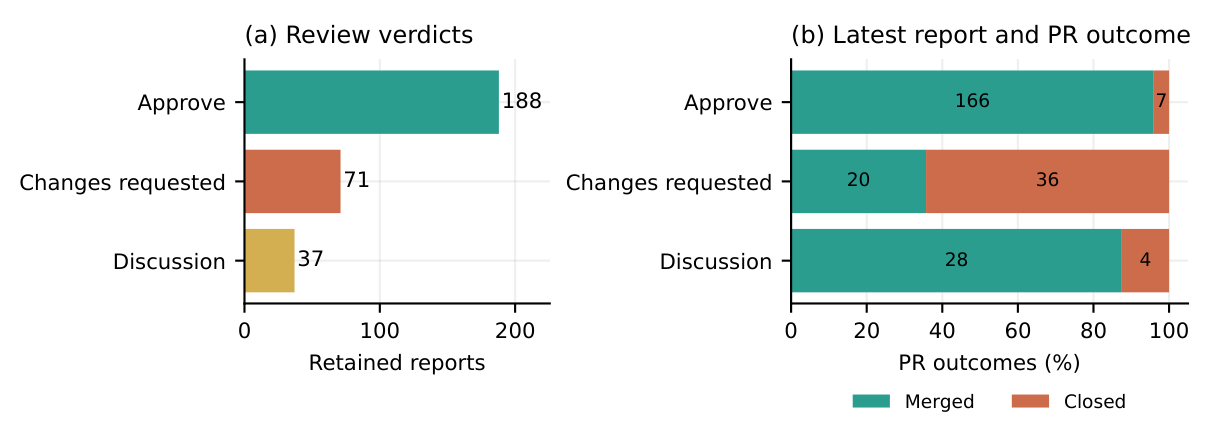
Mathematical review asks whether checked statements match advertised claims and whether attribution, novelty, and code quality are adequate. Retained reports mostly approved submissions, but no independent labels establish review accuracy. Historical API estimates total $308.52 across 285 reports; six newer quota-based reports total $752.38 in nominal API-equivalent estimates, not cash expenditure. The service was later manually disabled.
| Price basis | Reports | Total | Median |
|---|---|---|---|
| Historical API estimates | 285 | $308.52 | $0.20 |
| Codex API-equivalent estimates | 6 | $752.38 | $89.03 |
8 Exposition and the structure of the library
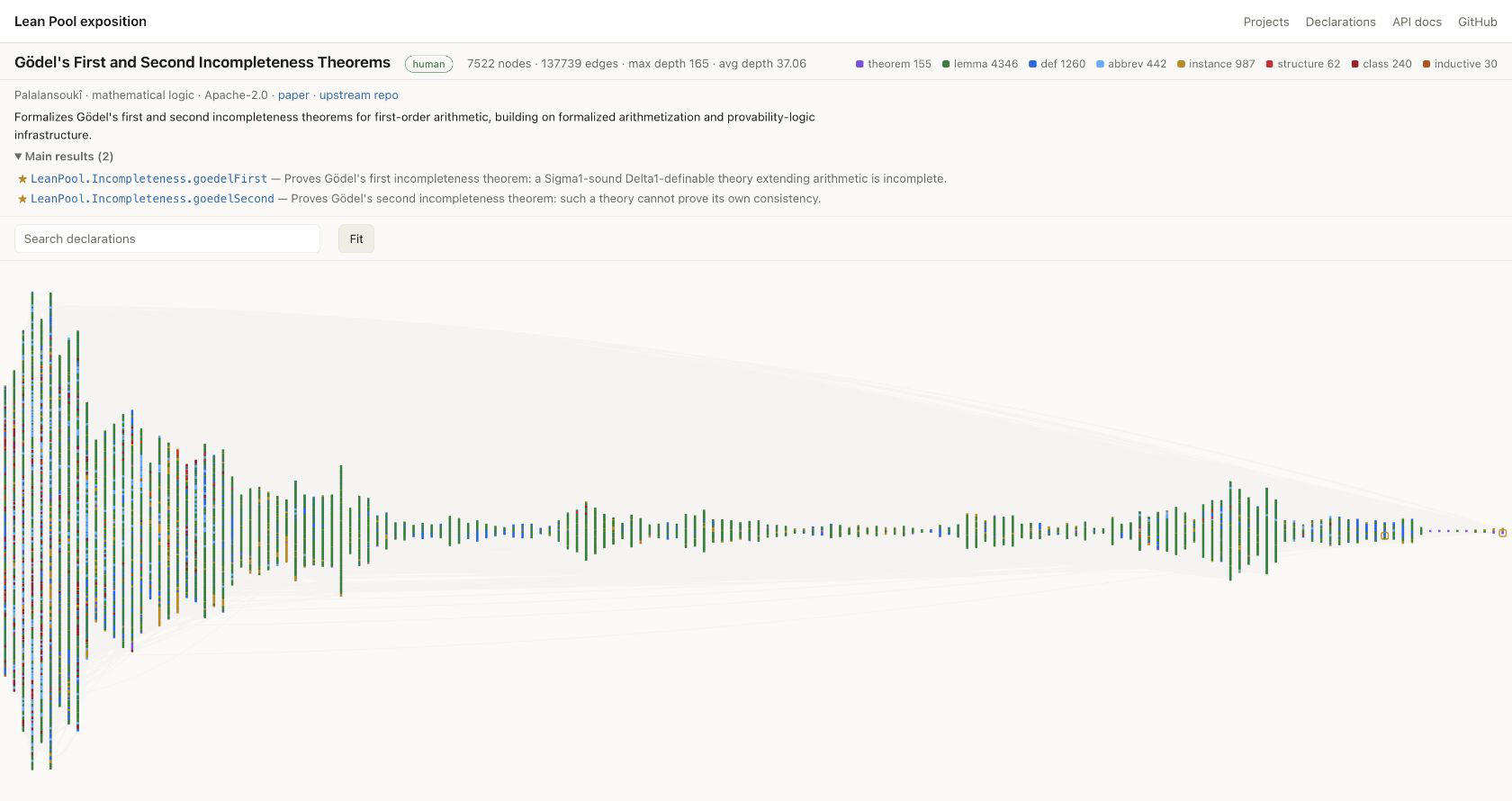
Exposition connects project descriptions and headline results to Lean statements, source links, and declaration graphs [133]. The deployed export covers 203 projects, 173,362 source-visible declarations, and 1,389,967 dependency links; it predates the latest imports, explaining its smaller project count. Graph size records formal structure rather than mathematical importance. Readers must inspect assumptions and definitions before reusing a result.
| Exposition coverage | Count |
|---|---|
| Documented projects | 203 |
| Source declarations | 173,362 |
| Theorems and lemmas | 124,412 |
| Dependency links | 1,389,967 |
| Declarations used by multiple others | 87,408 |
| Project | Declarations | Dependencies |
|---|---|---|
| Gödel’s incompleteness theorems | 7,522 | 137,739 |
| Classification of compact surfaces | 7,833 | 79,052 |
| Navier–Stokes and Euler | 48,626 | 530,547 |
| Language generation in the limit | 419 | 1,823 |
9 Finding and building on archived results
Use Octo for semantic queries, Exposition for browsing subjects and projects, and project cards for a known paper. Follow candidates into source and API documentation to check assumptions and import paths.
| Starting point | Preferred tool | What the reader obtains |
|---|---|---|
| A mathematical question | Octo semantic search | Candidate declarations across the archive |
| A subject or project | Exposition | Project descriptions, statements, and dependency graphs |
| A known paper or result | Project card | Attribution, source references, and formal headline results |
| A candidate to reuse | Source and API documentation | Full assumptions, supporting definitions, and import paths |
10 Related work
Related systems address complementary tasks: maintaining shared libraries, discovering results, constructing proofs, and repairing or assessing formalizations.
Archives and shared libraries.
AFP combines reviewed submissions with maintenance; Mathlib integrates general-purpose mathematics; Reservoir indexes packages; Software Heritage preserves source [16] [207] [130] [3]. Lean Pool emphasizes independently attributed projects kept compatible together. Tau Ceti, Palomar, and Mathlib use different integration and review policies.
| Project | Contributions | Maintenance | Acceptance criteria | Documentation |
|---|---|---|---|---|
| Lean Pool | Human, AI, and mixed projects; direct submissions and attributed imports | Agents propose upgrades and optimizations; maintainers oversee merges | Completed proofs; permitted axioms; attributed cards; permissive license; CI and mathematical review | Project cards, informal results, dependency graphs, source-linked API |
| Tau Ceti | AI-authored mathematics following human roadmaps | AI workers prioritize maintenance and review, update Mathlib pins, and repair the library | CI and adversarial AI review; roadmap fit, reuse, API coherence, and compatibility with Mathlib | Human roadmaps, module documentation, declaration docstrings |
| Palomar Registry | Human, AI, or mixed formalizations submitted by an author or authorized maintainer | Verified versions persist; authors resubmit updates | Lean and NanoDa proof checks; automated review of statement faithfulness, disclosure, and research interest | Recorded statements, provenance, dependencies, and public verification and review reports |
| Mathlib | Human contributors; disclosed AI use with contributor understanding and justification | Community maintenance across Lean releases | Human review, generality, integration, maintainability, style, and CI | Module and declaration documentation, API reference, library overviews |
Discovery, formalization, and reuse.
TheoremSearch and TheoremGraph support discovery; LeanDojo and LeanAgent assist proof construction. Repository-level benchmarks and the LeanEval audit examine working within existing developments and reusing formalized mathematics [7] [126] [220] [121] [15].
Repair and mathematical review.
Proof-repair systems address compatibility, while statement-evaluation methods test correspondence between natural language and formal expressions. Expert audits underline why filling proof gaps is insufficient without faithful definitions and statements [216] [183] [109] [154].
11 Conclusion
The archive shows that agent-assisted maintenance can keep many independently developed formalizations compatible and reusable. Its operational evidence supports that practical role, while review reliability, ongoing coverage, and the costs of human oversight remain incompletely measured.
AI use statement
AI assisted evidence collection, analysis code, interpretation, literature discovery, figures, and writing. The author states that numerical results were computed from retained records rather than synthesized and accepts responsibility for the manuscript.
Reproducibility statement
The paper distinguishes newly executed measurements from historical reports and identifies source revisions and observation periods. Raw records and analysis programs are retained separately from the submission.
Acknowledgments
The acknowledgments credit Justin Asher for initial discovery tooling and CI, Austin Letson for proof golfing, and the archive’s contributors and upstream authors.
Appendix A Observation scope and measurement methods
Most archive and build observations are from September 21, 2026; Exposition is a September 20 export, and the last retained structured review is September 13. Source commands, exported declarations, contributor accounts, and review reports are counted separately. These distinct populations should not be combined as if they described one simultaneous snapshot.
| Evidence | Observation |
|---|---|
| Archive source census | September 21, 2026, 06:07 UTC |
| Public PR records | Retrieved September 21, 2026 |
| Structured review-service reports | Last retained report: September 13, 2026 |
| Exposition export | September 20, 2026, 14:24 UTC |
| LeanEval reuse analysis | Analysis retrieved September 12, 2026 |
| Automation job definitions | Unchanged revision rechecked September 21, 2026 |
| Build resources | Clean builds measured September 21, 2026 (UTC) |
| Optimization comparison | Historical revisions rebuilt September 13–14, 2026 (UTC) |
| Exposition screenshots | Live interface captured September 21, 2026 (UTC) |
Research records.
Retained inputs include source hashes, build logs, memory samples, review reports, and publication records. Validation regenerates displays without new compiler or model calls; model-generated assessments remain distinct from source attribution.
A.1 Composition of the collection
The largest projects vary widely in size and provenance. Two projects were separately retired for size-policy and textbook-scope reasons; those removals were curation decisions, not failed compiler repairs.
| Project | Provenance | Lean lines |
|---|---|---|
| Finite-time breakdown for Navier–Stokes and Euler | AI | 641,073 |
| A complex structure on the six-sphere | AI | 260,646 |
| Classification of Compact Surfaces | AI | 143,423 |
| Polynomial-factor hardness of the closest vector problem | mix | 135,818 |
| Improved asymptotic bounds for binary and spherical codes | mix | 112,078 |
| The Convex-Octagon Case of Erdős Problem 97 | AI | 101,724 |
| Jordan–Schönflies theorem | AI | 77,482 |
| Quantum parallel repetition | mix | 71,975 |
| Modular forms and the generalized residue theorem | mix | 67,709 |
| Ehrhart’s sharp volume inequality | mix | 56,357 |
| Sharp asymptotic upper bounds for sphere packing | mix | 55,713 |
| Gödel’s First and Second Incompleteness Theorems | human | 55,430 |
A.2 Build-resource comparison
The full Lean Pool build takes 60.28 minutes and peaks at 20.03 GiB of proportional process memory, versus 37.44 minutes and 7.35 GiB for matching-release Mathlib. Each row is a single build on a shared host, with dependency preparation, documentation, and separate CI audits outside timing. Different source sizes and cache roles limit direct efficiency comparisons; background activity was recorded separately.
| Library | Source MLOC | Build min | CPU h | RAM GiB |
|---|---|---|---|---|
| Lean Pool | 3.23 | 60.28 | 14.29 | 20.03 |
| Mathlib (matching release) | 2.33 | 37.44 | 9.38 | 7.35 |
| Mathlib (current) | 2.33 | 35.83 | 8.99 | 7.00 |
| Tau Ceti | 1.46 | 30.89 | 7.13 | 10.67 |
| Setting | Value |
|---|---|
| Host | Azure Linux VM; AMD EPYC 9V45 processor |
| Available CPUs / Lean threads | 16 / 16 |
| Physical RAM | 125.8 GiB |
| Dependency preparation | Prebuilt; outside timing |
| Root-library outputs | Absent before each build |
| Filesystem cache | Compilation inputs preloaded before timing |
| Artifact restoration | Disabled for the measured root library |
| Run order | Lean Pool, matching Mathlib, current Mathlib, Tau Ceti |
| Time instrumentation | GNU time; elapsed and aggregate user + system CPU |
| Memory instrumentation | Summed proportional resident memory of the build process group |
| Library | Lean | Source revision |
|---|---|---|
| Lean Pool | 4.34.0 | bc6f18b2 |
| Mathlib (matching release) | 4.34.0 | 5ed29652 |
| Mathlib (current) | 4.35.0-rc2 | 0a6c8e03 |
| Tau Ceti | 4.34.0-rc2 | 8aa2ad02 |
Appendix B CI and profiling
Checks combine full-library compilation, warning rejection, source and environment linters, generated-index validation, and archive admission rules. Sharded compilation is followed by a combined build. The comparison table distinguishes shared checks from each repository’s governance and performance requirements.
| Responsibility | Lean Pool | Mathlib | Tau Ceti |
|---|---|---|---|
| Compilation | Combined archive build; warning rejection | Library build, tests, warning checks | Complete source-tree build; warning and output checks |
| Declaration lint | Mathlib environment linters | Mathlib lint driver | Mathlib environment linters with a recorded baseline |
| Source style | Mathlib style checks; no waivers | Source and bibliography style checks | Style and header checks; bounded files |
| Logical assumptions | Allowed-axiom check and compiled-environment audit | Standard trusted Lean foundations; library review and linting | Allowed-axiom audit of compiled sources |
| Project governance | Attributed cards, completed results, permissive license, separated content PRs | Review of shared mathematical API | AI-contributed mathematics under trusted governance checks |
| Resource policy | No content option overrides; source and proof size limits | Library-configured options and reviewed exceptions | No content option overrides; per-process watchdog |
| Performance | Advisory per-file profiling | Build benchmark and telemetry tooling | Required comparison using hardware instructions or CPU time; advisory heartbeats |
Archive-specific rules.
Cards must resolve registered results and retain provenance, licensing, subject tags, and corresponding informal statements. Completed projects cannot bypass proof, axiom, linter, or resource checks. The separate challenge board permits open statements; proposed solutions undergo an independent kernel comparison against the registered statement.
Profiling.
Per-file profiling reports source changes, declarations, elapsed elaboration, and Lean heartbeats. Heartbeats are allocation-based computation counts, not substitutes for whole-build timings. Pool’s reports are advisory; Tau Ceti requires a base/head performance comparison.
Appendix C Daily jobs and contributor participation
The automation runner refreshes source, prevents duplicate instances of a job, and can use a fallback backend after failure. Job definitions describe intended responsibilities, not a census of which model performed historical work. Dependency repairs and optimization proposals still require checks and maintainer decisions.
| Job | Work performed |
|---|---|
| Recent discovery | Find recently completed formalizations; check attribution, license, fit, dependencies, and cost; prepare an import PR. |
| Older discovery | Search the preceding literature and repositories for completed projects missed by recent discovery; apply the same admission checks. |
| Open-PR review | Inspect current submissions, mathematical references, CI, reviews, and profiling; repair eligible branches or record unresolved issues. |
| Project optimization | Profile an existing project, shorten proofs or reduce compilation cost, validate the change, and open a PR. |
| Maintainer issues | Inspect submissions awaiting a maintainer decision; resolve eligible source or metadata problems and retain unresolved decisions. |
| Announcements | Identify newly accepted projects, check their advertised results, and announce them with attribution while suppressing duplicate posts. |
C.1 What other contributors have added
The table attributes merged community PRs covering mathematics, corrections, and tooling. Submitter counts remain separate from the original authorship recorded in project cards.
| Contributor | Merged PRs | Contributions |
|---|---|---|
| lyfar | 13 | Combinatorics, geometry, and project corrections |
| jtraverso | 7 | Convex duality, graph decompositions, matching, flows, and concentration |
| Lemmy00 | 2 | Pythagorean parametrization; Cramer–Wold |
| ldct | 2 | Commuting probability; Chudnovsky formula |
| AlexeyMilovanov | 1 | Harper’s isoperimetric theorem |
| ElNando888 | 1 | Krafft sieve |
| Hydrodynamical | 1 | Vlasov mean-field limit |
| JonCYeh | 1 | Pentagonal number theorem and analytic Jacobi triple product |
| dillon-11 | 1 | Lehmer polynomial and Coxeter element |
| gersh | 1 | Three-body nonintegrability |
| jarfo | 1 | Unique multiset sums |
| mccorvie | 1 | Classification of surfaces |
| rkirov | 1 | Jacobian of a Riemann surface |
| vaguiarl | 1 | Odlyzko bound solution |
Appendix D Stable-version migration
The stable migration needed further repairs after two initial jobs failed. Accepted integration changed 639 files with 5,951 added or removed lines; final membership also reflected unrelated imports and retirements. Adjustments included stronger measurability, sigma-finiteness, and maximality hypotheses. A successful build verifies the accepted statements, not equivalence with every pre-upgrade declaration. Churn is an effort proxy; historical charges and human labor were not logged.
| Recorded stage | Count |
|---|---|
| Probe projects | 191 |
| Compiler failures | 97 |
| Warning only projects | 32 |
| Repair jobs | 97 |
| Repair jobs succeeded | 95 |
| Repair jobs failed | 2 |
| Accepted projects | 198 |
| Changed files | 639 |
| Line churn | 5,951 |
| Target Lean | Files edited | Lines changed |
|---|---|---|
| 4.31.0-rc1 | 825 | 25,583 |
| 4.32.0-rc1 | 402 | 5,653 |
| 4.33.0-rc1 | 576 | 11,690 |
| 4.33.0-rc2 | 585 | 5,221 |
| 4.34.0-rc1 | 448 | 4,676 |
| 4.34.0 | 639 | 5,951 |
Appendix E Accepted optimization changes
Whole-library optimization pairs fix dependencies, configuration, CPU affinity, and threads within each pair, remove root outputs, and preload dependency inputs outside timing. Memory is sampled proportionally across the process group. Project-level results include medians, single runs, and unmatched cache preparation, so they are reported separately instead of pooled into one speedup.
| PR | Revision | Lean | Wall min | CPU hours | RAM GiB |
|---|---|---|---|---|---|
| 117 | Before | 4.30.0-rc2 | 5.30 | 0.96 | 15.60 |
| After | 4.30.0-rc2 | 5.25 | 0.94 | 15.57 | |
| 187 | Before | 4.32.0-rc1 | 16.11 | 4.04 | 26.12 |
| After | 4.32.0-rc1 | 15.59 | 3.90 | 26.85 | |
| 246 | Before | 4.32.0-rc1 | 21.83 | 5.51 | 25.95 |
| After | 4.32.0-rc1 | 23.01 | 5.81 | 24.58 | |
| 338 | Before | 4.33.0-rc2 | 30.22 | 7.66 | 21.02 |
| After | 4.33.0-rc2 | 29.13 | 7.38 | 20.89 | |
| 339 | Before | 4.34.0-rc1 | 28.46 | 7.20 | 19.81 |
| After | 4.34.0-rc1 | 26.82 | 6.78 | 19.55 |
Library-wide module and proof optimization.
A separate historical module/proof benchmark reduced retired instructions from 124.499 to 103.172 trillion and sampled anonymous memory from 13.222 to 5.594 GiB. It used a fixed workload on a shared WSL host before later imports. Its individual-process and anonymous-memory metrics differ from the newer Azure proportional-memory measurements.
| Workload | Instructions T | Process GiB | Anonymous GiB |
|---|---|---|---|
| Original source | 124.499 | 12.605 | 13.222 |
| Optimized source | 103.172 | 2.891 | 5.594 |
Appendix F Production reviews and agreement
Repeated reviews agree on 37 of 69 same-PR pairs, but code and models can change between reports. No pair has an explicitly matched reviewed revision. These counts therefore measure observed verdict consistency rather than mathematical correctness. Fourteen reports explicitly identify partial coverage.
| Comparison | Pairs | Same verdict |
|---|---|---|
| Same PR | 69 | 37 |
| Same reviewed revision | 0 | 0 |
| Report category | Reports |
|---|---|
| Project | 278 |
| Challenge | 7 |
| Solution | 2 |
| Refactor | 9 |
| Explicitly partial reports | 14 |
Service evolution and state.
The later Azure service split large changes for review and integrated findings with a source-coverage manifest. Coverage records what the model saw, not its accuracy. The workflow was manually disabled before the current census, so retained reports do not establish continuing review of recent imports.
Price accounting.
Historical API estimates and newer Standard-API-equivalent estimates use different accounting regimes. The newer jobs consume account quota, value input at uncached rates, and omit VM costs. Missing or overwritten executions are unrecoverable, so report totals are neither invoices nor complete operating costs.
Appendix G Exposition, discovery, and reuse
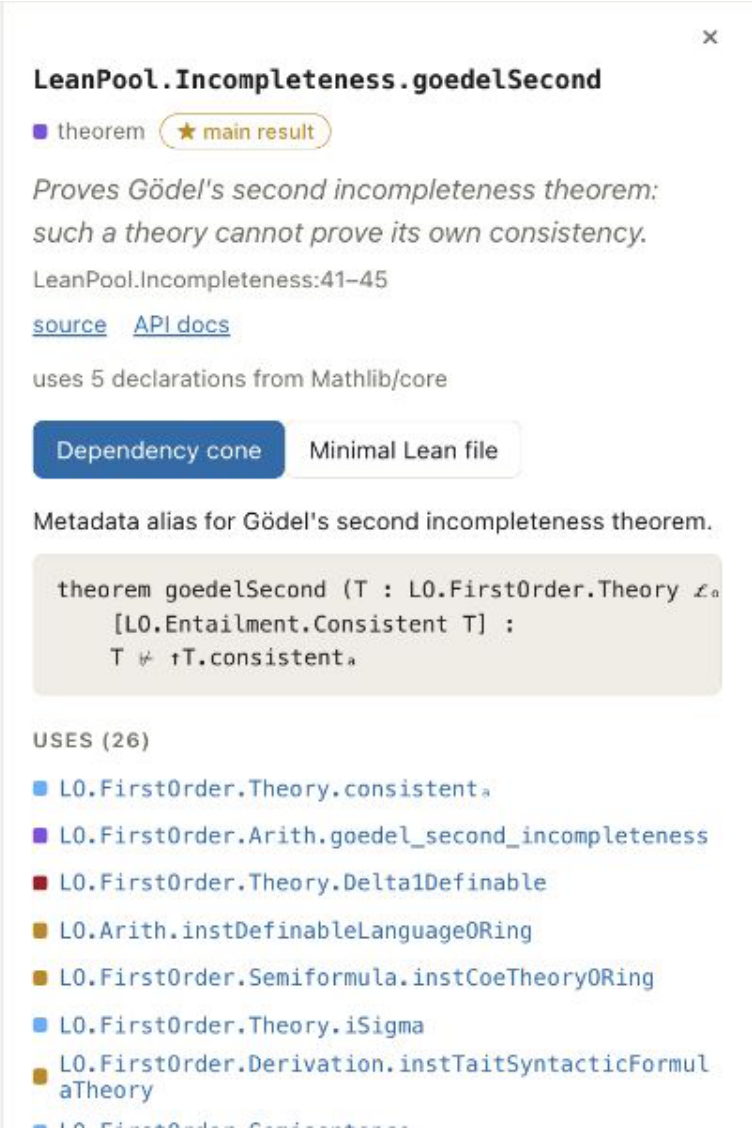
The preserved panel shows how a headline result opens its informal description, formal Lean statement, dependency information, and source links.
Maintaining the publication pipeline.
Graph caches depend on project source, transitive imports, toolchain configuration, and extractor version. Documentation reuses CI artifacts only when source revisions and verified trees match; cached exports still undergo data validation.
G.1 Recorded reuse
Reuse records distinguish direct theorem application, attributed copying, explicit package dependencies, and later maintainer-controlled projects. LeanEval matches normalized declarations in 20 solutions to Lean Pool, compared with 8 for the next repository shown. Matches can include both an archived project and its upstream source; ordinary package dependencies are excluded [15].
| Consumer | Recorded reuse |
|---|---|
| Kurosh subgroup development | Applies the archived finite-graph spanning-tree basis |
| Feige development | Copies attributed Pool isoperimetry; applies its theorem |
| Poincaré development | Pins Pool and reexports its nonintegrability theorem |
| Maintainer homotopy development | Contains attributed homotopy modules imported through Pool |
| Maintainer Mazur development | Uses the archived Grothendieck-vanishing result |
Appendix H Original upstream Lean versions
The complete 211-project table records upstream Lean versions and links the supporting source. A dagger identifies the latest pre-registration default-branch revision used when an import pin was unavailable; “Unpinned” means the retained evidence supplied no toolchain pin.
| No. | Project | Upstream Lean |
|---|---|---|
| 1 | 2-Coloring Cycles in One Round | 4.28.0† |
| 2 | A 4AP-free permutation of the positive integers | 4.33.1 |
| 3 | A complex structure on the six-sphere | 4.33.0 |
| 4 | A Conditional Fourteen-Point Case of Erdős Problem 132 | 4.32.0-rc1† |
| 5 | A Conditional Sieve Criterion for Twin Primes via Krafft Geometry | 4.32.0-rc1† |
| 6 | A Detailed Proof of the Chudnovsky Formula | 4.32.0-rc1† |
| 7 | A formalization of Borel determinacy in Lean | 4.28.0-rc1† |
| 8 | A sharp 5/8 bound for Erdős Problem 865 | 4.28.0 |
| 9 | ABC implies that Ramanujan’s tau function misses almost all primes | 4.26.0† |
| 10 | Accelerated Nesterov convergence under local Polyak-Lojasiewicz conditions | 4.28.0† |
| 11 | Almost all primes are partially regular | 4.26.0† |
| 12 | Analysis of Boolean functions in Lean | 4.16.0-rc2† |
| 13 | Apportionmentlib | 4.30.0† |
| 14 | Archon-FirstProof-Results | 4.28.0† |
| 15 | Artin-Wedderburn Theorem | 4.14.0-rc2† |
| 16 | Asymptotically attaining the Moore bound | 4.32.2 |
| 17 | Aumann’s Agreement Theorem | 4.28.0† |
| 18 | Axiomatic projective geometry (Faure–Frölicher) | Unpinned |
| 19 | Bennett–Bernstein, Freedman, and Hoeffding concentration inequalities | 4.28.0 |
| 20 | BKLO simultaneous perfect matchings and spread matchings | 4.28.0 |
| 21 | Boolean Isoperimetry and Conway–Guy Coherent Gaps | 4.28.0† |
| 22 | Bounds for the centered Hardy-Littlewood maximal constant | 4.32.0 |
| 23 | Brauer Group Core | 4.26.0-rc2† |
| 24 | Burkholder Martingale Transform Inequality | 4.30.0-rc2 |
| 25 | Carlet’s Kasami cyclic-additive conjecture | 4.33.0 |
| 26 | Certified Runge-Kutta Order Conditions | 4.30.0-rc2 |
| 27 | Chaos and the Julia set of the complex exponential | 4.34.0 |
| 28 | Chebyshev Quotients and Demazure Multiplicities | 4.28.0 |
| 29 | Chordal graphs: minimal separators and simplicial vertices | 4.34.0-rc1† |
| 30 | Chvátal’s conjecture and sharp Boolean correlation | 4.33.1 |
| 31 | Circuit Complexity in Lean 4 | 4.29.0-rc4† |
| 32 | circuitlib: a circuit verification library for Lean 4 | 4.30.0-rc1 |
| 33 | Classification of Compact Surfaces | 4.32.2† |
| 34 | Classification of groups of order p * q | 4.15.0† |
| 35 | Classification of low-dimensional solvable Lie algebras | 4.19.0† |
| 36 | Clawristotle: Vlasov-Maxwell-Landau steady-state classification | 4.24.0 |
| 37 | Coinductive Interaction Trees using QPFs | 4.29.0† |
| 38 | Common-neighbour counterexamples for Saxl graphs | 4.34.0-rc2 |
| 39 | Conditional formalization of Zhou’s Connes-rigidity counterexample | 4.34.0-rc2 |
| 40 | Connes-Kreimer Hopf algebra of rooted trees | 4.30.0-rc2† |
| 41 | Convex Three-Distance Degree-Six Theorem and Exceptional-Word Closures | 4.34.0-rc1† |
| 42 | Counterexamples to graph compactness and two-degenerate extremal bounds | 4.32.0 |
| 43 | Counting Critical Portraits | 4.31.0† |
| 44 | Craig interpolation and Beth definability for propositional dynamic logic | 4.33.1 |
| 45 | Craig Interpolation for Gödel-Löb logic via coalgebraic proofs | 4.28.0† |
| 46 | Dead Ends in Square-Free Digit Walks | 4.26.0 |
| 47 | Demazure Operators and Lean | 4.14.0-rc3† |
| 48 | Density-One GKP Divisibility and Its Carry-Language Characterization | 4.32.0-rc1† |
| 49 | Dilatations of categories and commutative rings | 4.24.0 |
| 50 | Directed Topology in Lean 4 | 4.6.0-rc1 |
| 51 | Disproof of the Aharoni-Korman Conjecture | 4.16.0-rc2† |
| 52 | Disproof of the Köthe conjecture (Krempa’s matrix form) | 4.28.0 |
| 53 | DomainTheory | 4.30.0 |
| 54 | Duality theory in linear optimization and its extensions | 4.18.0† |
| 55 | Ehrhart’s sharp volume inequality | 4.32.0 |
| 56 | Erdős Problem #137: powerful products of consecutive integers | 4.28.0 |
| 57 | Erdős Problem #367 | 4.28.0 |
| 58 | Erdős Problem 346: Ratio Limit Forces the Golden Ratio | 4.31.0† |
| 59 | Euclidean Distance Geometry | 4.32.0-rc1† |
| 60 | Euler’s pentagonal number theorem | 4.26.0-rc2 |
| 61 | Euler’s pentagonal number theorem, two independent proofs, and the Jacobi triple product | 4.34.0-rc1 |
| 62 | Even graphs are edge-disjoint unions of cycles | 4.28.0 |
| 63 | Event Structures and Causal-Consistent Reversibility | 4.28.1† |
| 64 | Exact odd-prime distributions of central-binomial valuations | 4.32.0-rc1† |
| 65 | Exceptional Set in the abc Conjecture | 4.21.0-rc3† |
| 66 | Existence of a finitely presented non-sofic group | 4.32.0 |
| 67 | Existence of Nash equilibria via Brouwer’s fixed-point theorem | 4.30.0† |
| 68 | Explicit type A and BC root pairings | 4.30.0-rc2† |
| 69 | Extended Demazure Product on ASP Permutations | 4.31.0-rc2 |
| 70 | Factorization Systems | 4.14.0-rc2† |
| 71 | Feige’s sharp unit-slack inequality | 4.31.0 |
| 72 | Fel’s Conjecture on Syzygies of Numerical Semigroups | 4.26.0 |
| 73 | Fermat’s Last Theorem for regular primes | 4.34.0-rc2 |
| 74 | FinEqs - reducing equations defining a subset of n-space over a finite field | 4.24.0† |
| 75 | Finite max-flow / min-cut | 4.28.0 |
| 76 | Finite witnesses and the width hierarchy for language generation | 4.24.0 |
| 77 | Finite Čencov-Petz Uniqueness | 4.29.1 |
| 78 | Finite-N Kuramoto Synchronization | 4.31.0-rc1† |
| 79 | Finite-time breakdown for Navier–Stokes and Euler | 4.34.0-rc2 |
| 80 | Finitely generated cones and finite LP duality | 4.28.0† |
| 81 | First Order Language of ZF Set Theory | 4.22.0-rc3† |
| 82 | Flean: Floating-Point Numbers in Lean | 4.27.0-rc1† |
| 83 | Formal Learning Theory Kernel | 4.29.0-rc6† |
| 84 | Formalisation of the Bruhat-Tits Tree | 4.19.0† |
| 85 | Formalizations of theorems related to model checking | 4.30.0† |
| 86 | Formalized Complex Analysis in Lean | 4.28.0-rc1† |
| 87 | Foundational local complex-analytic geometry | 4.32.0 |
| 88 | FrontierMath Ramsey Hypergraphs | 4.28.0 |
| 89 | Fundamental groups of finite connected graphs | 4.32.0 |
| 90 | Galois groups of quadratic polynomial iterates | 4.33.1 |
| 91 | Gaussian Moments Conjecture counterexamples | 4.34.0 |
| 92 | Genus-Zero Pairings and Catalan Numbers | 4.29.0-rc6† |
| 93 | Geometric Four-Colorings of the Moser Lattice and Ring | 4.32.0-rc1† |
| 94 | Global completeness of one-sorted definedness-free matching logic | 4.33.0 |
| 95 | Grothendieck’s Vanishing Theorem | 4.28.0 |
| 96 | Gödel’s First and Second Incompleteness Theorems | 4.16.0-rc2 |
| 97 | Halving the Kalton-Roberts upper bound | 4.28.0† |
| 98 | Homogeneous self-dual interior-point method for linear programming | 4.31.0-rc1† |
| 99 | Hurwitz’s Classification of Euclidean Composition Algebras | 4.33.0 |
| 100 | Improved asymptotic bounds for binary and spherical codes | 4.32.0 |
| 101 | Improved long gaps between consecutive primes | 4.33.0 |
| 102 | Improved Lower Bounds for Strong n-Conjectures | 4.30.0-rc2† |
| 103 | Infinitary logic and countable model theory | 4.34.0-rc1 |
| 104 | Infinite counterexamples to Connes’s rigidity conjecture | 4.32.0 |
| 105 | Irrationality of (3) | 4.18.0† |
| 106 | Jordan–Schönflies theorem | 4.32.2 |
| 107 | Kahn–Kalai expectation-threshold theorem | 4.32.0 |
| 108 | Known Bounds for the Hadwiger-Nelson Problem | 4.32.0-rc1† |
| 109 | Kolokolnikov’s ACMAX conjecture | 4.32.0-rc1 |
| 110 | Kurosh and Schreier subgroup theorems via covering graphs | 4.32.0 |
| 111 | Lean-QuantumAlg | 4.30.0 |
| 112 | Lehmer’s Polynomial and the E10 Coxeter Element | 4.32.0-rc1† |
| 113 | Lentil: Temporal Logic of Actions in Lean 4 | 4.28.0† |
| 114 | Leo Moser’s finite distinct-subset-sums inequality | 4.32.0-rc1† |
| 115 | Maxima of Coxeter frieze patterns are Fibonacci numbers | 4.10.0-rc2† |
| 116 | Mean-field derivation and well-posedness of the Vlasov equation | 4.33.0-rc1 |
| 117 | Minimum modulus for the unique multiset-sum problem | 4.32.0† |
| 118 | Misere combinatorial games | 4.29.0-rc1 |
| 119 | Modular forms and the generalized residue theorem | 4.29.0-rc8 |
| 120 | Monlib4 Operator-Algebra and Quantum-Set Core | 4.21.0-rc3† |
| 121 | Monotonicity Formula for Stationary Harmonic Maps | 4.30.0-rc2 |
| 122 | Monsky’s Theorem | 4.16.0-rc2† |
| 123 | Moreira’s version of Sard’s theorem | 4.27.0-rc1 |
| 124 | MRiscX | 4.29.0† |
| 125 | Nash-Williams fronts and 2-better-quasi-orders | 4.28.0 |
| 126 | Near-perfect triangle packings from sum-zero triples | 4.28.0† |
| 127 | Neukirch’s Algebraic Number Theory: Hilbert ramification theory | 4.5.0-rc1† |
| 128 | Nivat’s conjecture | 4.33.1 |
| 129 | On the paucity of lattice triangles | 4.26.0† |
| 130 | Optimal Pebbling Number of the Hypercube | 4.30.0-rc2† |
| 131 | Oracle Computability and Turing Degrees | 4.24.0† |
| 132 | Osterwalder-Schrader Axioms for the Gaussian Free Field | 4.29.0† |
| 133 | Partial Combinatory Algebras | 4.15.0-rc1† |
| 134 | PCF Theory | 4.18.0-rc1† |
| 135 | Period Lengths of Rational Cut-and-Project Gap Sequences | 4.29.1 |
| 136 | Planar Point Sets Whose Non-Diameter Distances Form a Geometric 3-Chain | 4.31.0-rc1† |
| 137 | Poincaré’s Nonintegrability Theorem for the Restricted Three-Body Problem | 4.33.0-rc1† |
| 138 | Pointwise Birkhoff Ergodic Theorem | 4.20.0-rc5† |
| 139 | Poitou’s Explicit Odlyzko Bound for Root Discriminants | 4.33.0-rc1† |
| 140 | Polylean Unit Conjecture Counterexample | 4.19.0-rc3† |
| 141 | Polynomial ABC (Mason–Stothers) and its corollaries | 4.9.0-rc2 |
| 142 | Polynomial parametrizations of Pythagorean triples | 4.30.0-rc2† |
| 143 | Polynomial-factor hardness of the closest vector problem | 4.32.0 |
| 144 | Prekopa-Leindler, Brunn-Minkowski, and the isoperimetric inequality | 4.26.0-rc2† |
| 145 | Primitive Sets Above x (Erdos Problem 1196) | 4.30.0-rc1† |
| 146 | Pumping Lemma for Context-Free Grammars | 4.15.0-rc1† |
| 147 | Pólya’s enumeration theorem | 4.14.0-rc2 |
| 148 | Quadratic-order prime classification | 4.28.0† |
| 149 | Quantum parallel repetition | 4.32.0 |
| 150 | Quartic-over-logarithmic lower bound for rational permanent formulas | 4.32.0 |
| 151 | Quasi-Borel Spaces | 4.28.0-rc1† |
| 152 | Radó’s theorem for Riemann surfaces | 4.33.0 |
| 153 | Rellich–Kondrachov compact embedding theorem | 4.29.1† |
| 154 | Riemann Mapping Theorem | 4.26.0 |
| 155 | Riemann–Roch for algebraic function fields | 4.31.0 |
| 156 | RL Theory in Lean | 4.28.0-rc1† |
| 157 | Sabidussi’s compatibility conjecture for Eulerian multigraphs | 4.31.0 |
| 158 | Selberg Sieve | 4.7.0-rc2† |
| 159 | Sensitivity Conjecture: sqrt(deg) <= sensitivity | 4.28.0† |
| 160 | Serre’s mass formula for totally ramified local-field extensions | 4.32.2 |
| 161 | Shannon Entropy Characterization | 4.28.0† |
| 162 | Sharp asymptotic upper bounds for sphere packing | 4.32.0 |
| 163 | Sharp Five-Distance and Sup-Norm Gap Theorems | 4.30.0† |
| 164 | Simple zeros of the Riemann zeta function | 4.34.0-rc2 |
| 165 | Spectral positivity | 4.30.0 |
| 166 | Spectral theorem for compact self-adjoint operators | 4.29.1 |
| 167 | Square-difference-free polynomials beyond Naslund’s conjectured bound | 4.33.0 |
| 168 | Stable phase retrieval for Hermite-Fock expansions | 4.29.0-rc6† |
| 169 | Strengthened V0 Bounded Arithmetic Interfaces | 4.22.0† |
| 170 | Sums of Distinct Factorials That Are Powers of Two (Erdos Problem 403) | 4.31.0† |
| 171 | Sums of Three Squares | 4.29.1† |
| 172 | Sundog certificates | 4.30.0 |
| 173 | Superexponential lower bounds for multicolor triangle Ramsey numbers | 4.32.0 |
| 174 | Synthetic Euclidean geometry: Euclid’s Elements Book I | Unpinned† |
| 175 | Thakur’s hypotheses on power sums of F_q[t] | 4.28.0† |
| 176 | The 5/8 theorem | 4.28.0† |
| 177 | The Anderson Conjecture: A Weakly Quasi-Complete Ring Need Not Be Quasi-Complete | 4.29.0-rc8† |
| 178 | The Bannai-Bannai-Stanton Bound on Distance Sets | 4.31.0† |
| 179 | The Bollobás–Nikiforov conjecture | 4.33.0-rc1 |
| 180 | The Convex-Octagon Case of Erdős Problem 97 | 4.32.0-rc1† |
| 181 | The Cramer-Wold theorem | 4.32.0-rc1† |
| 182 | The Erdős–Graham–Ruzsa–Straus two-prime theorem | 4.29.1† |
| 183 | The Erdős–Sós conjecture (Erdős Problem 548) | 4.28.0 |
| 184 | The Erdős–Tuza–Valtr conjecture | 4.13.0-rc3 |
| 185 | The Fundamental Inequality of Valued Fields | 4.30.0† |
| 186 | The Hanson-Wright inequality for sub-Gaussian quadratic forms | 4.33.0 |
| 187 | The Jacobian of a Compact Riemann Surface | 4.33.0-rc2 |
| 188 | The Johnson–Lindenstrauss Lemma and Quantized JL | 4.31.0† |
| 189 | The Komlós and Beck–Fiala bounds with constant 36 | 4.34.0 |
| 190 | The Kunen inconsistency theorem | 4.29.0-rc4† |
| 191 | The main theorem of polytopes | 4.7.0-rc2 |
| 192 | The optimal exponent relating sumsets and difference sets | 4.32.1 |
| 193 | The polynomial Freiman–Ruzsa conjecture | 4.34.0-rc2 |
| 194 | The polynomial method and restricted sums of congruence classes | 4.27.0-rc1 |
| 195 | The Ramanujan-Nagell theorem | 4.26.0-rc2 |
| 196 | The Rupert Problem for convex polyhedra | 4.28.0 |
| 197 | The Three-Gap (Steinhaus) Theorem | 4.29.1 |
| 198 | The transcendence of | 4.30.0-rc2† |
| 199 | The Wallace problem in ZFC | 4.30.0 |
| 200 | The Zhang-Yeung non-Shannon information inequality | 4.28.0-rc1 |
| 201 | Turán’s theorem (the "Book" weighting proof) | 4.24.0-rc1† |
| 202 | Ulm’s theorem for countable reduced abelian p-groups | 4.30.0-rc1 |
| 203 | Unconditional Schauder Bases | 4.30.0-rc2 |
| 204 | Uniqueness of Shannon Capacity-Achieving Priors | 4.29.1† |
| 205 | Verified canonical labelling of finite graphs | 4.33.1 |
| 206 | Verified interval-Cauchy real arithmetic | 4.17.0-rc1† |
| 207 | Virasoro Project | 4.27.0-rc1† |
| 208 | Weierstrass models and singular points for Tate’s algorithm | nightly 2023-08-19 † |
| 209 | Whitehead’s theorem for CW-complexes | 4.21.0-rc3 |
| 210 | Wigner Semicircle Distribution | 4.24.0† |
| 211 | ZFLean | 4.27.0† |
Appendix I Imported projects and their publications
The complete 211-project concordance links each imported project to upstream source and identified publications. It distinguishes companion papers, mathematical source material, software releases, and records without an identified publication. These are provenance records, not independent endorsements of every advertised mathematical claim.
| No. | Imported project / upstream | Publications and mathematical sources |
|---|---|---|
| 1 | 2-Coloring Cycles in One Round | Companion paper: 2-Coloring Cycles in One Round [68]. |
| 2 | A 4AP-free permutation of the positive integers | Companion paper: A 4AP-free permutation of the positive integers [97]. |
| 3 | A complex structure on the six-sphere | Mathematical manuscript: A compact complex threefold fibred by tori over the projective line, and the six-sphere [10]. |
| 4 | A Conditional Fourteen-Point Case of Erdős Problem 132 | Mathematical source: Constructions of Maximum Few-Distance Sets in Euclidean Spaces [204]. |
| 5 | A Conditional Sieve Criterion for Twin Primes via Krafft Geometry | Companion preprint: Variational Optimisation of Spectral Sieve Quotients for Primes in Bounded Symmetric Intervals [185]. |
| 6 | A Detailed Proof of the Chudnovsky Formula | Mathematical source: A detailed proof of the Chudnovsky formula with means of basic complex analysis – Ein ausführlicher Beweis der Chudnovsky-Formel mit elementarer Funktionentheorie [155]. |
| 7 | A formalization of Borel determinacy in Lean | Companion paper: A formalization of Borel determinacy in Lean [149]. |
| 8 | A sharp 5/8 bound for Erdős Problem 865 | No publication identified; see upstream documentation. |
| 9 | ABC implies that Ramanujan’s tau function misses almost all primes | Companion paper: ABC implies that Ramanujan’s tau function misses almost all primes [12]. |
| 10 | Accelerated Nesterov convergence under local Polyak-Lojasiewicz conditions | Companion paper: Optimal local linear convergence of Nesterov’s accelerated gradient method for functions under the Polyak–Łojasiewicz inequality [67]. |
| 11 | Almost all primes are partially regular | Companion paper: Almost all primes are partially regular [45]. |
| 12 | Analysis of Boolean functions in Lean | Mathematical source (book): Analysis of Boolean Functions [168]. |
| 13 | Apportionmentlib | Mathematical source (book): Fair Representation: Meeting the Ideal of One Man, One Vote [22]. |
| 14 | Archon-FirstProof-Results | Source challenge paper: First Proof [1]. |
| 15 | Artin-Wedderburn Theorem | Mathematical source: The Wedderburn-Artin Theorem [35]. Mathematical source (book): A First Course in Noncommutative Rings [128]. |
| 16 | Asymptotically attaining the Moore bound | Companion paper: Asymptotically attaining the Moore bound [212]. |
| 17 | Aumann’s Agreement Theorem | Companion paper: We Can’t Agree to Disagree, Formally: Aumann’s Theorem and Assumption Accounting in Lean [47]. |
| 18 | Axiomatic projective geometry (Faure–Frölicher) | Mathematical source (book): Modern Projective Geometry [66]. |
| 19 | Bennett–Bernstein, Freedman, and Hoeffding concentration inequalities | Companion manuscript for reusable components: Linear-Error Clique Partitions of Split Graphs via Structured Triangle Packing [78]. |
| 20 | BKLO simultaneous perfect matchings and spread matchings | Companion manuscript for reusable components: Linear-Error Clique Partitions of Split Graphs via Structured Triangle Packing [78]. Mathematical source: Edge-decompositions of graphs with high minimum degree [25]. |
| 21 | Boolean Isoperimetry and Conway–Guy Coherent Gaps | Mathematical source: A sum packing problem of Erdös and the Conway-Guy sequence [32]. Companion manuscript: Robust Harper Stability at the Exponential Scale [157]. Mathematical source: Optimal numberings and isoperimetric problems on graphs [90]. |
| 22 | Bounds for the centered Hardy-Littlewood maximal constant | Companion proof note: A lower bound 1.6855 for the planar centred maximal constant over squares [139]. |
| 23 | Brauer Group Core | Mathematical source (book): Central Simple Algebras and Galois Cohomology [80]. |
| 24 | Burkholder Martingale Transform Inequality | Mathematical source: Boundary Value Problems and Sharp Inequalities for Martingale Transforms [37]. |
| 25 | Carlet’s Kasami cyclic-additive conjecture | Companion paper: On a conjecture on the Kasami APN function: reductions, structure theorems, a proof for , and exhaustive verification for [162]. |
| 26 | Certified Runge-Kutta Order Conditions | Companion preprint: What Order a Method Knows: certified Runge–Kutta order conditions over rooted trees, machine-checked in Lean 4 [159]. |
| 27 | Chaos and the Julia set of the complex exponential | Mathematical source: The exponential map is chaotic: An invitation to transcendental dynamics [199]. |
| 28 | Chebyshev Quotients and Demazure Multiplicities | Companion paper: Chebyshev quotients, Demazure multiplicities, and Dyck-path models [31]. |
| 29 | Chordal graphs: minimal separators and simplicial vertices | Companion preprint: Complete-Split Extremizers for a Fractional Triangle-Cover Functional on Chordal Graphs [77]. |
| 30 | Chvátal’s conjecture and sharp Boolean correlation | Companion paper: A proof of Chvátal’s conjecture via a sharp correlation inequality [40]. |
| 31 | Circuit Complexity in Lean 4 | No publication identified; see upstream documentation. |
| 32 | circuitlib: a circuit verification library for Lean 4 | Mathematical source: A Complete Theory of Sequential Digital Circuits: Denotational, Operational and Algebraic Semantics [75]. |
| 33 | Classification of Compact Surfaces | No publication identified; see upstream documentation. |
| 34 | Classification of groups of order p * q | Companion paper: Classifying the groups of order in Lean [91]. |
| 35 | Classification of low-dimensional solvable Lie algebras | Mathematical source (book): Classification and Identification of Lie Algebras [201]. |
| 36 | Clawristotle: Vlasov-Maxwell-Landau steady-state classification | Companion paper: Semi-Autonomous Formalization of the Vlasov-Maxwell-Landau Equilibrium [108]. |
| 37 | Coinductive Interaction Trees using QPFs | Prior Coq formalization paper: Interaction trees: representing recursive and impure programs in Coq [221]. |
| 38 | Common-neighbour counterexamples for Saxl graphs | Companion paper: Common neighbour conjectures for Saxl graphs fail at every base size [188]. Software release: Computational source code and Lean formalization for Common neighbour conjectures for Saxl graphs fail at every base size [189]. The registered Zenodo DOI identifies the accompanying software. |
| 39 | Conditional formalization of Zhou’s Connes-rigidity counterexample | Companion paper: ICC property (T) groups without W∗-superrigidity [230]. |
| 40 | Connes-Kreimer Hopf algebra of rooted trees | Companion preprint: How a Tree Forgets Its Order: the Eulerian idempotent and the Adams spectrum on the commutative Connes–Kreimer–Butcher Hopf algebra of rooted trees, machine-checked in Lean 4 [161]. Companion preprint: How a Tree Remembers Its Cuts: the Connes–Kreimer–Foissy Hopf Algebra of Rooted Trees, Machine-Checked in Lean 4 [160]. |
| 41 | Convex Three-Distance Degree-Six Theorem and Exceptional-Word Closures | Mathematical source: On the graph of large distances [65]. |
| 42 | Counterexamples to graph compactness and two-degenerate extremal bounds | Companion paper: Ten Advances in Mathematics and Theoretical Computer Science [175]. |
| 43 | Counting Critical Portraits | Mathematical source: Degree-d-invariant laminations [208]. Software release: no-way-labs/lean-critical-portraits: lean-critical-portraits [118]. The registered Zenodo DOI identifies software. |
| 44 | Craig interpolation and Beth definability for propositional dynamic logic | Companion paper: Propositional Dynamic Logic has Craig Interpolation: a tableau-based proof [34]. |
| 45 | Craig Interpolation for Gödel-Löb logic via coalgebraic proofs | Companion thesis: Proofs as Coalgebras [79]. Mathematical source: Interpolation properties for provability logics GL and GLP [197]. |
| 46 | Dead Ends in Square-Free Digit Walks | Companion paper: Dead ends in square-free digit walks [44]. |
| 47 | Demazure Operators and Lean | Companion thesis: Demazure operators and Lean [192]. Mathematical source: SCHUBERT CELLS AND COHOMOLOGY OF THE SPACESG/P [28]. |
| 48 | Density-One GKP Divisibility and Its Carry-Language Characterization | Mathematical source (book): Concrete Mathematics: A Foundation for Computer Science [86]. |
| 49 | Dilatations of categories and commutative rings | Companion paper: Dilatations of categories, via their Lean formalization [152]. Prior formalization: Formalizing multi-graded Brenner–Schröer Proj schemes and dilatations of rings in Lean4 [153]. |
| 50 | Directed Topology in Lean 4 | Companion paper: The Directed Van Kampen Theorem in Lean [26]. |
| 51 | Disproof of the Aharoni-Korman Conjecture | Companion paper: The Aharoni–Korman conjecture is false [99]. Mathematical source: Greene-Kleitman’s theorem for infinite posets [5]. |
| 52 | Disproof of the Köthe conjecture (Krempa’s matrix form) | Companion paper: A counterexample to Köthe’s conjecture and a question of Rowen [4]. |
| 53 | DomainTheory | Companion manuscript: Scott’s 3 Successively Less Topological, Simpler, and More Constructive Presentations of Domain Theory and Their Equivalence [58]. Mathematical source: Domains for denotational semantics [194]. |
| 54 | Duality theory in linear optimization and its extensions | Companion paper: Duality theory in linear optimization and its extensions – formally verified [61]. |
| 55 | Ehrhart’s sharp volume inequality | Companion paper: Ten Advances in Mathematics and Theoretical Computer Science [175]. |
| 56 | Erdős Problem #137: powerful products of consecutive integers | No publication identified; see upstream documentation. |
| 57 | Erdős Problem #367 | Companion manuscript: Powerful parts of consecutive integers and Davenport–Zannier polynomials [103]. |
| 58 | Erdős Problem 346: Ratio Limit Forces the Golden Ratio | No publication identified; see upstream documentation. |
| 59 | Euclidean Distance Geometry | Mathematical source: Remarks to Maurice Frechet’s Article “Sur La Definition Axiomatique D’Une Classe D’Espace Distances Vectoriellement Applicable Sur L’Espace De Hilbert [193]. |
| 60 | Euler’s pentagonal number theorem | No publication identified; see upstream documentation. |
| 61 | Euler’s pentagonal number theorem, two independent proofs, and the Jacobi triple product | Formalization blueprint: Pentagonal Number Theorem [51]. |
| 62 | Even graphs are edge-disjoint unions of cycles | Companion manuscript for reusable components: Linear-Error Clique Partitions of Split Graphs via Structured Triangle Packing [78]. |
| 63 | Event Structures and Causal-Consistent Reversibility | Mathematical source: Event structures [217]. |
| 64 | Exact odd-prime distributions of central-binomial valuations | Mathematical source (working paper): Carry-Run Theorem and Sakib Index for the Exact Distribution of over mod [191]. Mathematical source: Über die Ergänzungssätze zu den allgemeinen Reciprocitätsgesetzen. [122]. |
| 65 | Exceptional Set in the abc Conjecture | Companion paper: Bounds on the exceptional set in the conjecture [27]. |
| 66 | Existence of a finitely presented non-sofic group | Companion paper: Ten Advances in Mathematics and Theoretical Computer Science [175]. |
| 67 | Existence of Nash equilibria via Brouwer’s fixed-point theorem | Mathematical source: Equilibrium points in n -person games [163]. |
| 68 | Explicit type A and BC root pairings | Mathematical source (book): Introduction to Lie Algebras and Representation Theory [104]. |
| 69 | Extended Demazure Product on ASP Permutations | Companion paper: An extended Demazure product on integer permutations via min-plus matrix multiplication [182]. |
| 70 | Factorization Systems | Mathematical source (book): Category Theory in Context [186]. |
| 71 | Feige’s sharp unit-slack inequality | Companion paper: Sharp small-deviation inequalities for sums of independent nonnegative random variables [72]. |
| 72 | Fel’s Conjecture on Syzygies of Numerical Semigroups | Companion paper: Fel’s Conjecture on Syzygies of Numerical Semigroups [46]. |
| 73 | Fermat’s Last Theorem for regular primes | Companion paper: A complete formalization of Fermat’s Last Theorem for regular primes in Lean [29]. |
| 74 | FinEqs - reducing equations defining a subset of n-space over a finite field | Companion paper: Reducing the number of equations defining a subset of the -space over a finite field [24]. |
| 75 | Finite max-flow / min-cut | Companion manuscript for reusable components: Linear-Error Clique Partitions of Split Graphs via Structured Triangle Packing [78]. |
| 76 | Finite witnesses and the width hierarchy for language generation | Companion paper: Characterizing Language Generation in the Limit: Finite Witnesses and a Separation-Width Hierarchy [136]. |
| 77 | Finite Čencov-Petz Uniqueness | Mathematical source (book): Statistical Decision Rules and Optimal Inference [49]. |
| 78 | Finite-N Kuramoto Synchronization | Companion preprint: Kuramoto-lean: Lean 4 Library for Finite-N Kuramoto Synchronisation Dynamics [39]. |
| 79 | Finite-time breakdown for Navier–Stokes and Euler | Companion paper: Finite Time Blowup for Navier–Stokes [171]. Companion paper: Finite Time Blowup for the Euler Equation [170]. |
| 80 | Finitely generated cones and finite LP duality | Companion preprint: Affine Profile Reduction for Fractional Triangle Packings in Split Graphs [76]. |
| 81 | First Order Language of ZF Set Theory | Mathematical source (book): Set Theory [111]. |
| 82 | Flean: Floating-Point Numbers in Lean | Technical standard: IEEE Standard for Floating-Point Arithmetic [107]. |
| 83 | Formal Learning Theory Kernel | Companion textbook: A Textbook of Formal Learning Theory [87]. |
| 84 | Formalisation of the Bruhat-Tits Tree | Companion paper: Formalising the Bruhat-Tits Tree [146]. Mathematical source (book): Trees [196]. |
| 85 | Formalizations of theorems related to model checking | Mathematical source: An automata-theoretic approach to linear temporal logic [214]. |
| 86 | Formalized Complex Analysis in Lean | No publication identified; see upstream documentation. |
| 87 | Foundational local complex-analytic geometry | No publication identified; see upstream documentation. |
| 88 | FrontierMath Ramsey Hypergraphs | Companion manuscript: A constant-factor lower bound for [84]. Mathematical source: Choosing between incompatible ideals [36]. |
| 89 | Fundamental groups of finite connected graphs | Mathematical source (book): Algebraic Topology [93]. |
| 90 | Galois groups of quadratic polynomial iterates | Mathematical source: On Stoll’s criterion for the maximality of quadratic arboreal Galois representations [135]. Mathematical source: Arboreal Galois representation for a certain type of quadratic polynomials [134]. Mathematical source: Galois groups over of some iterated polynomials [202]. |
| 91 | Gaussian Moments Conjecture counterexamples | Companion paper: Small Counterexamples to the Gaussian Moments Conjecture [143]. |
| 92 | Genus-Zero Pairings and Catalan Numbers | No publication identified; see upstream documentation. |
| 93 | Geometric Four-Colorings of the Moser Lattice and Ring | Companion paper: A note on geometric colorings of the Moser lattice [60]. |
| 94 | Global completeness of one-sorted definedness-free matching logic | Companion paper: Completeness and incompleteness of basic matching logic [48]. |
| 95 | Grothendieck’s Vanishing Theorem | Companion expert-review paper: Sorries Are Not the Hard Part: An Expert-Review Case Study of a Semi-Autonomous Formalization [109]. Mathematical source (book): Algebraic Geometry [92]. |
| 96 | Gödel’s First and Second Incompleteness Theorems | Mathematical source: Über formal unentscheidbare Sätze der Principia Mathematica und verwandter Systeme I [81]. |
| 97 | Halving the Kalton-Roberts upper bound | Companion paper: Halving the original Kalton–Roberts upper bound for nearly additive set functions [98]. |
| 98 | Homogeneous self-dual interior-point method for linear programming | Mathematical source: An O(nL)-Iteration Homogeneous and Self-Dual Linear Programming Algorithm [223]. |
| 99 | Hurwitz’s Classification of Euclidean Composition Algebras | Mathematical source (document): Über die Composition der quadratischen Formen von beliebig vielen Variablen [106]. |
| 100 | Improved asymptotic bounds for binary and spherical codes | Companion paper: Ten Advances in Mathematics and Theoretical Computer Science [175]. |
| 101 | Improved long gaps between consecutive primes | Companion paper: Improved Long Gaps Between Primes [174]. |
| 102 | Improved Lower Bounds for Strong n-Conjectures | Companion paper: IMPROVED LOWER BOUNDS FOR STRONG n-CONJECTURES [100]. |
| 103 | Infinitary logic and countable model theory | Mathematical source (book): Lectures on Infinitary Model Theory [150]. |
| 104 | Infinite counterexamples to Connes’s rigidity conjecture | Companion paper: Ten Advances in Mathematics and Theoretical Computer Science [175]. |
| 105 | Irrationality of (3) | Companion paper: A Formal Proof of the Irrationality of in Lean 4 [141]. Mathematical source: A Note on the Irrationality of (2) and (3) [30]. |
| 106 | Jordan–Schönflies theorem | No companion paper is listed in the retained upstream documentation; the repository documents the theorem and its proof structure. |
| 107 | Kahn–Kalai expectation-threshold theorem | Mathematical source: A Short Proof of Kahn-Kalai Conjecture [209]. |
| 108 | Known Bounds for the Hadwiger-Nelson Problem | Mathematical source: The chromatic number of the plane is at least 5 – a human-verifiable proof [179]. |
| 109 | Kolokolnikov’s ACMAX conjecture | Companion paper: Maximizing Algebraic Connectivity with 2(n-2) Edges: The Large Vertex Number Case [231]. Source conjecture: Maximizing algebraic connectivity for certain families of graphs [120]. |
| 110 | Kurosh and Schreier subgroup theorems via covering graphs | Mathematical source: Die Untergruppen der freien Produkte von beliebigen Gruppen [127]. |
| 111 | Lean-QuantumAlg | Companion paper: Building Shor’s Algorithm in Lean: An Agentic Formalization of Quantum Attacks on RSA-2048 and P-256 [227]. Companion paper: An Agentic Formalization for Certified Quantum Neural Network Design [112]. |
| 112 | Lehmer’s Polynomial and the E10 Coxeter Element | No publication identified; see upstream documentation. |
| 113 | Lentil: Temporal Logic of Actions in Lean 4 | No publication identified; see upstream documentation. |
| 114 | Leo Moser’s finite distinct-subset-sums inequality | Mathematical source: Sets of Integers Whose Subsets Have Distinct Sums [89]. |
| 115 | Maxima of Coxeter frieze patterns are Fibonacci numbers | Companion paper: On Upper Bounds of Frieze Patterns [42]. |
| 116 | Mean-field derivation and well-posedness of the Vlasov equation | Companion paper: A Formalization of the Mean-Field Derivation of the Vlasov Equation [156]. |
| 117 | Minimum modulus for the unique multiset-sum problem | Mathematical source (preprint): The Exact Minimum Order for Unique Multiset Sums in Finite Abelian Groups [110]. Companion paper: Minimum modulus for the unique multiset-sum problem [69]. |
| 118 | Misere combinatorial games | No publication identified; see upstream documentation. |
| 119 | Modular forms and the generalized residue theorem | Mathematical source: Non-Integer Valued Winding Numbers and a Generalized Residue Theorem [105]. |
| 120 | Monlib4 Operator-Algebra and Quantum-Set Core | Companion thesis: On quantum graph theory: non-commutative graph theory [169]. Mathematical source: A Constructive Elementary Proof of the Skolem-Noether Theorem for Matrix Algebras [203]. |
| 121 | Monotonicity Formula for Stationary Harmonic Maps | Mathematical source (book): Theorems on Regularity and Singularity of Energy Minimizing Maps [200]. |
| 122 | Monsky’s Theorem | Mathematical source: On Dividing A Square Into Triangles [158]. |
| 123 | Moreira’s version of Sard’s theorem | Mathematical source: Hausdorff measures and the Morse-Sard theorem [56]. |
| 124 | MRiscX | Mathematical source: Hoare-Style Logic for Unstructured Programs [147]. |
| 125 | Nash-Williams fronts and 2-better-quasi-orders | Mathematical source: Towards better: A motivated introduction to better-quasi-orders [180]. |
| 126 | Near-perfect triangle packings from sum-zero triples | Companion preprint: Linear-Error Clique Partitions of Split Graphs via Structured Triangle Packing [78]. |
| 127 | Neukirch’s Algebraic Number Theory: Hilbert ramification theory | Mathematical source (book): Algebraic Number Theory [165]. |
| 128 | Nivat’s conjecture | Companion AI-generated manuscript: Pattern complexity and Nivat’s conjecture [85]. |
| 129 | On the paucity of lattice triangles | Companion paper: On the paucity of lattice triangles [13]. |
| 130 | Optimal Pebbling Number of the Hypercube | Companion paper: Optimal pebbling of the hypercube [176]. |
| 131 | Oracle Computability and Turing Degrees | Prior formalization paper: Formalizing computability theory via partial recursive functions [38]. |
| 132 | Osterwalder-Schrader Axioms for the Gaussian Free Field | No publication identified; see upstream documentation. |
| 133 | Partial Combinatory Algebras | Mathematical source: Partial Combinatory Algebras [178]. |
| 134 | PCF Theory | Mathematical source: Cardinal Arithmetic [2]. |
| 135 | Period Lengths of Rational Cut-and-Project Gap Sequences | Companion manuscript: Period Length Formulas for Rational Cut-and-Project Strip Projections: Multiset and Set Cases [124]. |
| 136 | Planar Point Sets Whose Non-Diameter Distances Form a Geometric 3-Chain | No publication identified; see upstream documentation. |
| 137 | Poincaré’s Nonintegrability Theorem for the Restricted Three-Body Problem | Mathematical source: A new proof of Poincaré’s result on the restricted three-body problem [219]. |
| 138 | Pointwise Birkhoff Ergodic Theorem | Mathematical source (book): Ergodic Theory [181]. |
| 139 | Poitou’s Explicit Odlyzko Bound for Root Discriminants | Mathematical source (document): Sur les petits discriminants [184]. |
| 140 | Polylean Unit Conjecture Counterexample | Mathematical source: A counterexample to the unit conjecture for group rings [73]. |
| 141 | Polynomial ABC (Mason–Stothers) and its corollaries | Companion paper: Formalizing Mason-Stothers Theorem and its Corollaries in Lean 4 [21]. |
| 142 | Polynomial parametrizations of Pythagorean triples | Mathematical source: Parametrization of Pythagorean triples by a single triple of polynomials [71]. |
| 143 | Polynomial-factor hardness of the closest vector problem | Companion paper: Ten Advances in Mathematics and Theoretical Computer Science [175]. |
| 144 | Prekopa-Leindler, Brunn-Minkowski, and the isoperimetric inequality | No publication identified; see upstream documentation. |
| 145 | Primitive Sets Above x (Erdos Problem 1196) | Companion paper: Primitive sets and von Mangoldt chains: Erdős Problem #1196 and beyond [8]. |
| 146 | Pumping Lemma for Context-Free Grammars | No publication identified; see upstream documentation. |
| 147 | Pólya’s enumeration theorem | No publication identified; see upstream documentation. |
| 148 | Quadratic-order prime classification | Mathematical source (thesis): Singular Moduli and the Ideal Class Group [74]. |
| 149 | Quantum parallel repetition | Companion paper: Ten Advances in Mathematics and Theoretical Computer Science [175]. |
| 150 | Quartic-over-logarithmic lower bound for rational permanent formulas | Companion paper: Ten Advances in Mathematics and Theoretical Computer Science [175]. |
| 151 | Quasi-Borel Spaces | Mathematical source: A Domain Theory for Statistical Probabilistic Programming [211]. Mathematical source: A convenient category for higher-order probability theory [96]. |
| 152 | Radó’s theorem for Riemann surfaces | No publication identified; see upstream documentation. |
| 153 | Rellich–Kondrachov compact embedding theorem | No publication identified; see upstream documentation. |
| 154 | Riemann Mapping Theorem | No publication identified; see upstream documentation. |
| 155 | Riemann–Roch for algebraic function fields | No publication identified; see upstream documentation. |
| 156 | RL Theory in Lean | Companion paper: Towards Formalizing Reinforcement Learning Theory: A Robbins-Siegmund Approach [228]. |
| 157 | Sabidussi’s compatibility conjecture for Eulerian multigraphs | Companion manuscript: Graph Puzzles III.1: A proof of Sabidussi’s compatibility conjecture [210]. |
| 158 | Selberg Sieve | Mathematical source: Lectures on sieves [95]. |
| 159 | Sensitivity Conjecture: sqrt(deg) <= sensitivity | Mathematical source: Induced subgraphs of hypercubes and a proof of the Sensitivity Conjecture [102]. |
| 160 | Serre’s mass formula for totally ramified local-field extensions | Mathematical source: Une formule de masse pour les extensions totalement ramifiées de degré donné d’un corps local [195]. |
| 161 | Shannon Entropy Characterization | Mathematical source: A Mathematical Theory of Communication [198]. |
| 162 | Sharp asymptotic upper bounds for sphere packing | Companion paper: Ten Advances in Mathematics and Theoretical Computer Science [175]. |
| 163 | Sharp Five-Distance and Sup-Norm Gap Theorems | Software release: Sharp five-distance and sup-norm gap theorems for Kronecker sequences (Lean 4 / Mathlib) [33]. Mathematical source: Higher dimensional gap theorems for the maximum metric [94]. |
| 164 | Simple zeros of the Riemann zeta function | Companion paper: A new proof that more than of the zeros of the Riemann zeta function are simple and on the critical line [129]. |
| 165 | Spectral positivity | No publication identified; see upstream documentation. |
| 166 | Spectral theorem for compact self-adjoint operators | Mathematical source: Chapter II. Compact Self-Adjoint Operators [41]. |
| 167 | Square-difference-free polynomials beyond Naslund’s conjectured bound | Companion proof note: Square-difference-free sets in past the conjectured bound [114]. Source conjecture: Paley Graphs and Sárközy’s Theorem in Function Fields [164]. |
| 168 | Stable phase retrieval for Hermite-Fock expansions | No publication identified; see upstream documentation. |
| 169 | Strengthened V0 Bounded Arithmetic Interfaces | Mathematical source (book): Logical Foundations of Proof Complexity [52]. |
| 170 | Sums of Distinct Factorials That Are Powers of Two (Erdos Problem 403) | No publication identified; see upstream documentation. |
| 171 | Sums of Three Squares | Mathematical source: Sums of three squares [14]. |
| 172 | Sundog certificates | No publication identified; see upstream documentation. |
| 173 | Superexponential lower bounds for multicolor triangle Ramsey numbers | Companion paper: Ten Advances in Mathematics and Theoretical Computer Science [175]. |
| 174 | Synthetic Euclidean geometry: Euclid’s Elements Book I | Mathematical source: A FORMAL SYSTEM FOR EUCLID’SELEMENTS [18]. |
| 175 | Thakur’s hypotheses on power sums of F_q[t] | Companion paper: Thakur’s hypotheses on power sums of [43]. |
| 176 | The 5/8 theorem | Mathematical source: What is the Probability that Two Group Elements Commute? [88]. The registry DOI resolves to an unrelated article; this row cites the Gustafson paper named by the registry. |
| 177 | The Anderson Conjecture: A Weakly Quasi-Complete Ring Need Not Be Quasi-Complete | Mathematical source: Quasi-complete Semilocal Rings and Modules [11]. |
| 178 | The Bannai-Bannai-Stanton Bound on Distance Sets | Companion report: Formalisation of the Bannai-Bannai-Stanton Theorem in Lean 4 [59]. |
| 179 | The Bollobás–Nikiforov conjecture | Companion manuscript: The Bollobás–Nikiforov inequality for nonnegative edge weights [53]. |
| 180 | The Convex-Octagon Case of Erdős Problem 97 | Mathematical source: On Sets of Distances of n Points [63]. |
| 181 | The Cramer-Wold theorem | Mathematical source: Some Theorems on Distribution Functions [55]. |
| 182 | The Erdős–Graham–Ruzsa–Straus two-prime theorem | Companion draft: A Machine-Checked Proof of the Erdős–Graham–Ruzsa–Straus Two-Prime Theorem [62]. Mathematical source: On the prime factors of [64]. |
| 183 | The Erdős–Sós conjecture (Erdős Problem 548) | The retained upstream documentation states that a paper is in preparation; it links the Erdős Problems statement and its Lean formalization. |
| 184 | The Erdős–Tuza–Valtr conjecture | Companion paper: On the Erdős–Tuza–Valtr conjecture [20]. |
| 185 | The Fundamental Inequality of Valued Fields | No publication identified; see upstream documentation. |
| 186 | The Hanson-Wright inequality for sub-Gaussian quadratic forms | Mathematical source (book): High-Dimensional Probability [215]. |
| 187 | The Jacobian of a Compact Riemann Surface | No publication identified; see upstream documentation. |
| 188 | The Johnson–Lindenstrauss Lemma and Quantized JL | Mathematical source (QJL): QJL: 1-Bit Quantized JL Transform for KV Cache Quantization with Zero Overhead [225]. Mathematical source: Extensions of Lipschitz mappings into a Hilbert space [113]. |
| 189 | The Komlós and Beck–Fiala bounds with constant 36 | Companion paper: An elementary proof of the Komlós conjecture [116]. |
| 190 | The Kunen inconsistency theorem | Mathematical source: Elementary embeddings and infinitary combinatorics [123]. |
| 191 | The main theorem of polytopes | No publication identified; see upstream documentation. |
| 192 | The optimal exponent relating sumsets and difference sets | Companion paper: Settling the Optimal Exponent Relating Sumsets and Difference Sets [138]. |
| 193 | The polynomial Freiman–Ruzsa conjecture | Mathematical source: Marton’s Conjecture in abelian groups with bounded torsion [83]. Mathematical source: Improved Exponent for Marton’s Conjecture in [137]. Mathematical source: On a conjecture of Marton [82]. |
| 194 | The polynomial method and restricted sums of congruence classes | Mathematical source: The Polynomial Method and Restricted Sums of Congruence Classes [9]. |
| 195 | The Ramanujan-Nagell theorem | Companion paper: A formal proof of the Ramanujan–Nagell theorem in Lean 4 [23]. |
| 196 | The Rupert Problem for convex polyhedra | No publication identified; see upstream documentation. |
| 197 | The Three-Gap (Steinhaus) Theorem | Companion manuscript: A Lean 4 Formalization of the Three-Gap (Steinhaus) Theorem, Uniform in the Rotation Number [125]. Mathematical source: The Three Gap Theorem (Steinhaus Conjecture) [213]. |
| 198 | The transcendence of | Mathematical source: The Transcendence of [166]. |
| 199 | The Wallace problem in ZFC | Companion paper: The Wallace problem and countably compact torsion-free Abelian groups in ZFC [70]. |
| 200 | The Zhang-Yeung non-Shannon information inequality | Mathematical source: On characterization of entropy function via information inequalities [229]. |
| 201 | Turán’s theorem (the "Book" weighting proof) | Mathematical source (book): Proofs from THE BOOK [6]. |
| 202 | Ulm’s theorem for countable reduced abelian p-groups | No publication identified; see upstream documentation. |
| 203 | Unconditional Schauder Bases | Mathematical source (book): Classical Banach Spaces I and II [140]. |
| 204 | Uniqueness of Shannon Capacity-Achieving Priors | Mathematical source (book): Elements of Information Theory [54]. |
| 205 | Verified canonical labelling of finite graphs | No publication identified; see upstream documentation. |
| 206 | Verified interval-Cauchy real arithmetic | Prior Coq formalization paper: Certified Exact Transcendental Real Number Computation in Coq [167]. |
| 207 | Virasoro Project | Mathematical source (book): Infinite-Dimensional Lie Algebras [115]. |
| 208 | Weierstrass models and singular points for Tate’s algorithm | Mathematical source (document): Elliptic Curve Handbook [50]. |
| 209 | Whitehead’s theorem for CW-complexes | No publication identified; see upstream documentation. |
| 210 | Wigner Semicircle Distribution | Mathematical source (lecture notes): Math 247A: Introduction to Random Matrix Theory [117]. |
| 211 | ZFLean | Mathematical source (book): Set Theory [111]. |