Overview
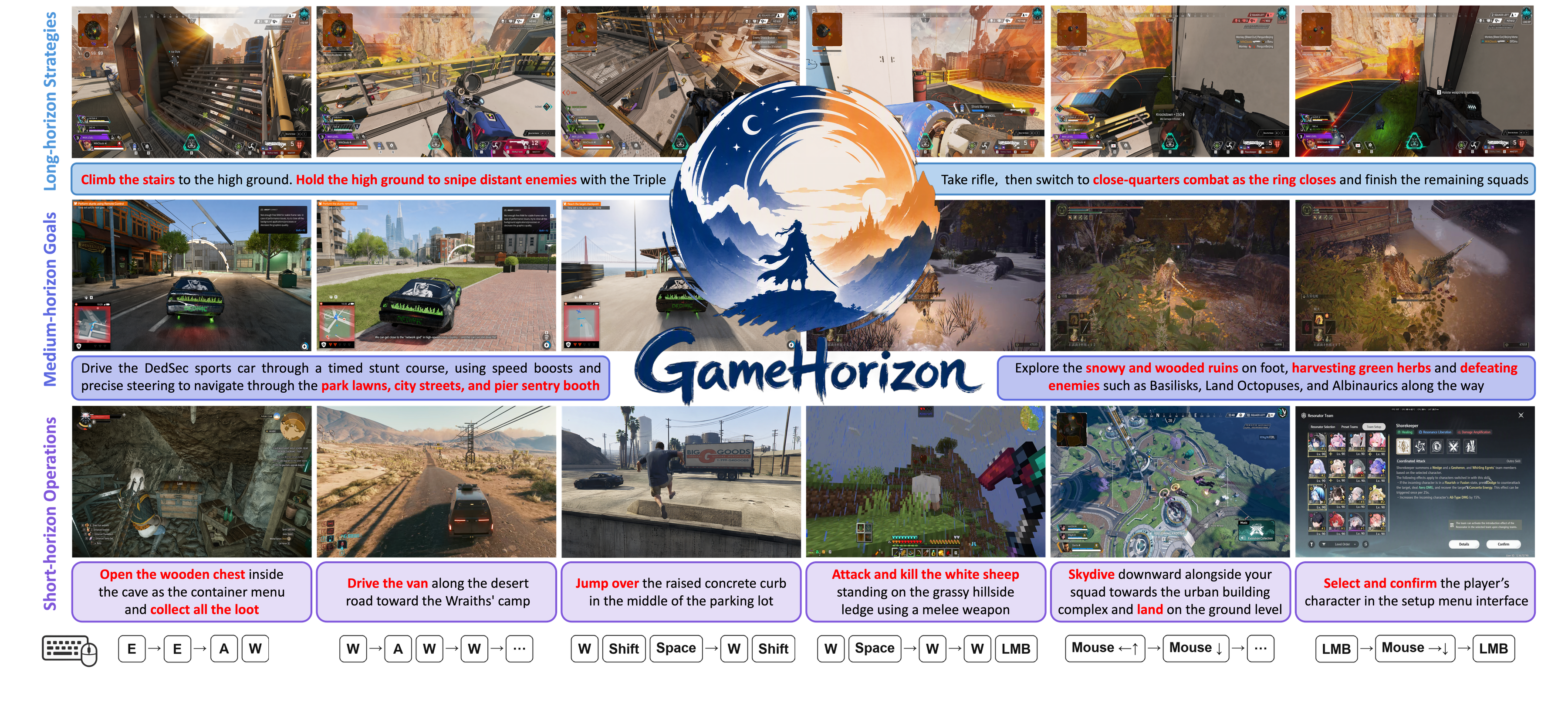
At a glance
GameHorizon combines 5,000 hours of synchronized human gameplay from 21 titles with an automatic instruction annotator and a benchmark. Instructions describe immediate operations, medium-term goals, and longer strategies. The offline track tests 47 models with standardized questions; an online Minecraft track diagnoses individual failures within longer tasks. Future planning and top-down goal decomposition remain difficult, and offline success does not establish reliable open-ended gameplay.
1 Introduction
Fast game-action policies and general-purpose reasoning models are usually tested with different interfaces. GameHorizon places observations, instructions, and executable controls in a common evaluation format. It aims to separate recognizing an ongoing action, choosing a future action, and decomposing a broad objective. [1], [2], [4], [9], [15].
The contribution is a dataset and diagnostic evaluation framework, rather than a newly trained game agent. Its breadth comes mainly from the offline corpus; the online experiments use Minecraft, where underlying states can be checked and reset.
2 Related Work
Earlier corpora often cover a single game, infer controls from video, or omit dense language annotations. Bespoke online agent harnesses and small rollout counts also make comparisons difficult. GameHorizon records controls directly across multiple games and evaluates several model families through common questions, while retaining an online track for execution. [1], [9], [22], [23], [25], [26], [36], [38].
3 GameHorizon Suite
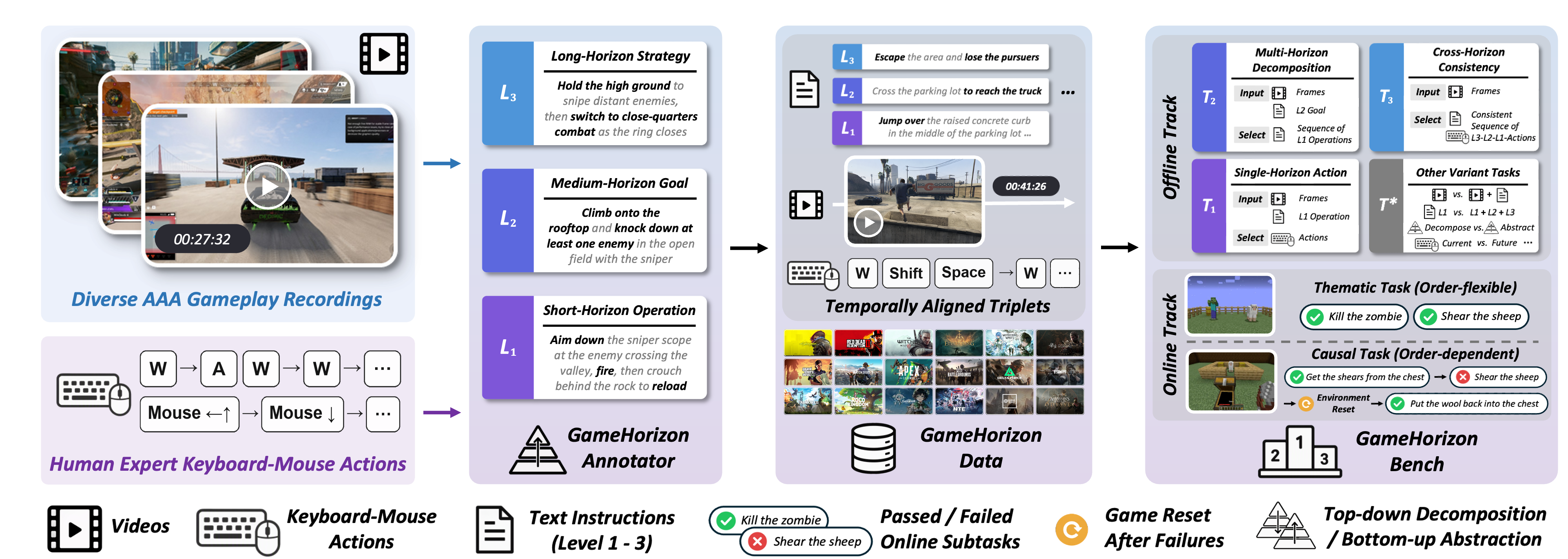
The suite links three stages: an annotator that builds instruction hierarchies, a synchronized gameplay dataset, and an offline/online benchmark.
3.1 Overview
One hundred experienced players record 2K video at 60 frames per second alongside keyboard and mouse events. A bottom-up annotation pipeline groups immediate operations into goals and then strategies. The nominal horizons are 1–5 seconds, 1–2 minutes, and 5–8 minutes. Unlike inverse dynamics labels, the recorded controls reflect actual player inputs; the textual instructions are model-generated interpretations of those inputs.
3.2 GameHorizon-Annotator
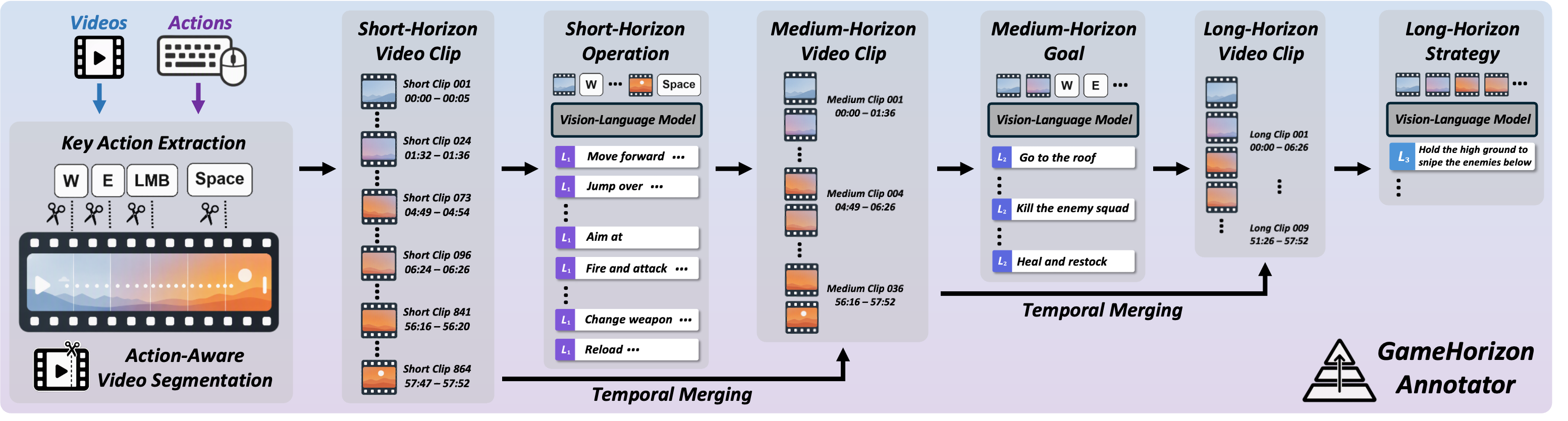
Game-specific keybinds map raw input events to candidate actions. Rules identify sustained actions and discrete boundaries; a VLM uses the video to resolve ambiguous controls and refine segments. Adjacent clips are merged according to action continuity and semantic coherence, with dynamic programming enforcing duration constraints. [41], [42], [43].
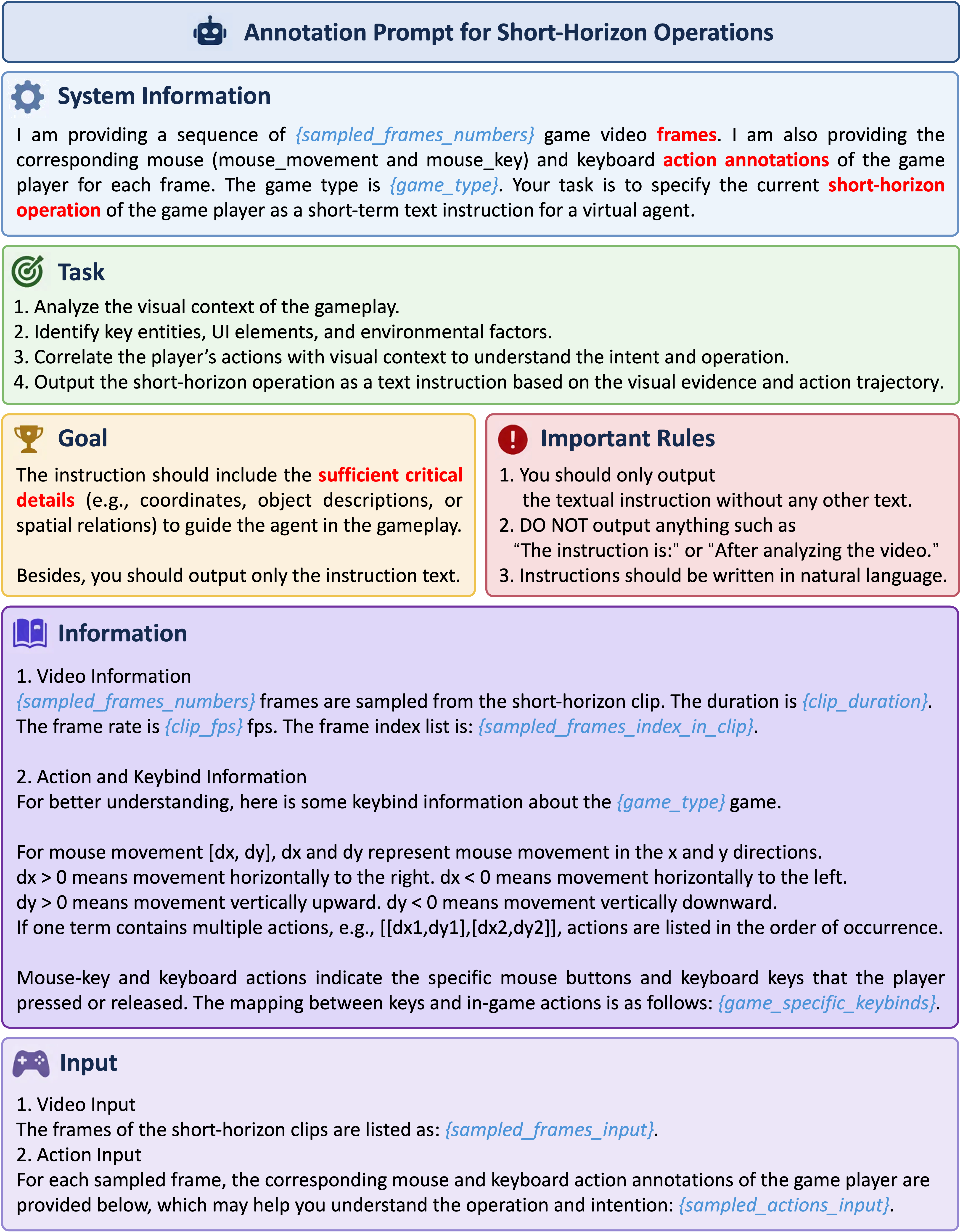
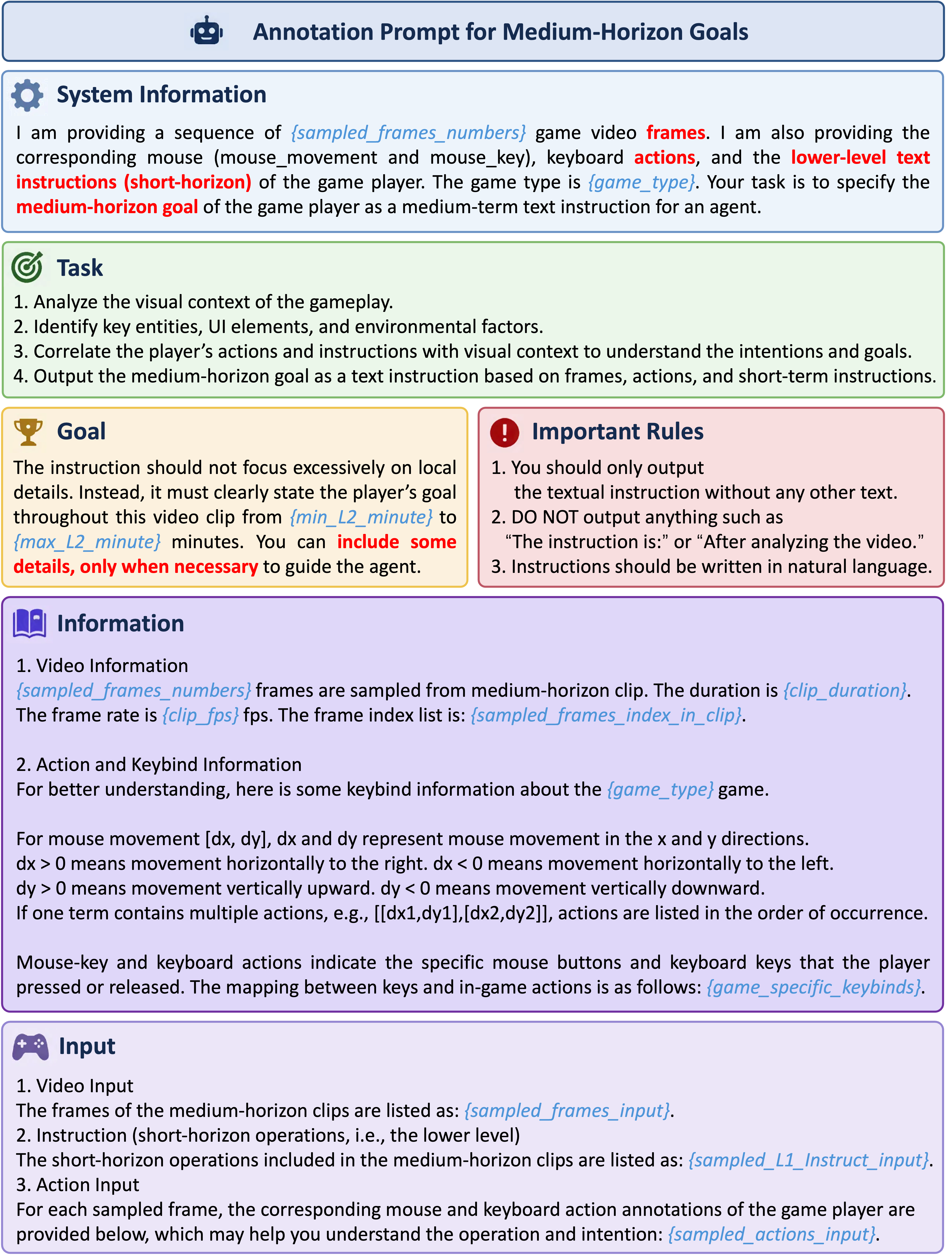
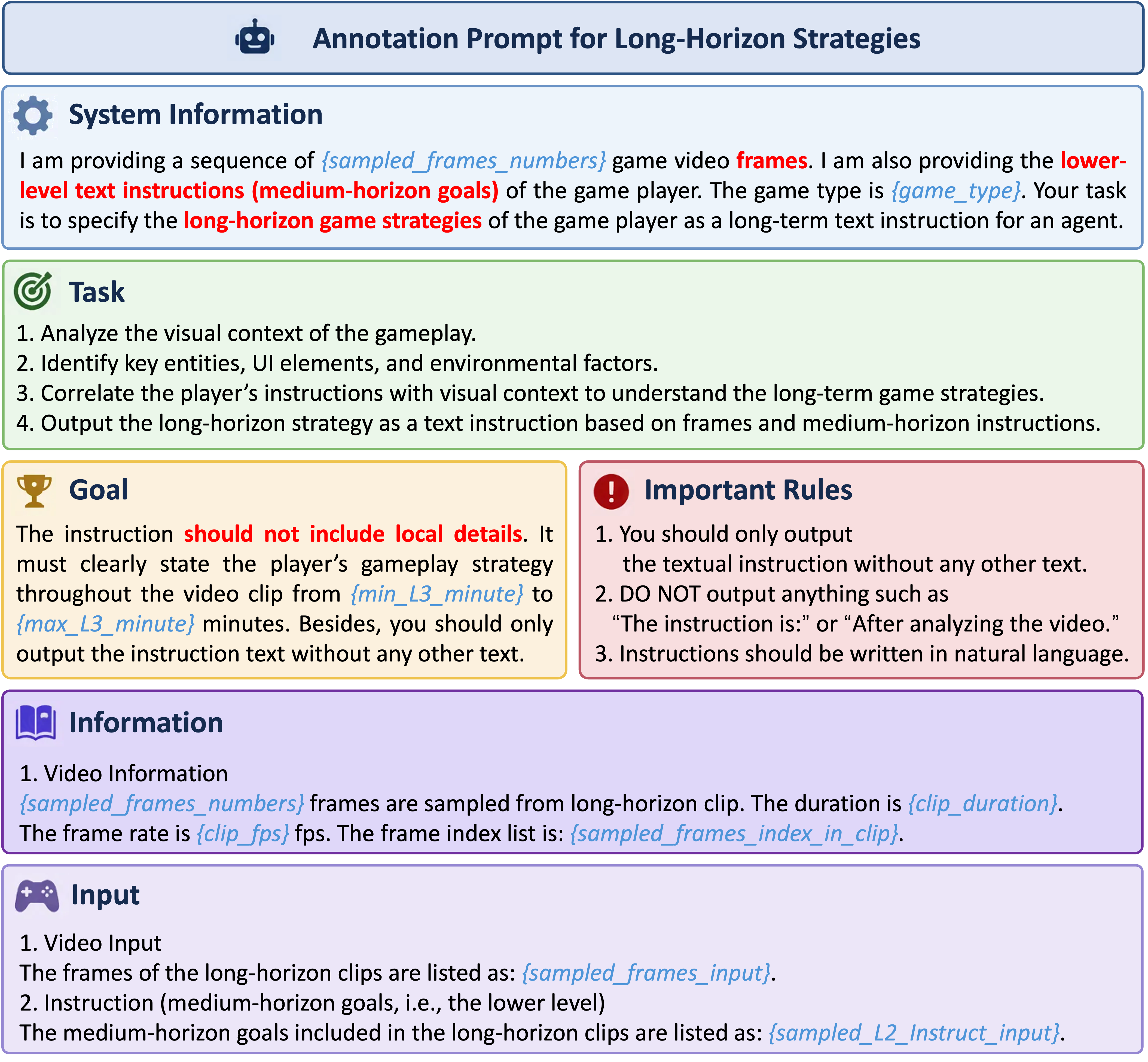
For immediate operations, the annotator sees frames, synchronized controls, and keybinds. Medium-horizon goals add the constituent operation instructions. Long-horizon strategies use frames and medium-level goals, omitting raw controls and local details. This reduces annotation cost, but agreement with automatically generated labels should not be mistaken for independently verified human intent.
| Game Title | Recording Duration and Share | Annotation Counts | Avg. Instruction Span (s) | ||||||||
|---|---|---|---|---|---|---|---|---|---|---|---|
| Total (h) | Share (%) | Valid Rate (%) | Valid (h) | Actions () | |||||||
| Valorant | |||||||||||
| Minecraft | |||||||||||
| Grand Theft Auto V | |||||||||||
| Palworld | |||||||||||
| Delta Force | |||||||||||
| Roco Kingdom: World | |||||||||||
| Red Dead Redemption 2 | |||||||||||
| Cyberpunk 2077 | |||||||||||
| Genshin Impact | |||||||||||
| PUBG: Battlegrounds | |||||||||||
| Elden Ring Nightreign | |||||||||||
| The Witcher 3: Wild Hunt | |||||||||||
| Elden Ring | |||||||||||
| Escape from Tarkov | |||||||||||
| Apex Legends | |||||||||||
| Wuthering Waves | |||||||||||
| Neverness to Everness | |||||||||||
| Assassin’s Creed | |||||||||||
| Black Myth: Wukong | |||||||||||
| Watch Dogs 2 | |||||||||||
| Honor of Kings: World | |||||||||||
| Total / Avg. | |||||||||||
| Dataset | Data Scope | Annotation Properties | Notes | ||||
| Large Scale | AAA- Focused | Direct Human Actions | Instruction Annotations | Dense Instructions | Multi- Horizon | ||
| Single-Game Datasets | |||||||
| MineRL (Guss et al., 2019) | ✗ | ✗ | ✓ | ✗ | ✗ | ✗ | Minecraft; human actions; no textual instructions. |
| MineDojo (Fan et al., 2022) | ✓ | ✗ | ✗ | ✗ | ✗ | ✗ | Web Minecraft videos; no actions or instructions. |
| VPT (Baker et al., 2022) | ✓ | ✗ | ✗ | ✗ | ✗ | ✗ | Web Minecraft videos; IDM actions; no instructions. |
| STEVE-1 (Lifshitz et al., 2023) | ✗ | ✗ | ✓ | ✓ | ✗ | ✗ | Minecraft; only 10K short-term text instructions. |
| PLAICraft (He et al., 2025) | ✓ | ✗ | ✓ | ✗ | ✗ | ✗ | Minecraft; human actions; no textual instructions. |
| WildWorld (Li et al., 2026) | ✗ | ✓ | ✗ | ✗ | ✗ | ✗ | Monster Hunter Wilds; AI actions; no instructions. |
| EgoCS-400K (Guo et al., 2026) | ✓ | ✓ | ✗ | ✗ | ✗ | ✗ | CS; replay-derived action labels; no instructions. |
| Multi-Game Datasets | |||||||
| NitroGen (Magne et al., 2026) | ✓ | ✗ | ✗ | ✗ | ✗ | ✗ | Gamepad-overlay actions without text instructions. |
| Open-P2P (Yue et al., 2026) | ✓ | ✗ | ✓ | ✓ | ✗ | ✗ | Majority non-AAA games; sparse text instructions. |
| D2E (Choi et al., 2026) | ✗ | ✗ | ✗ | ✗ | ✗ | ✗ | Mostly IDM-inferred actions; no text instructions. |
| Gaming-500-hours (Markov AI, 2026) | ✗ | ✗ | ✓ | ✗ | ✗ | ✗ | Majority non-AAA games; no textual instructions. |
| GameHorizon-Data (Ours) | ✓ | ✓ | ✓ | ✓ | ✓ | ✓ | AAA; human actions; dense multi-horizon instructions. |
3.3 GameHorizon-Data
The corpus includes 411.03 million action events. Filtering removes uninformative or low-quality footage before language annotation, leaving 4,341 hours, or 86.8% of the recordings; controls remain available for all 5,000 hours. The retained footage has 5,947,588 operation instructions, 189,158 goals, and 47,290 strategies. Mean spans are 2.63, 82.6, and 330.4 seconds, respectively.
Game representation is uneven: Valorant contributes 617.5 hours, while the smallest title contributes 35.9 hours. Each retained frame shares an instruction at each horizon, so millions of frame-aligned labels are not millions of independent human annotations.
3.4 GameHorizon-Bench
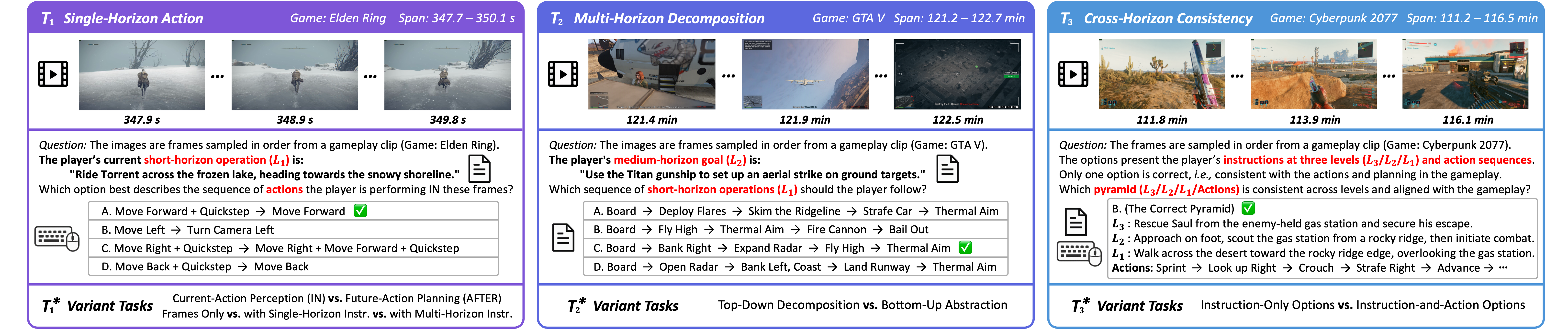
The offline track has three four-choice tasks: match observations and an immediate instruction to controls; select the operation sequence for a medium-level goal; and identify a consistent combination of video, instructions, and actions. Ten diagnostic variants vary the time horizon, available language, abstraction direction, and inclusion of controls.
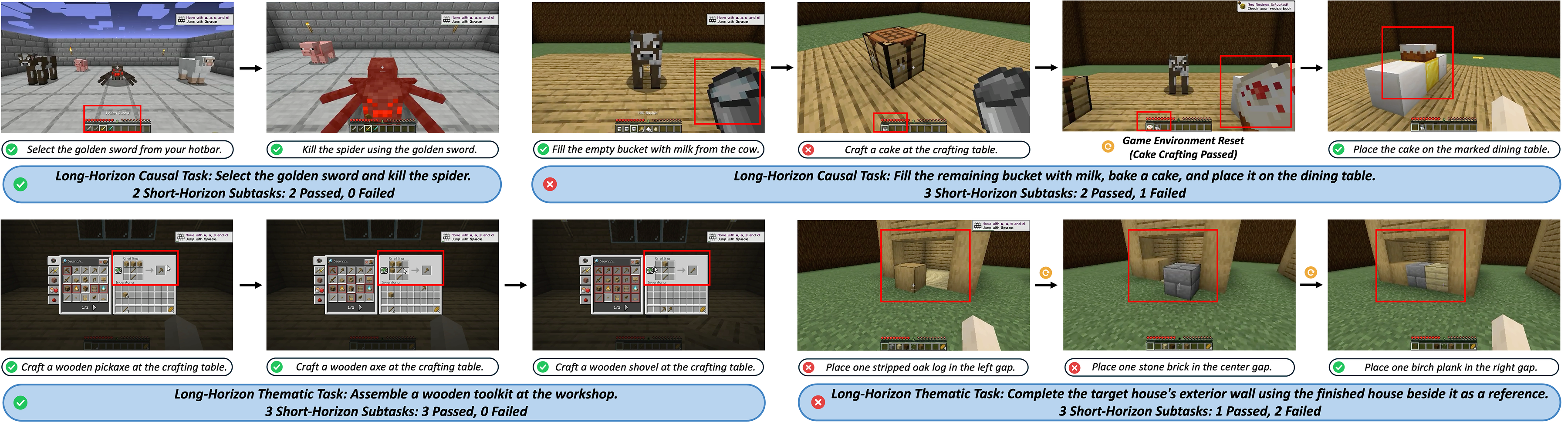
The online track contains ten causal tasks with ordered steps and ten thematic tasks with flexible step order, comprising 62 subtasks in Minecraft. After a failed step, the environment is reset to its success state so later steps can still be diagnosed. A long task passes only if every step succeeds without such assistance; subtask scores and end-to-end success therefore measure different things.
| Benchmark | Benchmark Scope | Annotation Properties | Evaluation Settings | Notes | |||
| Model Diversity | AAA- Focused | Direct Human Actions | Multi- Horizon | Reproducible Offline | Stepwise Online | ||
| Single-Game Benchmarks | |||||||
| MineDojo (Fan et al., 2022) | ✗ | ✗ | ✗ | ✗ | ✗ | ✗ | Online success rates in Minecraft; the game agents only. |
| MCU (Zheng et al., 2025) | ✗ | ✗ | ✗ | ✗ | ✗ | ✗ | Minecraft; VLM-based online scores; game agents only. |
| MineExplorer (Ju et al., 2026) | ✗ | ✗ | ✗ | ✗ | ✗ | ✓ | Online milestone rates in Minecraft; the VLMs only. |
| Multi-Game Benchmarks | |||||||
| BALROG (Paglieri et al., 2025) | ✗ | ✗ | ✗ | ✗ | ✗ | ✓ | Non-AAA; the online progress scores; LLMs and VLMs. |
| VideoGameBench (Zhang et al., 2025) | ✗ | ✗ | ✗ | ✗ | ✗ | ✗ | Retro and classic games; online scores and VLMs only. |
| Orak (Park et al., 2026) | ✗ | ✗ | ✗ | ✗ | ✗ | ✗ | Majority non-AAA; the online scores; LLMs and VLMs. |
| GameWorld (Ouyang et al., 2026) | ✗ | ✗ | ✗ | ✗ | ✗ | ✗ | Browser mini-games only; online scores; VLM agents. |
| GameVerse (Zhang et al., 2026) | ✗ | ✗ | ✗ | ✗ | ✗ | ✓ | Mostly non-AAA; online milestone scores; VLM agents. |
| GameHorizon-Bench (Ours) | ✓ | ✓ | ✓ | ✓ | ✓ | ✓ | AAA; reproducible offline; stepwise online; diverse models. |
4 Experiments
The experiments compare question-answering models, specialist game policies, reasoning settings, and online execution. All reported rankings concern the versions and configurations tested in this paper.
4.1 Evaluation Protocols and Details
Each primary task has 1,000 questions, and each of ten variants has 200: 5,000 questions altogether. Of 47 models, 44 answer questions directly. Three specialist game agents are evaluated only on action matching: their predicted control sequences are aligned to the four options, and predictions matching none are marked wrong. This interface differs from direct multiple-choice answering. [1], [2], [15], [50].
The online study selects three models from each of four offline performance tiers. Every subtask receives up to 400 model calls, with automatic success checks against Minecraft state. Diagnostic variants use four models, limiting conclusions about the wider model population.
4.2 Offline Primary Tasks
Across the 44 question-answering models, mean accuracy is 64.7%, ranging from 44.6% to 80.2%; chance is 25%. Mean scores are 57.3% for action matching, 65.1% for goal decomposition, and 71.6% for cross-horizon consistency. GPT-6-Astra leads the reported aggregate ranking. These are recognition tasks with supplied alternatives, not free-form action rollouts.
Specialist game agents score 22.0–28.1% on unseen games; a Minecraft-tuned JARVIS-VLA reaches 54.2% on its in-domain comparison. Predictions with no option overlap can score below chance. Differences in training domain, model size, and output interface prevent attributing all gaps to one architectural choice.
Thinking improves two tested configurations by 5.6 and 9.3 percentage points but reduces two smaller configurations by 8.2 and 5.9 points. The authors associate some declines with hallucinated reasoning. Comparisons suggesting interference from multimodal unification or computer-use tuning are observational model comparisons, rather than controlled causal ablations.
| Tier 1 | Tier 2 | ||||||||||
|---|---|---|---|---|---|---|---|---|---|---|---|
| Rank | Model | Overall | Rank | Model | Overall | ||||||
| 1 | GPT-6-Astra | 69.4 | 79.6 | 91.5 | 80.2 | 12 | Doubao-Seed-2.0-Pro | 59.2 | 74.9 | 80.0 | 71.4 |
| 2 | Gemini 3.8 Flash | 65.9 | 81.2 | 84.8 | 77.3 | 13 | Claude Fable 5 | 62.9 | 72.7 | 78.1 | 71.2 |
| 3 | Gemini 3.7 Flash | 66.2 | 80.1 | 83.9 | 76.7 | 14 | GPT-5.6 Terra | 62.1 | 75.6 | 74.4 | 70.7 |
| 4 | Gemini 3.6 Flash | 62.3 | 79.1 | 84.6 | 75.3 | 15 | Qwen3.7-Plus | 58.8 | 75.9 | 71.5 | 68.7 |
| 5 | GPT-5.6 Sol | 65.3 | 77.5 | 81.5 | 74.8 | 16 | Qwen3.8-27B | 59.9 | 77.4 | 68.1 | 68.5 |
| 6 | Kimi-K3 | 64.4 | 79.3 | 79.7 | 74.5 | 17 | GPT-5.6 Luna | 61.6 | 70.7 | 71.1 | 67.8 |
| 7 | Gemini 3.5 Flash | 64.9 | 77.4 | 80.8 | 74.4 | 17 | Kimi-K2.6 | 61.2 | 73.2 | 69.0 | 67.8 |
| 8 | GPT-5.5 | 64.6 | 78.9 | 76.2 | 73.2 | 19 | Doubao-Seed-2.0-Lite | 55.2 | 69.0 | 76.3 | 66.8 |
| 9 | Gemini 3.1 Pro | 64.5 | 75.8 | 78.2 | 72.8 | 20 | Gemma 4 31B-IT | 53.8 | 68.6 | 76.6 | 66.3 |
| 10 | Doubao-Seed-2.1-Turbo | 63.1 | 79.4 | 75.5 | 72.7 | 21 | MiniMax-M3 | 57.8 | 68.5 | 70.6 | 65.6 |
| 11 | Doubao-Seed-2.1-Pro | 62.9 | 76.7 | 76.6 | 72.1 | 22 | Qwen3-VL-235B-A22B-Thinking | 58.2 | 71.6 | 65.9 | 65.2 |
| Tier 3 | Tier 4 | ||||||||||
| Rank | Model | Overall | Rank | Model | Overall | ||||||
| 23 | Claude Opus 4.8 | 59.1 | 62.1 | 73.1 | 64.8 | 34 | Qwen3.6-35B-A3B | 53.3 | 52.9 | 66.3 | 57.5 |
| 24 | Claude Sonnet 5 | 54.4 | 57.7 | 82.0 | 64.7 | 35 | Qwen3-Omni-30B-A3B-Instruct | 52.5 | 55.6 | 63.7 | 57.3 |
| 25 | Step-3.7-Flash | 57.5 | 71.3 | 63.4 | 64.1 | 36 | GELab-Zero-4B-Preview | 51.8 | 46.8 | 72.7 | 57.1 |
| 26 | Qwen3-VL-235B-A22B-Instruct | 55.1 | 62.1 | 73.1 | 63.4 | 37 | Qwen2.5-VL-7B-Instruct | 52.0 | 54.3 | 63.7 | 56.7 |
| 27 | GLM-5V-Turbo | 53.4 | 65.4 | 70.8 | 63.2 | 38 | InternVL3.5-8B | 51.8 | 50.2 | 65.5 | 55.8 |
| 28 | GPT-5.2 | 58.9 | 58.9 | 70.6 | 62.8 | 39 | GLM-4.1V-9B-Thinking | 54.9 | 54.8 | 55.3 | 55.0 |
| 29 | Qwen3.5-397B-A17B | 53.3 | 60.1 | 73.5 | 62.3 | 40 | GPT-4o | 55.7 | 46.3 | 61.3 | 54.4 |
| 30 | BAGEL-7B-MoT | 51.7 | 57.3 | 75.1 | 61.4 | 41 | UI-TARS-1.5-7B | 49.1 | 47.1 | 62.9 | 53.0 |
| 31 | Qwen2.5-VL-32B-Instruct | 54.8 | 58.0 | 69.7 | 60.8 | 42 | Ovis-U1-3B | 44.7 | 39.6 | 59.2 | 47.8 |
| 32 | Step3-VL-10B | 55.4 | 64.7 | 61.7 | 60.6 | 43 | InternVL3.5-2B | 45.1 | 40.3 | 52.7 | 46.0 |
| 33 | SenseNova-U1-8B-MoT | 48.2 | 59.2 | 67.5 | 58.3 | 44 | InternVL-U-4B | 46.1 | 37.9 | 49.8 | 44.6 |
| Average over all models: Overall | |||||||||||
| Model | In-Domain | Zero-Shot | |
| NitroGen | 22.0 | ✗ | ✓ |
| Open-P2P | 24.4 | ✗ | ✓ |
| JARVIS-VLA | 28.1 | ✗ | ✓ |
| Model | In-Domain | Zero-Shot | |
| Open-P2P | 26.8 | ✗ | ✓ |
| Gemma 4 31B-IT | 54.1 | ✗ | ✓ |
| JARVIS-VLA | 54.2 | ✓ | ✗ |
| Model | Thinking | Overall | ||||
| UI-TARS-1.5-7B | ✗ | 49.1 | 47.1 | 62.9 | 53.0 | – |
| ✓ | 45.2 | 45.4 | 43.9 | 44.8 | -8.2 | |
| Qwen2.5-VL-7B | ✗ | 52.0 | 54.3 | 63.7 | 56.7 | – |
| ✓ | 44.4 | 52.2 | 55.7 | 50.8 | -5.9 |
| Model | Thinking | Overall | ||||
| GLM-5V-Turbo | ✗ | 53.2 | 56.4 | 63.1 | 57.6 | – |
| ✓ | 53.4 | 65.4 | 70.8 | 63.2 | +5.6 | |
| Doubao-Seed-2.1-Pro | ✗ | 56.4 | 56.8 | 75.2 | 62.8 | – |
| ✓ | 62.9 | 76.7 | 76.6 | 72.1 | +9.3 |
4.3 Offline Variant Tasks
Across four models, current-action recognition exceeds future-action planning. Short instructions raise recognition from 44.5% to 58.6%; adding higher-level instructions reaches 60.0%. Future planning changes from 34.6% with frames alone to 34.8% with short instructions and 41.8% with all horizons: a 7.2-point gain over frames alone, or 7.0 points beyond short instructions.
Bottom-up abstraction scores 98.4%, compared with 69.5% for top-down decomposition. Rich low-level evidence makes selecting a higher-level goal easier, but near-ceiling accuracy limits this variant’s discrimination. Adding action sequences to cross-horizon options changes accuracy from 74.0% to 73.4%; this small effect is specific to the tested questions and models.
| Model | Current-Action Perception | Future-Action Planning | ||||
|---|---|---|---|---|---|---|
| Frames Only | + Short | + Multi-Horizon | Frames Only | + Short | + Multi-Horizon | |
| Qwen2.5-VL-32B-Instruct | 39.0 | 53.5 () | 54.5 () | 33.5 | 29.5 () | 33.5 () |
| Qwen3-VL-235B-A22B-Instruct | 41.0 | 52.0 () | 54.5 () | 37.0 | 34.0 () | 39.5 () |
| Gemini 3.1 Pro | 50.0 | 67.0 () | 67.0 () | 34.0 | 36.5 () | 46.5 () |
| Gemini 3.5 Flash | 48.0 | 62.0 () | 64.0 () | 34.0 | 39.0 () | 47.5 () |
| Overall | 44.5 | 58.6 () | 60.0 () | 34.6 | 34.8 () | 41.8 () |
| Model | Top-Down Decomposition | Bottom-Up Abstraction |
| Qwen2.5-VL-32B-Instruct | 61.0 | 98.0 () |
| Qwen3-VL-235B-A22B-Instruct | 61.5 | 98.0 () |
| Gemini 3.1 Pro | 76.5 | 99.0 () |
| Gemini 3.5 Flash | 79.0 | 98.5 () |
| Overall | 69.5 | 98.4 () |
| Model | w/o Actions | w/ Actions |
| Qwen2.5-VL-32B-Instruct | 69.0 | 68.5 () |
| Qwen3-VL-235B-A22B-Instruct | 72.0 | 71.0 () |
| Gemini 3.1 Pro | 77.5 | 77.5 () |
| Gemini 3.5 Flash | 77.5 | 76.5 () |
| Overall | 74.0 | 73.4 () |
4.4 Stepwise Online Track
The twelve sampled models preserve their broad offline tier ordering online. The highest reported end-to-end score is 45%, or nine of twenty tasks; ten models complete at most two tasks. Subtask resets expose where failures occur without inflating the all-steps-success measure.
This association supports offline scores as a useful diagnostic for the tested Minecraft tasks. It does not establish general validity across the 21 offline titles, arbitrary agent harnesses, or unrestricted long-horizon gameplay; the online task set is small and models were sampled by offline tier.
| Tier 1 | Tier 2 | ||||||||||||
|---|---|---|---|---|---|---|---|---|---|---|---|---|---|
| Online | Model | Offline | Short-Horizon | Long-Horizon | Causal | Thematic | Online | Model | Offline | Short-Horizon | Long-Horizon | Causal | Thematic |
| Rank | Rank | Subtasks | Tasks | Rank | Rank | Subtasks | Tasks | ||||||
| 1 | GPT-6-Astra | 1 | 66.1 (41/62) | 45.0 (9/20) | 40.0 (4/10) | 50.0 (5/10) | 4 | GPT-5.6 Terra | 14 | 37.1 (23/62) | 10.0 (2/20) | 20.0 (2/10) | 0.0 (0/10) |
| 2 | Gemini 3.6 Flash | 4 | 56.5 (35/62) | 30.0 (6/20) | 30.0 (3/10) | 30.0 (3/10) | 5 | GPT-5.6 Luna | 17 | 33.9 (21/62) | 10.0 (2/20) | 10.0 (1/10) | 10.0 (1/10) |
| 3 | Kimi-K3 | 6 | 46.8 (29/62) | 10.0 (2/20) | 20.0 (2/10) | 0.0 (0/10) | 6 | MiniMax-M3 | 21 | 29.0 (18/62) | 10.0 (2/20) | 10.0 (1/10) | 10.0 (1/10) |
| Tier 3 | Tier 4 | ||||||||||||
| Online | Model | Offline | Short-Horizon | Long-Horizon | Causal | Thematic | Online | Model | Offline | Short-Horizon | Long-Horizon | Causal | Thematic |
| Rank | Rank | Subtasks | Tasks | Rank | Rank | Subtasks | Tasks | ||||||
| 7 | GLM-5V-Turbo | 27 | 27.4 (17/62) | 5.0 (1/20) | 10.0 (1/10) | 0.0 (0/10) | 10 | Qwen3.6-35B-A3B | 34 | 11.3 (7/62) | 5.0 (1/20) | 10.0 (1/10) | 0.0 (0/10) |
| 8 | Qwen3.5-397B-A17B | 29 | 19.4 (12/62) | 5.0 (1/20) | 10.0 (1/10) | 0.0 (0/10) | 11 | InternVL3.5-8B | 38 | 3.2 (2/62) | 0.0 (0/20) | 0.0 (0/10) | 0.0 (0/10) |
| 9 | Step3-VL-10B | 32 | 14.5 (9/62) | 5.0 (1/20) | 10.0 (1/10) | 0.0 (0/10) | 12 | UI-TARS-1.5-7B | 41 | 1.6 (1/62) | 0.0 (0/20) | 0.0 (0/10) | 0.0 (0/10) |
5 Conclusion
GameHorizon provides aligned controls and multi-horizon language plus complementary recognition and execution tests. Its results motivate better future planning and goal decomposition. Remaining evaluation limits include model-generated instruction targets, multiple-choice recognition, restricted diagnostic model samples, and online coverage confined to Minecraft. The paper states an intention to release the resources. Project · Repository.
Appendix A More Details on GameHorizon-Annotator
A.1 Annotation Prompts
The three original prompts are preserved below. All include video metadata and require a concise instruction as output. Immediate prompts retain operational details; medium-level prompts combine lower-level instructions into a sustained goal; long-level prompts omit controls and keybinds to emphasize strategy.
A.2 Action-Aware Video Segmentation
Segmentation calibrates input semantics, classifies actions as deterministic, ambiguous, or visually dependent, and reconstructs frame-aligned held keys, triggers, mouse states, and camera motion. Priority rules choose a primary action while retaining concurrent evidence. It merges repeated labels, smooths brief noise, splits long segments, and uses a VLM to refine ambiguous boundaries and remove temporal gaps or overlaps.
A.3 Game-Specific Keybinds
The original Apex Legends and Cyberpunk 2077 keybind tables retain all event-to-action mappings, including inputs with multiple meanings. Context-dependent mappings explain why raw control labels alone cannot always determine the intended action.
| Input Event | In-Game Action Semantics |
|---|---|
| KEY_W | Move Forward |
| KEY_S | Move Back |
| KEY_A | Move Left |
| KEY_D | Move Right |
| SPACE | Jump |
| LSHIFT | Sprint |
| KEY_C | Crouch – Toggle |
| LCONTROL | Crouch – Hold |
| RI_MOUSE_LEFT_BUTTON_DOWN | Attack |
| RI_MOUSE_RIGHT_BUTTON_DOWN | Aim Down Sight |
| KEY_R | Reload |
| KEY_V | Melee |
| KEY_1 | Equip Weapon 1 |
| KEY_2 | Equip Weapon 2 |
| KEY_3 | Holster Weapons |
| RI_MOUSE_WHEEL | Cycle Weapon |
| KEY_G | Equip Grenade |
| KEY_N | Inspect Weapon |
| KEY_Q | Tactical Ability |
| KEY_Z | Ultimate Ability |
| KEY_E | Interact / Pickup / Open Door / Revive / Use Zipline |
| KEY_4 | Use Selected Health Item |
| KEY_H | Character Utility Action |
| RI_MOUSE_MIDDLE_BUTTON_DOWN | Smart Tag / Middle Mouse Button |
| TAB | Open/Close Inventory |
| KEY_M | Open/Close Map |
| Input Event | In-Game Action Semantics |
|---|---|
| KEY_W | Move Forward / Vehicle Accelerate |
| KEY_S | Move Back / Vehicle Brake or Reverse |
| KEY_A | Move Left / Vehicle Turn Left |
| KEY_D | Move Right / Vehicle Turn Right |
| SPACE | Jump / Vehicle Handbrake / Pause Braindance |
| LSHIFT | Sprint – Toggle / Change Braindance Layer |
| RSHIFT | Sprint – Hold |
| KEY_C | Crouch – Toggle / Skip Dialogue |
| LCONTROL | Crouch – Hold / Vehicle Horn / Panzer Smokescreen |
| RI_MOUSE_LEFT_BUTTON_DOWN | Shoot / Fast Attack / Panzer Primary Cannon |
| RI_MOUSE_RIGHT_BUTTON_DOWN | Aim / Block / Panzer Missile Launcher |
| RI_MOUSE_MIDDLE_BUTTON_DOWN | Use Combat Gadget / Tag / Reverse Camera / Braindance Zoom |
| RI_MOUSE_WHEEL | Cycle Weapon / Next or Previous Weapon / Braindance Zoom |
| KEY_R | Reload / Vehicle Radio / Restart Braindance |
| KEY_Q | Quick Attack / Vehicle Cycle Camera / Rewind Braindance |
| KEY_E | Cyberware Systems / Fast-Forward Braindance |
| KEY_F | Interact / Pickup / Enter or Exit Vehicle |
| KEY_X | Use Consumable / Exit Braindance |
| KEY_Y | Skip Dialogue / Dialogue Confirm |
| KEY_Z | Open Notifications / Quickhack Details |
| KEY_T | Open Phone |
| TAB | Scan – Hold / Braindance Analysis Mode |
| KEY_1 | Select First Weapon / Previous Item |
| KEY_2 | Select Second Weapon |
| KEY_3 | Select Third Weapon / Next Item |
| LMENU | Cycle Weapon / Weapon Wheel / Vehicle Cycle Lights |
| KEY_V | Call Vehicle |
| KEY_B | Draw or Withdraw Weapon |
| KEY_I | Open Main Menu / Inventory |
| KEY_M | Open Map |
| KEY_J | Open Journal |
| KEY_K | Open Crafting |
| ESCAPE | Pause Menu / Close Menu |
Appendix B More Results on GameHorizon-Bench
The appendix preserves additional online examples and all twenty task definitions with their 62 subtasks. Causal tasks require the prescribed sequence; thematic tasks allow flexible order. The examples show actual execution order and resets after failures, while a task counts as completed only when all its steps succeed.
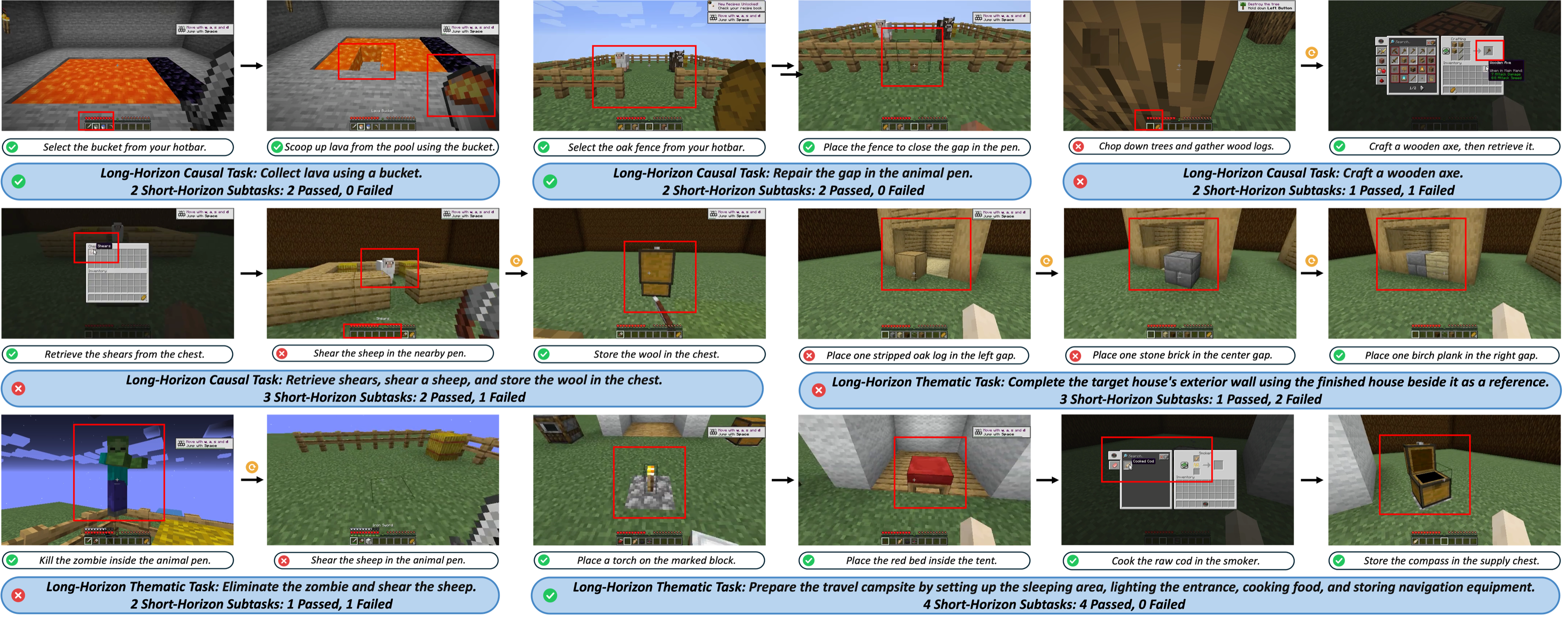
| No. | Long-Horizon Task | Steps | Short-Horizon Subtasks |
|---|---|---|---|
| Causal Tasks | |||
| 1 | Craft a wooden axe. | 2 | (1)Chop down trees and gather wood logs outside. (2)Use the crafting table to craft a wooden axe and retrieve it. |
| 2 | Craft an armor stand from workshop materials. | 5 | (1)Craft four oak planks from an oak log. (2)Craft eight sticks from the oak planks. (3)Smelt three stone blocks into smooth stone. (4)Craft six smooth stone slabs. (5)Craft an armor stand from the sticks and a smooth stone slab. |
| 3 | Craft an item frame from workshop materials. | 3 | (1)Craft eight oak planks from two oak logs. (2)Craft eight sticks from four oak planks. (3)Craft an item frame from eight sticks and one leather. |
| 4 | Retrieve shears, shear a sheep, and store the wool in the chest. | 3 | (1)Retrieve the shears from the chest. (2)Shear the sheep in the nearby pen. (3)Store the wool in the chest. |
| 5 | Fill the remaining bucket with milk, bake a cake, and place it on the dining table. | 3 | (1)Fill the remaining empty bucket with milk from the cow. (2)Craft a cake at the crafting table. (3)Place the cake on the marked dining table. |
| 6 | Repair the gap in the animal pen. | 2 | (1)Select the oak fence from the hotbar. (2)Place the oak fence to close the gap in the pen. |
| 7 | Mine the missing obsidian block, repair the ruined portal, and ignite it. | 3 | (1)Mine the loose obsidian block using the diamond pickaxe. (2)Place the obsidian in the missing portal-frame position. (3)Ignite the completed Nether portal with flint and steel. |
| 8 | Collect lava using a bucket. | 2 | (1)Select the bucket from the hotbar. (2)Scoop up lava from the pool using the empty bucket. |
| 9 | Mine iron, forge an iron sword, and use it to defeat the zombie. | 4 | (1)Mine two iron ore blocks using the stone pickaxe. (2)Smelt the iron ore into two iron ingots. (3)Craft an iron sword. (4)Kill the zombie using the iron sword. |
| 10 | Select the golden sword and use it to kill the spider. | 2 | (1)Select the golden sword from the hotbar. (2)Kill the spider using the golden sword. |
| Thematic Tasks | |||
| 1 | Complete the target house’s exterior wall using the finished house beside it as a reference. | 6 | (1)Place a stripped oak log in the ground-row left gap. (2)Place a stone brick block in the ground-row center gap. (3)Place a birch plank in the ground-row right gap. (4)Place a dark oak plank in the second-row left gap. (5)Place a glass block in the second-row center gap. (6)Place a spruce plank in the second-row right gap. |
| 2 | Eliminate the zombie and shear the sheep. | 2 | (1)Kill the zombie inside the animal pen. (2)Shear the sheep in the animal pen. |
| 3 | Store items from the inventory into the chest. | 2 | (1)Store the iron ingots in the chest. (2)Store the bread in the chest. |
| 4 | Assemble a mixed-material toolkit at the workshop. | 3 | (1)Craft an iron pickaxe. (2)Craft a wooden axe. (3)Craft a diamond sword. |
| 5 | Secure and light the tunnel to mine coal and iron. | 4 | (1)Fill a gap in the passage using cobblestone. (2)Place a torch in the mine. (3)Mine coal ore. (4)Mine iron ore. |
| 6 | Complete routine farm chores by gathering food, planting crops, and managing livestock. | 5 | (1)Milk the cow using an empty bucket. (2)Pick up the egg lying on the ground. (3)Plant wheat seeds on the farmland. (4)Kill the sheep using the diamond sword. (5)Kill the chicken using the iron sword. |
| 7 | Collect raw blocks for building. | 2 | (1)Dig dirt blocks using an iron shovel. (2)Mine stone blocks using a diamond pickaxe. |
| 8 | Process building materials and food at the shelter. | 2 | (1)Smelt cobblestone in the furnace. (2)Cook raw mutton in the smoker. |
| 9 | Assemble a wooden toolkit at the workshop. | 3 | (1)Craft a wooden pickaxe. (2)Craft a wooden axe. (3)Craft a wooden shovel. |
| 10 | Prepare the travel campsite by setting up the sleeping area, lighting the entrance, cooking food, and storing navigation equipment. | 4 | (1)Place the red bed on the wooden sleeping pad inside the tent. (2)Place a torch on the marked block at the campsite entrance. (3)Cook the raw cod in the smoker. (4)Store the compass in the supply chest. |