Overview
This edition follows the 28-page arXiv v3 dated 11 October 2026, retaining all nine figures, 25 numbered tables, 15 displayed equations and 73 references. Four figures are restored from native PDF artwork to preserve fine labels, plots and original image detail. Read the scores as task progress, including half-credit contact, rather than binary success rates. The study concerns stationary tabletop arms with two-finger grippers; mobile platforms do not expose base control to the policy.
At a glance
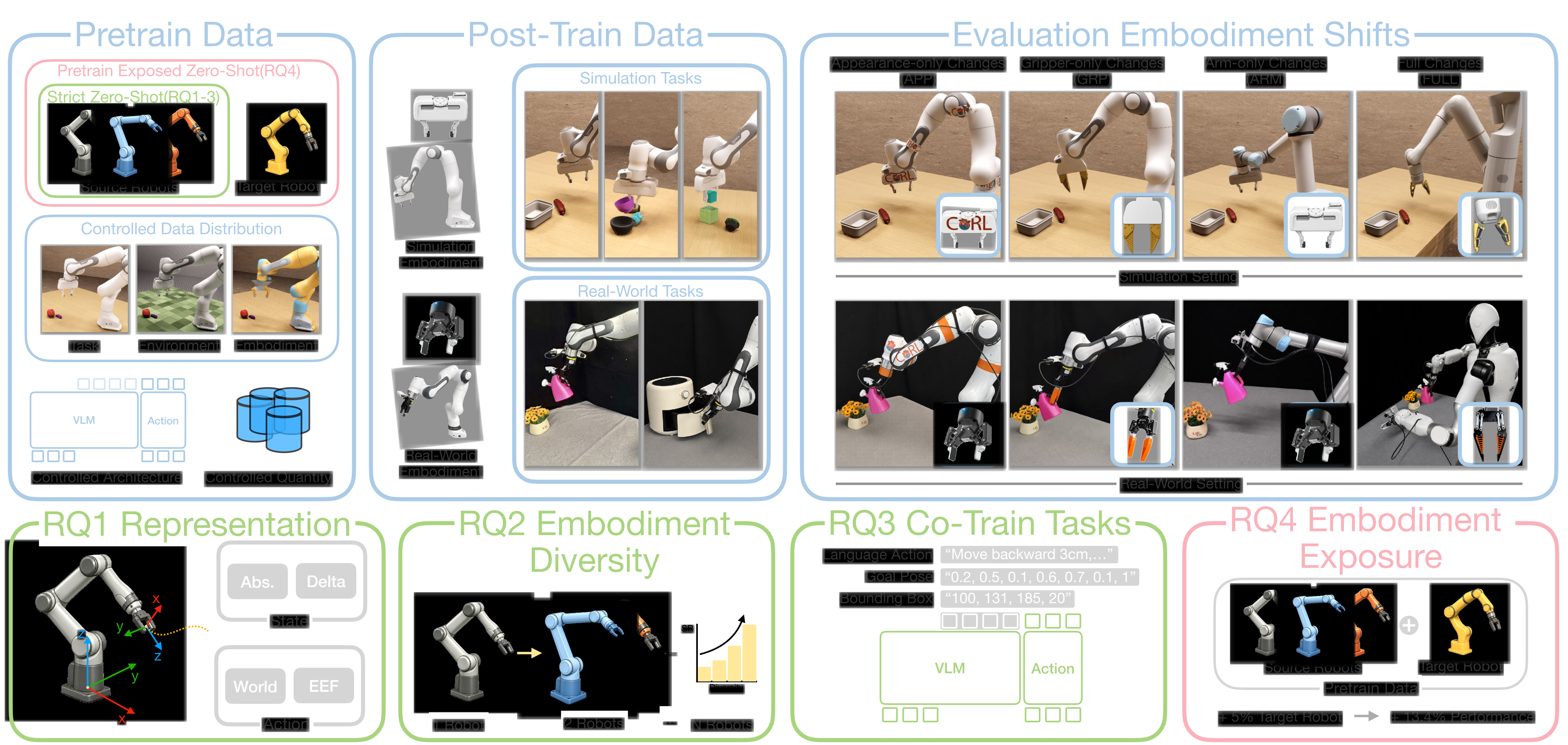
ZETA separates strict transfer to a robot absent from all training from transfer to a robot seen during pretraining but absent from downstream demonstrations. Across seven simulated and seven physical targets, controlled experiments favor local end-effector representations, broad procedural source diversity and auxiliary supervision. In simulation, 5% target-robot pretraining exposure adds 13.4 percentage points of average progress on two targets. These findings concern the tested tabletop setting, not universal transfer across robot morphologies.
1 Introduction
Comparisons of cross-embodiment policies can mix changes in tasks, cameras, objects, data quantity and target exposure. ZETA holds these factors controlled where possible and studies appearance, gripper, arm and combined shifts. Its four questions concern representations, source diversity, auxiliary objectives and target exposure. The first three use strict zero-shot protocols; the fourth deliberately includes the target during pretraining. The primary evidence is simulated, with physical validation of representations and diversity.
2 Related Work
Prior work supplies broad robot datasets, transferable policy interfaces and cross-embodiment evaluations. ZETA’s contribution is controlled comparison and explicit exposure accounting within a fixed manipulation regime.
2.1 Data Composition in Multi-Embodiment Pretraining
Pooling heterogeneous robots can improve coverage, but source diversity is often entangled with dataset scale, tasks and architecture. ZETA compares procedural source counts under both fixed-total and fixed-per-source trajectory budgets, then separately replaces source data with target data at fixed total size. Its Franka-family pool is narrower than an arbitrary collection of unrelated robots.
2.2 Cross-Embodiment Policy Design: Representations, Interfaces, and Supervision
Shared action spaces, embodiment-specific interfaces and auxiliary semantic supervision offer distinct transfer mechanisms. ZETA compares Cartesian state/action frames and auxiliary objectives under a shared backbone. Its language-action variant follows LAP; the state-free interpretation connects to work questioning explicit proprioceptive state inputs.
2.3 Zero-Shot Cross-Embodiment Evaluation and Benchmarks
An unseen downstream robot–task pair is different from a robot absent from all training. The benchmark separates those conditions and controls tasks, scenes, cameras and budgets, rather than ranking published methods whose exposure protocols differ.
3 Problem Formulation and Preliminaries
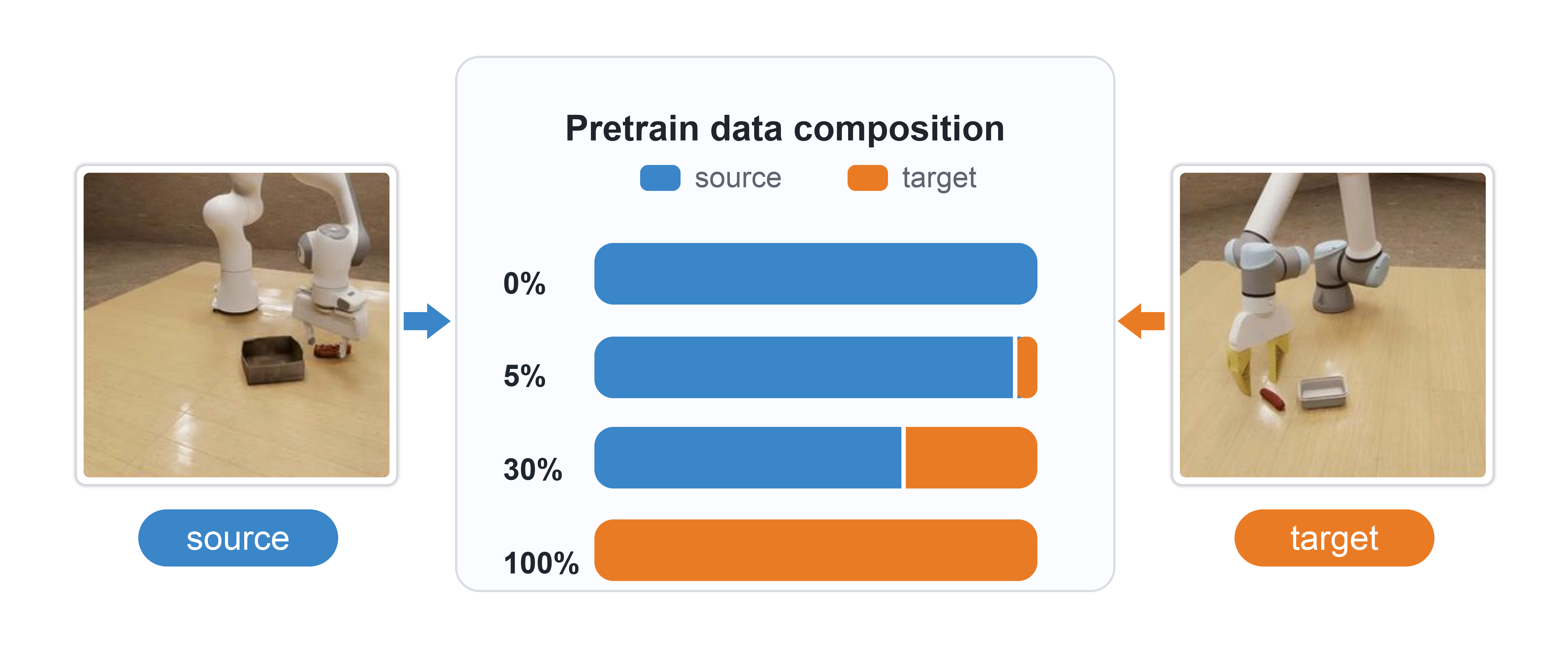
Pretraining contains a set of robots and tasks; post-training contains downstream tasks demonstrated only by a source robot. Evaluation uses a different target robot on those same downstream tasks. Strict zero-shot excludes that target from pretraining as well. Pretrain-exposed zero-shot permits target data only on pretraining tasks, which remain disjoint from downstream tasks. Appearance, gripper, arm and full changes identify which robot factors vary.
4 Study Design
The experiment varies robot representation, procedural training coverage, auxiliary labels or target exposure while retaining a common two-finger tabletop control interface.
4.1 Representative State-Action Representations
The four variants combine base-frame or current-gripper-frame motion deltas with absolute base-frame pose history or EEF-relative pose history. Joint-indexed interfaces are excluded because dimensions, limits and semantics differ across robots. The transform is vectorized as translation plus Euler angles. Expressing motion and history locally reduces dependence on a robot’s base coordinates; a zero-length relative-state history degenerates to a constant identity and carries no pose information.
4.2 Controlled Data Construction
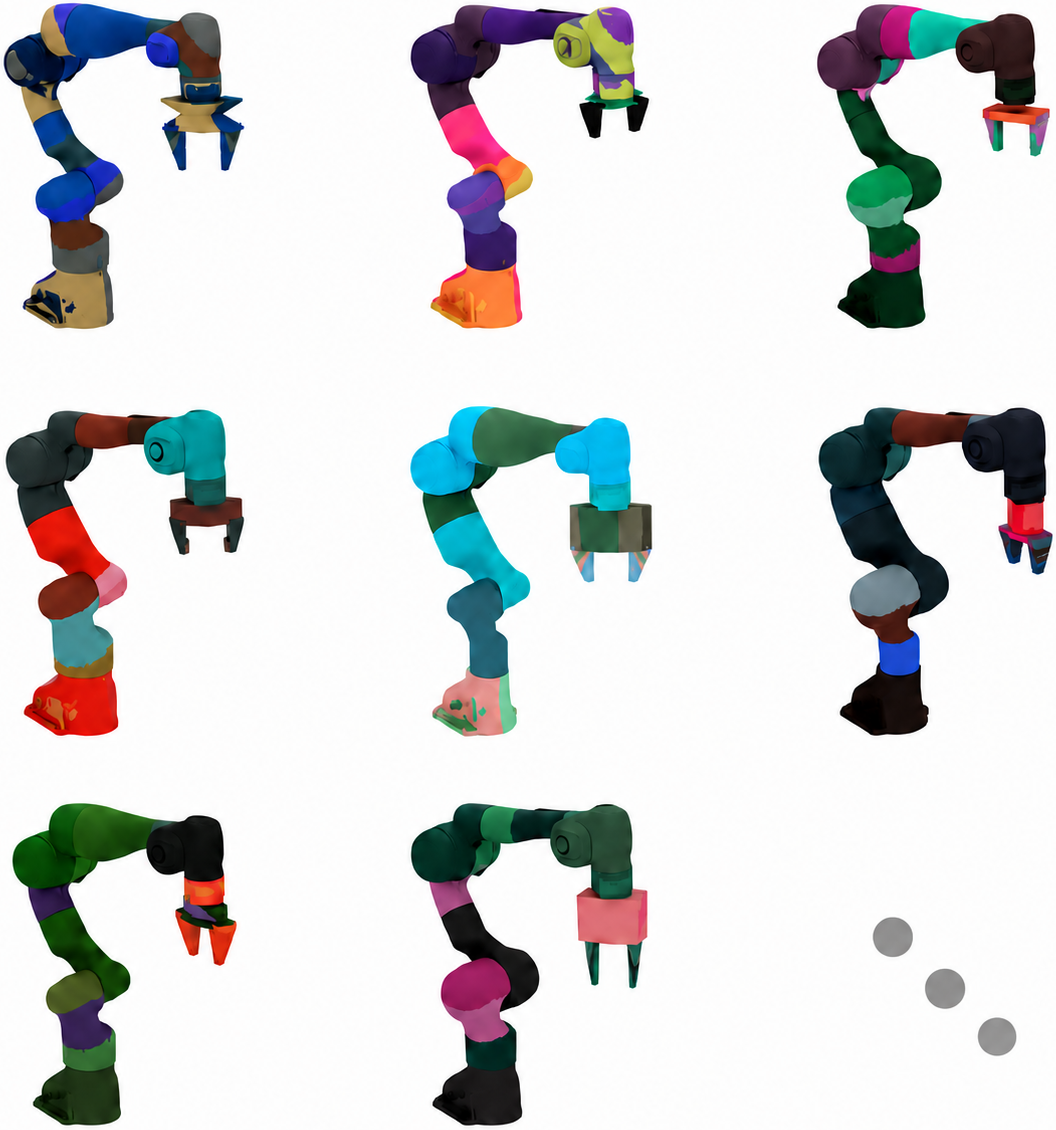
Most comparisons pretrain on 640K pick-and-place trajectories, then use 40K source demonstrations per simulated downstream task or 50 per physical task. The 512 sources are procedurally varied Franka-style arms; commercial test robots are excluded under the strict protocol. Pretraining randomizes geometry, appearance, cameras, objects and simple physical parameters. The fixed-per-source diversity sweep instead allows the total pretraining dataset to grow. Physical validation uses real source post-training data, so it is not a test of direct simulation-only deployment.
4.3 Auxiliary Co-training Objectives
Three auxiliary tasks predict structured language actions, the next manipulation-relevant goal pose or instruction-relevant object boxes. They supply local motion, spatial progress or grounding supervision through text tokens. Auxiliary training is enabled only in designated variants and is applied during both pretraining and post-training.
4.4 Embodiment Shift Categories
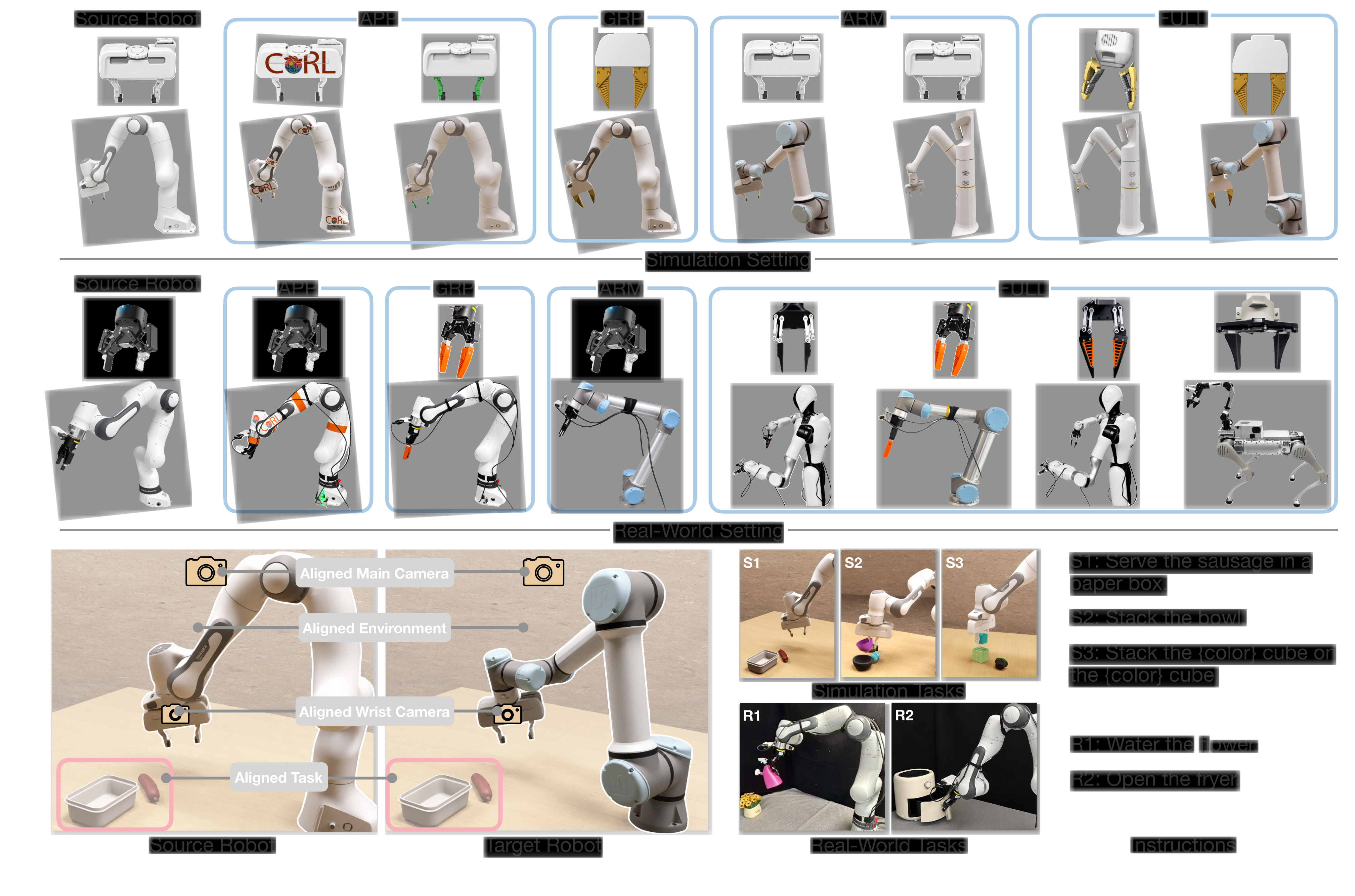
Simulation uses a Franka arm/hand source and seven held-out targets: two texture changes, one gripper replacement, two arm replacements and two combined changes. Physical experiments use Franka–Robotiq as the source and corresponding hardware categories. Keeping a two-finger interface makes comparison tractable but excludes dexterous-hand transfer.
5 Controlled Experiments
Each research question changes one designated factor or budget regime. Results are grouped by embodiment-shift category; the controlled training and evaluation setup is essential to interpreting their differences.
5.1 Shared Experimental Setup
The backbone follows π0.5. Evaluation matches post-training objects, scene, lighting and a 30×40 cm initial-pose region; wrist and third-person views are aligned across robots. Each simulated model has three independent training runs and 100 rollouts for each of three tasks on seven targets, totaling 6,300. Physical models have ten trials for each of two tasks on seven targets, totaling 140. Scores are macro-averaged task progress; simulation uncertainty is standard deviation across three training runs.
| State | Action | APP | GRP | ARM | FULL | Average | |
|---|---|---|---|---|---|---|---|
| Abs. EEF | World-Delta | 87.7 2.1 | 86.3 1.3 | 82.6 1.7 | 38.5 0.8 | 33.9 2.3 | 60.3 1.1 |
| Abs. EEF | EEF-Delta | 92.6 1.0 | 91.8 1.1 | 88.2 2.6 | 39.9 0.5 | 38.6 0.8 | 64.6 0.4 |
| EEF-Delta | World-Delta | 87.8 1.4 | 88.0 0.9 | 77.2 1.0 | 69.8 1.9 | 58.4 1.3 | 73.4 0.7 |
| EEF-Delta | EEF-Delta | 91.5 0.6 | 90.0 1.1 | 78.3 2.4 | 74.3 0.9 | 60.4 0.9 | 75.7 1.3 |
5.2 RQ1: How Do State-Action Representations Affect Transfer?
With all 512 sources, EEF-relative state is the major improvement under arm and full shifts: arm progress rises from roughly 39% to 70–74%, and full-shift progress from 34–39% to 58–60%. Combining EEF-relative state and action gives 75.7% average simulated progress versus 60.3% for absolute state/base-frame deltas. The same combination reaches 89.9% physical progress versus 56.0–61.6% for the alternatives. This best-average representation is used in the later diversity and auxiliary studies.
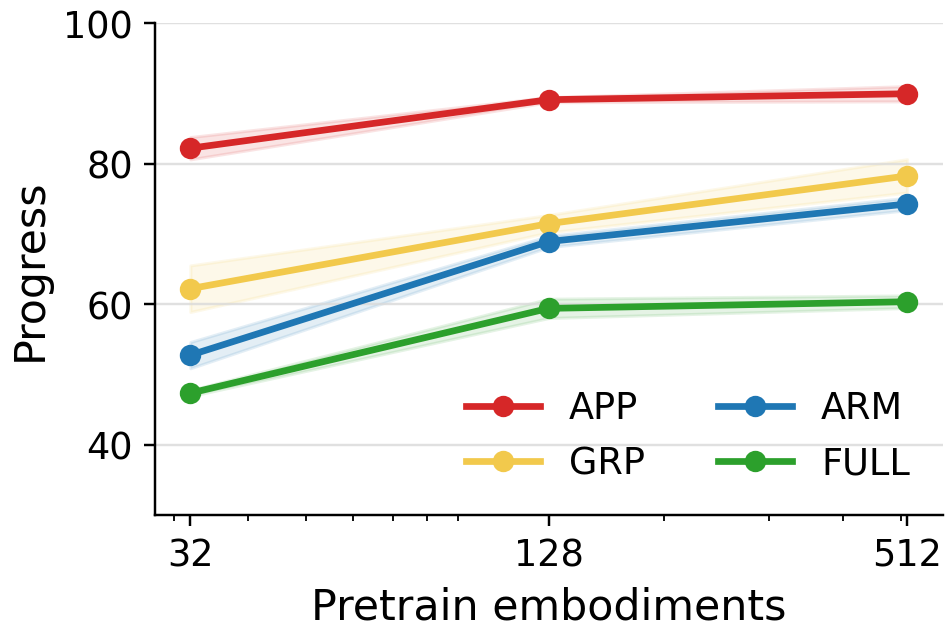
(a) Simulation
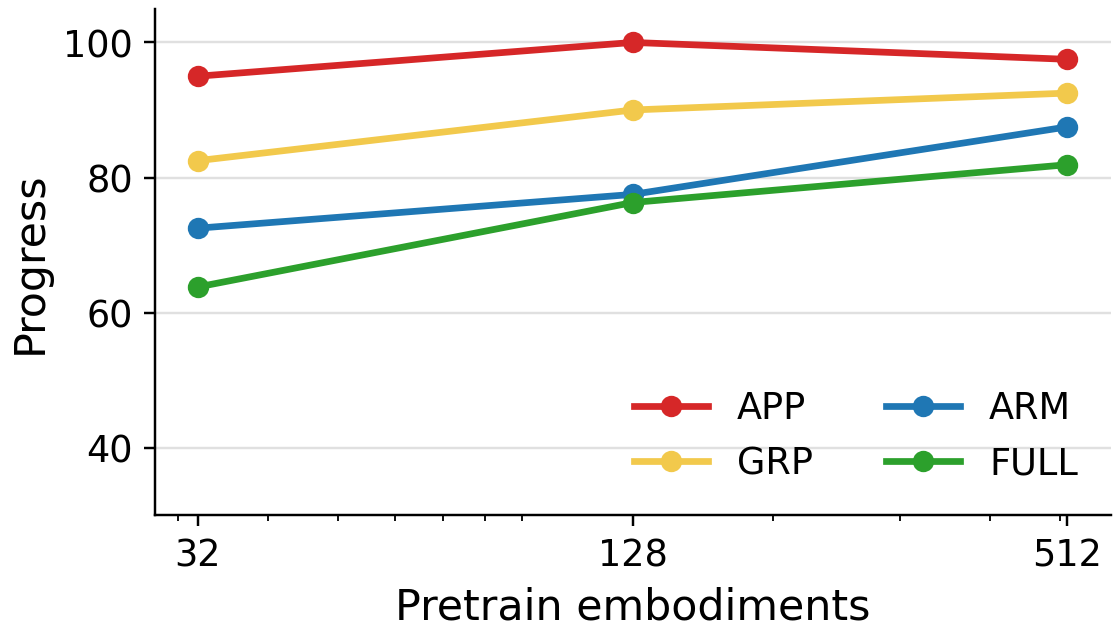
(b) Real world
5.3 RQ2: How Does Source-Embodiment Diversity Affect Transfer Under Different Budget Controls?
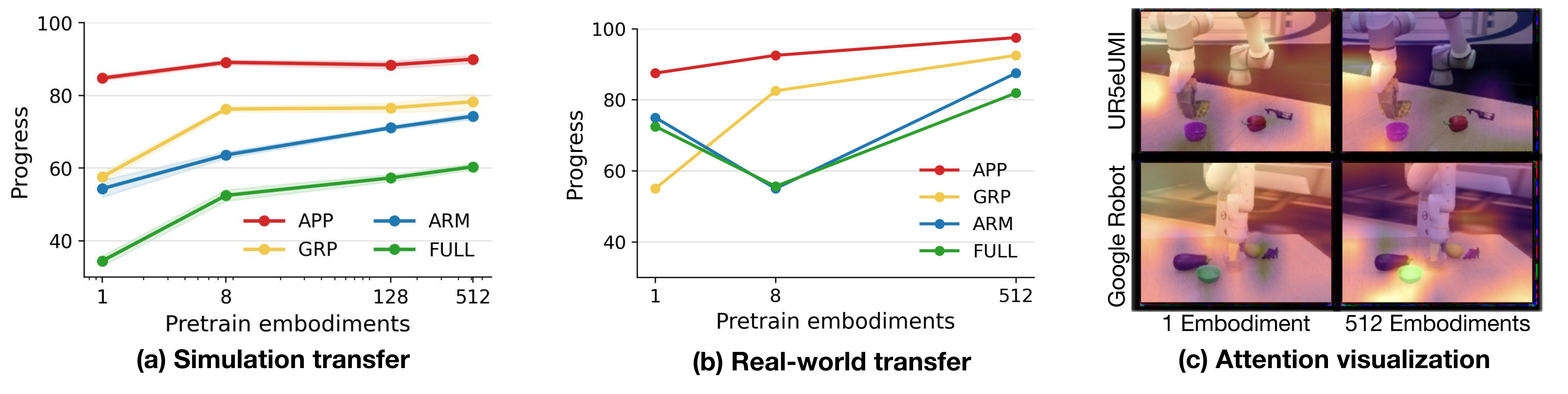
At fixed 640K trajectories, growing from one source to 512 reduces data per source from 640K to 1,250 but improves average simulated progress by about 18 points. Physical performance is non-monotonic: eight sources hurt arm/full transfer before 512 recover. A separate 32/128/512-source sweep fixes trajectories per source, so both coverage and total data grow; progress improves over that range. These are complementary budget comparisons, not a universal monotonic scaling law. Attention maps and feature overlap are qualitative supporting evidence.
5.4 RQ3: How Do Co-training Tasks Affect Transfer?
Auxiliary tasks are tested in simulation, where the required extra annotations are available. Mean progress rises from 75.7% without co-training to 77.7–82.3%; object-box prediction is strongest in the aggregate. EEF-only language-action labels outperform mixed-frame labels, consistent with the local action interface. Gains are concentrated in larger robot shifts, but these auxiliary effects have no matching physical trial set here.
| Post train data | APP | GRP | ARM | FULL | Average | |
|---|---|---|---|---|---|---|
| No co-training | 91.5 0.6 | 90.0 1.1 | 78.3 2.4 | 74.3 0.9 | 60.4 0.9 | 75.7 1.3 |
| Language-action (eef-frame) | 90.5 1.1 | 88.6 0.2 | 86.7 1.4 | 79.3 0.9 | 70.5 0.5 | 81.3 0.5 |
| Language-action (both frames) | 89.5 1.5 | 88.6 0.4 | 79.8 0.8 | 73.8 1.6 | 68.4 1.5 | 77.7 0.3 |
| Subgoal | 89.1 1.8 | 90.3 0.8 | 87.4 2.2 | 77.8 0.5 | 71.5 1.5 | 81.8 0.8 |
| Task-conditioned BBox | 90.4 1.4 | 90.2 0.4 | 87.0 0.9 | 80.1 0.8 | 71.9 1.4 | 82.3 0.2 |
5.5 RQ4: How Does Target-Embodiment Exposure Affect Transfer?
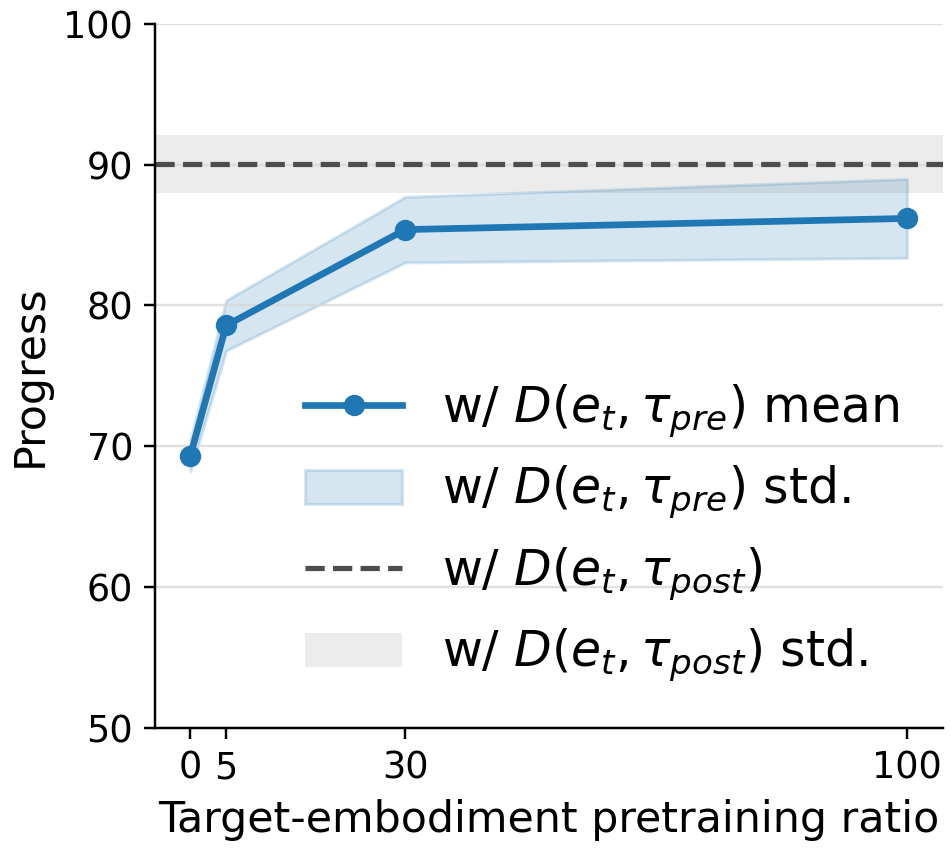
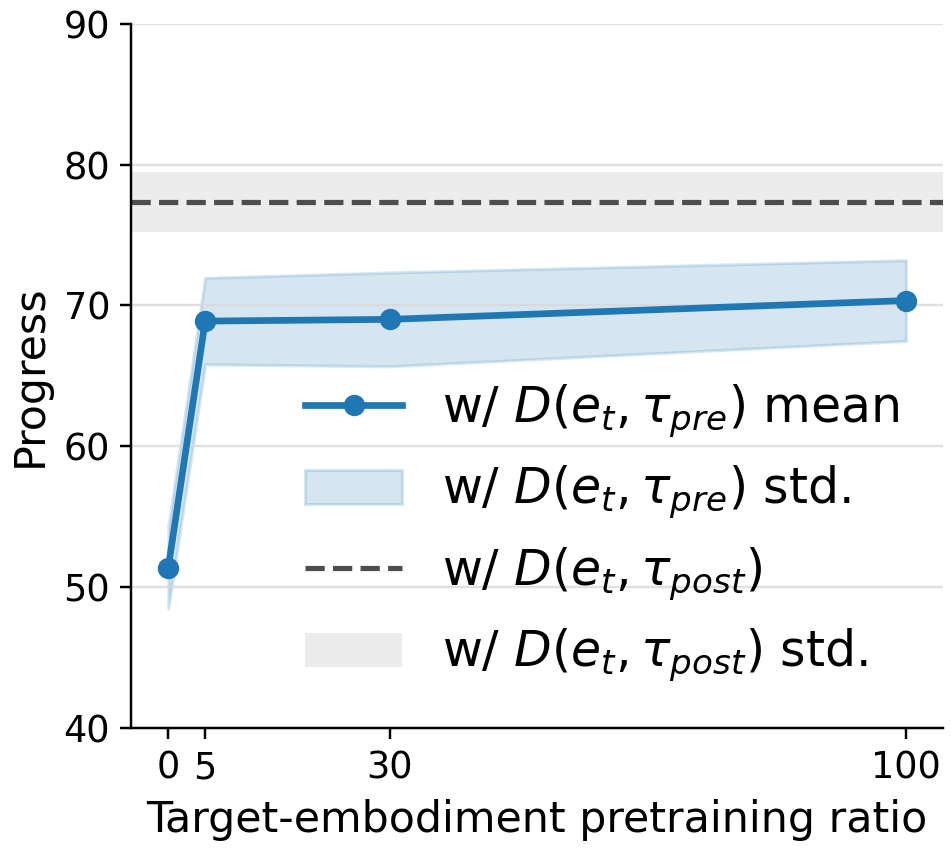
For UR5e–UMI and GoogleRobot, target trajectories replace source trajectories within a fixed 640K pretraining budget. Five-percent exposure raises the reported per-target means from 69.3% to 78.6% and 51.4% to 68.9%, averaging a 13.4-point gain. Target downstream demonstrations remain excluded; an additional target-post-trained oracle is explicitly non-zero-shot. Table 5 reports an interaction with representation and narrower gaps after exposure. Its EEF/EEF value at 5% exposure is 71.1%, below the 73.75% average of the two Figure 6 means; both original results are retained without assuming an unstated reconciliation.
5.6 Practical Guidance for Cross-Embodiment Transfer within the Studied Setting
Within this setting, report target exposure explicitly, favor local EEF state/actions for large robot shifts, evaluate source diversity together with its data allocation, and consider auxiliary supervision. Absolute state can remain competitive for smaller appearance or gripper changes. The recommendations are conditional on the tested backbone, tasks and procedural source family.
6 Limitations and Conclusion
The controlled setting isolates robot differences but does not test mobile-base control, dexterous hands or long-horizon tasks. Matched objects and camera layouts deliberately remove additional generalization challenges. Source diversity, representations and auxiliary labels improve transfer here; target exposure changes the problem enough that strict and pretrain-exposed results should be reported separately. Deployment engineering and broad morphology coverage remain open.
Appendix A Formal Definitions of the Two Zero-Shot Protocols
Both protocols post-train only on the source robot’s downstream demonstrations. Strict zero-shot excludes the target robot everywhere; pretrain-exposed zero-shot includes that robot on disjoint pretraining tasks. Neither uses target downstream demonstrations, but their hardware familiarity and difficulty differ. The retained formal table makes this distinction explicit.
| Protocol | Pre-train data | Post-train data | Eval. | ||||||||
|---|---|---|---|---|---|---|---|---|---|---|---|
|
|
|
| ||||||||
| Pretrain- exposed zero-shot |
|
|
|
Appendix B Per-RQ Experimental Design Matrix
The design matrix records each question’s variable, exposure protocol, data pool, representation and evaluation platform. Representation and diversity have simulated and physical evidence; auxiliary objectives and target-exposure comparisons are simulated. Shared backbone, observations, action horizon, post-training data and scenes are fixed unless the relevant question explicitly varies them.
| RQ | Factor studied | Zero-shot protocol | Pretraining data | Representation | Eval. |
|---|---|---|---|---|---|
| RQ1 | State-action representation | Strict zero-shot | 512 non-target source embodiments | Varied across four designs | Sim. + real |
| RQ2 | Source-embodiment diversity | Strict zero-shot | Primary: 1/8/512 sources, fixed total budget. Complementary: 32/128/512 sources, fixed per-embodiment budget. | Fixed to best-average RQ1 | Sim. + real |
| RQ3 | Auxiliary co-training objective | Strict zero-shot | 512 non-target source embodiments with auxiliary objectives | Fixed to best-average RQ1 | Sim. |
| RQ4 | Target-embodiment exposure | Pretrain-exposed zero-shot | Fixed-size pretraining pool with controlled target-embodiment replacement | Fixed to best-average RQ1 | Sim. |
Appendix C Detailed Experimental Results
Tables 8–19 retain simulated per-task/per-robot results, including the source robot and all seven held-out targets; entries list the three training runs separately. Tables 20–23 retain physical representation/diversity results for opening the fryer and watering the flower, with ten trials per cell. These detailed results expose task-specific failures and non-monotonic diversity effects hidden by aggregate category means.
| Target embodiment | Abs. EEF / World-Delta | Abs. EEF / EEF-Delta | EEF-Delta / World-Delta | EEF-Delta / EEF-Delta |
|---|---|---|---|---|
| Franka | 80.8/ 83.8/ 79.8 | 89.9/ 82.8/ 89.9 | 85.9/ 80.8/ 86.9 | 84.8/ 91.9/ 90.9 |
| Franka+logo | 83.8/ 79.8/ 82.8 | 83.8/ 90.9/ 93.9 | 86.9/ 85.9/ 86.9 | 88.9/ 85.9/ 86.9 |
| Franka+green | 84.8/ 83.8/ 82.8 | 87.9/ 88.9/ 89.9 | 81.8/ 82.8/ 86.9 | 85.9/ 91.9/ 86.9 |
| Franka+UMI | 79.8/ 78.8/ 77.8 | 83.8/ 90.9/ 83.8 | 70.7/ 80.8/ 76.8 | 74.8/ 81.8/ 86.9 |
| UR5e+Franka | 65.7/ 68.7/ 70.7 | 70.7/ 69.7/ 70.7 | 76.8/ 81.8/ 74.8 | 78.8/ 81.8/ 75.8 |
| Google+Franka | 0.0/ 0.0/ 0.0 | 2.0/ 1.0/ 1.0 | 54.5/ 53.5/ 53.5 | 50.5/ 58.6/ 56.6 |
| UR5e+UMI | 69.7/ 60.6/ 58.6 | 69.7/ 76.8/ 75.8 | 69.7/ 62.7/ 59.6 | 69.7/ 69.7/ 69.7 |
| GoogleRobot | 1.0/ 1.0/ 0.0 | 0.0/ 1.0/ 0.0 | 59.6/ 58.6/ 64.7 | 54.5/ 55.6/ 53.5 |
| Target embodiment | Abs. EEF / World-Delta | Abs. EEF / EEF-Delta | EEF-Delta / World-Delta | EEF-Delta / EEF-Delta |
|---|---|---|---|---|
| Franka | 82.0/ 90.0/ 87.0 | 95.0/ 93.0/ 89.0 | 84.0/ 84.0/ 88.0 | 91.0/ 87.0/ 86.0 |
| Franka+logo | 87.0/ 83.0/ 83.0 | 95.0/ 87.0/ 89.0 | 87.0/ 86.0/ 89.0 | 79.0/ 88.0/ 87.0 |
| Franka+green | 87.0/ 89.0/ 78.0 | 95.0/ 85.0/ 85.0 | 82.0/ 82.0/ 84.0 | 87.0/ 89.0/ 90.0 |
| Franka+UMI | 77.0/ 83.0/ 77.0 | 86.0/ 86.0/ 81.0 | 82.0/ 73.0/ 75.0 | 73.0/ 77.0/ 69.0 |
| UR5e+Franka | 78.0/ 75.0/ 77.0 | 71.0/ 79.0/ 73.0 | 72.0/ 68.0/ 65.0 | 83.0/ 83.0/ 85.0 |
| Google+Franka | 0.0/ 0.0/ 2.0 | 0.0/ 0.0/ 0.0 | 64.0/ 66.0/ 58.0 | 77.0/ 70.0/ 73.0 |
| UR5e+UMI | 70.0/ 64.0/ 61.0 | 77.0/ 65.0/ 71.0 | 62.0/ 53.0/ 50.0 | 74.0/ 74.0/ 69.0 |
| GoogleRobot | 0.0/ 1.0/ 0.0 | 0.0/ 0.0/ 0.0 | 41.0/ 55.0/ 48.0 | 29.0/ 54.0/ 54.0 |
| Target embodiment | Abs. EEF / World-Delta | Abs. EEF / EEF-Delta | EEF-Delta / World-Delta | EEF-Delta / EEF-Delta |
|---|---|---|---|---|
| Franka | 94.0/ 98.0/ 94.0 | 97.0/ 99.0/ 98.0 | 97.0/ 93.0/ 91.0 | 98.0/ 98.0/ 96.0 |
| Franka+logo | 92.0/ 97.0/ 90.0 | 99.0/ 98.0/ 98.0 | 95.0/ 93.0/ 93.0 | 96.0/ 98.0/ 96.0 |
| Franka+green | 87.0/ 92.0/ 90.0 | 96.0/ 92.0/ 98.0 | 97.0/ 91.0/ 93.0 | 94.0/ 93.0/ 96.0 |
| Franka+UMI | 95.0/ 89.0/ 86.0 | 93.0/ 98.0/ 91.0 | 82.0/ 79.0/ 75.7 | 77.0/ 81.0/ 84.0 |
| UR5e+Franka | 79.0/ 82.0/ 81.0 | 89.0/ 92.0/ 91.0 | 75.0/ 88.0/ 79.0 | 71.0/ 77.0/ 84.0 |
| Google+Franka | 2.0/ 10.0/ 2.0 | 3.0/ 2.0/ 3.0 | 79.0/ 74.0/ 74.0 | 79.0/ 75.0/ 78.0 |
| UR5e+UMI | 79.0/ 71.0/ 67.0 | 84.0/ 80.0/ 85.0 | 59.0/ 58.0/ 61.0 | 69.0/ 63.0/ 66.0 |
| GoogleRobot | 2.0/ 2.0/ 2.0 | 6.0/ 2.0/ 2.0 | 70.0/ 57.0/ 63.0 | 59.0/ 47.0/ 56.0 |
| Target embodiment | 1 source | 8 sources | 512 sources |
|---|---|---|---|
| Franka | 84.8/ 80.8/ 81.8 | 82.8/ 81.8/ 85.9 | 84.8/ 91.9/ 90.9 |
| Franka+logo | 80.8/ 76.8/ 84.8 | 84.8/ 80.8/ 81.8 | 88.9/ 85.9/ 86.9 |
| Franka+green | 78.8/ 81.8/ 79.8 | 80.8/ 84.8/ 85.9 | 85.9/ 91.9/ 86.9 |
| Franka+UMI | 53.5/ 53.5/ 61.6 | 72.7/ 75.8/ 77.8 | 74.8/ 81.8/ 86.9 |
| UR5e+Franka | 40.4/ 50.5/ 45.5 | 52.5/ 52.5/ 58.6 | 78.8/ 81.8/ 75.8 |
| Google+Franka | 41.4/ 45.5/ 45.5 | 56.6/ 41.4/ 53.5 | 50.5/ 58.6/ 56.6 |
| UR5e+UMI | 40.4/ 33.3/ 40.4 | 63.6/ 54.5/ 56.6 | 69.7/ 69.7/ 69.7 |
| GoogleRobot | 31.3/ 28.3/ 26.3 | 47.5/ 45.5/ 43.4 | 54.5/ 55.6/ 53.5 |
| Target embodiment | 1 source | 8 sources | 512 sources |
|---|---|---|---|
| Franka | 87.0/ 81.0/ 84.0 | 92.0/ 87.0/ 85.0 | 91.0/ 87.0/ 86.0 |
| Franka+logo | 84.0/ 84.0/ 83.0 | 89.0/ 87.0/ 93.0 | 79.0/ 88.0/ 87.0 |
| Franka+green | 85.0/ 85.0/ 86.0 | 86.0/ 86.0/ 86.0 | 87.0/ 89.0/ 90.0 |
| Franka+UMI | 64.0/ 65.0/ 58.0 | 68.0/ 71.0/ 67.0 | 73.0/ 77.0/ 69.0 |
| UR5e+Franka | 57.0/ 60.0/ 56.0 | 76.0/ 73.0/ 76.0 | 83.0/ 83.0/ 85.0 |
| Google+Franka | 55.0/ 64.0/ 61.0 | 70.0/ 71.0/ 62.0 | 77.0/ 70.0/ 73.0 |
| UR5e+UMI | 51.0/ 49.0/ 39.0 | 63.0/ 66.0/ 64.0 | 74.0/ 74.0/ 69.0 |
| GoogleRobot | 15.0/ 28.0/ 29.0 | 45.0/ 35.0/ 49.0 | 29.0/ 54.0/ 54.0 |
| Target embodiment | 1 source | 8 sources | 512 sources |
|---|---|---|---|
| Franka | 93.0/ 92.0/ 91.0 | 95.0/ 95.0/ 96.0 | 98.0/ 98.0/ 96.0 |
| Franka+logo | 89.0/ 87.0/ 93.0 | 94.0/ 98.0/ 95.0 | 96.0/ 98.0/ 96.0 |
| Franka+green | 91.0/ 89.0/ 87.0 | 96.0/ 97.0/ 98.0 | 94.0/ 93.0/ 96.0 |
| Franka+UMI | 53.0/ 51.0/ 59.0 | 86.0/ 81.0/ 87.0 | 77.0/ 81.0/ 84.0 |
| UR5e+Franka | 55.0/ 59.0/ 60.0 | 68.0/ 69.0/ 63.0 | 71.0/ 77.0/ 84.0 |
| Google+Franka | 60.0/ 64.0/ 59.0 | 66.0/ 69.0/ 67.0 | 79.0/ 75.0/ 78.0 |
| UR5e+UMI | 39.0/ 36.0/ 33.0 | 61.0/ 55.0/ 55.0 | 69.0/ 63.0/ 66.0 |
| GoogleRobot | 39.0/ 35.0/ 28.0 | 43.0/ 46.0/ 52.0 | 59.0/ 47.0/ 56.0 |
| Target embodiment | No co-training | LAP (EEF frame) | LAP (both frames) | Subgoal | BBox |
|---|---|---|---|---|---|
| Franka | 84.8/ 91.9/ 90.9 | 90.9/ 84.8/ 91.9 | 88.9/ 91.9/ 91.9 | 91.9/ 95.0/ 93.9 | 85.9/ 91.9/ 87.9 |
| Franka+logo | 88.9/ 85.9/ 86.9 | 87.9/ 85.9/ 86.9 | 85.9/ 87.9/ 90.9 | 97.0/ 91.9/ 95.0 | 92.9/ 92.9/ 91.9 |
| Franka+green | 85.9/ 91.9/ 86.9 | 80.8/ 87.9/ 80.8 | 87.9/ 86.9/ 89.9 | 92.9/ 96.0/ 95.0 | 88.9/ 88.9/ 88.9 |
| Franka+UMI | 74.8/ 81.8/ 86.9 | 84.8/ 82.8/ 85.9 | 76.8/ 79.8/ 76.8 | 84.8/ 88.9/ 93.9 | 85.9/ 86.9/ 88.9 |
| UR5e+Franka | 78.8/ 81.8/ 75.8 | 78.8/ 84.8/ 81.8 | 72.7/ 76.8/ 68.7 | 89.9/ 91.9/ 92.9 | 84.8/ 83.8/ 83.8 |
| Google+Franka | 50.5/ 58.6/ 56.6 | 77.8/ 74.8/ 73.7 | 58.6/ 58.6/ 61.6 | 68.7/ 69.7/ 70.7 | 71.7/ 72.7/ 64.7 |
| UR5e+UMI | 69.7/ 69.7/ 69.7 | 77.8/ 72.7/ 74.8 | 70.7/ 74.8/ 70.7 | 80.8/ 78.8/ 79.8 | 79.8/ 85.9/ 73.7 |
| GoogleRobot | 54.5/ 55.6/ 53.5 | 67.7/ 61.6/ 68.7 | 62.6/ 50.5/ 55.6 | 62.6/ 62.6/ 64.7 | 59.6/ 69.7/ 57.6 |
| Target embodiment | No co-training | LAP (EEF frame) | LAP (both frames) | Subgoal | BBox |
|---|---|---|---|---|---|
| Franka | 91.0/ 87.0/ 86.0 | 84.0/ 87.0/ 89.0 | 81.0/ 86.0/ 87.0 | 80.0/ 82.0/ 86.0 | 87.0/ 90.0/ 86.0 |
| Franka+logo | 79.0/ 88.0/ 87.0 | 85.0/ 89.0/ 84.0 | 92.0/ 89.0/ 84.0 | 85.0/ 79.0/ 84.0 | 81.0/ 89.0/ 85.0 |
| Franka+green | 87.0/ 89.0/ 90.0 | 88.0/ 85.0/ 85.0 | 82.0/ 82.0/ 83.0 | 85.0/ 76.0/ 84.0 | 89.0/ 83.0/ 86.0 |
| Franka+UMI | 73.0/ 77.0/ 69.0 | 86.0/ 80.0/ 82.0 | 74.0/ 74.0/ 75.0 | 78.0/ 82.0/ 86.0 | 79.0/ 79.0/ 82.0 |
| UR5e+Franka | 83.0/ 83.0/ 85.0 | 83.0/ 86.0/ 80.0 | 73.0/ 84.0/ 82.0 | 83.0/ 80.0/ 86.0 | 79.0/ 76.0/ 79.0 |
| Google+Franka | 77.0/ 70.0/ 73.0 | 69.0/ 68.0/ 69.0 | 76.0/ 72.0/ 61.0 | 73.0/ 68.0/ 60.0 | 76.0/ 83.0/ 74.0 |
| UR5e+UMI | 74.0/ 74.0/ 69.0 | 73.0/ 80.0/ 71.0 | 70.0/ 65.0/ 68.0 | 83.0/ 72.0/ 81.0 | 74.0/ 72.0/ 80.0 |
| GoogleRobot | 29.0/ 54.0/ 54.0 | 65.0/ 68.0/ 58.0 | 62.0/ 55.0/ 65.0 | 31.0/ 55.0/ 57.0 | 64.0/ 67.0/ 64.0 |
| Target embodiment | No co-training | LAP (EEF frame) | LAP (both frames) | Subgoal | BBox |
|---|---|---|---|---|---|
| Franka | 98.0/ 98.0/ 96.0 | 96.0/ 96.0/ 95.0 | 93.0/ 91.0/ 95.0 | 89.0/ 90.0/ 94.0 | 96.0/ 95.0/ 94.0 |
| Franka+logo | 96.0/ 98.0/ 96.0 | 94.0/ 94.0/ 96.0 | 91.0/ 94.0/ 95.0 | 94.0/ 94.0/ 93.0 | 96.0/ 95.0/ 94.0 |
| Franka+green | 94.0/ 93.0/ 96.0 | 97.0/ 91.0/ 97.0 | 92.0/ 89.0/ 92.0 | 92.0/ 98.0/ 94.0 | 96.0/ 94.0/ 92.0 |
| Franka+UMI | 77.0/ 81.0/ 84.0 | 95.0/ 93.0/ 91.0 | 86.0/ 85.0/ 91.0 | 91.0/ 92.0/ 90.0 | 94.0/ 93.0/ 94.0 |
| UR5e+Franka | 71.0/ 77.0/ 84.0 | 92.0/ 90.0/ 88.0 | 86.0/ 88.0/ 83.0 | 80.0/ 83.0/ 83.0 | 91.0/ 84.0/ 89.0 |
| Google+Franka | 79.0/ 75.0/ 78.0 | 74.0/ 79.0/ 77.0 | 68.0/ 77.0/ 82.0 | 73.0/ 77.0/ 70.0 | 84.0/ 80.0/ 85.0 |
| UR5e+UMI | 69.0/ 63.0/ 66.0 | 86.0/ 84.0/ 86.0 | 87.0/ 80.0/ 86.0 | 86.0/ 89.0/ 87.0 | 83.0/ 89.0/ 87.0 |
| GoogleRobot | 59.0/ 47.0/ 56.0 | 56.0/ 58.0/ 60.0 | 66.0/ 73.0/ 70.0 | 75.0/ 71.0/ 71.0 | 61.0/ 59.0/ 68.0 |
| Setting | UR5e+UMI | GoogleRobot |
|---|---|---|
| Strict zero-shot (0%) | 69.7/ 69.7/ 69.7 | 54.5/ 55.6/ 53.5 |
| Pretrain-exposed (5%) | 75.8/ 73.7/ 74.8 | 68.7/ 64.7/ 68.7 |
| Pretrain-exposed (30%) | 86.9/ 83.8/ 75.8 | 71.7/ 72.7/ 67.7 |
| Pretrain-exposed (100%) | 89.9/ 84.8/ 85.9 | 73.7/ 68.7/ 71.7 |
| Target post-training oracle | 83.8/ 78.8/ 80.8 | 69.7/ 62.6/ 60.6 |
| Setting | UR5e+UMI | GoogleRobot |
|---|---|---|
| Strict zero-shot (0%) | 74.0/ 74.0/ 69.0 | 29.0/ 54.0/ 54.0 |
| Pretrain-exposed (5%) | 80.0/ 77.0/ 80.0 | 70.0/ 61.0/ 67.0 |
| Pretrain-exposed (30%) | 87.0/ 82.0/ 85.0 | 70.0/ 69.0/ 59.0 |
| Pretrain-exposed (100%) | 88.0/ 81.0/ 86.0 | 71.0/ 61.0/ 71.0 |
| Target post-training oracle | 97.0/ 92.0/ 92.0 | 81.0/ 79.0/ 76.0 |
| Setting | UR5e+UMI | GoogleRobot |
|---|---|---|
| Strict zero-shot (0%) | 69.0/ 63.0/ 66.0 | 59.0/ 47.0/ 56.0 |
| Pretrain-exposed (5%) | 87.0/ 79.0/ 80.0 | 75.0/ 68.0/ 77.0 |
| Pretrain-exposed (30%) | 91.0/ 90.0/ 87.0 | 76.0/ 68.0/ 67.0 |
| Pretrain-exposed (100%) | 92.0/ 84.0/ 84.0 | 77.0/ 71.0/ 68.0 |
| Target post-training oracle | 98.0/ 95.0/ 93.0 | 90.0/ 88.0/ 89.0 |
| Target embodiment | Abs. EEF / World-Delta | Abs. EEF / EEF-Delta | EEF-Delta / World-Delta | EEF-Delta / EEF-Delta |
|---|---|---|---|---|
| Franka+Robotiq | 90.0 | 95.0 | 80.0 | 100.0 |
| Franka+Robotiq (CoRL logo) | 90.0 | 90.0 | 90.0 | 100.0 |
| Franka+Umi | 80.0 | 85.0 | 90.0 | 100.0 |
| UR | 55.0 | 35.0 | 55.0 | 90.0 |
| Humanoid robot | 0.0 | 0.0 | 35.0 | 100.0 |
| UR+Umi | 60.0 | 50.0 | 60.0 | 80.0 |
| Humanoid robot+Umi | 0.0 | 0.0 | 55.0 | 85.0 |
| Piper-on-Quadruped | 35.0 | 0.0 | 40.0 | 80.0 |
| Target embodiment | Abs. EEF / World-Delta | Abs. EEF / EEF-Delta | EEF-Delta / World-Delta | EEF-Delta / EEF-Delta |
|---|---|---|---|---|
| Franka+Robotiq | 85.0 | 85.0 | 90.0 | 100.0 |
| Franka+Robotiq (CoRL logo) | 85.0 | 90.0 | 65.0 | 95.0 |
| Franka+Umi | 55.0 | 75.0 | 30.0 | 85.0 |
| UR | 40.0 | 85.0 | 70.0 | 85.0 |
| Humanoid robot | 0.0 | 0.0 | 40.0 | 80.0 |
| UR+Umi | 55.0 | 60.0 | 60.0 | 75.0 |
| Humanoid robot+Umi | 0.0 | 0.0 | 25.0 | 65.0 |
| Piper-on-Quadruped | 20.0 | 20.0 | 30.0 | 90.0 |
| Target embodiment | 1 source | 8 sources | 512 sources |
|---|---|---|---|
| Franka+Robotiq | 80.0 | 100.0 | 100.0 |
| Franka+Robotiq (CoRL logo) | 90.0 | 100.0 | 100.0 |
| Franka+Umi | 80.0 | 100.0 | 100.0 |
| UR | 75.0 | 75.0 | 90.0 |
| Humanoid robot | 95.0 | 90.0 | 100.0 |
| UR+Umi | 65.0 | 75.0 | 80.0 |
| Humanoid robot+Umi | 75.0 | 70.0 | 85.0 |
| Piper-on-Quadruped | 90.0 | 45.0 | 80.0 |
| Target embodiment | 1 source | 8 sources | 512 sources |
|---|---|---|---|
| Franka+Robotiq | 80.0 | 95.0 | 100.0 |
| Franka+Robotiq (CoRL logo) | 85.0 | 85.0 | 95.0 |
| Franka+Umi | 30.0 | 65.0 | 85.0 |
| UR | 75.0 | 35.0 | 85.0 |
| Humanoid robot | 85.0 | 30.0 | 80.0 |
| UR+Umi | 55.0 | 35.0 | 75.0 |
| Humanoid robot+Umi | 50.0 | 30.0 | 65.0 |
| Piper-on-Quadruped | 65.0 | 70.0 | 90.0 |
Appendix D Taxonomy of Zero-Shot Protocols in Prior Work
The source reclassifies representative prior papers by target exposure during pretraining and post-training. Some “zero-shot” claims concern only unseen robot–task combinations, while others exclude the target robot entirely. This is the authors’ protocol taxonomy, not a controlled rerun or performance ranking of those prior systems; original table qualifications and citations remain.
| Work | Target embodiment | Target embodiment | Protocol |
|---|---|---|---|
| in pretraining? | in post-training? | ||
| LAP [64] | ✗ | ✗ | Strict |
| Cloak [39] | ✗ | ✗ | Strict |
| RDT2 [29] | ✗ | ✗ | Strict |
| Octo [15] | ✓ | ✗ | Pretrain-exposed |
| [37] | ✓ | ✗ | Pretrain-exposed |
| Qwen-RobotManip [61] | ✓ | ✗ | Pretrain-exposed |
| OpenVLA [20] | ✓ | ✗ | Pretrain-exposed |
| Gemini Robotics 1.5 [14]∗ | ✓ | ✗ | Pretrain-exposed |
| Being-H0.5 [31]† | ✓ | ✓ | Unseen task–emb. pair |
∗Gemini Robotics 1.5 reports zero-shot transfer to tasks observed only on another embodiment, while the evaluated target embodiments are already included in its multi-embodiment pretraining and receive no robot-specific post-training.
†Being-H0.5 reports unseen task–embodiment pairs as zero-shot even though the target embodiment participates in post-training, so the evaluation falls outside both strict and pretrain-exposed protocols.
Appendix E Cross-Embodiment Feature Visualization
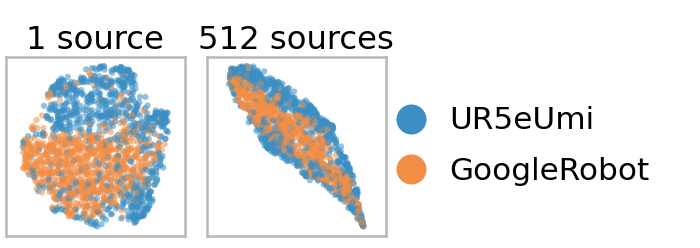
Mean-pooled final VLM features from 3,600 frames in 1,200 trajectories are projected with cosine-distance UMAP. UR5e–UMI and GoogleRobot features overlap more visibly after 512-source than one-source training. This selected two-dimensional visualization is qualitative alignment evidence, not a quantitative causal explanation of transfer.
Appendix F Data-Construction Details
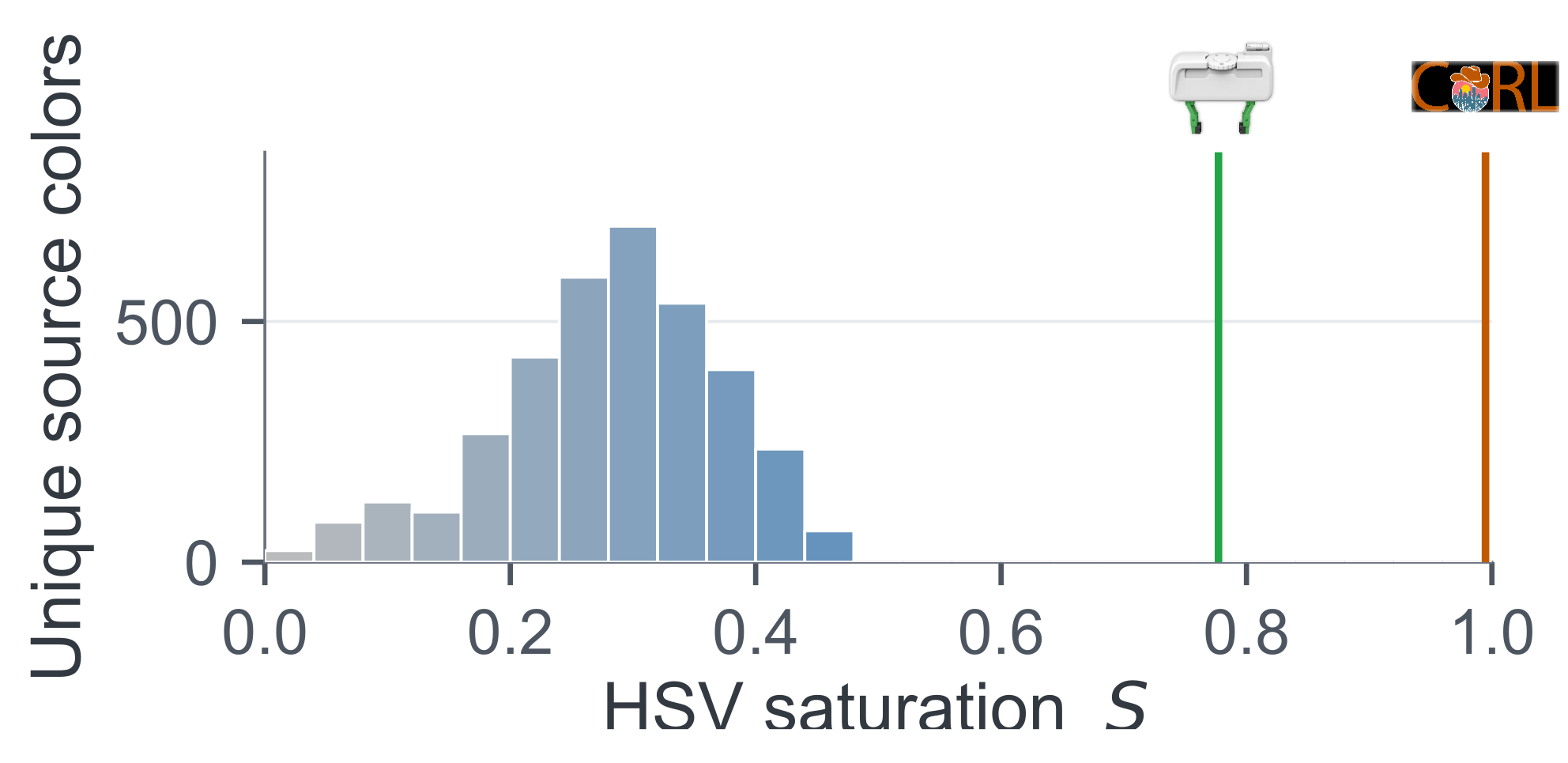
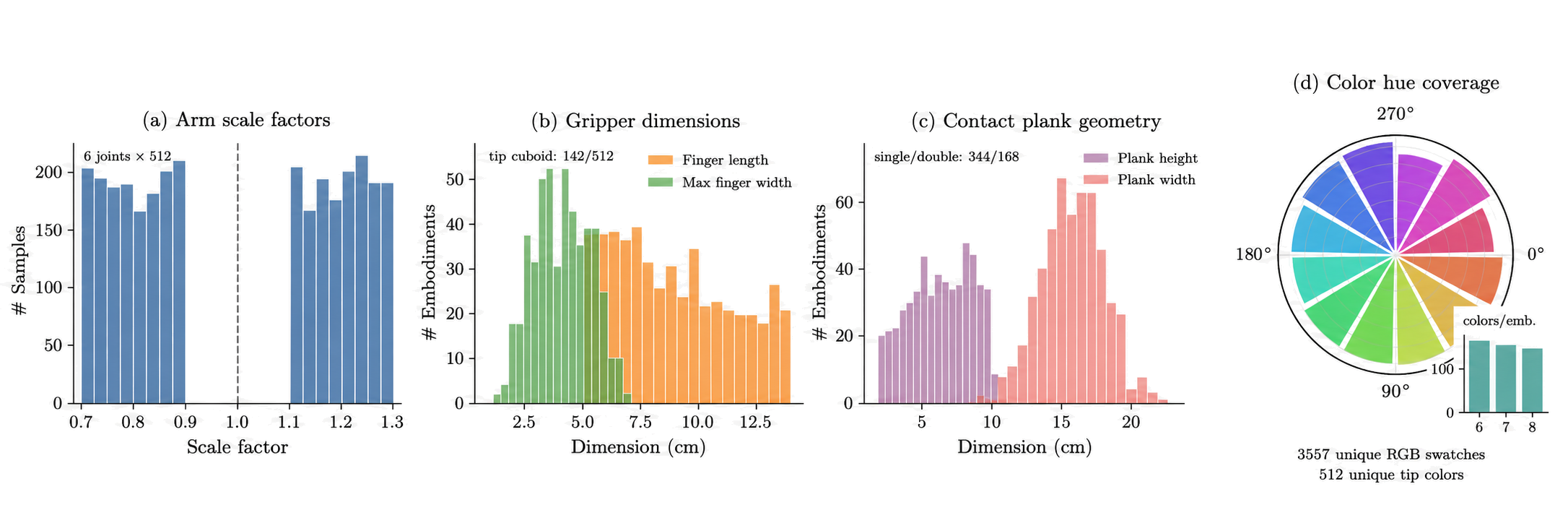
Six movable arm-link regions are scaled roughly 0.7–1.3, with corresponding visual/collision geometry changes. Gripper fingers, contact planks and low-saturation 6–8-color palettes vary across 512 Franka-style sources. Held-out green/logo appearances have saturation 0.77/0.99 versus source maximum 0.46, but are not strongly out-of-distribution in all visual respects. Pretraining uses over 1,000 materials and 10,000 filtered objects, randomized lights/layouts/cameras, mass and friction. Post-training/evaluation deliberately keep each downstream scene and object set fixed.
Appendix G Embodiment Shift Taxonomy
The following taxonomy identifies the exact arm, gripper and appearance changes. A mobile platform’s presence does not imply its base is controlled or represented by the policy.
G.1 Simulation
The simulated source is a seven-degree-of-freedom Franka arm with its standard hand. Targets add a logo or green fingers, attach a UMI gripper, pair a UR5e or GoogleRobot arm with a Franka hand, or change both arm and gripper. GoogleRobot’s mobile-base states and commands are excluded. The two appearance targets retain the source kinematics.
G.2 Real World
The physical source is Franka–Robotiq. Targets are logo-textured Franka–Robotiq, Franka–UMI, UR5e–Robotiq, UR5e–UMI, a humanoid with native or UMI gripper, and a Piper arm on a quadruped. Humanoid trials expose only the right arm and fix the left; mobile and quadruped base states/actions are excluded throughout. Thus “full” denotes combined manipulator/end-effector changes within the stationary task interface.
Appendix H Experimental Setup Details
The appendix specifies simulator/rendering choices, camera calibration, scene controls, progress scoring and downstream tasks needed to interpret the comparison.
H.1 Simulation Platform
MuJoCo supplies physics and IsaacSim supplies rendering for the simulated experiments.
H.2 Camera Calibration Details
A shared tabletop frame separates task geometry from robot base conventions. Third-person camera extrinsics are identical in that frame for corresponding simulated trajectories; wrist cameras are aligned relative to each gripper. Physical cameras approximate the same workspace and gripper coverage. These calibrations reduce viewpoint shift, so performance is not evidence for transfer to arbitrary uncalibrated views.
H.3 Environment and Object Set Details
Simulation fixes lighting, materials and workspace across corresponding robot trials. Physical experiments use a black enclosure and gray tablecloth with matched layout. Evaluation uses exactly the object instances from source post-training, excluding an additional object-identity shift.
H.4 Details of Metrics
Each rollout scores 0, 0.5 or 1: failure, contact with the necessary task object, or full completion. Means are expressed as percentages. Aggregation first averages tasks per robot, then robots within each of four shift categories, then the four categories equally. Because categories contain different robot counts, this is not a simple mean across all target robots. Simulation standard deviations summarize three run-level aggregates.
H.5 Downstream Tasks
Simulated downstream tasks serve sausages and stack bowls or cubes, with 40K source trajectories each. Physical tasks open an air fryer and water a plant, with 50 source demonstrations each. These downstream tasks are disjoint from pretraining tasks.
Appendix I Auxiliary Co-Training Objective Specifications
The loader samples imitation/auxiliary examples at 0.75/0.25. Actions use flow matching; auxiliary answers use next-token cross-entropy. Language actions convert translation to centimeters and rotation to degrees, round to integers and verbalize nonzero motion plus gripper state; mixed-frame prompts explicitly state their reference frame. Subgoals encode the next relevant waypoint in the current EEF frame. Bounding boxes are task-conditioned, one per camera, in XYXY order with normalized coordinates quantized into 256 bins. Exact prompts and response formats are retained in Table 25.
| Objective | Prompt template | Target format |
|---|---|---|
| Language-action (EEF frame) | The task is {instruction}. Predict the robot’s action in the end-effector frame; State: {state tokens}; Answer: | move {direction} {value} cm; tilt/rotate {direction} {value} degrees; open gripper; close gripper. |
| Language-action (mixed frame) | The task is {instruction}. Predict the robot’s action in the {action frame}; State: {state tokens}; Answer: | move {direction} {value} cm; rotate {direction} {value} degrees; close gripper. |
| Subgoal prediction | In order to {instruction}, what is the next goal pose as xyz and rpy? Answer: | [x,y,z,roll,pitch,yaw], e.g., [0.012,-0.004,0.085,1.57,0.00,-0.12]. |
| Task-conditioned BBox | In order to {instruction}, what is the bounding box of the object to be manipulated in the images? Answer: | [x_min,y_min,x_max,y_max] per view, e.g., [[q_xmin,q_ymin,q_xmax,q_ymax], ...]. |
Appendix J Additional RQ4 Target-Exposure Details
Each exposure sweep builds a separate target-specific 640K pick-and-place pool and replaces a chosen fraction of non-target trajectories. The two targets differ in arm degrees of freedom and platform morphology, but base control remains excluded. The target-post-trained oracle uses downstream target demonstrations and serves only as an upper reference. Pretraining familiarity narrows, but does not remove, the remaining target-task adaptation gap.
Appendix K Model Training Details
A pretrained vision-language stream and separate action expert interact through a mixture-of-transformers backbone. Inputs use 224×224 images, four state-history entries and 99th-percentile normalization; outputs are 12-step action chunks. Flow matching trains actions, with an additional auxiliary cross-entropy weight of 0.25 when enabled. Pretraining runs 120K steps at batch 320 on 16 H800 GPUs; post-training runs 100K steps at batch 160 on eight. The separate loader ratio and auxiliary-loss weight are both reported source settings.
Appendix L Policy Inference and Action Execution Details
Each request supplies an instruction, wrist/third-person RGB images and four EEF states. The retained formulas give all four representation-specific request/response conversions: base-frame deltas update vectorized absolute pose, while local EEF deltas compose transforms. Gripper output is quantized to close/no-op/open. The server batches up to ten requests; one warmed-up query takes 168 ms and 6,168 MiB on an RTX 4090 in the reported setup. These are serving measurements, not a complete sensing-to-actuation latency or guaranteed control frequency.
Equations
Appendix M Additional Problem-Setup Details
Demonstrations pair observations and actions for a robot/task combination; state/action encoding follows each experimental variant. The policy maps observation history plus instruction to an action chunk. The stated controls hold unless explicitly varied, particularly the growing total budget in the fixed-per-source sweep and target-data replacement in exposure studies.