Overview
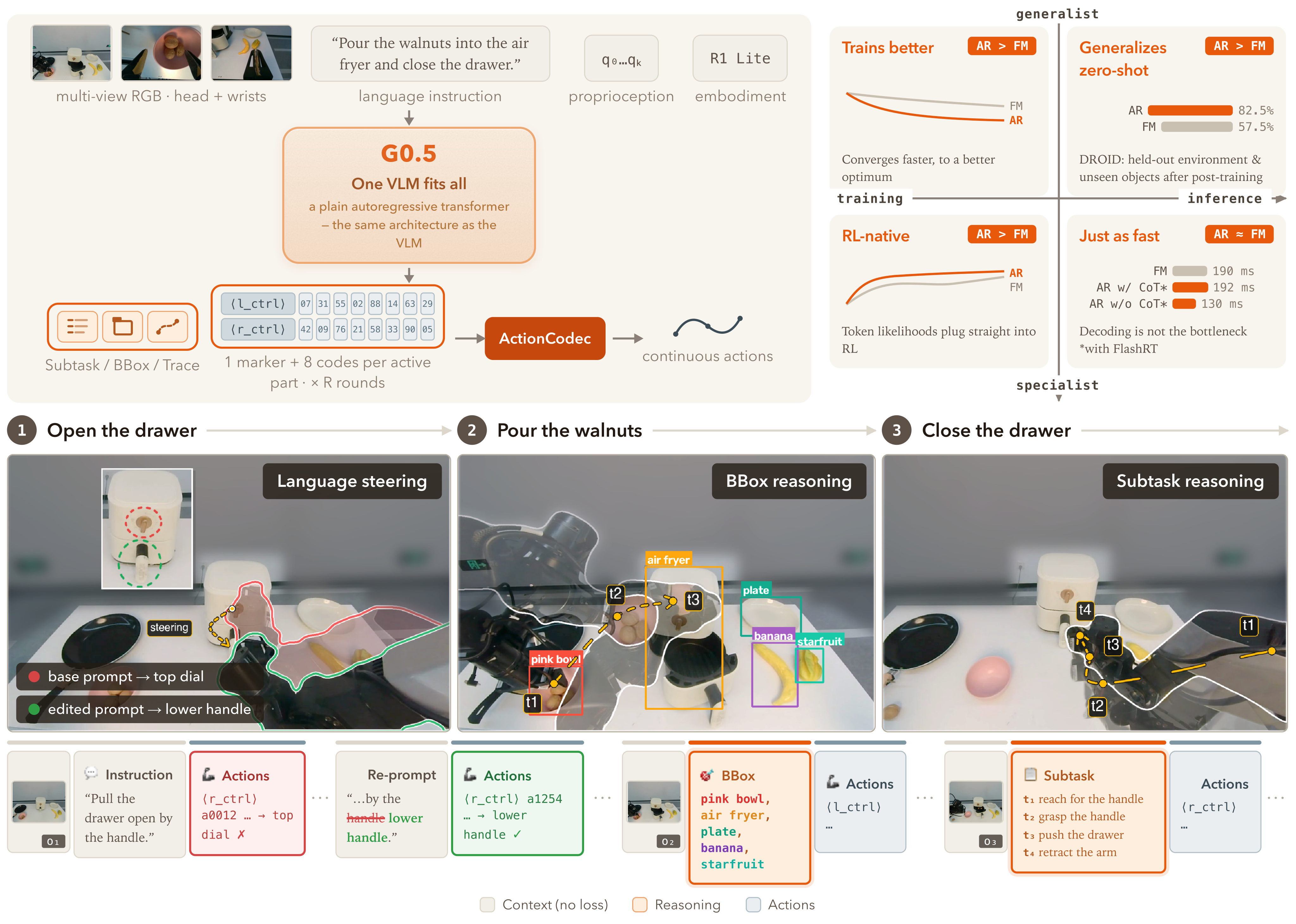
At a glance
This edition follows all 32 pages of Galaxea G0.5 v 1, preserving twelve figures, seven numbered tables, the complete token template, action layout, displayed objective and references. A Qwen3.5-2B decoder emits optional reasoning and discrete action codes; a separately learned ActionCodec converts codes into continuous robot commands.
Reported results include 76.7% real-task success across six settings, 82.5% held-out DROID score after DROID post-training, 98.9% LIBERO success and 0.3136 BEHAVIOR partial-progress score after four epochs. These are distinct protocols and metrics, not interchangeable measures of general capability.
CoT benefits the tested stage-conditioned long tasks more than single-stage picking. Pretraining data, embodiment exposure, auxiliary codec and optional flow head remain parts of the system; the experiments do not isolate an architectural cause for every gain.
1 Introduction
Instead of using a vision-language model only to condition a continuous action expert, G0.5 predicts reasoning and actions in a shared autoregressive vocabulary. Grouped action compression reduces token count, optional CoT supplies intermediate grounding, and short visual history enters the encoder.
Prompt edits can influence actions in either conditioned or shared-decoder systems; the proposed distinction is the direct token-generation interface, not a general impossibility of influencing an external expert. Figure 1 retains the complete rollout and latency panel: FlashRT AR 130 ms without CoT or 192 ms with CoT versus FM 190 ms. Hardware and a detailed timing protocol are not specified in this report.
2 Related Work
2.1 VLA Architectures: from VLM-as-Encoder to VLM-as-Actor
The paper contrasts autoregressive action-token policies such as RT-2 and OpenVLA with continuous experts such as pi0. Separate action losses can change pretrained features; shared token prediction preserves the original objective form, but does not by itself prove that language capabilities cannot degrade.
2.2 Action Tokenization and Cross-Embodiment
FAST compresses trajectories through a fixed transform, while ActionCodec and FASTer motivate learned residual codes and grouping. G0.5 maps supported bodies into five fixed parts and 27 continuous dimensions, then emits sparse group tokens. Adding a body without new head parameters presumes compatibility with that representation, not arbitrary morphology.
2.3 Reasoning and Chain-of-Thought in VLAs
HAMSTER separates high-level reasoning from control; ECoT trains reasoning before actions. G0.5 combines subtask text, object boxes, 2 D gripper traces and action hints in prompt-selectable formats. The relevant novelty claim concerns this combination with grouped actions and a shared decoder.
3 G0.5 Model Design
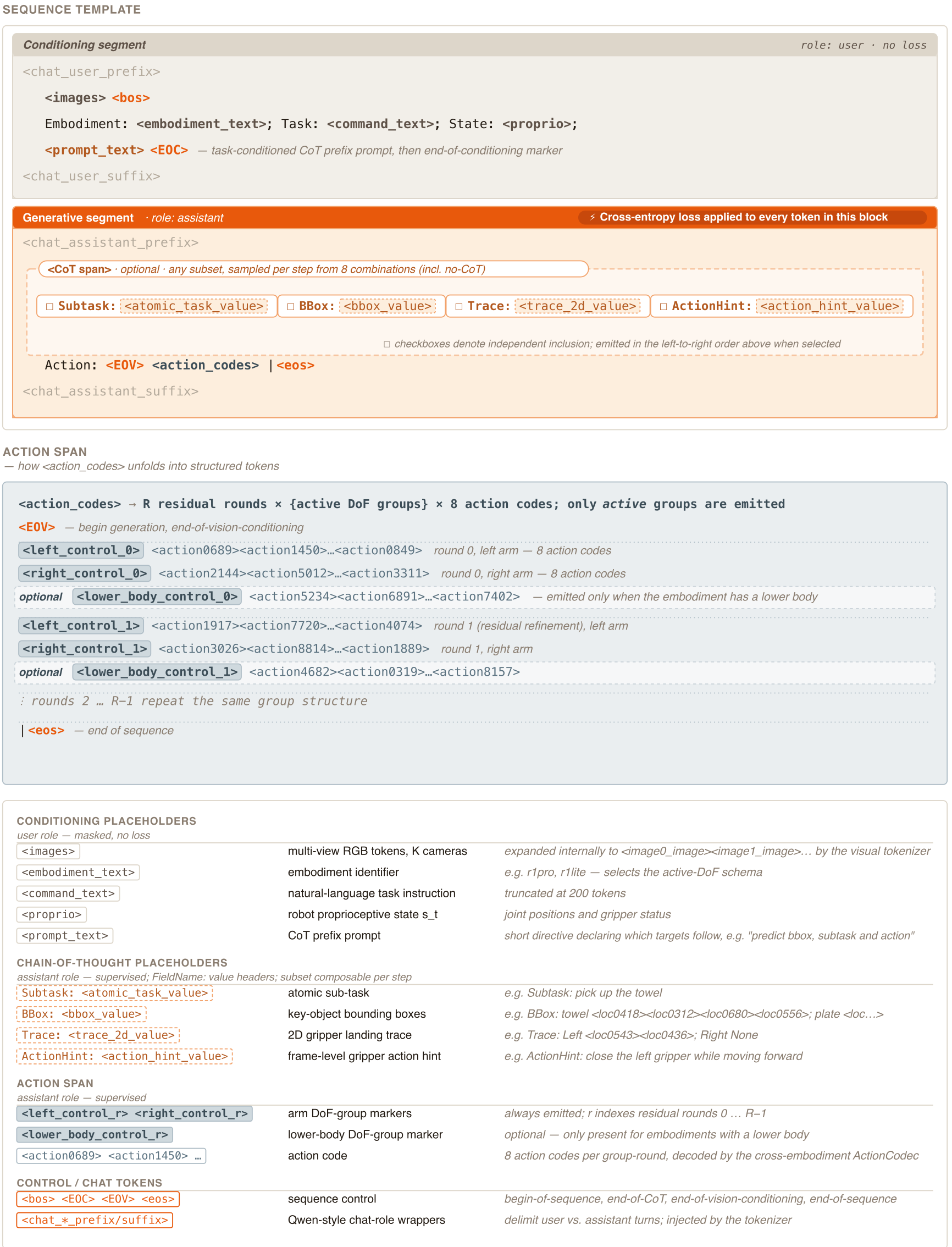
Inputs are multi-camera RGB history, embodiment identifier, task and proprioception. Qwen3.5-2B predicts the assistant segment, and Equation 1 applies next-token cross-entropy only to those generated tokens. Conditioning tokens are masked from the loss.
The default policy is autoregressive; an optional pi0.5-style flow-matching head conditions on trunk states for comparisons. The common decoder loss does not include the separate action codec’s earlier training objectives. Figure 2 preserves the full sequence format and all special-token definitions.
Equation 1
| (1) |
3.1 Structured Tokenization of Heterogeneous Action Data
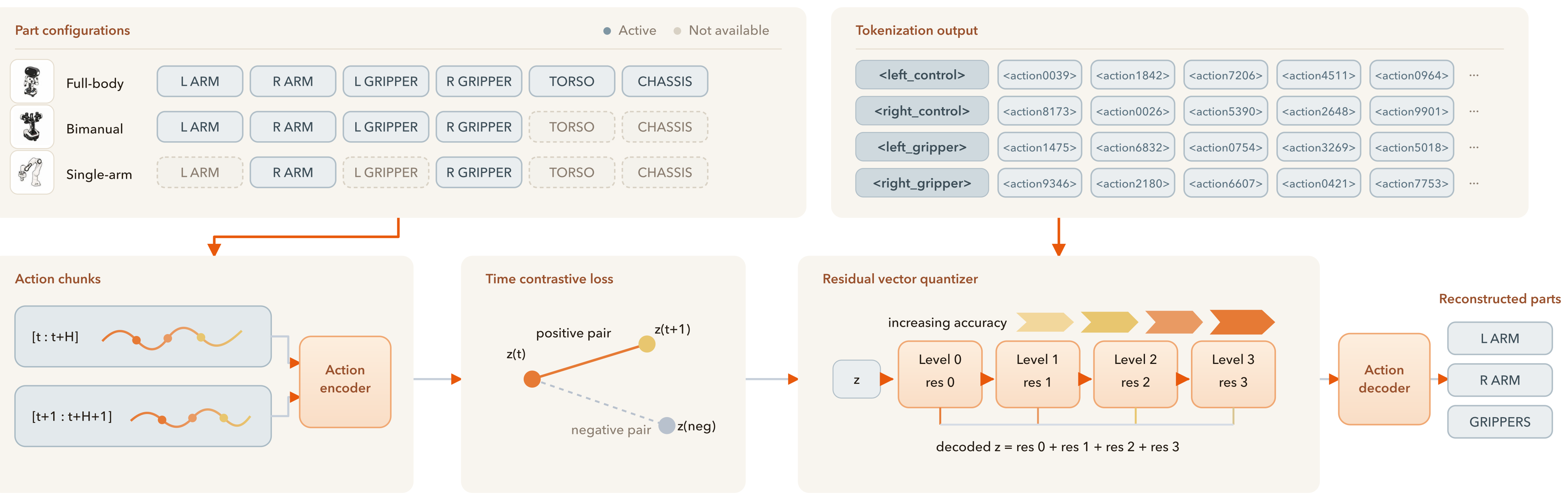
Robot actions are divided into semantic motion parts, padded to a shared maximum dimension and encoded by a residual vector quantizer. A temporal contrastive term encourages adjacent motions to have consistent codes. Each active group contributes a marker and eight codes per residual round; inactive groups need no action tokens.
Figure 2 describes sparse active groups but its legend calls arm markers always emitted; Figure 3 also depicts separate gripper markers. Exact illustrations are retained without inventing a resolved serialization convention or an unspecified fixed residual-round count.
3.2 Native Chain-of-Thought
Subtask, BBox, Trace and ActionHint fields can precede actions. Training samples eight curated formats, including no CoT, rather than all sixteen mathematical subsets of four optional fields. The source’s general “any subset” wording should be read with this restricted training recipe.
CoT is generated intermediate supervision, not verified internal reasoning. Its effect on behavior is evaluated by turning formats on/off at inference; the long-task probes still receive external stage instructions.
3.3 Visual Memory
Following pi0.7 and MEM, factorized temporal/spatial attention is inserted every four vision-transformer layers. Final-layer history tokens are discarded, and all historical frames are dropped on 30% of training examples. Continuous state embeddings align proprioception with frames.
This bounds the decoder’s visual-token input while retaining only a multi-second history. Single-frame BEHAVIOR evaluation cannot demonstrate online tracking of previous decisions; the proposed benefit there is a learned visual prior, not persistent episode memory.
4 G0.5 Pre-training
A single main pretraining stage mixes robot demonstrations and web/VQA samples under generated-token cross-entropy. Separate action-codec training precedes this stage. The report describes composition and sampling qualitatively but omits a full source-hour inventory, exact mixture weights and a reproducible total pretraining budget.
Robot data mixture.
Fourteen real/simulated embodiments share the exact 27-dimensional layout retained below:9 left control, 1 left gripper, 9 right control, 1 right gripper and 7 lower-body dimensions. Unused slots are padded at data merge; sparse token emission is a separate representation step. Normalization/clipping and filters vary by source.
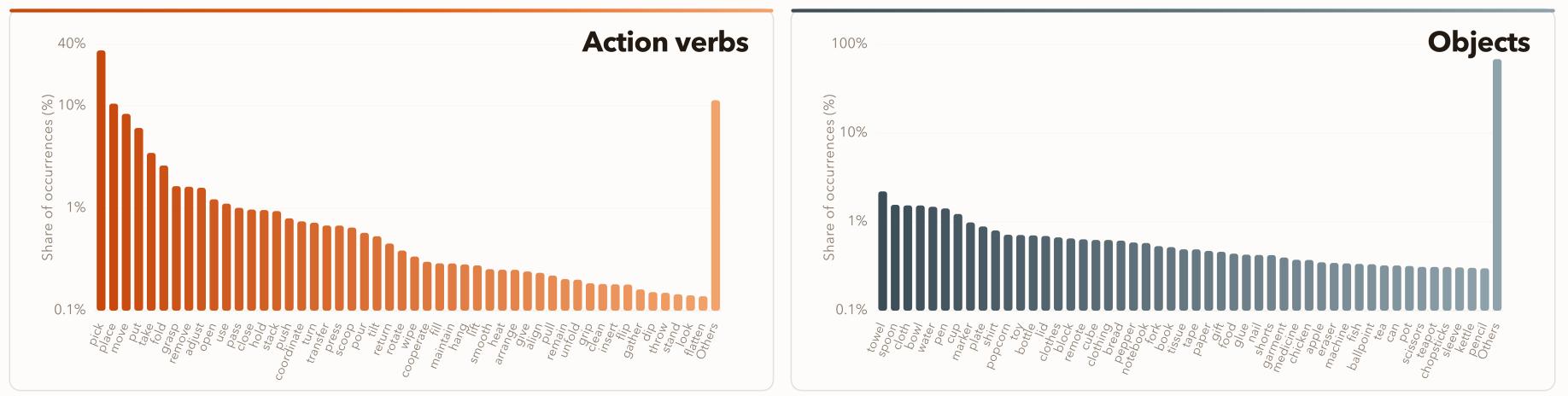
DROID is excluded from foundation pretraining but used subsequently for its evaluation. Figure 4 shows long-tailed concepts dominated by picking/placing and household objects; occurrence frequencies are not a measured task-competence distribution.

Original selectable source block
Autolabeling pipeline.
Rule-based segmentation and keyframes feed multimodal APIs including Gemini3 and Doubao Seed2.0Pro for episode/subtask/action-hint labels. Foundation-model grounding plus SAM3 tracking supplies boxes/masks. Forward kinematics and camera projection supply 2 D end-effector traces; label accuracy is not independently quantified.
Web and VQA co-training.
Generic web VQA, embodied VQA and in-house subtask/grounding/commonsense labels are mixed with actions in an action-heavy ratio. Shared cross-entropy allows all targets in one vocabulary, although exposure counts and token-length differences can change their effective optimization weights.
Chain-of-thought supervision.
Each robot example receives one of eight weighted formats; subtask text is emphasized. The listed families include task text, subtask/action hints, trajectories and bounding boxes. Standard evaluations use no CoT, except the explicit CoT probes in Section 5.6.
Implementation Details.
AdamW uses warmup, a constant phase and cosine decay with the vision tower unfrozen. Sparse multi-second image history includes the present frame and stochastic history dropout. Exact base learning rate, steps, batch size, history offsets and total compute are not supplied here; downstream settings are more specific.
5 Experiments
Evaluation separates held-out environment/object transfer after dataset adaptation, simulation fine-tuning, long-horizon mobile progress, physical fine-tuning, referring-context effects and inference-time CoT/head switching. Claims of zero-shot performance must be interpreted relative to each stated training exclusion.
5.1 DROID Environment- and Object-Level Zero-Shot Evaluation
G0.5 is post-trained on DROID before deployment. Only the evaluation room and physical object instances are excluded from both training stages. This is environment/object-level transfer, not zero-shot transfer to the DROID dataset.
5.1.1 Evaluation Setup
Robot Platform.
The platform is a 7 DoF Franka Research 3 with a Robotiq 2 F-85 gripper, desk mount, right-side global RGB camera and wrist RGB camera. Instructions and both views condition control.
Tasks.
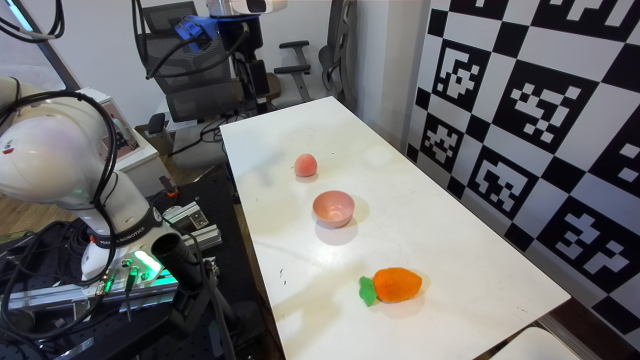
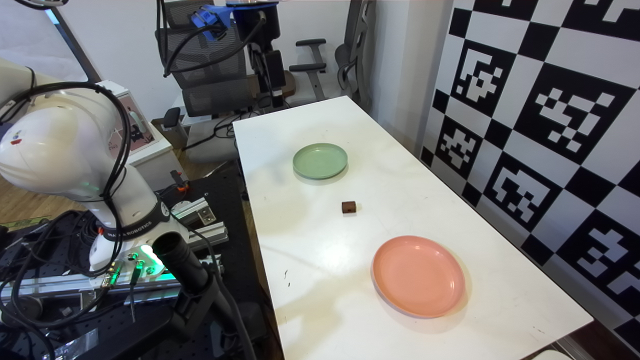
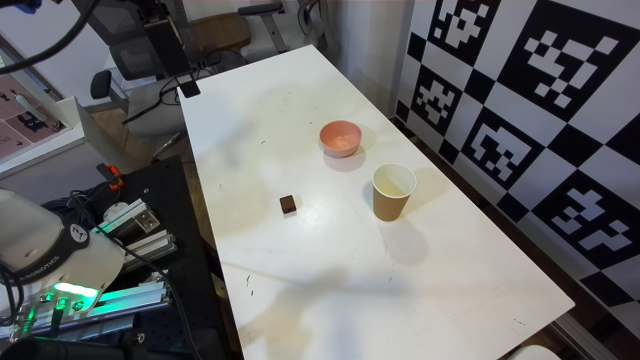
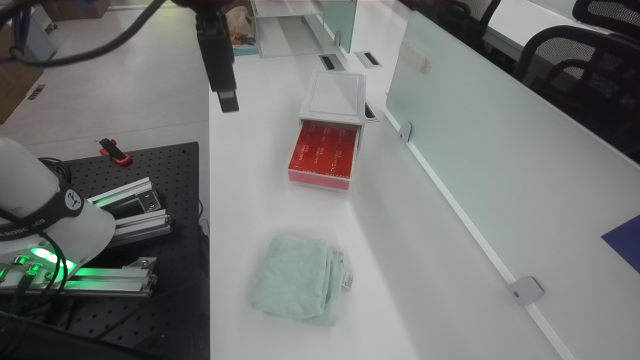
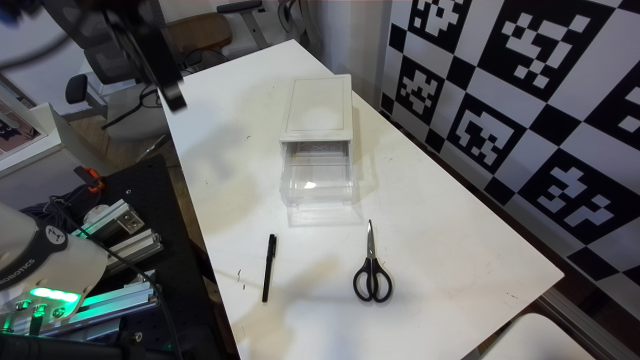
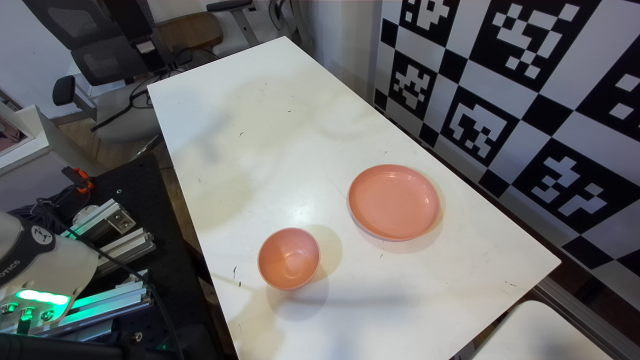
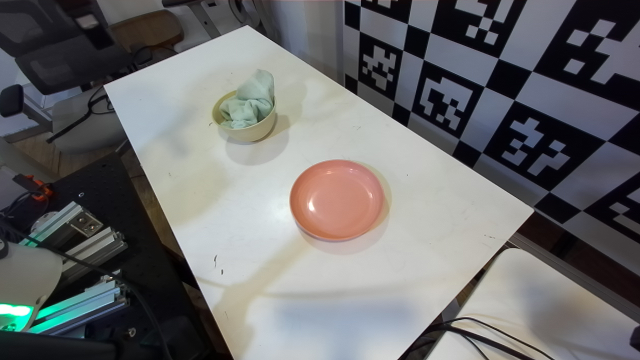
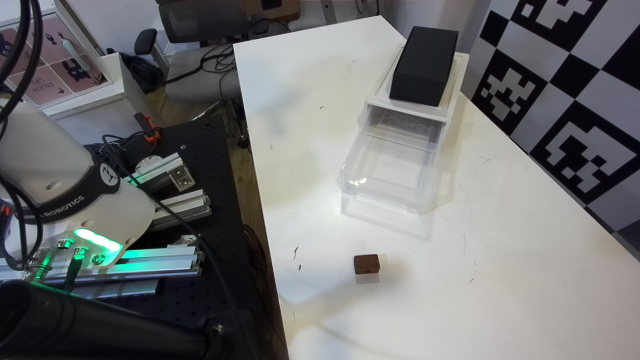
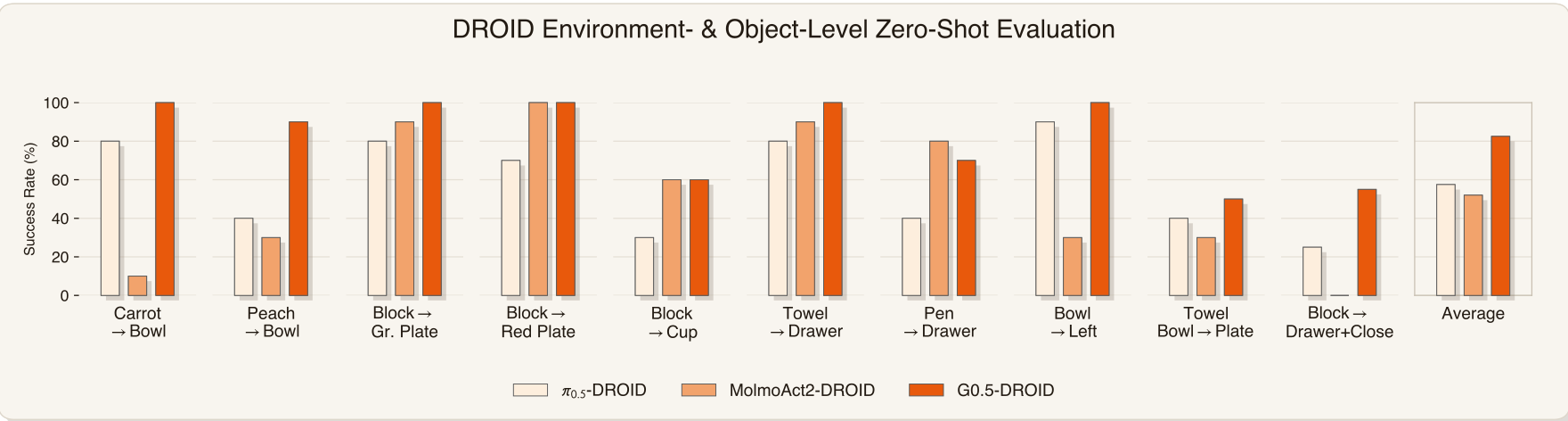
Ten tasks cover carrot/peach to bowl, block to green/red plate or cup, towel/pen to drawer, moving a bowl left, towel bowl-to-plate and block insertion followed by drawer closure. Figure 5 retains all eight scene panels and their labels.
Evaluation Protocol.
Each task has ten trials. Nine use binary completion; block-in-drawer-plus-close awards 0.5 for insertion only. Thus the reported 82.5% average includes partial credit and is not simply the fraction of 100 fully successful trials.
Baselines.
Comparators are pi0.5-DROID and MolmoAct 2-DROID, with different foundation models and preprocessing. Their common downstream dataset does not equalize pretraining data or isolate decoder architecture.
5.1.2 Quantitative Results
The reported aggregate scores are 82.5% G0.5, 57.5% pi0.5 and 52.0% MolmoAct 2:25.0 and 30.5 percentage-point gaps. Figure 6 preserves every task bar. Small per-task samples and the lack of intervals limit precision.
G0.5 -DROID vs. π 0.5 -DROID.
The main marked-scene comparison reports G0.5 ahead of pi0.5 on all ten tasks. This statement does not extend to the earlier unmarked drawer test, where G0.5 scored lower.
G0.5 -DROID vs. MolmoAct2-DROID.
MolmoAct 2 is reported to freeze near some objects or grasp before reaching them, and scores zero on the combined insertion/closure task. These qualitative failure observations complement the tested scores without establishing a general model limitation.
Effect of visual contrast on drawer localisation.
Without orange drawer markers, towel insertion scores were 90% pi0.5, 80% MolmoAct 2 and 60% G0.5. Adding high-contrast cards raises G0.5 to 100%. The marker-assisted main result therefore depends on a visual intervention that particularly helps G0.5; semi-transparent target localization remains a weakness.
5.2 Simulation Benchmarks
5.2.1 Bridge-SimplerEnv
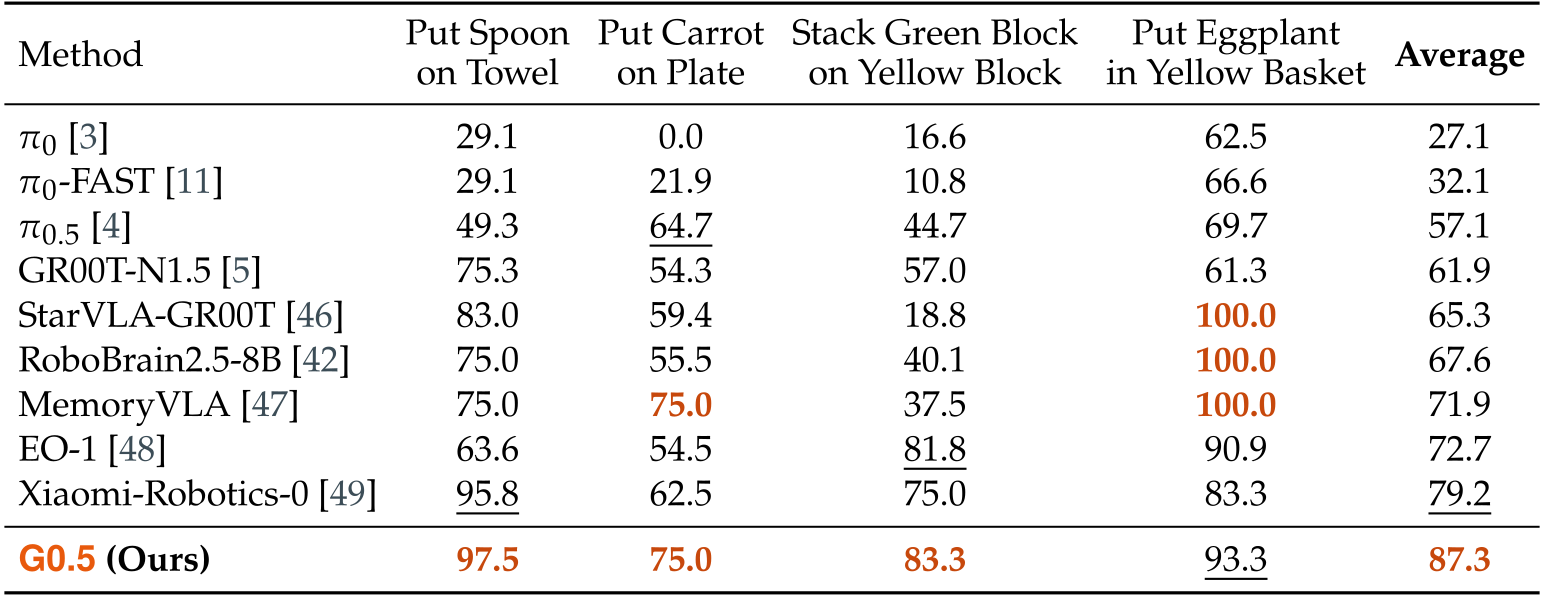
BridgeDataV2 fine-tuning uses 80 ksteps at 3×10⁻⁵ and no proprioception in either training or evaluation. Four SimplerEnv WidowX tasks score 97.5, 75.0, 83.3 and 93.3%, averaging 87.3%, with no extra simulation-domain training. Baselines are compiled from prior benchmark studies, not all rerun under an identical training budget.
Original selectable table
| Method |
|
|
|
|
Average | ||||||||
| [3] | 29.1 | 0.0 | 16.6 | 62.5 | 27.1 | ||||||||
| -FAST [11] | 29.1 | 21.9 | 10.8 | 66.6 | 32.1 | ||||||||
| [4] | 49.3 | 64.7 | 44.7 | 69.7 | 57.1 | ||||||||
| GR00T-N1.5 [5] | 75.3 | 54.3 | 57.0 | 61.3 | 61.9 | ||||||||
| StarVLA-GR00T [46] | 83.0 | 59.4 | 18.8 | 100.0 | 65.3 | ||||||||
| RoboBrain2.5-8B [42] | 75.0 | 55.5 | 40.1 | 100.0 | 67.6 | ||||||||
| MemoryVLA [47] | 75.0 | 75.0 | 37.5 | 100.0 | 71.9 | ||||||||
| EO-1 [48] | 63.6 | 54.5 | 81.8 | 90.9 | 72.7 | ||||||||
| Xiaomi-Robotics-0 [49] | 95.8 | 62.5 | 75.0 | 83.3 | 79.2 | ||||||||
| G0.5 (Ours) | 97.5 | 75.0 | 83.3 | 93.3 | 87.3 |
5.2.2 RoboTwin 2.0
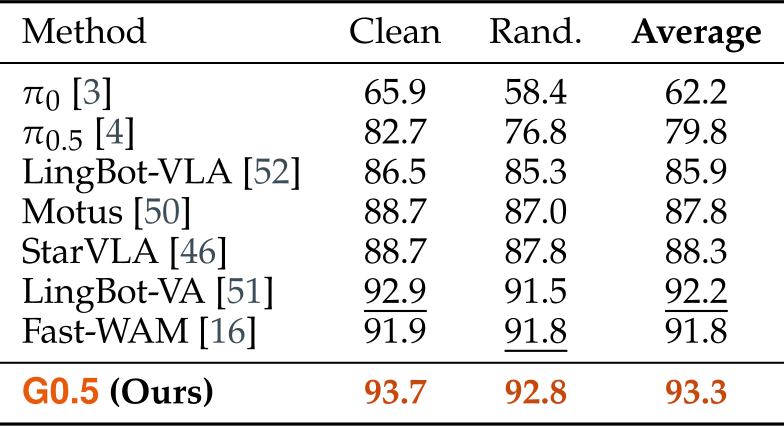
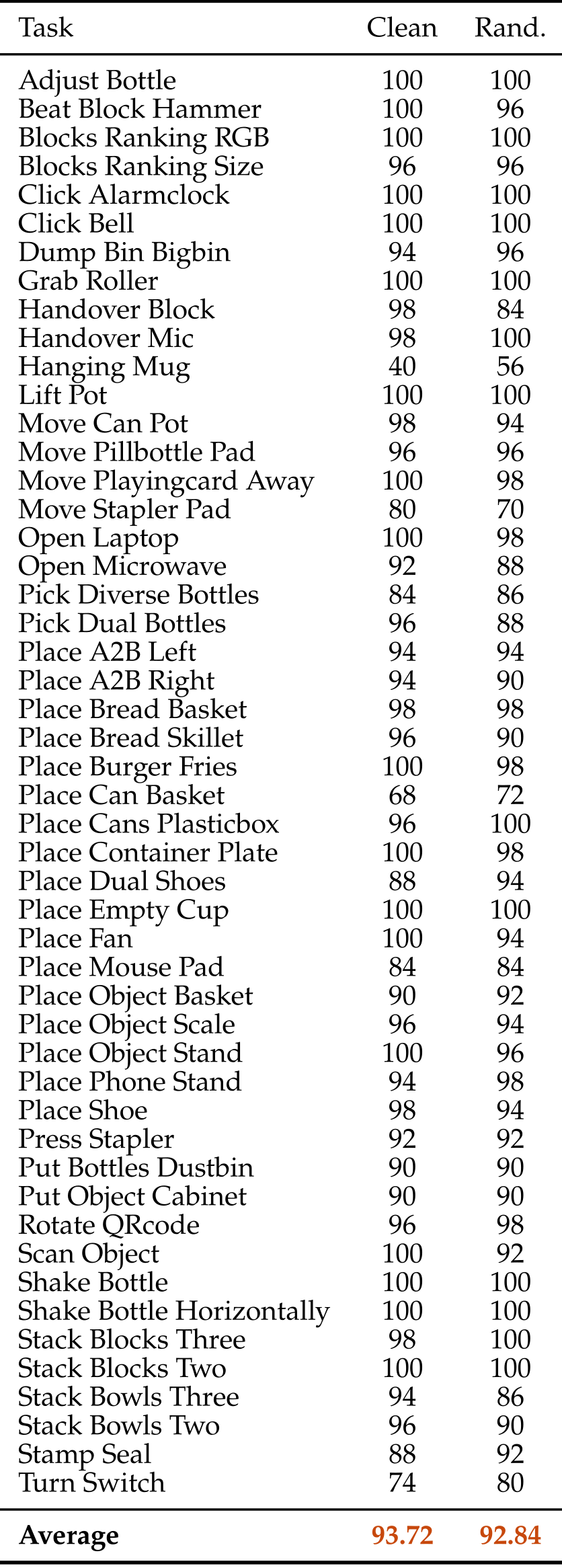
RoboTwin fine-tuning combines 2, 500 clean and 25, 000 randomized demonstrations for four epochs, learning rate 4×10⁻⁵, batch 1, 024. The protocol states 100 trials/task/setting. Clean 93.72% and randomized 92.84% average 93.28%, rounded 93.3%; all fifty task rows remain in Table 7.
5.2.3 LIBERO
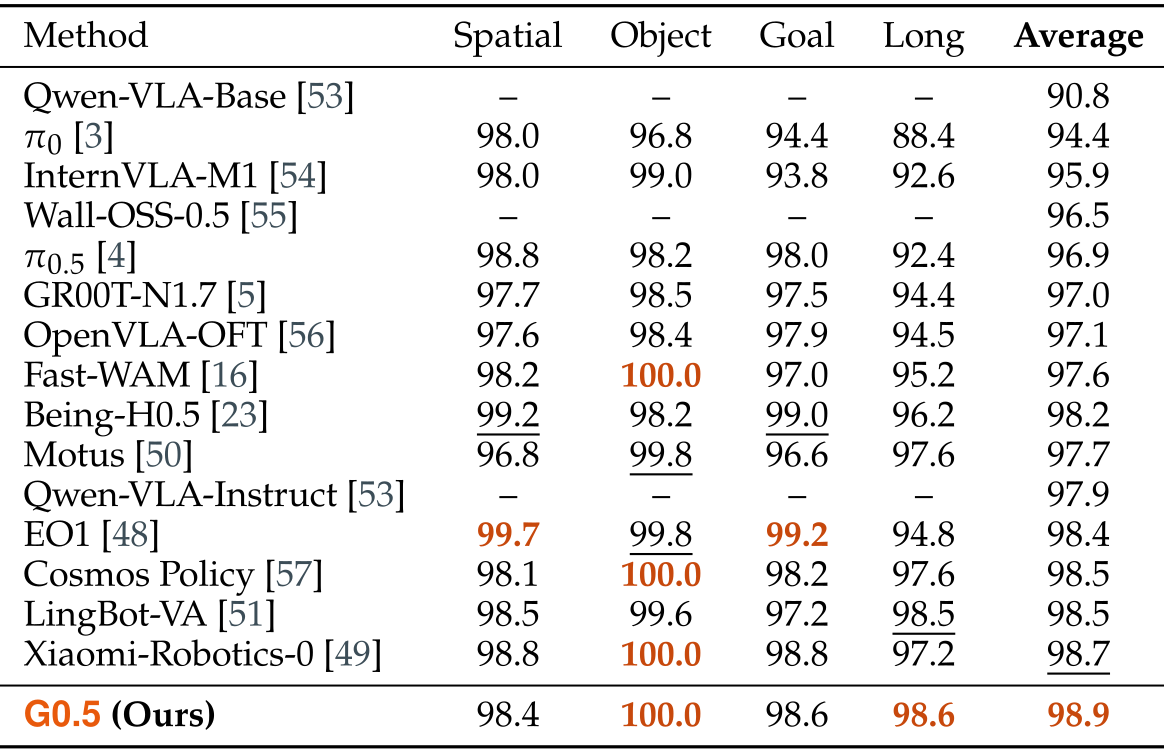
LIBERO has four ten-task suites with fifty demonstrations per task. Fine-tuning uses 100 ksteps, learning rate 10⁻⁵ and weight decay 10⁻², followed by fifty rollouts/task. Spatial 98.4, Object 100, Goal 98.6 andLong 98.6 average 98.9%. Differences near this ceiling are small and lack uncertainty estimates.
Original selectable table
| Method | Spatial | Object | Goal | Long | Average |
| Qwen-VLA-Base [53] | – | – | – | – | 90.8 |
| [3] | 98.0 | 96.8 | 94.4 | 88.4 | 94.4 |
| InternVLA-M1 [54] | 98.0 | 99.0 | 93.8 | 92.6 | 95.9 |
| Wall-OSS-0.5 [55] | – | – | – | – | 96.5 |
| [4] | 98.8 | 98.2 | 98.0 | 92.4 | 96.9 |
| GR00T-N1.7 [5] | 97.7 | 98.5 | 97.5 | 94.4 | 97.0 |
| OpenVLA-OFT [56] | 97.6 | 98.4 | 97.9 | 94.5 | 97.1 |
| Fast-WAM [16] | 98.2 | 100.0 | 97.0 | 95.2 | 97.6 |
| Being-H0.5 [23] | 99.2 | 98.2 | 99.0 | 96.2 | 98.2 |
| Motus [50] | 96.8 | 99.8 | 96.6 | 97.6 | 97.7 |
| Qwen-VLA-Instruct [53] | – | – | – | – | 97.9 |
| EO1 [48] | 99.7 | 99.8 | 99.2 | 94.8 | 98.4 |
| Cosmos Policy [57] | 98.1 | 100.0 | 98.2 | 97.6 | 98.5 |
| LingBot-VA [51] | 98.5 | 99.6 | 97.2 | 98.5 | 98.5 |
| Xiaomi-Robotics-0 [49] | 98.8 | 100.0 | 98.8 | 97.2 | 98.7 |
| G0.5 (Ours) | 98.4 | 100.0 | 98.6 | 98.6 | 98.9 |
5.3 Long-horizon Tasks
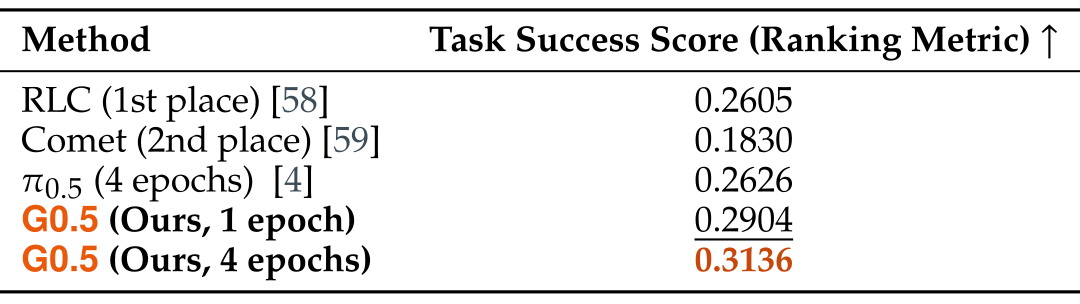
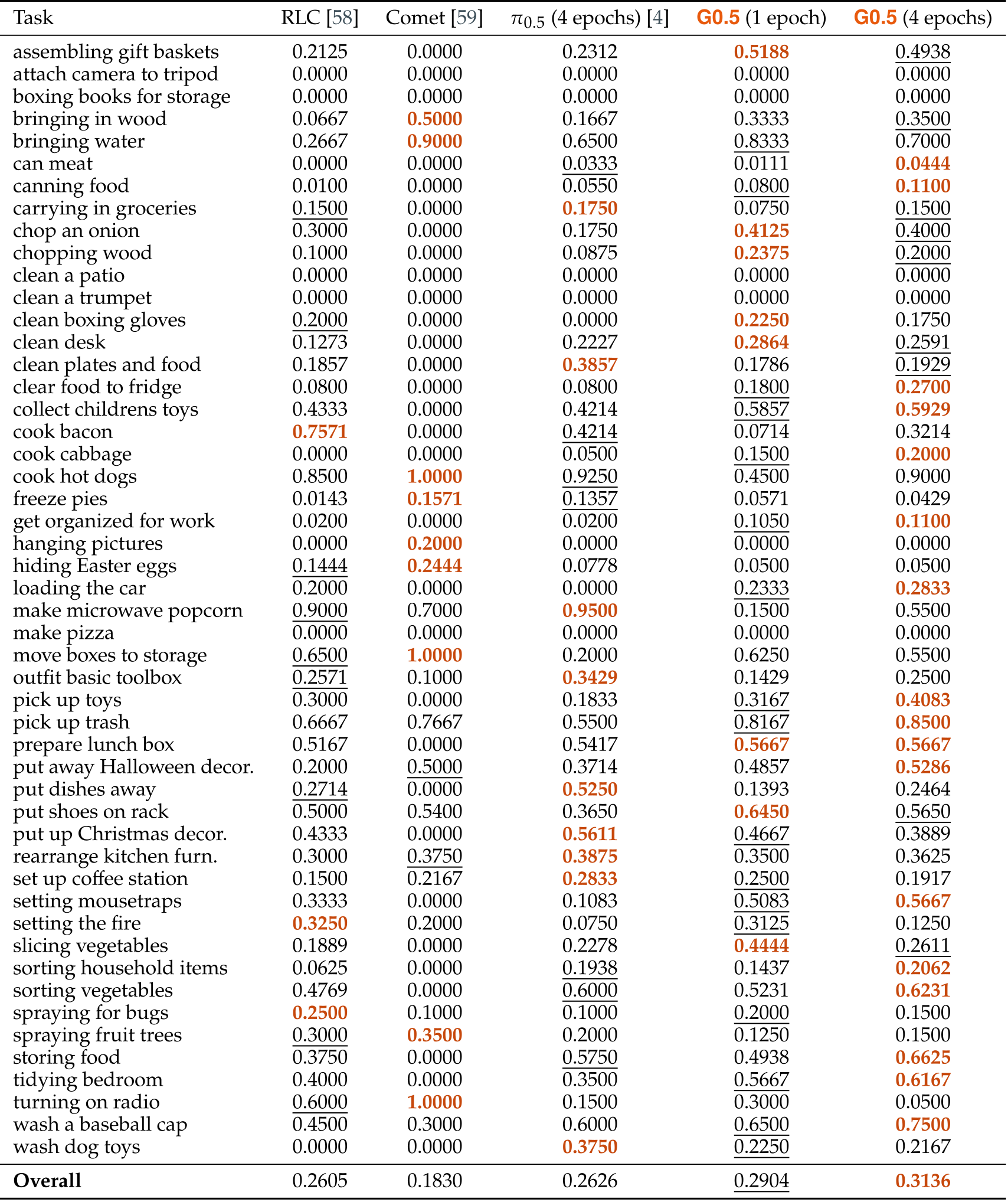
The 2025 BEHAVIOR challenge provides 10, 000 demonstrations across fifty household tasks, over 1, 100 hours, with ten evaluation instances per task. Its score is the fraction of satisfied BDDL goal predicates in the best matching goal clause, so 0.3136 means partial progress rather than 31.36% whole-episode completion.
Episodes average 6.6 minutes and can last 14 minutes, requiring R1-Pro navigation and bimanual manipulation. This is a simulator benchmark, distinct from the real six-setting evaluation.
5.3.1 Implementation Details
All tasks share one checkpoint, low-resolution RGB and single-frame post-training/evaluation, without the competition winner’s stage head. G0.5 and pi0.5 scores average two evaluation runs; RLC uses four checkpoints and public leaderboard results. These resource differences accompany comparisons.
5.3.2 Key Findings and Analysis
G0.5 scores 0.2904 after one epoch and 0.3136 after four, versus 0.2626 for pi0.5 at four epochs and 0.2605 for RLC. The relative pi0.5 gains are 10.6% and 19.4%, equivalent to 2.78 and 5.10 points on a 100 point scale. The headline 31.4% is the four-epoch result.
Matched downstream data supports transfer efficiency, but changes in architecture, foundation data and training prevent attributing the entire difference to a single component. More epochs improve the overall mean while several individual tasks regress.
Structured Action Decomposition Benefits Mobile Manipulation.
Factoring navigation and arm groups is a plausible reason for strong mobile manipulation. Examples include moving boxes,+0.35 over pi0.5, trash,+0.30, and loading a car,+0.28. No flat-tokenization ablation in this report isolates grouping as their cause.
Pre-Training Distribution Shapes Downstream Strengths.
Frequent pick/place training aligns with strengths such as mousetraps and gift baskets. Microwave popcorn remains 0.55 versus pi0.5’s 0.95; hot dogs improves 0.45→0.90 with more fine-tuning. The reported 29 wins/15 losses/6 ties across tasks describe this comparison, not universal task dominance.
Visual Memory Pre-Training Improves Long-Horizon Performance.
Temporal pretraining is proposed to improve single-frame representations of moving-camera scenes. Because there is no otherwise-matched no-memory pretraining ablation, this remains an interpretation of task patterns. Dropping final history tokens and using one-frame deployment also limits what can be inferred about long-term memory.
5.4 Real-World Fine-Tuning Evaluation
Four semantic tasks create six task-embodiment settings on R1-Lite and R1-Pro. Shared tasks test adaptation across these platforms after fine-tuning; this is not an unseen-body zero-shot experiment.
Robot Embodiments.
R1-Lite has two 6 DoF arms, 3 DoF torso and mobile base; R1-Pro has two 7 DoF arms, 4 DoF torso and mobile base. A common output representation supports both after source-specific preprocessing and task adaptation.
Baselines and Fine-Tuning Protocol.
G0.5, pi0.5andGR00T-N1.7 use the same task data and sixteenH20GPUs for the same 4–10 hour duration per setting, with aligned observations/actions/inference/control. Equal wall time is a practical budget match, not equal gradient updates or identical pretraining resources.
Evaluation Protocol.
Fifteen real episodes per setting are interleaved across models. Full-task success is separate from a stage-based process score. The text promises detailed stage scoring in the appendix, but this 32 page version’s appendix contains only BEHAVIOR/RoboTwin tables; process-score maxima and complete rubrics are not supplied.
Observation Setup.
Both robots use two wrist RGB cameras and an external global camera. This differs from the DROID two-view setup and conditions physical comparisons.
5.4.1 Task Definitions and Evaluation Metrics
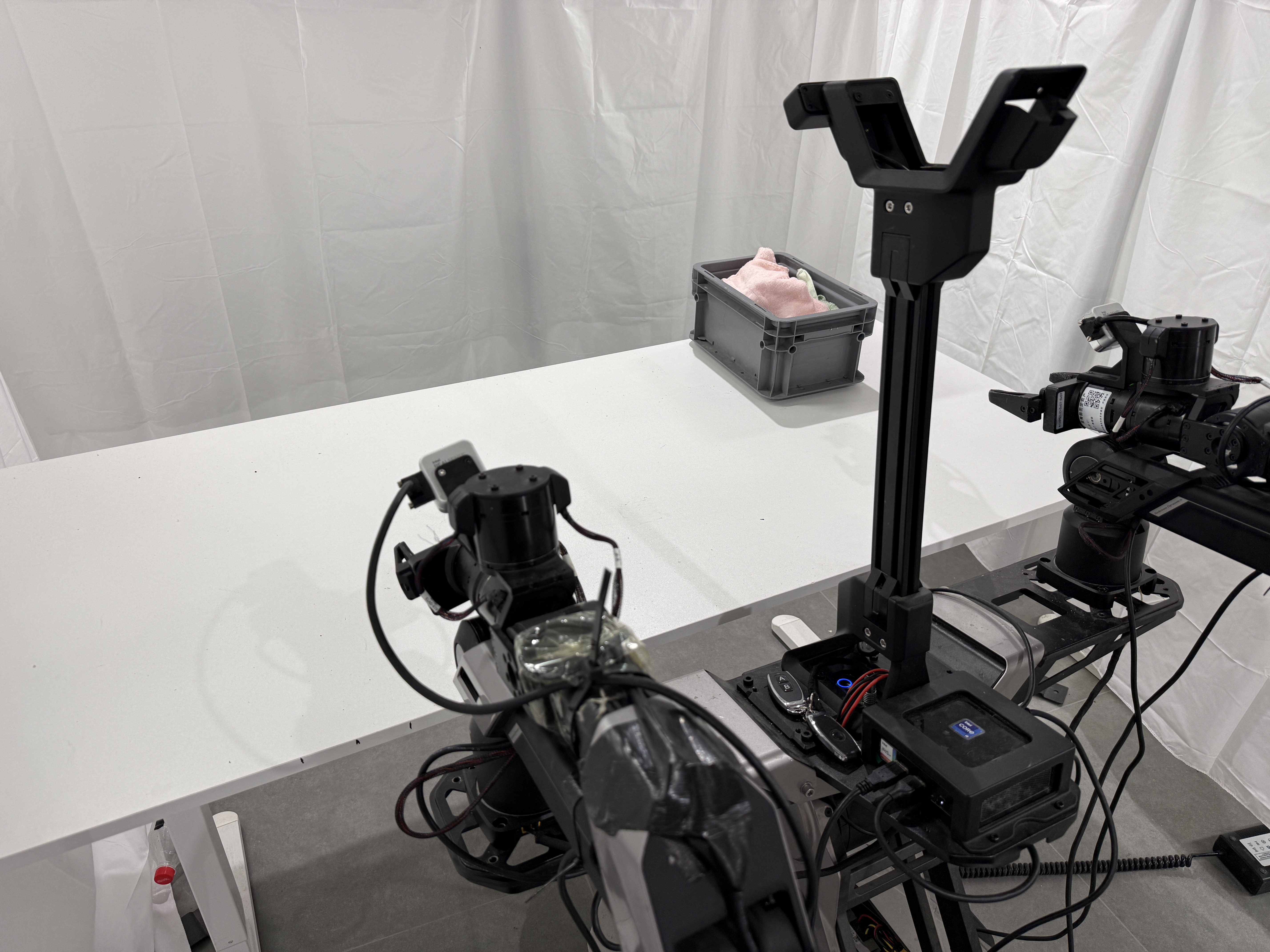
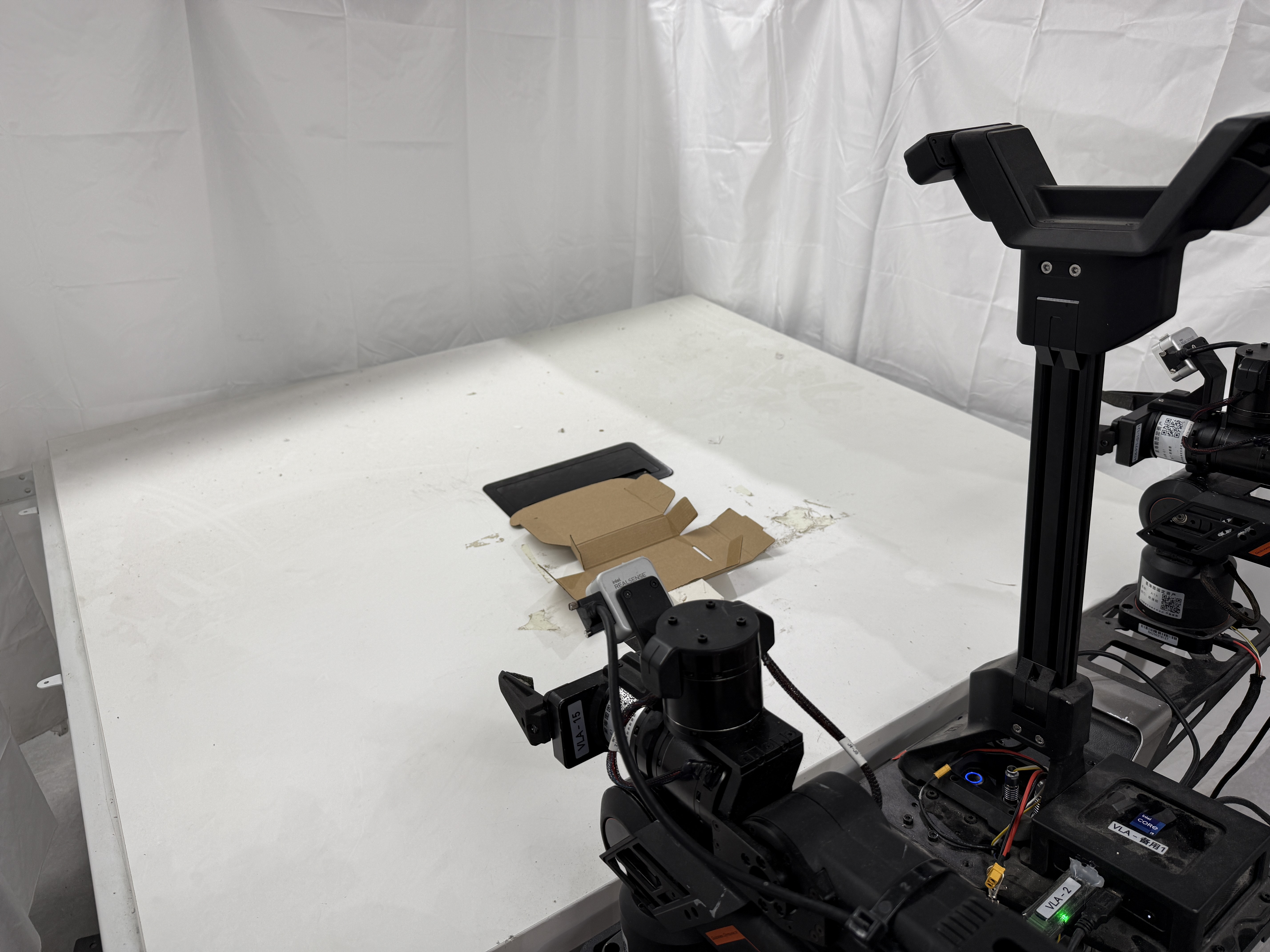
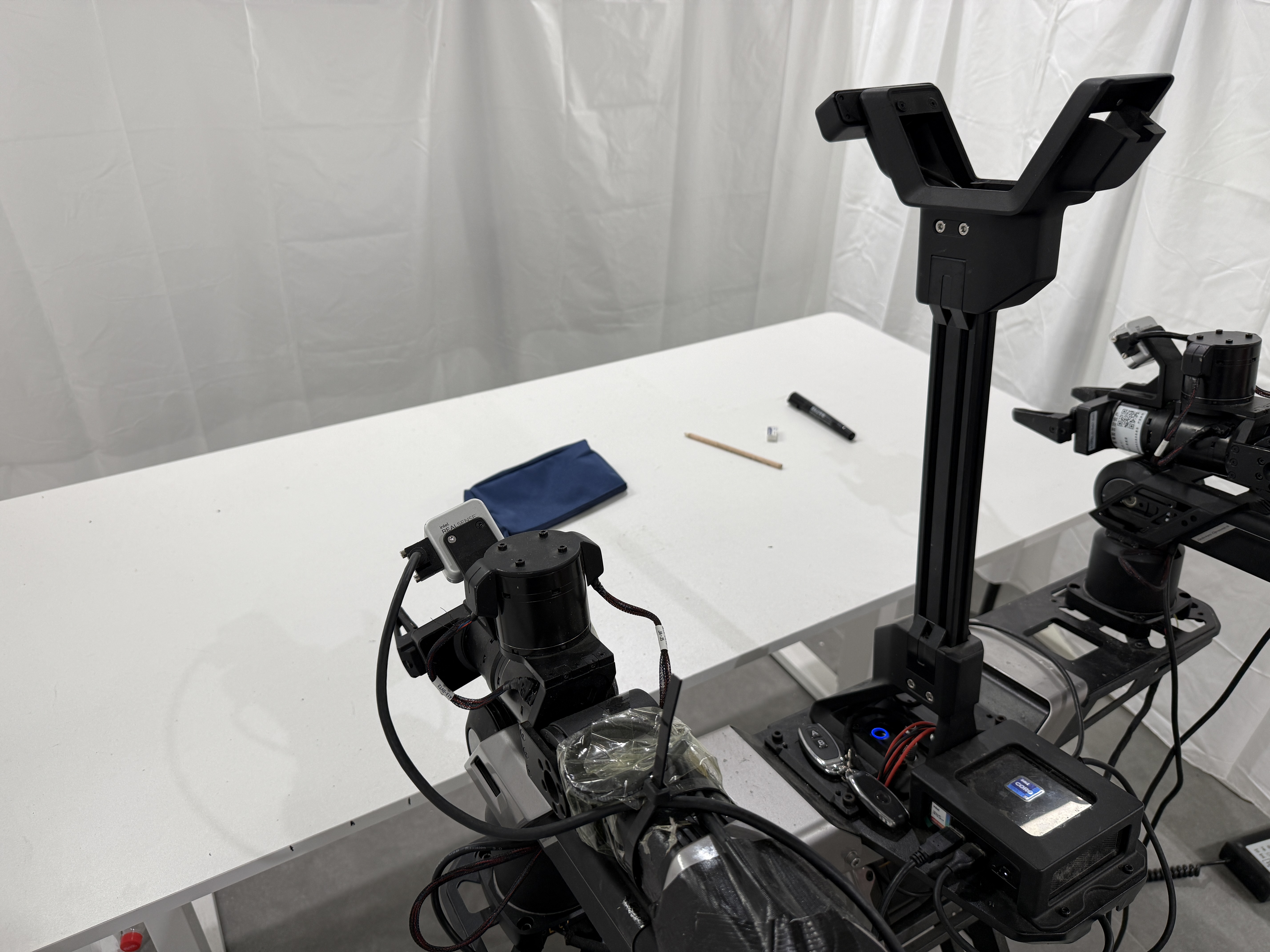
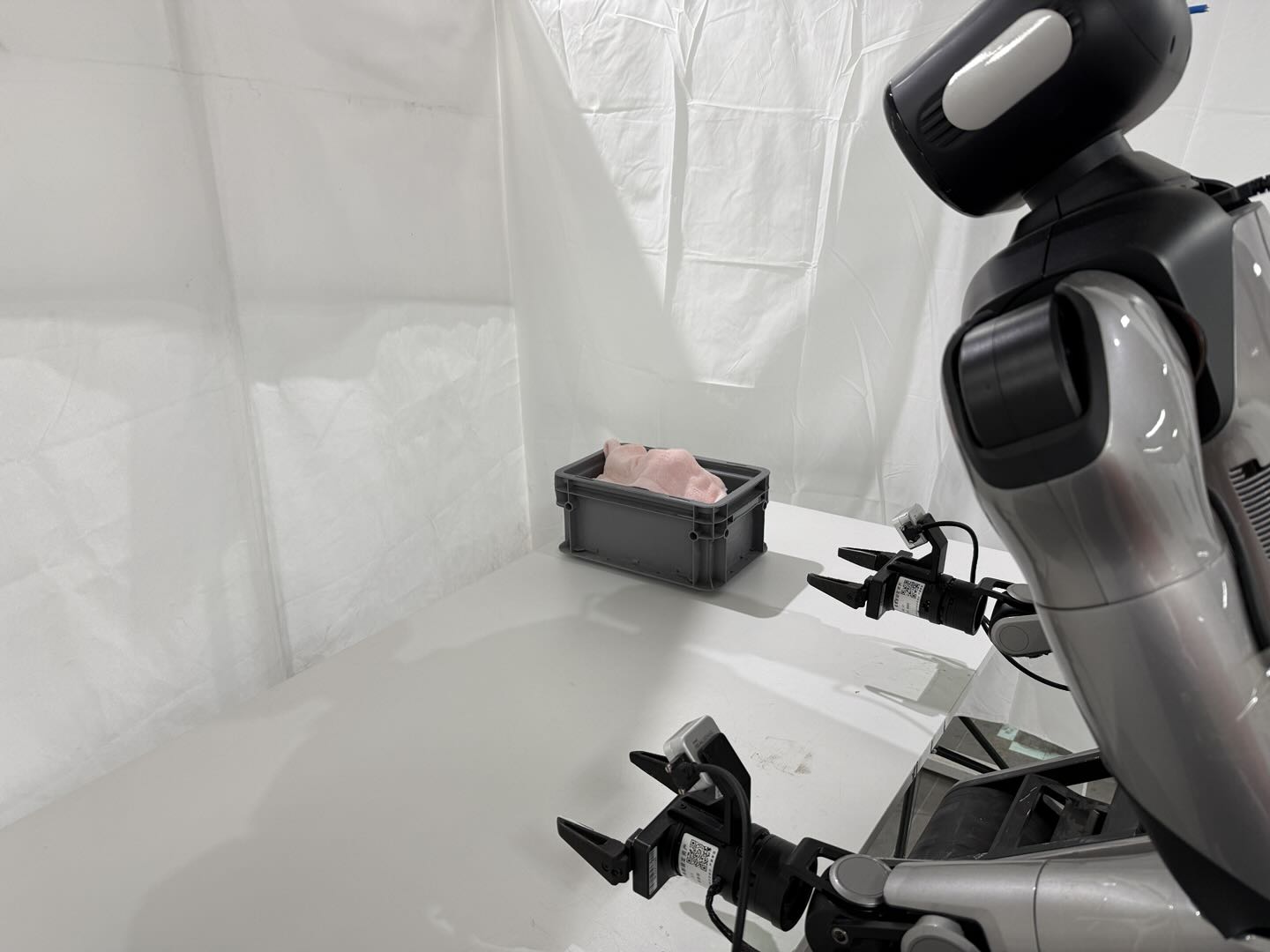
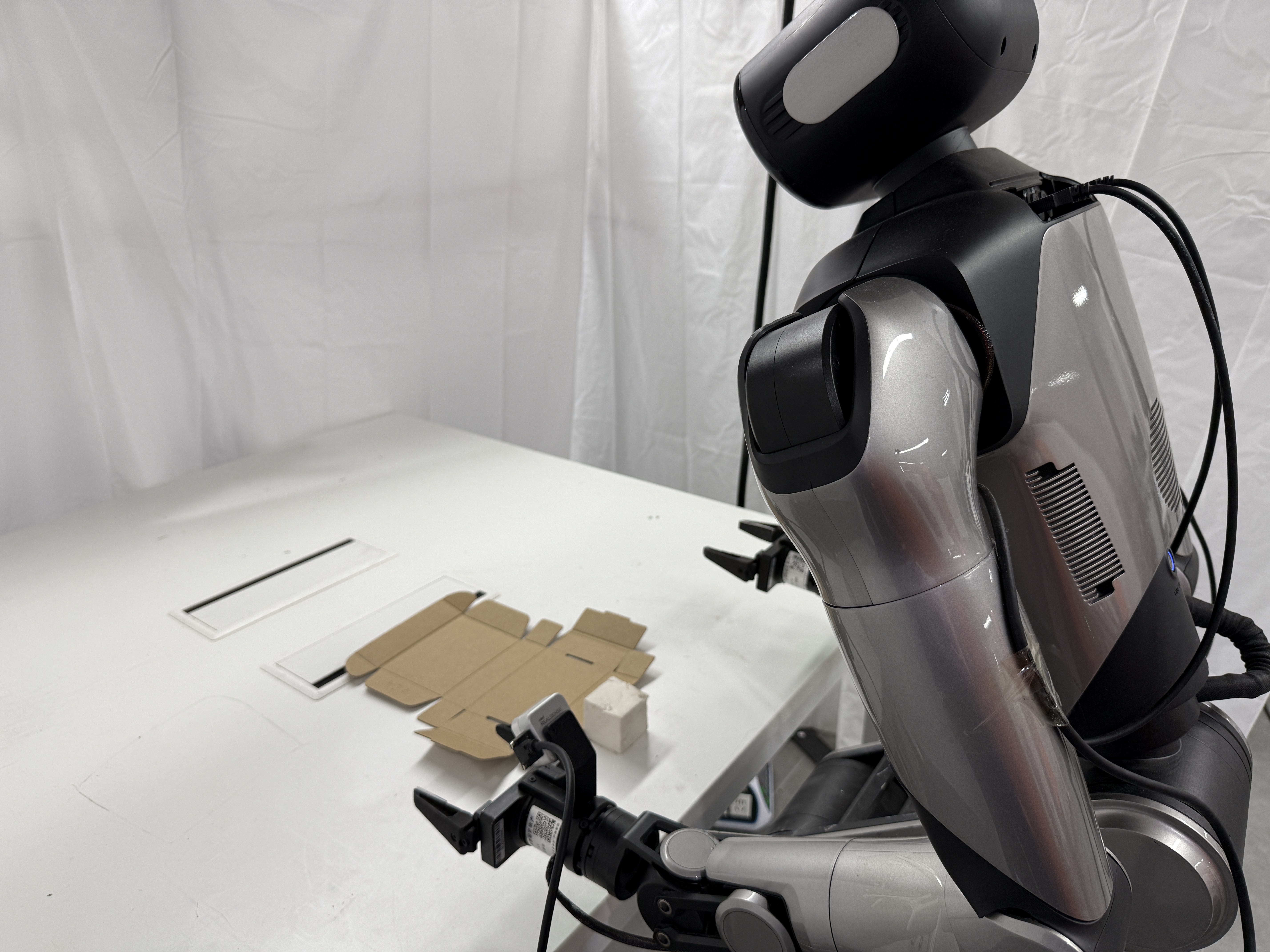
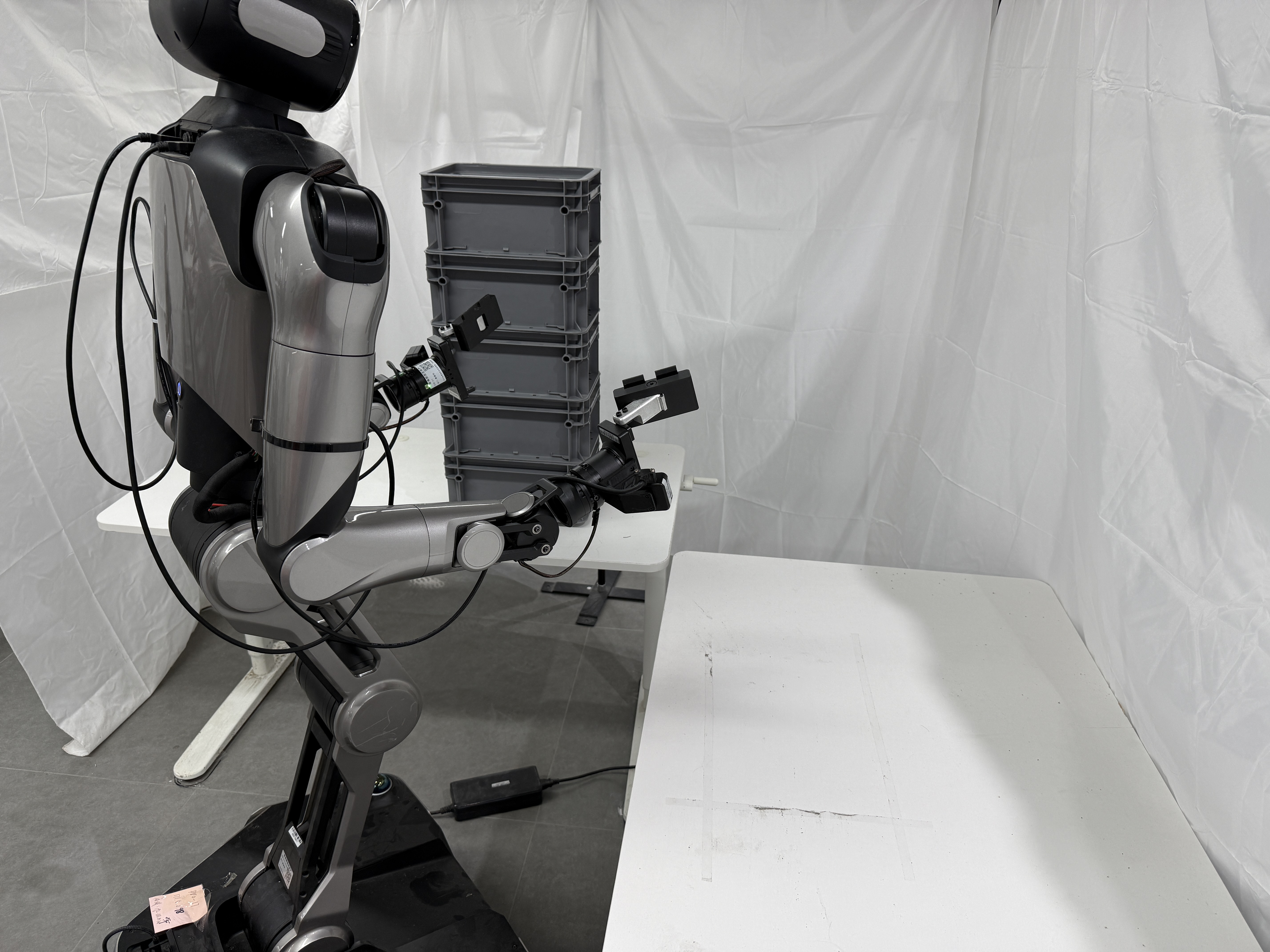
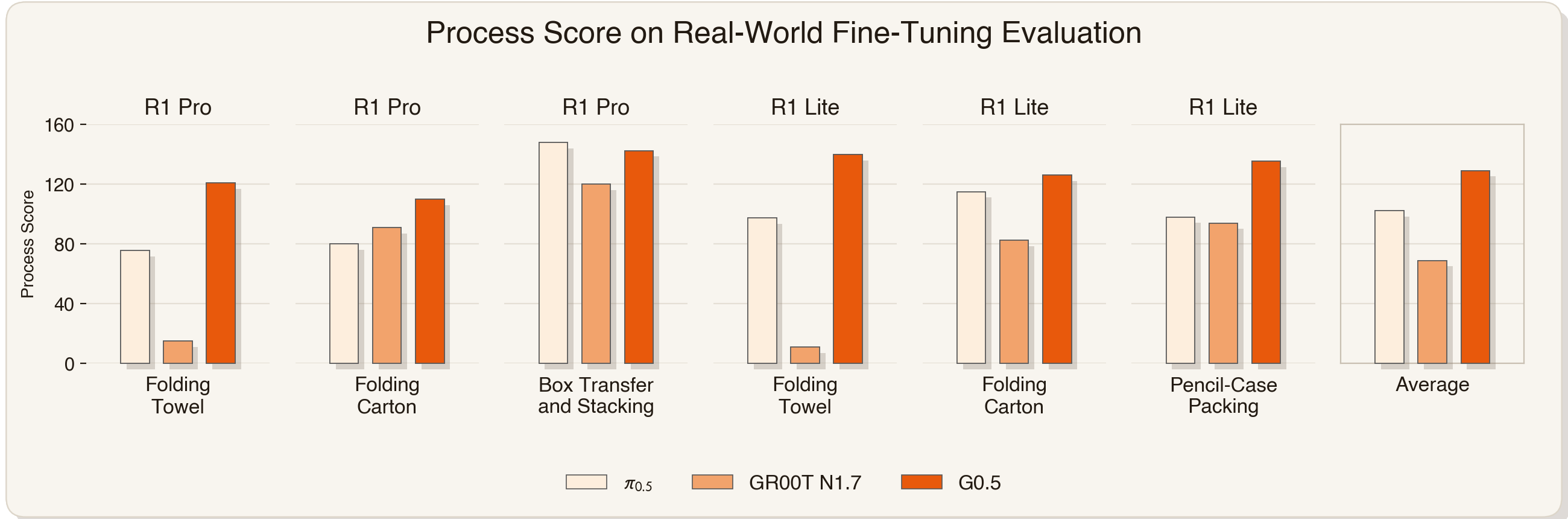
Towel folding grasps, unfolds, flattens, folds and places a deformable towel; carton folding assembles a flat carton. Both are tested on both bodies. R1-Lite additionally unzips, fills and closes a pencil case; R1-Pro transfers five boxes and aligns grooves while stacking. Figure 7 retains all six scenes.
These tasks require sequential contact and bimanual coordination. Their process scores should not be normalized or compared across task rubrics whose full definitions are absent.
5.4.2 Quantitative Results
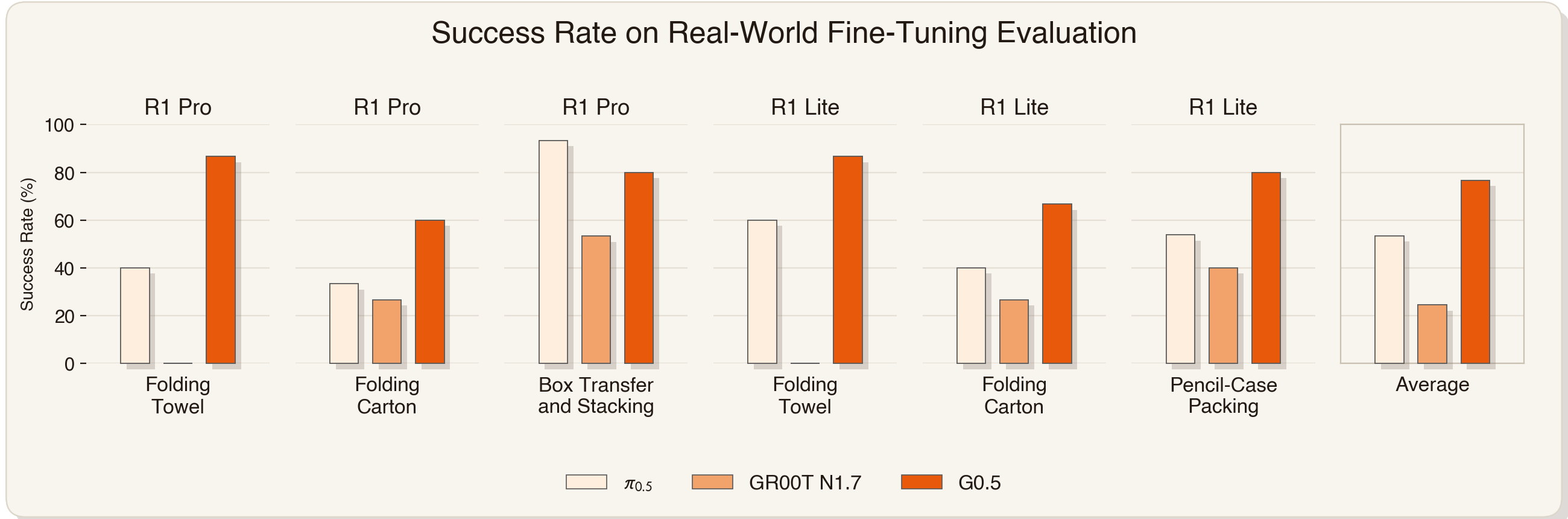
Across six settings, mean success is 76.7% G0.5, 53.3% pi0.5and 24.4% GR00T; process scores are 129.2, 105.2 and 68.9. G0.5 leads five settings, but pi0.5 leads R1-Pro stacking 93.3% versus 80.0%.
For the four shared towel/carton settings, success is 75.0% versus 43.3% and 13.3%. G0.5’s R1-Pro/R1-Lite means are 75.6/77.8%. These are small-sample empirical averages without confidence intervals.
5.5 Pick-and-Place Benchmark
PP Bench distinguishes selecting the instructed object from completing its grasp and placement. This helps localize some failures, although its language-following metric checks approaching/attempting the object and does not independently verify every container or instruction constraint.
Dataset and Post-training Setup.
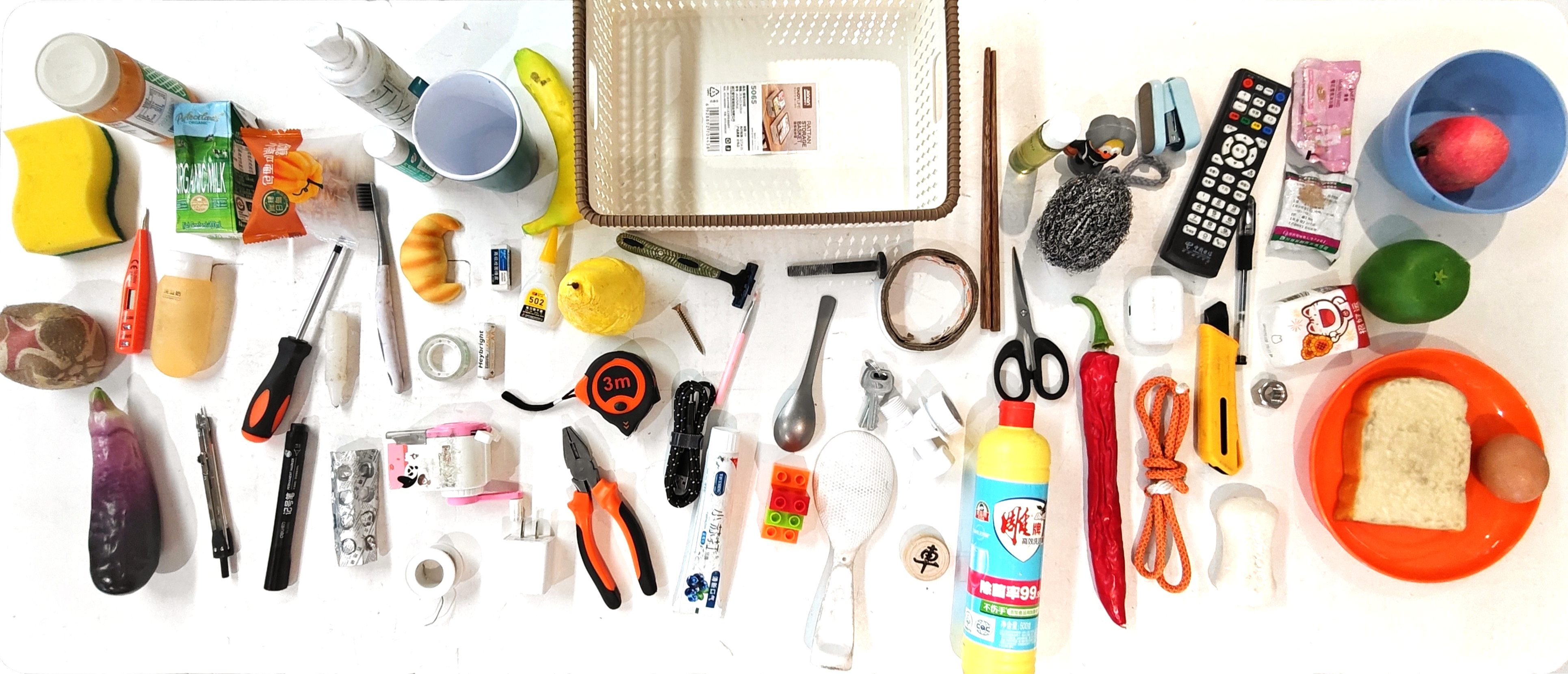
Fifty hours of R1-Lite demonstrations have 5–20 objects per scene and explicit object/container instructions. Nested 1/10/50 hour subsets train for 12/8/4 epochs. Increasing data therefore also changes total sample exposure and epoch count; it is not a constant-compute scaling experiment.
Evaluation Setting.
Each policy receives 64 paired real trials over 48 in-distribution objects and 16 categories absent from post-training, with 16 objects/containers arranged per scene. These unseen categories need not be absent from foundation training. Attempts toward the right object count for language following; successful grasp and correct-container placement count for task success.
Results and Analysis.
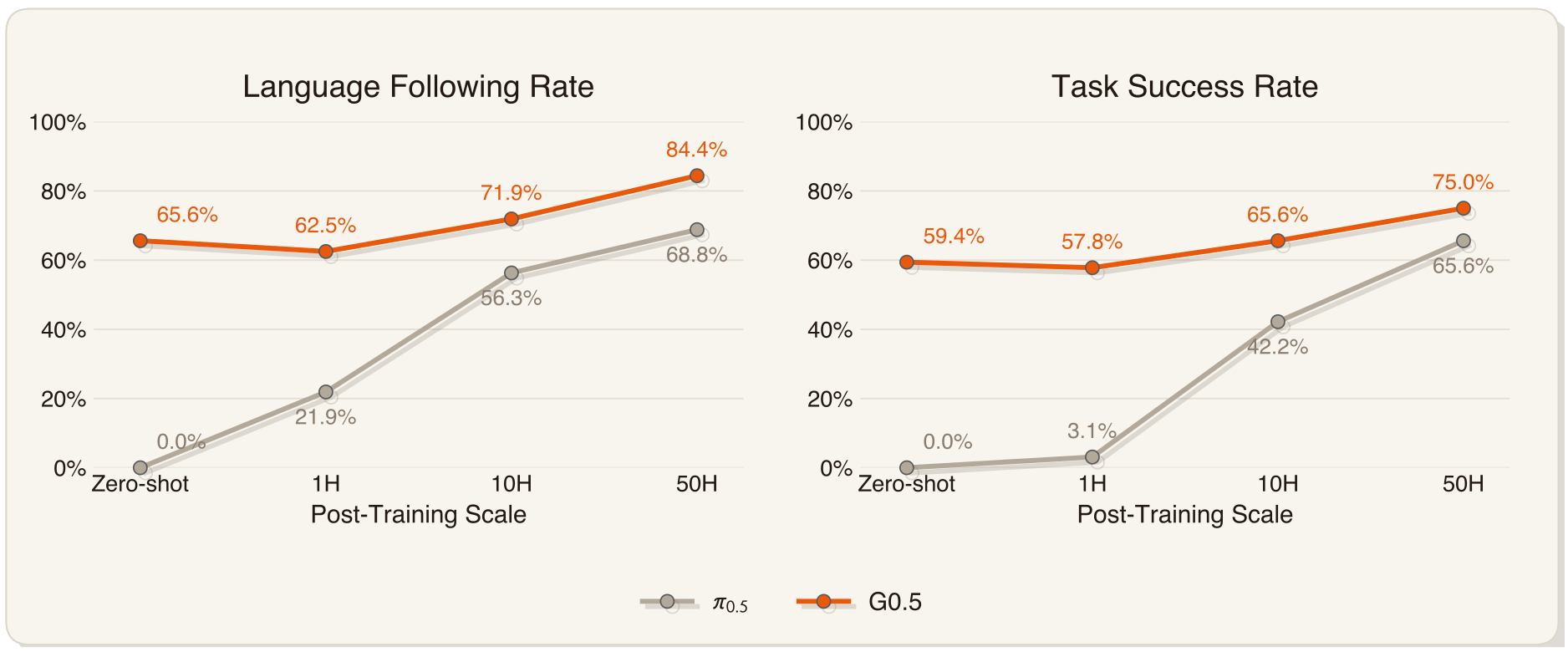
G0.5 language-following/task-success pairs are 65.6/59.4 zero-shot, 62.5/57.8 at 1 hour, 71.9/65.6 at 10 hours and 84.4/75.0 at 50 hours. Thus 1 hour fine-tuning slightly reduces both metrics. At 50 hours, pi0.5scores 68.8/65.6, leaving 15.6 and 9.4 point gaps.
Additional box coordinates yield 85.9/76.6, a small numerical increase over 84.4/75.0 despite prose saying no improvement. Adding target object/container crops gives 98.4/84.4. Those auxiliary localization inputs change available information; gains do not demonstrate language-only grounding at 98.4%.

Original selectable table
| Metric | Name-only | + Box Coord. | + Target Visual |
| Language Following Rate | 84.4% | 85.9% | 98.4% |
| Task Success Rate | 75.0% | 76.6% | 84.4% |
5.6 Zero-Shot Probe of CoT and Action Head
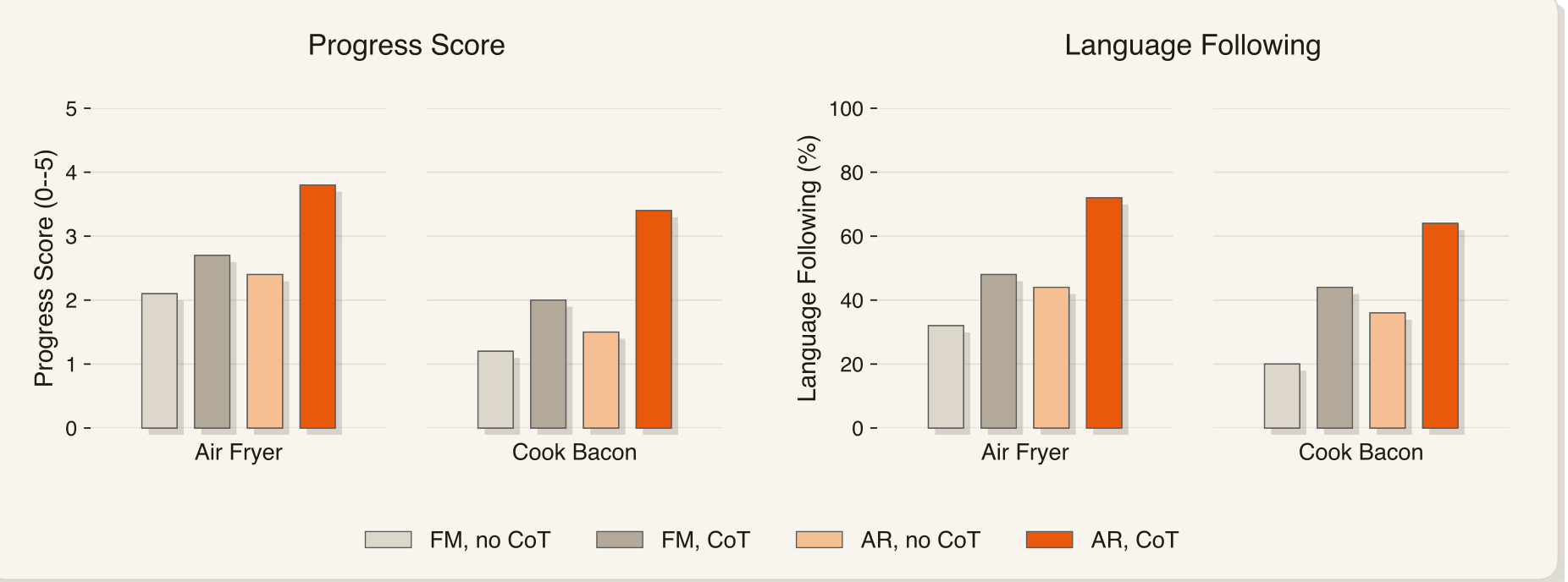
One pretrained checkpoint is switched between AR and optional FM heads and between CoT-on/off. Both heads condition on post-CoT states. PP uses 64 rollouts; Air Fryer and Cook Bacon each receive externally supplied instructions for five sequential stages and five rollouts per cell. No fine-tuning occurs within this probe.
Progress is defined as integer completed stages, 0–5. With five rollouts, a simple mean must fall in 0.2 increments, yet reported values include 2.1, 2.7 and 1.5. Additional pooling or fractional scoring is unspecified; preserve the reported averages without inventing a denominator.
Finding 1: CoT improves grounding and execution within long-horizon stage-conditioned rollouts.
CoT changes PP language following by about one trial: AR 65.6→67.2 andFM59.4→60.9. For long tasks, reported AR progress improves 2.4→3.8 AirFryer and 1.5→3.4 Bacon. This supports the tested stage-conditioned setup, not autonomous discovery or scheduling of all five stages.
Qualitative observation: instruction wording.
Adverbs, spatial qualifiers and alternative verbs sometimes changed successful rollouts in informal AR-only trials. The authors explicitly label this qualitative. No controlled wording sweep or statistical causal estimate is provided.
Finding 2: AR appears to follow the CoT more closely than the FM head.
FM progress improves 2.1→2.7 AirFryer and 1.2→2.0 Bacon, less than AR. CoT-on language following is 72 versus 48% and 64 versus 44%, respectively. Direct token attention versus pooled FM conditioning is proposed as an explanation, but not probed independently.
CoT correctness.
Human scoring finds roughly 90% correct CoT on PP, 85% AirFryer and 80% Bacon, with no systematic head difference. Separate rollouts diverge and therefore do not share identical CoT traces. Similar aggregate judged correctness does not fully control trace content or prove a decoding mechanism.
5.7 G0.5 Fine-Tunes with RL Out of the Box
One demonstration per LIBERO task initializes joint AR/FM post-training, then four tasks with comparable initial success are selected for GRPO. AR samples with temperature and exact token log-probabilities; FM uses an SDE/denoising-path approximation following RLinf.
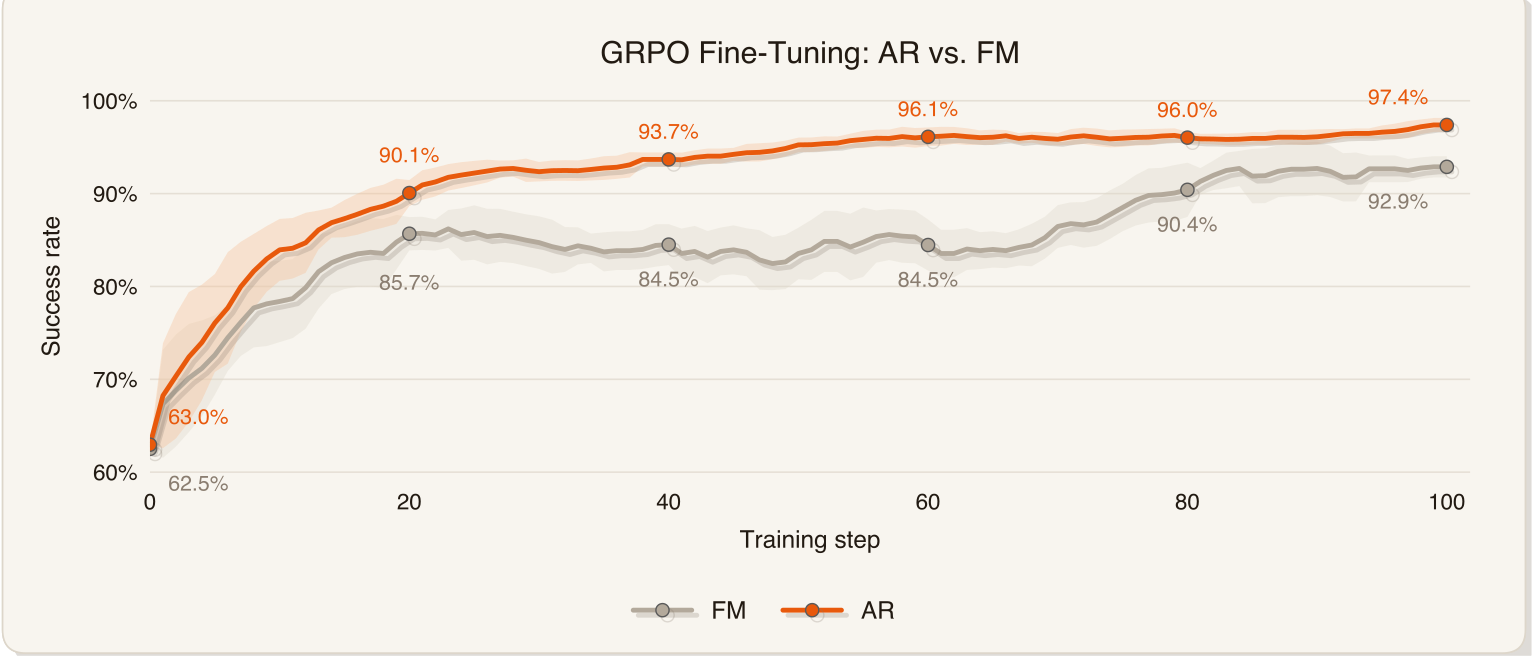
Figure 12 reports 63.0→97.4% AR and 62.5→92.9% FM by 100 steps, with mean±standard-deviation bands. The selected four tasks, seed count, reward details and full RL hyperparameters are not enumerated here. Discrete code likelihood is exact for tokens, not automatically a continuous executed-action density when decoding is many-to-one.
6 Conclusion
Results support autoregressive codes as a practical VLA interface with optional reasoning and RL fine-tuning. Component-level explanations remain hypotheses where controlled ablations are absent. Semi-transparent drawers, only seconds of history and lack of separate lower-body evaluation are acknowledged limits.
The conclusion’s broad claim that zero-shot PP language following exceeds the post-trained pi0.5 baseline needs a data-budget qualification:65.6% exceeds its 1/10 hour results, but not its 50 hour 68.8%. BEHAVIOR’s one-epoch gain is 0.2904, while the headline 0.3136 requires fourepochs.
7 Contributors
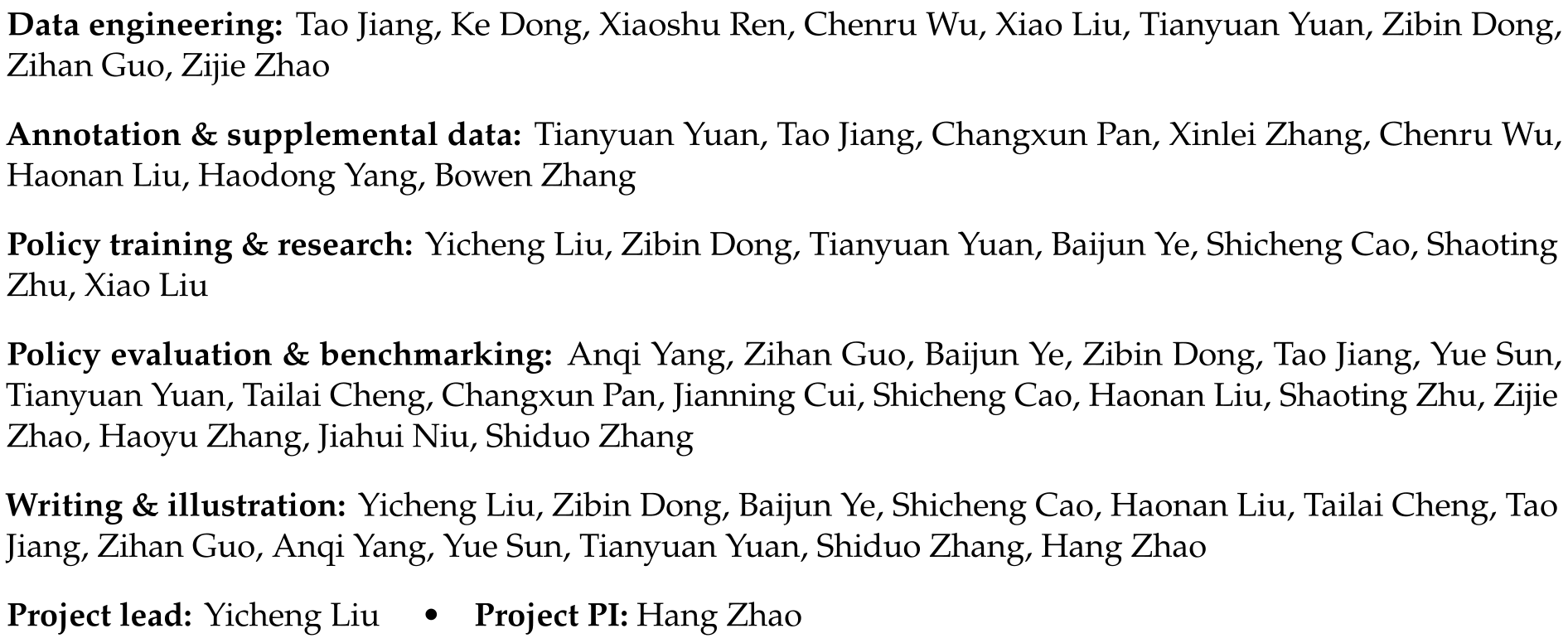
The PDF credits Galaxea Team, with Yicheng Liu as project lead and Hang Zhao as PI. Complete named contributor roles are retained below; catalog author metadata remains available for author-list membership.
Original selectable source block
Data engineering: Tao Jiang, Ke Dong, Xiaoshu Ren, Chenru Wu, Xiao Liu, Tianyuan Yuan, Zibin Dong, Zihan Guo, Zijie Zhao
Annotation & supplemental data: Tianyuan Yuan, Tao Jiang, Changxun Pan, Xinlei Zhang, Chenru Wu, Haonan Liu, Haodong Yang, Bowen Zhang
Policy training & research: Yicheng Liu, Zibin Dong, Tianyuan Yuan, Baijun Ye, Shicheng Cao, Shaoting Zhu, Xiao Liu
Policy evaluation & benchmarking: Anqi Yang, Zihan Guo, Baijun Ye, Zibin Dong, Tao Jiang, Yue Sun, Tianyuan Yuan, Tailai Cheng, Changxun Pan, Jianning Cui, Shicheng Cao, Haonan Liu, Shaoting Zhu, Zijie Zhao, Haoyu Zhang, Jiahui Niu, Shiduo Zhang
Writing & illustration: Yicheng Liu, Zibin Dong, Baijun Ye, Shicheng Cao, Haonan Liu, Tailai Cheng, Tao Jiang, Zihan Guo, Anqi Yang, Yue Sun, Tianyuan Yuan, Shiduo Zhang, Hang Zhao
Project lead: Yicheng Liu • Project PI: Hang Zhao
Appendix A Appendix / supplemental material
The appendix contains all fifty BEHAVIOR task rows and all fifty RoboTwin Clean/Randomized rows. BEHAVIOR includes exact-zero tasks for every method and regressions after longer fine-tuning; RoboTwin’s hanging-mug 40/56 and turn-switch 74/80 show weaker cases hidden by a high mean.
These are the full supplemental contents of v 1. The real-world process-score rubric promised in the main text is absent; no missing scoring rules have been invented.
Original selectable table
| Task | RLC [58] | Comet [59] | (4 epochs) [4] | G0.5 (1 epoch) | G0.5 (4 epochs) |
| assembling gift baskets | 0.2125 | 0.0000 | 0.2312 | 0.5188 | 0.4938 |
| attach camera to tripod | 0.0000 | 0.0000 | 0.0000 | 0.0000 | 0.0000 |
| boxing books for storage | 0.0000 | 0.0000 | 0.0000 | 0.0000 | 0.0000 |
| bringing in wood | 0.0667 | 0.5000 | 0.1667 | 0.3333 | 0.3500 |
| bringing water | 0.2667 | 0.9000 | 0.6500 | 0.8333 | 0.7000 |
| can meat | 0.0000 | 0.0000 | 0.0333 | 0.0111 | 0.0444 |
| canning food | 0.0100 | 0.0000 | 0.0550 | 0.0800 | 0.1100 |
| carrying in groceries | 0.1500 | 0.0000 | 0.1750 | 0.0750 | 0.1500 |
| chop an onion | 0.3000 | 0.0000 | 0.1750 | 0.4125 | 0.4000 |
| chopping wood | 0.1000 | 0.0000 | 0.0875 | 0.2375 | 0.2000 |
| clean a patio | 0.0000 | 0.0000 | 0.0000 | 0.0000 | 0.0000 |
| clean a trumpet | 0.0000 | 0.0000 | 0.0000 | 0.0000 | 0.0000 |
| clean boxing gloves | 0.2000 | 0.0000 | 0.0000 | 0.2250 | 0.1750 |
| clean desk | 0.1273 | 0.0000 | 0.2227 | 0.2864 | 0.2591 |
| clean plates and food | 0.1857 | 0.0000 | 0.3857 | 0.1786 | 0.1929 |
| clear food to fridge | 0.0800 | 0.0000 | 0.0800 | 0.1800 | 0.2700 |
| collect childrens toys | 0.4333 | 0.0000 | 0.4214 | 0.5857 | 0.5929 |
| cook bacon | 0.7571 | 0.0000 | 0.4214 | 0.0714 | 0.3214 |
| cook cabbage | 0.0000 | 0.0000 | 0.0500 | 0.1500 | 0.2000 |
| cook hot dogs | 0.8500 | 1.0000 | 0.9250 | 0.4500 | 0.9000 |
| freeze pies | 0.0143 | 0.1571 | 0.1357 | 0.0571 | 0.0429 |
| get organized for work | 0.0200 | 0.0000 | 0.0200 | 0.1050 | 0.1100 |
| hanging pictures | 0.0000 | 0.2000 | 0.0000 | 0.0000 | 0.0000 |
| hiding Easter eggs | 0.1444 | 0.2444 | 0.0778 | 0.0500 | 0.0500 |
| loading the car | 0.2000 | 0.0000 | 0.0000 | 0.2333 | 0.2833 |
| make microwave popcorn | 0.9000 | 0.7000 | 0.9500 | 0.1500 | 0.5500 |
| make pizza | 0.0000 | 0.0000 | 0.0000 | 0.0000 | 0.0000 |
| move boxes to storage | 0.6500 | 1.0000 | 0.2000 | 0.6250 | 0.5500 |
| outfit basic toolbox | 0.2571 | 0.1000 | 0.3429 | 0.1429 | 0.2500 |
| pick up toys | 0.3000 | 0.0000 | 0.1833 | 0.3167 | 0.4083 |
| pick up trash | 0.6667 | 0.7667 | 0.5500 | 0.8167 | 0.8500 |
| prepare lunch box | 0.5167 | 0.0000 | 0.5417 | 0.5667 | 0.5667 |
| put away Halloween decor. | 0.2000 | 0.5000 | 0.3714 | 0.4857 | 0.5286 |
| put dishes away | 0.2714 | 0.0000 | 0.5250 | 0.1393 | 0.2464 |
| put shoes on rack | 0.5000 | 0.5400 | 0.3650 | 0.6450 | 0.5650 |
| put up Christmas decor. | 0.4333 | 0.0000 | 0.5611 | 0.4667 | 0.3889 |
| rearrange kitchen furn. | 0.3000 | 0.3750 | 0.3875 | 0.3500 | 0.3625 |
| set up coffee station | 0.1500 | 0.2167 | 0.2833 | 0.2500 | 0.1917 |
| setting mousetraps | 0.3333 | 0.0000 | 0.1083 | 0.5083 | 0.5667 |
| setting the fire | 0.3250 | 0.2000 | 0.0750 | 0.3125 | 0.1250 |
| slicing vegetables | 0.1889 | 0.0000 | 0.2278 | 0.4444 | 0.2611 |
| sorting household items | 0.0625 | 0.0000 | 0.1938 | 0.1437 | 0.2062 |
| sorting vegetables | 0.4769 | 0.0000 | 0.6000 | 0.5231 | 0.6231 |
| spraying for bugs | 0.2500 | 0.1000 | 0.1000 | 0.2000 | 0.1500 |
| spraying fruit trees | 0.3000 | 0.3500 | 0.2000 | 0.1250 | 0.1500 |
| storing food | 0.3750 | 0.0000 | 0.5750 | 0.4938 | 0.6625 |
| tidying bedroom | 0.4000 | 0.0000 | 0.3500 | 0.5667 | 0.6167 |
| turning on radio | 0.6000 | 1.0000 | 0.1500 | 0.3000 | 0.0500 |
| wash a baseball cap | 0.4500 | 0.3000 | 0.6000 | 0.6500 | 0.7500 |
| wash dog toys | 0.0000 | 0.0000 | 0.3750 | 0.2250 | 0.2167 |
| Overall | 0.2605 | 0.1830 | 0.2626 | 0.2904 | 0.3136 |
Original selectable table
| Task | Clean | Rand. |
| Adjust Bottle | 100 | 100 |
| Beat Block Hammer | 100 | 96 |
| Blocks Ranking RGB | 100 | 100 |
| Blocks Ranking Size | 96 | 96 |
| Click Alarmclock | 100 | 100 |
| Click Bell | 100 | 100 |
| Dump Bin Bigbin | 94 | 96 |
| Grab Roller | 100 | 100 |
| Handover Block | 98 | 84 |
| Handover Mic | 98 | 100 |
| Hanging Mug | 40 | 56 |
| Lift Pot | 100 | 100 |
| Move Can Pot | 98 | 94 |
| Move Pillbottle Pad | 96 | 96 |
| Move Playingcard Away | 100 | 98 |
| Move Stapler Pad | 80 | 70 |
| Open Laptop | 100 | 98 |
| Open Microwave | 92 | 88 |
| Pick Diverse Bottles | 84 | 86 |
| Pick Dual Bottles | 96 | 88 |
| Place A2B Left | 94 | 94 |
| Place A2B Right | 94 | 90 |
| Place Bread Basket | 98 | 98 |
| Place Bread Skillet | 96 | 90 |
| Place Burger Fries | 100 | 98 |
| Place Can Basket | 68 | 72 |
| Place Cans Plasticbox | 96 | 100 |
| Place Container Plate | 100 | 98 |
| Place Dual Shoes | 88 | 94 |
| Place Empty Cup | 100 | 100 |
| Place Fan | 100 | 94 |
| Place Mouse Pad | 84 | 84 |
| Place Object Basket | 90 | 92 |
| Place Object Scale | 96 | 94 |
| Place Object Stand | 100 | 96 |
| Place Phone Stand | 94 | 98 |
| Place Shoe | 98 | 94 |
| Press Stapler | 92 | 92 |
| Put Bottles Dustbin | 90 | 90 |
| Put Object Cabinet | 90 | 90 |
| Rotate QRcode | 96 | 98 |
| Scan Object | 100 | 92 |
| Shake Bottle | 100 | 100 |
| Shake Bottle Horizontally | 100 | 100 |
| Stack Blocks Three | 98 | 100 |
| Stack Blocks Two | 100 | 100 |
| Stack Bowls Three | 94 | 86 |
| Stack Bowls Two | 96 | 90 |
| Stamp Seal | 88 | 92 |
| Turn Switch | 74 | 80 |
| Average | 93.72 | 92.84 |