Overview
This edition covers the complete nineteen-page arXiv v2 dated 10 July 2026, including all labeling, training, prompt and qualitative appendices. All eleven figures and six numbered tables are retained. Hang Zhao is the corresponding author.
At a glance
DriveMA predicts a compact driving intention before generating waypoints. Because both an expert trajectory and a generated trajectory can be mapped to motion categories, the model can be trained to make its trajectory agree with its own stated intention.
Two supervised stages establish the interface; reinforcement learning assigns decision correctness to decision tokens and trajectory/consistency rewards to planning tokens. Reported Waymo Rater Feedback Scores are 8.060 for 2B and 8.079 for 4B. These are benchmark planning results, not demonstrated on-road deployment.
1 Introduction
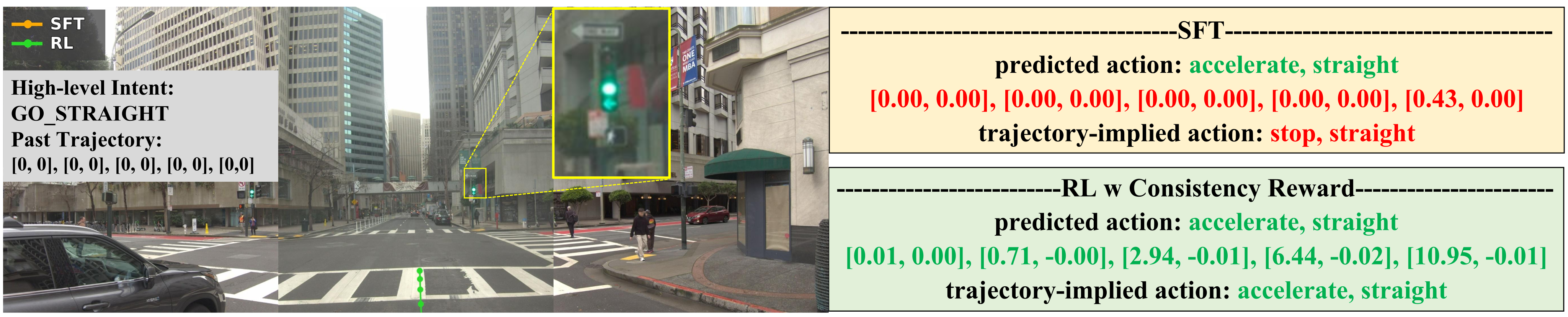
A plausible statement such as “accelerate” can accompany nearly stationary waypoints when recent motion was static. Figure 1 illustrates this language–trajectory mismatch at a green light.
The contribution is exploiting the verifiability of a simple meta-action interface through automatic labels, action-focused pretraining and separate turn-level rewards. Meta-actions themselves are not claimed as a new vocabulary. Rule-consistent motion remains narrower than correct scene understanding or safe driving.
2 Related Work
Related work supplies language interfaces and ways to align them with motion. DriveMA isolates a small maneuver interface so that a trajectory-derived check can directly supervise consistency.
2.1 Language Interfaces for Driving VLAs
DriveVLM decomposes scene understanding and planning; AutoVLA combines reasoning with action generation. NoRD reduces reasoning overhead. DriveMA focuses on the compact decision at the end of such pipelines rather than requiring a long reasoning trace.
2.2 Language-Action Alignment
SimLingo uses multitask/action-dreaming training, LinkVLA unifies language and action representations, and Drive-R1 uses extensive driving-domain supervision. DriveMA adds an explicit comparison between a predicted intention and a rule-based projection of the resulting trajectory.
3 DriveMA
Build trajectory-derived labels, teach decisions and decision-conditioned planning, then optimize the two assistant turns with different rewards. Training and verification use related but distinct action spaces.
3.1 Overview
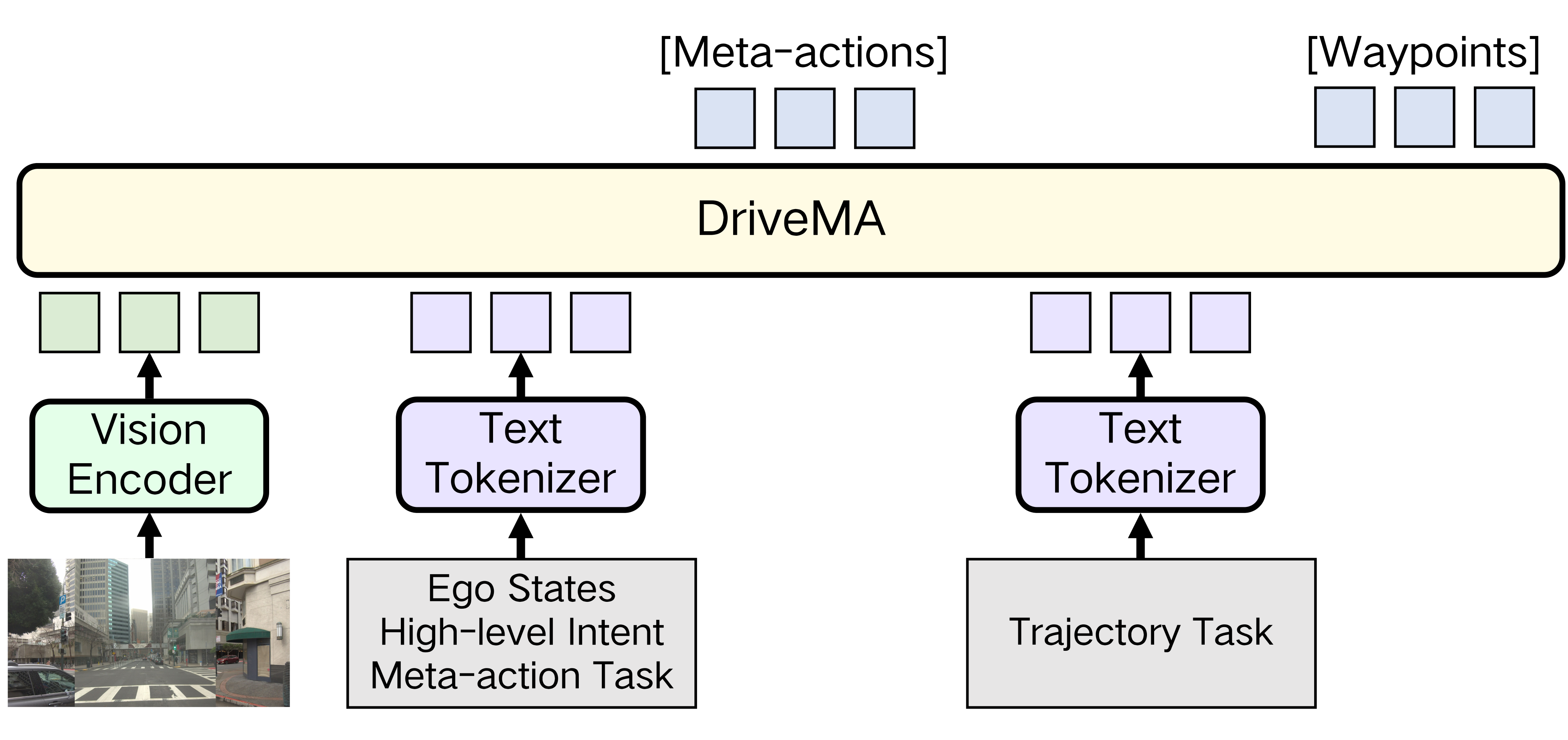
A vision encoder processes current camera views. The native text tokenizer represents ego state, route intent, meta-actions and numerical waypoint coordinates. Generation follows input → meta-action → trajectory; the second turn conditions on the first.
Equation
3.2 Chunk-Based Meta-Action Labeling
Partition an expert future trajectory into nonoverlapping chunks and label each using motion statistics and fixed, training-derived thresholds. Each label pairs longitudinal stop/decelerate/keep/accelerate with a lateral maneuver.
The default uses one chunk for the entire planning horizon. Annotation can distinguish ten lateral labels using constrained visual disambiguation, whereas the consistency reward merges visually ambiguous maneuvers into coarser groups.
Equation
3.3 Meta-Action-Guided Supervised Training
Separate driving-domain decision adaptation from full planning supervision. The first stage predicts expert meta-actions and answers action-related driving questions; the second predicts the expert meta-action followed by expert waypoints.
Action-Centric Pretraining.
Warm up input → expert meta-action without generating a trajectory. Mix in 240,000 public driving VQA examples selected for intention, action choice and risk-aware behavior. These labels provide domain knowledge in addition to trajectory-derived supervision.
Equation
Meta-Action-Conditioned Planning SFT.
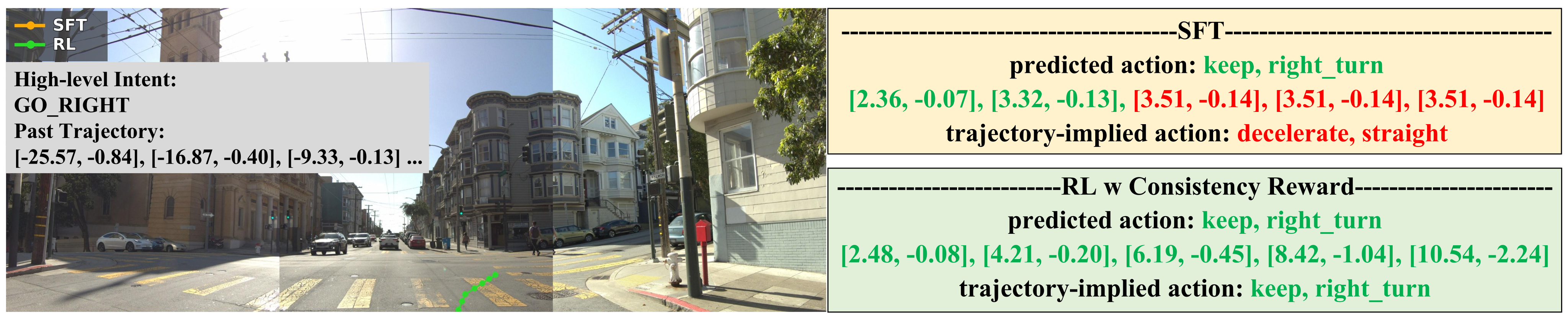
Train the two-turn target input → expert meta-action → expert trajectory. This teaches conditioning on correct decisions, while inference must condition on the model’s own potentially mistaken decision; supervised training alone does not enforce consistency.
Equation
3.4 Turn-Level Credit Assignment Reinforcement Learning
Sample multiple decision/trajectory pairs and score the turns separately. Dense here means rewards specific to the two turns, rather than a separate environment reward at every waypoint.
Multi-Turn Rollout.
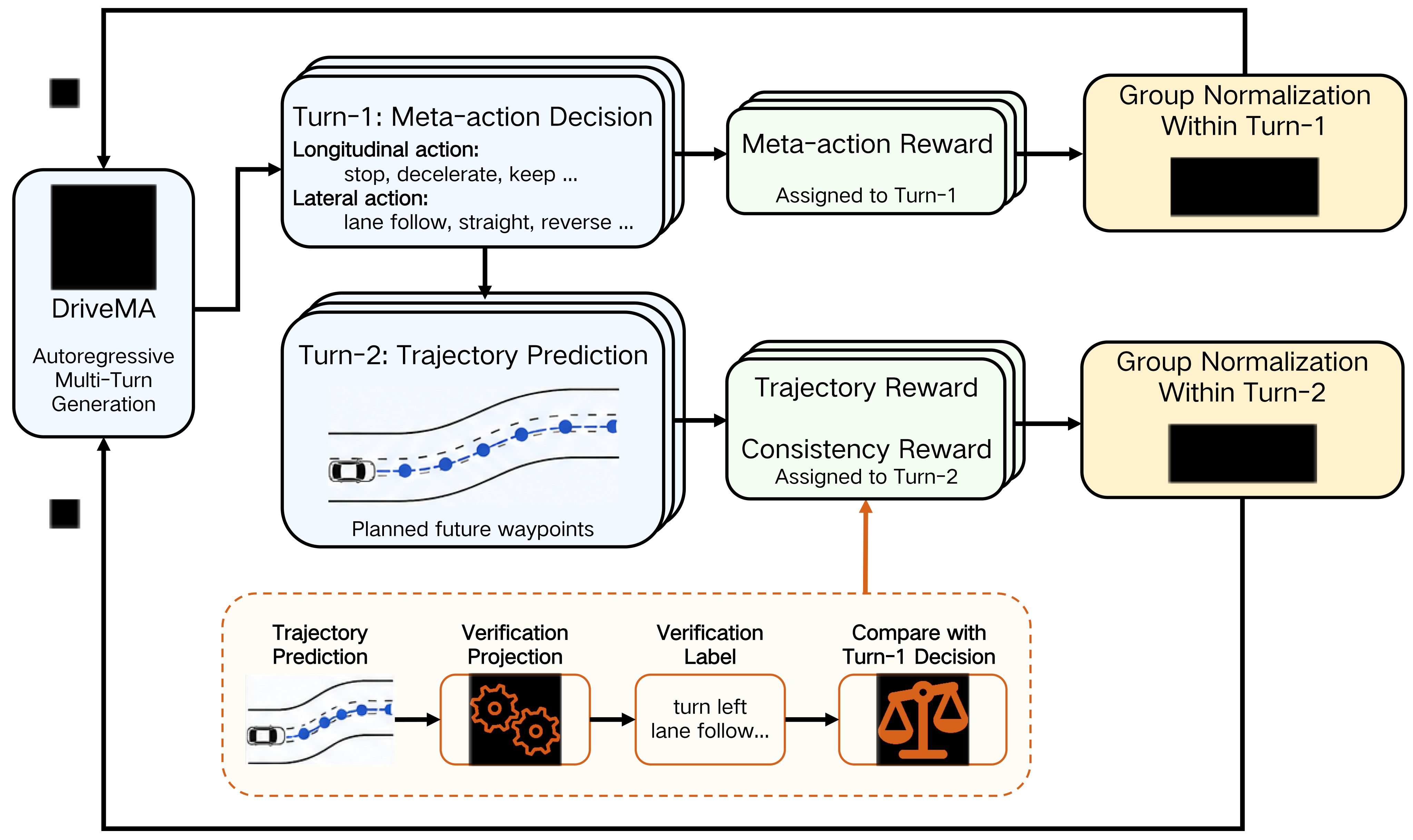
For each input, sample G completions from the old policy. Each completion contains a decision turn and a trajectory turn; their token-index sets determine where the corresponding reward advantage is applied. Figure 3 preserves the full credit-assignment diagram.
Dense Reward Design.
Turn one receives meta-action correctness against the expert label. Turn two receives trajectory quality plus agreement between the generated motion and the predicted action, after both are projected into the common verification space.
Use RFS for Waymo trajectory quality and PDMS for NAVSIM. Consistency checks longitudinal class and rule-aware coarse lateral class; it does not verify turn-versus-lane-change semantics. The paper leaves the exact agreement aggregation, meta-action reward scoring and malformed-output handling unspecified.
Equations
Turn-Level Advantage Normalization.
Normalize each turn’s rewards across the G sampled completions using its own mean and standard deviation. Unlike a single sequence-level GRPO advantage, decision correctness updates decision tokens while trajectory quality and consistency update trajectory tokens.
Equation
Optimization Objective.
Average the clipped policy surrogate over tokens within each turn, then combine turn means with weights λ₁ and λ₂ and average across completions. A separate KL penalty to the fixed pre-RL model constrains policy drift.
The full objective, probability ratio and asymmetric clipping expression remain below. Numerical lower/upper clipping bounds and the normalization stabilizer are not given in the hyperparameter appendix.
Equations
4 Experiments
Evaluate preference-based Waymo planning and NAVSIM v1 trajectory simulation, then isolate supervised stages, rewards, data volume and action granularity. Reported results have no confidence intervals or independent-seed dispersion.
4.1 Experiments Setup
Both benchmark configurations use current images from front-left, front and front-right cameras, along with nonvisual driving state and route intent. Image history is absent, but four seconds of motion history are present in the published prompt.
Datasets.
WOD-E2E emphasizes challenging long-tail driving and uses preference-based RFS. NAVSIM evaluates planning with its nonreactive simulation protocol and PDMS components for collision, drivable area, progress, time-to-collision and comfort.
Action-centric pretraining combines 240,000 examples from WaymoQA, IDKB and LingoQA. These additional samples should be counted when interpreting the full model’s data efficiency.
Implementation Details.
Build on Qwen3.5. Downsample Waymo’s 10-Hz training data fivefold and predict five future points at 1 Hz over five seconds. Its RL subset contains 479 expert-scored trajectory samples; repeated optimization uses this fixed set.
NAVSIM predicts four 1-Hz points over four seconds. The paper reports a 103,000-sample trainval split with 18,000 held out for RL. The displayed prompt is the five-second Waymo form; a separate four-second NAVSIM template is not printed.
4.2 Main Results
Tables 1–2 retain every baseline, component score and original bold/underlined emphasis. The largest model is not uniformly best, and DriveMA does not lead every NAVSIM planner.
| Method | RFS Overall | RFS Spotlight | ADE@5s | ADE@3s |
|---|---|---|---|---|
| E2E planning methods | ||||
| Swin-Trajectory [16] | 7.543 | 6.670 | 2.814 | 1.208 |
| DiffusionLTF [15] | 7.717 | 6.414 | 2.891 | 1.356 |
| UniPlan [12] | 7.780 | 6.654 | 2.986 | 1.308 |
| FROST-Drive [4] | 7.856 | 7.094 | 3.565 | 2.537 |
| RAP [5] | 8.043 | 7.204 | 2.646 | 1.174 |
| Driving VLA methods | ||||
| AutoVLA [30] | 7.557 | 6.944 | 2.958 | 1.351 |
| NoRD [17] | 7.709 | – | – | 1.250 |
| HMVLM [25] | 7.737 | 6.727 | 3.072 | 1.327 |
| Poutine [19] | 7.986 | 6.893 | 2.742 | 1.206 |
| DriveMA-2B | 8.060 | 7.251 | 2.616 | 1.154 |
| DriveMA-4B | 8.079 | 7.169 | 2.670 | 1.166 |
WOD-E2E.
DriveMA-2B/4B reach overall RFS 8.060/8.079 versus RAP’s 8.043 in the reported comparison. The 2B model has better spotlight RFS than 4B, 7.251 versus 7.169, and lower 5-second ADE, 2.616 versus 2.670.
Thus increasing size raises overall RFS but worsens these other metrics. The small aggregate margins have no reported uncertainty; “state of the art” refers to this paper’s comparison table and evaluation date.
NAVSIM Benchmark.
DriveMA-4B achieves 91.2 PDMS, above listed VLA baselines including ReCogDrive at 90.8. It ties DiffusionDriveV2 and trails RAP at 93.8. DriveMA-2B scores 90.5, below ReCogDrive.
The component metrics expose tradeoffs: 4B improves progress over 2B while collision and comfort scores are slightly lower. These simulated trajectory metrics do not establish real-world collision rates.
| Method | PDMS | Collision | Area | Progress | TTC | Comfort |
|---|---|---|---|---|---|---|
| End-to-end planning methods | ||||||
| TransFuser [1] | 84.0 | 97.7 | 92.8 | 79.2 | 92.8 | 100.0 |
| Hydra-MDP [11] | 86.5 | 98.3 | 96.0 | 78.7 | 94.6 | 100.0 |
| TrajHF [7] | 86.4 | 96.6 | 96.6 | 84.5 | 92.1 | 100.0 |
| DiffusionDriveV2 [31] | 91.2 | 98.3 | 97.9 | 87.5 | 94.8 | 99.9 |
| RAP [5] | 93.8 | 99.1 | 98.9 | 86.0 | 96.7 | 100.0 |
| Driving VLA methods | ||||||
| AutoVLA [30] | 89.1 | 98.4 | 95.6 | 81.9 | 98.0 | 99.9 |
| DriveVLA-W0 [8] | 90.2 | 98.7 | 99.1 | 83.3 | 95.3 | 99.3 |
| ReCogDrive [9] | 90.8 | 97.9 | 97.3 | 87.3 | 94.9 | 100.0 |
| DriveMA-2B | 90.5 | 98.9 | 97.8 | 85.3 | 95.2 | 100.0 |
| DriveMA-4B | 91.2 | 98.7 | 97.8 | 86.7 | 95.5 | 99.9 |
4.3 Ablation Study of Training Strategy
Direct trajectory SFT gives RFS 7.741; adding meta-actions gives 7.804, and action-centric pretraining gives 7.893. Meta-actions alone reduce spotlight RFS from 7.094 to 6.832, so the initial gain is not uniform.
From the same pretrained initialization, full-reward vanilla GRPO reaches 7.978, whereas separate turn credit reaches 8.060. Trajectory-only turn credit yields 8.009 but only 88.50% language–action consistency; adding the consistency term raises that measure to 98.80%.
The full reward mix gives the best overall/spotlight RFS and ADE in this ablation, with consistency 98.79%, effectively tied but numerically below 98.80%. The consistency metric reuses the reward’s projection rule, so it is not independent verification of fine-grained maneuver correctness.
| Training Objective | RFS Overall | RFS Spotlight | ADE@5s | L-A Consistency (%) |
|---|---|---|---|---|
| Planning interface and SFT baselines | ||||
| Direct Trajectory SFT | 7.741 | 7.094 | 3.065 | – |
| Meta-Action SFT w/o ACP | 7.804 | 6.832 | 2.802 | 90.59 |
| Meta-Action SFT w/ ACP | 7.893 | 7.189 | 2.774 | 91.31 |
| RL baseline | ||||
| Vanilla GRPO w all rewards | 7.978 | 7.087 | 2.660 | 95.95 |
| Reward ablation under turn-level credit assignment RL | ||||
| 8.009 | 7.146 | 2.627 | 88.50 | |
| 8.052 | 7.029 | 2.674 | 98.80 | |
| 8.038 | 7.018 | 2.646 | 91.32 | |
| 8.060 | 7.251 | 2.616 | 98.79 | |
Selectable original panel labels
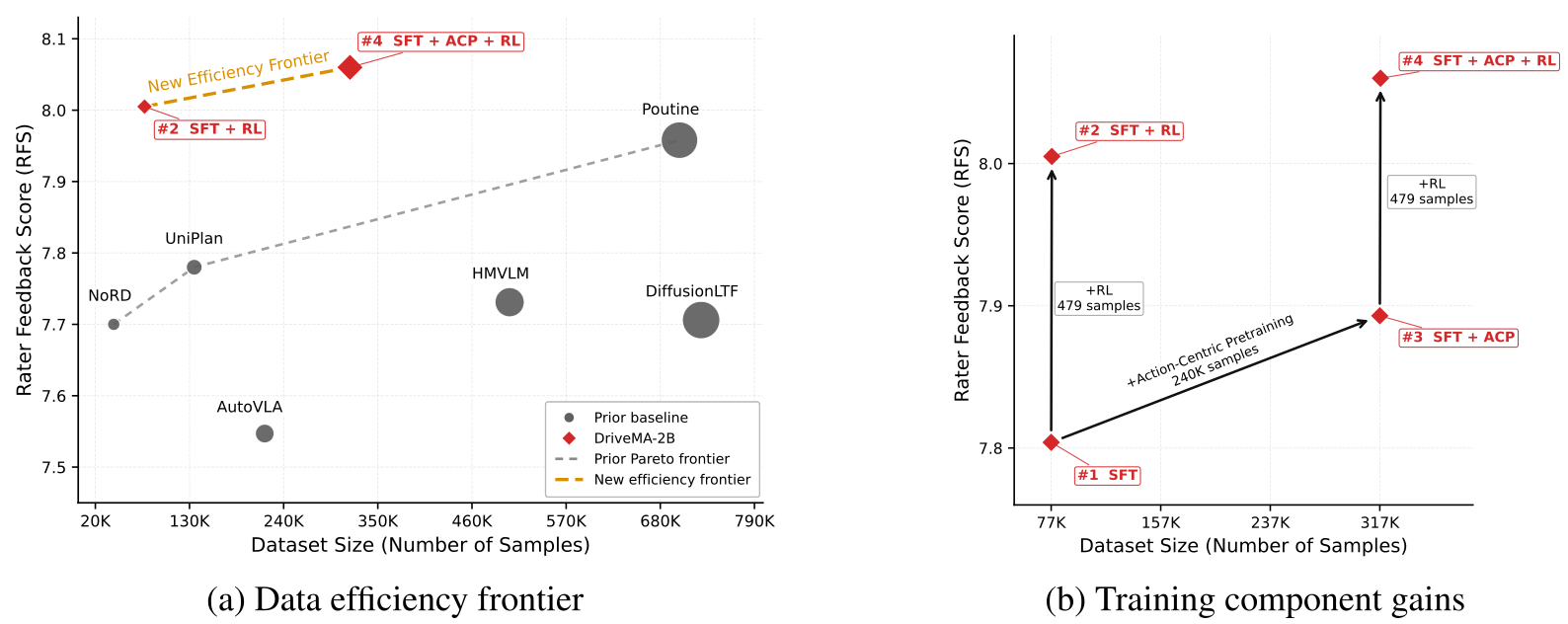
(a) Data efficiency frontier
(b) Training component gains
4.4 Data-Efficient Language-Action Alignment
With 77,000 planning samples and 479 preference samples, the no-ACP RL model reaches 8.005 RFS; adding 240,000 action-centric samples gives 8.060. The quoted 7.804→8.005 improvement starts from meta-action SFT, despite the paragraph calling it “direct SFT”; Table 3’s direct-trajectory baseline is 7.741.
Figure 5 compares training sample totals from NoRD. These cross-method counts do not match architectures, pretrained knowledge or training compute. Six hundred RL steps reuse the small preference subset; 479 is not the number of optimization steps.
4.5 Meta-Action Granularity Analysis
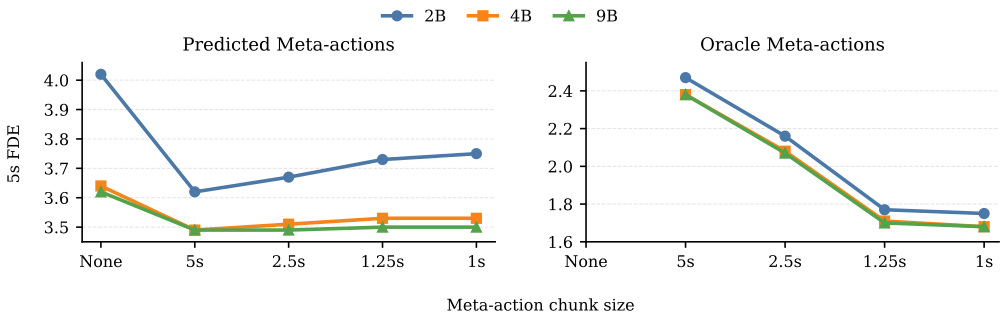
Under SFT, vary only longitudinal chunk duration from five seconds to 2.5, 1.25 or one second, keeping lateral intent at five seconds. Compare predicted labels with oracle expert labels for 2B/4B/9B models using five-second final displacement error.
Finer oracle labels help, but prediction gains saturate near the single five-second action and 9B adds little over 4B. Observed longitudinal patterns rise from 4 to 14, 122 and 221; entropy rises from 1.761 to 5.100. This is a pre-RL interface-predictability study, not an RL scaling result.
The HTML prose points to Table 6 for pattern counts; the actual table is Table 4, as correctly referenced in the PDF.
| Size | Obs. | Entropy |
|---|---|---|
| 5s | 4 | 1.761 |
| 2.5s | 14 | 2.871 |
| 1.25s | 122 | 4.453 |
| 1s | 221 | 5.100 |
5 Conclusion
A compact, checkable intermediate decision improves the reported planning pipeline when supervised and optimized explicitly. The strongest evidence is the controlled reward/credit ablation, while broader comparisons include different training data and backbones.
6 Limitations
Rule thresholds and visual disambiguation can introduce label noise near maneuver boundaries. Richer reasoning traces would need their own verifiers; the present reward cannot simply validate arbitrary language.
Consistency is weaker than correctness: a wrong intention and a matching trajectory can agree. Results lack uncertainty, real-vehicle execution, latency analysis and an independent audit of the label resolver or consistency checker.
Appendix A Additional Details on Meta-Action Labeling and Verification
The action vocabulary contains four longitudinal labels and ten lateral labels, all retained below. Training labels use geometry first and visual context only for ambiguous lateral distinctions; reward verification uses a coarser space.
| straight | lane_follow |
| left_turn | right_turn |
| left_lane_change | right_lane_change |
| left_shift_slightly | right_shift_slightly |
| reverse | turn_around |
Longitudinal annotation.
Cluster training trajectories using maximum speed, net displacement and path length to identify near-static motion, then convert the clusters into fixed thresholds. Stop requires all three conditions: speed ≤1.333 m/s, displacement ≤1.952 m and path length ≤1.957 m.
Otherwise classify the speed-profile slope: ≤−.448 means decelerate, ≥.429 accelerate, and the open interval between them means keep. The thresholds shown are rounded to three decimals; clustering details and separate benchmark-specific threshold sets are not fully specified.
| Label | Rule |
|---|---|
| stop | , , |
| decelerate | |
| keep | |
| accelerate |
Lateral annotation.
Near-straight motion requires absolute heading change ≤15° and maximum lateral displacement below 1.5 m. Final lateral displacement above .75 m or below −.75 m assigns left/right slight shift; the inclusive central interval assigns straight.
For other trajectories, heading sign and final lateral displacement form left/right-oriented groups. Backward motion supplies reverse outside near-static cases. The exact turn-around and unmatched-geometry fallback rules are not provided in Table 6.
| Case | Rule |
|---|---|
| near-straight group | and m |
| left_shift_slightly | near-straight group and m |
| right_shift_slightly | near-straight group and m |
| straight | near-straight group and m |
| left-oriented group | and |
| right-oriented group | and |
Fine-grained lateral disambiguation.
A left-oriented trajectory may be a turn, lane change or lane following, depending on the road. A visual resolver receives three front-camera images and structured trajectory information, choosing only among rule-provided candidates.
This resolver refines training targets, not the geometric reward check. Its model, prompt, error rate and human validation are not specified, limiting reproducibility of the fine-grained labels.
Verification space for consistency reward.
Longitudinal verification keeps all four categories. Laterally, straight and lane_follow map to forward; turn/lane-change pairs map to left or right. Slight left/right shifts, reverse and turn-around each keep their own category.
Consequently, consistency distinguishes slight shifts but deliberately cannot distinguish a turn from a same-direction lane change. The complete original mapping and reward expression remain below; agreement alone does not certify legal or collision-free behavior.
Equations
Appendix B Training and Inference Hyperparameters
The appendix specifies the two supervised stages, RL sampling and greedy evaluation. All stages fine-tune the vision encoder, language model and multimodal projector.
Supervised fine-tuning.
Run each supervised stage for one epoch with learning rate 10⁻⁵ and effective batch 64 on eight NVIDIA A800 GPUs. Limit each image through max_pixels=512×512=262,144; this is a pixel cap, not a guarantee that all inputs are square.
Reinforcement learning.
RL runs 600 steps at learning rate 10⁻⁶, effective batch 64, eight completions per group and one step per generation. Sample at temperature one and penalize KL with β=.4.
Decision/planning turn weights are .2/.8. Within the planning reward, trajectory quality has weight 1 and consistency .5. Full-parameter training and the same image pixel cap remain in effect.
Inference.
Evaluate one trajectory from greedy decoding with the training image-size cap. The paper does not report sampled best-of-N selection or inference latency for these results.
Appendix C Training/Inference Prompt Format
The exact two-turn prompt is preserved below with all line breaks and indentation. Inputs include current three-view images, route intent, current velocity/acceleration and four seconds of trajectory, acceleration and velocity sampled as sixteen 4-Hz steps.
Coordinates use forward-positive x and left-positive y. Turn one outputs longitudinal/lateral labels; turn two outputs five 1-Hz future coordinates for Waymo. Supervised responses are supplied only during training; inference uses predicted decisions.
Human:
You are an expert driver.

Input:
- 1 frame of multi-view images collected from the ego-vehicle at the present timestep:
  front_left_view: <image>; front_view: <image>;
  front_right_view: <image>
- Current high-level intent: <intent>
- Current acceleration: <current_acceleration>
- Current velocity: <current_velocity>
- 4-second past trajectory (16 steps at 4 Hz): <past_trajectory>
- 4-second past acceleration (16 steps at 4 Hz): <past_acceleration>
- 4-second past velocity (16 steps at 4 Hz): <past_velocity>

Coordinate System Definition:
X-axis: positive forward, negative backward;
Y-axis: positive left, negative right.

Task: Inspect the input and make the decision.
Output format:
longitudinal action: xx, lateral action: xx

Assistant:
longitudinal action: <longitudinal_action>, lateral action: <lateral_action>

Human:
Task: Given the above information, predict the optimal 5-second future trajectory (5 steps at 1 Hz) of the ego vehicle.
Output format:
[x_1, y_1], [x_2, y_2], [x_3, y_3], [x_4, y_4], [x_5, y_5]

Assistant:
[<x_1>, <y_1>], [<x_2>, <y_2>], [<x_3>, <y_3>], [<x_4>, <y_4>], [<x_5>, <y_5>]
Appendix D Qualitative Comparison with the Previous State of the Art
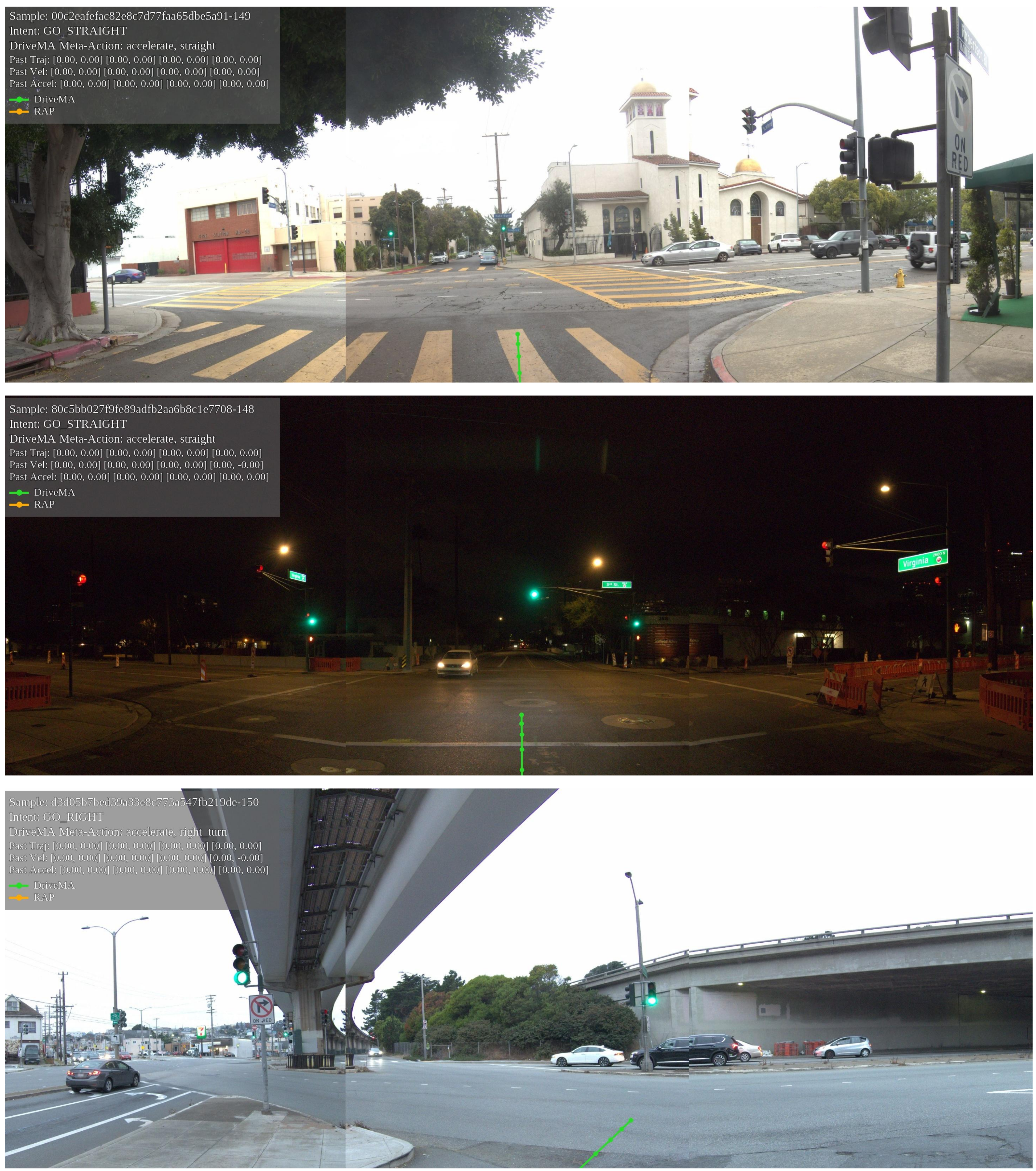
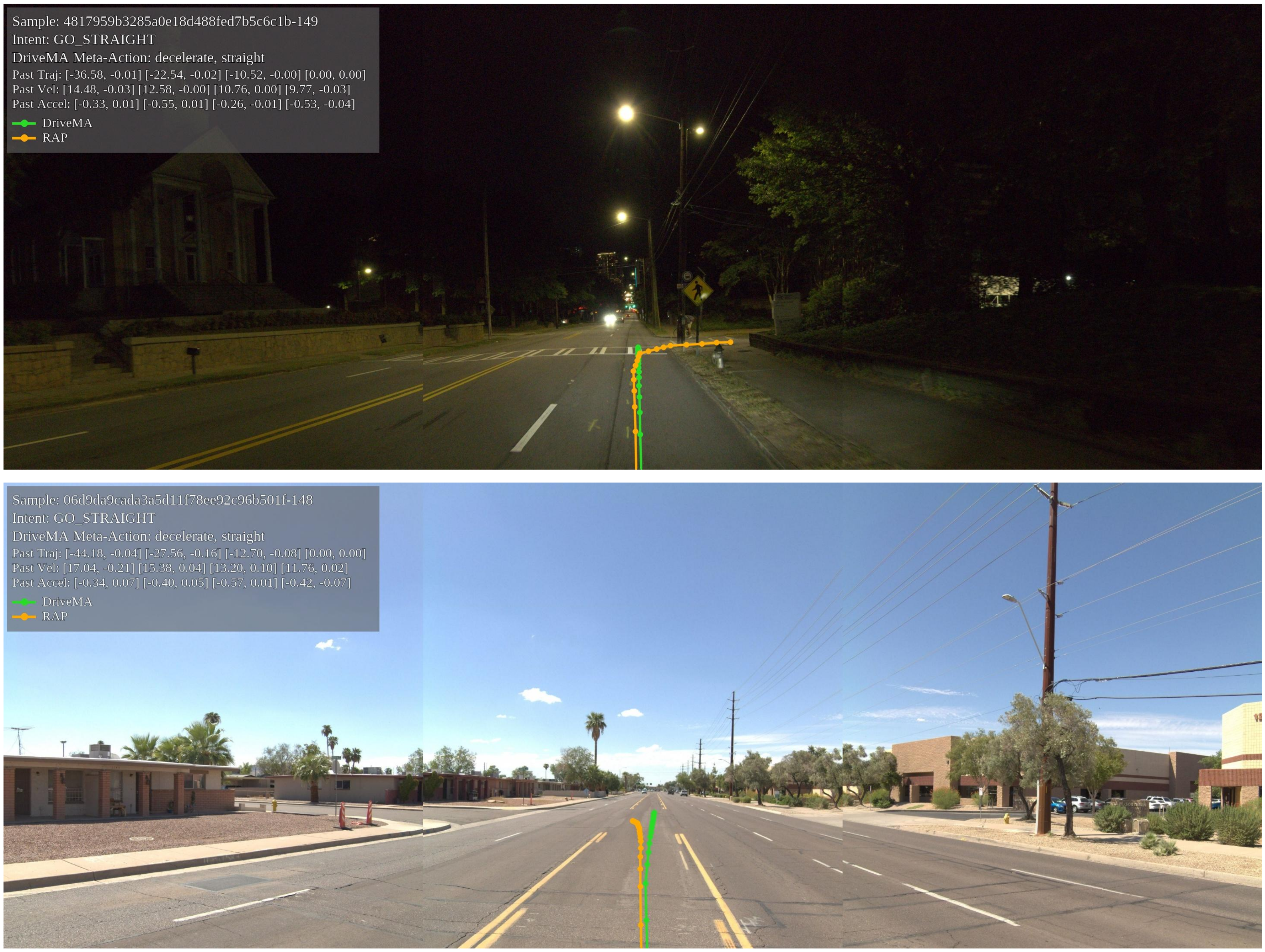
The appendix compares selected DriveMA and RAP trajectory overlays under the same scenes. These examples illustrate failure modes and favorable outcomes, without a scenario-level success-rate or causal attribution experiment.
Starting from static history at green lights.
Three green-light scenes have nearly static motion history. DriveMA predicts acceleration and moving waypoints; RAP remains near the historical position. These examples illustrate recovery from a misleading motion prior, without quantifying how often the behavior occurs.
Route-intent consistency at side intersections.
At two side intersections, GO_STRAIGHT remains the route intent despite nearby turning opportunities. DriveMA predicts decelerate/straight and follows the through lane, whereas RAP turns toward a side road in the displayed overlays.
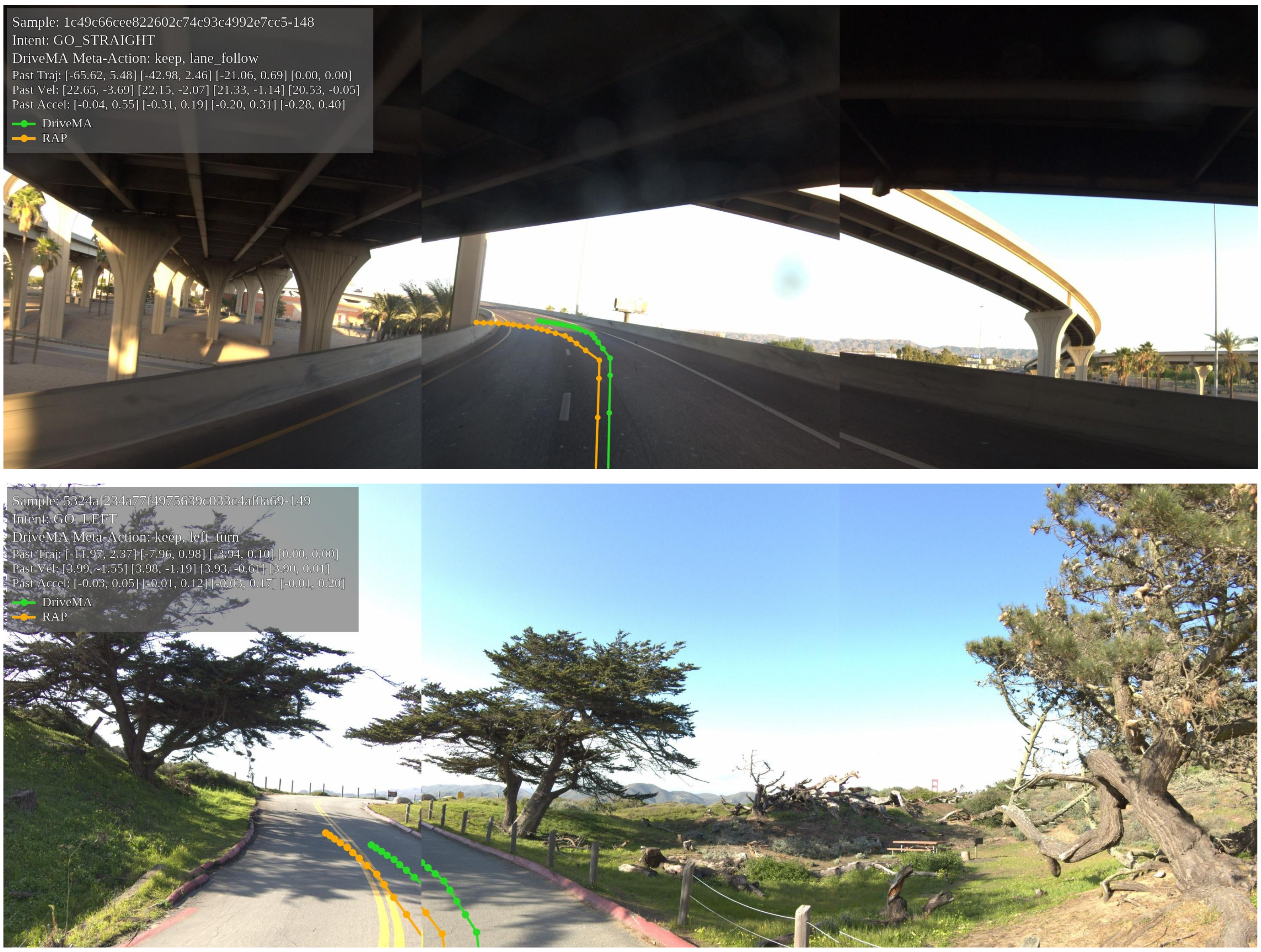
Trajectory curvature control on curved roads.
Two curved-road examples show RAP bending toward a road boundary or opposing lane while DriveMA follows a more moderate curve. The image comparison supports geometric plausibility in these cases; no executed curb contact or collision is measured.
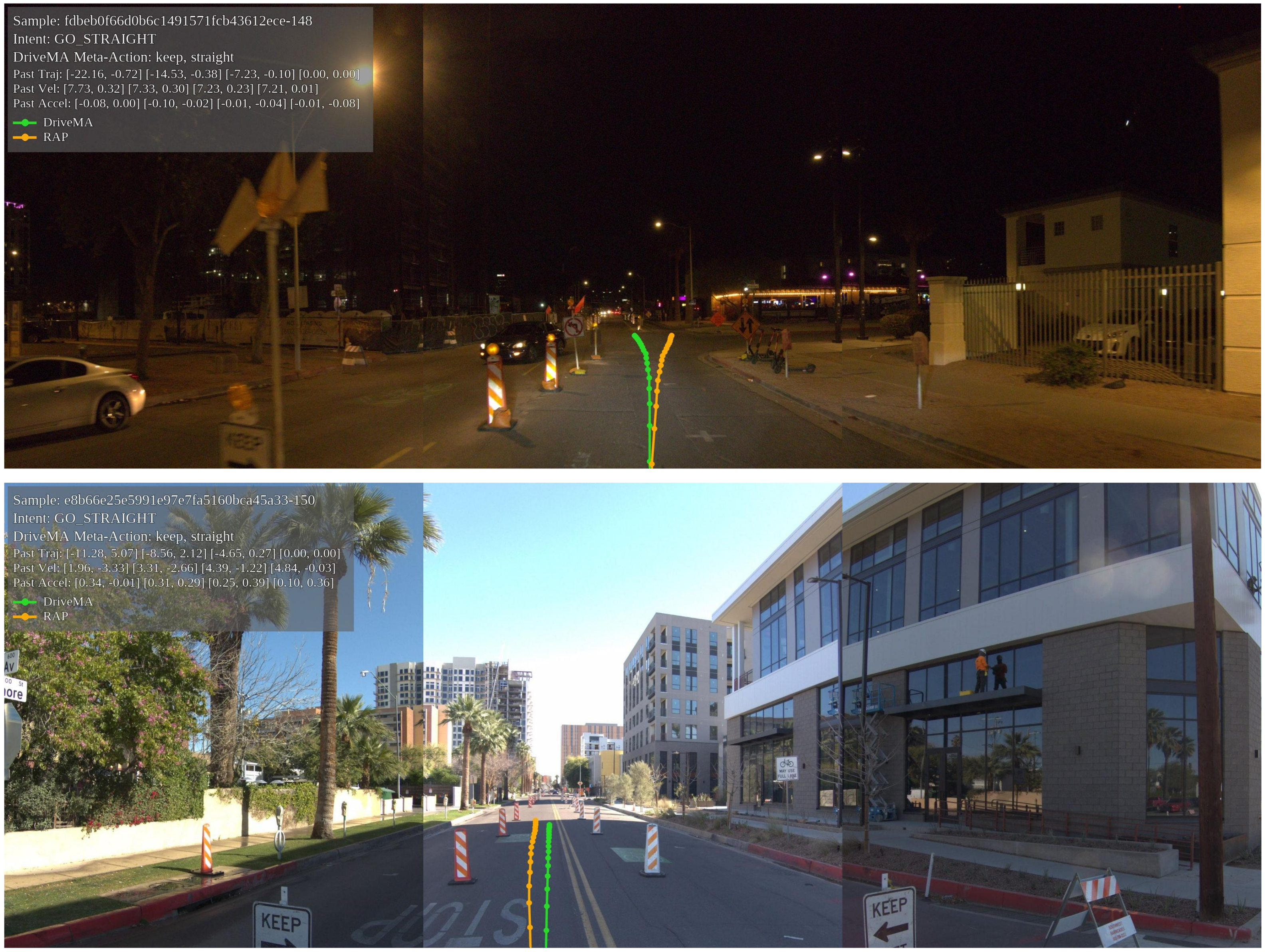
Planning under cone-defined temporary corridors.
In two construction scenes, temporary cone corridors differ from normal lane markings. DriveMA’s overlays remain nearer the corridor center, including one shifted near a double-yellow line; RAP drifts toward a boundary. The illustration is not a general rule authorizing lane-boundary crossing.
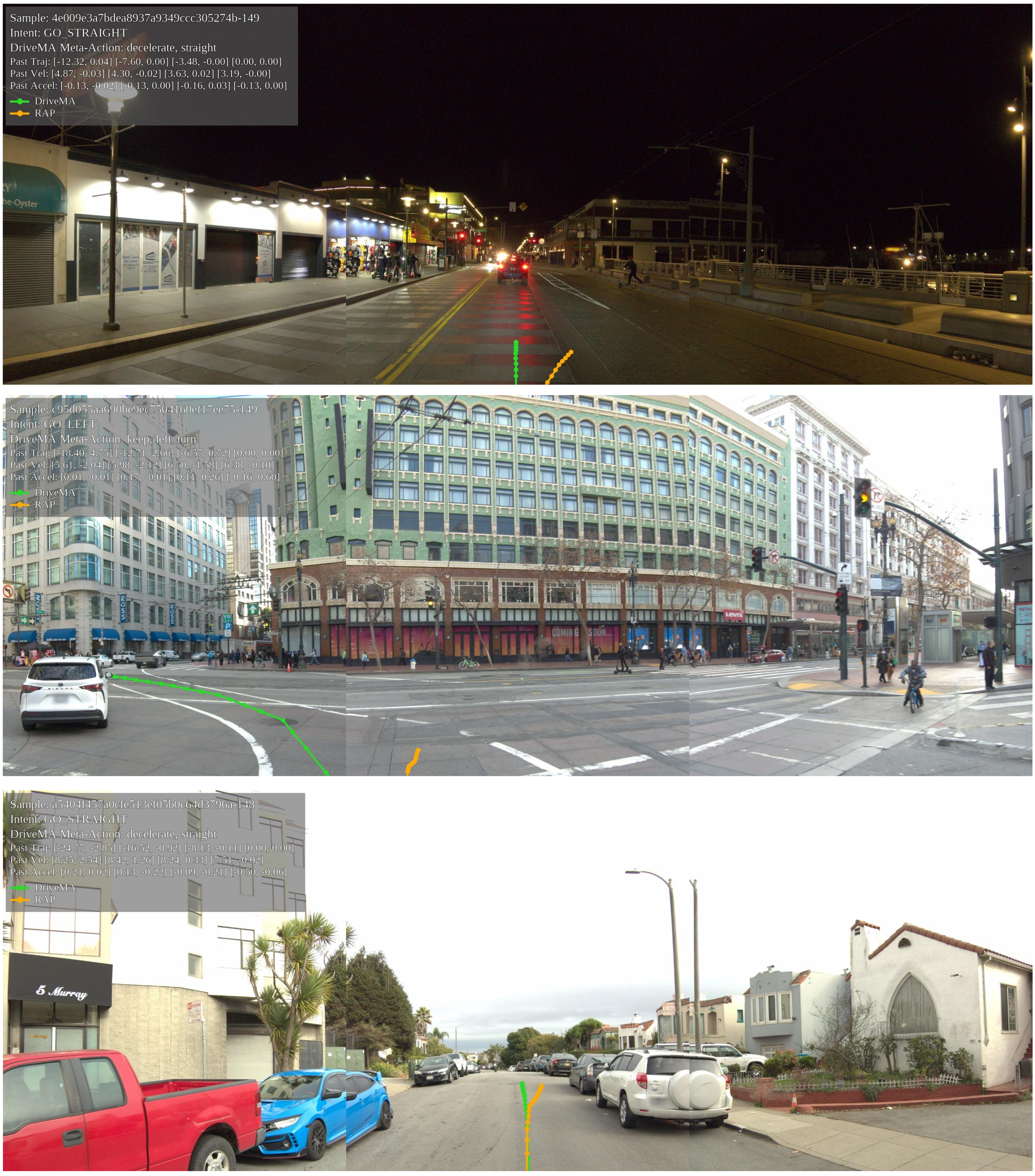
Maneuver-direction errors in complex scenes.
The final three cases combine a red-light straight route, an intended left turn and an oncoming road user. DriveMA retains the requested maneuver while slowing where appropriate; RAP shows rightward deviation, missed turning direction or excessive roadside avoidance. These remain selected qualitative comparisons.