Overview
This edition covers the complete eighteen-page arXiv v2, dated 25 May 2026, including all appendix implementation and filtering details. Roberto Martín-Martín and Kristen Grauman are equal advisers. All six figures, both numbered tables and the original filtering prompt are retained.
At a glance
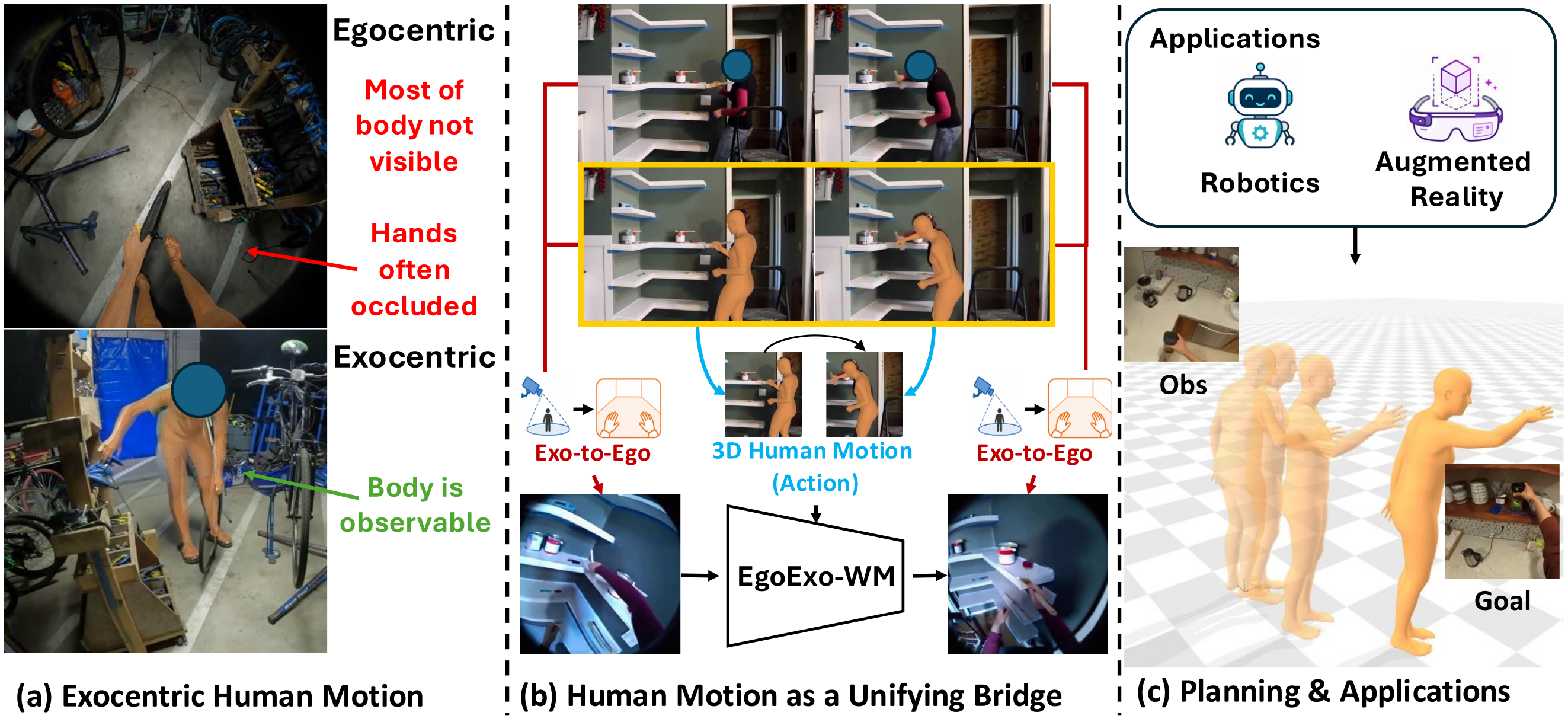
EgoExo-WM uses reconstructed human motion twice: as an action representation and as guidance for translating exocentric videos into egocentric observations. Mixing converted clips with real first-person data trains a latent world model to predict future observations and rank proposed whole-body trajectories.
Experiments replace ten of a fixed 200 training hours with converted internet video. Gains are measured on short open-loop predictions and offline pose-trajectory selection; robot execution and augmented-reality coaching are proposed applications, not demonstrated deployments.
1 Introduction
Egocentric footage aligns with an embodied observer but often hides the body needed for action labels. Third-person footage exposes motion and diverse activities, while its viewpoints do not directly match first-person observations.
Recover 3D pose, use it to guide exo-to-ego generation, then pair the generated views with the same motion sequence. The result expands training experience without requiring every clip to have been captured by a wearable camera.
The evaluation spans household activities and Ego-Exo4D bike/cooking clips. The main contribution is testing converted exocentric supervision in a world model; it does not establish unrestricted conversion of arbitrary internet video or general long-horizon control.
2 Related Work
The framework connects action-conditioned world models, viewpoint translation and monocular human pose recovery. Its distinction is using one recovered motion sequence to align both generated observations and world-model actions.
World Models.
PEVA and EgoControl predict egocentric futures from body motion; latent-action and language-conditioned systems offer other forms of control. EgoExo-WM targets the shortage of paired first-person observations and explicit whole-body motion by converting third-person footage.
A wrist-consistency objective additionally encourages predicted visual latents to retain hand-placement information. This provides a pose-related learning signal rather than a physical-contact constraint.
Exo-to-Ego Generation.
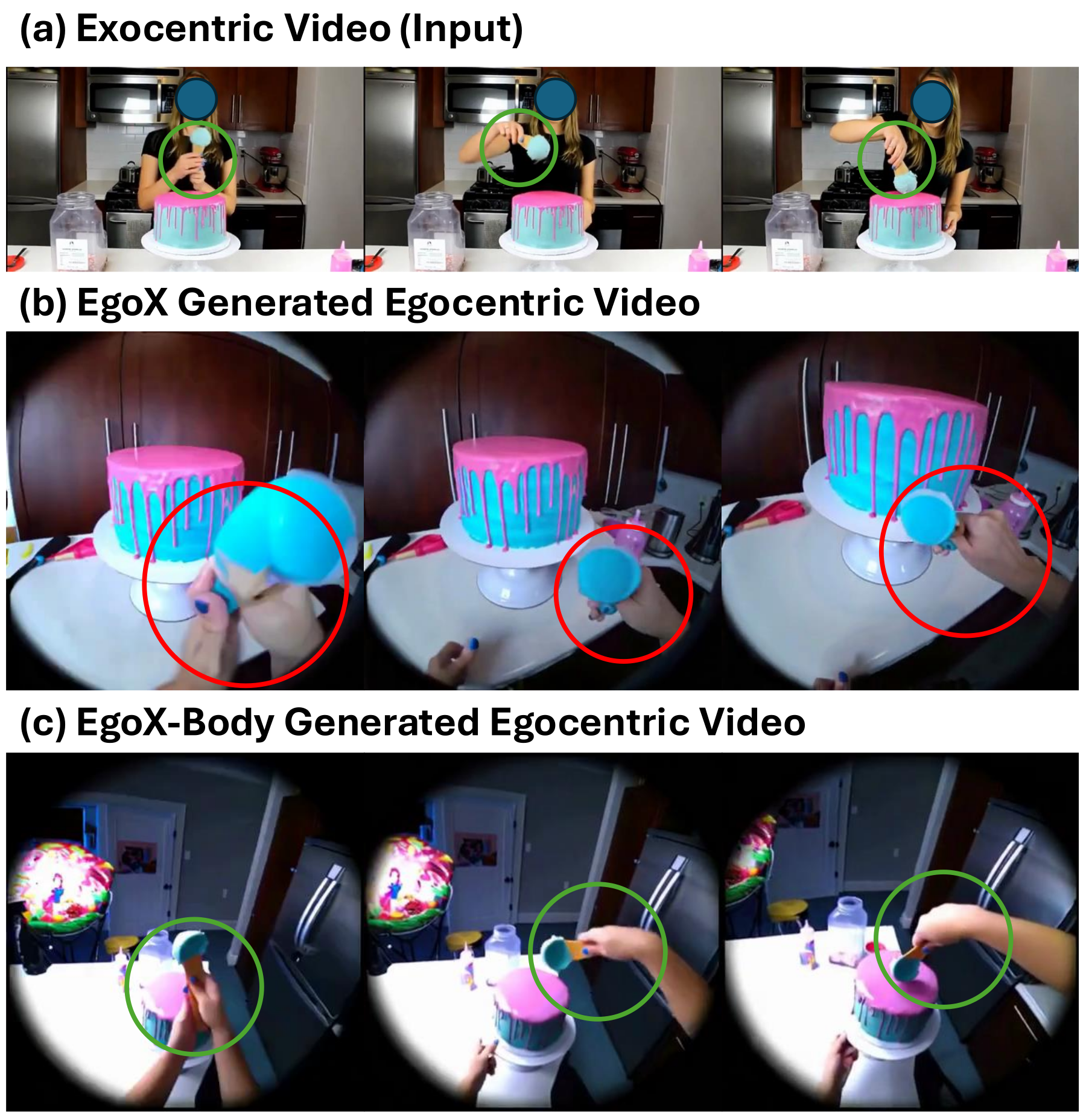
EgoX combines reconstructed geometry, generative video priors and language conditioning. EgoX-Body adds body overlays to exocentric inputs and projected hand skeletons to an egocentric prior, addressing swapped hands and mismatched motion illustrated in Figure 3.
Conversion remains underdetermined when the third-person view misses objects or contacts. The paper presents qualitative conversion comparisons; the framework could incorporate other converters.
Human Pose Estimation.
Human-pose estimators compress images into joint or parametric-body representations such as SMPL and MHR. Here that recovered structure supplies both the world-model action and viewpoint-generation guidance, so pose errors can affect both sides of a training pair.
3 EgoExo-WM
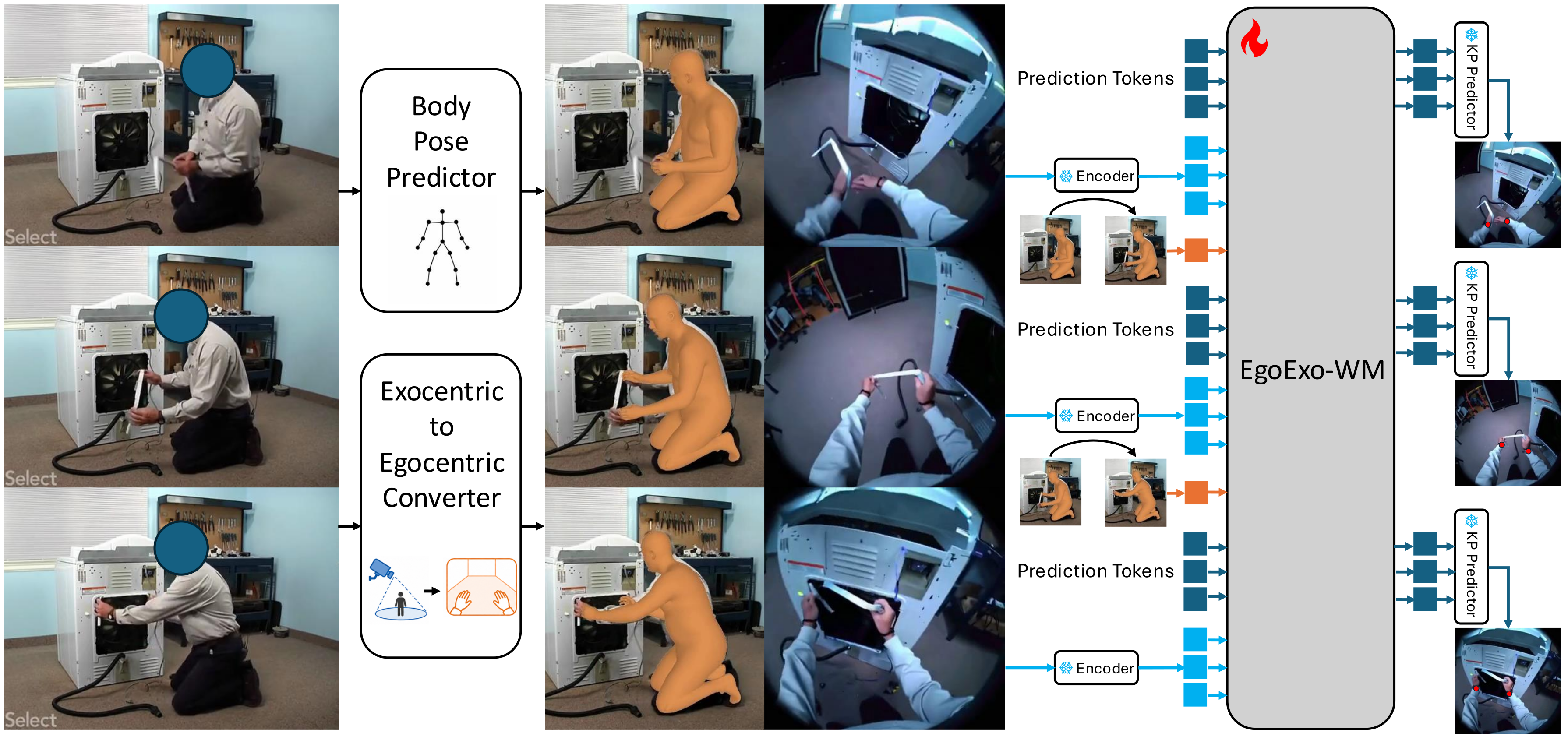
First train a motion-conditioned latent predictor, then augment its data through EgoX-Body. At evaluation, roll out sampled human motions and select the candidate whose predicted final representation is closest to a supplied goal image.
3.1 World Model Training
Represent each action by root-translation change and Euler-angle relative rotations for 22 body joints: 3+22×3=69 values. Encode images with DINOv3-L and predict the next visual latent from a fixed context window plus the next action, using autoregressive teacher forcing.
Train with squared latent-prediction error plus a wrist-heatmap consistency term weighted by λ=1. The wrist decoder is pretrained and frozen, as specified in the appendix; gradients still guide the predicted visual latent.
Real motion-capture observations and converted clips share this observation/action format. The original formulas remain below, including the printed s-hat notation inside the wrist-head expression, which is not separately defined.
Equations
3.2 Exo-to-Ego Data Generation
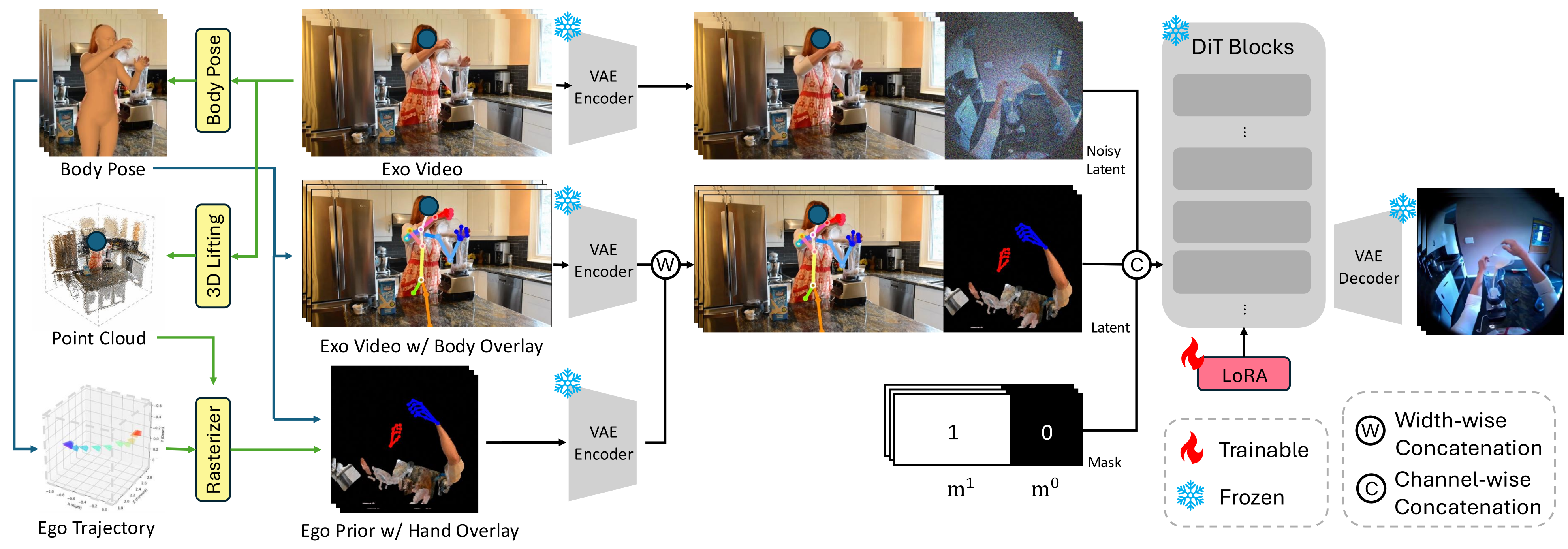
EgoX-Body overlays recovered full-body skeletons on exocentric conditioning frames. A reconstructed scene and head-anchored camera provide an approximate egocentric view, with projected wrist/finger skeletons grounding hand locations.
Training uses hand estimates from HaMeR; inference projects the pose recovered from the third-person input. These are estimator-derived conditions, even where the paper calls the training poses ground truth.
The diffusion model receives a clean exocentric latent concatenated with noise and a body-overlaid exocentric latent concatenated with the egocentric hand prior. Figure 4 preserves the exact width/channel concatenations, mask, frozen components and trainable LoRA paths.
3.3 Planning with EgoExo-WM
UniEgoMotion proposes temporally coherent human-motion candidates from the current egocentric observation. Roll each candidate through the learned latent dynamics, compare its terminal latent with an encoded goal image and select the lowest squared-distance cost.
Although surrounding prose says closest rollout state, the printed cost uses the final time t+H; the experimental protocol also specifies terminal-state scoring. A goal image is assumed available. No text-to-goal generator is trained or evaluated here.
The experiment ranks four eight-step proposals over two seconds. It is an MPC-style evaluator of proposed motion, with no reported physical execution, receding-horizon robot success rate or search beyond the sampled candidates.
Equations

Selectable original MathML
4 Experiments and Results
Tests separate visual/action-consistent prediction from offline selection of goal-directed motion. Ablations hold architecture and objective fixed while changing whether the ten exocentric training hours are absent, raw or converted.
4.1 Experimental Setup
Use a matched 200-hour data budget. Ego-WM and pixel-space baselines use 200 hours of Nymeria; the full and naive mixed variants use 190 hours of Nymeria plus ten hours of converted or raw exocentric video. Converted sources are approximately five hours HowTo100M, one CrossTask and four 100 Days of Hands.
Test on HOMAGE and single-agent LEMMA clips with SAM-Body4D poses, plus 125 clips each from Ego-Exo4D Bike and Cooking with provided UniEgoMotion poses. The wording reports 150 clips for HOMAGE/LEMMA without explicitly resolving whether that is per dataset or combined.
PEVA-L/XL/XXL use 7/15/15 context frames. EgoControl* is the authors’ adapted reimplementation because the original model/code was unavailable at writing. All use 224×224 input; equal data volume does not imply identical architectures or context windows.
Both numbered result tables are retained in full. Table 1 has four dataset panels; Table 2 compares raw UniEgoMotion with world-model ranking using either egocentric-only or converted-data training.
| HOMAGE | ||||
|---|---|---|---|---|
| Model | L2 | PCK@ | ||
| 2s | Avg | 2s | Avg | |
| PEVA-L | ||||
| PEVA-XL | ||||
| PEVA-XXL | ||||
| EgoControl∗ | ||||
| Ego-WM | ||||
| Naive EgoExo-WM | ||||
| EgoExo-WM | 0.057 | 0.047 | 0.404 | 0.531 |
| LEMMA | ||||
|---|---|---|---|---|
| Model | L2 | PCK@ | ||
| 2s | Avg | 2s | Avg | |
| PEVA-L | ||||
| PEVA-XL | ||||
| PEVA-XXL | ||||
| EgoControl∗ | ||||
| Ego-WM | ||||
| Naive EgoExo-WM | ||||
| EgoExo-WM | 0.058 | 0.045 | 0.515 | 0.618 |
| Model | HOMAGE | LEMMA | Ego-Exo4D-Bike | Ego-Exo4D-Cooking | ||||
|---|---|---|---|---|---|---|---|---|
| MPJPE | Wrist MPJPE | MPJPE | Wrist MPJPE | MPJPE | Wrist MPJPE | MPJPE | Wrist MPJPE | |
| UniEgoMotion | ||||||||
| UniEgoMotion + Ego-WM | ||||||||
| UniEgoMotion + EgoExo-WM | ||||||||
Evaluation Protocol.
Open-loop evaluation predicts eight frames at 4 Hz, a two-second horizon. EgoExo-WM and PEVA feed predictions back autoregressively; EgoControl predicts at 16 Hz in one pass and is downsampled. Report final and mean DINOv3-L latent L2 error.
Wrist PCK@20 uses ViTPose on pixel-generated frames but a learned wrist decoder for latent models. This difference in measurement pipeline matters when interpreting cross-family comparisons; no separate threshold-unit clarification is provided.
For planning, sample four horizon-eight trajectories, rank terminal latent distance to the goal, and report body/wrist MPJPE against recorded motion, with means and standard deviations over five runs. MPJPE evaluates pose agreement, not completed-object-task success; the table does not explicitly print physical units.
4.2 Direct Evaluation of World Model Accuracy
Against the same-architecture Ego-WM, converted training lowers mean latent error from .058 to .047 on HOMAGE and .055 to .045 on LEMMA; mean wrist PCK rises from .396 to .531 and .527 to .618. The much larger gap to PEVA also includes architectural/objective differences.
Compared with raw-exocentric mixing, conversion further helps household-domain errors and wrist consistency. Bike terminal error is .049 versus the naive variant’s .048, with both averaging .040; Cooking errors tie at .062 final/.052 average. The strongest overall result is not a strict win in every cell.
Wrist PCK improves more broadly, but Cooking final PCK ties Ego-WM at .460. The paper gives baseline dispersion bounds and planning run statistics, without full per-cell uncertainty or an isolated no-wrist-loss ablation.
4.3 Impact for Model-Predictive Control Planning
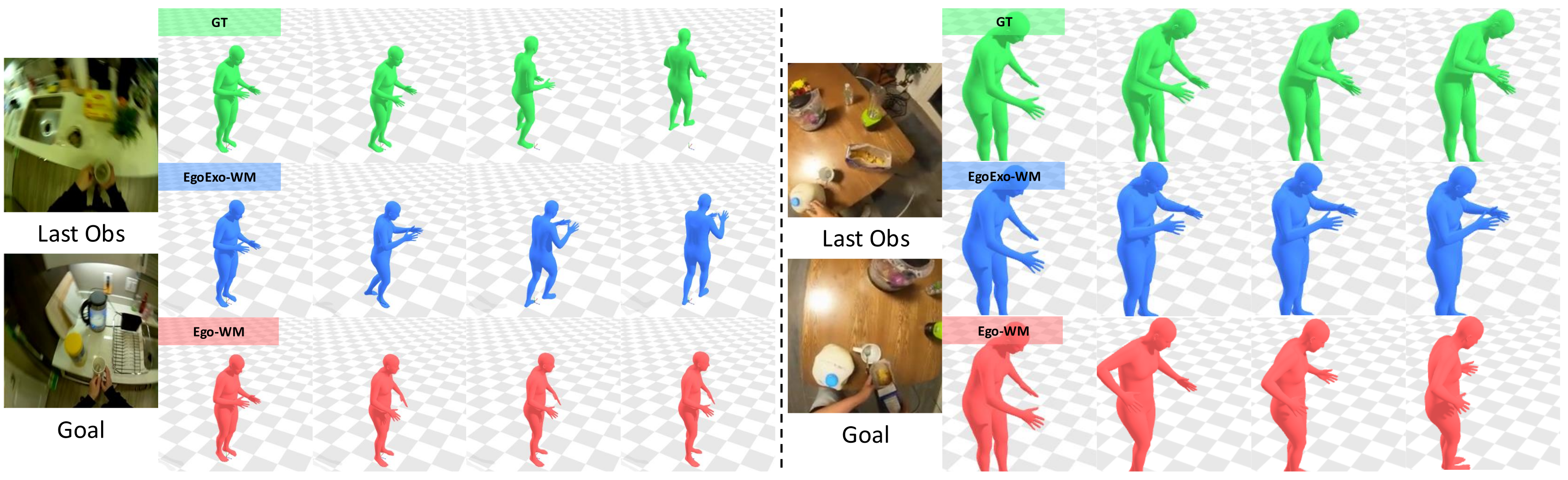
Ranking with EgoExo-WM reduces body MPJPE relative to unranked UniEgoMotion from .404→.362 on HOMAGE, .444→.396 on LEMMA, .292→.245 on Bike and .533→.498 on Cooking. Wrist errors also decrease, and every listed error is below ranking with Ego-WM.
Figure 5 shows selected sink-navigation and cereal-pouring examples. These results support better selection among the same motion proposals; they do not establish collision-free execution, correct object dynamics or articulated-finger control. The action space contains body joints, not detailed hand articulation.
5 Limitations and Conclusion
Pose-aligned conversion improves a world model under a fixed training-data budget, particularly on household activities underrepresented in the base dataset. Only about ten converted hours are used because generation is costly; no large-scale scaling curve is reported.
Generated clips contain 49 frames, and planning spans two seconds. Occlusion, precise contact, small objects, pose mistakes and nearly black/white generations remain failure sources. Longer-horizon prediction and executed robot/assistive applications remain future work.
Appendix A Technical appendices and supplementary material
The supplement specifies the latent predictor, wrist decoder, skeleton mapping, conversion geometry and the complete clip-selection/post-processing pipeline. Exact formulas, table values, figures and the filtering prompt remain available alongside these concise notes.
A.1 World Model Implementation Details
Implementation details distinguish the trainable world model from the pretrained frozen wrist decoder. The action skeleton is adapted for comparison with Xsens-based baselines.
A.1.1 Architecture and Training Details
Use CDiT-L/2 with 24 layers, width 1024, sixteen attention heads and MLP ratio four. DINOv3 ViT-L/16 encodes 224×224 images as 196 patch tokens on a 14×14 grid, each of dimension 1024.
Train 100,000 iterations with AdamW, constant learning rate 8×10⁻⁵, β=(.9,.95), zero weight decay, clipping 10 and bfloat16. Eight A40 GPUs at batch 64 each give global batch 512. Evaluate EMA weights; compile training and evaluation with torch.compile.
The source ends its context specification with the incomplete sentence “We condition on 3.” It does not explicitly name what is counted, so no completed context specification is invented.
A.1.2 Action Representation
Map Xsens’s 23-joint skeleton to the 22-joint SMPL layout by dropping lumbar L3 and mapping L5/T12/T8 to the three SMPL spine joints. In reverse, duplicate the corresponding lumbar joint to restore the L3 entry.
This changes skeleton layout while retaining the action parameterization. The mapping approximates the extra torso joint; it does not supply independently measured motion for that joint.
A.1.3 Wrist-Position Consistency Objective
Pretrain a six-layer Transformer wrist decoder, width 256, sixteen heads and MLP ratio four, on Nymeria/EgoExo4D. Each 1024-dimensional DINO patch predicts a 16×16 heatmap tile; the 196 tiles form one 224×224 channel. Freeze this decoder for world-model training.
Generate pseudo-targets from ViTPose wrists with mean confidence above .3, deduplicating locations within five pixels. Splat isotropic Gaussians of σ=3 pixels and combine wrists by elementwise maximum. Apply per-pixel MSE only to frames with at least one visible wrist.
The single channel supervises wrist location without explicit left/right identity. Auxiliary decoder pretraining includes EgoExo4D; the paper does not detail its split relationship to the held-out Bike/Cooking evaluation clips.
A.2 EgoX-Body Details
EgoX-Body combines monocular scene reconstruction, body-pose conversion and projected hand guidance. Practical generation changes reduce cost but do not eliminate view-synthesis failures.
A.2.1 Release
The authors state that an EgoX-Body release will include usage guidelines. This is a planned-release statement in the paper, not confirmation of a current release or a specified license.
A.2.2 Compute Details
Train EgoX-Body for 20,000 iterations on four GH200 accelerators. This subsection reports about 3.5 minutes per 49-frame inference sample; the later practical-modifications subsection reports approximately 3.25 minutes. Both original estimates are retained.
A.2.3 Body Pose and Scene Reconstruction
SAM-Body4D recovers human motion and ViPE reconstructs a time-varying scene. Convert MHR pose to SMPL-X for downstream rendering; pose supplies actor/hand motion and the reconstructed scene supplies the approximate first-person geometry.
A.2.4 Egocentric Prior and Hand Overlay
Place the virtual pinhole camera at the midpoint of SMPL-X eye joints L_EYE=23 and R_EYE=24, then advance it .1 m and remove points too near the camera. Use eye-to-eye direction for the horizontal basis, camera-center-to-NECK for vertical and their cross product for forward.
Project sixteen joints and fifteen bones per hand. The overlay draws left-hand joints/bones red and right-hand ones blue, following wrist-to-finger chains. Camera-basis normalization and the near-point cutoff are not numerically specified.
Equation
A.2.5 Practical Modifications
Add 250 H2O training examples emphasizing people facing the camera. Remove EgoX’s Geometry Guided Attention, lower generation resolution from 448×448 to 384×384, and output 49-frame videos at 16 Hz.
Reported GH200 inference time falls from about 17.5 to 3.25 minutes per video under these combined changes. This is not an isolated ablation of any one modification; another subsection gives the rounded estimate 3.5 minutes.
A.3 Exocentric Video Selection and Filtering
Split raw video with adaptive scene detection and reject short scenes. Check three representative frames for one visible person with reliable head/upper-body ViTPose keypoints. Estimate camera motion from ORB matches and affine transforms, rejecting noticeable zoom, translation or rotation.
GPT-4o-mini then accepts only scenes with a clear visible human action, worst-case overlay coverage below 20% and no photographic picture-in-picture overlay. Exact scene-duration, pose-confidence and camera-motion thresholds are not supplied here.
VLM Filtering Prompt.
The original prompt is preserved verbatim below, including indentation and exclusions for passive poses, talking-to-camera scenes and photographic overlays. It requests conservative JSON judgments over all sampled images; ordinary text, logos and UI overlays remain distinct from photographic inserts.
Check these images and answer STRICTLY in JSON.

You are judging the scene across all provided images together.

Definitions:
- A "human action" means a visible person actively doing something.
- human_action should be true ONLY if a person is clearly performing
  a visible action in at least one image, and the scene overall appears
  to depict a human action.
  Examples: cutting, cooking, typing, walking, opening something,
  holding or manipulating objects, cleaning, assembling, playing.

- human_action should be false for:
  - static poses (standing, sitting without action)
  - portraits/selfies
  - empty scenes
  - landscapes
  - objects moving without human involvement
  - animals acting without humans
  - a person just talking to the camera (e.g. vlog-style, speaking, presenting)
  - a person facing the camera without clear interaction with objects

Overlay rules:
- An "overlay" is anything drawn on top of the main scene.
- overlay_is_photographic should be true ONLY if any image contains a
  natural photo or video image as an overlay (e.g. picture-in-picture, inset video).
- overlay_is_photographic should be false for logos, branding, text,
  subtitles, UI elements, icons, flat illustrations, watermarks.

Rules:
- human_action: true only if a clear human action is visible across the set
- overlay_pct: estimated percent (0-100) of the image covered by overlays;
  if images differ, use the highest / worst-case estimate
- passes = human_action AND overlay_pct < 20 AND (overlay_is_photographic == false)

Be conservative if unsure.
A.3.1 Post-Processing
Center-crop each 384×384 generated video to 85%, resize to 224×224 and downsample from 16 to 8 Hz. A 49-frame sequence becomes 25 frames. Apply identical temporal sampling to its recovered body-motion sequence.
Training uses 8-Hz converted clips whereas the evaluation protocol reports 4-Hz rollouts. The source does not fully explain the action/timing adaptation between these rates.
A.3.2 Failure Cases
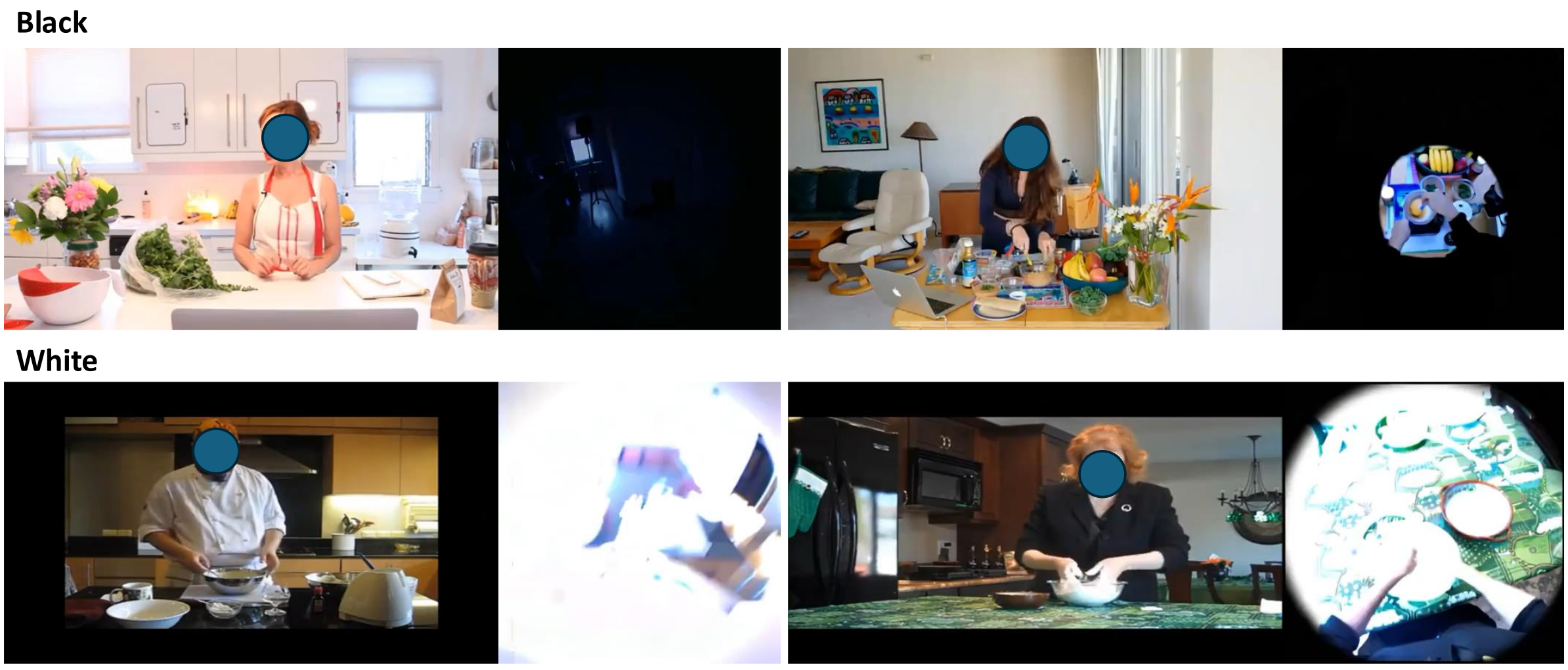
Black/white generations can arise when a person faces the source camera and the reconstructed egocentric prior sees little scene content. Figure 6 preserves representative examples. Other rejected footage includes title cards, overexposure, blur and sped-up tutorials with abrupt temporal changes.
A.3.3 Filtering EgoX-Body Generated Videos
Measure quality on the 326×326 ego crop. Keep clips only when mean near-black fraction is below .30, mean near-white fraction below .20, median Laplacian variance above 50 and median adjacent-grayscale mean absolute difference below 32.5.
Thresholds are chosen by inspecting clips near each cutoff and retain about 80% of candidates. Exact black/white pixel thresholds and quantitative filtering precision/recall are not reported; this heuristic rejects obvious artifacts rather than certifying interaction accuracy.