At a glance
PRTS adds temporally weighted contrastive learning to vision-language-action pretraining. State–action embeddings identify the relevant language goal, while a reverse contrastive objective ranks same-task examples by discounted distance to completion. A role-aware attention mask computes these representations alongside discrete action prediction in one backbone pass. After pretraining on 167.8B tokens, a continuous action expert is attached and fine-tuned. Evaluation covers simulation, 14 physical tasks, controlled shifts and qualitative intervention recovery; the learned scores are evidence of task/progress structure, not calibrated probabilities of arbitrary real-world success.
1 Introduction
The motivating gap is that immediate action imitation and general visual-language supervision do not explicitly teach progress toward a goal. PRTS supplies this signal from demonstration timing and task identity, drawing on contrastive reinforcement learning. It combines a multi-positive temporal objective, isolated state–action and language representations, and an efficient shared forward pass. Training remains offline and demonstration-based: the method adds an RL-inspired representation objective rather than collecting policy-improvement rollouts during pretraining.
2 Preliminaries
For the specified goal-reaching reward, a policy’s discounted return equals discounted future occupancy of the goal. Standard contrastive RL distinguishes future goal samples from marginally sampled goals, learning a log density ratio. Equation 7 includes both a goal-marginal correction and a state–action-dependent offset; raw embedding similarity therefore should not be read as an absolute success probability. This occupancy connection motivates PRTS, whose language goals require a different positive-sampling construction.
Equations 1–7
| (1) |
| (2) |
| (3) |
| (4) |
| (5) |
| (6) |
| (7) |
3 Method
The method adapts contrastive goal learning to task-labelled demonstrations, then integrates it into a backbone that also predicts action tokens. Continuous control is learned in a separate post-training stage.
3.1 Problem Setup
Each demonstration supplies a task instruction, camera images, proprioception and an action sequence. PRTS seeks representations that encode task identity and progress without separately annotated rewards, progress comparisons or a separately trained critic. Task labels and demonstration lengths still provide supervision; “reward-label-free” does not mean learning without structured data or an assumption that the demonstrations approach completion.
3.2 Language-Conditioned Contrastive Reinforcement Learning
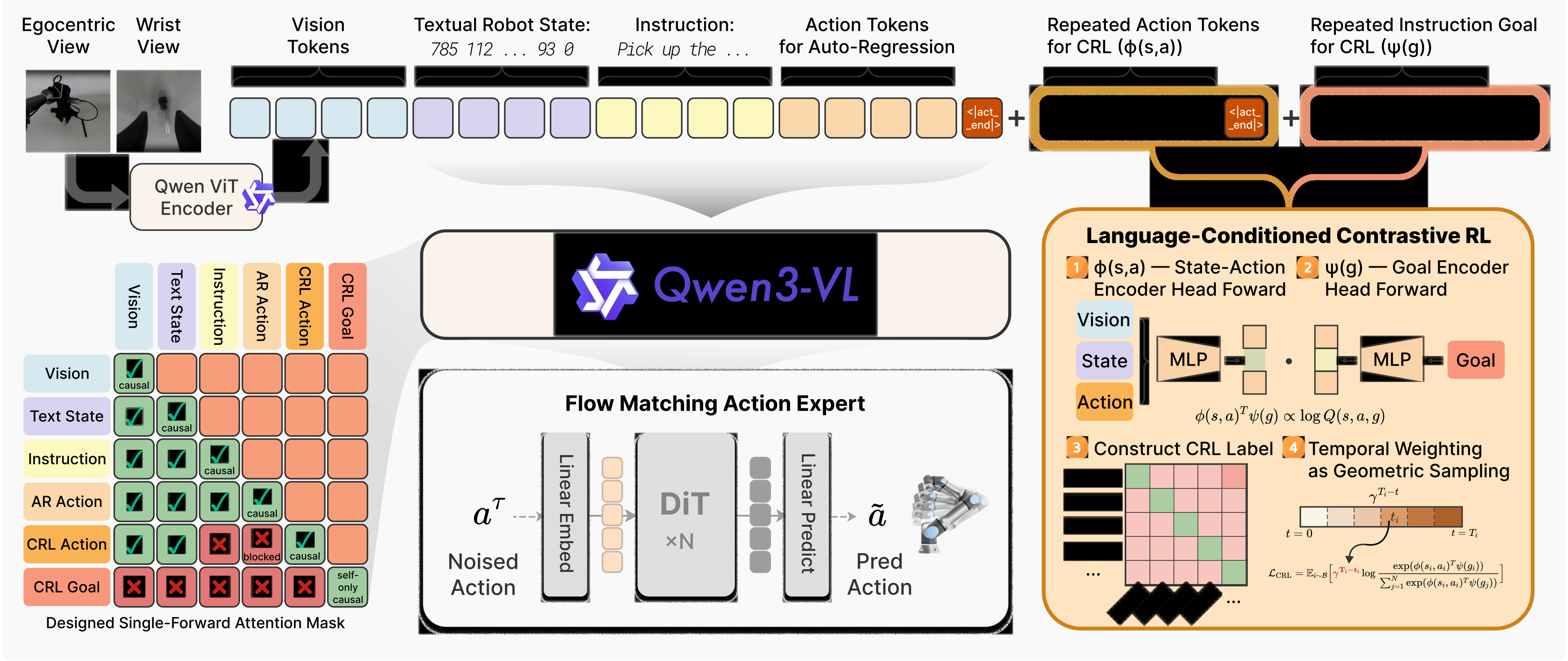
All batch samples from the same task are positives for its fixed language goal. Their normalized target weights are proportional to γ raised to the remaining trajectory length, emphasizing examples nearer completion. The state–action-to-language loss primarily distinguishes tasks; merely weighting each example’s classification loss does not impose an ordering within its trajectory. The reverse language-to-state–action loss distributes probability among multiple same-task positives according to those temporal weights, creating the progress signal.
Theorem 1 identifies the ideal reverse-objective similarity with log discounted occupancy plus a goal-dependent constant under deterministic expert demonstrations. Its interpretation relies on the terminal goal and trajectory assumptions made in Appendix B. It does not establish calibrated reachability for stochastic, failed or out-of-distribution behavior. Action chunks use the same construction with a chunk as the action representation.
Equations 8–13
| (8) |
| (9) |
| (10) |
| (11) |
| (12) |
| (13) |
3.3 PRTS Architecture
The Qwen3-VL backbone receives visual tokens, discretized textual robot state, instruction tokens and FAST action tokens. Two appended blocks repeat the action and instruction, ending in learned pooling tokens. The action-contrastive block can attend to vision, state and itself, but cannot read the language or autoregressive-action stream. The goal block attends only within its own instruction block. Ordinary action tokens retain causal attention. These restrictions prevent shortcut leakage between the two embeddings while preserving the usual action-prediction computation.
Small projection heads, normalization and a learned temperature produce contrastive scores; cross-device negatives enlarge the batch pool. Pretraining combines action-token, robot-QA, subtask and bidirectional contrastive losses. A custom CuTe attention kernel and sequence packing reduce overhead. Post-training adds a randomly initialized flow-matching DiT expert and uses only its continuous-action loss, with gradients also updating the backbone. The expert uses five denoising steps. The paper demonstrates representation shaping rather than an explicit deployment-time value-search procedure.
Equations 14–17
| (14) |
| (15) |
| (16) |
| (17) |
4 Datasets
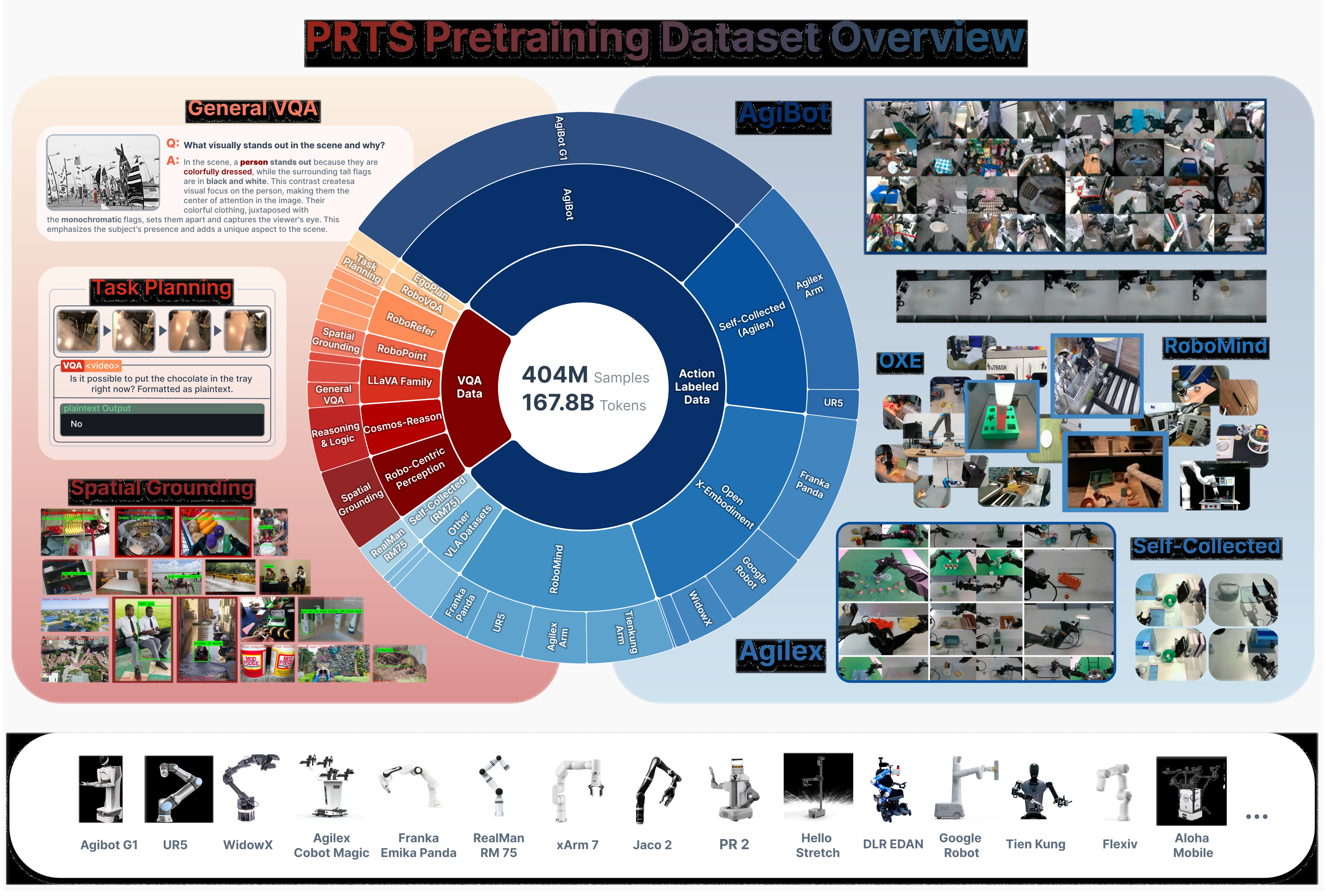
The reported corpus contains 404M samples and 167.8B tokens, divided between action-labelled robot experience and visual reasoning. The dataset diagram gives the original token-share breakdown.
4.1 Action-Labeled Data
Action supervision combines AgiBotWorld, RoboMind, Open X-Embodiment and internally collected RealMan/Agilex trajectories. The sources broaden task types, robot hardware, contact-rich manipulation and long-horizon coordination; some also provide fine-grained subtask labels. Their diversity supports pretraining, while downstream evaluation still uses task- and platform-specific demonstrations.
4.2 Visual-Reasoning Data
Grounding data cover referring expressions, pointing, spatial relations and affordances through RefCOCO, Pixmo-Point, RoboPoint, RoboRefIt, RefSpatial and RoboAfford. Cosmos-Reason1, EgoPlanIT and RoboVQA add physical/temporal reasoning and subgoal prediction. A curated LLaVA-Instruct subset preserves general vision-language competence. These complementary objectives mean the full model’s capabilities cannot be attributed to the contrastive loss alone; the matched ablation tests its incremental effect.
5 Related Work
PRTS builds on discrete-action VLAs and later systems that combine semantic supervision with continuous action experts. Its distinction from separate value modules is that the contrastive objective directly updates the shared vision-language representation. Contrastive RL supplies a classification-based alternative to Bellman or Monte Carlo regression; PRTS adapts that idea to fixed language goals and multiple timed positives. Claims about advantages over other training families should be separated from the narrower evidence of its own controlled ablation.
6 Experiments
Experiments examine nominal success, the contribution of contrastive pretraining, distribution shifts, instruction recombination, recovery after interventions, learned score structure and training efficiency. Simulation tables use benchmark-specific baseline sets; the physical comparison uses π₀ and π₀.₅.
6.1 Experimental Setup
Pretraining starts from Qwen3-VL-4B-Instruct with contrastive coefficient 1 and temporal discount 0.995. It uses packed length-4096 sequences, global batch 256, roughly 2K contrastive negatives, about 220K updates and one week on 64 H100s. The 675M-parameter action expert is attached afterward. Post-training schedules vary: LIBERO uses batch 32 for 30K steps and horizon 20; SimplerEnv uses 1024/20K/horizon 16; RealMan uses 64/100K/horizon 20; Flexiv uses 32/40K/horizon 20.
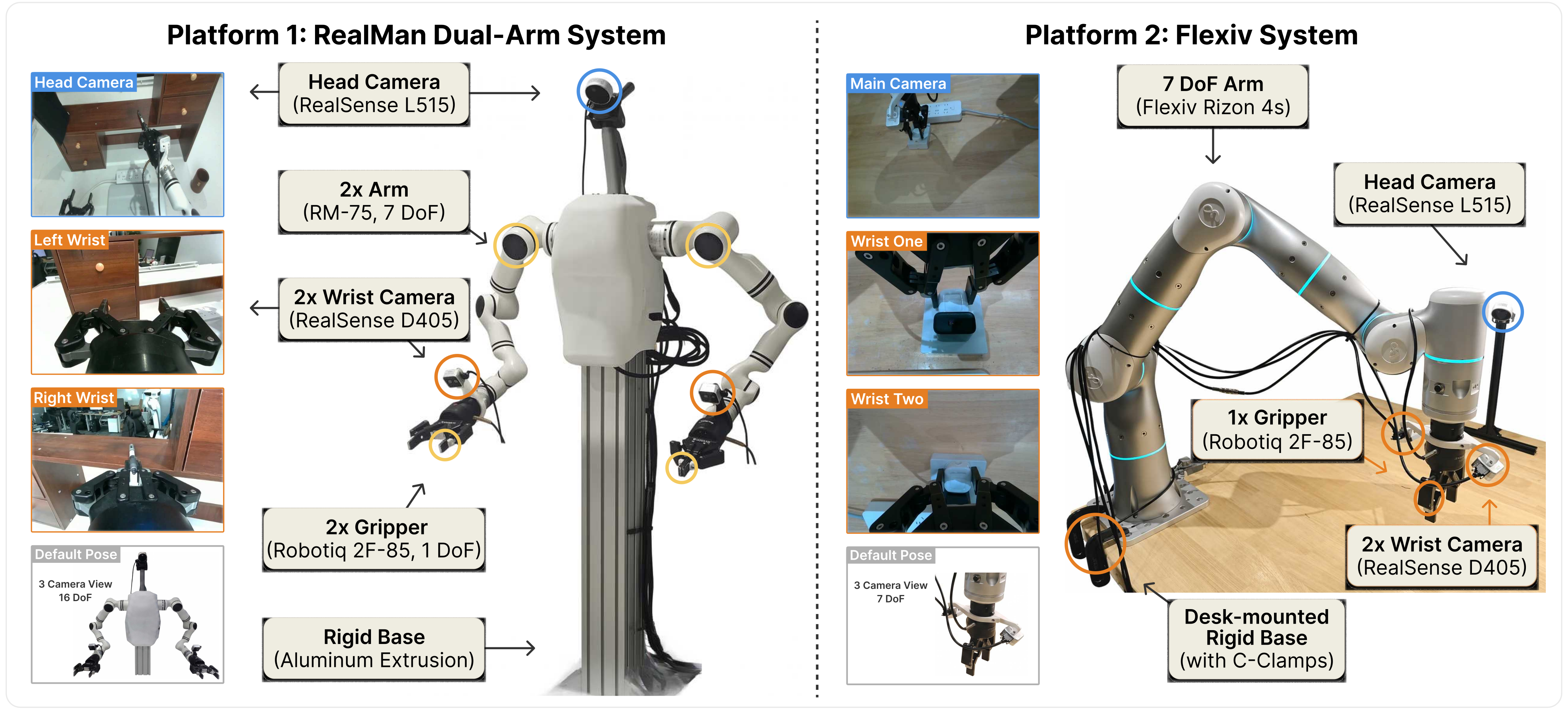
RealMan is a 14-DoF dual-arm platform with head and wrist cameras; Flexiv provides single-arm tasks. Each physical task cell has 20 trials. Flexiv permits up to five grasp attempts or two minutes; RealMan grasping tasks permit five feasible retries and a three-minute limit. Reported batch-times-step budgets make data exposure visible, but are not normalized total FLOPs across different backbones or pretraining corpora.
| Benchmark | Global batch size | Gradient steps | Action chunk |
| LIBERO | K | ||
| SimplerEnv (WidowX) | K | ||
| RealMan Dual-Arm Robot Platform (all-task fine-tuning) | K | ||
| Flexiv Robot Platform (single-task fine-tuning) | K |
6.2 Overall Performance
The standard-LIBERO checkpoint is evaluated directly on LIBERO-Plus and LIBERO-Pro, with no additional perturbation-specific training. SimplerEnv uses separate post-training on real BridgeData V2 trajectories. These are downstream adaptation and transfer results, rather than an entirely unadapted pretrained policy evaluation.
6.2.1 LIBERO
PRTS reaches 98.4% average LIBERO success and 96.6% on Long. At the same batch-32/30K-step budget, ABot-M0 reaches 97.9% average and 94.8% Long; its larger-budget reported model reaches 98.6% average. PRTS therefore approaches the best reported mean with less post-training exposure, rather than exceeding every baseline. The 0.5-point matched-budget advantage is small on this near-saturated benchmark.
| Method | Spatial | Object | Goal | Long | Average |
| Diffusion Policy (Chi et al., 2023) | 78.5 | 87.5 | 73.5 | 64.8 | 76.1 |
| OpenVLA (Kim et al., 2024) | 84.7 | 88.4 | 79.2 | 53.7 | 76.5 |
| SpatialVLA (Qu et al., 2025) | 88.2 | 89.9 | 78.6 | 55.5 | 78.1 |
| CoT-VLA (Zhao et al., 2025) | 87.5 | 91.6 | 87.6 | 69.0 | 83.9 |
| GR00T-N1 (Bjorck et al., 2025) | 94.4 | 97.6 | 93.0 | 90.6 | 93.9 |
| F1-VLA (Lv et al., 2025) | 98.2 | 97.8 | 95.4 | 91.3 | 95.7 |
| InternVLA-M1 (Chen et al., 2025) | 98.0 | 99.0 | 93.8 | 92.6 | 95.9 |
| Discrete Diffusion VLA (Liang et al., 2025) | 97.2 | 98.6 | 97.4 | 92.0 | 96.3 |
| GR00T-N1.6 (Bjorck et al., 2025) | 97.7 | 98.5 | 97.5 | 94.4 | 97.0 |
| OpenVLA-OFT (Kim et al., 2025) | 97.6 | 98.4 | 97.9 | 94.5 | 97.1 |
| X-VLA (Zheng et al., 2025) | 98.2 | 98.6 | 97.8 | 97.6 | 98.1 |
| -Fast (Pertsch et al., 2025) (bs=32, 30K steps) | 96.4 | 96.8 | 88.6 | 60.2 | 85.5 |
| (Black et al., 2024) (bs=32, 30K steps) | 96.8 | 98.8 | 95.8 | 85.2 | 94.2 |
| Qwen3-VL-PI (starVLA Contributors, 2025) (bs=32, 30K steps) | 95.2 | 99.0 | 96.2 | 88.4 | 94.7 |
| (Black et al., 2025) (bs=256, 30K steps) | 98.8 | 98.2 | 98.0 | 92.4 | 96.9 |
| ABot-M0 (Yang et al., 2026) (bs=32, 30K steps) | 98.6 | 99.6 | 98.6 | 94.8 | 97.9 |
| ABot-M0 (Yang et al., 2026) (bs=64, 40K steps) | 98.8 | 99.8 | 99.0 | 96.6 | 98.6 |
| PRTS (Ours) (bs=32, 30K steps) | 98.8 | 99.8 | 98.4 | 96.6 | 98.4 |
6.2.2 LIBERO-Plus
On LIBERO-Plus, PRTS averages 81.4% versus π₀.₅’s 80.7%. Gains are concentrated in robot-state and background shifts, while π₀.₅ is stronger on some other axes, including noise and layout. This supports an aggregate robustness improvement, not uniformly dominant performance under every perturbation.
| Method | Camera | Robot | Language | Light | Background | Noise | Layout | Average |
| OpenVLA (Kim et al., 2024) | 0.8 | 3.5 | 23.0 | 8.1 | 34.8 | 15.2 | 28.5 | 15.6 |
| WorldVLA (Cen et al., 2025) | 0.1 | 27.9 | 41.6 | 43.7 | 17.1 | 10.9 | 38.0 | 25.0 |
| NORA (Hung et al., 2025) | 2.2 | 37.0 | 65.1 | 45.7 | 58.6 | 12.8 | 62.1 | 39.0 |
| UniVLA (Bu et al., 2025) | 1.8 | 46.2 | 69.6 | 69.0 | 81.0 | 21.2 | 31.9 | 42.9 |
| RIPT-VLA (Tan et al., 2025) | 55.2 | 31.2 | 77.6 | 88.4 | 91.6 | 73.5 | 74.2 | 68.4 |
| OpenVLA-OFT (Kim et al., 2025) | 56.4 | 31.9 | 79.5 | 88.7 | 93.3 | 75.8 | 74.2 | 69.6 |
| (Black et al., 2024) (bs=32, 30K steps) | 13.8 | 6.0 | 58.8 | 85.0 | 81.4 | 79.0 | 68.9 | 53.6 |
| -Fast (Pertsch et al., 2025) (bs=32, 30K steps) | 65.1 | 21.6 | 61.0 | 73.2 | 73.2 | 74.4 | 68.8 | 61.6 |
| Qwen3-VL-PI (starVLA Contributors, 2025) (bs=32, 30K steps) | 43.6 | 46.6 | 81.8 | 88.4 | 89.4 | 70.1 | 74.7 | 68.9 |
| ABot-M0 (Yang et al., 2026) (bs=32, 30K steps) | 65.7 | 53.1 | 81.2 | 96.8 | 95.0 | 87.5 | 81.3 | 78.7 |
| (Black et al., 2025) (bs=256, 30K steps) | 64.0 | 58.0 | 88.5 | 96.6 | 81.4 | 87.5 | 85.9 | 80.7 |
| PRTS (Ours) (bs=32, 30K steps) | 59.5 | 72.4 | 89.6 | 96.5 | 96.7 | 81.3 | 83.3 | 81.4 |
6.2.3 LIBERO-Pro
LIBERO-Pro averages 58.8%, compared with 53.3% for π₀.₅. PRTS is strongest on Position at 24.3% and novel Task instructions at 31.5%; the latter compares with 0.8% for π₀.₅ and 22.3% for ABot-M0. Object/semantic axes are easier and are not all led by PRTS. Environment perturbations were omitted because their official assets were unavailable. The low absolute success on Position and Task remains a substantial limitation despite the relative gains.
| Method | Semantic | Object | Position | Task | Average |
| OpenVLA (Kim et al., 2024) | 97.2 | 93.0 | 0.0 | 0.0 | 47.6 |
| Qwen3-VL-PI (starVLA Contributors, 2025) (bs=32, 30K steps) | 95.5 | 70.4 | 4.3 | 3.9 | 43.5 |
| ABot-M0 (Yang et al., 2026) (bs=32, 30K steps) | 97.1 | 82.5 | 7.1 | 22.3 | 52.2 |
| (Black et al., 2024) (bs=32, 30K steps) | 90.5 | 90.5 | 0.0 | 0.0 | 45.3 |
| (Black et al., 2025) (bs=256, 30K steps) | 95.8 | 96.0 | 20.8 | 0.8 | 53.3 |
| PRTS (Ours) (bs=32, 30K steps) | 97.0 | 82.3 | 24.3 | 31.5 | 58.8 |
6.2.4 SimplerEnv with Visual Matching
On SimplerEnv’s WidowX visual-matching tasks, PRTS reaches 77.1% average versus GR00T-N1.5’s 61.9% under the stated matching post-training batch and update count. Scores are 83.3% for spoon placement, 66.6% for carrot placement, 58.3% for block stacking and 100% for eggplant placement. This demonstrates adaptation to another robot/data setting; it does not remove the BridgeData fine-tuning requirement.
| Method | Put Spoon On Towel | Put Carrot On Plate | Stack Green Block On Yellow Block | Put Eggplant In Yellow Basket | Average |
| OpenVLA (Kim et al., 2024) | 0.0 | 0.0 | 0.0 | 4.1 | 1.0 |
| RT-1-X (Collaboration., 2023) | 0.0 | 4.2 | 0.0 | 0.0 | 1.1 |
| OpenVLA-OFT (Kim et al., 2025) | 34.2 | 30.0 | 30.0 | 72.5 | 41.8 |
| SpatialVLA (Qu et al., 2025) | 16.7 | 25.0 | 29.2 | 100.0 | 42.7 |
| CogACT (Li et al., 2024a) | 71.7 | 50.8 | 15.0 | 67.5 | 51.3 |
| F1-VLA (Lv et al., 2025) | 50.0 | 70.8 | 50.0 | 66.7 | 59.4 |
| Qwen3-VL-PI (starVLA Contributors, 2025) | 78.1 | 46.9 | 30.2 | 88.5 | 60.9 |
| GR00T-N1.5 (Bjorck et al., 2025) | 75.3 | 54.3 | 57.0 | 61.3 | 61.9 |
| (Black et al., 2024) | 29.1 | 0.0 | 16.6 | 62.5 | 27.1 |
| (Black et al., 2025) | 29.2 | 41.7 | 0.0 | 41.7 | 28.2 |
| -Fast (Pertsch et al., 2025) | 29.1 | 21.9 | 10.8 | 66.6 | 48.3 |
| PRTS (Ours) | 83.3 | 66.6 | 58.3 | 100.0 | 77.1 |
6.2.5 Real-World Evaluation
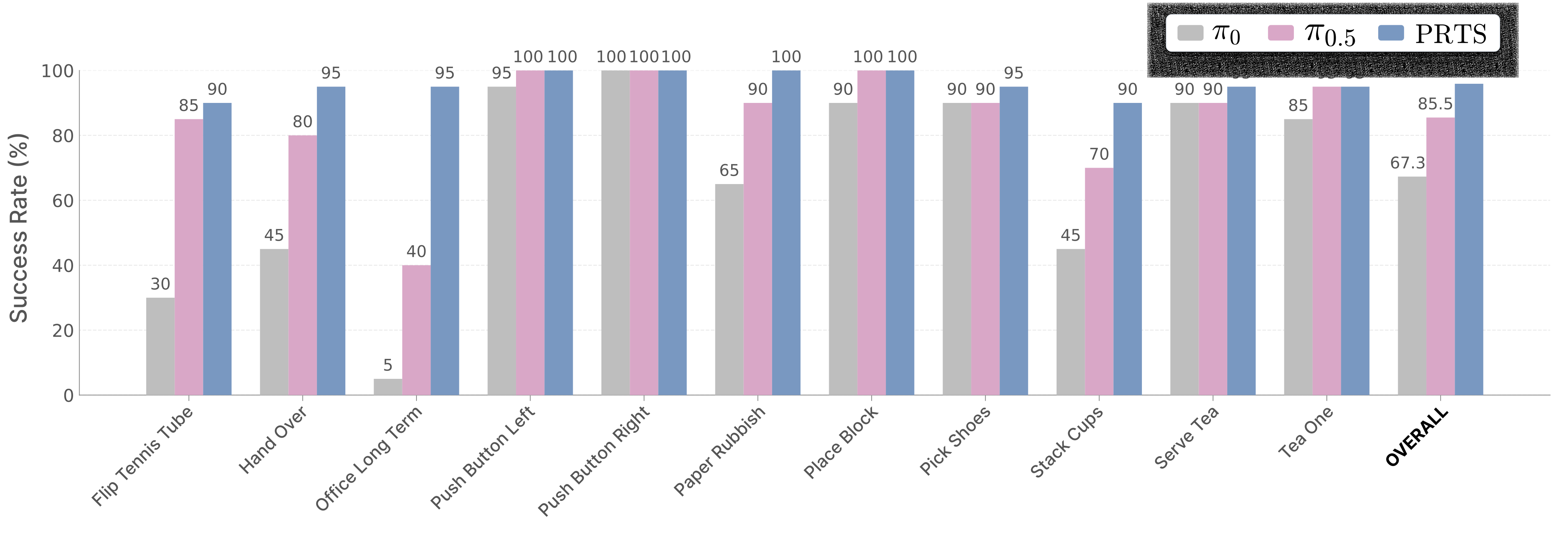
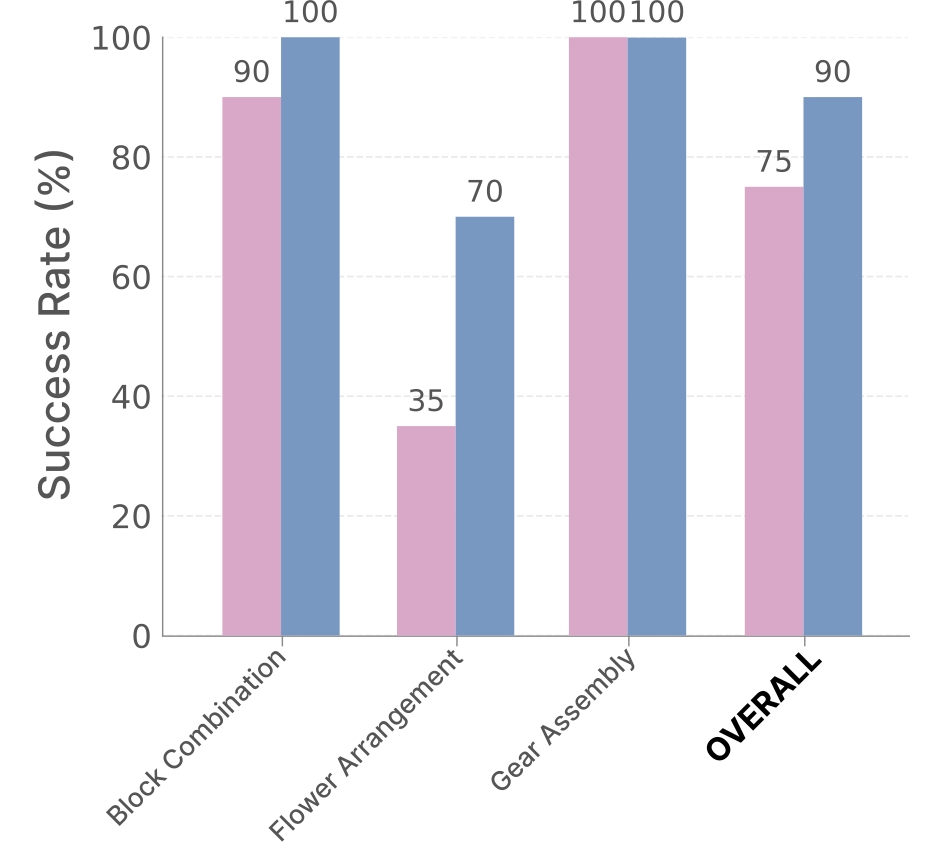
A single mixed-task RealMan checkpoint averages 95.9% across eleven tasks, versus 85.5% for π₀.₅ and 67.3% for π₀. All PRTS task scores are at least 90%; the long office sequence improves particularly strongly, from π₀.₅’s 40% to 95%. Flexiv instead uses per-task fine-tuning: PRTS averages 90% versus 75%, with 100% block combination, 70% flower arrangement and 100% gear assembly. These comparisons show strong task performance under the stated retries and time limits; the matched CRL ablation provides the more direct evidence about the objective itself.
6.3 Effect of Contrastive RL
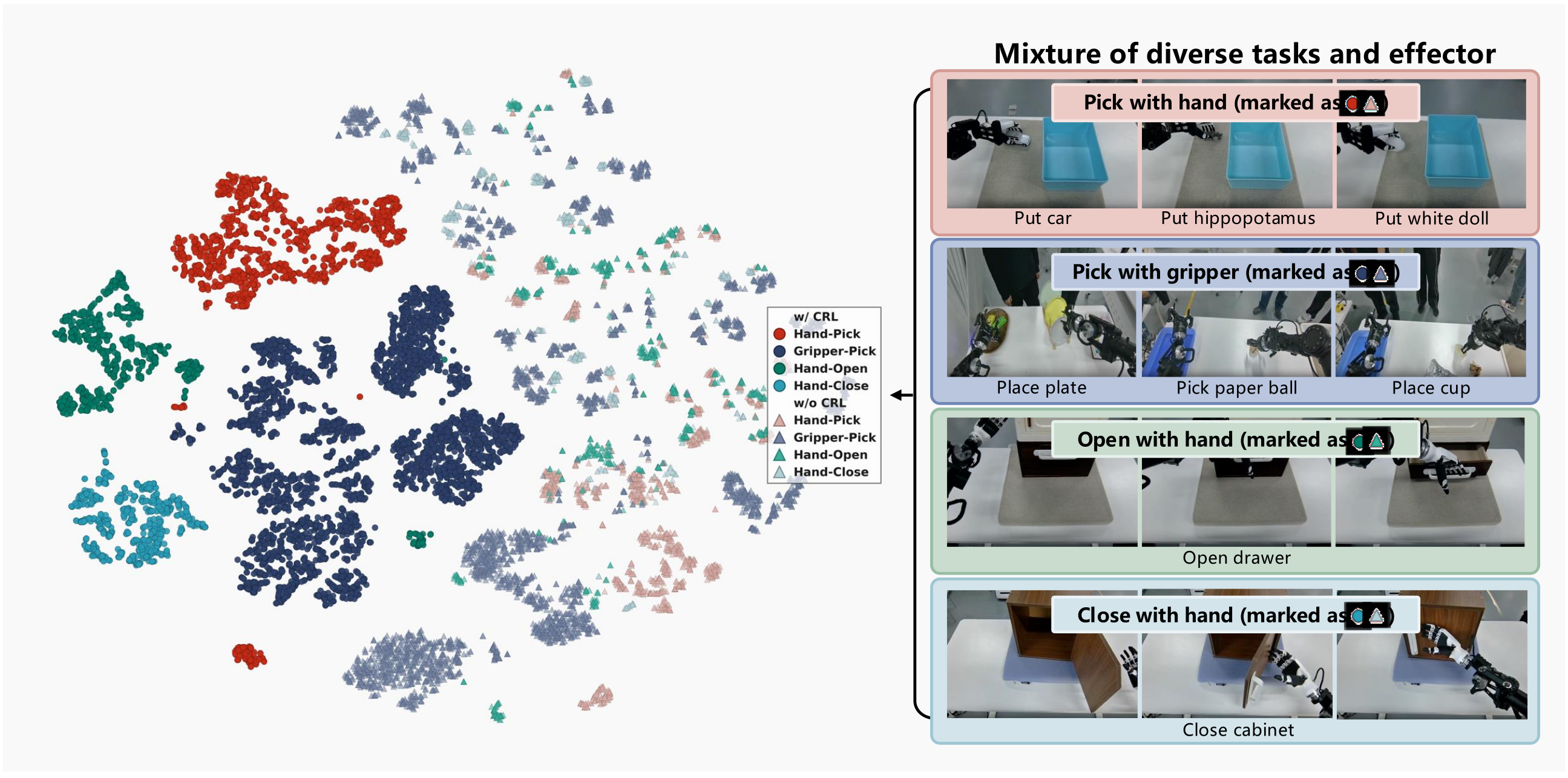
Removing CRL while holding PRTS architecture, data and downstream recipe fixed lowers average success from 98.4% to 97.8% on LIBERO, 81.4% to 76.5% on Plus, and 58.8% to 53.8% on Pro. The larger gains occur under shifts: Pro Position improves by 10.5 points and Task by 11.4. Effects are not universal: Object-Task falls from 10.0% to 8.8%, and Pro Object falls by 2.2 points. The accompanying t-SNE visualization shows more separated manipulation-related groups with CRL, but remains a qualitative projection rather than proof of causal compositional reasoning.
| Benchmark | Suite / Perturbation | PRTS w/o CRL | PRTS w/ CRL | |
| LIBERO | Spatial | 97.8 | 98.8 | +1.0 |
| Object | 99.8 | 99.8 | 0.0 | |
| Goal | 98.0 | 98.4 | +0.4 | |
| Long | 95.6 | 96.6 | +1.0 | |
| Average | 97.8 | 98.4 | +0.6 | |
| LIBERO-Plus | Camera | 56.7 | 59.5 | +2.8 |
| Robot | 56.1 | 72.4 | +16.3 | |
| Language | 87.3 | 89.6 | +2.3 | |
| Light | 96.4 | 96.5 | +0.1 | |
| Background | 95.8 | 96.7 | +0.9 | |
| Noise | 72.3 | 81.3 | +9.0 | |
| Layout | 82.9 | 83.3 | +0.4 | |
| Average | 76.5 | 81.4 | +4.9 | |
| LIBERO-Pro | Semantic | 96.8 | 97.0 | +0.2 |
| Object | 84.5 | 82.3 | -2.2 | |
| Position | 13.8 | 24.3 | +10.5 | |
| Task | 20.1 | 31.5 | +11.4 | |
| Average | 53.8 | 58.8 | +5.0 |
| Method | LIBERO-Spatial | LIBERO-Object | LIBERO-Goal | LIBERO-Long | ||||
| Pos (Avg.) | Task (Avg.) | Pos (Avg.) | Task (Avg.) | Pos (Avg.) | Task (Avg.) | Pos (Avg.) | Task (Avg.) | |
| PRTS w/o CRL | 26.8 | 34.4 | 4.8 | 10.0 | 13.0 | 20.2 | 10.4 | 15.6 |
| PRTS w/ CRL | 26.8 | 62.2 | 36.0 | 8.8 | 19.0 | 33.8 | 15.4 | 21.2 |
| 0.0 | +27.8 | +31.2 | -1.2 | +6.0 | +13.6 | +5.0 | +5.6 | |
6.4 Controlled Real-World Generalization
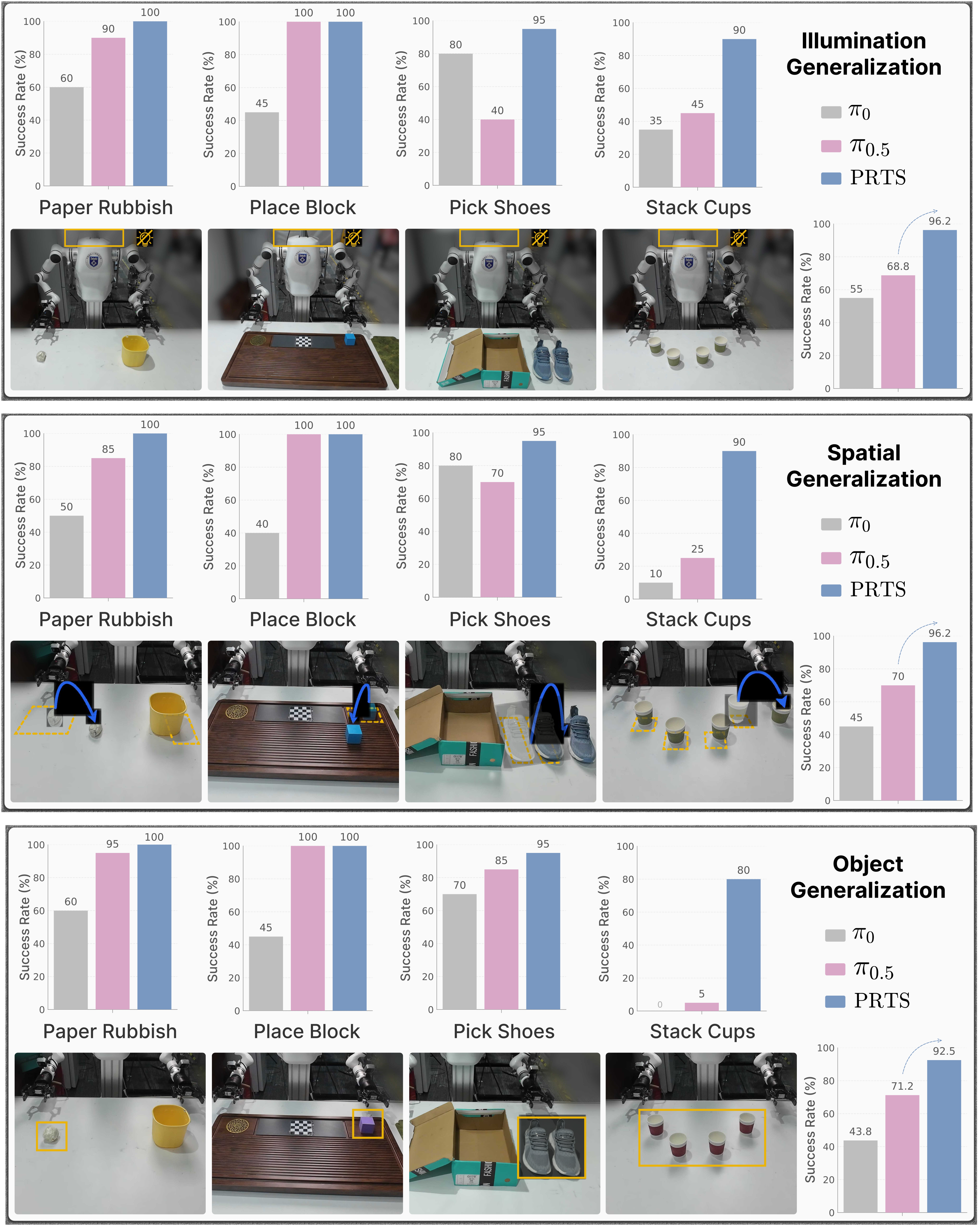
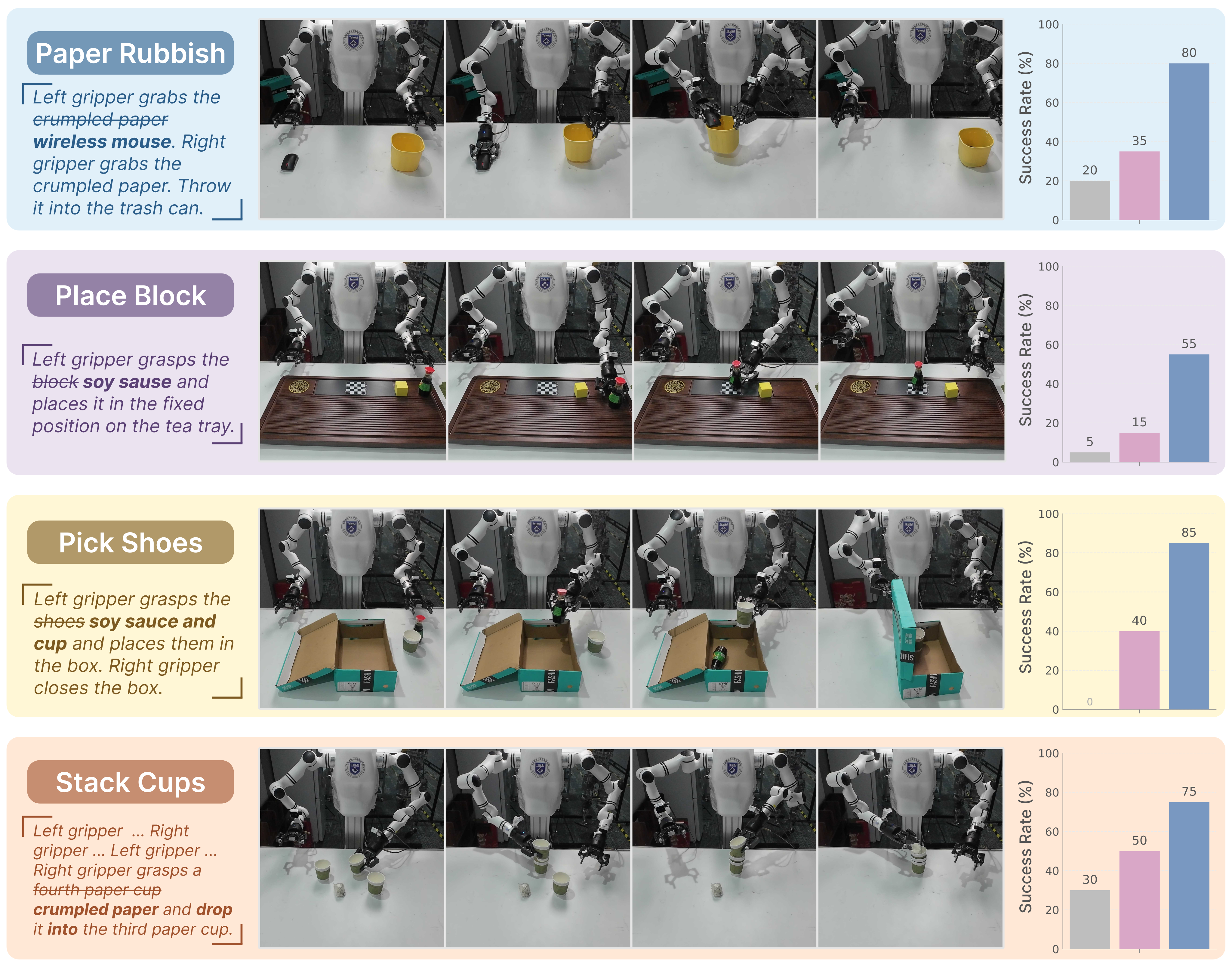
Four RealMan tasks are tested under illumination, position, same-category object and instruction changes. PRTS retains 80–100% success under the first three axes. Novel instructions recombine already learned skills: putting a mouse into the receptacle, selecting a soy-sauce bottle among distractors, packing a bottle and cup into the shoebox, and replacing the final cup-stack step with paper disposal. Their respective success rates are 80%, 55%, 85% and 75%, averaging 73.8% versus π₀.₅’s 35.0%. This is meaningful recombination of known primitives, with instruction changes still harder than visual shifts; it is not a test of arbitrary unseen motor skills.
6.5 Robustness and Recovery under Human Interventions
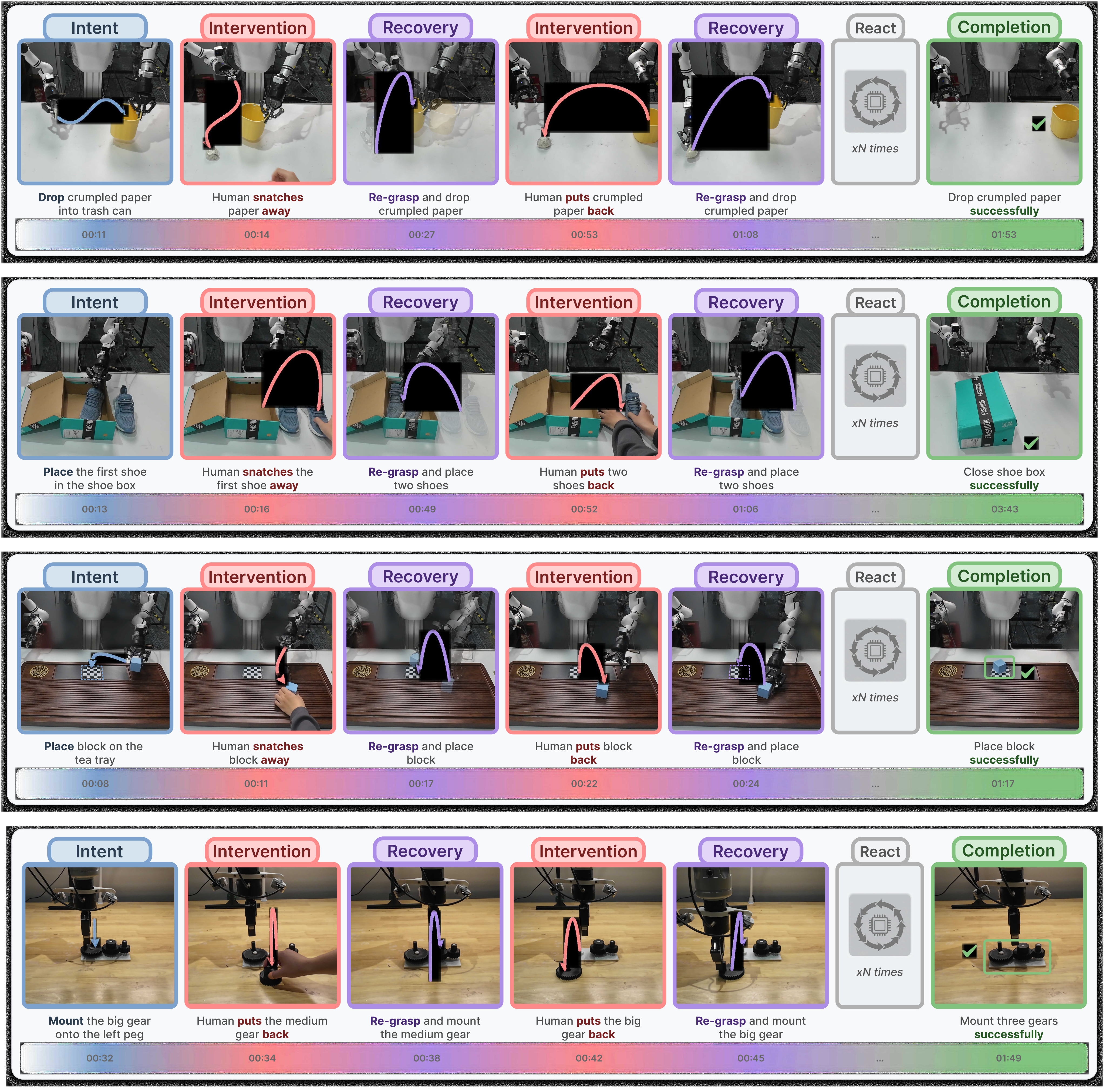
Intervention examples move objects before grasping, remove them during transport, or reset a completed stage. PRTS is reported to re-localize targets and resume the affected subgoals on Paper Rubbish, Pick Shoes, Place Block and Gear Assembly. The study uses roughly five trials per task and explicitly reports qualitative behavior instead of a formal success-rate table. It illustrates recovery, but does not quantify reliability or establish a broadly validated recovery guarantee.
6.6 CRL Value Visualization
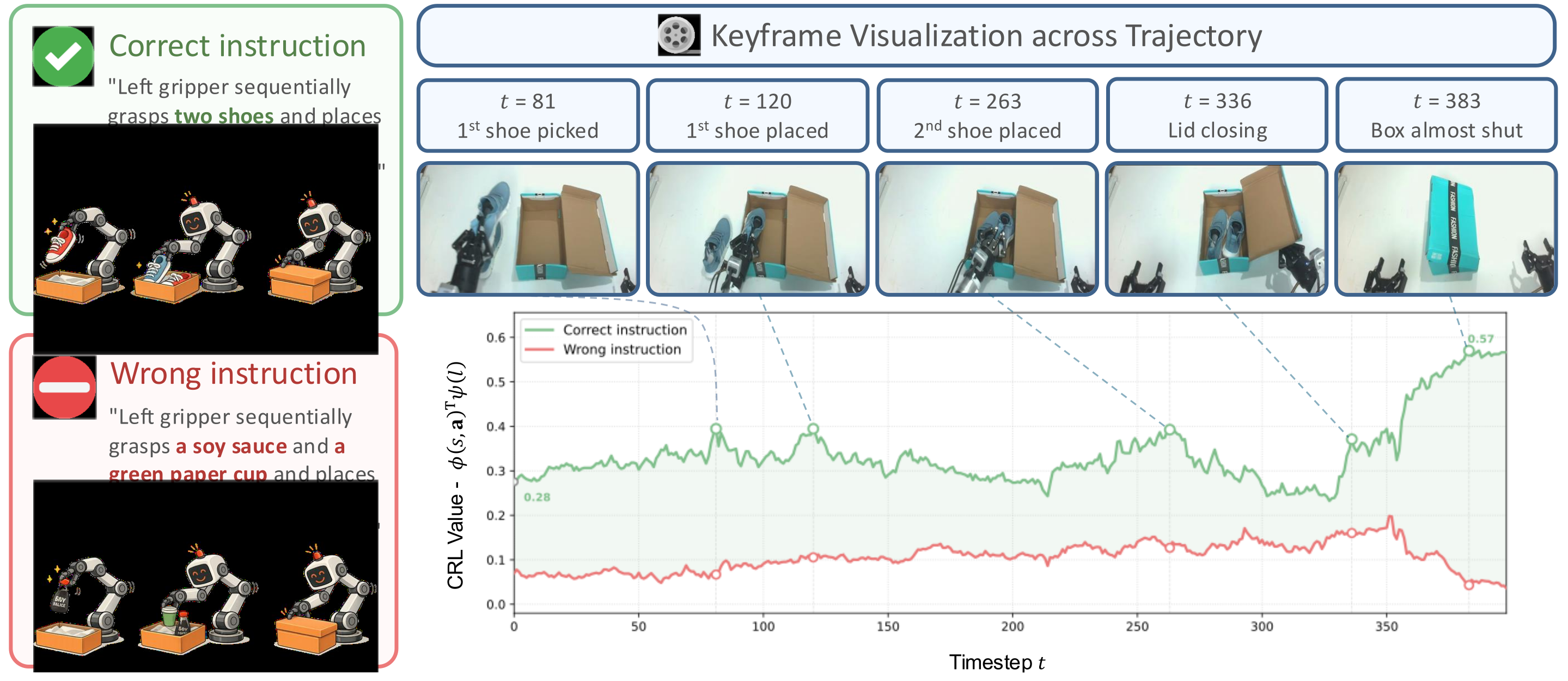
Before RealMan post-training, the contrastive heads score a held-out shoe-packing demonstration under its correct instruction and an incorrect bottle/cup instruction. The correct score rises overall from about 0.28 to 0.57, with increases near grasping, placement and lid closure; the incorrect score stays around 0.04–0.20. The curve is not strictly monotone. This single trajectory demonstrates instruction discrimination and progress sensitivity, but does not calibrate scores as probabilities or exhaustively distinguish physical feasibility from semantic mismatch.
6.7 Pre-training Efficiency
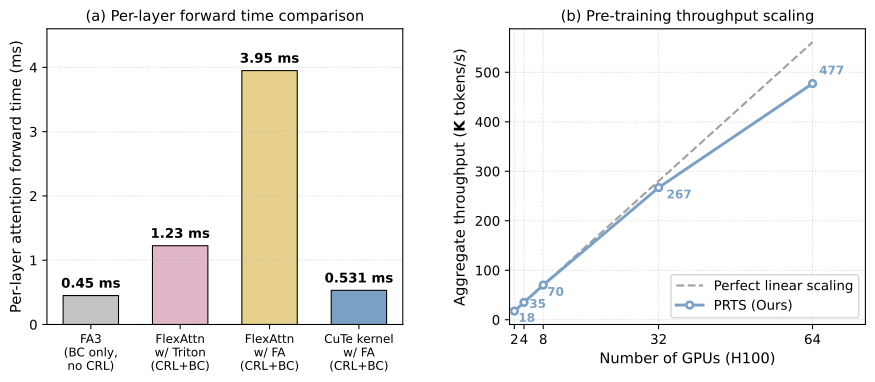
The fused role-aware CuTe kernel takes 0.531 ms per attention-layer forward pass versus 0.45 ms for BC-only FA3, a 1.18× ratio; the general FlexAttention alternatives are slower. Full-training throughput reaches about 477K tokens/s on 64 H100s, with reported scaling efficiencies of 95.2% at 32 GPUs and 85.1% at 64 relative to the two-GPU baseline. These measurements support modest kernel overhead and scalable implementation, not zero added cost. The microbenchmark prose says one H100 while Figure 10’s caption says two; the original discrepancy is retained.
7 Conclusion
The clearest result is that adding a temporally structured contrastive objective during large-scale pretraining improves downstream policy robustness, especially in the matched perturbation ablation. The method remains dependent on labelled demonstrations, terminal timing assumptions, substantial pretraining and task-specific continuous-action fine-tuning. Open limits include low success on difficult instruction/layout shifts, uncalibrated value scores, small qualitative recovery studies and the absence of a proof covering arbitrary stochastic or failed trajectories.
Appendix A Contributions
The contribution statement attributes data collection and standardization to Jiangyuan Zhao, Yang Zhang and Fangzheng Yan; infrastructure to a broader engineering team; architecture/algorithm and project leadership to Yang Zhang; training and evaluation to Zhang, Zhao and Chenyou Fan; and advising to Chenjia Bai. The full fourteen-author byline is retained.
Appendix B Proof of Theorem 1
The proof minimizes the reverse contrastive cross-entropy by matching its predicted distribution to the normalized temporal targets. Taking logarithms yields a score linear in remaining time, plus a goal/batch normalization term. It then equates this time dependence with discounted occupancy for a deterministic expert trajectory reaching the goal at its terminal step, absorbing constant factors into the offset.
This is an idealized objective argument. The proof assumes the stated terminal-visit structure, treats the batch-dependent normalization in expectation, and does not establish that a finite normalized neural model attains the exact optimum. It supplies a rationale for temporal representation learning rather than a general probability-calibration theorem for deployed policies.
Equations 18–25
| (18) |
| (19) |
| (20) |
| (21) |
| (22) | ||||
| (23) |
| (24) |
| (25) |
Comparison with Standard CRL.
Standard CRL samples future states geometrically; PRTS instead assigns explicit geometric weights to multiple state–action positives for a fixed language goal. This uses more same-task examples per batch and adapts the supervision to language labels. The claimed occupancy correspondence is conditional on the demonstration assumptions above, and the paper provides no separate quantitative variance comparison for the two estimators.
Appendix C Detailed real-world task descriptions and illustrations
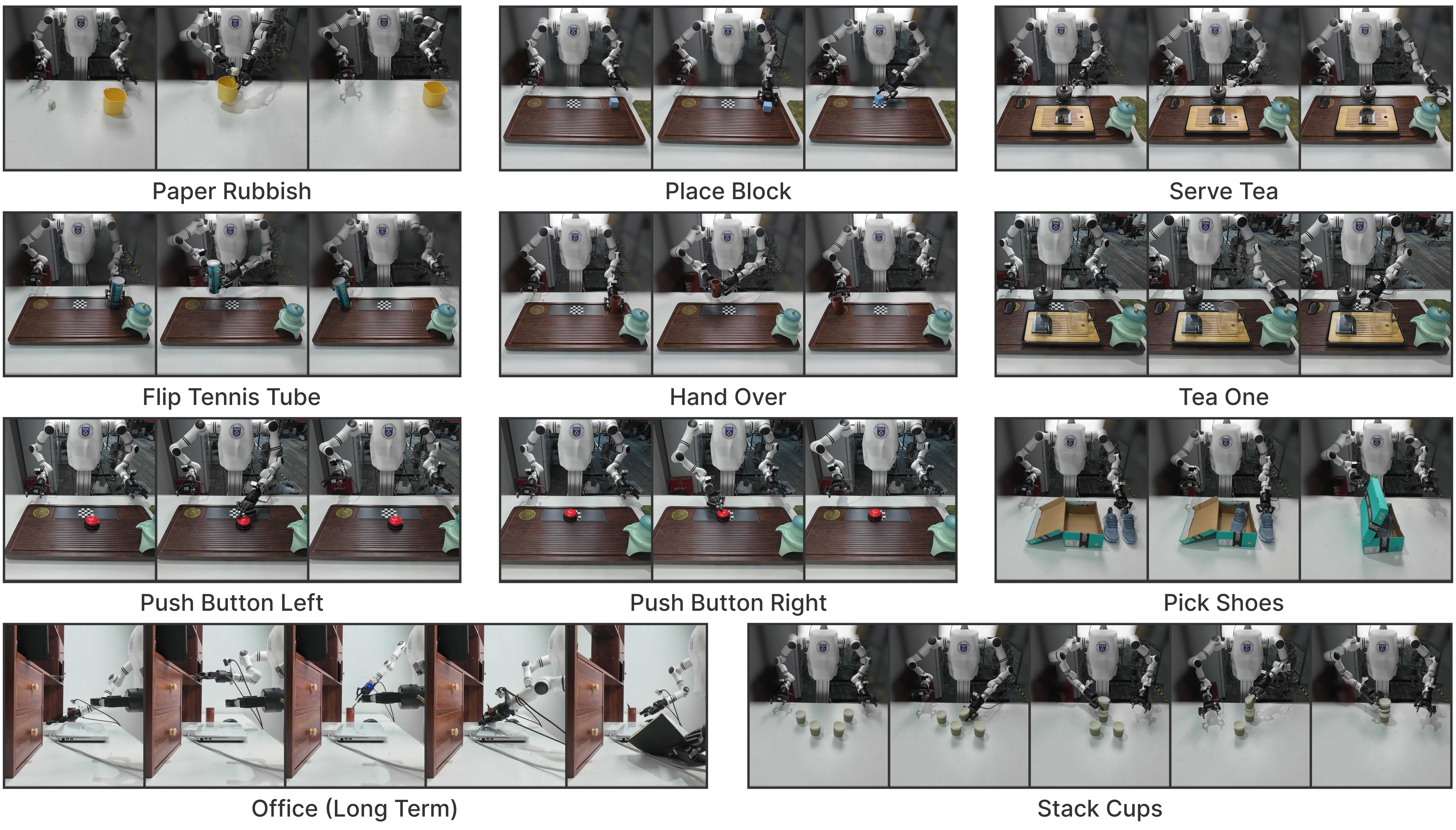
The appendix retains all task illustrations, per-task physical success rates and controlled-generalization results. The descriptions specify what must be manipulated and how substeps compose, while the main protocol supplies retry and time limits.
C.1 RealMan dual-arm tasks
The eleven dual-arm tasks cover paper disposal while holding the bin, block placement, serving a cup onto a coaster, transferring a tennis tube, handing over a pen holder, moving a cup and returning the arm, pressing left/right buttons, packing two shoes and closing the box, and alternating arms to stack four cups. The long office sequence places a mouse, inserts a pen, operates two switches and moves a book. Tables 8–9 retain all success cells and perturbation results; the task instructions make clear which operations are reused in the recombination tests.
C.2 Flexiv single-arm tasks
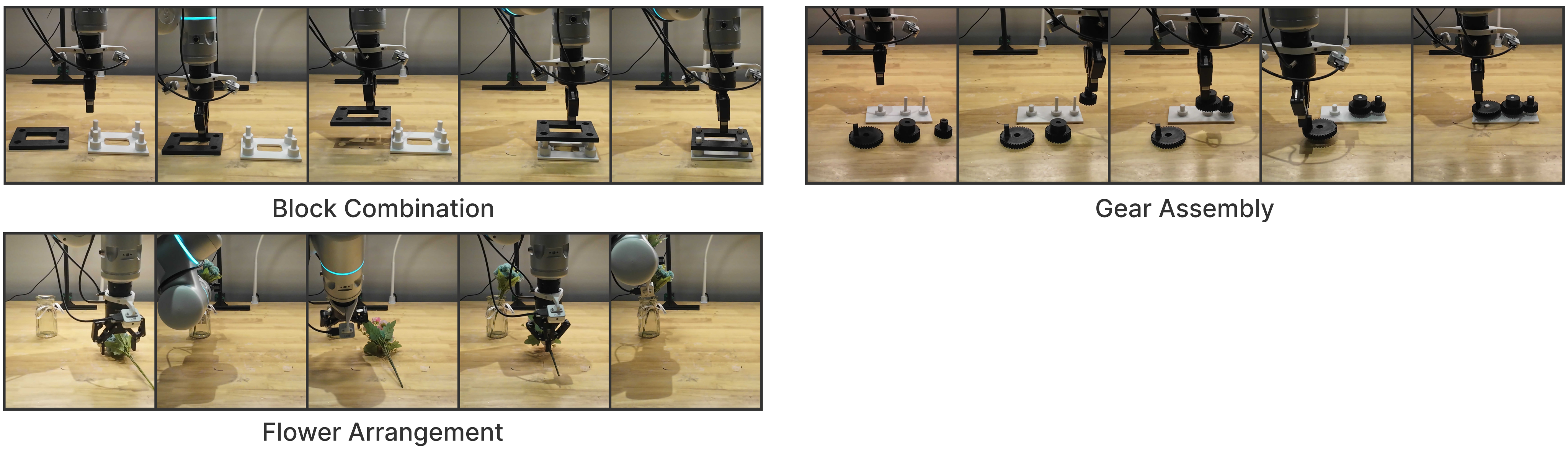
Flexiv performs three contact-sensitive sequences: aligning a four-hole plate with four posts, mounting three differently sized gears on designated posts, and placing two flowers into a glass receptacle. The original rollout panels show the objects and required placements. Each uses its own fine-tuned policy rather than the eleven-task shared RealMan checkpoint.
| Task | PRTS | ||
| Flip Tennis Tube | 30.0 | 85.0 | 90.0 |
| Hand Over | 45.0 | 80.0 | 95.0 |
| Office Long Term | 5.0 | 40.0 | 95.0 |
| Push Button Left | 95.0 | 100.0 | 100.0 |
| Push Button Right | 100.0 | 100.0 | 100.0 |
| Paper Rubbish | 65.0 | 90.0 | 100.0 |
| Place Block | 90.0 | 100.0 | 100.0 |
| Pick Shoes | 90.0 | 90.0 | 95.0 |
| Stack Cups | 45.0 | 70.0 | 90.0 |
| Serve Tea | 90.0 | 90.0 | 95.0 |
| Tea One | 85.0 | 95.0 | 95.0 |
| OVERALL | 67.3 | 85.5 | 95.9 |
| Method | Paper Rubbish | Place Block | Pick Shoes | Stack Cups | ||||||||||||
| Light | Pos | Obj | Task | Light | Pos | Obj | Task | Light | Pos | Obj | Task | Light | Pos | Obj | Task | |
| 60.0 | 50.0 | 60.0 | 20.0 | 45.0 | 40.0 | 45.0 | 5.0 | 80.0 | 80.0 | 70.0 | 0.0 | 35.0 | 10.0 | 0.0 | 30.0 | |
| 90.0 | 85.0 | 95.0 | 35.0 | 100.0 | 100.0 | 100.0 | 15.0 | 40.0 | 70.0 | 85.0 | 40.0 | 45.0 | 25.0 | 5.0 | 50.0 | |
| PRTS (Ours) | 100.0 | 100.0 | 100.0 | 80.0 | 100.0 | 100.0 | 100.0 | 55.0 | 95.0 | 95.0 | 95.0 | 85.0 | 90.0 | 90.0 | 80.0 | 75.0 |
Appendix D Detailed results on LIBERO-Pro Task and Position variations
The full LIBERO-Pro breakdown shows where aggregate gains remain uneven. PRTS’s novel-instruction success ranges from 62.2% on Spatial to 8.8% on Object, with 33.8% Goal and 21.2% Long. Position results are 26.8%, 36.0%, 19.0% and 15.4%, respectively; π₀.₅ is better on Goal-Position at 38.0%. These cells qualify the aggregate claim of stronger generalization and reveal substantial remaining failures.
| Method | libero-spatial | libero-object | libero-goal | libero-long | ||||
| Pos (Avg.) | Task (Avg.) | Pos (Avg.) | Task (Avg.) | Pos (Avg.) | Task (Avg.) | Pos (Avg.) | Task (Avg.) | |
| OpenVLA [Kim et al., 2024] | 0.0 | 0.0 | 0.0 | 0.0 | 0.0 | 0.0 | 0.0 | 0.0 |
| Qwen3-VL-PI [starVLA Contributors, 2025] (bs=32, 30K steps) | 14.4 | 0.0 | 0.2 | 0.0 | 1.2 | 8.8 | 1.2 | 6.8 |
| ABot-M0 [Yang et al., 2026] (bs=32, 30K steps) | 13.4 | 54.8 | 9.0 | 9.8 | 5.6 | 10.6 | 0.2 | 14.0 |
| [Black et al., 2024] (bs=32, 30K steps) | 0.0 | 0.0 | 0.0 | 0.0 | 0.0 | 0.0 | 0.0 | 0.0 |
| [Black et al., 2025] (bs=256, 30K steps) | 20.0 | 1.0 | 17.0 | 1.0 | 38.0 | 0.0 | 8.0 | 1.0 |
| PRTS (Ours) (bs=32, 30K steps) | 26.8 | 62.2 | 36.0 | 8.8 | 19.0 | 33.8 | 15.4 | 21.2 |