At a glance
Fast-WAM uses future-video prediction as a training objective but omits future-video generation during deployment. A pretrained video backbone encodes the current observation once, and an action expert denoises an action chunk. Controlled variants suggest that video co-training matters more than explicit test-time imagination on the evaluated tasks. Reported inference latency is 190 ms, versus 580 ms for joint generation and 810 ms for sequential video-then-action generation.
1 Introduction
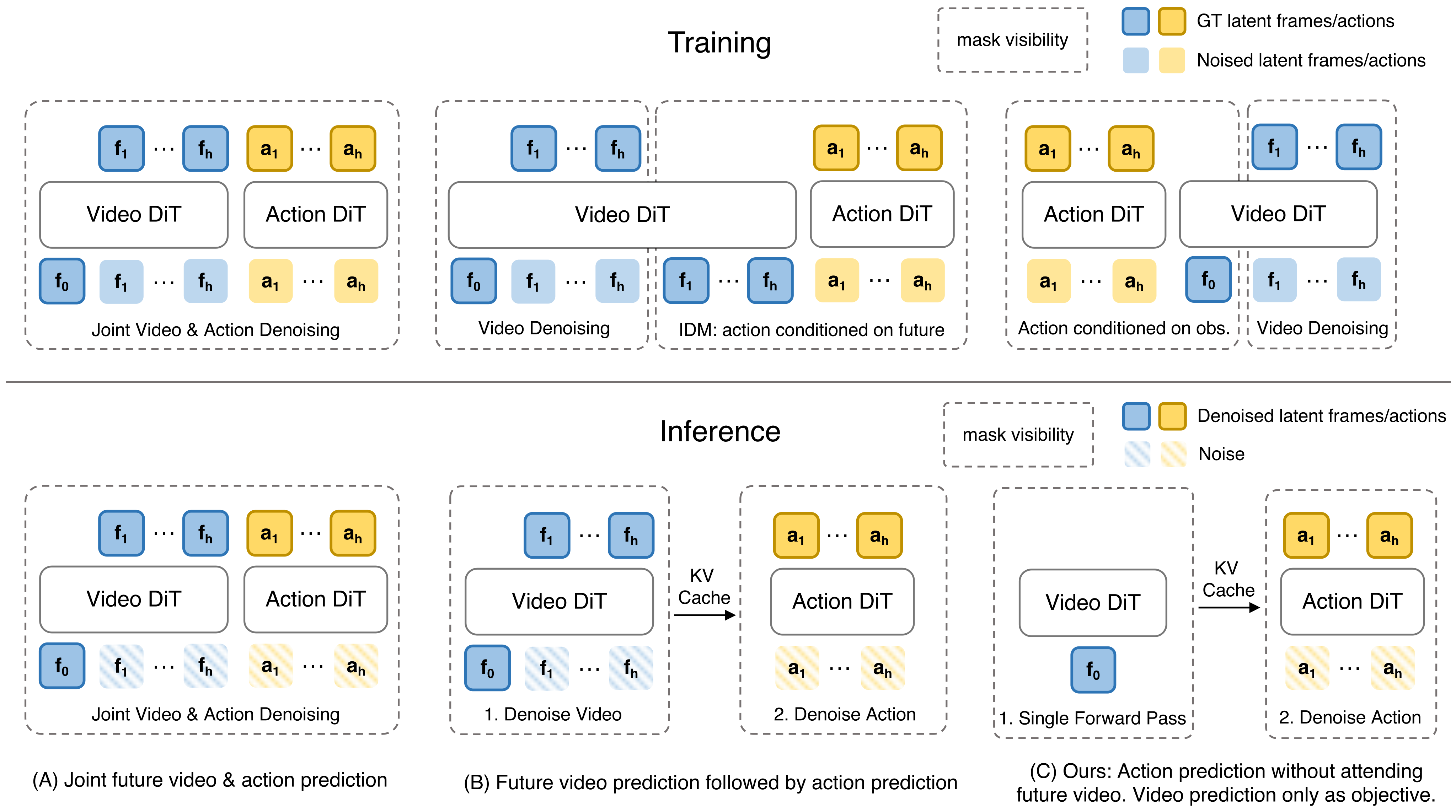
A world action model can benefit from predicting video in two different ways: the training loss can improve its representation, and generated future observations can guide actions at inference. Existing systems often combine both, obscuring which accounts for improved control. Fast-WAM separates them using a shared implementation with joint-generation, sequential-generation and no-video-co-training controls.
The central result is empirical: retaining video supervision while skipping future synthesis remains competitive on LIBERO, RoboTwin and one real towel-folding task. This does not prove that future imagination is unnecessary for all planning or out-of-distribution control. The comparison omits outer autoregressive rollout and tests a particular model/data regime. This edition covers all 13 pages of v2, dated 23 March 2026, including four complete numbered figures, both Figure 2 panels, all three tables, nine equations and 38 references.
2 Related Work
Vision-Language-Action Policies.
Policies such as OpenVLA and π₀.₅ inherit semantic knowledge from pretrained vision-language components and directly generate actions. Fast-WAM keeps a similarly direct deployment interface but uses future-video supervision to adapt its representation. This is a distinction between objectives and inference procedures, rather than a claim that every VLA lacks temporal knowledge.
World Action Models and Video-based Robot Policies.
Video-policy methods include joint video/action denoising and video-first action prediction, represented here by work such as Motus and LingBot-VA. Prior Video Prediction Policy and Unified Video Action Model also exploit predictive representations or reduce decoding cost. Fast-WAM emphasizes controlled comparisons of the training loss and inference dependency rather than claiming to originate every form of implicit video-based control.
3 Method
3.1 Problem Formulation
The standard policy predicts an action chunk from the current observation and instruction. An imagine-then-execute formulation introduces a future-video variable and integrates the action distribution conditioned on that future. Fast-WAM instead conditions actions on a deterministic latent representation z(o,l), obtained from the current context in one video-backbone pass.
The future-prediction loss still trains the backbone. Removing sampled future frames does not remove the pretrained video prior or all internal representations of dynamics. The experiment isolates explicit synthesis in these implementations, not whether the model internally represents future consequences.
Equations 1–4
| (1) |
| (2) |
| (3) |
| (4) |
3.2 Model Architecture
Overview.
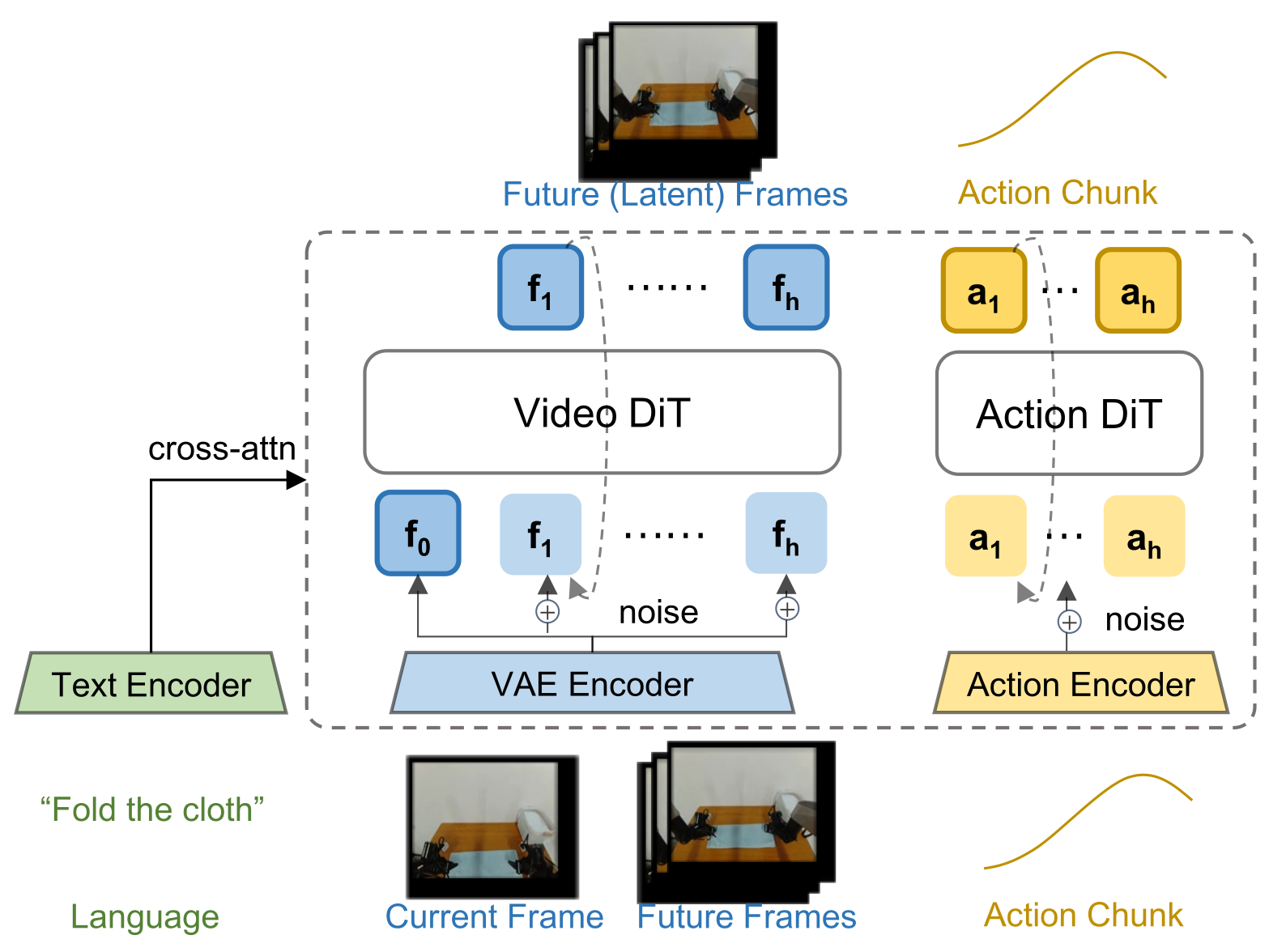
Training includes clean first-frame tokens, noisy future-video tokens and noisy action tokens. At deployment, the future tokens disappear. The clean visual context is encoded once and supplies features for action generation. “Single pass” refers to the video encoder: the action expert still performs ten denoising steps.
Architecture.
The backbone is a Wan video diffusion transformer, instantiated as Wan2.2-5B, with its pretrained T5 text encoder and video VAE. A separate action transformer shares attention with the video branch. Language reaches both branches through cross-attention.
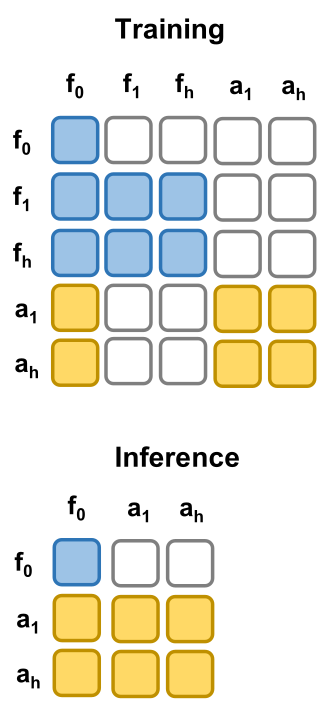
The mask is the key design: future-video tokens can access each other and the clean first frame; actions can access each other and the clean first frame, but cannot read future-video tokens. Clean first-frame tokens do not read future/action tokens. Thus video targets cannot leak into action conditioning during training. At inference, the current-frame representation can be cached while the action expert denoises. Figure 2 retains the complete architecture and both training/inference masks.
Training objective.
Both branches use flow matching: interpolate a clean target with Gaussian noise and regress the noise-minus-target velocity field. The total loss is action loss plus λ times the future-video loss. Action targets are chunks; video targets are VAE latents. The paper gives the objective but does not specify λ or every training/batch/image-resolution choice needed for a full reproduction.
Equations 5–9
| (5) |
| (6) |
| (7) |
| (8) |
| (9) |
3.3 Controlled Variants for Disentangled WAM Design
Fast-WAM-Joint allows video/action attention and denoises both together. Fast-WAM-IDM first generates future video, then conditions the action expert on that representation; its ground-truth video inputs receive noise augmentation with probability 0.5 during training. The no-video-co-training variant keeps Fast-WAM’s architecture and deployment procedure while removing the auxiliary video objective.
This last ablation is particularly informative because its inference latency stays unchanged. However, it still starts from a pretrained video backbone: the experiment removes robot-task video co-training, not all video learning. The imagination variants also differ in attention and training choices, so the comparison supports a design-level tradeoff rather than isolating a single mathematical variable under identical optimization.
4 Experiment
4.1 Implementation Details
The 5B video backbone and 1B action expert total approximately 6B parameters; the action expert uses hidden width 1,024. Actions have horizon 32, and fourfold temporal subsampling gives nine video frames per chunk. Multiple camera views are concatenated before VAE encoding.
Inference uses ten action-denoising steps and classifier-free guidance scale 1.0. The schedule is described as logit-normal. Training uses AdamW at 10⁻⁴ learning rate, 0.01 weight decay, cosine decay, mixed precision and gradient clipping at 1.0. Reported latency is measured on one RTX 5090D V2 with 32 GB memory. “Without embodied pretraining” means no additional robot-data pretraining, not training from scratch or absence of large-scale video/text pretraining.
4.2 Experiment Setup
The evaluation combines two simulation benchmarks with a single physical towel-folding task. Success percentages summarize task outcomes; inference latency measures computational delay, while physical completion time includes the behavior selected by the policy. These are distinct metrics.
LIBERO.
LIBERO comprises four suites of ten tasks, each with 500 demonstrations. Models train for 20,000 steps. Evaluation uses 2,000 trials across 40 tasks with varied random seeds. The paper does not report uncertainty across independent training runs, so small differences near saturation are not established statistical equivalence.
RoboTwin 2.0.
RoboTwin 2.0 training mixes 2,500 clean and 25,000 randomized demonstrations, with 30,000 optimization steps. Evaluation reports 100 trials per task under each clean/randomized condition. Although the prose says “over 50” tasks, the complete results table contains exactly 50 task rows. Its 14 column means recompute exactly to the printed averages.
Real-World Evaluation.
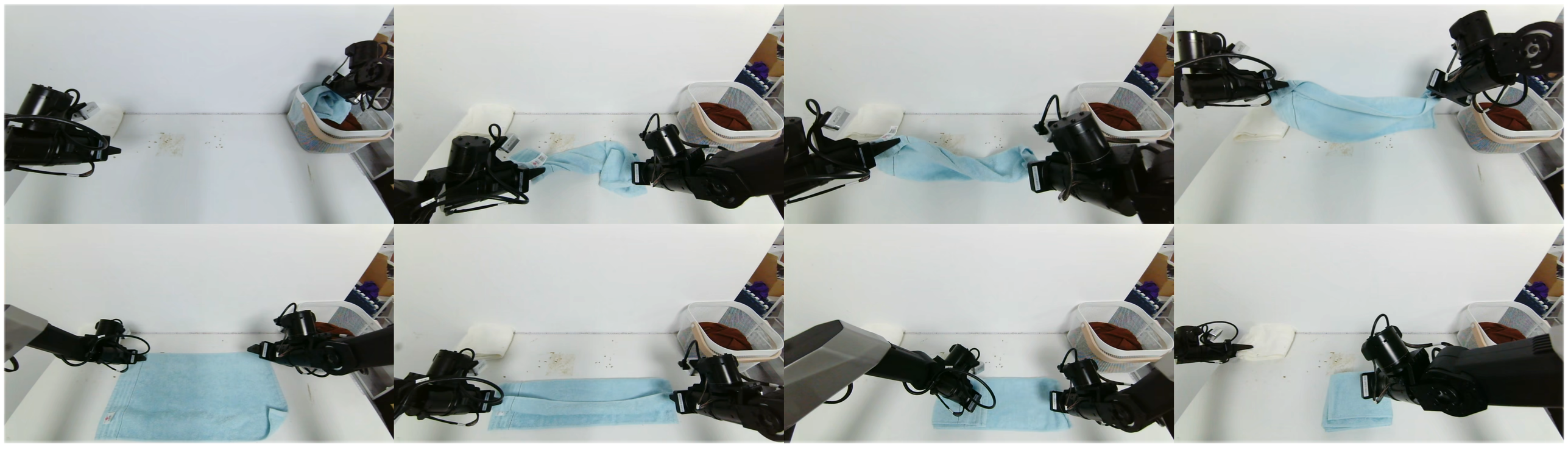
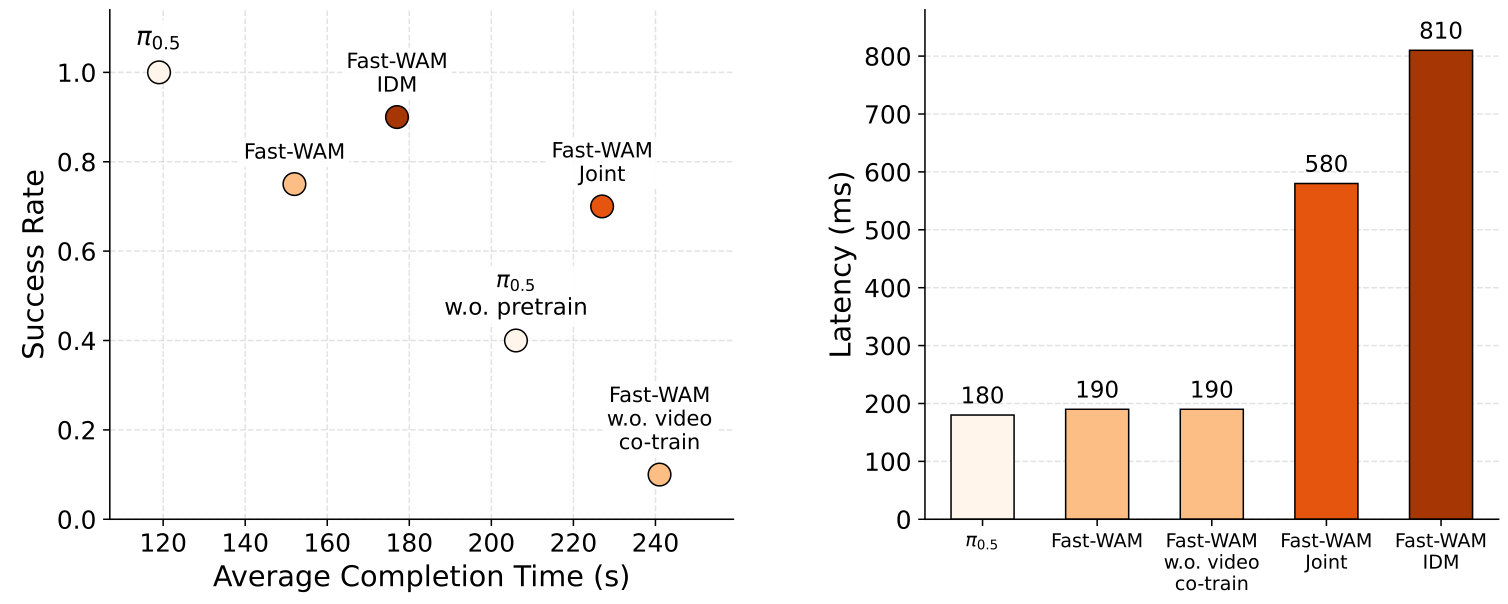
The real experiment uses 60 hours of teleoperated towel folding on Galaxea R1 Lite, with 30,000 training steps. It measures success and mean completion time to distinguish an efficient fold from repeated correction. Figure 3 retains all eight demonstration images. Trial counts, success criteria, timeout/censoring rules and confidence intervals are not specified, limiting interpretation of the scatter plot.
4.3 Main Results
4.3.1 Overall comparison on simulation benchmarks
Fast-WAM scores 91.88% clean and 91.78% randomized on RoboTwin, averaging 91.8%. Pretrained LingBot-VA is slightly higher at 92.2%; pretrained Motus scores 87.8%, and Motus initialized from Wan without embodied pretraining scores 77.3%. The 80.6% LingBot-VA-from-Wan comparison has only a clean result, with the randomized cell missing; it is not a matched two-condition average.
On LIBERO, Fast-WAM gives Spatial/Object/Goal/Long scores of 98.2/100.0/97.0/95.2%, averaging 97.6%. The reported pretrained baselines include π₀.₅ at 96.9%, Motus at 97.7% and LingBot-VA at 98.5%. These are strong benchmark results, but the table mixes methods with different pretraining data and does not make Fast-WAM uniformly best.
| Method | Embodied PT. | Clean | Rand. | Average |
| [10] | ✓ | 65.92 | 58.40 | 62.2 |
| [11] | ✓ | 82.74 | 76.76 | 79.8 |
| Motus [5] | ✓ | 88.66 | 87.02 | 87.8 |
| Motus from WAN2.2 | ✗ | 77.56 | 77.00 | 77.3 |
| LingBot-VA [3] | ✓ | 92.90 | 91.50 | 92.2 |
| LingBot-VA from WAN2.2 | ✗ | 80.60 | – | 80.6 |
| Fast-WAM (Ours) | ✗ | 91.88 | 91.78 | 91.8 |
| Fast-WAM Variants | ||||
| Fast-WAM | ✗ | 91.88 | 91.78 | 91.8 |
| Fast-WAM-Joint | ✗ | 90.84 | 90.32 | 90.6 |
| Fast-WAM-IDM | ✗ | 91.16 | 91.34 | 91.3 |
| Fast-WAM w.o. video co-train | ✗ | 82.76 | 84.80 | 83.8 |
| Method | Embodied PT. | Spatial | Object | Goal | Long | Average |
| OpenVLA [9] | ✓ | 84.7 | 88.4 | 79.2 | 53.7 | 76.5 |
| [10] | ✓ | 96.8 | 98.8 | 95.8 | 85.2 | 94.1 |
| [11] | ✓ | 98.8 | 98.2 | 98.0 | 92.4 | 96.9 |
| LingBot-VA [3] | ✓ | 98.5 | 99.6 | 97.2 | 98.5 | 98.5 |
| Motus [5] | ✓ | 96.8 | 99.8 | 96.6 | 97.6 | 97.7 |
| Fast-WAM (Ours) | ✗ | 98.2 | 100.0 | 97.0 | 95.2 | 97.6 |
| Fast-WAM Variants | ||||||
| Fast-WAM | ✗ | 98.2 | 100.0 | 97.0 | 95.2 | 97.6 |
| Fast-WAM-Joint | ✗ | 99.6 | 99.4 | 98.2 | 96.8 | 98.5 |
| Fast-WAM-IDM | ✗ | 98.8 | 97.8 | 97.8 | 97.6 | 98.0 |
| Fast-WAM w.o. video co-train | ✗ | 89.2 | 99.2 | 95.4 | 90.0 | 93.5 |
4.3.2 Controlled comparison with Fast-WAM variants
On RoboTwin, Fast-WAM/Joint/IDM score 91.8/90.6/91.3%; removing video co-training gives 83.8%, an 8.0-point drop. On LIBERO, the corresponding scores are 97.6/98.5/98.0%, versus 93.5% without video co-training, a 4.1-point drop. The largest LIBERO ablation losses are Spatial (98.2→89.2%) and Long (95.2→90.0%).
These differences support the auxiliary training objective in this setting. Explicit imagination is not consistently better or worse across the two benchmarks, and no confidence intervals establish equivalence between close scores. Better task performance is compatible with improved representations, but the paper does not directly measure their physical accuracy or causal content.
4.3.3 Real-world performance and efficiency
Pretrained π₀.₅ has the best plotted real-world success and completion time. Within the Fast-WAM family, IDM has the highest success, while Fast-WAM finishes faster. The plot places Fast-WAM at roughly 75% success and 150 seconds, IDM near 90% and 175 seconds, and Joint near 70% and 225 seconds; these are visual readings, not tabulated measurements. The no-video variant is explicitly reported at only 10% success and has the longest completion time.
Latencies are 180 ms for π₀.₅, 190 ms for Fast-WAM and its no-video ablation, 580 ms for Joint, and 810 ms for IDM. Thus Fast-WAM is approximately 3.1× faster than Joint and 4.3× faster than IDM; the headline “over 4×” applies to the latter comparison. It is not faster than π₀.₅ in this chart. Chunk inference latency is not the per-action actuator update period, and physical completion time cannot be inferred from latency alone.
The fixed-latency auxiliary-loss ablation provides stronger evidence for training benefit than the plot provides for universal dispensability of imagination. One real task, unspecified rollout counts and no uncertainty estimates leave the generalization scope open.
5 Conclusion
The demonstrated design uses video prediction to train a policy representation while avoiding its expensive explicit synthesis at deployment. It preserves high benchmark success with much lower latency than two imagination-based variants, although sequential imagination improves real-task success in the reported comparison. Larger-scale pretraining and model scaling remain future work; the results do not settle whether explicit look-ahead helps on tasks requiring search, counterfactual reasoning or unseen dynamics.
Appendix A Appendix
A.1 RoboTwin Detailed Results
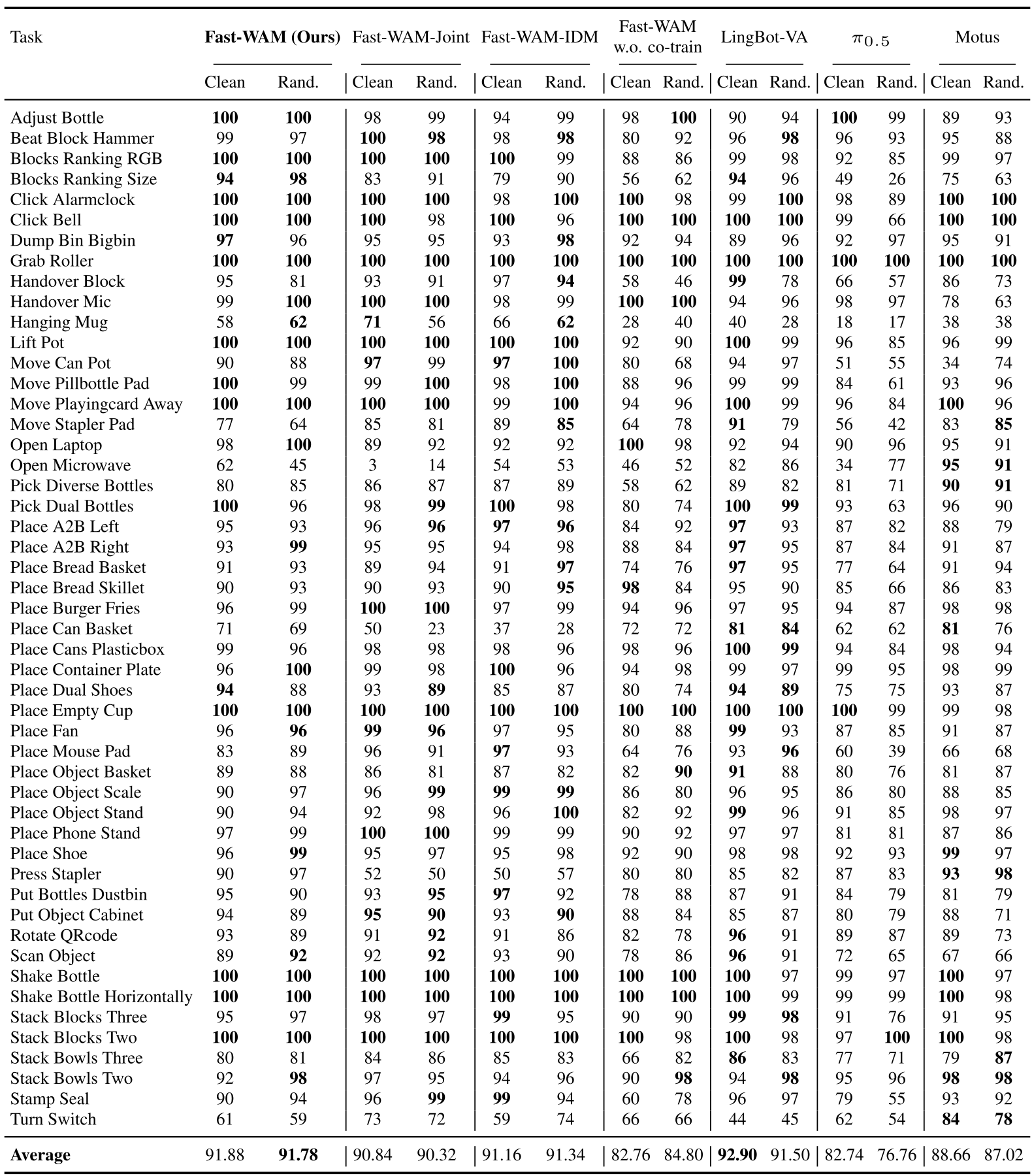
Table 3 preserves all 50 RoboTwin task rows for seven methods under clean and randomized conditions. The averages conceal meaningful task differences: Fast-WAM exceeds Joint/IDM on randomized Press Stapler (97% versus 50/57%) and Place Can Basket (69% versus 23/28%), but trails them on randomized Handover Block (81% versus 91/94%) and Move Stapler Pad (64% versus 81/85%). Hanging Mug and Open Microwave remain difficult. The no-video variant even exceeds Fast-WAM on some cells, so the auxiliary objective improves the aggregate without winning every individual task.
Original selectable table
| Task | Fast-WAM (Ours) | Fast-WAM-Joint | Fast-WAM-IDM | Fast-WAM w.o. co-train | LingBot-VA | Motus | ||||||||
| Clean | Rand. | Clean | Rand. | Clean | Rand. | Clean | Rand. | Clean | Rand. | Clean | Rand. | Clean | Rand. | |
| Adjust Bottle | 100 | 100 | 98 | 99 | 94 | 99 | 98 | 100 | 90 | 94 | 100 | 99 | 89 | 93 |
| Beat Block Hammer | 99 | 97 | 100 | 98 | 98 | 98 | 80 | 92 | 96 | 98 | 96 | 93 | 95 | 88 |
| Blocks Ranking RGB | 100 | 100 | 100 | 100 | 100 | 99 | 88 | 86 | 99 | 98 | 92 | 85 | 99 | 97 |
| Blocks Ranking Size | 94 | 98 | 83 | 91 | 79 | 90 | 56 | 62 | 94 | 96 | 49 | 26 | 75 | 63 |
| Click Alarmclock | 100 | 100 | 100 | 100 | 98 | 100 | 100 | 98 | 99 | 100 | 98 | 89 | 100 | 100 |
| Click Bell | 100 | 100 | 100 | 98 | 100 | 96 | 100 | 100 | 100 | 100 | 99 | 66 | 100 | 100 |
| Dump Bin Bigbin | 97 | 96 | 95 | 95 | 93 | 98 | 92 | 94 | 89 | 96 | 92 | 97 | 95 | 91 |
| Grab Roller | 100 | 100 | 100 | 100 | 100 | 100 | 100 | 100 | 100 | 100 | 100 | 100 | 100 | 100 |
| Handover Block | 95 | 81 | 93 | 91 | 97 | 94 | 58 | 46 | 99 | 78 | 66 | 57 | 86 | 73 |
| Handover Mic | 99 | 100 | 100 | 100 | 98 | 99 | 100 | 100 | 94 | 96 | 98 | 97 | 78 | 63 |
| Hanging Mug | 58 | 62 | 71 | 56 | 66 | 62 | 28 | 40 | 40 | 28 | 18 | 17 | 38 | 38 |
| Lift Pot | 100 | 100 | 100 | 100 | 100 | 100 | 92 | 90 | 100 | 99 | 96 | 85 | 96 | 99 |
| Move Can Pot | 90 | 88 | 97 | 99 | 97 | 100 | 80 | 68 | 94 | 97 | 51 | 55 | 34 | 74 |
| Move Pillbottle Pad | 100 | 99 | 99 | 100 | 98 | 100 | 88 | 96 | 99 | 99 | 84 | 61 | 93 | 96 |
| Move Playingcard Away | 100 | 100 | 100 | 100 | 99 | 100 | 94 | 96 | 100 | 99 | 96 | 84 | 100 | 96 |
| Move Stapler Pad | 77 | 64 | 85 | 81 | 89 | 85 | 64 | 78 | 91 | 79 | 56 | 42 | 83 | 85 |
| Open Laptop | 98 | 100 | 89 | 92 | 92 | 92 | 100 | 98 | 92 | 94 | 90 | 96 | 95 | 91 |
| Open Microwave | 62 | 45 | 3 | 14 | 54 | 53 | 46 | 52 | 82 | 86 | 34 | 77 | 95 | 91 |
| Pick Diverse Bottles | 80 | 85 | 86 | 87 | 87 | 89 | 58 | 62 | 89 | 82 | 81 | 71 | 90 | 91 |
| Pick Dual Bottles | 100 | 96 | 98 | 99 | 100 | 98 | 80 | 74 | 100 | 99 | 93 | 63 | 96 | 90 |
| Place A2B Left | 95 | 93 | 96 | 96 | 97 | 96 | 84 | 92 | 97 | 93 | 87 | 82 | 88 | 79 |
| Place A2B Right | 93 | 99 | 95 | 95 | 94 | 98 | 88 | 84 | 97 | 95 | 87 | 84 | 91 | 87 |
| Place Bread Basket | 91 | 93 | 89 | 94 | 91 | 97 | 74 | 76 | 97 | 95 | 77 | 64 | 91 | 94 |
| Place Bread Skillet | 90 | 93 | 90 | 93 | 90 | 95 | 98 | 84 | 95 | 90 | 85 | 66 | 86 | 83 |
| Place Burger Fries | 96 | 99 | 100 | 100 | 97 | 99 | 94 | 96 | 97 | 95 | 94 | 87 | 98 | 98 |
| Place Can Basket | 71 | 69 | 50 | 23 | 37 | 28 | 72 | 72 | 81 | 84 | 62 | 62 | 81 | 76 |
| Place Cans Plasticbox | 99 | 96 | 98 | 98 | 98 | 96 | 98 | 96 | 100 | 99 | 94 | 84 | 98 | 94 |
| Place Container Plate | 96 | 100 | 99 | 98 | 100 | 96 | 94 | 98 | 99 | 97 | 99 | 95 | 98 | 99 |
| Place Dual Shoes | 94 | 88 | 93 | 89 | 85 | 87 | 80 | 74 | 94 | 89 | 75 | 75 | 93 | 87 |
| Place Empty Cup | 100 | 100 | 100 | 100 | 100 | 100 | 100 | 100 | 100 | 100 | 100 | 99 | 99 | 98 |
| Place Fan | 96 | 96 | 99 | 96 | 97 | 95 | 80 | 88 | 99 | 93 | 87 | 85 | 91 | 87 |
| Place Mouse Pad | 83 | 89 | 96 | 91 | 97 | 93 | 64 | 76 | 93 | 96 | 60 | 39 | 66 | 68 |
| Place Object Basket | 89 | 88 | 86 | 81 | 87 | 82 | 82 | 90 | 91 | 88 | 80 | 76 | 81 | 87 |
| Place Object Scale | 90 | 97 | 96 | 99 | 99 | 99 | 86 | 80 | 96 | 95 | 86 | 80 | 88 | 85 |
| Place Object Stand | 90 | 94 | 92 | 98 | 96 | 100 | 82 | 92 | 99 | 96 | 91 | 85 | 98 | 97 |
| Place Phone Stand | 97 | 99 | 100 | 100 | 99 | 99 | 90 | 92 | 97 | 97 | 81 | 81 | 87 | 86 |
| Place Shoe | 96 | 99 | 95 | 97 | 95 | 98 | 92 | 90 | 98 | 98 | 92 | 93 | 99 | 97 |
| Press Stapler | 90 | 97 | 52 | 50 | 50 | 57 | 80 | 80 | 85 | 82 | 87 | 83 | 93 | 98 |
| Put Bottles Dustbin | 95 | 90 | 93 | 95 | 97 | 92 | 78 | 88 | 87 | 91 | 84 | 79 | 81 | 79 |
| Put Object Cabinet | 94 | 89 | 95 | 90 | 93 | 90 | 88 | 84 | 85 | 87 | 80 | 79 | 88 | 71 |
| Rotate QRcode | 93 | 89 | 91 | 92 | 91 | 86 | 82 | 78 | 96 | 91 | 89 | 87 | 89 | 73 |
| Scan Object | 89 | 92 | 92 | 92 | 93 | 90 | 78 | 86 | 96 | 91 | 72 | 65 | 67 | 66 |
| Shake Bottle | 100 | 100 | 100 | 100 | 100 | 100 | 100 | 100 | 100 | 97 | 99 | 97 | 100 | 97 |
| Shake Bottle Horizontally | 100 | 100 | 100 | 100 | 100 | 100 | 100 | 100 | 100 | 99 | 99 | 99 | 100 | 98 |
| Stack Blocks Three | 95 | 97 | 98 | 97 | 99 | 95 | 90 | 90 | 99 | 98 | 91 | 76 | 91 | 95 |
| Stack Blocks Two | 100 | 100 | 100 | 100 | 100 | 100 | 100 | 98 | 100 | 98 | 97 | 100 | 100 | 98 |
| Stack Bowls Three | 80 | 81 | 84 | 86 | 85 | 83 | 66 | 82 | 86 | 83 | 77 | 71 | 79 | 87 |
| Stack Bowls Two | 92 | 98 | 97 | 95 | 94 | 96 | 90 | 98 | 94 | 98 | 95 | 96 | 98 | 98 |
| Stamp Seal | 90 | 94 | 96 | 99 | 99 | 94 | 60 | 78 | 96 | 97 | 79 | 55 | 93 | 92 |
| Turn Switch | 61 | 59 | 73 | 72 | 59 | 74 | 66 | 66 | 44 | 45 | 62 | 54 | 84 | 78 |
| Average | 91.88 | 91.78 | 90.84 | 90.32 | 91.16 | 91.34 | 82.76 | 84.80 | 92.90 | 91.50 | 82.74 | 76.76 | 88.66 | 87.02 |