Overview
This edition covers arXiv v3 dated 11 July 2026, with the Reinforcement Learning Journal 2026 header and complete supplement. Jiaheng Hu and Jay Shim share first-author credit; Peter Stone and Roberto Martín-Martín share supervision. Code. Results are simulated; physical-robot continual learning remains future work.
At a glance
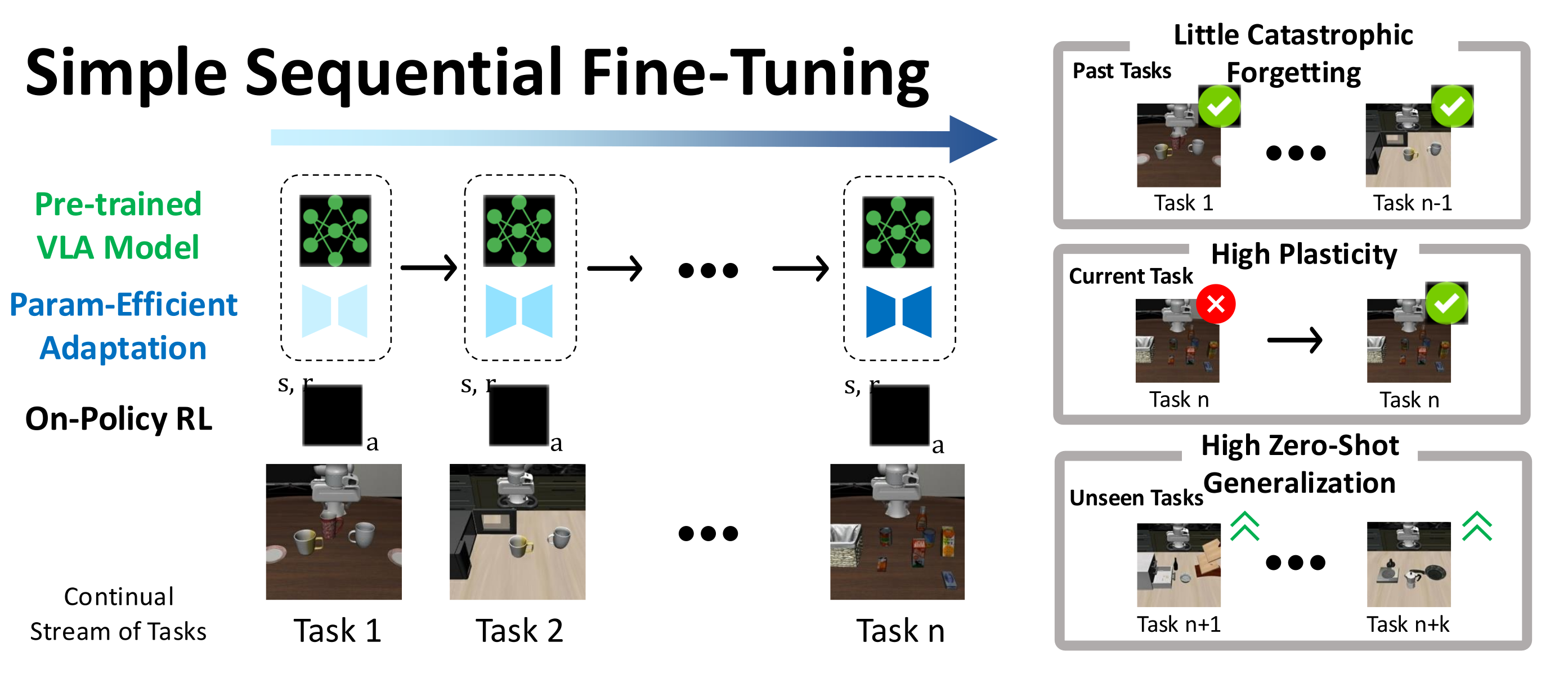
A pretrained VLA adapted sequentially with LoRA and on-policy GRPO can learn new manipulation tasks while largely retaining earlier and held-out performance. Across the tested settings, this simple recipe often matches or beats specialized continual-learning methods.
Ablations suggest that pretrained capacity, constrained updates and on-policy data jointly matter. This is an empirical result under particular checkpoints, training budgets and task distributions—not a guarantee that arbitrary VLAs naturally avoid forgetting.
1 Introduction
Continual reinforcement learning must adapt to a task stream without sacrificing prior skills. Replay, regularization and task-specific parameters address forgetting but add memory, access assumptions or constraints that can impede new learning.
This study asks whether large pretrained policies and parameter-efficient RL change that tradeoff. Sequential fine-tuning needs no replay, old-task environment or separate task adapter, while retaining the base model’s useful behavior. The experiments support it as a strong baseline, with scope constrained by pretraining, task selection and finite sequences.
2 Background & Related Work
The comparison connects pretrained action models, on-policy RL, continual-learning methods and low-rank adaptation. The distinction between prior demonstrations and demonstration-free continual post-training matters throughout.
Vision-Language-Action Models.
OpenVLA decodes discrete action tokens; OpenVLA-OFT predicts short action chunks. Continuous heads generate actions through diffusion or flow matching, as in π₀. All combine visual input, language instructions and robot actions, but their adaptation sensitivity can differ.
Reinforcement Learning Post-Training of VLA Models.
Pretrained competence makes sparse-reward exploration possible. Stable policy updates, small learning rates and suitable likelihood objectives remain important. The study uses GRPO throughout, with Flow-SDE for continuous heads; the full objectives are retained in Appendix A.
Continual Reinforcement Learning.
Continual RL methods preserve value functions, policies, experience or dynamics through regularization, replay or isolated capacity. Much earlier evidence comes from smaller networks trained from scratch; the current study examines pretrained VLAs with substantial existing competence.
Parameter-Efficient Fine-Tuning.
LoRA freezes W₀ and learns a factorized update BA, usually at rank much smaller than either matrix dimension. The update can be merged into W₀ after training. This reduces trainable parameters but does not inherently guarantee preservation of every old behavior.
Equations
3 Problem Formulation
Each task is a language-conditioned finite-horizon control problem. Tasks arrive in a fixed sequence, and the evaluation separates final seen-task success, forgetting, forward transfer and held-out success.
3.1 Language-Conditioned MDP for VLA Post-Training
The policy receives camera images and an observable natural-language instruction, and controls end-effector pose plus gripper state with sparse binary rewards. State/action spaces are shared within each experimental setting. Treating camera images as MDP states assumes they suffice for the relevant dynamics; partial observability is not explicitly modeled.
Equations
3.2 Continual Reinforcement Learning in Language-Conditioned MDPs
At stage k, maximize average return across tasks seen so far while interacting only with the current task. Sequential fine-tuning uses no old-task data or demonstrations during this phase. Language identifies the requested task; this is not hidden-task continual learning.
The pretrained starting checkpoint has already used demonstrations, and some comparison methods intentionally relax the current-data restriction. Those distinctions prevent interpreting “no demonstrations” as no supervised robot training anywhere in the pipeline.
Equations
3.3 Evaluation Metrics
AVG is final mean success on trained tasks. NBT is mean performance immediately after a task was learned minus its final performance; it may be negative, and averaging can hide individual regressions. FWT compares future-task success before direct training against the original checkpoint. ZS measures final success on tasks held out from continual post-training, not necessarily from all prior pretraining.
4 An Empirical Study of Continual RL for VLAs
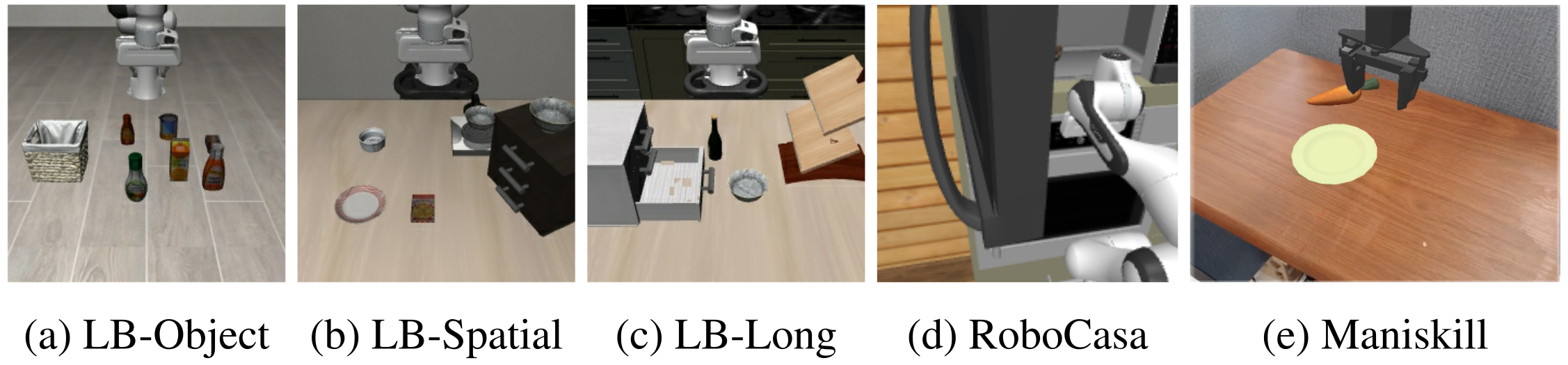
Main comparisons use three LIBERO suites, then vary visual conditions, task order, model/domain, training duration and sequence length. Three seeds support the tabulated means and standard errors; figures and all detailed settings remain below.
4.1 Experimental Setup
Methods share architecture, learning rate, optimizer, batch size, LoRA and GRPO settings from RLinf. Method-specific coefficients receive local sweeps within an order of magnitude of published defaults; sequential fine-tuning receives no extra tuning. This is a controlled local comparison, not exhaustive optimization of every competitor.
CRL Algorithms
Eight approaches are counted including the joint-training oracle: sequential fine-tuning, EWC, expert replay, dark experience replay, dynamic weight expansion, SLCA, RETAIN and multitask training. They trade off regularization, stored data/logits, task-specific adapters or discounted updates. The oracle has simultaneous task access and is an empirical reference, not a mathematical upper bound.
4.2 Results: A Study of CRL Methods on VLAs
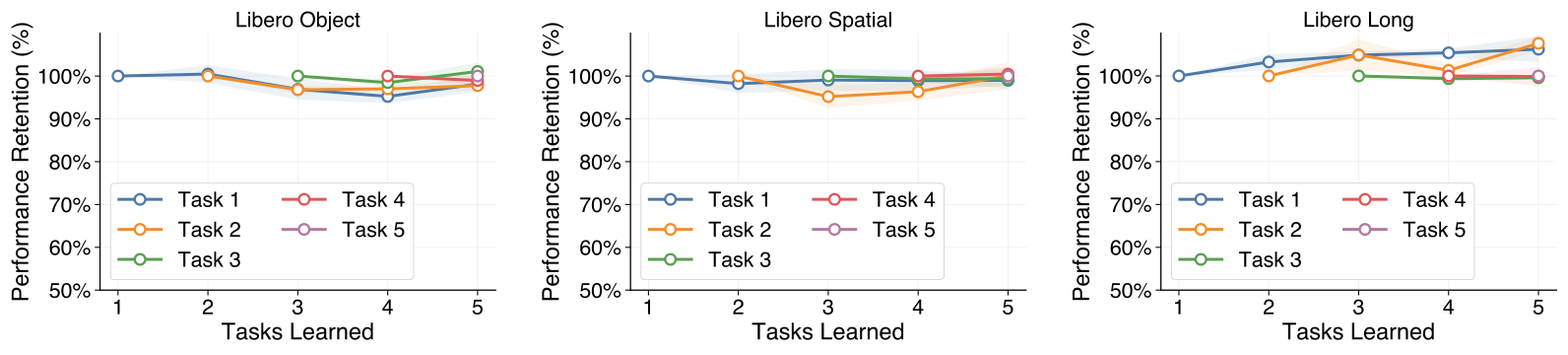
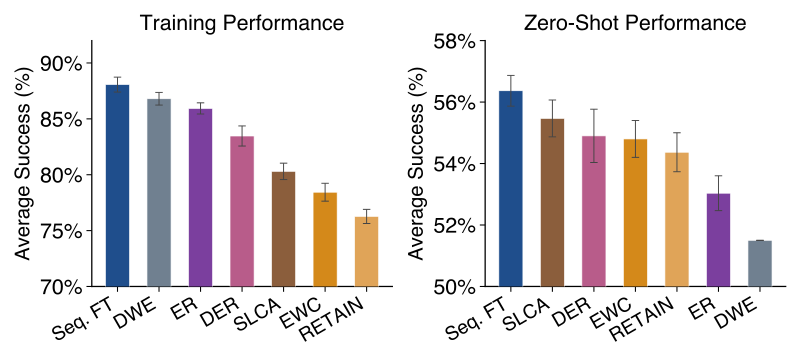
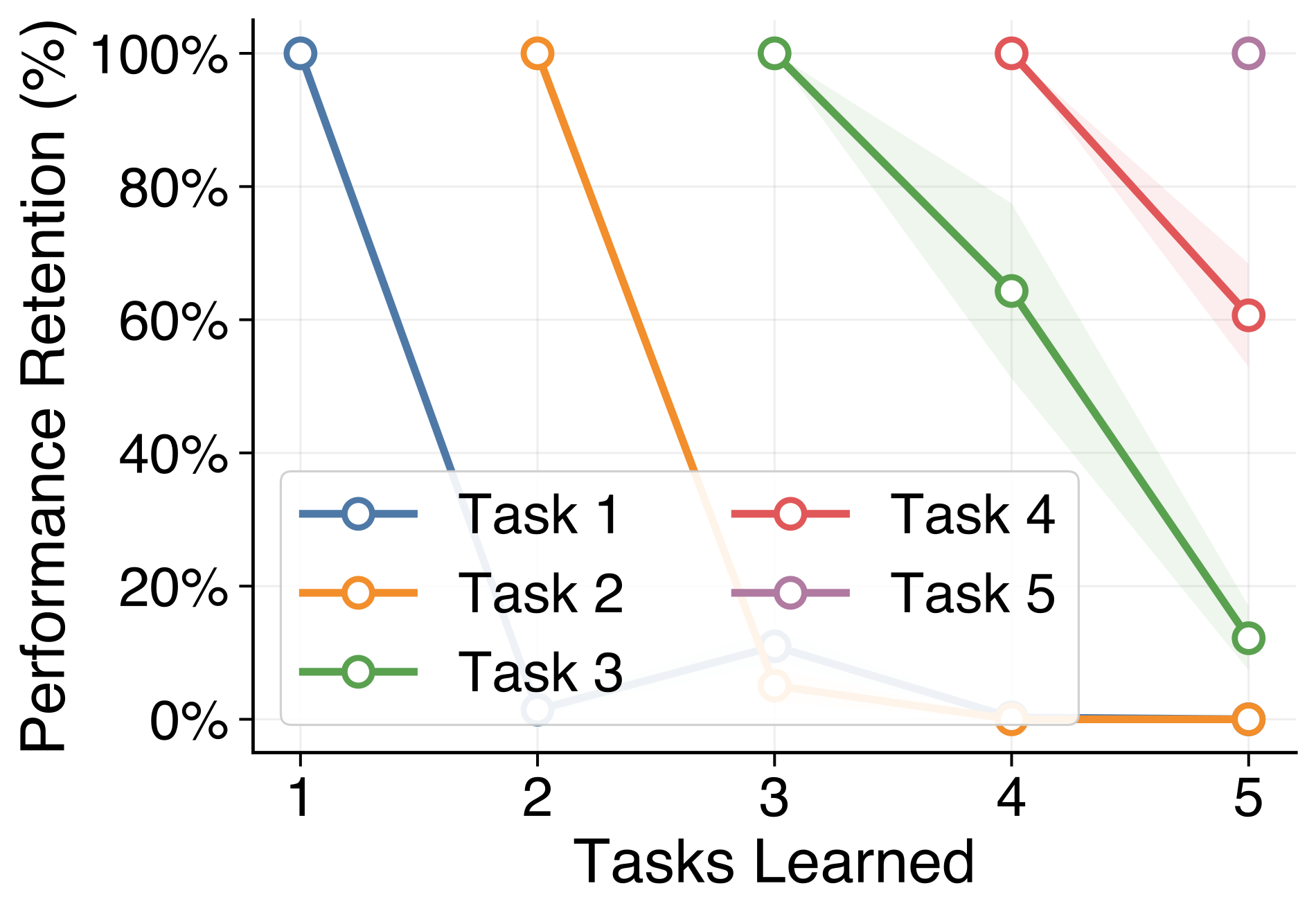
The main LIBERO results show high final success and small average forgetting under sequential LoRA/GRPO. Table 1 preserves every metric and uncertainty; the task-wise retention plots complement the averaged NBT statistic.
Evaluation Domains
For Spatial/Object/Long, sequential fine-tuning achieves AVG 81.2/93.2/89.8%, NBT 0.3/1.0/−2.4 percentage points, and ZS 57.1/25.4/86.6%. Joint training reaches AVG 85.8/95.7/90.5%. Thus the sequential recipe is close in seen-task success and sometimes better on held-out tasks, though Object ZS is lower than the oracle’s 27.6%.
EWC/SLCA/RETAIN often constrain adaptation; isolated task adapters retain old tasks but cannot share positive transfer. Expert replay uses demonstrations, whereas DER stores past interaction logits without expert labels—the text’s broad claim that all replay requires demonstrations is too strong. LIBERO results from other protocols are not directly comparable if their tasks, demonstrations or budgets differ.
| Domain / Method | Metrics (%) | |||||
|---|---|---|---|---|---|---|
| AVG | AVG | NBT | FWT | ZS | ZS | |
| libero-spatial | ||||||
| Sequential Fine-Tuning | 81.20.4 | +24.3 | 0.30.5 | 3.91.5 | 57.11.1 | +5.6 |
| Elastic Weight Consolidation | 66.10.9 | +9.3 | 0.71.7 | 1.50.3 | 52.60.9 | +1.1 |
| Expert Replay | 80.20.5 | +23.3 | 0.61.1 | -2.30.1 | 49.21.0 | -2.3 |
| Dark Experience Replay | 73.41.3 | +16.6 | 4.71.3 | 0.70.9 | 55.20.7 | +3.7 |
| Dynamic Weight Expansion | 79.60.9 | +22.7 | 0.00.0 | 0.00.0 | 51.50.0 | +0.0 |
| SLCA (Layered LR) | 69.90.7 | +13.0 | -0.62.0 | 1.50.3 | 56.10.9 | +4.6 |
| RETAIN (Weight Merging) | 66.00.7 | +9.1 | 2.91.4 | 1.41.4 | 53.70.8 | +2.2 |
| Multitask (Oracle) | 85.80.2 | +28.9 | – | – | 51.20.7 | -0.3 |
| libero-object | ||||||
| Sequential Fine-Tuning | 93.20.7 | +37.6 | 1.00.7 | 7.10.8 | 25.40.2 | +5.8 |
| Elastic Weight Consolidation | 82.61.2 | +26.9 | 0.10.8 | 10.00.4 | 25.30.8 | +5.6 |
| Expert Replay | 88.80.2 | +33.1 | 4.50.6 | 6.41.1 | 26.70.5 | +7.1 |
| Dark Experience Replay | 89.10.2 | +33.4 | 0.81.1 | 6.80.8 | 24.81.7 | +5.2 |
| Dynamic Weight Expansion | 92.40.3 | +36.7 | 0.00.0 | 0.00.0 | 19.60.0 | +0.0 |
| SLCA (Layered LR) | 84.10.7 | +28.4 | -1.60.5 | +5.21.4 | 24.20.2 | +4.6 |
| RETAIN (Weight Merging) | 76.60.3 | +20.9 | 0.81.0 | 1.81.5 | 22.50.9 | +2.9 |
| Multitask (Oracle) | 95.70.7 | +40.1 | – | – | 27.61.3 | +8.0 |
| libero-long-horizon | ||||||
| Sequential Fine-Tuning | 89.80.9 | +6.8 | -2.41.0 | 0.50.1 | 86.60.2 | +3.3 |
| Elastic Weight Consolidation | 86.60.3 | +3.6 | 0.81.3 | 3.01.3 | 86.50.1 | +3.1 |
| Expert Replay | 88.80.8 | +5.8 | -0.21.7 | -1.10.6 | 83.20.2 | -0.1 |
| Dark Experience Replay | 87.60.4 | +4.6 | 0.70.8 | 0.70.2 | 84.70.2 | +1.3 |
| Dynamic Weight Expansion | 88.40.5 | +5.4 | 0.00.0 | 0.00.0 | 83.40.0 | +0.0 |
| SLCA (Layered LR) | 86.90.6 | +3.9 | -1.31.0 | -0.20.3 | 86.10.7 | +2.7 |
| RETAIN (Weight Merging) | 86.20.9 | +3.2 | 1.61.0 | 1.01.2 | 86.90.2 | +3.6 |
| Multitask (Oracle) | 90.50.8 | +7.5 | – | – | 85.20.5 | +1.8 |
4.3 Robustness Under Controlled Perturbations
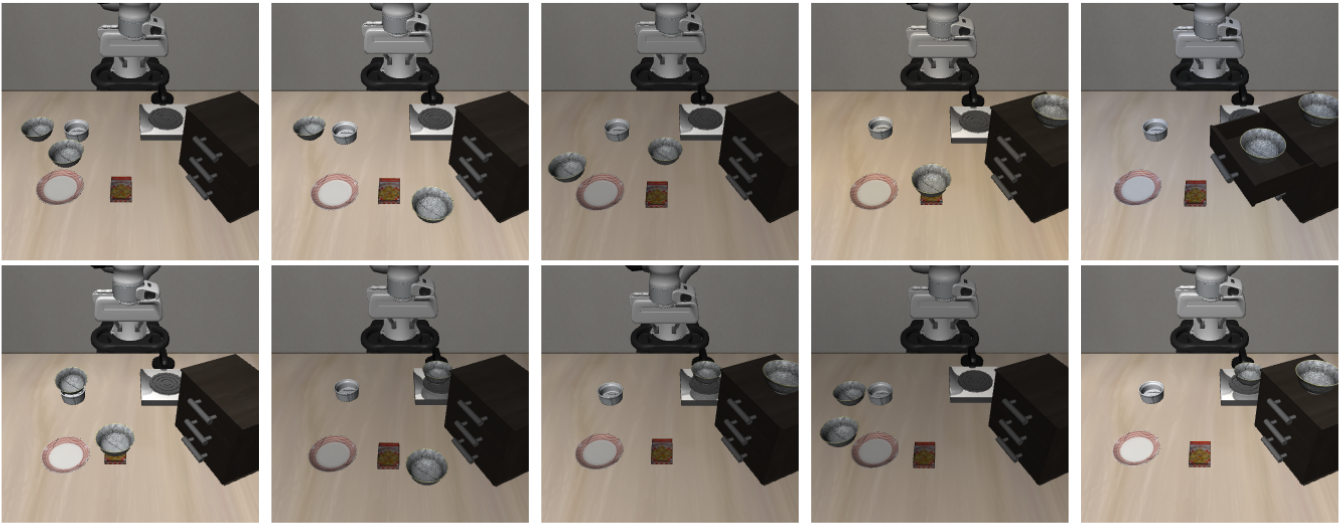
Per-task camera, lighting and robot-base changes retain low NBT. Sequential AVG is 75.5/82.4/81.2%, compared with oracle 75.2/87.0/86.1%; corresponding ZS is 46.7/54.9/42.7%. Camera ZS falls 0.6 points from its initial checkpoint despite exceeding the oracle, so relative superiority does not imply no loss of pretrained generalization.
π₀ on RoboCasa obtains 29.5±3.0% AVG and 21.5±1.9% ZS; OpenVLA on ManiSkill reaches 70.9±1.5% and 51.0±0.8%. Low forgetting can coexist with low absolute competence. Model and domain change together, so these are breadth checks rather than isolated causal architecture tests.
Three Spatial task orders give AVG 79.8/81.2/80.2% versus oracle 85.8%, and NBT 1.4/1.6/−0.3 points. The narrative “under 5%” oracle gap does not hold for all reordered means: gaps reach 6.0 and 5.6 points. Three sampled orders do not establish order independence.
| Domain / Method | Metrics (%) | |||||
|---|---|---|---|---|---|---|
| AVG | AVG | NBT | FWT | ZS | ZS | |
| Camera Perturbation | ||||||
| Seq. FT | 75.50.2 | +18.9 | -0.50.5 | 3.71.1 | 46.70.2 | -0.6 |
| Multitask (Oracle) | 75.20.1 | +18.6 | – | – | 43.80.5 | -3.6 |
| Lighting Perturbation | ||||||
| Seq. FT | 82.40.5 | +26.7 | 0.20.4 | 5.70.1 | 54.91.0 | +1.9 |
| Multitask (Oracle) | 87.00.3 | +31.3 | – | – | 54.10.3 | +1.2 |
| Robot State Perturbation | ||||||
| Seq. FT | 81.20.9 | +23.4 | 0.60.5 | 0.20.3 | 42.70.7 | +2.4 |
| Multitask (Oracle) | 86.10.3 | +28.3 | – | – | 42.20.7 | +1.9 |
| Pi-0 on RoboCasa | ||||||
| Seq. FT | 29.53.0 | +10.6 | -0.12.1 | 1.21.7 | 21.51.9 | +2.7 |
| Multitask (Oracle) | 31.42.3 | +12.5 | – | – | 20.81.2 | +2.0 |
| OpenVLA on ManiSkill | ||||||
| Seq. FT | 70.91.5 | +19.4 | -1.01.5 | 0.50.6 | 51.00.8 | +11.0 |
| Multitask (Oracle) | 72.80.2 | +21.2 | - | - | 50.70.8 | +10.7 |
| Task Order Perturbation | ||||||
| Seq. FT (Re-order 1) | 79.80.5 | +22.9 | 1.41.4 | 3.50.3 | 54.40.8 | +3.9 |
| Seq. FT (Re-order 2) | 81.21.0 | +24.4 | 1.61.7 | 0.81.3 | 55.70.5 | +4.2 |
| Seq. FT (Re-order 3) | 80.21.0 | +23.3 | -0.30.5 | 2.41.3 | 57.61.0 | +6.1 |
| Multitask (Oracle) | 85.80.2 | +28.9 | – | – | 51.20.7 | -0.3 |
4.4 Additional Experiments and Discussions
Further experiments increase training on the weakest task, test continuous-head sensitivity and extend the sequence to thirty tasks. They clarify budget and architecture boundaries rather than removing them.
4.4.1 Closing the Training Gap Between the Multi-task Oracle and Sequential Fine-Tuning
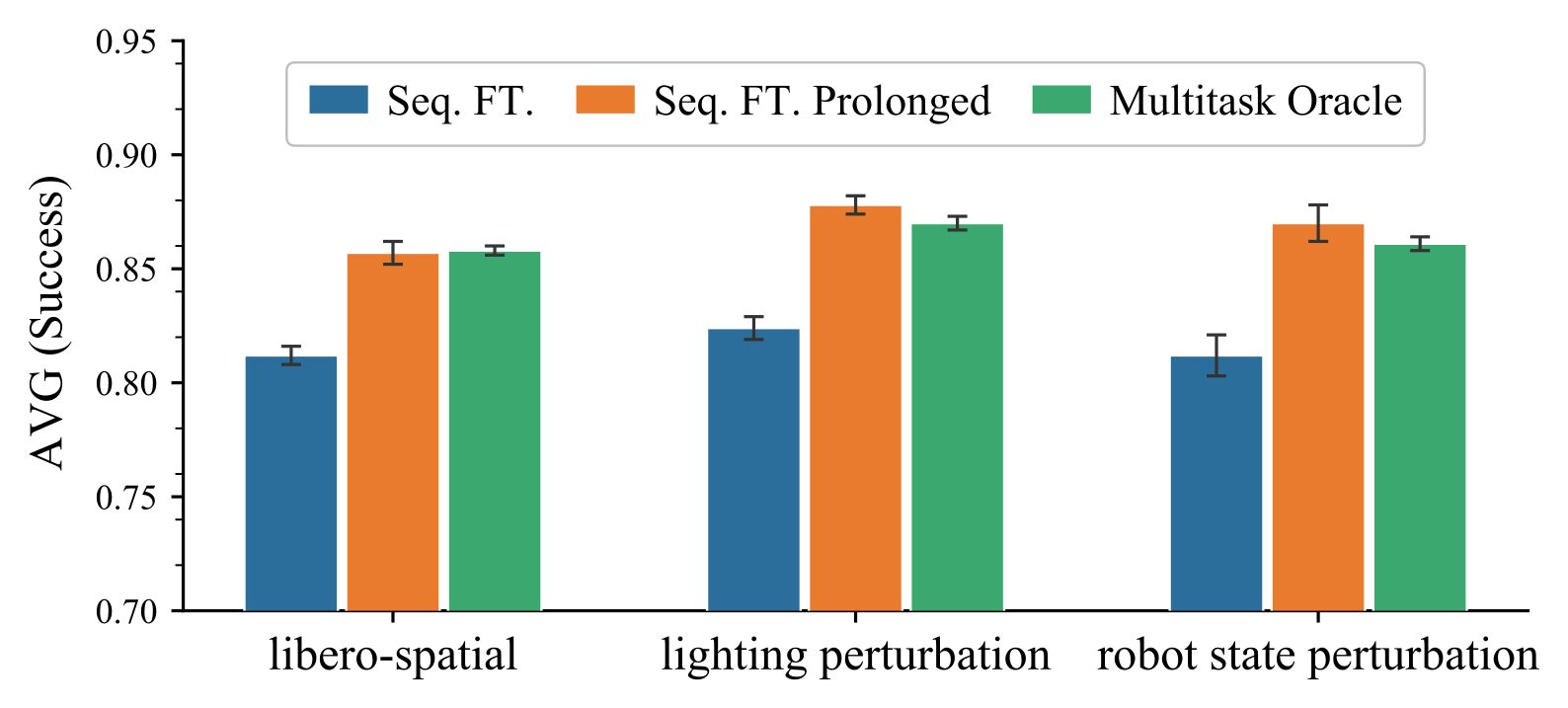
For Spatial, lighting and robot-state settings, doubling episodes on the lowest-performing task brings sequential AVG near the multitask reference. This shows that the observed gap can shrink with additional targeted computation. It does not match sample budgets or prove the original optimizer avoided every suboptimal solution.
4.4.2 Properties of VLAs with Continuous Diffusion Heads
The π₀ result uses a continuous flow-based head, discussed under the broader diffusion-head heading. Such heads require more careful adaptation, including lower LoRA rank. The proposed explanation—greater drift from expressive continuous denoising—is a conjecture; the default rank-32 table does not specify the separate π₀ rank used.
4.4.3 Training on Longer Task Sequences
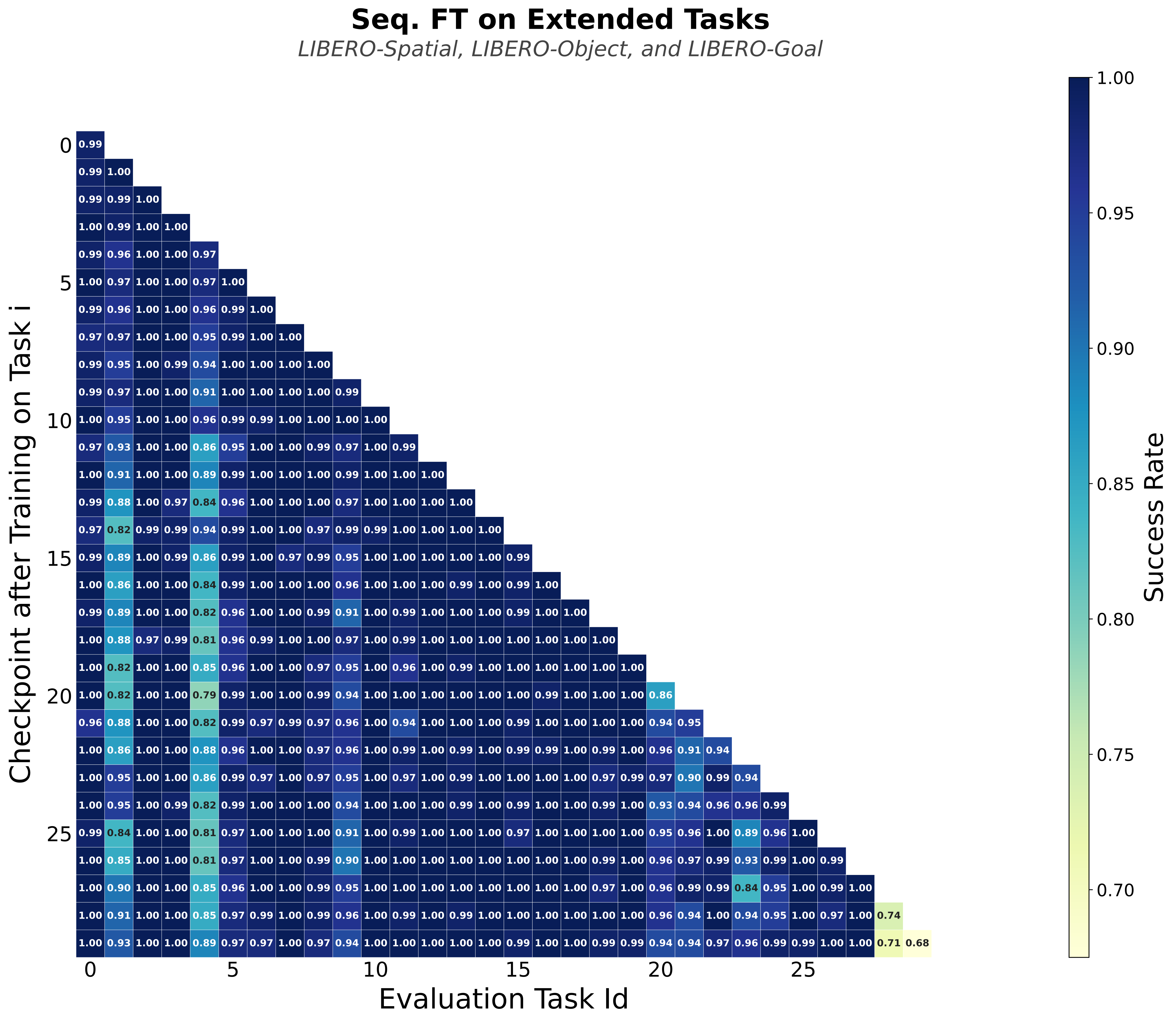
A thirty-task sequence combines Spatial, Object and Long suites. Figure 7 retains the entire checkpoint-by-task success matrix and shows substantial retention over this longer finite sequence. It is still a simulated, selected task stream, not an open-ended lifetime guarantee.
5 Analysis: What Makes Sequential Fine-Tuning So Effective?
Ablations examine the learning objective, model capacity and adaptation parameterization. Mechanistic explanations based on policy support, Fisher curvature and update geometry are suggestive; they should be separated from guarantees or cleanly isolated causal factors.
5.1 Why Little Catastrophic Forgetting?
Replacing RL with supervised fine-tuning drops Spatial AVG to 29.9% and raises NBT to 78.7 points; a 12M CNN policy gives 13.1% AVG/11.4 NBT; full fine-tuning gives 7.3%/40.9. The original is 81.2%/0.3. These changes also differ in data, initialization or optimization suitability, so they support the tested recipe rather than proving each component universally necessary. Table 3 repeats 0.3±0.5 under original FWT, inconsistent with Table 1’s 3.9±1.5; both source tables remain unchanged.
The on-policy argument connects to RL’s Razor and Retaining by Doing: sampled current-policy actions can reduce abrupt distribution shift. However, parameter sharing, finite steps and repeated updates can move probabilities outside sampled regions; on-policy sampling alone does not impose a KL bound to the initial policy. The printed supervised-gradient, KL and policy-gradient equations are retained.
The authors use normalized diagonal empirical Fisher energy along current gradients as an interference proxy: 0.02 for OpenVLA-OFT versus 0.16 for the small policy. This is local and parameterization-dependent. The second-order approximation omits a first-order term and equates curvature with Fisher; these require conditions not established here. Random-vector near-orthogonality does not imply task gradients are random or harmless.
Rank-512 LoRA and full fine-tuning have similar mean effective ranks, 303.4 versus 324.7, but LoRA has smaller across-layer spread, 89.3 versus 465.0, nuclear norm 0.42 versus 4.31, and NBT 0.6 versus 40.9. These correlations motivate an update-geometry explanation; they do not isolate rank, magnitude and layerwise imbalance as separate causes. Rank constraints alone need not avoid high-Fisher directions.
| Ablation | Metrics | |||||
|---|---|---|---|---|---|---|
| AVG | AVG | NBT | FWT | ZS | ZS | |
| Seq. FT (Original) | 81.2±0.4 | +24.3 | 0.3±0.5 | 0.3±0.5 | 57.1±1.1 | +5.6 |
| Supervised fine-tuning instead of RL | 29.92.3 | -27.0 | 78.71.9 | -53.80.0 | 1.10.9 | -50.4 |
| Smaller Policy | 13.1±0.9 | -53.7 | 11.43.7 | -63.4±0.5 | 0.00.0 | -56.2 |
| Without LoRA | 7.35.2 | -49.6 | 40.911.8 | -50.41.3 | 0.00.0 | -51.5 |
Equations
| Method | Effective Rank (mean) | Effective Rank (std) | Nuclear Norm | NBT |
|---|---|---|---|---|
| LoRA Rank 32 (default) | 27.5 | 5.7 | 0.48 | 0.3 |
| Full Finetuning | 324.7 | 465.0 | 4.31 | 40.9 |
| LoRA Rank 512 | 303.4 | 89.3 | 0.42 | 0.6 |
Equation
5.2 Why Good Plasticity?
The authors argue that sparse binary-return feedback supplies less new supervision per rollout than action-labeled demonstrations, so roughly 100M rank-32 adapter parameters can absorb the information from about 50k episodes without needing full-model updates. This is an information-content intuition, not a formal parameter-capacity/sample-complexity theorem: trajectories, sampled actions and advantage estimates also influence gradients.
5.3 Why Good Zero-shot Generalization?
Held-out success is often slightly higher under sequential training than multitask training, but not uniformly—Object in Table 1 is an exception. Shifting objectives might regularize representations; the authors explicitly leave this mechanism unresolved. ZS measures the specified held-out tasks, not all pretrained abilities.
6 Conclusion
Sequential LoRA with stable on-policy RL is a useful low-complexity continual-adaptation baseline for already capable VLAs in these simulations. Remaining questions include broader task distributions, longer streams, calibrated causal explanations, compute/sample efficiency and physical-robot transfer or real-world RL.
Acknowledgments
The authors acknowledge LARG/UT Austin computational resources, RLinf infrastructure and research support from NSF, ONR, ARO, Lockheed Martin, Amazon and Good Systems. Jiaheng Hu receives a Two Sigma PhD fellowship. Peter Stone’s compensated Sony AI role is disclosed under UT Austin’s research-objectivity review.
Supplementary material
The full thirty-task success matrix precedes detailed training objectives, evaluation metrics, baselines, hyperparameters and all task/perturbation illustrations. Every printed panel and task instruction is retained.
Appendix A GRPO Training Formulation
GRPO samples trajectories from the previous policy, normalizes returns within a group and maximizes a clipped importance-ratio objective. Autoregressive models use action-token likelihoods. Continuous heads add scheduled Gaussian noise to the flow dynamics, enabling a stochastic trajectory likelihood through Flow-SDE.
The complete objective, ratio, normalized advantage, deterministic ODE and stochastic dynamics remain. A deterministic flow driven by random initial noise can already induce an action distribution; added SDE noise supplies the chosen exploration/likelihood construction, rather than being the only possible source of stochasticity. Zero return-variance handling is not specified in the displayed formula.
Equations
Appendix B Evaluation Metrics
Sᵢⱼ records task-j success after training through task i, with S₀ⱼ the initial checkpoint. All four exact metric formulas are retained. Reported percentages and changes should be read as rates and percentage-point differences.
Equation
Training Average Final Success (AVG).
AVG averages the final checkpoint over all continual-training tasks. It combines acquisition and retention and does not alone diagnose forgetting.
Equation 1
| (1) |
Negative Backward Transfer (NBT).
NBT averages Sⱼⱼ−Sᵀⱼ over earlier tasks, excluding the last. Zero means no net average loss, while negative values indicate average backward improvement. Improvements can cancel losses on individual tasks.
Equation 2
| (2) |
Forward Transfer (FWT).
FWT averages each future task’s success just before it is trained minus the initial checkpoint’s success. It depends on task order and evaluates transfer before direct post-training, not final retention.
Equation 3
| (3) |
Held-Out Tasks Performance (ZS).
ZS averages final success on the held-out task set. “Held out” refers to continual training; the base policy is broadly pretrained and additionally initialized with in-domain demonstrations.
Equation 4
| (4) |
Appendix C Evaluation Algorithms
Sequential fine-tuning trains only the current task. The multitask oracle jointly accesses all tasks. EWC applies Fisher-weighted parameter penalties; expert replay adds behavior cloning from stored demonstrations; DER matches stored previous-policy logits without expert labels.
DWE allocates a separate LoRA adapter per task, increasing memory and preventing cross-task transfer. SLCA uses slower trunk and faster action-head learning rates. RETAIN discounts each task’s weight update before merging it into the base. These methods preserve different information and do not share identical storage/access assumptions.
Appendix D Experiment Setup
Starting checkpoints receive in-domain supervised demonstrations: 10 for Object, 10 for Spatial, 432 for Long, 240 for RoboCasa and 140 for ManiSkill. Initial training success is 55.6/56.9/83.0/18.9/51.6%. Main sequences have five LIBERO tasks or four RoboCasa/ManiSkill tasks.
Episodes per task are 10,240/10,240/5,120/3,840/10,240, with horizons 512/512/512/480/80. ManiSkill fixes appearance and restricts initialization to forty positions and four rotations. Tasks are selected for nonzero, nonsaturated initial competence, emphasizing refinement of existing skills rather than learning entirely novel behaviors.
| Parameter | libero-object | libero-spatial | libero-long-horizon | RoboCasa | maniskill |
|---|---|---|---|---|---|
| Base Model | OpenVLA-OFT | OpenVLA-OFT | OpenVLA-OFT | Pi-0 | OpenVLA |
| # of SFT Demos | 10 | 10 | 432 | 240 | 140 |
| Initial Training Success | 55.6 | 56.9 | 83.0 | 18.9 | 51.6 |
| # of Training Tasks | 5 | 5 | 5 | 4 | 4 |
| Episodes per Task | 10240 | 10240 | 5120 | 3840 | 10240 |
| Episode Length | 512 | 512 | 512 | 480 | 80 |
Appendix E Ablation Setup
The supervised ablation uses 432 demonstrations, batch 256 and 600 updates. The 12M CNN/MLP policy receives thirty initial demonstrations and starts at 66.8% success versus the VLA’s 56.9%; it then follows the RL budget. Full fine-tuning updates the base parameters with the shared RL hyperparameters.
These are informative stress tests, but initial competence, pretraining content, data distribution, model architecture and hyperparameter suitability differ. They cannot isolate parameter count or on-policy sampling alone.
| Parameter | Supervised fine-tuning instead of RL | Smaller Policy | Without LoRA |
|---|---|---|---|
| Base Model | 7B OpenVLA-OFT | 12M CNN with MLP Head | 7B OpenVLA-OFT |
| # of Training Tasks | 5 | 5 | 5 |
| Pre-training Demos | 10 | 30 | 10 |
| Initial Training Success | 56.9 | 66.8 | 56.9 |
| Batch Size | 256 | 8192 | 8192 |
| RL Episodes per Task | - | 10240 | 10240 |
| SFT Dataset Demos | 432 | - | - |
| SFT Training Steps | 600 | - | - |
Appendix F Shared Hyperparameter
Shared settings include AdamW at 2×10⁻⁵, global batch 8,192, group size eight, sixteen rollout epochs and LoRA rank 32. The table lists clipping 0.20/0.28, γ=0.99, GAE λ=0.95, gradient norm one, and zero explicit KL/entropy coefficients. All optimizer constants remain in Table 7; the continuous-head lower-rank exception is not numerically specified.
| Algorithm | Name | Value |
|---|---|---|
| GRPO | Optimizer | AdamW |
| Learning rate | ||
| AdamW | 0.9 | |
| AdamW | 0.999 | |
| Adamw | ||
| Gradient clip norm | 1.0 | |
| Global batch size | 8192 | |
| Discount | 0.99 | |
| GAE | 0.95 | |
| Clip ratio (low/high) | 0.20 / 0.28 | |
| KL coefficient | 0.0 | |
| Entropy bonus | 0.0 | |
| Rollout epochs | 16 | |
| Group size | 8 | |
| LoRA rank | 32 |
Appendix G Method Hyperparameters
EWC uses λ=10⁶ and 65,536 Fisher samples. ER/DER use replay weight 0.03, ten trajectories and global batch 8,192. SLCA rates are 4×10⁻⁶/4×10⁻⁵; RETAIN merges with coefficient 0.5. Sequential, DWE and multitask add no method-specific coefficient beyond shared settings.
| Algorithm | Name | Value |
| EWC | regularization coefficient | |
| fisher estimation samples | 65536 | |
| ER | Replay loss weight | 0.03 |
| Replay # trajectories | 10 | |
| Replay global batch size | 8192 | |
| DER | Replay loss weight | 0.03 |
| Replay # trajectories | 10 | |
| Replay global batch size | 8192 | |
| SLCA | slow learning rate | |
| fast learning rate | ||
| RETAIN | merge coefficient | 0.5 |
Appendix H Environment Description
The following ten task lists preserve all 46 original image–instruction pairs and their training/held-out assignments. Thirty additional panels show camera, lighting and robot-base perturbations.
H.1 Libero-Spatial
LIBERO-Spatial keeps the target black bowl and destination plate while varying its spatial relation to nearby objects.
H.1.1 Training Tasks
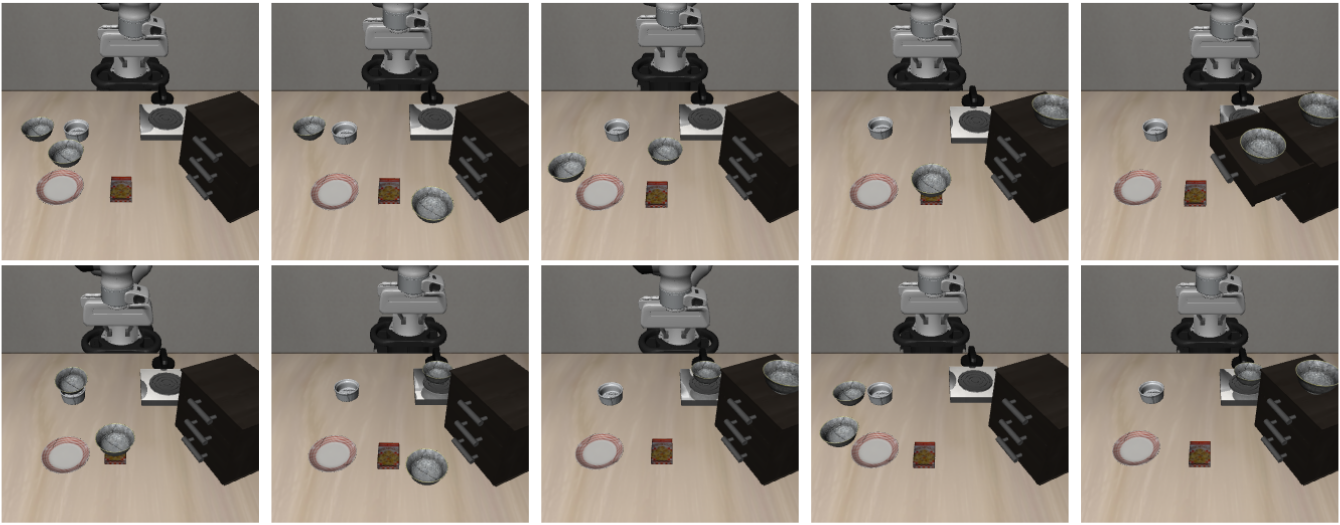
Five training placements include between plate/ramekin, beside ramekin, table center, atop cookie box and inside the cabinet’s top drawer. Exact instructions and corresponding views remain below.
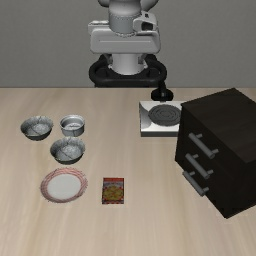
pick up the black bowl between the plate and the ramekin and place it on the plate
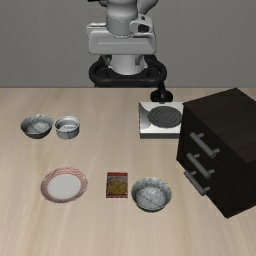
pick up the black bowl next to the ramekin and place it on the plate
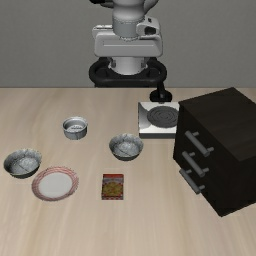
pick up the black bowl from table center and place it on the plate
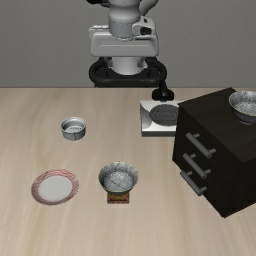
pick up the black bowl on the cookie box and place it on the plate
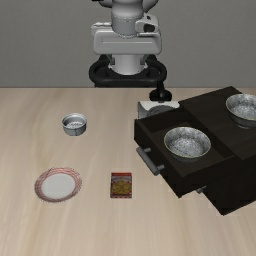
pick up the black bowl in the top drawer of the wooden cabinet and place it on the plate
H.1.2 Held-Out Tasks
Five held-out placements put the bowl on the ramekin, beside the cookie box, on the stove, beside the plate or on the wooden cabinet. These test related spatial configurations.
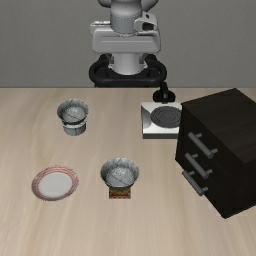
pick up the black bowl on the ramekin and place it on the plate
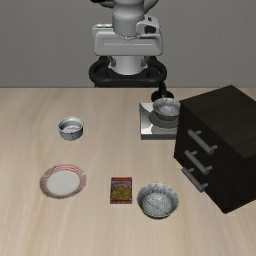
pick up the black bowl next to the cookie box and place it on the plate
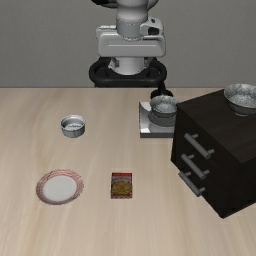
pick up the black bowl on the stove and place it on the plate
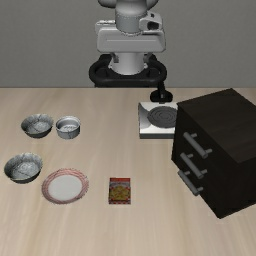
pick up the black bowl next to the plate and place it on the plate
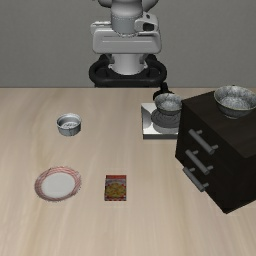
pick up the black bowl on the wooden cabinet and place it on the plate
H.2 Libero-Long
LIBERO-Long combines multi-object or multi-stage manipulation, including drawers, baskets, stove and microwave.
H.2.1 Training Tasks
Training covers bowl-in-drawer/closing, two-mug placement, book-to-caddy, mug-plus-pudding placement and two groceries into a basket. All five original instructions remain paired with their images.
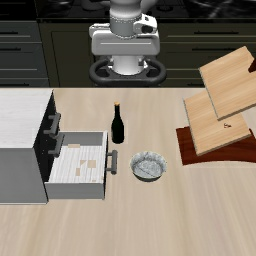
put the black bowl in the bottom drawer of the cabinet and close it
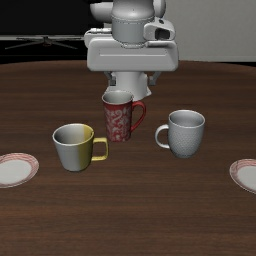
put the white mug on the left plate and put the yellow and white mug on the right plate

pick up the book and place it in the back compartment of the caddy
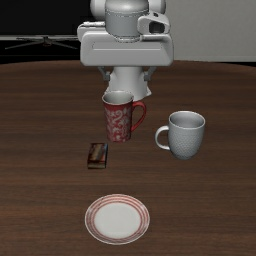
put the white mug on the plate and put the chocolate pudding to the right of the plate
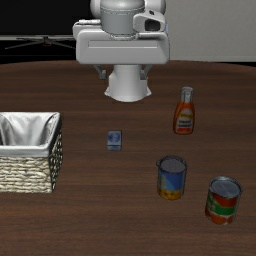
put both the alphabet soup and the cream cheese box in the basket
H.2.2 Held-Out Tasks
Held-out tasks change grocery pairs and add stove/moka-pot or microwave sequences. The five exact instructions preserve the distinction between object composition and longer action chains.
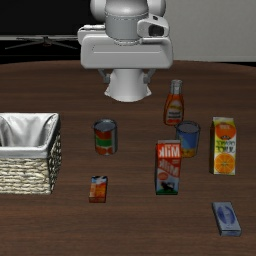
put both the alphabet soup and the tomato sauce in the basket
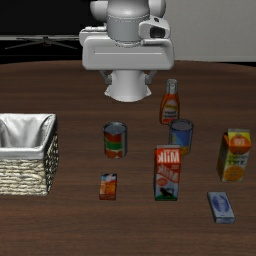
put both the cream cheese box and the butter in the basket
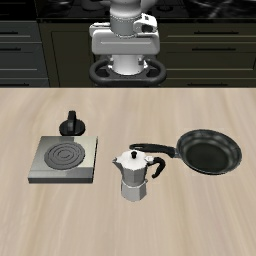
turn on the stove and put the moka pot on it
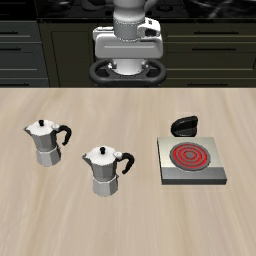
put both moka pots on the stove
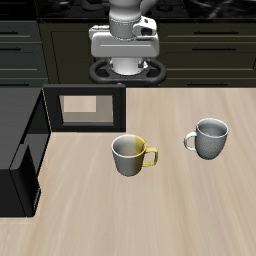
put the yellow and white mug in the microwave and close it
H.3 Libero-Object
LIBERO-Object largely fixes the basket-placement behavior and changes the requested grocery object.
H.3.1 Training Tasks
Training targets tomato sauce, butter, milk, chocolate pudding and orange juice. The five original views/instructions remain.
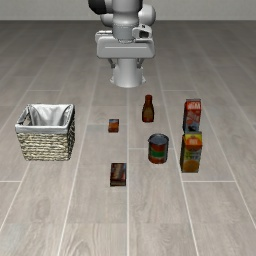
pick up the tomato sauce and place it in the basket
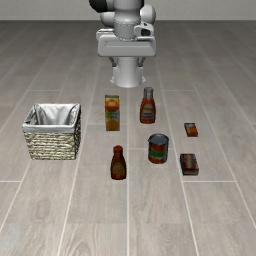
pick up the butter and place it in the basket
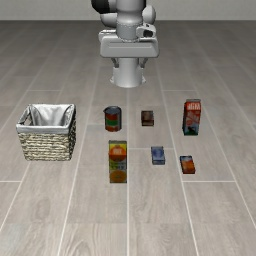
pick up the milk and place it in the basket
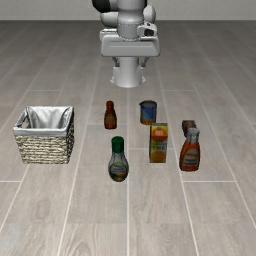
pick up the chocolate pudding and place it in the basket
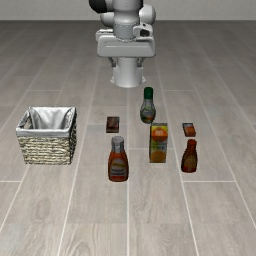
pick up the orange juice and place it in the basket
H.3.2 Held-Out Tasks
Held-out targets alphabet soup, cream cheese, salad dressing, barbecue sauce and ketchup. These are related object substitutions within the same task family.
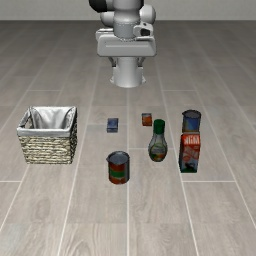
pick up the alphabet soup and place it in the basket
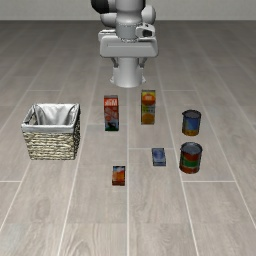
pick up the cream cheese and place it in the basket
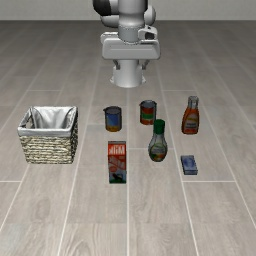
pick up the salad dressing and place it in the basket
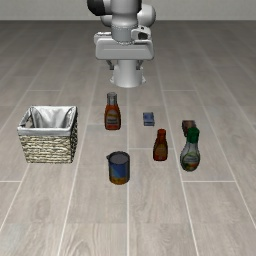
pick up the bbq sauce and place it in the basket
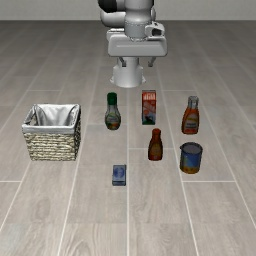
pick up the ketchup and place it in the basket
H.4 RoboCasa
RoboCasa tests π₀ on kitchen interactions beyond pick-and-place, with four training and four held-out instructions.
H.4.1 Training Tasks
Training turns the sink spout, turns on the faucet, closes a drawer and presses the coffee-machine button. Each original image and instruction is retained.
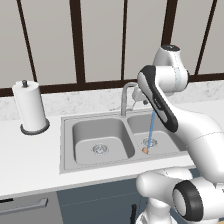
turn sink spout
turn on sink faucet
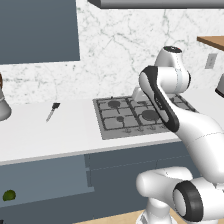
close drawer
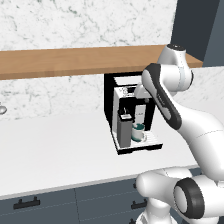
press coffee machine button
H.4.2 Held-Out Tasks
Held-out tasks close a cabinet or microwave door, turn the microwave on/off and turn off the sink faucet. The source uses the shared CloseSingleDoor illustration for the first instruction.
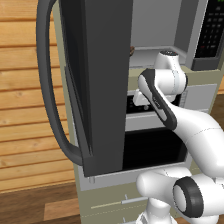
close cabinet or microwave door
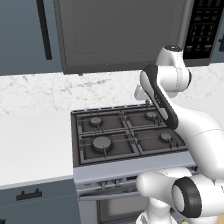
turn on microwave
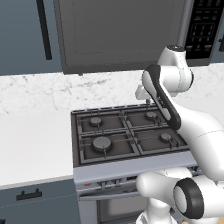
turn off microwave
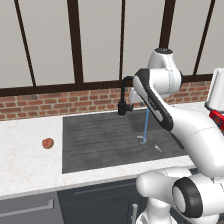
turn off sink faucet
H.5 Maniskill Put Plate On Scene 25 Main
The ManiSkill scene fixes plate/table appearance and uses object-to-plate instructions with restricted object positions/rotations.
H.5.1 Training Tasks
Training puts carrot, bread, ketchup bottle and fast-food cup on the plate. Original task images and wording remain below.
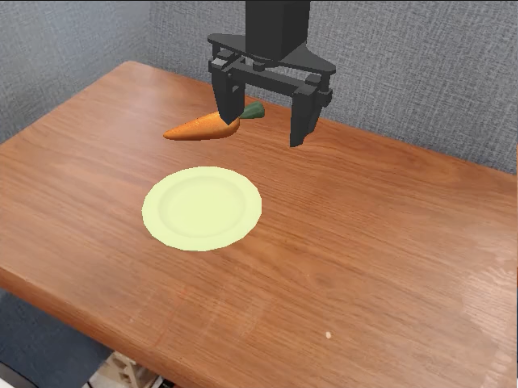
put carrot on plate
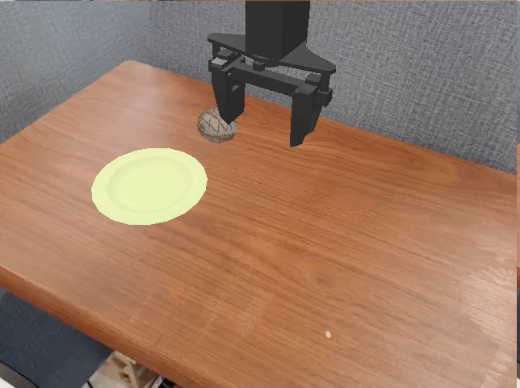
put bread on plate
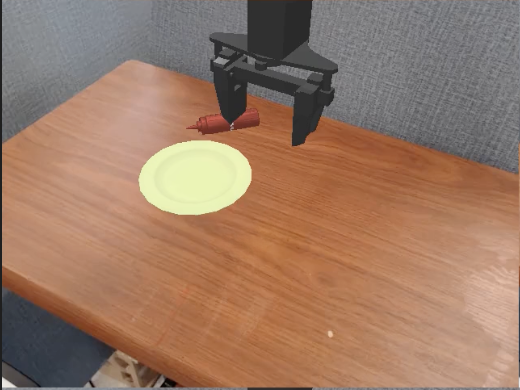
put ketchup bottle on plate
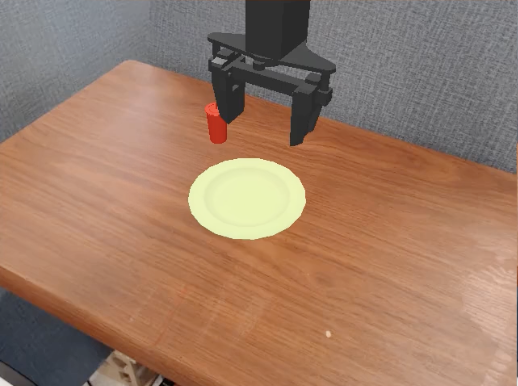
put fast food cup on plate
H.5.2 Held-Out Tasks
Held-out objects are watering can, pipe, toy bear and hamburger. This evaluates object transfer under the standardized scene configuration.
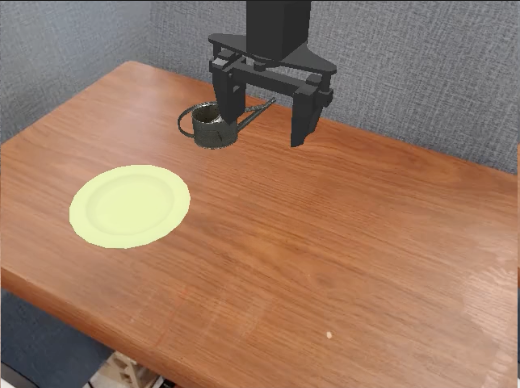
put watering can on plate
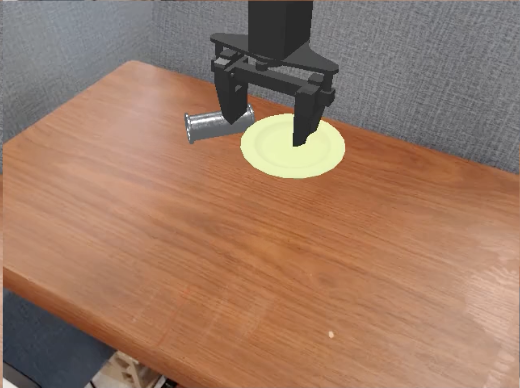
put pipe on plate
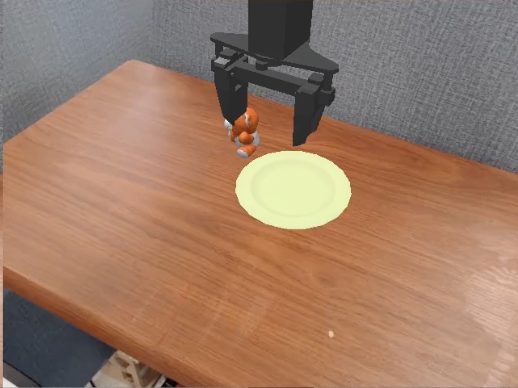
put toy bear on plate
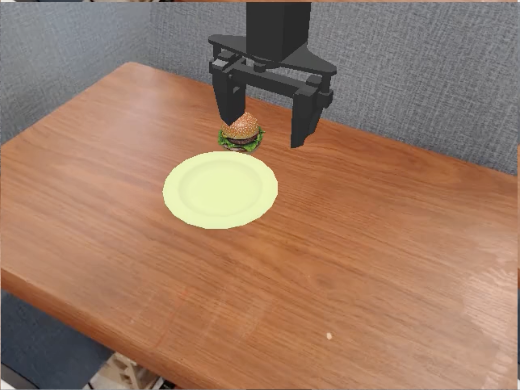
put hamburger on plate
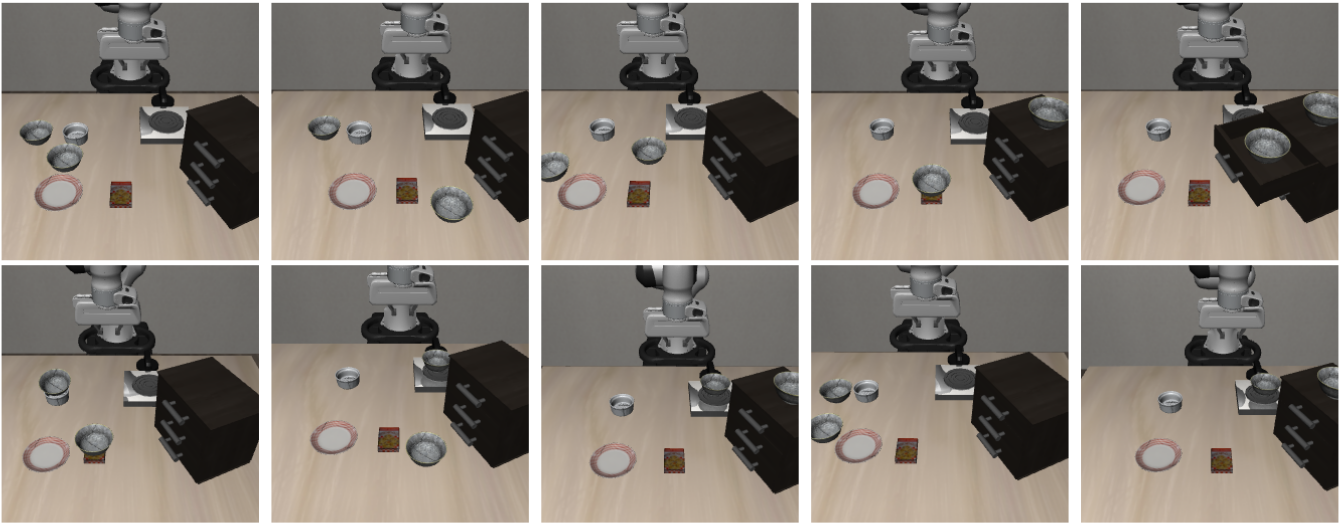
H.6 Perturb Camera Angle
All ten camera-perturbation views are retained, showing viewpoint/angle changes across the Spatial tasks.
H.7 Perturb Lighting Conditions
All ten lighting-perturbation views are retained. Intensity varies by task; this is controlled simulated appearance variation.
H.8 Perturb Robot Position
All ten robot-base perturbation views are retained, showing changed initial robot placement across tasks.