Overview
This edition covers arXiv v2, dated 8 October 2026, including all six appendices. Zibin Dong and Yicheng Liu contributed equally; Dong’s work was completed during an internship at Knowin AI. “Without VLA pretraining” describes the policy backbone: the tokenizer still learns from robotic datasets.
At a glance
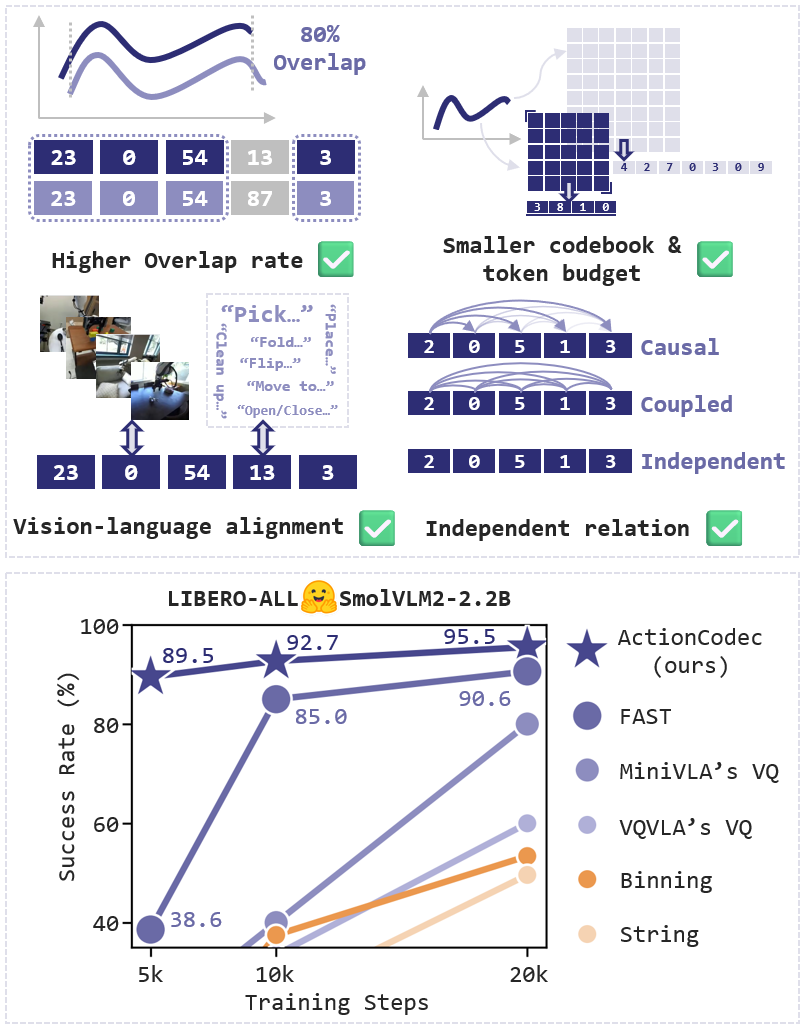
ActionCodec optimizes action tokens for downstream policy learning, not just trajectory reconstruction. It favors consistent tokens for adjacent chunks, a compact vocabulary/token budget, language/temporal alignment and limited query self-attention. Embodiment prompts support shared tokenizer training; residual quantization post-training improves reconstruction.
A SmolVLM2-2.2B policy reaches 95.5% average LIBERO success; a blockwise variant reaches 97.4%. These models fine-tune a pretrained VLM without prior VLA training. Separate appendix experiments add large-scale VLA pretraining. The information-theoretic identities motivate experiments, but do not prove policy improvements.
1 Introduction
A good reconstruction target can still be difficult for a VLM to predict. The paper evaluates tokenizers through learning speed, closed-loop success and late-stage degradation, comparing learned VQ representations with binning, strings and FAST.
The four design choices jointly affect stability, fidelity and token usage. Their controlled studies concern a small VQ-family setup; broad claims of an optimal tokenizer are not established by those experiments.

2 Preliminaries
An encoder maps a T-step, D-dimensional action chunk to n latent queries. Nearest-codebook lookup produces n discrete indices; a decoder reconstructs the action sequence. Training combines reconstruction, codebook and commitment losses with stop-gradient terms. The original definitions and objective remain below.
Equations 1
| (1) |
3 A VLA Perspective on Action Tokenization
Expected token cross-entropy separates model mismatch from conditional target entropy. For a deterministic tokenizer, action-conditioned entropy is zero; sensitivity to perturbations is a different quantity. The token-capacity bound grows with token count and vocabulary size, while conditioning on images/language reduces uncertainty.
Context information and autoregressive-prefix information are complementary chain-rule terms. The paper measures proxies and policy behavior, not their mutual information. Its design studies train tokenizers on all LIBERO data, then fine-tune SmolVLM2-256M on LIBERO-Goal.
Equations 2–4
| (2) |
| (3) |
| (4) |
3.1 Impacts of Overlap Rate
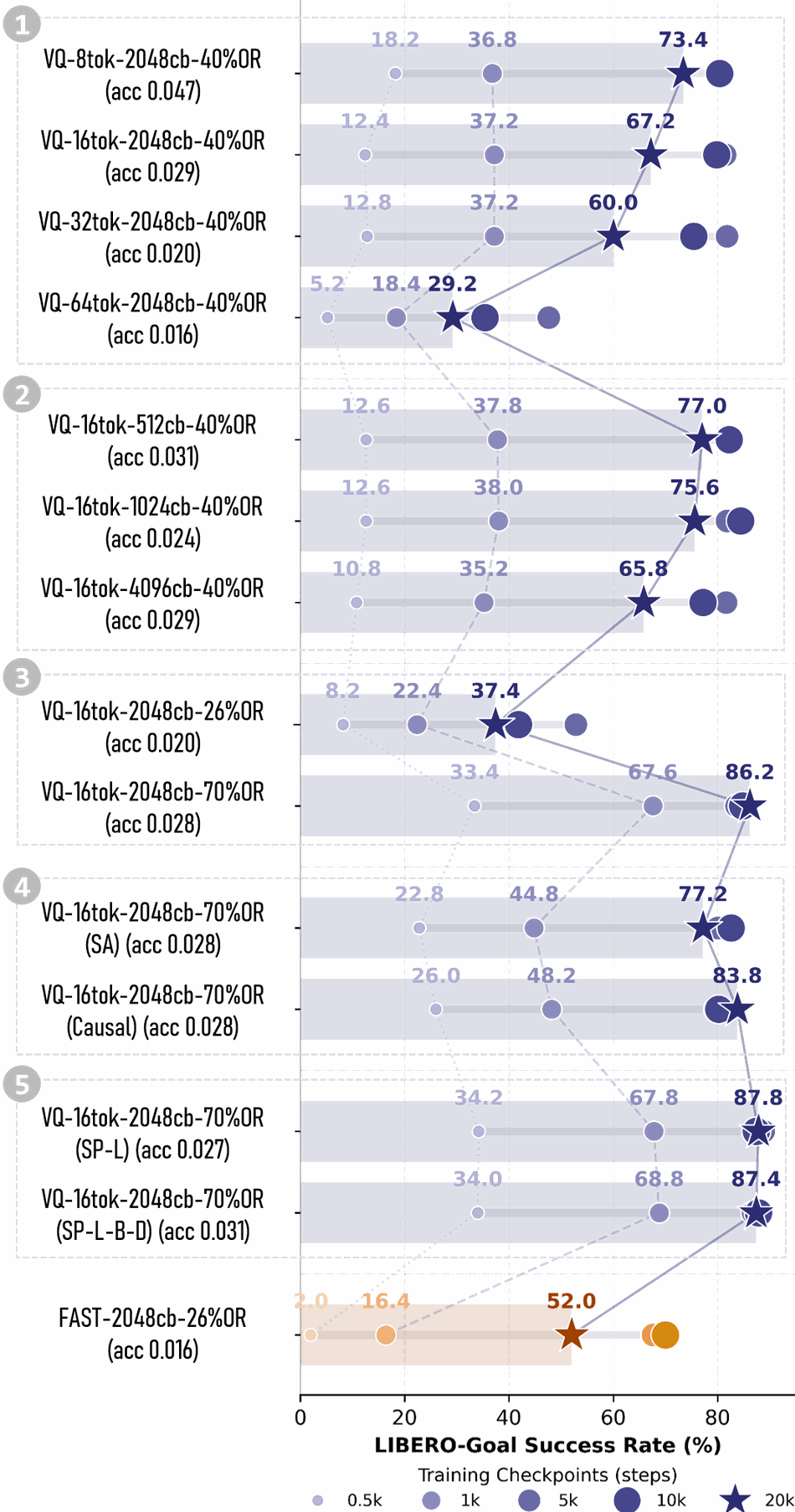
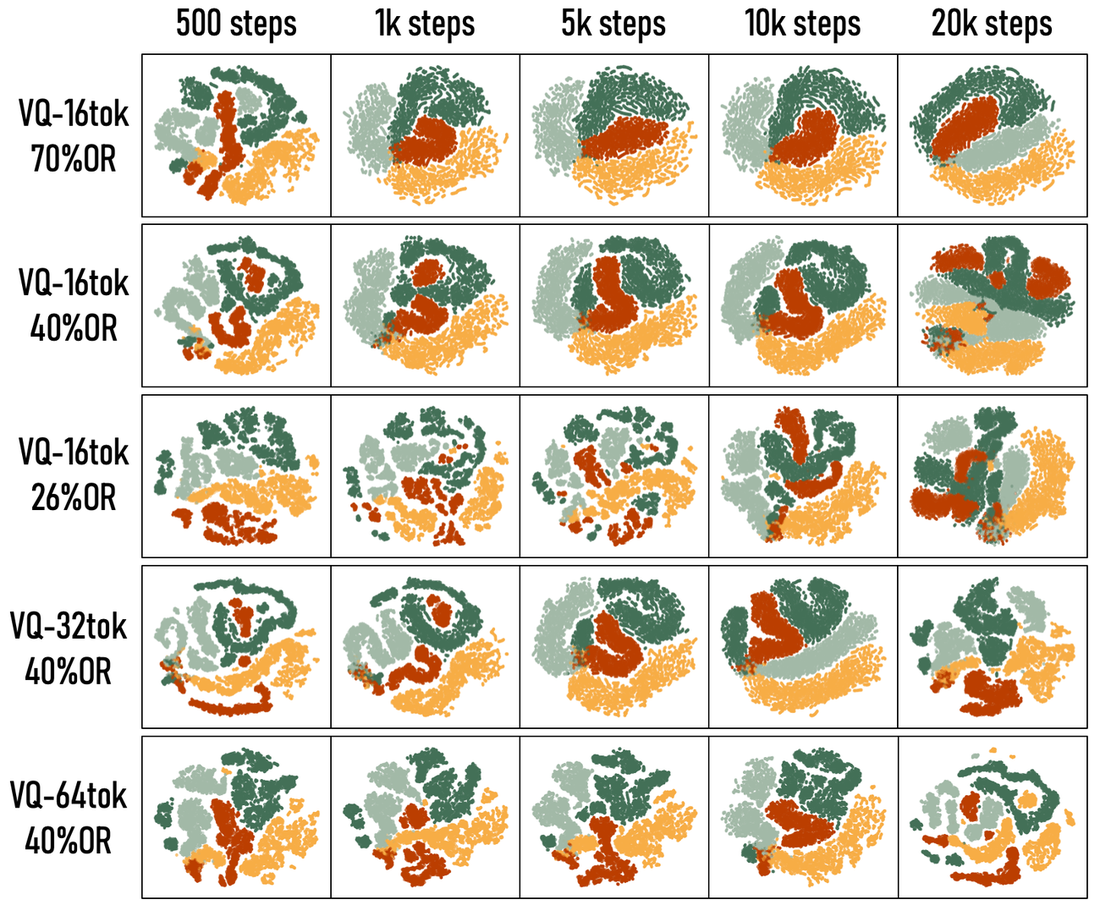
Changing a perturbation-contrastive weight produces 26%, 40% and 70% adjacent-chunk overlap. At 500 policy updates, 70% overlap gives 33.4% success, versus 8.2% for the basic VQ tokenizer and 2% for FAST. Four-task t-SNE plots show earlier task separation and less late-stage drift.
These are associations under controlled horizon, vocabulary and token budget; changing the contrastive loss also changes reconstruction and token usage. Maximizing overlap without a fidelity constraint could erase useful motion distinctions.
3.2 Impacts of Vocabulary Size and Token Budget
Token counts 8/16/32/64 and vocabularies 512/1024/2048/4096 are compared while overlap is held near 40% by retuning contrastive strength. Larger token counts are particularly associated with late-stage rollout degradation. Very small representations lose reconstruction fidelity; 16 tokens and 2,048 codes are a practical compromise, not a unique optimum.
Equation
3.3 Impacts of Vision-Language Alignment and Residual Grammar
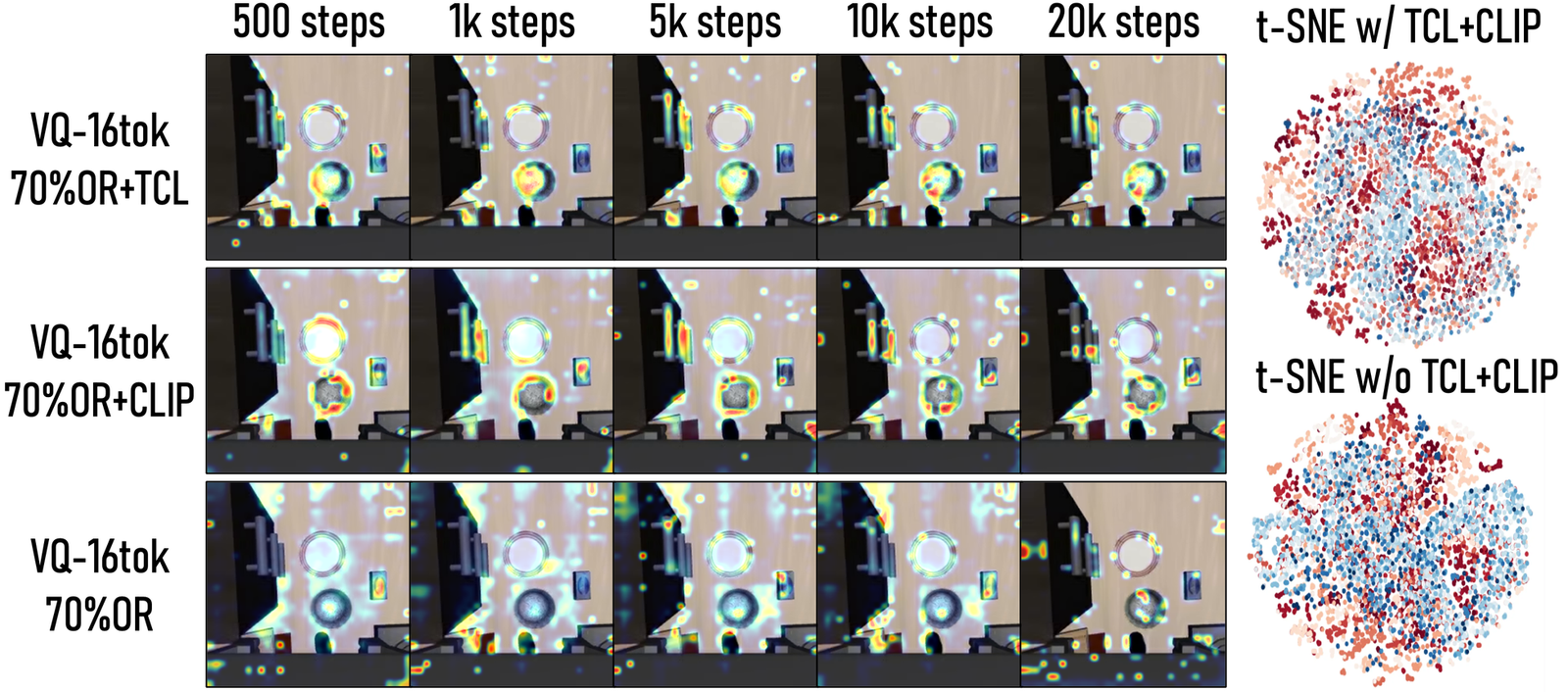
Time-contrastive learning aligns neighboring action chunks; a language-contrastive objective aligns action embeddings with instructions, with an additional L1 regularizer. Attention maps suggest language alignment emphasizes instruction-relevant objects, while temporal alignment can capture demonstration-specific patterns. Neither visualization measures mutual information.
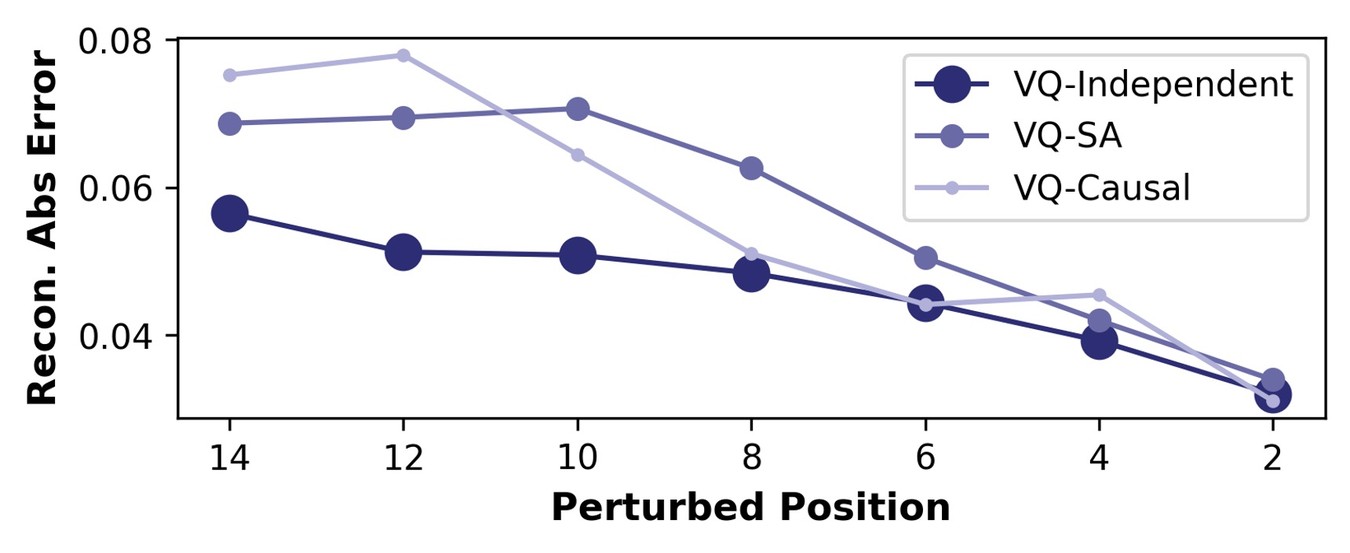
A Perceiver using cross-attention alone is compared with bidirectional or causal query self-attention. Shuffling one predicted token before continuing generation hurts the cross-attention variant less. “Independent” means no query self-attention; all queries share the action input and may remain statistically dependent.
Equations 5–6
| (5) | ||||
| (6) |
4 ActionCodec
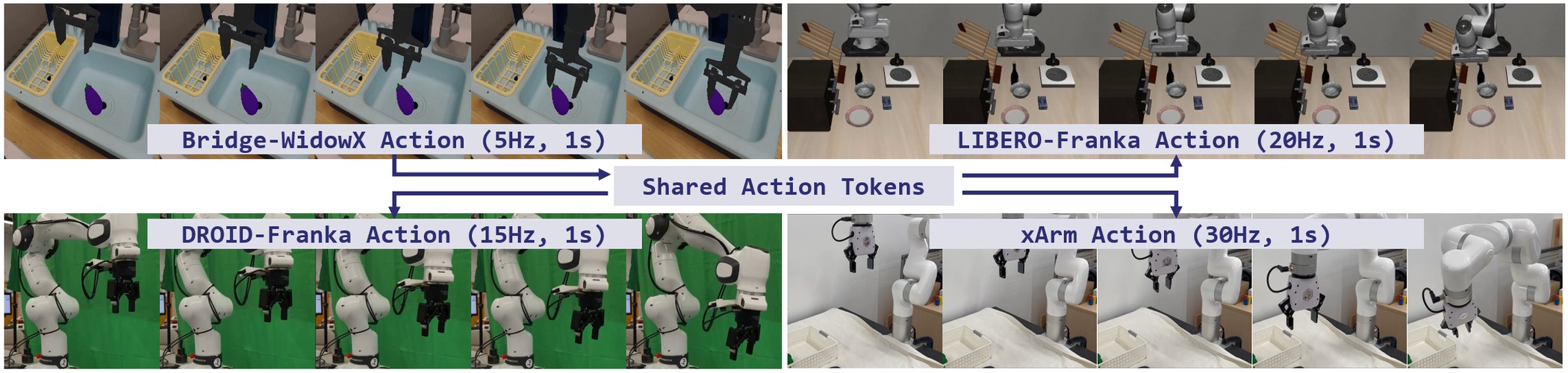
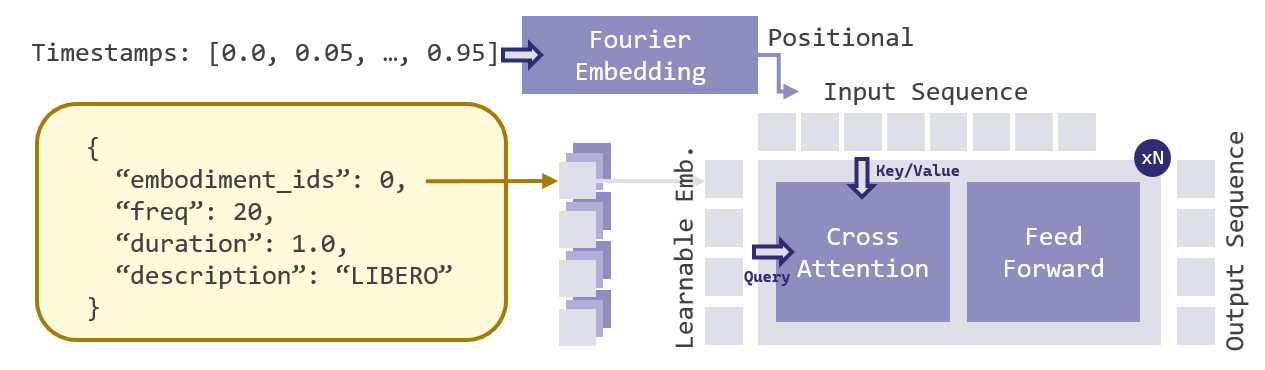
Embodiment-specific learned queries and timestamp encodings let one Perceiver tokenizer use LIBERO, BridgeData and DROID with different control rates. Cross-embodiment trajectory demonstrations illustrate transfer of motion patterns; they do not establish arbitrary task transfer.
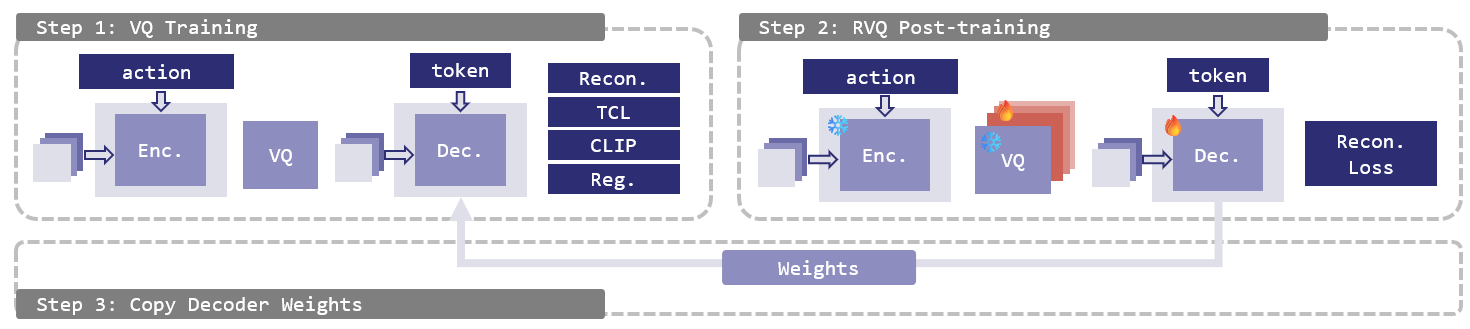
After stable single-codebook training, freeze the encoder and primary codebook and train residual codebooks plus the decoder for reconstruction. The full three-level tokenizer supports blockwise prediction. Ordinary ActionCodec copies the refined decoder back while retaining its original 16-token encoding; this preserves the first-level labels exactly.
5 Experiments
Experiments cover controlled tokenizer comparisons, action-generation architectures, two real robot tasks and component ablations. All original figures and comparison tables are retained.
5.1 Comparison with Mainstream Action Tokenizers
With a shared SmolVLM2-2.2B backbone, ActionCodec reaches 89.5% LIBERO success after 5,000 steps, versus FAST’s 38.6%; final averages are 95.5% and 90.6%. Smaller 256M/500M ActionCodec policies reach 92.3%/92.5%.
Table 2 reports 16 tokens, 72% overlap, 0.9 s policy latency and 22 actions/s for 20-step chunks. Throughput counts decoded actions, not independent reactive decisions at 22 Hz. Baseline horizons and token budgets differ; these are complete-method comparisons rather than matched-budget ablations.
| Model | Pt. | Goal | Spatial | Object | Long | Avg. |
Avg. Rank |
| Octo-Base [27] | Y | 84.6 | 78.9 | 85.7 | 51.1 | 75.1 | 10.5 |
| SpatialVLA [30] | Y | 78.6 | 88.2 | 89.9 | 55.5 | 78.1 | 9.5 |
| GR00T-N1 [3] | Y | 93.0 | 94.4 | 97.6 | 90.6 | 93.9 | 6.6 |
| UniVLA [5] | Y | 95.6 | 96.5 | 96.8 | 92.0 | 95.2 | 5.4 |
| VQ-VLA [36] | Y | 75.2 | - | - | 60.0 | - | - |
| OpenVLA [19] | Y | 79.2 | 84.7 | 88.4 | 53.7 | 76.5 | 10.0 |
| OpenVLA-OFT [18] | Y | 97.9 | 97.6 | 98.4 | 94.5 | 97.1 | 2.5 |
| [4] | Y | 95.8 | 96.8 | 98.8 | 85.2 | 94.2 | 4.5 |
| [15] | Y | 98.0 | 98.8 | 98.2 | 92.4 | 96.8 | 2.5 |
| FAST [29] | Y | 88.6 | 96.4 | 96.8 | 60.2 | 85.5 | 7.4 |
| ActionCodec (2.2B) | N | 95.4 | 96.2 | 99.6 | 90.6 | 95.5 | 5.1 |
| ActionCodec-BAR | N | 97.6 | 97.2 | 99.8 | 94.8 | 97.4 | 2.0 |
| Model | Pt. | Goal | Spatial | Object | Long | Avg. |
Avg. Rank |
| Diffusion Policy [7] | N | 68.3 | 78.3 | 92.5 | 50.5 | 72.4 | 13.8 |
| MiniVLA [2] | N | - | - | - | 77.0 | - | - |
| OpenVLA-OFT [18] | N | 91.7 | 94.3 | 95.2 | 86.5 | 91.9 | 7.8 |
| SmolVLA 2.2B [31] | N | 91.0 | 93.0 | 94.0 | 77.0 | 88.8 | 10.2 |
| FAST [29] | N | 89.0 | 87.0 | 63.0 | 48.0 | 71.8 | 14.2 |
| [15] | N | 94.6 | 96.6 | 97.2 | 85.8 | 93.3 | 6.4 |
| VLA-0 [12] | N | 96.2 | 97.0 | 97.8 | 87.6 | 94.7 | 3.8 |
| Model | Pt. | Goal | Spatial | Object | Long | Avg. |
Avg. Rank |
| SmolVLM2-2.2B (256M/500M) + Tokenizers | |||||||
| Binning | N | 27.4 | 64.2 | 71.0 | 50.8 | 53.4 | 15.5 |
| String | N | 30.8 | 69.6 | 71.6 | 26.4 | 49.6 | 15.5 |
| VQVLA’s | N | 60.5 | 56.0 | 69.8 | 51.4 | 60.5 | 15.2 |
| MiniVLA’s | N | 82.1 | 82.8 | 90.2 | 75.2 | 82.6 | 12.8 |
| FAST | N | 89.2 | 90.2 | 97.2 | 85.8 | 90.6 | 9.4 |
| ActionCodec (256M) | N | 91.2 | 94.2 | 97.0 | 86.8 | 92.3 | 7.5 |
| ActionCodec (500M) | N | 96.4 | 91.6 | 96.0 | 85.8 | 92.5 | 7.8 |
| ActionCodec (2.2B) | N | 95.4 | 96.2 | 99.6 | 90.6 | 95.5 | 3.8 |
| Variants | |||||||
| ActionCodec-PD | N | 97.0 | 95.2 | 98.4 | 91.6 | 95.6 | 3.0 |
| ActionCodec-KI | N | 95.0 | 93.6 | 97.6 | 90.8 | 94.3 | 5.5 |
| ActionCodec-BAR | N | 97.6 | 97.2 | 99.8 | 94.8 | 97.4 | 1.0 |
| Model | Pt. | Spoon | Carrot | Block | Eggplant | Avg. |
Avg. Rank |
| Octo-Base [27] | Y | 12.5 | 8.3 | 0.0 | 43.1 | 16.0 | 7.3 |
| SpatialVLA [30] | Y | 16.7 | 25.0 | 29.2 | 100.0 | 42.7 | 4.0 |
| [4] | Y | 66.7 | 58.3 | 58.3 | 88.3 | 67.9 | 2.0 |
| OpenVLA-OFT [18] | Y | 12.5 | 4.2 | 8.3 | 0.0 | 6.3 | 8.1 |
| UniVLA [5] | Y | 54.2 | 66.7 | 50.0 | 4.2 | 43.8 | 3.5 |
| OpenVLA [19] | Y | 32.0 | 30.0 | 18.0 | 38.0 | 29.5 | 4.8 |
| VQ-VLA [36] | Y | 12.5 | 8.0 | 6.0 | 0.0 | 6.6 | 8.1 |
| FAST [29] | Y | 29.1 | 21.9 | 10.8 | 66.6 | 32.1 | 5.3 |
| ActionCodec-BAR | N | 71.7 | 64.2 | 55.0 | 70.0 | 65.2 | 2.0 |
| MiniVLA [2] | N | 68.0 | 44.0 | 70.0 | 14.0 | 49.0 | 1.8 |
| ActionCodec-BAR | N | 71.7 | 64.2 | 55.0 | 70.0 | 65.2 | 1.3 |
| Tokenizer |
Token Budget |
OR | Horizon |
Latency (s) |
Throughput (action/s) |
SR (%) |
| Binning [12] | 140.0±0.0 | 39% | 20 | 4.9 | 4.1 | 3.5 |
| Binning [12] | 56.0±0.0 | 38% | 8 | 2.6 | 3.1 | 53.4 |
| String [13] | 779.2±17.3 | 28% | 20 | 33.8 | 0.6 | 20.4 |
| String [13] | 311.8±7.8 | 34% | 8 | 12.7 | 0.6 | 49.6 |
| VQVLA’s [36] | 4.0±0.0 | 45% | 5 | 0.7 | 7.7 | 60.5 |
| MiniVLA’s [2] | 7.0±0.0 | 40% | 8 | 0.7 | 11.1 | 82.6 |
| FAST [29] | 24.3±9.1 | 19% | 20 | 1.5 | 13.1 | 90.6 |
| ActionCodec | 16.0±0.0 | 72% | 20 | 0.9 | 22.0 | 95.5 |
5.2 Integration with Prevailing VLA Paradigms
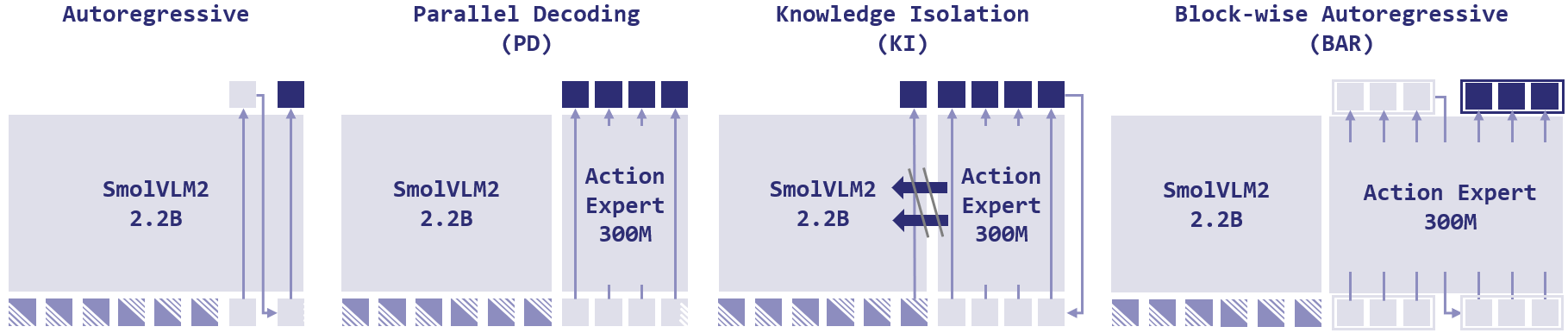
A 300M action expert enables parallel decoding (PD), knowledge isolation (KI) or blockwise autoregression (BAR). LIBERO averages are 95.6%, 94.3% and 97.4%, respectively, against 95.5% native autoregression. KI is weaker here despite outperforming its FAST-based counterpart.
On Simpler-WidowX, BAR averages 65.2%. It ties π0’s average rank within the mixed-pretraining block but falls below π0’s 67.9% average; it leads the separately ranked non-VLA-pretrained block. The headline ranking is not a win on every task or metric.
5.3 Real-world Evaluation
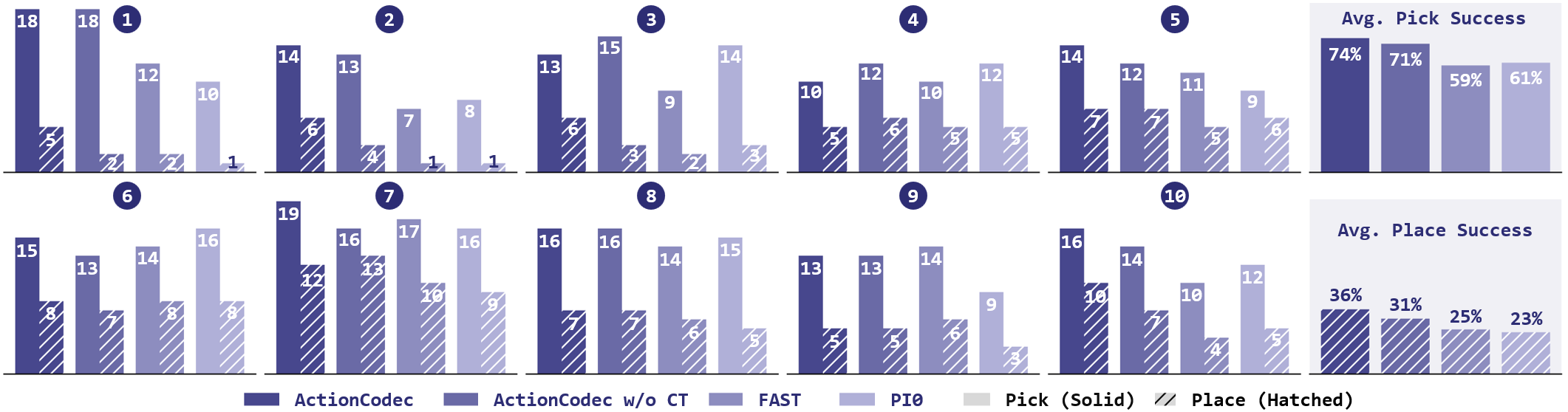
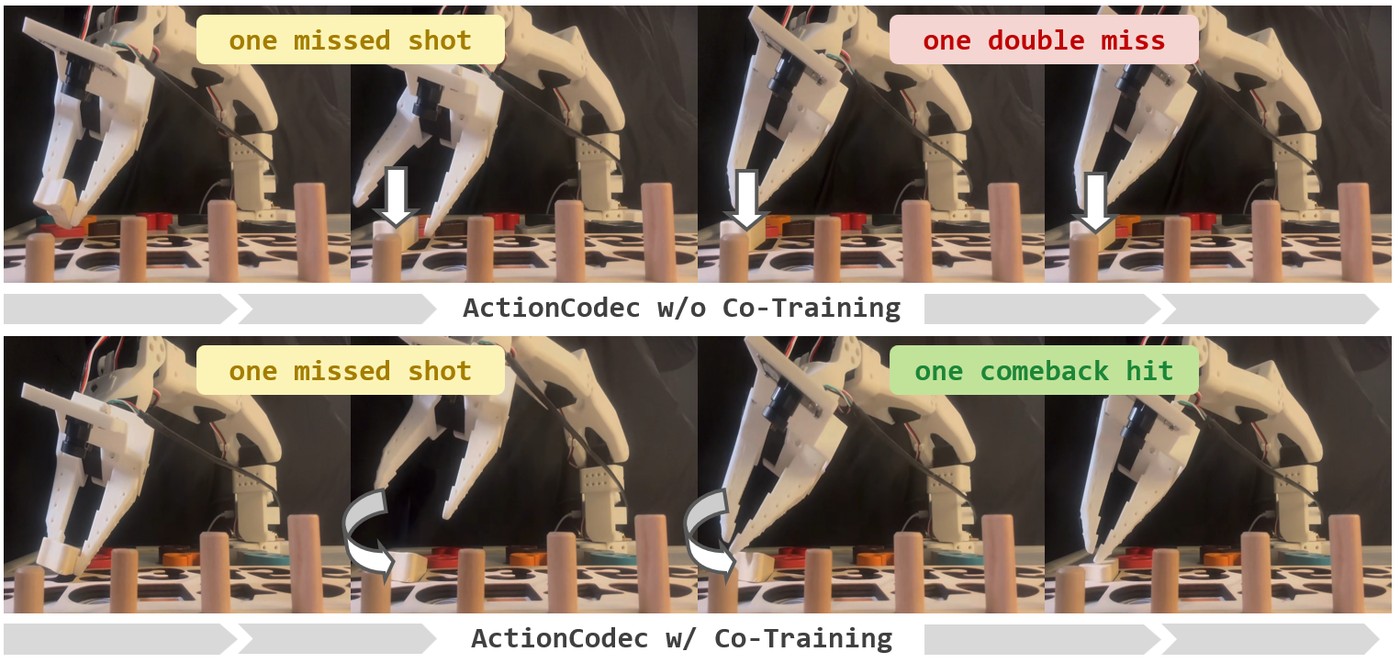
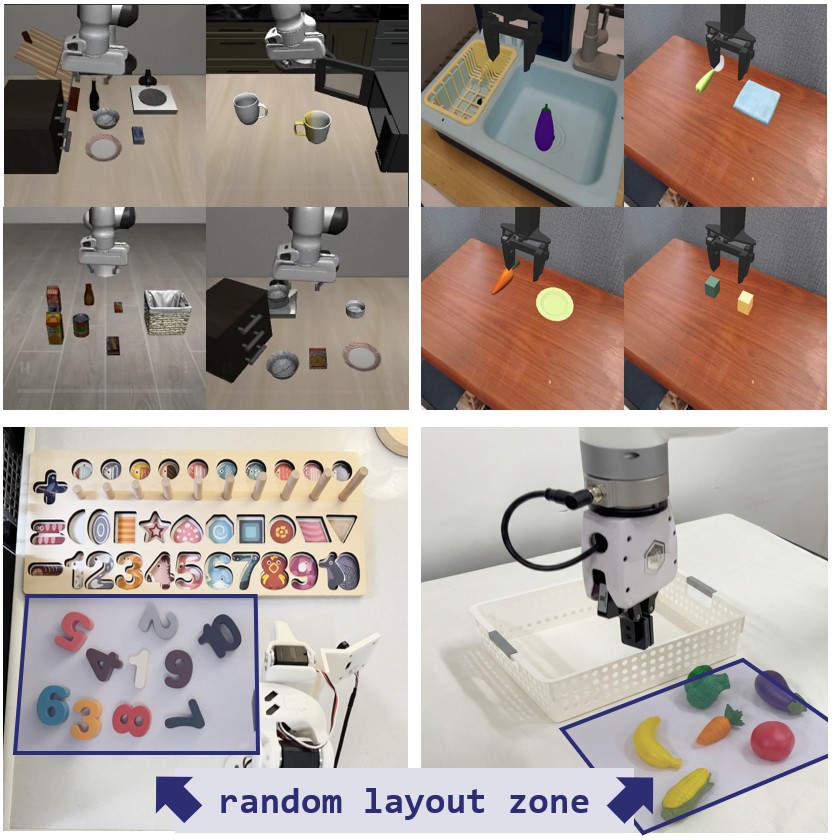
SO100-ShapeSorter tests selecting ten numbered blocks and inserting them into tight slots. Adding 22.9K community episodes particularly improves insertion/recovery, with qualitative corrective sequences retained in Figure 8. Appendix B clarifies that the “without co-training” variant still uses LIBERO, BridgeData and DROID; it excludes the SO100 community data, so it is not strictly task-only.
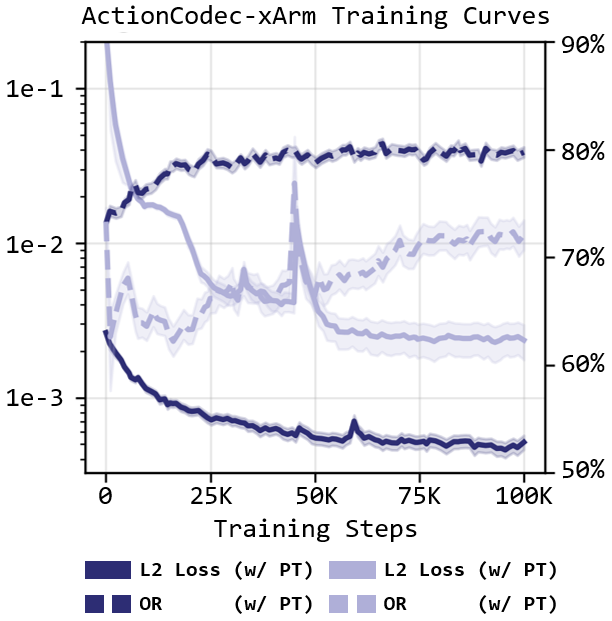
On xArm vegetable picking, initialization from the shared tokenizer improves reconstruction and overlap; policy success is 82.5%, versus 74.1% without tokenizer pretraining, 75.0% for π0 and 72.5% for π0-FAST. The source’s Table 4 reference for these numbers should be Table 3. Datasets: SO100 and xArm.
| Model |
ActionCodec w/ PT |
ActionCodec w/o PT |
FAST | |
| SR (%) | 82.5 | 74.1 | 75.0 | 72.5 |
5.4 Ablation Study
LIBERO success rises from 92.0% without co-training to 92.7% with co-training but no soft prompts, then 95.2% with prompts. RVQ decoder post-training adds only 0.3 points to reach 95.5%, despite reducing reconstruction error. This supports fidelity/stability tradeoffs in this setting, not a universal error threshold.
SmolVLM2, Qwen2.5VL and InternVL3.5 versions reach 95.5%, 95.1% and 94.6%. The original backbone logos in Table 4 remain; their identities are stated here for clarity.



6 Conclusion
The main contribution is a downstream-policy view of token quality: temporal consistency, compactness, context alignment and limited architectural coupling can matter more than minimum reconstruction error. Broader embodiment coverage and improved architectures/alignment remain open.
7 Limitations
The architecture prioritizes ablation flexibility rather than final performance. Two auxiliary contrastive losses add tuning choices. Even the additional 15K-hour, 14-embodiment study evaluates limited benchmarks and does not establish broad in-the-wild generalization.
Impact Statement
The authors frame the work as advancing machine learning and identify no particular societal consequence requiring special discussion. This is an impact statement, not a deployment safety evaluation.
Appendix A Related Works
Continuous VLA approaches use regression, diffusion or flow experts; discrete approaches preserve a language-model-style prediction objective but can increase sequential latency. Hybrid models also use discrete action supervision.
Binning and raw strings are simple but token-intensive. FAST compresses frequency coefficients with BPE; VQ-VLA, MiniVLA and other learned schemes adapt their latent codes. ActionCodec studies properties of those learned targets rather than treating reconstruction as the only quality metric.
The original bibliography omits two cited works, leaving question marks in the PDF. Their source keys identify Fast-WAM and G0.5; verified entries are appended without renumbering the 39 existing references.
Appendix B Experimental Setup and Benchmark Details
The appendices specify demonstrations, evaluation trials, model inputs, hardware, optimization and the specialized attention masks. All four hyperparameter tables and the complete prompt are retained.
B.1 Benchmarks
LIBERO has four ten-task suites, 50 demonstrations per task and 50 evaluation initial states per task. Simpler-WidowX uses four Bridge-trained out-of-domain tasks with 120 trials each after four fine-tuning epochs.
SO100 uses overhead/wrist RGB, absolute joint angles, 30 Hz demonstrations, 50 examples per numbered block and 20 randomized trials each. Pick and insertion are separate outcomes. The co-training ablation removes only SO100 community episodes.
xArm uses a third-person RGB camera, end-effector proprioception and delta-pose actions at 30 Hz, with 30 demonstrations and 20 randomized trials per vegetable. Pretrained tokenizer initialization uses LIBERO/BridgeData/DROID; the comparison initializes the tokenizer randomly on xArm. Both real-task policies train for 30,000 steps.
B.2 Details of Validation Experiments
Perceiver query attention can be removed or made bidirectional/causal while retaining shared action input. SmolVLM2-256M is fully fine-tuned after adding action vocabulary entries. Invalid generated sequences become zero-action chunks; FAST instead receives padding/truncation only when its BPE-decoded length is invalid.
Tokenizers see all LIBERO tasks, but design-study policy learning uses LIBERO-Goal. Curves inspect 500–20,000 steps, while Table 6 specifies a 30,000-step schedule. The [BOS] label denotes the prompt context token immediately before action generation.
Equation
B.2.1 Impacts of Overlap Rate
An InfoNCE-style auxiliary loss brings an action’s latent representation close to a Gaussian-perturbed copy, with other batch samples as negatives. Varying its weight controls overlap. The final model uses temporal and language contrastive objectives because they give more stable training in the reported comparisons.
Equation
Definition and controls.
Overlap is one minus normalized Hamming distance at corresponding token positions for adjacent one-step-shifted chunks, averaged over pairs. It is not set overlap. The overlap ablation fixes 16 tokens, 2,048 codes, horizon, stride and policy; capacity sweeps retune contrastive strength to keep overlap at 40%.
All three overlap variants use every code. Marginal perplexity falls from 2,016 to 1,290 as overlap increases, while reconstruction L1 error changes from 0.020 to 0.028. This indicates concentrated usage rather than codebook collapse; neither perplexity nor overlap directly estimates conditional entropy.
Equation 7
| (7) |
| OR (%) | Codebook utilization (%) | PPL | error | SR at 500 steps (%) |
| 26 | 100 | 2016 | 0.020 | 8.2 |
| 40 | 100 | 1583 | 0.029 | 12.4 |
| 70 | 100 | 1290 | 0.028 | 33.4 |
Equation
B.2.2 Impacts of Residual Grammar
Cross-attention-only, self-attention and causal self-attention tokenizers differ in direct latent-query interaction. During policy generation, one token is shuffled, the remaining sequence is generated and decoded, and L1 action error is measured. The first variant is more robust in these tests; statistical independence and a universal optimal attention pattern are not implied.

B.3 Details of Tokenizer Comparison Experiments
The shared tokenizer trains for 100,000 steps with batch 8,192 and learning rate 2×10⁻⁴, encoding one second through timestamp-aware position embeddings. Tokenizer robotic pretraining is separate from whether the policy backbone has VLA pretraining.
Binning and strings use eight-step horizons to contain sequence length; VQ baselines use official implementations/checkpoints with aligned statistics, and FAST uses its universal release. All comparison policies fully fine-tune SmolVLM2-2.2B jointly across LIBERO for 30,000 steps. Different tokenizer pretraining datasets remain a comparison qualification.
| Hyperparameters | Values |
| GPUs | 8NVIDIA RTX 3090 (24 GB VRAM) |
| Learning Rate | peak (1k steps linear warmup, 30k steps cosine decay to ) |
| Global Batch Size | 128 (16 per GPU) |
| Training Steps | 30k (LIBERO-Goal only) |
| Input Modalities | 1 Third-person camera, 1 Wrist camera (concatenated) |
| Input Image Size | 224 448 |
| Use Proprioception | True |
| Image Augmentation | Random crop (87.5%), Brightness/Contrast/Saturation (0.2), Hue (0.05) |
| Hyperparameters | Values |
| GPUs | 4NVIDIA A100 (80 GB VRAM) |
| Learning Rate | peak (1k steps linear warmup, 30k steps cosine decay to ) |
| Global Batch Size | 128 (32 per GPU) |
| Training Steps | 30k (applied to all four LIBERO task suites) |
| Input Modalities | 1 Third-person camera, 1 Wrist camera (concatenated) |
| Input Image Size | 224 448 |
| Use Proprioception | True |
| Image Augmentation | Random crop (87.5%), Brightness/Contrast/Saturation (0.2), Hue (0.05) |
| Hyperparameters | Values |
| GPUs | 8NVIDIA H100 (94 GB VRAM) |
| Learning Rate | |
| Global Batch Size | 128 (16 per GPU) |
| Training Epochs | 4 |
| Input Modalities | 1 Third-person camera |
| Input Image Size | 224 224 |
| Use Proprioception | True |
| Image Augmentation | Random crop (90%), Brightness/Contrast/Saturation (0.2), Hue (0.05) |
| Hyperparameters | Values |
| GPUs | 4NVIDIA A100 (80 GB VRAM) |
| Learning Rate | peak (1k steps linear warmup, 30k steps cosine decay to ) |
| Global Batch Size | 64 (16 per GPU) |
| Training Steps | 30k |
| Input Modalities | SO100: 1 Third-person camera, 1 Wrist camera (concatenated), xArm: 1 Third-person camera |
| Input Image Size | 224448 for SO100, 224224 for xArm |
| Use Proprioception | True |
| Image Augmentation | Brightness/Contrast/Saturation (0.2), Hue (0.05) |
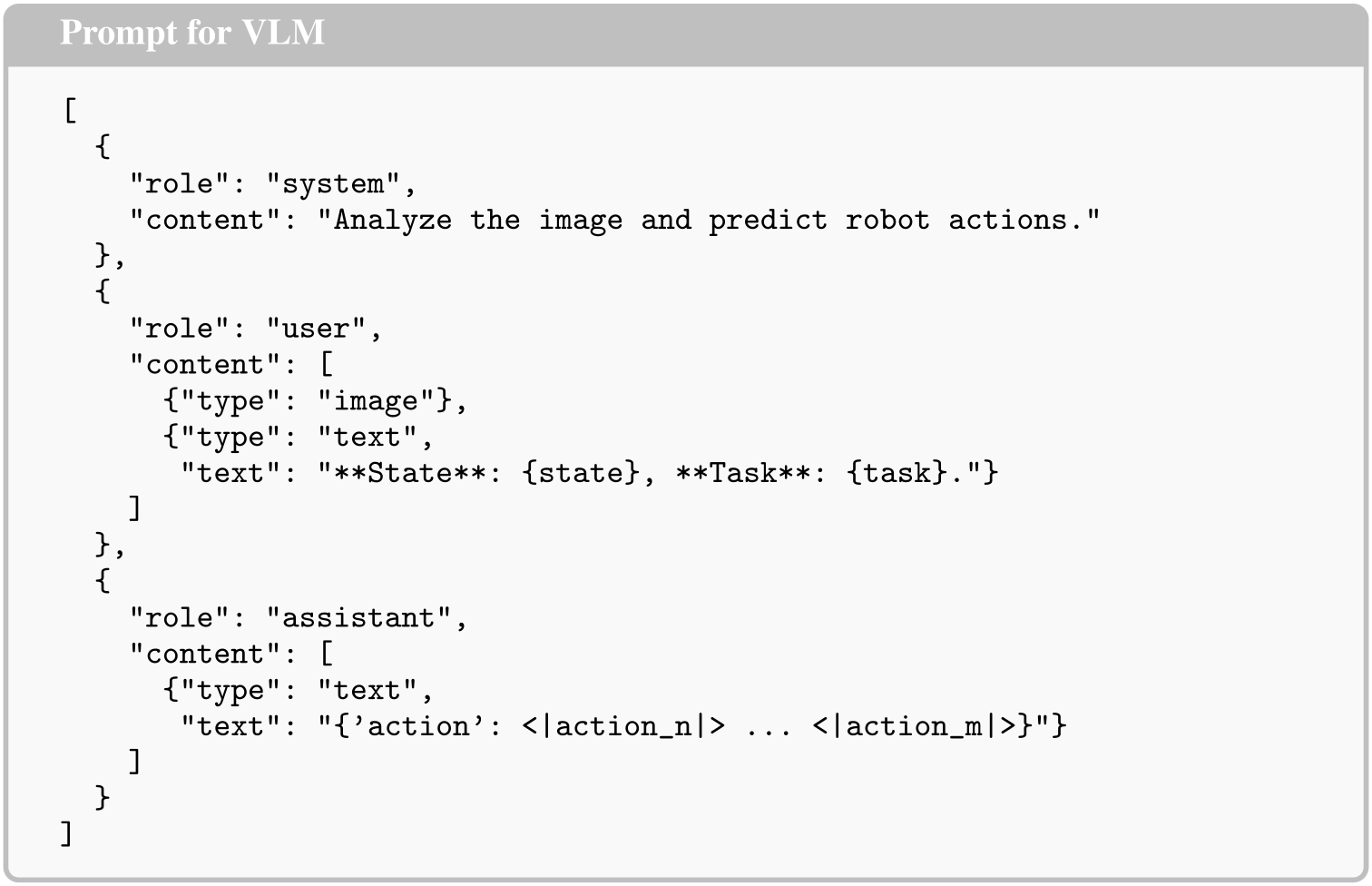
Copyable prompt
[
  {
    "role": "system",
    "content": "Analyze the image and predict robot actions."
  },
  {
    "role": "user",
    "content": [
      {"type": "image"},
      {"type": "text",
       "text": "**State**: {state}, **Task**: {task}."}
    ]
  },
  {
    "role": "assistant",
    "content": [
      {"type": "text",
       "text": "{’action’: <|action_n|> ... <|action_m|>}"}
    ]
  }
]
B.4 Details of Paradigm Adaptation Experiments
The 300M action expert consumes the VLM KV cache and handles specialized masks. PD predicts all token logits with bidirectional attention in one pass. KI trains a flow-matching action expert alongside autoregressive supervision, stopping expert gradients into the VLM.
BAR predicts each RVQ level in parallel but proceeds autoregressively across levels. One level reduces to PD; later levels refine residuals. Lower prefix-error sensitivity is empirical, not a proof that errors always damp. The expert adds capacity, so architecture gains are not tokenizer-only ablations.
Appendix C Details of Soft-Prompt
Each embodiment index selects learned query embeddings. Control frequency and encoded duration determine timestamps, which receive Fourier embeddings for encoder keys/values and decoder queries. These mechanisms distinguish embodiment-specific control conventions while sharing network weights.
Appendix D Details of RVQ Post-training
Train a 16-token single-level VQ model first. Initialize a three-level RVQ version from it, freeze the encoder and primary codebook, and optimize residual codebooks plus decoder with reconstruction/RVQ losses. Copying the decoder back preserves the original single-level token identities; BAR alone uses all three levels.
“No additional cost” concerns the ordinary tokenizer’s encoding/prediction interface, not the extra post-training computation or BAR’s extra levels. The paper demonstrates improved fidelity empirically rather than proving zero downstream degradation.
Appendix E Scope of the Information-Theoretic Analysis
The scope appendix distinguishes exact information identities from measured proxies and empirical design guidance.
E.1 Deterministic and Perturbation-Induced Entropy
A deterministic tokenizer has zero action-conditioned entropy. A separately defined Gaussian perturbation induces randomness near quantization boundaries; its entropy is not substituted into the deterministic identity. Adjacent-chunk overlap probes local consistency only when neighboring motion and context are sufficiently similar.
Equations 8
| (8) |
E.2 Capacity Subject to Fidelity
The practical bottleneck is to reduce token entropy subject to acceptable expected reconstruction distortion. Reducing token count/vocabulary too far violates fidelity. Fixing overlap during capacity sweeps removes one confound, while reconstruction and token-usage distributions still vary.
Equations 9
| (9) |
E.3 Alignment and Architectural Coupling
Attention maps, temporal/language contrastive comparisons and shuffled-prefix errors are qualitative/behavioral probes, not mutual-information estimators. Temporal alignment avoids direct image–action CLIP computation but can learn demonstration-specific patterns. Cross-attention-only queries remain coupled through their shared input.
Appendix F Additional Experimental Results and Comparison Protocols
Additional results separate large-scale VLA pretraining from the main no-VLA-pretraining setting, then clarify baseline costs and overfitting evidence.
F.1 Large-Scale VLA Pre-training and Transfer
A separate Qwen3.5-2B policy receives 15K hours across 14 embodiments with a π0.5-style KI objective. Reported success averages are 87.7% Simpler-WidowX fine-tuning, 98.2% LIBERO fine-tuning and 82.5% DROID zero-shot. These exceed the listed baseline averages, but dataset composition, trial/seed uncertainty and broad real-world transfer are not established by the aggregate table.
| Method | Simpler-WidowX FT | LIBERO FT | DROID ZS |
| -FAST | 32.1 | 85.5 | – |
| 57.1 | 96.8 | 57.5 | |
| MolmoAct2-DROID | – | – | 52.0 |
| ActionCodec (Qwen3.5-2B) | 87.7 | 98.2 | 82.5 |
F.2 Baseline Fairness and Encoding Cost
FAST and ActionCodec both encode 20-step LIBERO chunks, averaging 24.3 versus 16 tokens; other baselines have different horizons. FAST length repair preserves valid outputs. At batch 1,024, encoding costs are 0.11 versus 0.09 ms per chunk; these exclude policy generation and do not prove equal total training time.
Training-step convergence is useful under the shared VLA recipe, but tokenizer pretraining, token-dependent compute and wall-clock hardware costs remain distinct. The smaller-backbone result supports representation quality, not a fully matched total-compute comparison.
| Tokenizer | Encoding time per chunk (ms) |
| FAST | 0.11 |
| ActionCodec | 0.09 |
F.3 Optimization and Overfitting Evaluation
Raw token NLL is incomparable across different vocabularies and lengths. The paper instead tracks closed-loop success, where predicted actions alter later observations and errors accumulate. Late-stage success drops motivate its overfitting discussion; latent plots provide supporting evidence, not a separate causal diagnosis.