Overview
The reviewed arXiv v4 is dated 25 February 2026 and marked ICLR 2026. The fourteen authors are affiliated with Stanford, UT Austin and Amazon; Chengshu Li, Mengdi Xu, Arpit Bahety and Hang Yin contributed equally. All four appendices are retained.
At a glance
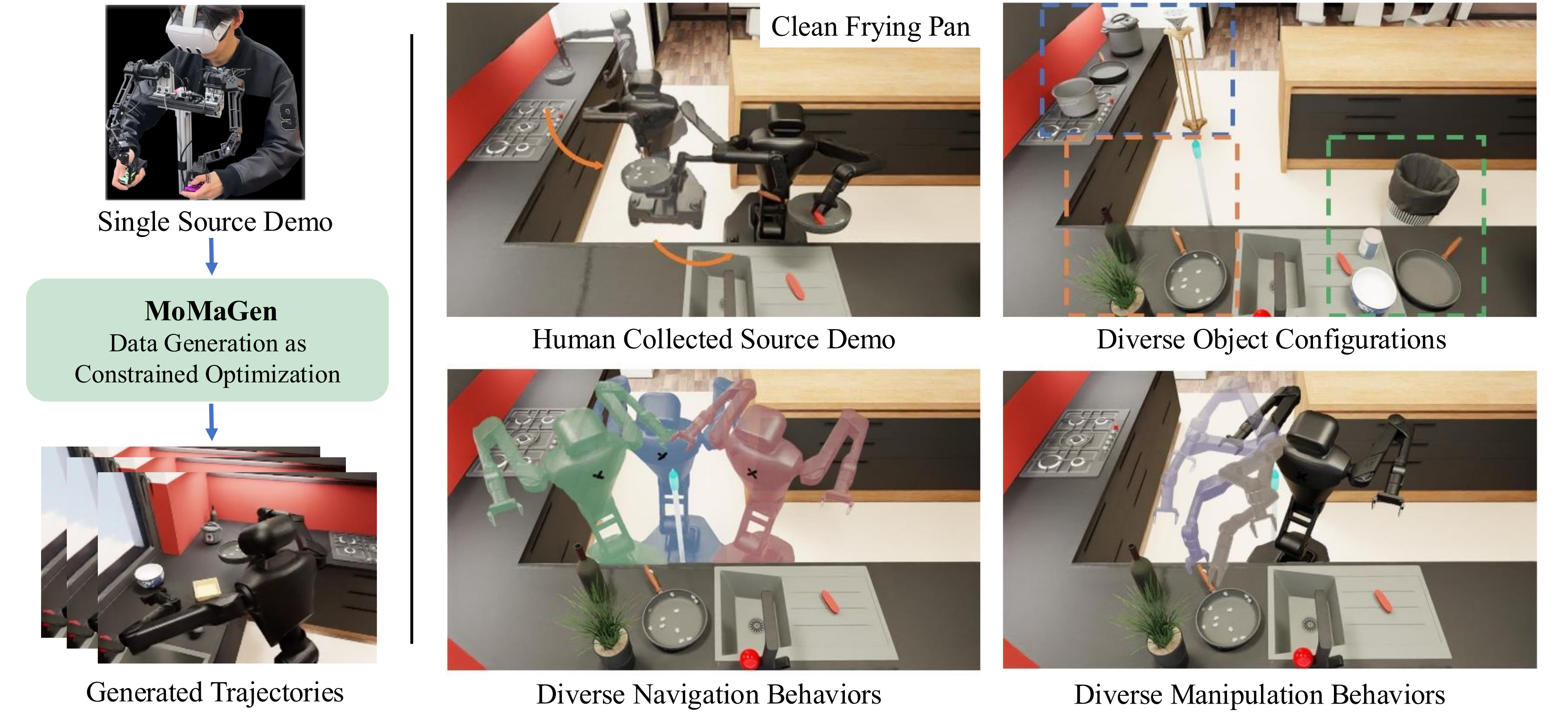
MoMaGen generates new demonstrations from one annotated source demonstration per task. It adapts the mobile base and camera as well as the arms, enforcing reachability and manipulation visibility while favoring visibility and compact posture during navigation.
Experiments generate data for four household tasks and train policies for cup picking and table tidying. On a matched real cup-picking setup, simulation pretraining followed by forty real training demonstrations yields 60% success for π₀ versus 0% without that simulation stage. The evidence concerns this small adaptation experiment, not general zero-shot real-world deployment. Project resources accompany the paper.
1 Introduction
Replaying a human demonstration in a new object arrangement can place a mobile robot too far from the next object or leave it outside the camera view. A feasible arm motion alone therefore does not provide suitable whole-body training data.
MoMaGen samples and plans new base/camera configurations, preserving object-relative contact motions from the source. Simulation validates generated trajectories before behavior cloning. This reduces repeated teleoperation, but still requires source annotation, task setup, privileged scene geometry and substantial generation compute.
2 Related Works
The MimicGen family expands seed demonstrations through simulation, complementing offline image augmentation, trial-and-error collection and scripted experts. SkillMimicGen adds motion planning; DexMimicGen supports bimanual timing; other approaches address dynamics and geometry.
Mobile imitation learning must coordinate navigation, manipulation and observation, making demonstrations costly to collect. Table 1 compares constraint choices. MoMaGen extends the two evaluated baselines with source-base replay, then tests its additional base sampling and visibility controls against those extensions.
| Methods | Bimanual | Mobile | Obstacles | Base | Active | Hard | Soft |
|---|---|---|---|---|---|---|---|
| Random. | Perception | Constraints | Constraints | ||||
| MimicGen (Mandlekar et al., 2023b) | ✗ | ✓ | ✗ | ✗ | ✗ | Succ | N/A |
| SkillMimicGen (Garrett et al., 2024) | ✗ | ✗ | ✓ | ✗ | ✗ | Succ, Kin, C-Free | N/A |
| DexMimicGen (Jiang et al., 2025b) | ✓ | ✗ | ✗ | ✗ | ✗ | Succ, Temp | N/A |
| DemoGen (Xue et al., 2025) | ✓ | ✗ | ✓ | ✗ | ✗ | Kin, C-Free | N/A |
| PhysicsGen (Yang et al., 2025) | ✓ | ✗ | ✗ | ✗ | ✗ | Kin, C-Free, Dyn | Trac |
| MoMaGen (Ours) | ✓ | ✓ | ✓ | ✓ | ✓ | Succ, Kin, C-Free, Temp, Vis | Vis, Ret |
3 Problem Formulation: Automated Data Generation as Constrained Optimization
A task is an MDP. A source trajectory supplies state/action sequences; successful generated trajectories become behavior-cloning data. Source demonstrations are segmented into object-centered subtasks with associated object and end-effector trajectories. The original dataset, learning-objective and trajectory expressions are retained below.
Free-space segments can be replanned under kinematic and collision constraints. Contact-rich segments retain the original end-effector motion relative to the relevant object. Equation 1 expresses dynamics, kinematics, collisions, visibility, transformed contact motion and eventual task success as hard conditions, with user-selected soft costs in the objective.
This is a unifying formulation; the implementation uses sampling, inverse kinematics, planning and replay rather than solving one globally optimal trajectory problem. The source equation uses the same end-effector symbol on both sides of its transform relation, although the prose distinguishes source and generated trajectories; the original notation remains unchanged.
Equations 1
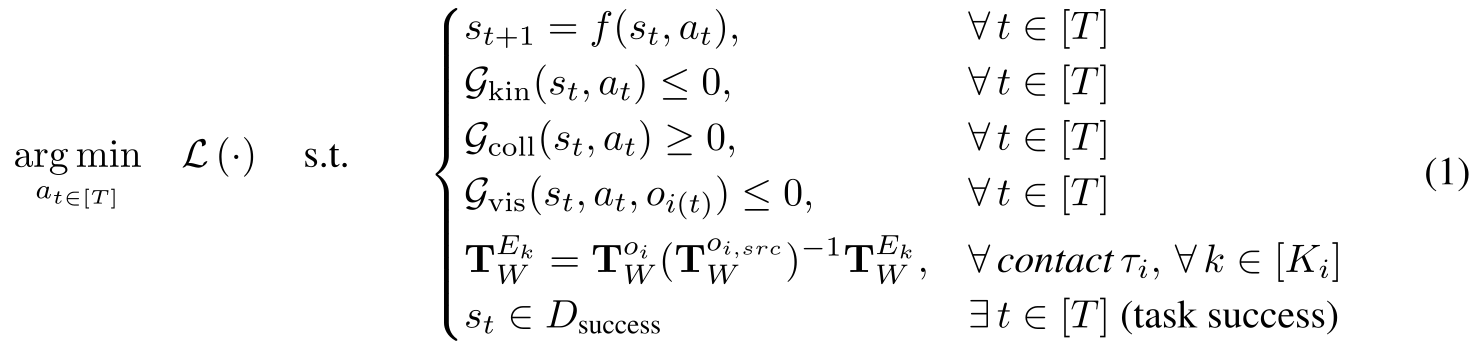
Original source/generated data, initial-state distribution, constraints, behavior-cloning objective and object/end-effector trajectories:
4 MoMaGen
MoMaGen specializes the general constraints for mobile bimanual tasks, then generates subtasks through conditional base/camera sampling and arm execution.
4.1 Constraints for Bimanual Mobile Manipulation
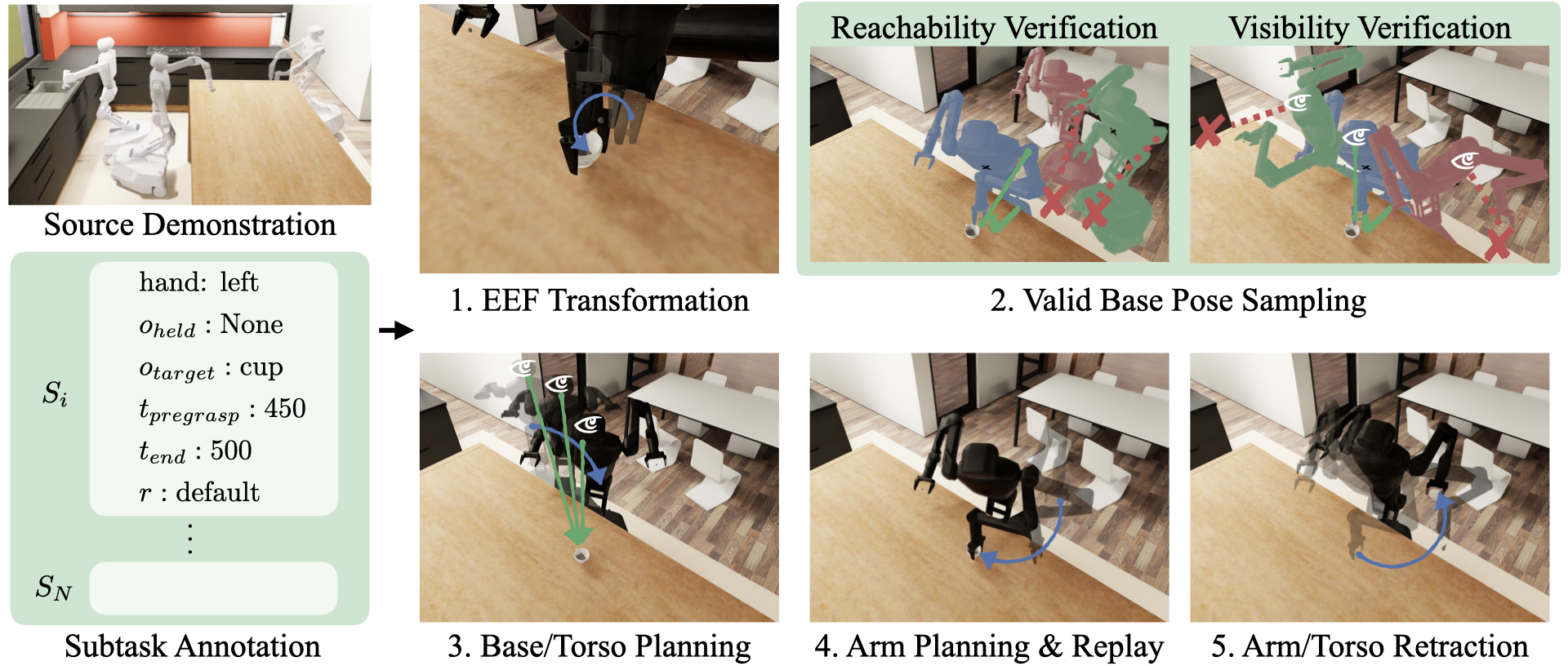
Reachability is hard: a sampled base pose must permit the required end-effector trajectory. Manipulation visibility is also hard: the camera must see task-relevant objects, using head or torso articulation as needed.
Navigation visibility is soft, allowing temporary loss of sight while biasing the camera toward the target. Retraction is another preference: after manipulation, arms and torso attempt a compact posture for safer subsequent navigation. These application-specific choices are motivated by policy training, not proved human-optimal behavior.
4.2 Automated Demonstration Generation for Bimanual Mobile Manipulation
One 1–3-minute demonstration per task is segmented into single-arm or synchronized bimanual subtasks. Annotation specifies target and held objects, the step before contact, the end step and the desired post-manipulation retraction.
For each subtask, generation aborts if the required held object is missing, transforms the contact trajectory into the new target-object frame, and checks visibility and arm inverse kinematics at the current pose. If needed, it samples another base/camera pose and plans the transition while favoring visibility.
The arm then plans to pregrasp, replays the transformed contact trajectory in task space and attempts retraction. cuRobo supplies inverse kinematics and motion planning. Fast feasibility checks precede expensive planning, and separate torso/arm subspaces simplify sampling.
Algorithm 1 retains all original operations and nesting. A maximum sampling budget, exact soft-cost weights and a global-optimality guarantee are not specified in this version; generation can fail through infeasibility, planning or simulation execution.
5 Experiments and Results
Generation experiments cover four household tasks and three randomization levels. Separate policy and hardware experiments test whether the resulting observations/actions provide useful imitation-learning data.

5.1 Task Setup
The BEHAVIOR-1K/OmniGibson tasks are Pick Cup, Tidy Table (counter to sink), Put Dishes Away (independent two-arm plate stacking) and Clean Frying Pan (coordinated scrubbing). They span navigation, grasping and contact-rich manipulation.
Each task uses one human demonstration, with base movement accounting for about 45% of its 1–3-minute duration. This is one demonstration per task, not a single trajectory shared across all four tasks.
5.2 Domain Randomization Schemes
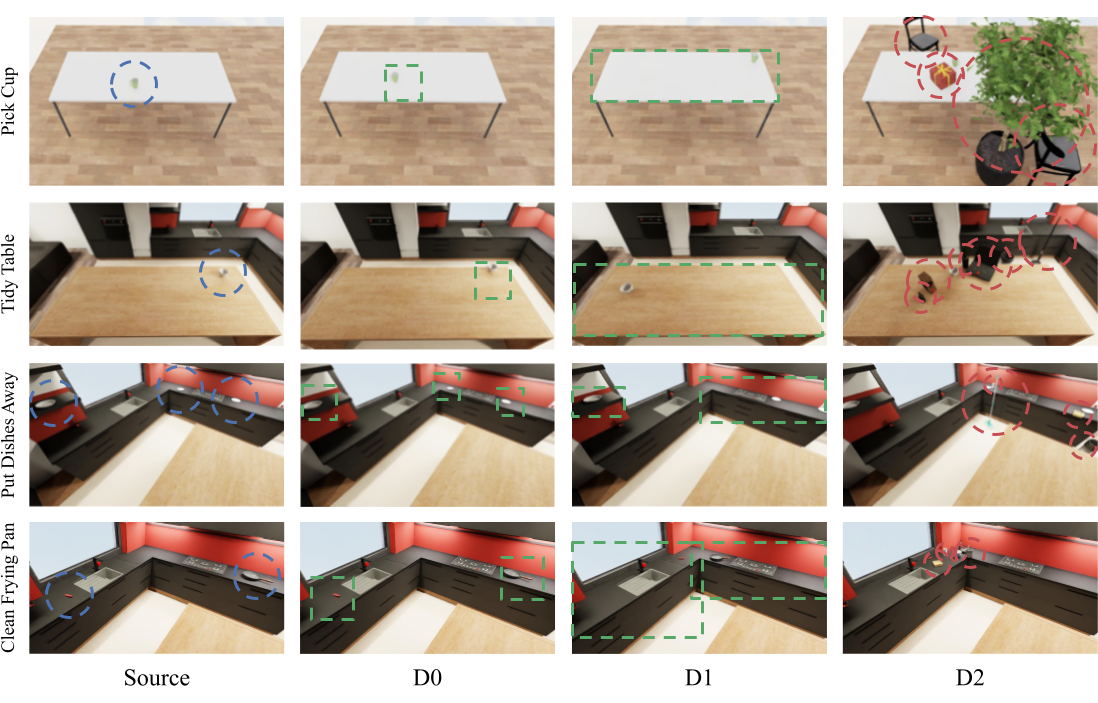
D0 perturbs relevant objects by ±15 cm and ±15° on their original furniture. D1 permits placement anywhere on that furniture with unrestricted orientation. D2 adds tabletop manipulation obstacles and floor navigation obstacles to D1. These perturbations retain the task and furniture layout; they do not establish arbitrary new-room generalization.
5.3 Data Generation Comparison
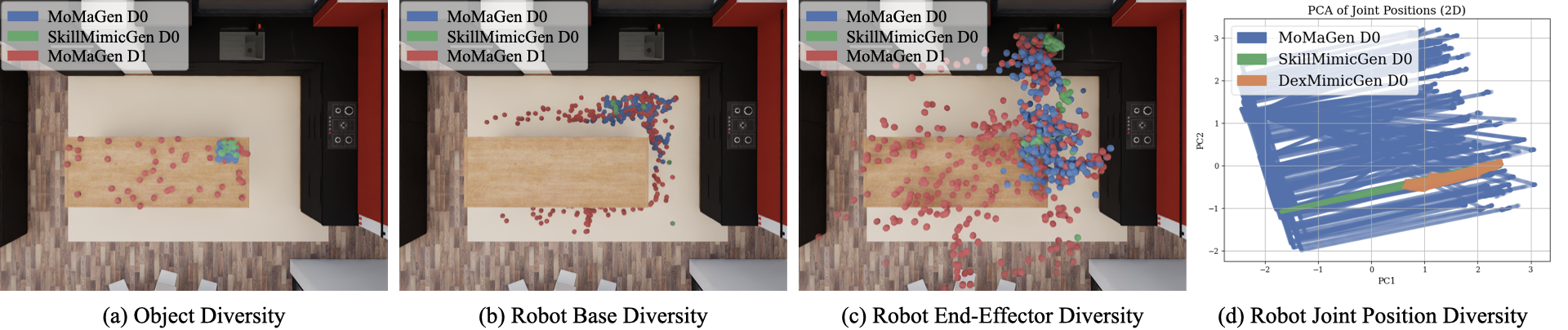
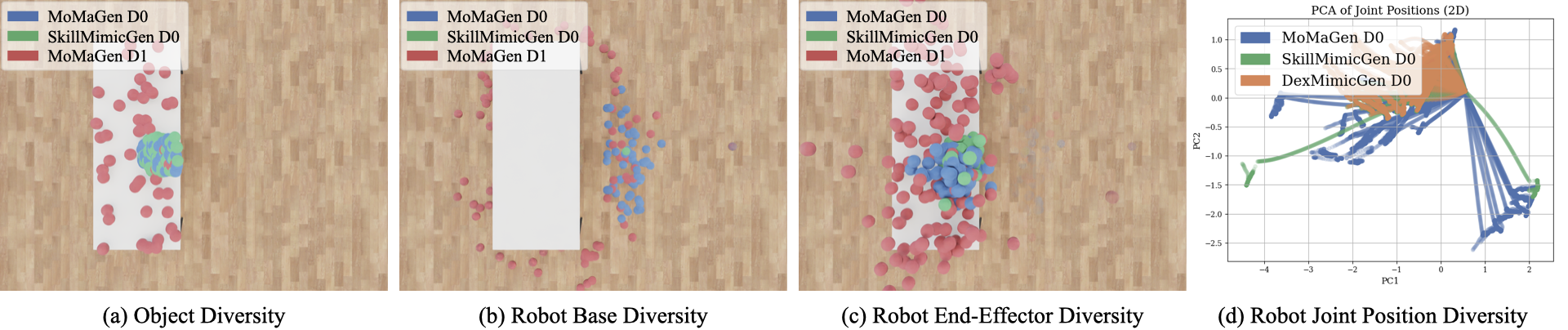
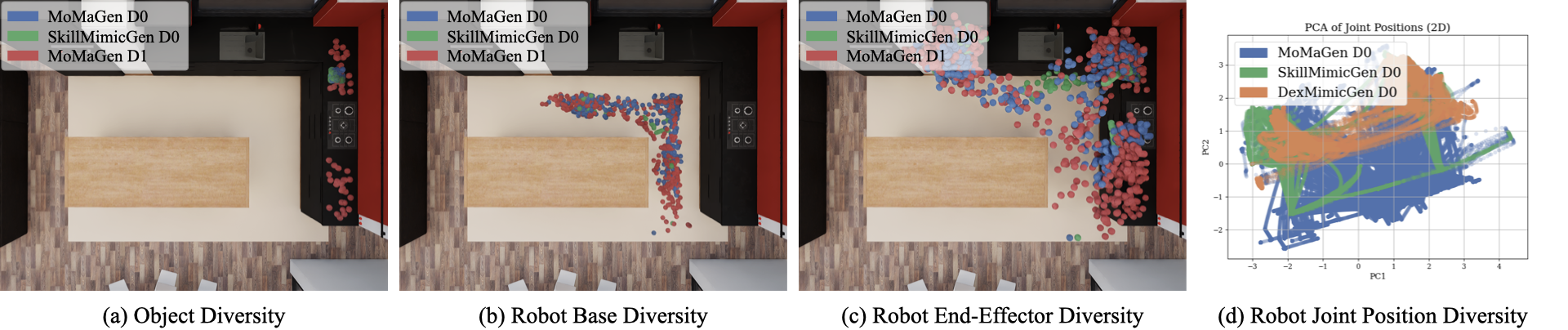
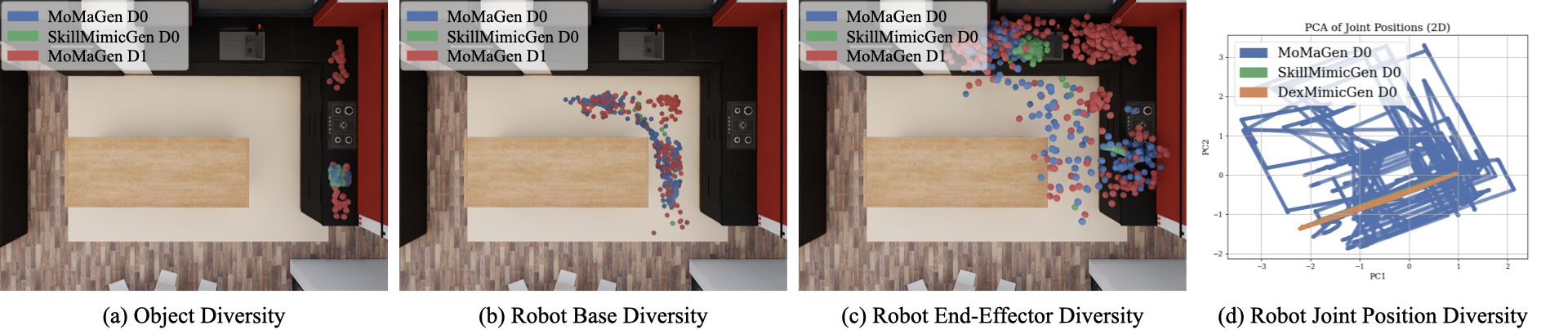
The compared SkillMimicGen and DexMimicGen extensions replay the source base trajectory. They generate data under D0 but report zero success under D1/D2 because replayed base poses cannot reach many moved objects. MoMaGen samples new base poses, widening object, end-effector and joint coverage in the fifty-trajectory visualizations.
Across the four tasks, MoMaGen’s D0 generation success averages about 64% (the text rounds to 63%). Rates fall from 0.86/0.80/0.38/0.51 in D0 to 0.47/0.22/0.07/0.16 in D2. The baselines are better on simple D0 cup picking and tie on dishes; they still generate some D0 pan-cleaning data despite prose saying they “fail” on harder tasks.
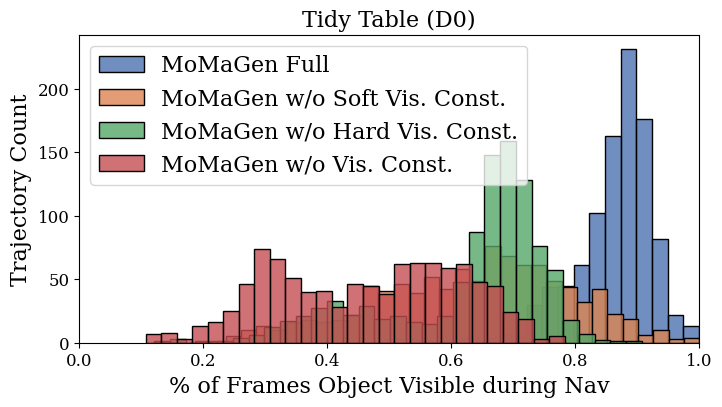
Visibility constraints increase target visibility during navigation: for example, D0 Tidy Table rises to 0.86 versus about 0.40 for the baselines. Removing either hard or soft visibility weakens the visibility distribution. The reported ratio characterizes generated data, not an unconditional visibility guarantee for every subsequent learned rollout.
A separate demonstration transfers an R1 Pick Cup trajectory to TIAGo through end-effector-space replay. Appendix B.2 describes this as proof of concept, with gripper/workspace limitations and no broad quantitative cross-embodiment benchmark.
| Methods | Pick Cup | Tidy Table | Put Dishes Away | Clean Frying Pan | |
|---|---|---|---|---|---|
| D0 | MoMaGen | 0.86 | 0.80 | 0.38 | 0.51 |
| SkillMimicGen | 1.00 | 0.69 | 0.38 | 0.40 | |
| DexMimicGen | 1.00 | 0.72 | 0.38 | 0.35 | |
| MoMaGen w/o soft vis. const. | 0.88 | 0.78 | 0.50 | 0.46 | |
| MoMaGen w/o hard vis. const. | 0.97 | 0.59 | 0.29 | 0.24 | |
| MoMaGen w/o vis. const. | 0.97 | 0.74 | 0.29 | 0.36 | |
| D1 | MoMaGen | 0.60 | 0.64 | 0.34 | 0.20 |
| MoMaGen w/o vis. const. | 0.66 | 0.48 | 0.23 | 0.13 | |
| D2 | MoMaGen | 0.47 | 0.22 | 0.07 | 0.16 |
| MoMaGen w/o vis. const. | 0.50 | 0.16 | 0.05 | 0.12 |
| Methods | Pick Cup | Tidy Table | Put Dishes Away | Clean Frying Pan | |
|---|---|---|---|---|---|
| D0 | MoMaGen | 1.00 | 0.86 | 0.79 | 0.69 |
| SkillMimicGen | 1.00 | 0.40 | 0.71 | 0.65 | |
| DexMimicGen | 1.00 | 0.39 | 0.71 | 0.67 | |
| MoMaGen w/o soft vis. const. | 1.00 | 0.63 | 0.62 | 0.56 | |
| MoMaGen w/o hard vis. const. | 0.98 | 0.63 | 0.68 | 0.55 | |
| MoMaGen w/o vis. const. | 0.90 | 0.46 | 0.40 | 0.35 | |
| D1 | MoMaGen | 0.93 | 0.89 | 0.78 | 0.80 |
| MoMaGen w/o vis. const. | 0.71 | 0.46 | 0.40 | 0.43 | |
| D2 | MoMaGen | 0.94 | 0.79 | 0.75 | 0.81 |
| MoMaGen w/o vis. const. | 0.73 | 0.48 | 0.40 | 0.44 |
5.4 Policy Learning with Generated Demonstrations
Generation uses privileged object poses and geometry. Deployment instead uses learned policies: WB-VIMA trains from scratch on proprioception and fused colored point clouds using simulated ground-truth depth; pretrained π₀ is fine-tuned with rank-32 LoRA on proprioception and three RGB views.
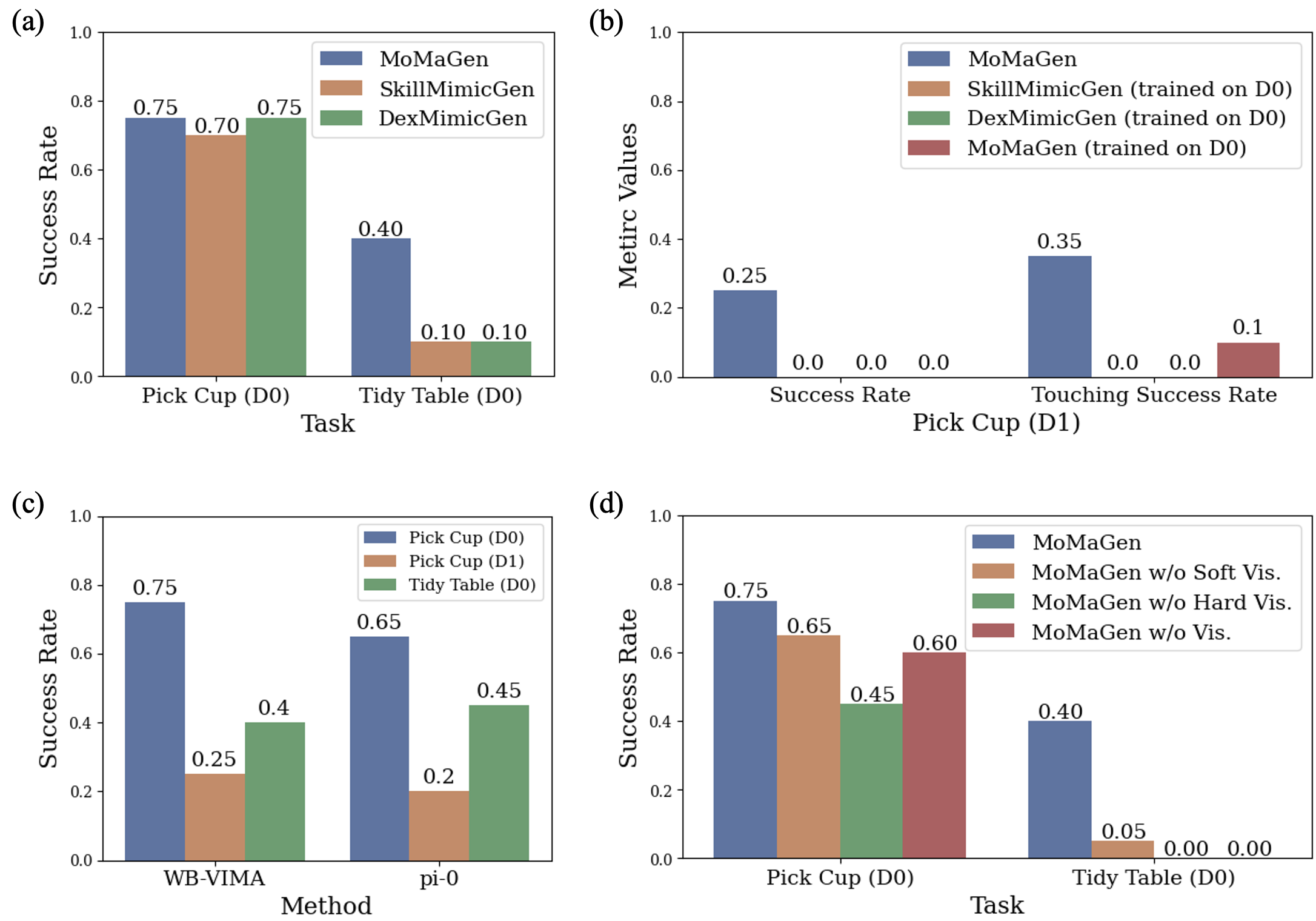
The main policy comparison uses 1,000 demonstrations for Pick Cup D0/D1 and Tidy Table D0, with twenty unseen evaluation episodes. MoMaGen matches baselines on easy cup picking and improves table tidying. For D1 cup picking, WB-VIMA succeeds on 25% of trials while baselines trained only on D0 fail, so this comparison changes training coverage as well as generation method.
π₀ also benefits from the generated data on these tasks. Removing visibility constraints reduces WB-VIMA cup success from 0.75 to 0.45–0.65 and table-tidying success from 0.40 to at most 0.05. This supports the constraints for these short-history policies, without isolating visibility from every associated trajectory change.
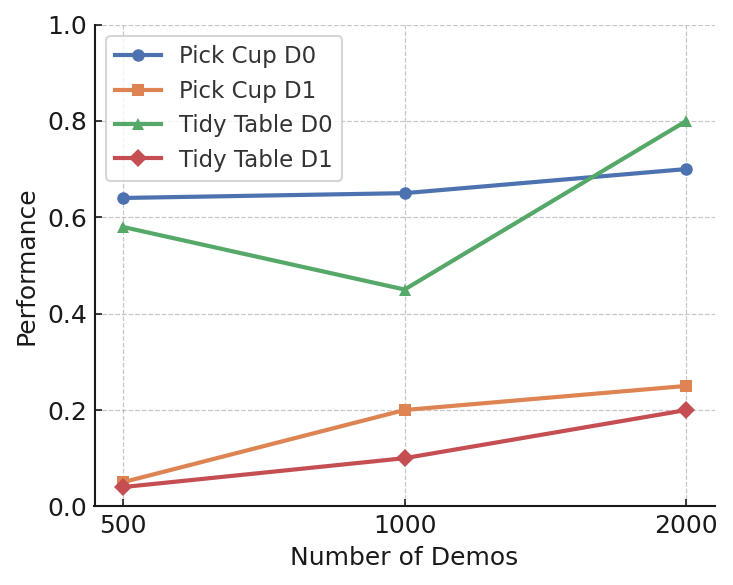
π₀ scaling uses 500, 1,000 or 2,000 demonstrations and 50k optimization steps. The trend is broadly positive, especially for D1, but Tidy Table dips at 1,000 before recovering. Repeated-training-seed uncertainty is not reported.
Real-world Pick Cup uses simulation pretraining followed by forty real training demonstrations: WB-VIMA reaches 10% and π₀ 60%, versus 0% without task-specific simulation pretraining. Ten additional real demonstrations are held out for validation. This is adaptation to a matched setup; no zero-shot transfer result or hardware evaluation trial count is supplied.
5.5 MoMaGen Failure and Computational Cost Analysis
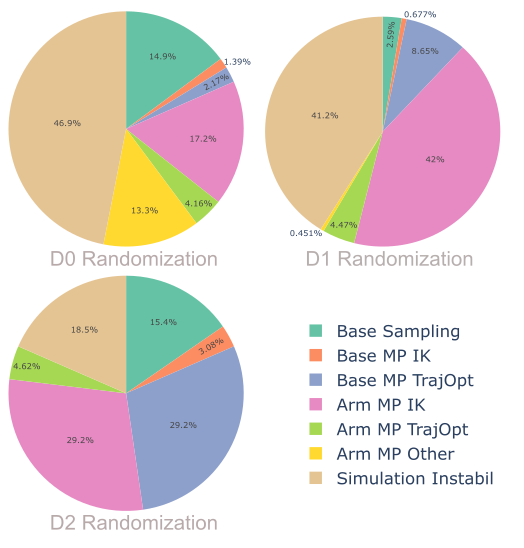
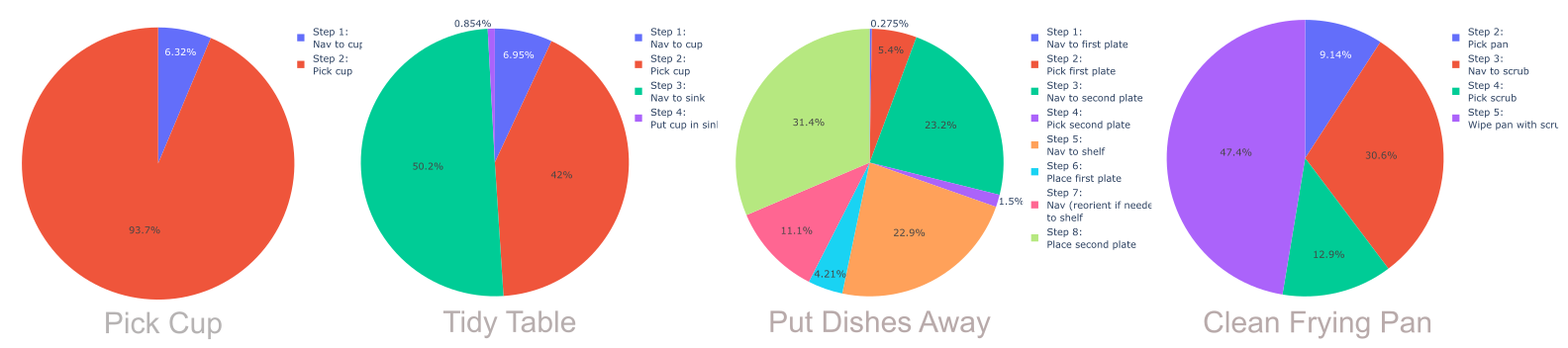
Failures are categorized as base sampling, base/arm inverse kinematics or trajectory optimization, other arm-planning failures, and simulation instability. Across randomization levels, the paper attributes about 35% to simulation instability, 40% to arm planning and 26% to base-related planning; these rounded averages are descriptive, not identified causal effects.
D2 obstacles increase navigation-related failures. The additional task-step plot shows later navigation/placement bottlenecks for dishes. Percentages are conditional on failed episodes and should not be read as whole-dataset failure probabilities.
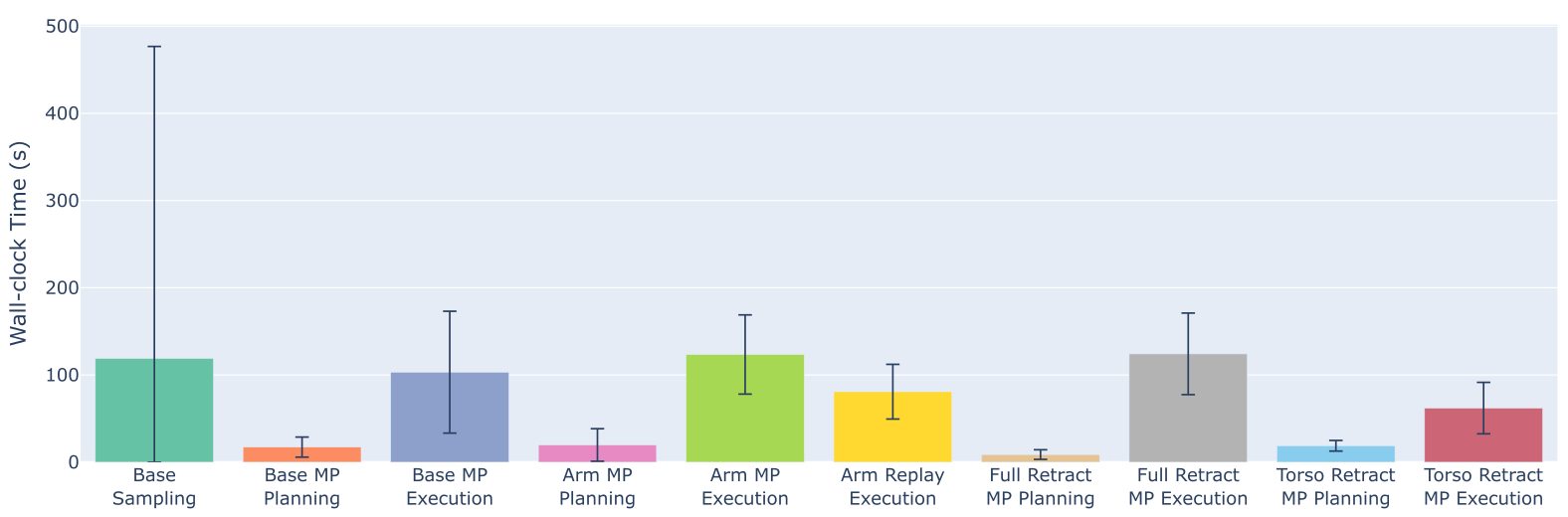
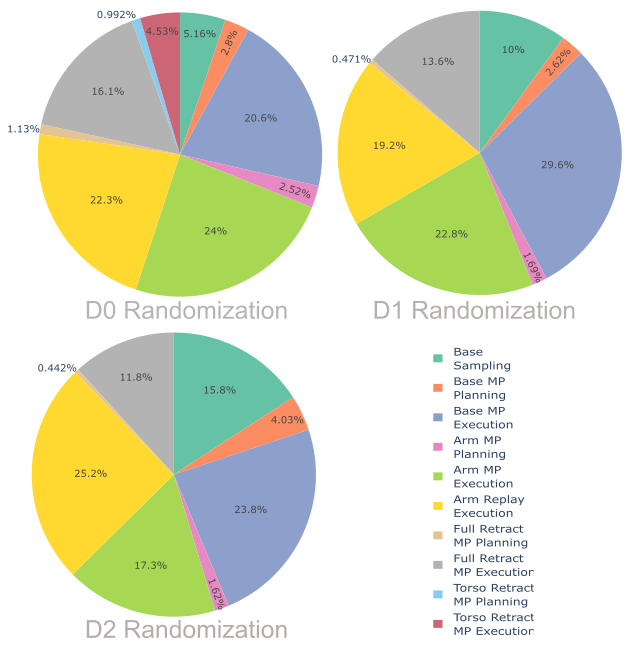
Execution in simulation dominates wall time: base planning averages about eighteen seconds versus about one hundred seconds for execution. Ring-shaped base sampling varies greatly with feasible-space size. The component-percentage chart includes successful episodes only; it excludes the aggregate cost of failed attempts. Informed sampling and better simulation/control are proposed improvements.
6 Conclusions and Limitations
The experiments support generating more varied mobile-manipulation data by adapting base placement and camera view. Effective learned policies still require suitable sensory inputs, training and real-world adaptation.
Generation assumes full scene geometry and object poses and consumes substantial GPU time. The main benchmark alternates navigation and manipulation. Although the conclusion leaves coupled whole-body manipulation to future work, Appendix B.1 adds a chair-pushing proof of concept; it does not provide a comparable quantitative whole-body benchmark. Perception-based generation is proposed, not demonstrated.
Reproducibility Statement
The authors provide a code submission and project-site resources for simulation tasks, generation and policy training. Appendix C retains the reported architecture and training settings; some implementation details and evaluation uncertainty remain unspecified in the paper.
Acknowledgments
Support is acknowledged from Stanford HAI, two ONR MURI grants, a UT-CNS Catalyst Grant and the Amazon Personal Robotics Group Faculty Award.
Appendix A Additional Experimental Results
The additional experiment describes task-specific simulation pretraining followed by real-world adaptation.
A.1 Sim-to-real
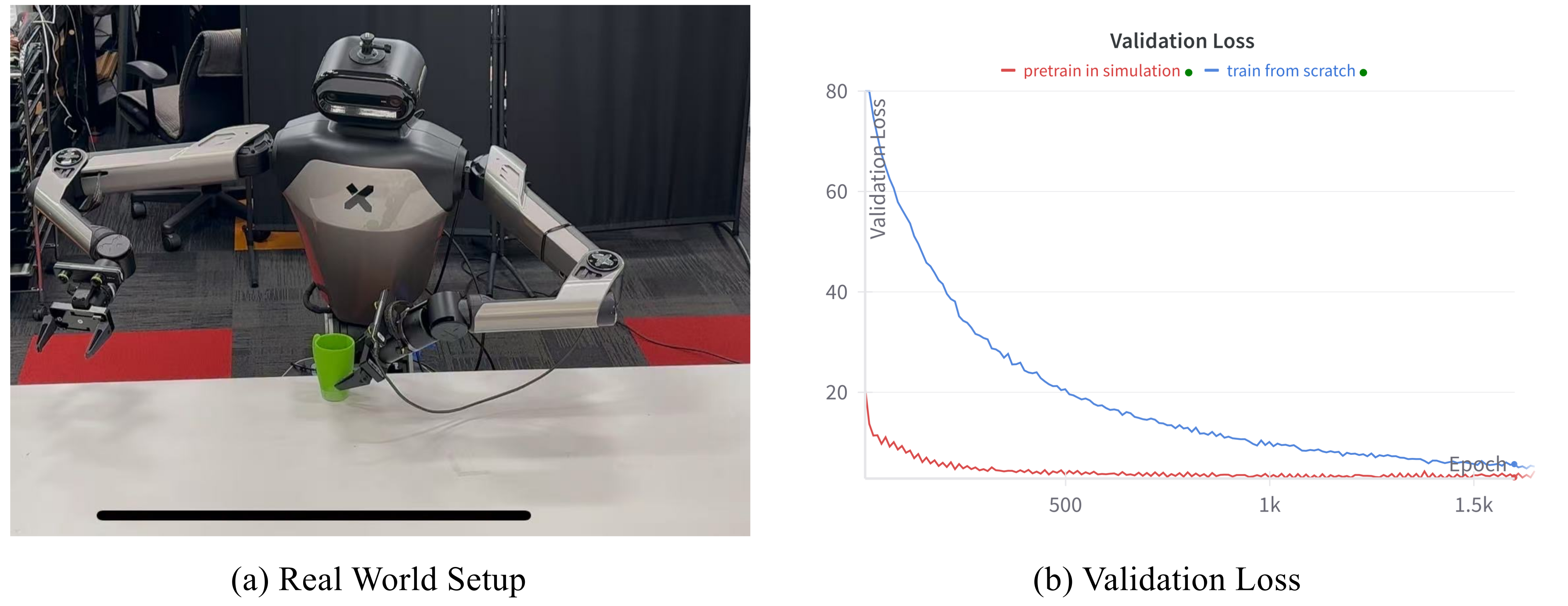
Hardware is a Galaxea R1 with an onboard ZED 2 and a ZED Mini above the left gripper. Refined depth is downsampled to 4,096 points. A white table and 3D-printed green cup approximate the simulated Pick Cup D0 setup.
Fifty real demonstrations are collected: forty train and ten validate. WB-VIMA starts from either random weights or 1.8M steps on 1,000 synthetic demonstrations, then trains 35k real-data steps. Simulation pretraining reduces validation loss to about three versus six and yields 10% versus 0% hardware success.
Both π₀ variants start from foundation-model weights; only one receives the extra simulation stage before real-data fine-tuning. Its 60% versus 0% success supports this adaptation sequence, not a comparison against an unpretrained foundation model. Trial counts, uncertainty and additional hardware tasks are not reported.
Appendix B Additional Data Generation Details
The appendix extends generation qualitatively, visualizes perturbations/diversity and reports generation cost and failure locations.
B.1 Can MoMaGen generalize across different families of mobile manipulation tasks?
Three additional task families are illustrated through proof-of-concept generated demonstrations and website videos. No aggregate success rates or learned-policy evaluation are given for these extensions.
Get Bottle from Fridge (Articulated Object Manipulation).
For Get Bottle from Fridge, the robot opens the door and then retrieves the initially occluded bottle. The relevant target switches from fridge to bottle after opening, making visibility constraints depend on the current subtask.
Pour Cat Food (Pouring and Particle Interaction).
For Pour Cat Food, the robot carries a tin of rigid particles to a bowl and tilts it to transfer the particles. The example requires coordinated orientation and sustained container control; it is not a general fluid-simulation result.
Push Chair (Whole-Body Control).
For Push Chair, base motion and end-effector contact direction are coupled while pushing the chair beneath a table. This demonstrates a whole-body contact example beyond the alternating main benchmark.
B.2 Can MoMaGen achieve cross-embodiment data generation?
An R1 source demonstration produces TIAGo Pick Cup trajectories despite different torso and arm workspaces. Task-space planning/replay avoids direct joint-trajectory copying.
Transfer still depends on embodiment feasibility. Larger grippers can collide in confined spaces, and bulkier arms can make R1 trajectories unreachable or self-colliding. One demonstrated transfer does not establish arbitrary robot interchangeability.
B.3 Visualizations of Domain Randomization Schemes
Figure 12 retains the source, D0, D1 and D2 configurations for all four tasks. Blue marks relevant objects, green their allowed placement range and red obstacles/distractors. The range is constrained to the same furniture even in D1/D2.
B.4 Visualizations of Data Diversity
Figures 13–15 extend the fifty-trajectory diversity visualizations to cup picking, dishes and pan cleaning. The plots show broader sampled state/action coverage with new base poses and D1 object placement; PCA projections alone do not quantify the full trajectory distribution.
B.5 Compute Resources
Generation runs on one NVIDIA TITAN RTX. A successful demonstration costs 0.1–1.3 GPU-hours, from cup picking to dishes. Cost depends on subtask count/length, scene complexity and success rate, so generating thousands of demonstrations remains substantial computation.
B.6 Failure Step Analysis
Figure 16 preserves failure shares by task step. Dishes fail more often during navigation and placement than initial picking. These distributions describe where failed generation stops, rather than independent per-step hazard estimates.
Appendix C Additional Policy Training Details
Both policy pipelines split generated demonstrations 90% for training and 10% for validation. The following sections retain preprocessing, architecture, task-specific crops and compute settings.
C.1 Data Cleaning
To remove teleoperation hesitation, the preprocessing discards a five-step interval whenever every absolute joint-position difference between its endpoints is below 10⁻³. This endpoint criterion is the reported rule; it need not imply that every intermediate state is identical. WB-VIMA has a two-step history and π₀ uses the current state.
C.2 WB-VIMA Training Details
WB-VIMA combines proprioception and egocentric colored point clouds in a task-specific policy trained from scratch.
Policy Architecture.
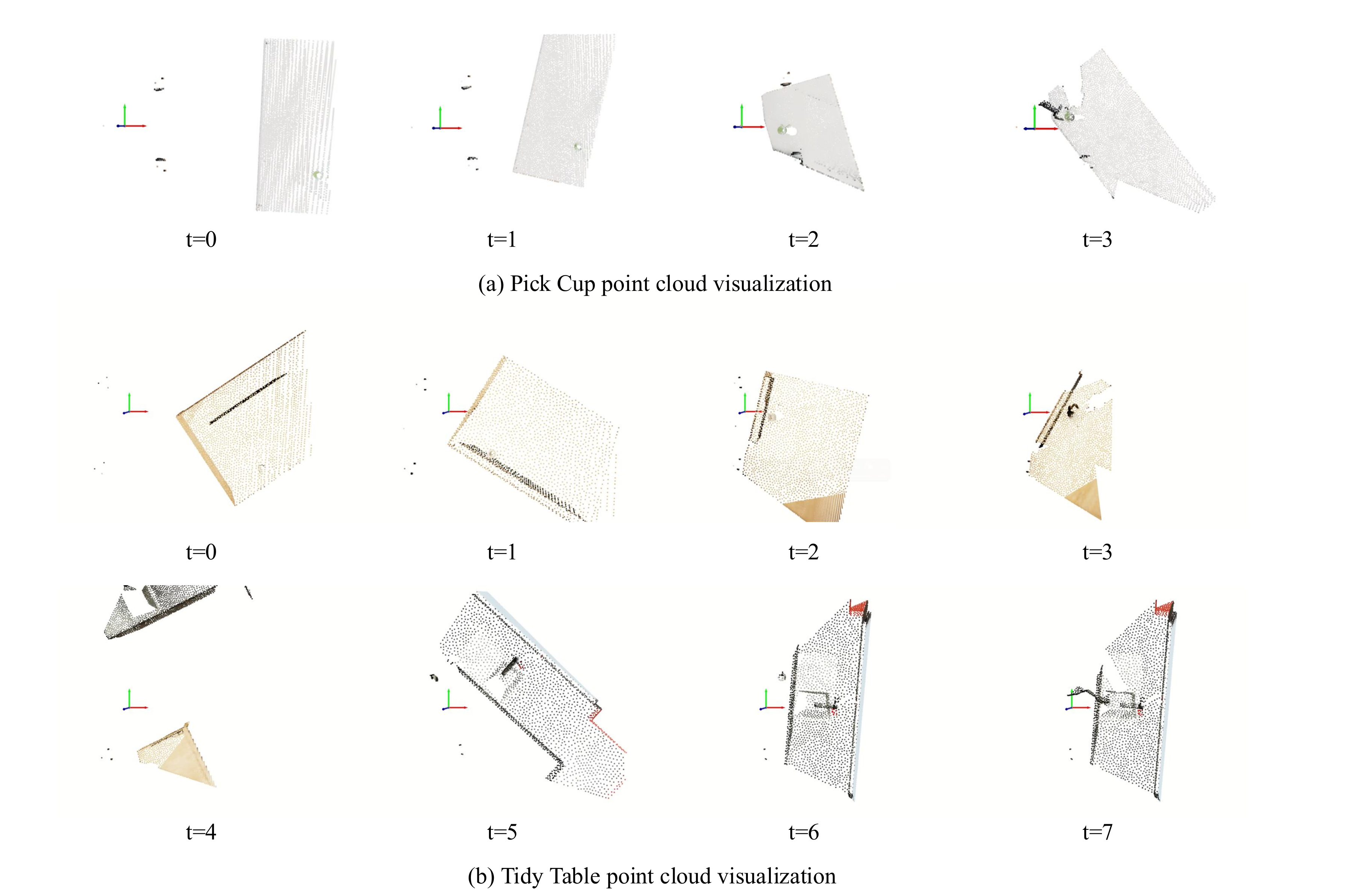
Inputs comprise three base-velocity values, four torso joints, six joints per arm and one width per gripper, totaling twenty-one. Three simulated RGB-D cameras are fused, cropped around the robot and farthest-point sampled to 4,096 points. Two observations form the history; Figure 17 retains all twelve example frames.
Hyperparameters.
Table 4 retains the full PointNet, transformer, diffusion-head and optimizer settings, including task-specific point-cloud crops. The 37.1M-parameter policy uses four transformer layers, eight heads, sixteen inference denoising steps and AdamW with a cosine schedule.
The table prints proprioceptive MLP hidden dimension two and hidden depth 256, apparently reversed relative to conventional usage; the values are preserved. Its batch is 128 per GPU on two GPUs, whereas the compute paragraph simply calls it batch 128. Hyperparameters are selected by grid search.
| Hyperparameter | Value |
|---|---|
| Number of points in point cloud | 4096 |
| PointNet hidden dim | 256 |
| PointNet hidden depth | 2 |
| PointNet output dim | 256 |
| PointNet activation | GELU |
| Proprioceptive MLP input dim | 21 |
| Proprioceptive MLP hidden dim | 2 |
| Proprioceptive MLP hidden depth | 256 |
| Proprioceptive MLP output dim | 256 |
| Proprioceptive MLP activation | ReLU |
| Transformer embedding size | 512 |
| Transformer layers | 4 |
| Transformer heads | 8 |
| Transformer dropout rate | 0.1 |
| Transformer activation | GEGLU |
| Action dim | 21 |
| Unet down dims | [128, 256] |
| Unet kernel size | 5 |
| Unet number of groups | 8 |
| Diffusion step embedding dim | 256 |
| Diffusion noise scheduler | DDIM |
| Number of training steps | 100 |
| Beta schedule | squaredcos_cap_v2 |
| Number of denoise steps per inference | 16 |
| Learning rate | 1e-4 |
| Learning rate scheduler | Cosine decay |
| Learning rate warmup steps | 100000 |
| Learning rate cosine steps | 1300000 |
| Optimizer | AdamW |
| Batch size per GPU | 128 |
| Number of GPUs in parallel | 2 |
| Pick Cup (D0) pointcloud clip range | x: [0.0, 2.3], y: [-0.5, 0.5], z: [0.7, 2.0] |
| Pick Cup (D1) pointcloud clip range | x: [0.0, 2.7], y: [-1.0, 1.0], z: [0.7, 2.0] |
| Tidy Table (D0) pointcloud clip range | x: [0.0, 2.3], y: [-1.5, 1.5], z: [0.7, 1.5] |
| Model size | 37.1M |
C.3 π 0 Training Details
π₀ provides a separate pretrained RGB-based policy, adapted through LoRA rather than training WB-VIMA’s point-cloud architecture.
Policy Architecture.
Rank-32 LoRA fine-tuning runs for 50k steps with batch 64. Three camera images and the same proprioceptive signals predict a fifty-step target-joint-position chunk.
Hyperparameters.
RGB inputs are resized to 224×224. Actions and proprioception are normalized by first/99th quantiles and padded to the expected 32 dimensions. A PaliGemma backbone accompanies a 300M-parameter action expert; Table 5 retains all reported settings.
The table describes a 3.3B-parameter model, ten flow-matching inference steps, learning rate 2.5×10⁻⁵, 1,000 warmup steps and 30,000 cosine steps. The text trains for 50k steps without explaining the remaining schedule behavior.
| Hyperparameter | Value |
|---|---|
| Proprioceptive MLP input dim | 32 |
| Proprioceptive MLP output dim | 1024 |
| Flow Matching MLP input dim | 32 |
| Flow Matching MLP hidden dim | 2048 |
| Flow Matching MLP hidden depth | 2 |
| Flow Matching MLP output dim | 1024 |
| Flow Matching MLP activation | swish |
| PaliGemma embedding size | 2048 |
| PaliGemma number of layers | 18 |
| PaliGemma number of heads | 18 |
| PaliGemma heads dimension | 256 |
| PaliGemma MLP dimension | 16384 |
| Action expert embedding size | 1024 |
| Action expert MLP dimension | 4096 |
| Number of flow matching steps per inference | 10 |
| Learning rate | 2.5e-5 |
| Learning rate scheduler | Cosine decay |
| Learning rate warmup steps | 1000 |
| Learning rate cosine steps | 30000 |
| Optimizer | AdamW |
| Batch size | 64 |
| Number of GPUs in parallel | 4 |
| Model size | 3.3B |
C.4 Compute Resources
WB-VIMA takes about forty hours for one million steps on two 24-GB RTX 3090 GPUs. π₀ takes about seven hours for 50k steps on four H200 GPUs. These training costs are additional to demonstration generation.
Appendix D Use of Large Language Models
The authors state that ChatGPT was used only for grammar, clarity and concision, not research ideation, experimental design or analysis.