Overview
This complete arXiv v1 is dated 1 October 2025. All six authors are affiliated with MIT CSAIL. The source acknowledges Amazon, ONR, SRI, DSTA, NSERC and NSF support; Lexi Foland is the corresponding author. No appendix appears in this version.
At a glance
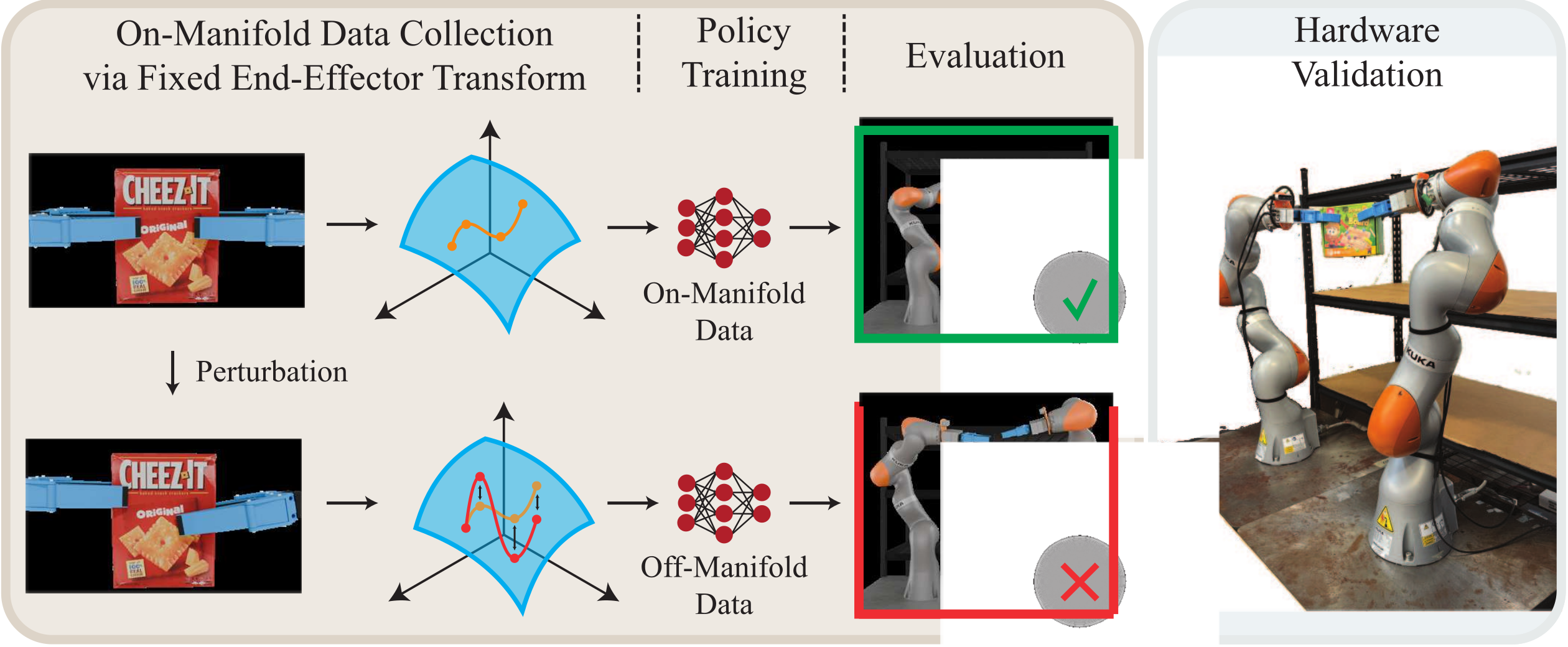
This study tests whether successful diffusion-policy manipulation implies precise learning of an underlying kinematic constraint. Two arms transport a box while preserving their relative gripper pose; the authors vary demonstration count, deliberate constraint noise and measured manifold curvature.
Policies learn an approximate constraint manifold even from clean demonstrations. More and cleaner data generally help, while measured curvature shows little predictive value in this task. A hardware study achieves 73% binary task success despite nonzero geometric error. Project materials accompany the paper.
I Introduction
Diffusion Policy can generate useful motions without enforcing exact kinematic constraints. Task success also depends on low-level control, contact forces and gripper compliance, which may hide errors in the learned commands.
The experiment therefore evaluates predicted joint-action knot points separately from physical outcomes. It asks how demonstration quantity, geometric quality and constraint-manifold curvature affect a bimanual box-transfer task. This isolates prediction-level constraint adherence, although it does not isolate every influence on executed task success.
II Related Work
Explicit manifold diffusion can enforce known geometry but may require specialized spaces or costly geometric operations. Guidance biases sampling toward rewards or constraints without generally guaranteeing feasibility. Motion primitives and low-level controllers move constraint handling elsewhere in the system.
Related work on diffusion as optimization, policy composition and action-space choice motivates testing the learned policy itself. This paper measures an ordinary imitation policy’s implicit constraint learning rather than introducing a new constraint-enforcing generator.
III Central Research Question
Both grippers must carry a box from a table to the second-highest shelf. Each grasp defines a fixed relative end-effector transform and thus a nonlinear equality-constrained subset of joint configuration space.
The authors compare dataset sizes, replayed demonstrations with controlled geometric noise, and curvature statistics, then reproduce the workflow on hardware. Generalization to other tasks or action representations is left open.
IV System Setup
A specialized teleoperation stack supplies high-quality demonstrations with explicit relative-transform locking and controllable elbow redundancy.
IV-A Enforcing Kinematic Constraints
Analytic inverse kinematics maps end-effector commands to each seven-joint arm. The stereographic shoulder–elbow–wrist angle controls redundancy while avoiding a problematic representational singularity.
When transform locking is enabled, the operator controls one arm and the other tracks the fixed relative pose. Commands that cannot preserve it because of joint limits, singularities or workspace constraints hold the last valid configuration. This collection-time mechanism follows cooperative bimanual control; it is not evidence that the learned policy enforces the same relation.
IV-B Teleoperation & Data Collection
A VR controller supplies each desired hand pose and elbow angle. The operator may first push an awkwardly placed box, then grasp, lock the transform, carry, release and retreat. Training initializations sample x∈[−0.2,0.2), y∈[0.55,0.65) and yaw∈[−π/8,π/8).
Simulation and hardware use two KUKA iiwa 14 arms, two scene cameras and two wrist cameras. Observations contain four RGB views, fourteen joint angles and the two previous gripper commands. Actions are sixteen absolute joint/gripper commands. Joint space exposes nonlinear constraint geometry and elbow motions around obstacles.
IV-C Inference Workflow
The policy conditions on two observations, predicts sixteen future actions and executes the first eight through first-order interpolation. Even feasible endpoints can have infeasible interpolated commands, so geometric evaluation uses only the policy’s predicted knot points. It does not certify every executed intermediate motion.
V Experiments
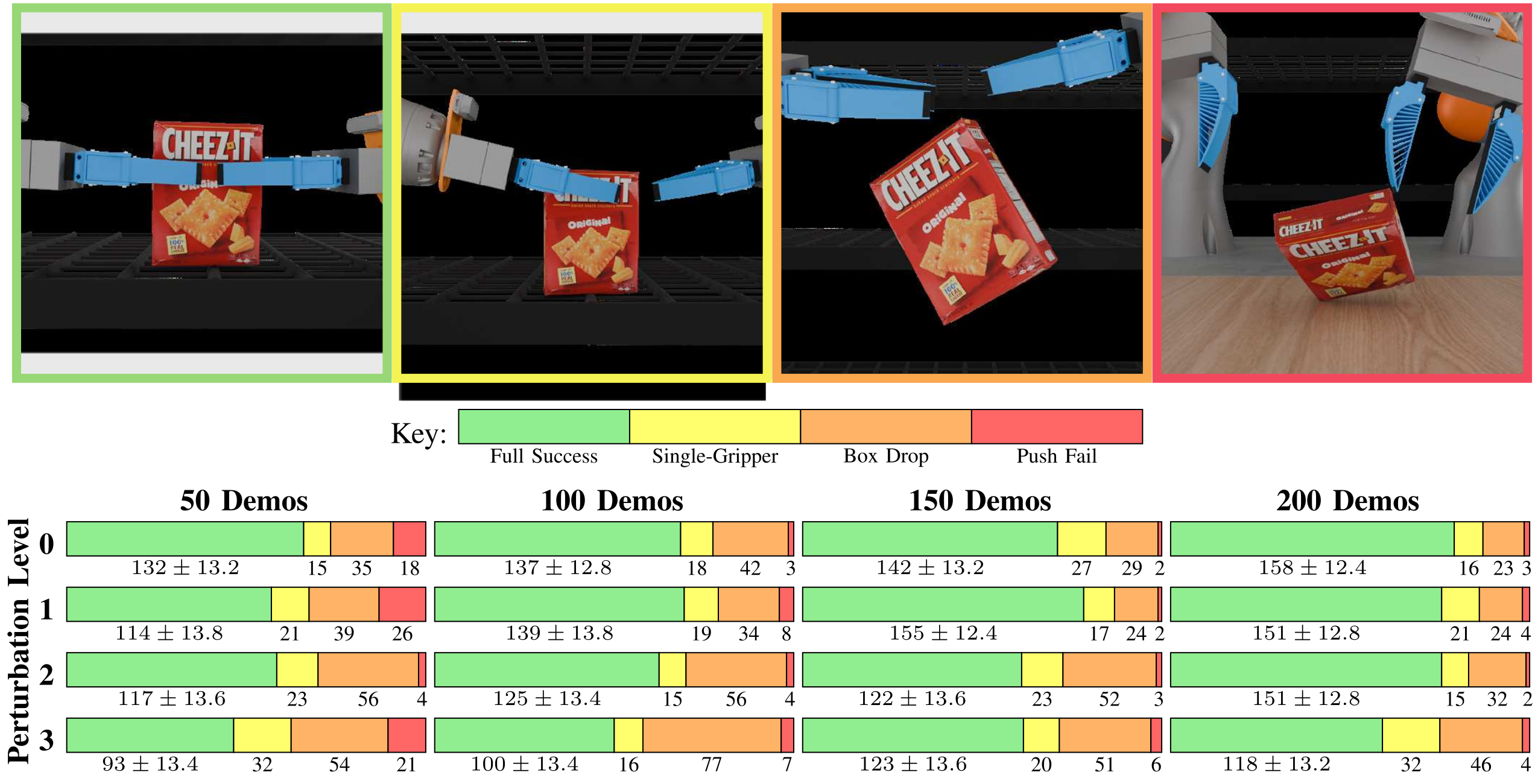
Sixteen simulation policies cross four demonstration counts with four perturbation levels. Hardware supplies a separate hundred-demonstration evaluation. Table I quantifies the injected data errors; Figure 2 and Tables II–III retain all outcomes and geometric measurements.
|
Perturbation Level |
Avg. Position Error (cm) |
Avg. Orientation Error (deg) | |
| 0 | 0.0 | 0.00 | 0.00 |
| 1 | 0.001 | 0.40 | 0.29 |
| 2 | 0.0025 | 1.01 | 0.71 |
| 3 | 0.005 | 2.02 | 1.43 |
V-A Metrics for Evaluation
Outcomes are full two-gripper success, success after losing one grasp, box-drop failure and failure to pick up. Binary success includes the first two. The chart labels the last outcome “Push Fail,” while the prose calls it “Full Failure.” A successful carry can still violate constraints or exert undesirable contact forces.
For each predicted chunk, error is measured relative to the most recent observed gripper transform, not the initial grasp for the whole episode. Position uses Euclidean distance and orientation the SO(3) geodesic distance. This incremental metric matches the short observation history but does not measure accumulated episode-wide drift.
For initial configuration q₀, the constraint is M={q: ᴸXᴿ(q)=ᴸXᴿ(q₀)}. Equation 1 supplies the map whose Jacobian and Hessian yield the Riemannian curvature tensor using JAX. Its squared Frobenius norm, the Kretschmann scalar, avoids cancellation of positive and negative scalar curvature.
For off-manifold q, curvature is computed on M̃={q̃: ᴸXᴿ(q̃)=ᴸXᴿ(q)}. The authors state that the scalar’s error changes quadratically with distance to M, without giving a detailed derivation in this version.
Equation 1

V-B Simulation Experiments
The two hundred clean demonstrations include short recovery episodes added after evaluating an initial hundred-demo policy. Transform-locking errors below 10⁻¹⁰ m and 10⁻⁶ rad are treated as zero.
Equation 2 adds temporally correlated Ornstein–Uhlenbeck noise to end-effector commands, with α=0.01 and η∈{0,0.001,0.0025,0.005}, sampled by Euler–Maruyama. The highest level is chosen near the limit where replay still completes the task. Table I gives mean errors up to 2.02 cm and 1.43°.
Each policy receives two hundred evaluation trials with a narrower initialization distribution: x∈[−0.1,0.1), y∈[0.575,0.625), yaw∈[−π/16,π/16). Thus this is not an out-of-range spatial-generalization test. Training seeds and detailed optimizer/model hyperparameters are not reported.
Equation 2

V-C Hardware Experiments
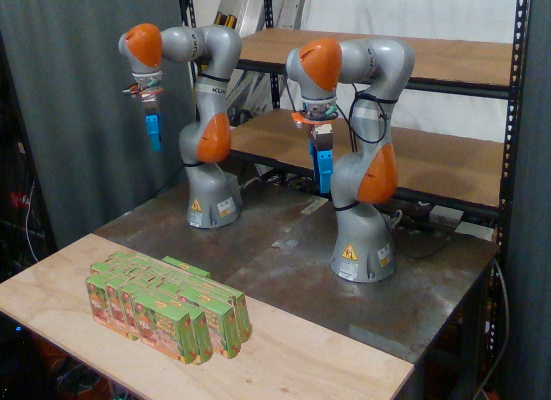
A separate hundred-demonstration hardware dataset is curated by adding or removing examples after inspecting initial policy failures. Evaluation uses a box-placement distribution similar to training; Figure 3 shows the placements. The paper does not state the hardware evaluation trial count.
VI Results
Results distinguish task outcomes, incremental geometric error and statistical association with curvature. Their conclusions are specific to this bimanual box task and joint-command representation.
VI-A Simulation Results
Simulation combines 50, 100, 150 or 200 demonstrations with four perturbation levels. Figure 2 shows category counts and Wilson confidence intervals for full success; Table II gives mean±standard-deviation geometric error.
1) Success Rates
Clean-data full successes rise from 132/200 with fifty demonstrations to 158/200 with two hundred. Fifty clean demonstrations outperform two hundred maximally perturbed demonstrations on full success (132 versus 118), but binary success is 147/200 versus 150/200 because it includes single-gripper completion.
Mild noise sometimes matches or exceeds clean-data results, possibly by widening data support; that explanation is not isolated experimentally. Scaling is not monotonic in every cell. The level-1/150-demo chart row sums to 198 despite the stated two hundred trials; the original counts are preserved.
2) Constraint Satisfaction
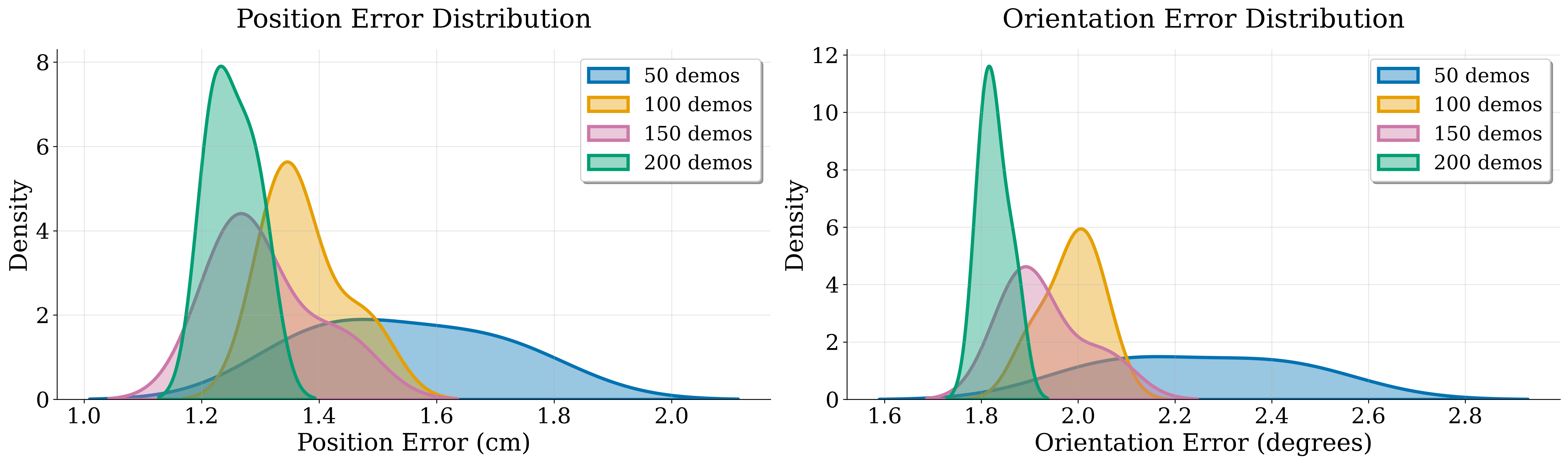
Even two hundred perfectly constrained demonstrations produce mean prediction errors of 1.22 cm and 1.80°. Increasing data generally improves constraint adherence more strongly than changing noise level. At maximum perturbation, position error rises only 6.6% for two hundred demonstrations (1.22→1.30 cm), versus about 26% for fifty (1.38→1.74 cm).
The authors conjecture that sufficient data can average away approximately zero-mean constraint noise and recover coarse manifold structure. The analogy with statistical interpolation results is qualitative; neither exact manifold recovery nor a diffusion-specific guarantee is proved.
Average Position Error (cm)
| Perturbation | 50 Demos | 100 Demos | 150 Demos | 200 Demos |
|---|---|---|---|---|
| Level 0 | 1.38 ± 0.83 | 1.32 ± 0.71 | 1.24 ± 0.61 | 1.22 ± 0.58 |
| Level 1 | 1.44 ± 0.86 | 1.35 ± 0.72 | 1.28 ± 0.62 | 1.22 ± 0.57 |
| Level 2 | 1.61 ± 0.92 | 1.36 ± 0.70 | 1.27 ± 0.61 | 1.27 ± 0.59 |
| Level 3 | 1.74 ± 1.02 | 1.48 ± 0.74 | 1.44 ± 0.68 | 1.30 ± 0.60 |
Average Orientation Error (degrees)
| Perturbation | 50 Demos | 100 Demos | 150 Demos | 200 Demos |
|---|---|---|---|---|
| Level 0 | 2.04 ± 1.47 | 2.00 ± 1.12 | 1.88 ± 0.91 | 1.80 ± 0.85 |
| Level 1 | 2.13 ± 1.45 | 2.00 ± 1.14 | 1.88 ± 0.92 | 1.83 ± 0.90 |
| Level 2 | 2.48 ± 1.48 | 1.91 ± 1.01 | 1.91 ± 0.94 | 1.82 ± 0.88 |
| Level 3 | 2.36 ± 1.51 | 2.05 ± 1.07 | 2.06 ± 1.00 | 1.87 ± 0.87 |
3) Curvature
Across sixteen policies, curvature/error Pearson correlation averages −0.098±0.033 and Spearman −0.110±0.036. These weak correlations do not support curvature as a useful predictor in the sampled motions.
For full success, single-gripper success and box drop, kernel density estimates with Scott’s bandwidth rule compare rollout mean/maximum curvature. Three-way Jensen–Shannon divergence averages 0.04/0.03 nats and peaks at 0.08/0.06, versus ln(3)≈1.099 for disjoint distributions. Failure before grasp is excluded because no constrained transport occurs.
Weak association is not proof of statistical independence or irrelevance of all geometry. The selected scalar may miss task-relevant directions; the demonstrated motions explore only a small portion of configuration space, and the actual data manifold may differ from the known kinematic manifold.
VI-B Hardware Experiments
Hardware achieves 60% full success plus 13% single-gripper success, with 8% box drops and 19% failures before successful pickup. Pushing a slim lightweight box can topple it or create off-center grasps. Compliance and strong grasp forces help tolerate some prediction error.
Table III gives 0.81±0.42 cm and 1.04±0.55° incremental errors. The surrounding prose’s broader claim of 1–3 cm and 2–2.5° for both simulation and hardware does not match those hardware averages; the table values are retained. No measured contact-force or damage evaluation accompanies the interpretation.
| Overall Task Success | I | II | III | IV | Avg. Pos. Error (cm) | Avg. Ori. Error (deg) |
|---|---|---|---|---|---|---|
| 73% | 60% | 13% | 8% | 19% | 0.81 ± 0.42 | 1.04 ± 0.55 |
VII Conclusion
Successful task execution can coexist with only approximate kinematic constraint learning. Cleaner demonstrations are valuable, especially with limited data, while the possibility of recovering coarse geometry from abundant noisy data remains a conjecture.
The conclusion describes noisy data as roughly 1.4 cm/2°; Table I instead reports 2.02 cm/1.43° at the highest level, apparently swapping the magnitudes. Its fourfold-data comparison approximately matches binary completion, not full two-gripper success.
Future tests should vary tasks, end-effector/relative action spaces and imitation algorithms to determine how general these findings are. The present evidence supports evaluating predicted geometry separately from outcome and low-level controller behavior, without asserting that diffusion policies cannot learn constraints in general.