Overview
The complete arXiv v1 is dated 24 September 2025. Pengxiang Li, Yinan Zheng and Yue Wang contributed equally; Huimin Wang led the project. Affiliations are Li Auto and Tsinghua University. This edition retains the full main paper and Appendices A–D.
At a glance
ReflectDrive fine-tunes a discrete-diffusion vision-language-action model to generate driving trajectories, then revises them using external safety scores. It first proposes diverse terminal goals; it then corrects unsafe waypoints and inpaints the surrounding trajectory around fixed safety anchors.
On NAVSIM, reflection raises the reported PDMS from 84.8 to 91.1. The 94.7 result additionally uses privileged future-agent information. The method demonstrates score-guided plan repair, while its safety and runtime remain dependent on the scorer, scene information and bounded inference budget.
1 Introduction
Imitation learning can reproduce demonstrations without explicitly enforcing drivable-area, collision or motion constraints. Rule-based postprocessing, reinforcement learning and differentiable diffusion guidance address this gap with different engineering and computation costs.
ReflectDrive combines a learned trajectory prior with gradient-free local edits. Discrete diffusion can regenerate tokens on both sides of an edit, unlike a strictly left-to-right autoregressive sequence. Goal diversification handles alternatives too distant for local repair. These mechanisms improve benchmark scores but do not constitute a proof of safe deployment.
2 Related Work
The related work separates learned end-to-end planning from methods that add safety or performance objectives beyond imitation.
End-to-End Autonomous Driving.
End-to-end planners integrate perception, prediction and planning, while VLA approaches reuse pretrained visual/language representations. Diffusion planners represent multiple plausible actions. ReflectDrive builds on LLaDA-V and LLaDA, using discrete tokens to support editable trajectories rather than only generating an initial plan.
Beyond Imitation Learning.
Post-refinement, reinforcement learning and diffusion guidance can improve learned plans beyond their demonstrations. Hydra-MDP, GoalFlow and AutoVLA illustrate different combinations of proposal generation and evaluation. ReflectDrive instead searches a small discrete neighborhood for an anchor and lets the pretrained model reconstruct a coherent trajectory around it.
3 Preliminaries
The method represents future planar waypoints as a discrete sequence and learns to recover randomly masked tokens from the remaining sequence and driving context.
3.1 Autonomous Driving Planning
Planning maps multi-view images, navigation instructions and ego status to N future two-dimensional waypoints. The target should follow the intended route while satisfying collision, drivable-area and motion-quality constraints. Training uses demonstrations; external inference-time scoring supplies additional constraints.
3.2 Discrete Diffusion
A discrete diffusion model corrupts a clean sequence through masking, then predicts its original tokens conditionally. Its bidirectional attention lets observed or deliberately fixed tokens constrain both earlier and later generated waypoints.
Forward and Reverse Process.
The forward process progressively replaces tokens with a mask symbol. The reverse model predicts original tokens from the masked sequence, timestep and scene context. Equation 1 gives the masked-token denoising loss; unmasked entries do not contribute to that reconstruction term. Discrete diffusion provides the generative framework.
Equation 1
| (1) |
Model Inference.
Generation starts from masked tokens and iteratively predicts them in parallel. Low-confidence predictions can be remasked for later updates. For inpainting, selected known tokens stay fixed throughout generation; ReflectDrive uses this ability for terminal goals and corrected safety anchors.
4 Method
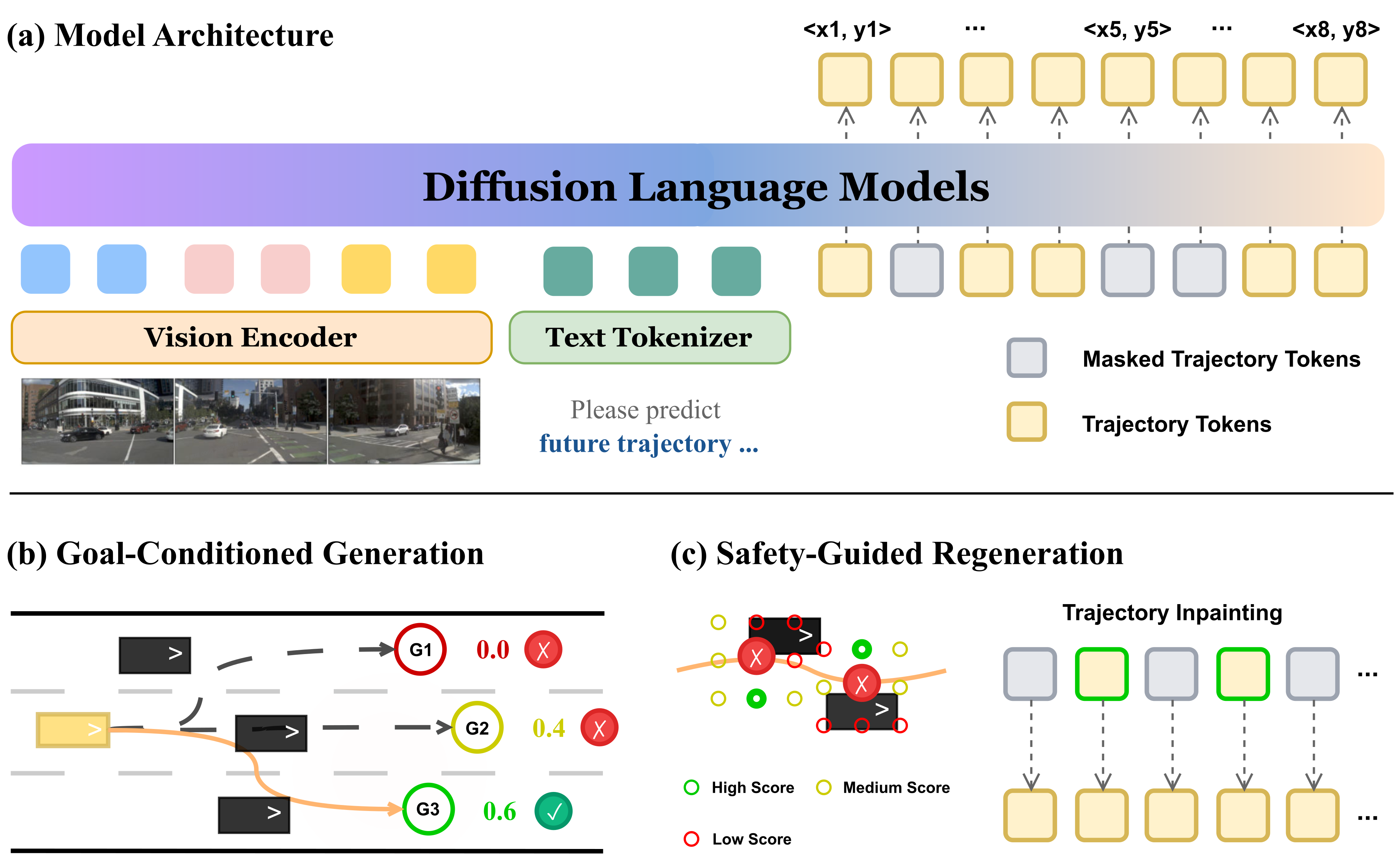
Figure 1 separates supervised training from reflective inference. Training learns tokenized driving trajectories; inference uses goal diversity and external scoring to revise those trajectories without gradient-based optimization.
4.1 Discrete Diffusion for Autonomous Driving Planning
A one-dimensional coordinate codebook converts continuous planar trajectories into a sequence compatible with the pretrained discrete-diffusion language model.
Trajectory Discretization.
Each x and y coordinate is independently quantized to the nearest uniform grid value over a bounded spatial interval. N two-dimensional waypoints become 2N tokens. The grid spacing trades coordinate precision against vocabulary size; the training table gives the spatial range [−100, 100], but does not specify the grid spacing.
Discrete Diffusion Model.
The planner initializes from pretrained LLaDA-V and applies the denoising objective to driving trajectories. Context combines front, front-left and front-right images with the navigation command and textual ego state. Training preserves the model’s ability to fill a trajectory around externally fixed tokens.
4.2 Reflective Inference
Reflective inference first chooses among globally different goal-conditioned plans, then repairs local violations in the best-scoring plan. The same model generates goals and trajectories; a dedicated goal model is suggested as a possible extension.
Scoring Function Definitions.
The global scorer ranks complete trajectories; the safety scorer identifies failing waypoints from the worst violation in a local time window; the local scorer ranks candidate replacement coordinate pairs. Appendix C defines the shared hard-compliance and quality components.
These scores require scene geometry and surrounding-agent information beyond the planner’s camera tokens. The paper does not fully specify a deployed perception pipeline supplying them. Its claim that every critical violation zeros the score also needs the appendix’s qualification: a static-object at-fault collision receives a 0.5 collision score.
Goal-Conditioned Generation.
The model proposes high-probability terminal waypoint pairs. Equation 2 selects candidates and applies non-maximum suppression, keeping spatially separated goals. The default is three goals with a 0.9 distance threshold.
Each fixed goal conditions trajectory inpainting. Equation 3 selects the highest global score. This step can choose a different route-level intention that a small local waypoint search cannot reach; it does not guarantee the goal obeys the navigation instruction.
Equations 2–3
| (2) |
| (3) |
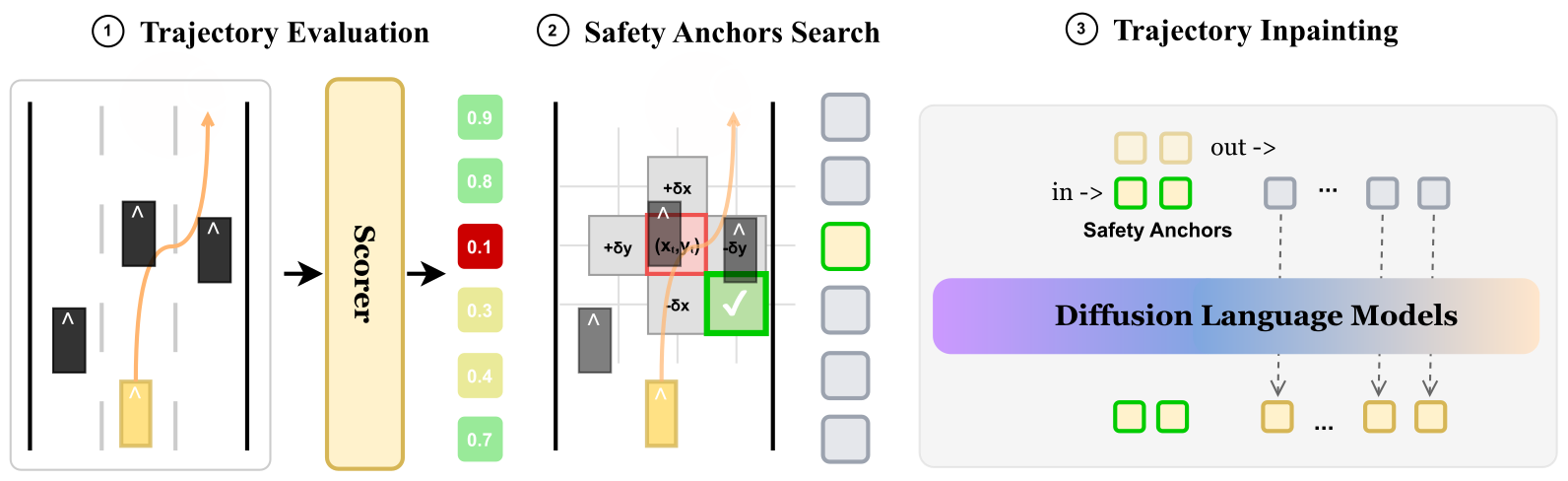
Safety-Guided Regeneration.
The safety scorer locates the earliest unsafe waypoint. Equation 4 searches a small Manhattan neighborhood for the highest-scoring replacement pair, fixes it as an anchor, and regenerates surrounding trajectory segments. The cycle stops when the scorer accepts the plan or the refinement budget expires.
The paper reports that most violations resolve in one to three iterations, with an example neighborhood radius at most ten grid steps and a default maximum of ten iterations. No hardware latency or frame-rate measurement establishes real-time operation. Approximate scores and bounded search allow unresolved failures; no guaranteed safe fallback is specified.
Equation 4
| (4) |
5 Experiments
Experiments compare NAVSIM planning scores, isolate the two reflection stages and vary generation/search settings. The appendix retains additional successes, failures and implementation details.
5.1 Benchmark and baselines
The planner uses three current-frame camera views, navigation text and ego state, with classifier-free guidance. Scores aggregate no-at-fault collision (NC), drivable-area compliance (DAC), time-to-collision (TTC), comfort and ego progress (EP) into PDMS. Public-test averages include both camera-only and camera-plus-LiDAR baselines.
The paper calls this closed-loop evaluation. NAVSIM’s official metric documentation describes non-reactive/pseudo-simulation and its approximate extensions; the precise benchmark version is not specified here. These results therefore do not establish interactive closed-loop road performance. The original NAVSIM reference remains available below.
Baselines.
Comparisons include UniAD, PARA-Drive, Transfuser, Hydra-MDP, DiffusionDrive, GoalFlow and post-reinforcement-fine-tuned AutoVLA. The base ReflectDrive model omits reflection. The dagger variant additionally gives the scorer ground-truth future agent states rather than constant-velocity predictions; it is a privileged-information analysis, not the deployable setting.
| Method | Paradigm | Input | NC↑ | DAC↑ | TTC↑ | Comf.↑ | EP↑ | PDMS↑ |
| Base End-to-End Planners | ||||||||
| UniAD | - | Cam | 100.0 | |||||
| PARA-Drive | - | Cam | ||||||
| Transfuser | - | C & L | 100.0 | |||||
| Augmented End-to-End Planners | ||||||||
| Hydra-MDP | - | C & L | 100.0 | |||||
| DiffusionDrive | Diffusion | C & L | 100.0 | |||||
| GoalFlow | Diffusion | C & L | 100.0 | |||||
| VLA Planners | ||||||||
| AutoVLA (Post-RFT) | Autoregressive | Cam | ||||||
| ReflectDrive (w/o R.I.) | Discrete Diffusion | Cam | 100.0 | |||||
| ReflectDrive (Ours) | Discrete Diffusion | Cam | 100.0 | |||||
| ReflectDrive† | Discrete Diffusion | Cam | 99.7 | 99.5 | 99.1 | 88.9 | 94.7 | |
| Human | – | – | ||||||
5.2 Main Results
Table 1 reports PDMS 84.8 for the base model, 91.1 for reflection and 94.7 with privileged future-agent states. Human trajectories score 94.8. Component scores explain both the gains and remaining safety differences.
Base Model Validation.
The unrefined discrete-diffusion VLA reaches PDMS 84.8, comparable to the listed base end-to-end planners. Its NC is 96.9, DAC 95.4, TTC 92.2 and EP 79.0. Pretrained multimodal knowledge plus imitation alone does not match the stronger score-augmented baselines.
Significant Improvements from Reflective Inference.
Reflection adds 6.3 PDMS points. DAC rises 95.4→99.3, TTC 92.2→93.5, NC 96.9→97.7 and EP 79.0→86.9. PDMS 91.1 exceeds GoalFlow’s 90.3 and AutoVLA’s 89.1 in this table.
The full model does not lead every safety component: AutoVLA has NC 98.4 and TTC 98.0. Sensor modalities and training procedures also differ. Table 1 reports full-model comfort 100.0, whereas the corresponding full configuration in Table 2 gives 99.9; both source values are retained.
Approaching Human Driving Performance.
With ground-truth future-agent states, PDMS rises to 94.7 versus the human-trajectory 94.8. Its NC/DAC/TTC are 99.7/99.5/99.1 and EP is 88.9 versus human 87.5.
Near-human aggregate scoring is conditional on privileged information. The authors call this an analytical upper bound, but it is not a proven optimizer bound or evidence of human-level driving with estimated scene states.
5.3 Qualitative results
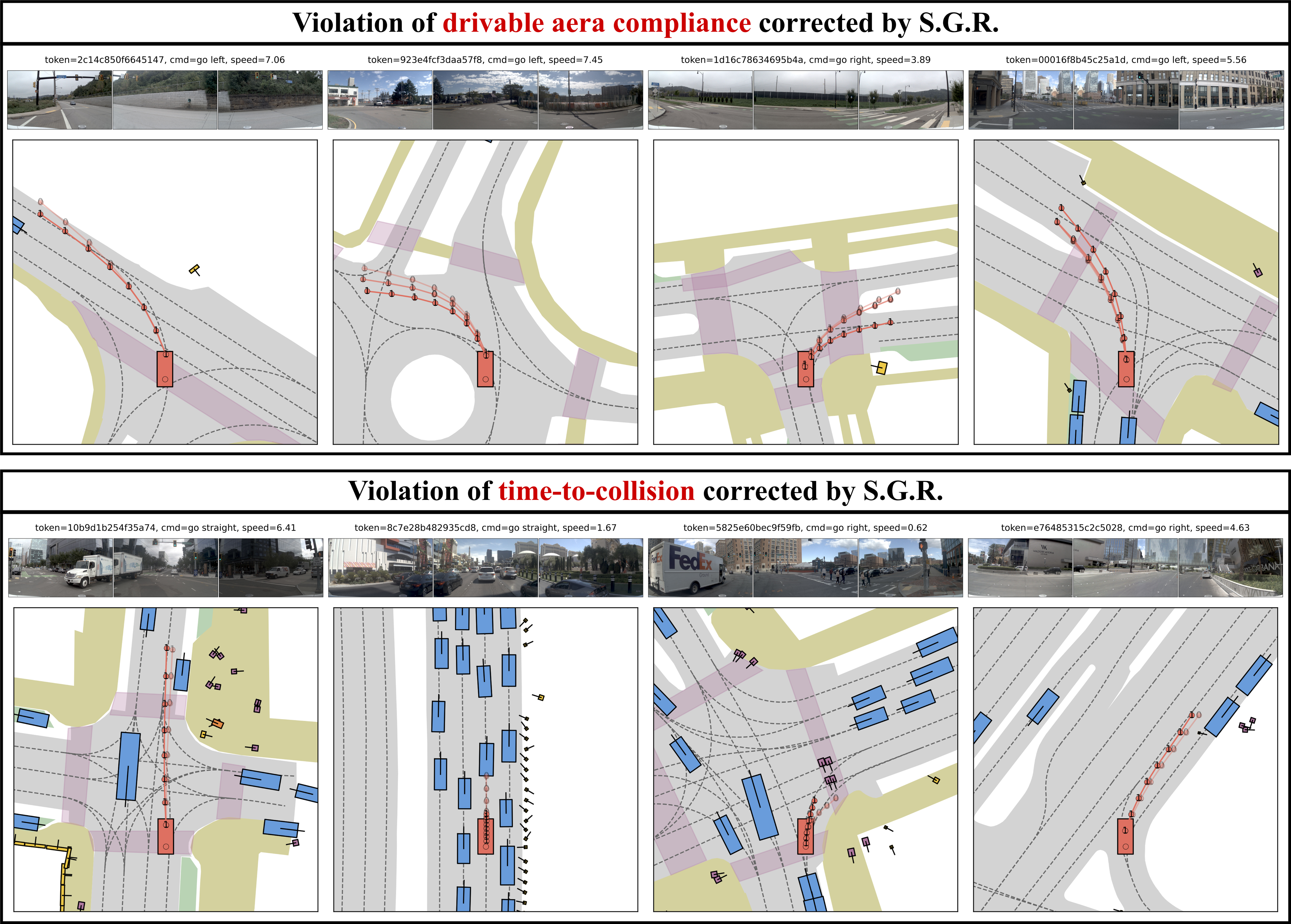
Figure 3 shows six selected road scenarios, including collisions and road-boundary violations. Reflection moves unsafe points and regenerates smoother connected paths. These examples illustrate the mechanism; Appendix A adds successes and Appendix D shows failures, so the selected main-panel improvements should not be read as universal.
5.4 ablation studies
Parameter sweeps examine denoising steps, goal counts and reflection search. A separate ablation compares goal-conditioned generation, safety-guided regeneration and their combination.
Ablation on Inference Parameters.
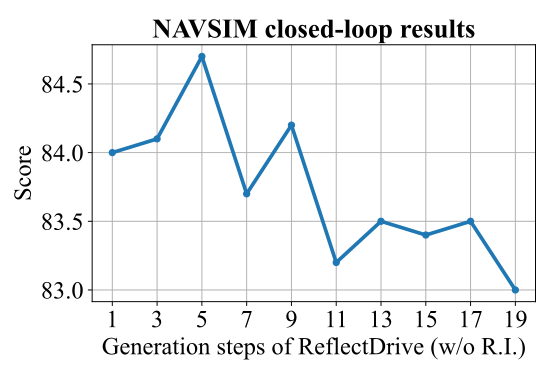
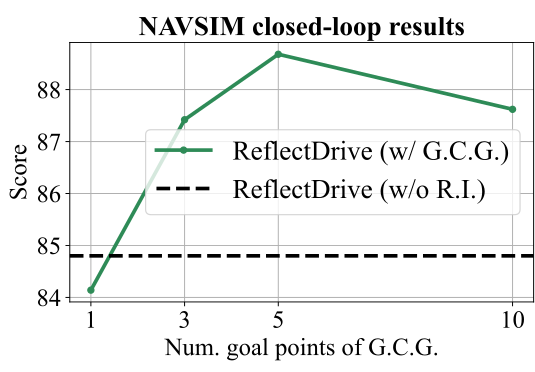
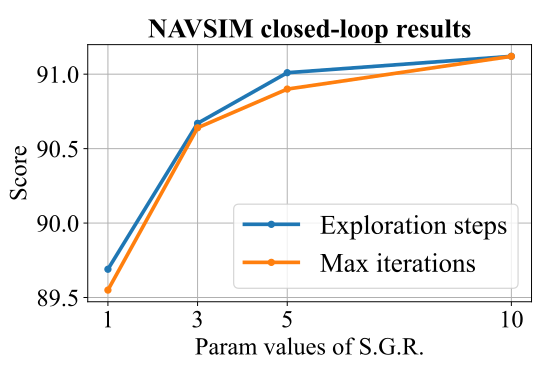
Five denoising steps give the best shown base-model score; additional steps are not monotonically beneficial. Five goal candidates give the best plotted goal-count score, whereas the default configuration uses three. Larger search radii and more refinement iterations generally improve the displayed sweep, but no latency/accuracy curve quantifies their cost.
The appendix’s failure analysis explicitly notes that more inference attempts need not improve a plan. The curves establish behavior over the tested ranges, not convergence or an unlimited-compute guarantee.
Design Choices for Reflective Inference.
Goal selection alone raises PDMS 84.8→87.4 and EP 79.0→83.8, while NC and TTC fall slightly. Safety regeneration alone reaches PDMS 90.3, NC 98.1 and TTC 94.8.
Combining both gives the highest aggregate PDMS 91.1 and EP 86.9, but lower NC/TTC (97.7/93.5) than safety regeneration alone. The stages complement aggregate planning quality without improving every safety metric simultaneously.
6 CONCLUSION
Discrete diffusion makes externally edited trajectory tokens compatible with global learned reconstruction. Goal diversity and local safety anchors substantially improve the reported NAVSIM score, and privileged-agent analysis shows sensitivity to scene prediction quality.
The evidence remains benchmark-specific. Bounded repair, current-frame inputs, scorer omissions and unmeasured runtime constrain deployment claims; the appendix makes these limitations explicit.
Appendix A Visualization of Planning Results
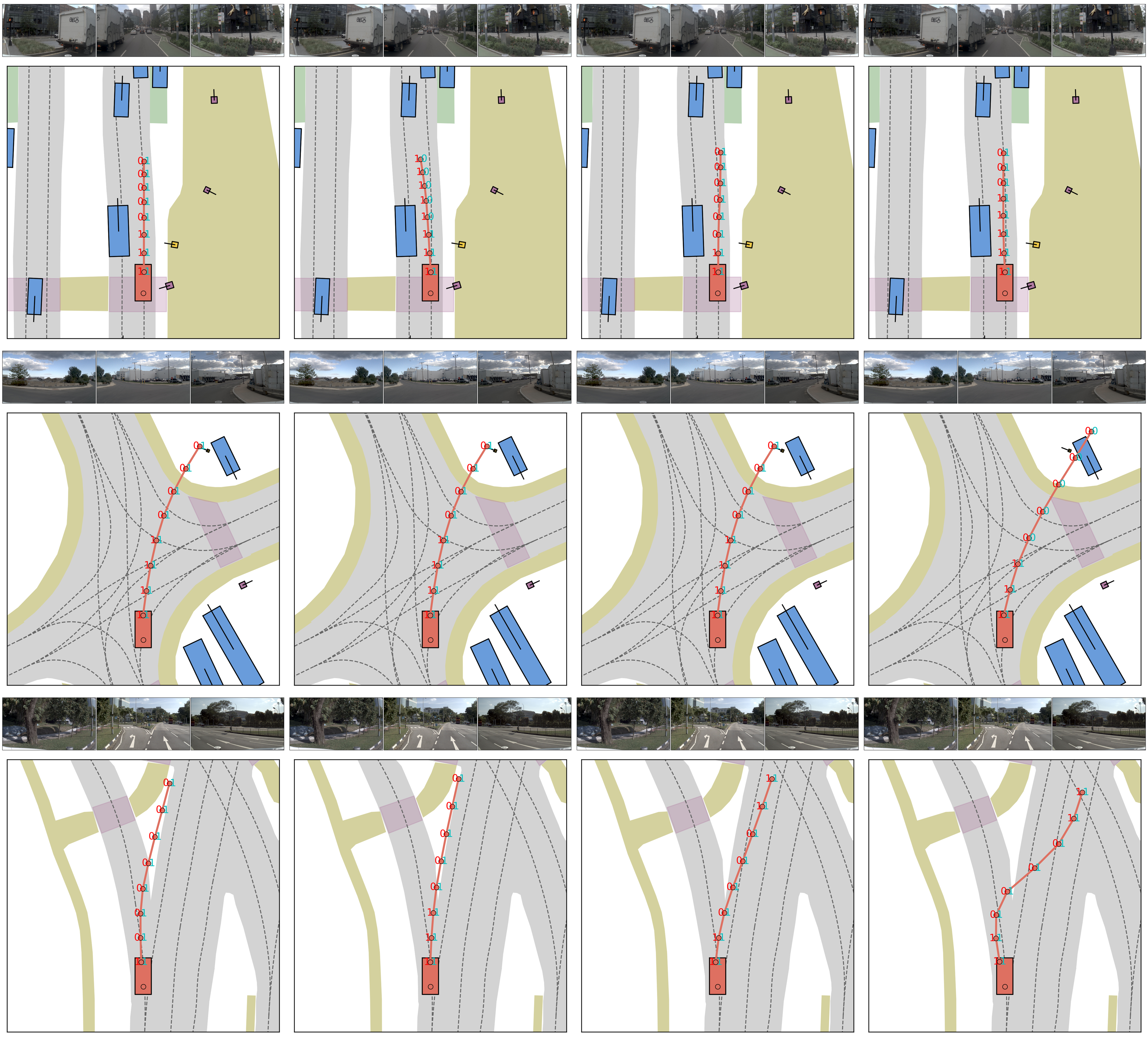
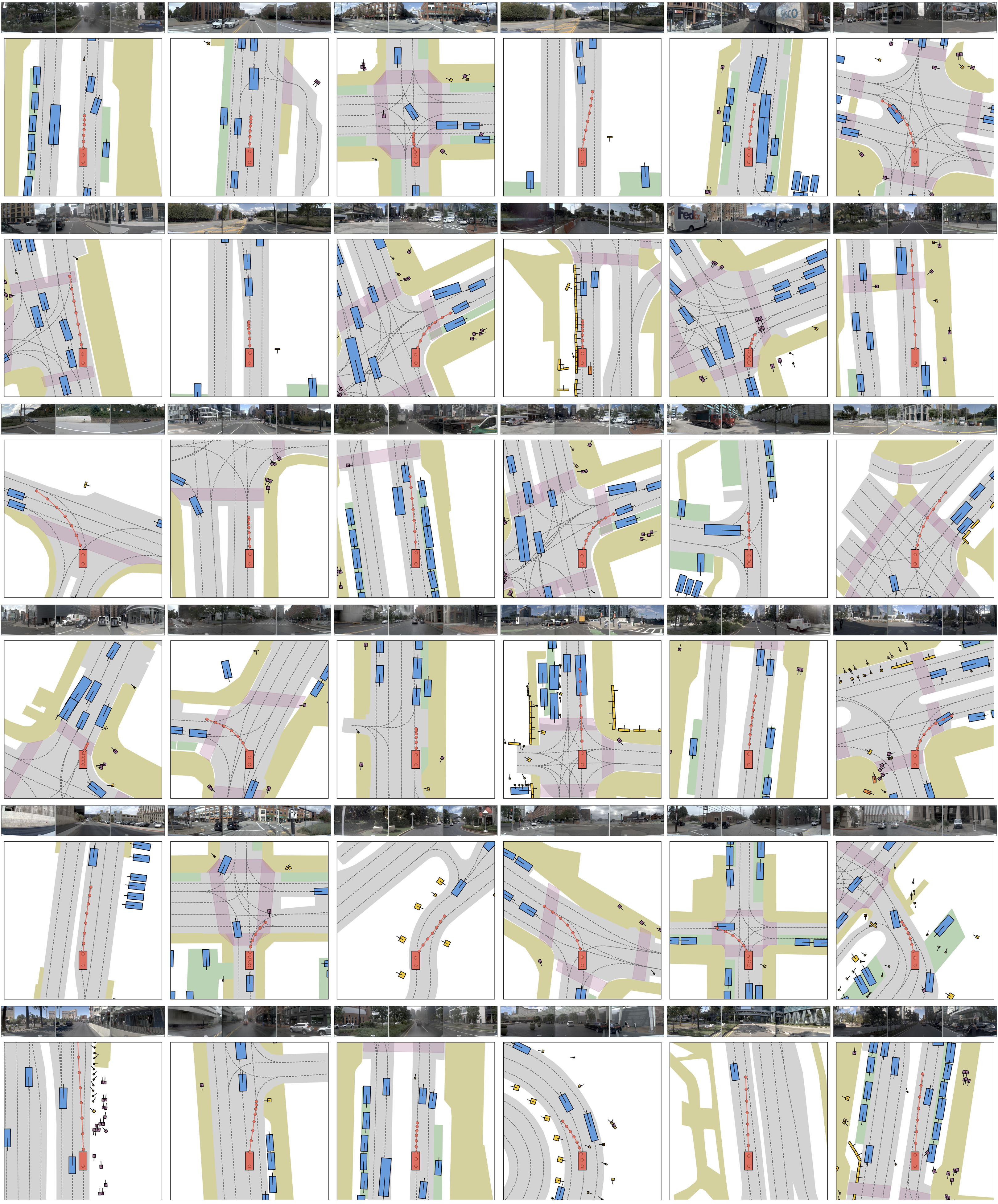
Figure 5 retains all thirty-six additional qualitative cases in the original six-by-six layout. They illustrate successful local corrections across varied traffic and road geometry, supplementing the six main-text examples without providing an independently sampled success rate.
Appendix B Supervised Fine-Tuning (SFT) Details
Supervised fine-tuning starts from LLaDA-V weights and its codebase. Table 4 specifies three epochs, batch size sixteen, no gradient accumulation beyond one step, learning rate 10⁻⁵, cosine scheduling, 0.03 warmup, zero weight decay, bfloat16 precision and an 8,192-token context.
Table 3 fixes five generation steps, answer/block lengths of thirty-two, low-confidence remasking, three goals, 0.9 goal separation and ten maximum refinement iterations. Exact training-set size, model size, spatial grid spacing and hardware timing are not supplied in this version.
| Parameter | Value |
| Steps | 5 |
| Answer length | 32 |
| Block length | 32 |
| Remask | low-confidence |
| Number of goal candidates () | 3 |
| NMS distance threshold () | 0.9 |
| Max refinement iterations | 10 |
| Parameter | Value |
|---|---|
| Spatial Range () | [-100, 100] |
| Batch Size | 16 |
| Gradient Accumulation Steps | 1 |
| Learning Rate | |
| Training Epochs | 3 |
| Max Context Length | 8192 |
| Learning Rate Scheduler | Cosine |
| Warmup Ratio | 0.03 |
| Weight Decay | 0.0 |
| Precision | bfloat16 |
Appendix C Scoring Function Implementation Details
The global and local scores multiply hard compliance H by quality Q. This structure penalizes violations before comparing route progress, temporal clearance and motion comfort; its behavior depends on the particular metric definitions below.
C.1 Hard Safety Compliance Term ( H ( τ ) )
Equation 5 multiplies no-at-fault collision and drivable-area scores. A front collision with any object, or a collision with a static object, counts as at-fault. NC is one without such a collision, one-half for an at-fault static-object collision and zero for other at-fault collisions.
DAC is one only if the vehicle’s entire footprint stays within the drivable area, otherwise zero. The safety scorer applies these checks locally. A static collision therefore reduces rather than necessarily eliminates the product, despite the main text’s stronger zero-score description.
Equation 5
| (5) |
C.2 Performance Quality Term ( Q ( τ ) )
Equation 6 averages EP, TTC and comfort with weights five, five and two. EP normalizes progress along the intended route against a feasible scene-specific upper bound. TTC is binary around a safety threshold, given as two seconds by example.
Comfort is binary according to longitudinal/lateral acceleration and jerk limits. The paper does not enumerate every threshold. These rule-based quantities are useful proxies but do not capture all navigation correctness or interaction behavior.
Equation 6
| (6) |
Appendix D Limitations & Future Work
The limitations distinguish missing motion information, weaknesses of reflection and computational efficiency. Figure 6 preserves all twelve panels across three four-step failure sequences.
• Model Inputs.
Three views of one timestep do not directly reveal surrounding vehicles’ speed and motion direction. The authors propose adding image history and predicting key obstacle trajectories, which could improve scoring and later interaction reasoning. Those extensions are not evaluated here.
• Reflection.
The adopted PDM scorer is not adapted specifically to high-level navigation. Failure cases oscillate between boundary and collision penalties, choose an incorrect correction direction, or start from a poor goal that the limited neighborhood cannot repair.
More iterations trade inference cost for uncertain benefit. Suggested remedies include better goals, reinforcement learning and learned rewards, possibly internalizing search in the model; these remain future work and could introduce new corner cases.
• Sample Efficiency.
The work prioritizes method validation over acceleration. Fewer inference iterations and engineering changes such as key/value caching may reduce cost, especially for short outputs. No measured latency, throughput or hardware budget substantiates the main text’s real-time aspiration.