At a glance
This edition follows the complete eight-page arXiv v4 manuscript dated September 9, 2026. It retains all four numbered figures, five tables, three equations, the training algorithm and 38 references. The opening figure missing from the HTML is restored from the PDF; both composite overview figures retain their original vector labels and embedded imagery. Dayi Dong and Maulik Bhatt contributed equally.
MIMIC-D trains a separate conditional diffusion policy for each robot from demonstrations with multiple valid coordination strategies. Each robot repeatedly samples an action trajectory using its own observation, which includes other robots’ states, and executes a short prefix before replanning. In navigation it reduces collisions; in bimanual manipulation it completes 15/20 simulated and 19/20 real transfers. The real test uses a fixed basket pose and sixteen demonstrations. These results support implicit coordination without exchanging planned actions, while assuming accurate state observations and a known set of agents.
I Introduction
Multi-modal coordination requires compatible choices: two agents may both pass left or both pass right, but independent incompatible choices cause collision. Ordinary regression can average such strategies into an unsafe middle path, while deterministic imitation may reproduce only one mode. Diffusion models can represent several action-trajectory modes [12][14].
MIMIC-D combines that representational capacity with observations of neighboring agents and repeated replanning. Its claim of decentralization concerns separate policies and no explicit communication or centralized action planner at execution. It does not mean agents ignore one another, use only proprioception, or operate from unprocessed camera images. The demonstrated tasks involve two or three robots, rather than large changing teams.
II Related Work
The related work separates learning from rewards, imitation from demonstrations, and diffusion-based trajectory modeling. The useful distinction is what information a policy receives at execution and whether its learned distribution captures multiple behaviors.
II- 1 Multi-agent Reinforcement Learning (MARL)
Multi-agent reinforcement learning must cope with other learners changing the environment. Centralized training with decentralized execution can use a joint critic while keeping execution policies separate, as in MADDPG, QMIX and MAPPO [18][19][20]. These methods generally need a task reward; MIMIC-D instead learns from demonstrations.
II- 2 Multi-agent Imitation Learning (MAIL)
Behavior cloning is simple but accumulates errors outside the demonstrated state distribution. Adversarial imitation, including MAGAIL [23], matches expert behavior through a discriminator, but the evaluated implementations may collapse to a single trajectory mode. MIMIC-D uses a generative action model rather than treating occupancy matching alone as sufficient for recovering behavioral diversity.
II- 3 Diffusion
MotionDiffuser and DJINN model interacting trajectories jointly [15][25]. MADiff uses agent modeling and attention, while LatentToM aligns policies through a consensus representation from shared visual observations [26][27]. The paper compares MIMIC-D with simpler baselines, not these recent decentralized diffusion alternatives; its experiments therefore establish a narrower comparison than a general state-of-the-art claim.
III Problem Formulation
The formal setting is a decentralized partially observed Markov decision process with a joint state, joint action, stochastic transition, and one observation function per agent. A robot chooses its action from its local observation rather than a central joint policy. The experiments specialize this abstraction to accurate positions or end-effector poses, including the other agents’ observed states; they do not evaluate uncertain visual perception or general partial-observation histories.
III-A Multi-Agent Imitation
Each expert demonstration records the interacting agents’ observations and finite-horizon action sequences. Multiple expert actions may be valid for the same observation. The goal is to reproduce that diversity while obtaining mutually compatible behaviors through one policy per agent.
All policies are optimized in one training loop, but their parameters are distinct. Deployment requires only the relevant agent’s policy and its observation. A joint dataset of coordinated demonstrations supplies behavior examples; successful coordination at test time is measured empirically rather than guaranteed by the formulation.
III-B Conditional Diffusion Models
Each conditional diffusion model corrupts an expert action trajectory with Gaussian noise and learns to reconstruct the clean sequence. Equations 1–2 preserve the noise process and squared denoising objective. Noise levels follow the log-normal training distribution used by Karras and colleagues [28].
Generation begins with a Gaussian trajectory and numerically integrates a probability-flow ordinary differential equation toward zero noise. A diffusion transformer supplies the denoiser [32]. The manuscript does not give the model depth, width, denoising-step count, optimizer schedule or navigation training-set sizes, so the general method is clearer than the full reproduction recipe.
Equations 1–2
| (1) |
| (2) |
IV MIMIC-D
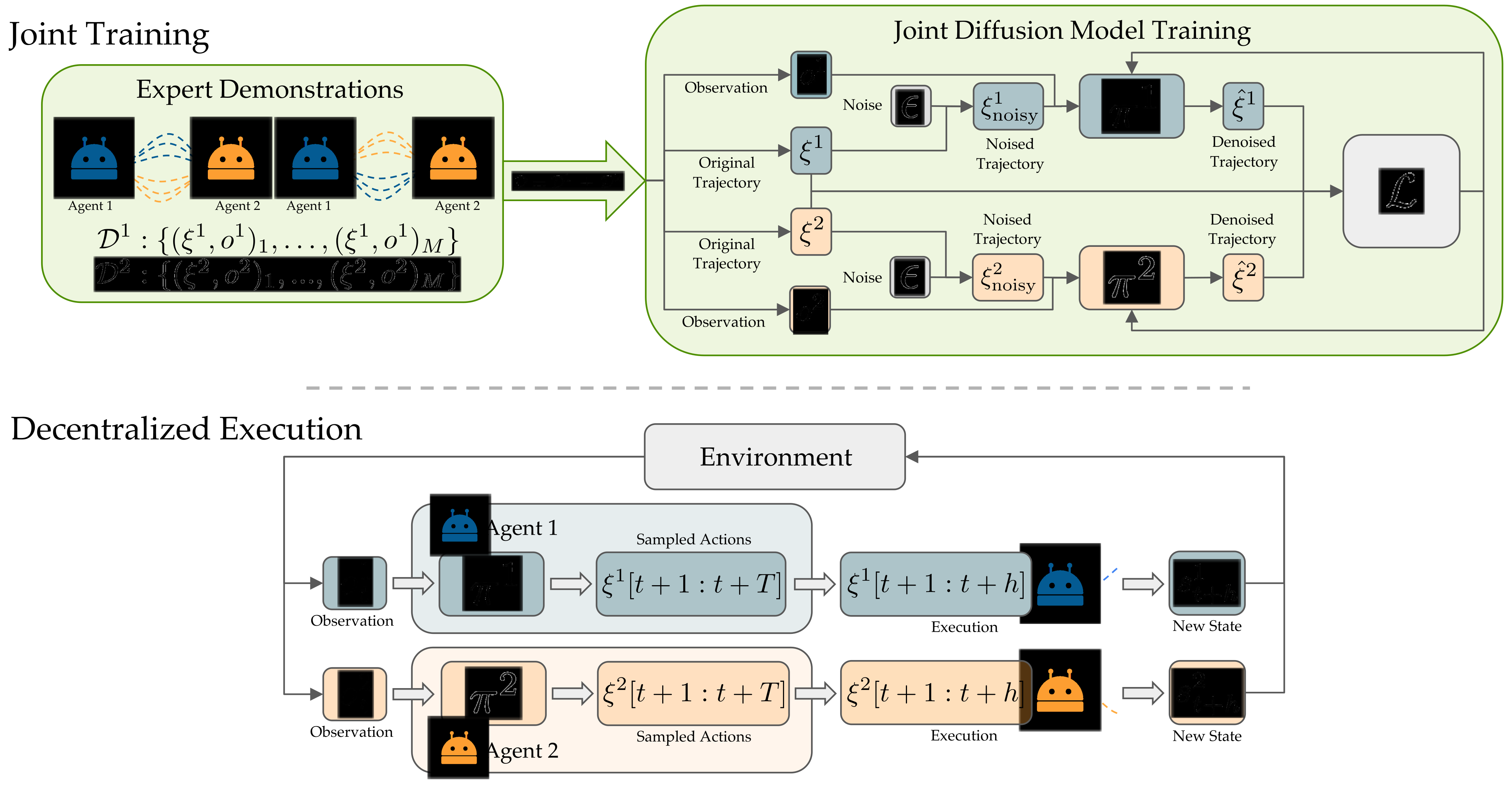
An agent’s denoiser receives its noisy future action sequence, noise scale and current observation. The observation provides both its own state and information about the other robots that it can observe. Figure 2 shows training over expert trajectories followed by independent, repeated action sampling at execution.
IV-A Joint Training
Equation 3 sums the individual agents’ denoising losses. Algorithm 1 samples a batch for each agent, accumulates those losses, and takes one AdamW optimizer step over all parameter sets. Separate models permit heterogeneous robots and controllers.
The authors attribute coordination partly to joint optimization. As written, however, each loss depends only on its own disjoint parameter block, so the gradient for one robot contains only its own denoising-loss gradient. Summing these losses alone adds no explicit cross-agent consistency or collision term. This mathematical reading limits the causal claim: other-agent observations, coordinated demonstration data and closed-loop replanning are the concrete interaction channels. There is no ablation isolating a shared optimizer from equivalent separate optimization.
Equation 3
| (3) |
IV-B Decentralized Online Execution
At each replanning cycle, every robot independently samples a trajectory of length T from its current observation, executes only the first h steps, then observes again. This receding-horizon loop lets a robot react to the other robot’s realized movement without receiving its future plan.
Independent stochastic sampling does not ensure that initially selected modes agree. Replanning can resolve disagreement in the demonstrations, but symmetric situations can still produce collisions, oscillation or stagnation. The method supplies no hard safety constraint or convergence guarantee.
V Simulated Experiments
Three environments test spatial mode selection, temporal yielding, and cooperative manipulation. Navigation reports collision incidence and distance to the expert trajectory distribution; manipulation separates successful lifting from completion of the entire transfer.
V-A Environments
Expert data deliberately includes several valid solutions. Mode counts are defined for Swap and Two Arm Lift; Road Crossing instead contains varied yielding behavior without a prescribed discrete mode distribution.
V-A 1 Two-Agent Swap
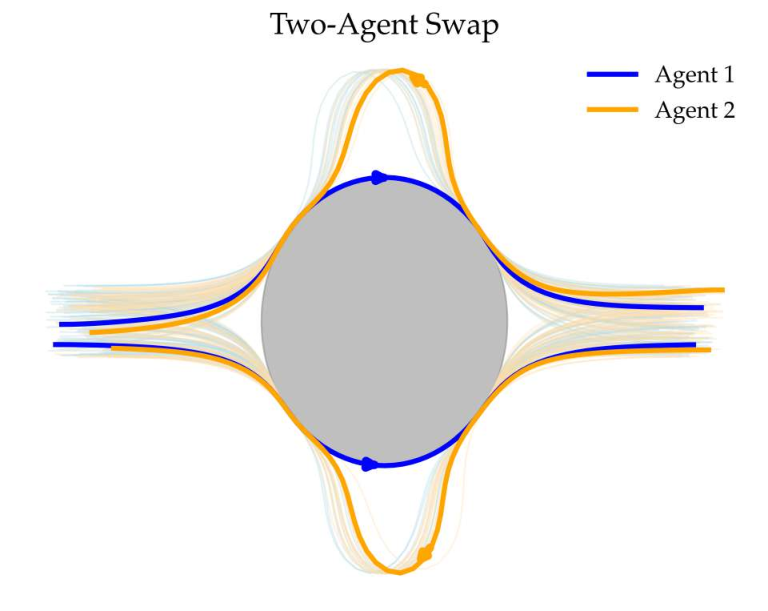
Two agents exchange positions around a central obstacle. Six equally represented modes include two opposite-side routes and four same-side routes in which one agent yields [33]. The symmetry makes compatible mode selection difficult. Agent observations contain their own and the other agent’s positions.
V-A 2 Three-Agent Road Crossing
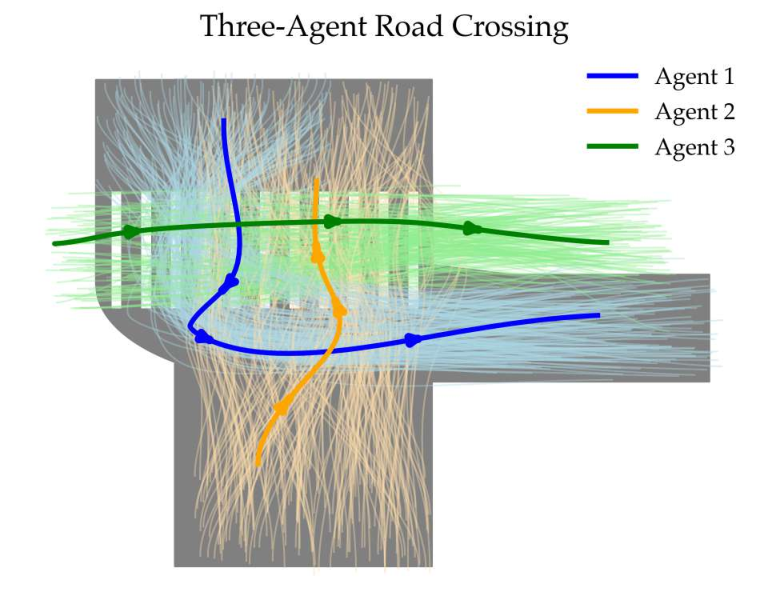
Three holonomic point robots with single-integrator dynamics move through intersecting paths. Position/action vectors are two-dimensional, and each robot observes all three positions. Successful behavior may require waiting as well as choosing a path. Demonstrations maintain at least 0.75 units of separation; they are not balanced across a fixed list of named modes.
V-A 3 Two Arm Lift
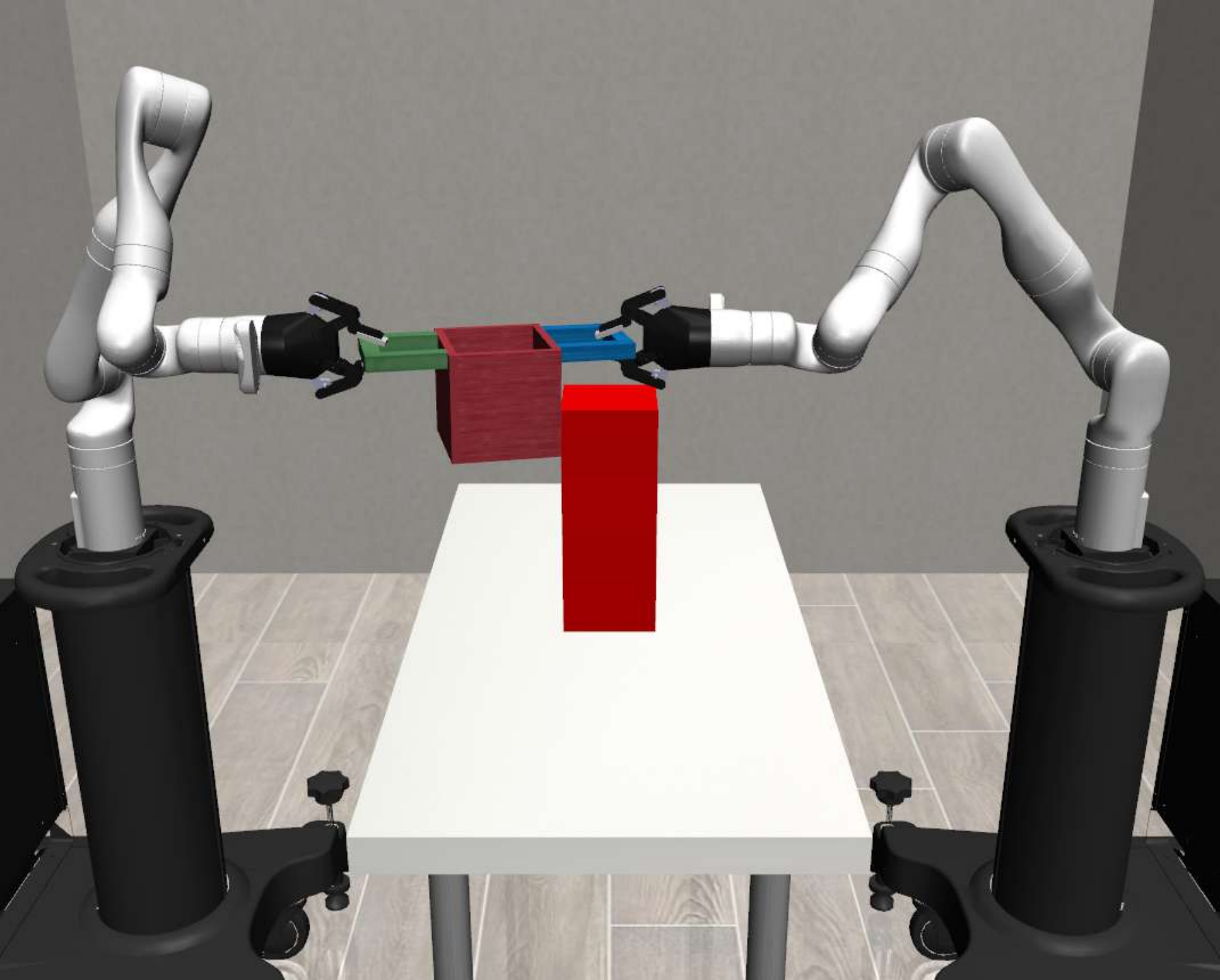
Two Kinova3 arms in robosuite [34] lift a pot and transfer it past an obstacle, using either its left or right side. Fifty demonstrations per mode give one hundred total. Coordination must preserve both grasps while choosing a common route; a rigid simulated pot can drop when the arms move inconsistently.
V-B Baselines
All three baselines are adapted to separate execution policies. They differ in policy representation or available observations, so comparisons should be interpreted at that system level.
V-B 1 MLP BC
MLP behavior cloning trains one feedforward policy per agent using a shared summed imitation loss. A deterministic action predictor can average demonstrated modes, making a geometrically invalid route even when it avoids the other robot.
V-B 2 MA-GAIL
The MAGAIL baseline uses one discriminator and an individual generator for each agent [23]. The paper’s trained baseline is deterministic at evaluation, so repeated rollout from a fixed state does not sample several modes. Its poor manipulation results are attributed to adversarial-training instability, but that mechanism is not separately tested.
V-B 3 Vanilla Diffusion
Vanilla Diffusion has the same summed training loss, but each policy observes only its own state and environment, excluding other agents’ states. This baseline can model alternative routes yet cannot react directly to a neighbor’s position. Its comparison with MIMIC-D primarily tests the added interaction information, not joint versus independent loss optimization. MADiff and LatentToM are excluded because their information and modeling assumptions differ.
V-C Comparison Metrics
Collision metrics count trajectories that cross an agent–agent or agent–obstacle threshold. Distribution matching uses Earth Mover’s Distance, with discrete Fréchet distance as the trajectory-pair cost [35][36]. These per-agent distribution scores complement collision counts: a good individual trajectory distribution does not by itself certify a coordinated joint distribution.
V-D Results
The tables retain every reported count and distance. Navigation uses one hundred sampled trajectories; simulated manipulation uses twenty trials. The manuscript provides no repeated-training uncertainty or confidence intervals, and its collision thresholds are relaxed relative to demonstration clearances.
V-D 1 Two-Agent Swap
Table I records any collision in 15/100 MIMIC-D trajectories, versus 52/100 for Vanilla Diffusion, 98/100 for MLP BC and 99/100 for MAGAIL. MIMIC-D has twelve agent collisions and three obstacle collisions. The “Total” column is the union of collision cases, not generally the arithmetic sum of its two categories.
Evaluation uses 2.7-unit inter-agent separation and a 3.9-unit obstacle radius, versus demonstrated values of three and four. These relaxed margins matter when interpreting the remaining failures. In Table II, MIMIC-D’s per-agent EMD is 1.50/1.24, while Vanilla Diffusion scores 1.20/1.74. Neither diffusion method wins both agents; MIMIC-D’s clearer gain is fewer collisions, not uniformly lower distribution distance.
V-D 2 Three-Agent Road Crossing
Table III gives MIMIC-D collision counts of 95, 14, 1 and 0 out of one hundred as thresholds decrease through 0.74, 0.675, 0.5625 and 0.375. The prose calls the first threshold 0.75; the table and original PDF print 0.74. Its zero collisions at the loosest threshold does not imply demonstration-level clearance: nearly all runs violate the strictest listed margin.
At 0.675, Vanilla Diffusion has 93 collision cases versus fourteen for MIMIC-D. Table IV also favors MIMIC-D for all three per-agent EMD scores: 0.3259, 0.4394 and 0.2845. The claim that stochastic sampling avoids the freezing-robot problem [37] is an empirical explanation, not a guarantee; the conclusion still acknowledges stagnation in symmetric settings.
V-D 3 Two Arm Lift
The policy plans 25 actions and executes ten before replanning. Each arm observes both end-effector poses, expressed in the respective robot-base frames, and the initial pot-handle positions. Test pot placement is randomized. The controller must first coordinate grasping/lifting, then keep the two arms moving along the same obstacle-avoidance mode.
Table V reports counts despite its “success rates” title: MIMIC-D lifts successfully in 18/20 trials and completes 15/20 transfers, or 90% and 75%. MLP BC lifts 2/20, MAGAIL 0/20 and Vanilla Diffusion 5/20; all three complete zero transfers. The tested baselines therefore fail well before reliable full-task coordination.
VI Hardware Experiments
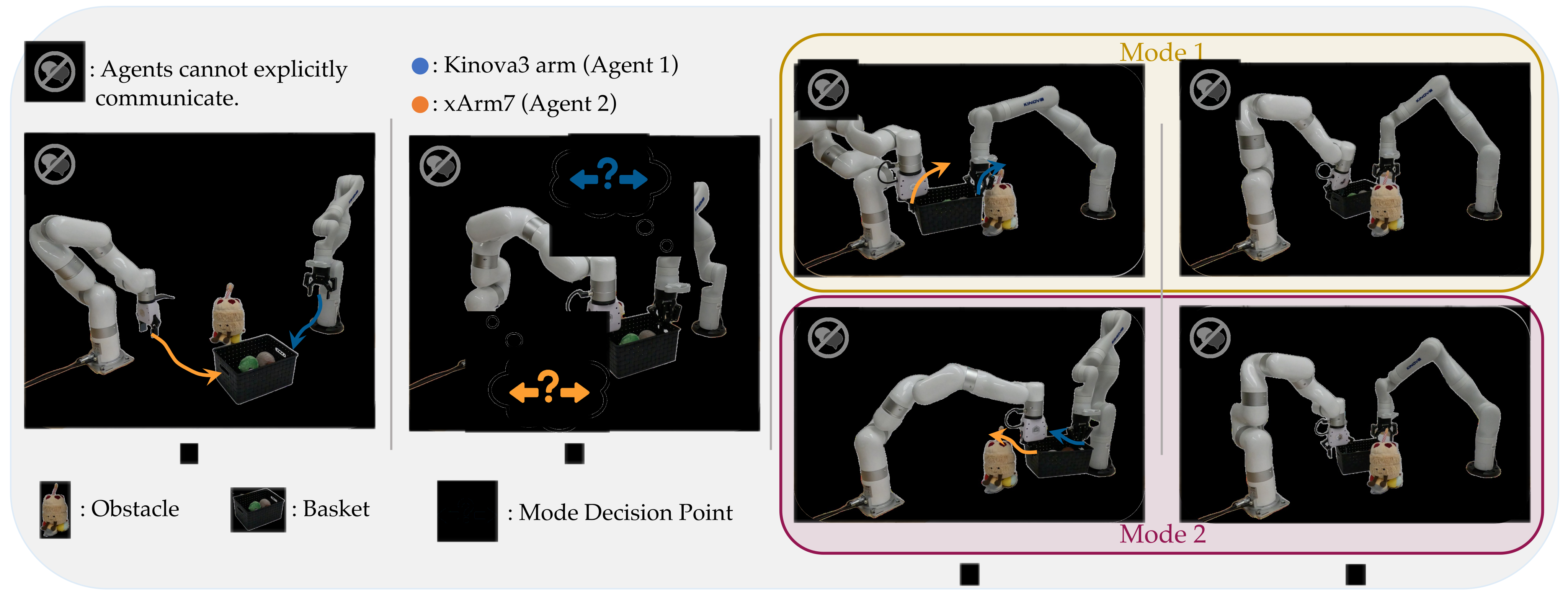
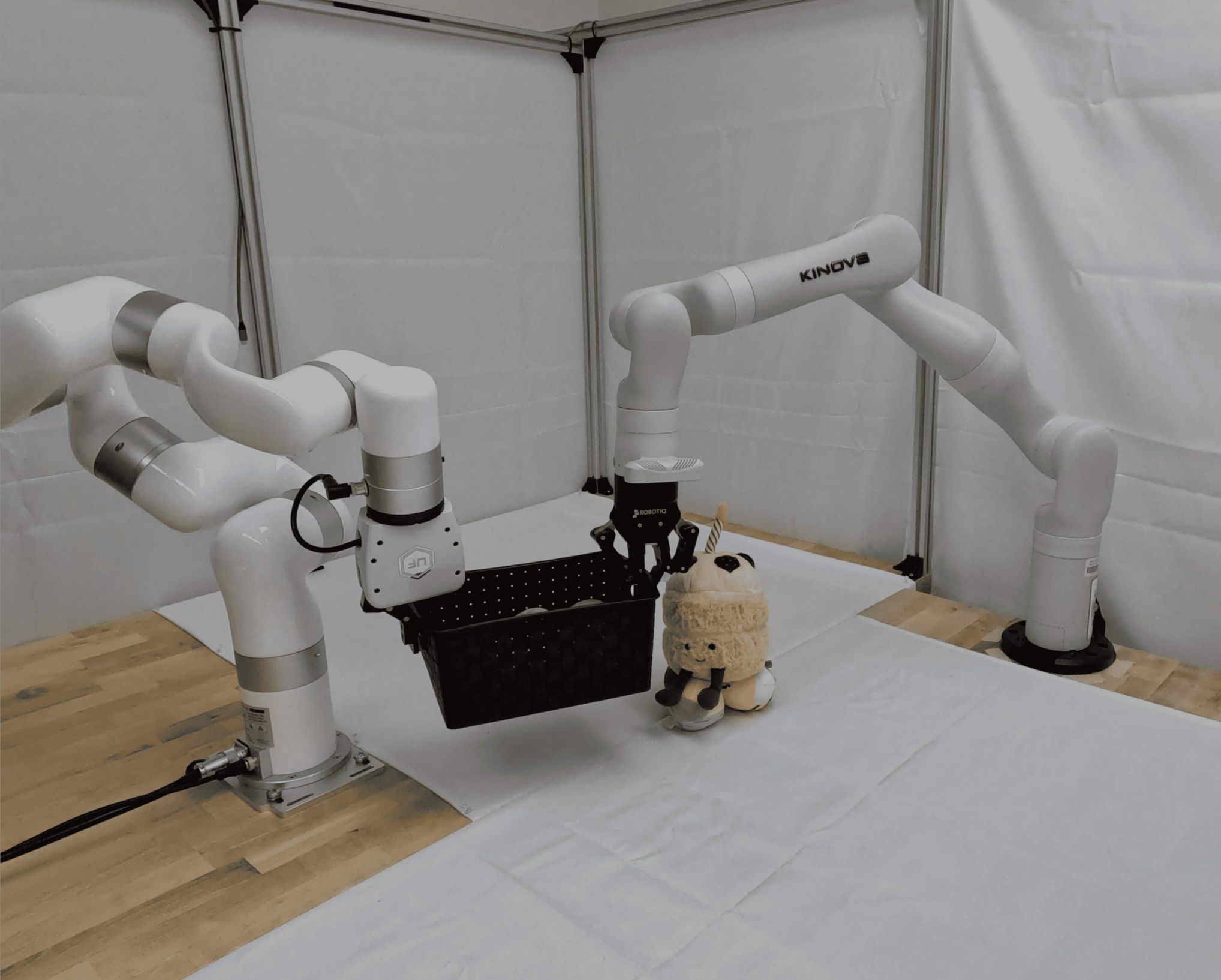
The hardware experiment pairs an xArm7 with a Kinova3, using a pose controller for the first and a velocity controller based on geometric impedance control for the second [38]. Eight demonstrations for each side of the obstacle give sixteen total. The basket’s pose is fixed and omitted from the observation, making this setting less variable than simulation.
MIMIC-D completes nineteen of twenty trials. Figure 1 shows both modes and the decision point; opposing initial movements can be corrected after replanning, sometimes with oscillation. The flexible real basket tolerates mismatch better than the rigid simulated pot, which helps explain the higher hardware success alongside the fixed starting pose.
The paper reports no hardware baseline trials. Its suggestion that baselines would remain as poor as in simulation is an extrapolation, not a measured hardware comparison. The small test set and one fixed setup do not establish robustness to new basket poses, unseen partners or arbitrary household scenes.
VII Conclusion
The evidence supports conditioning decentralized diffusion policies on observable teammate state and repeatedly replanning to resolve coordination choices. It also shows that reproducing a single-agent trajectory distribution is insufficient: Vanilla Diffusion can capture route diversity while colliding with a teammate.
Limits include perfect-state observations, known agent identities, small team sizes, symmetry-induced incompatible modes, occasional oscillation and uncertain behavior outside the demonstration distribution. Camera-based perception, human partners and improved out-of-distribution performance are future work. Summed separable losses and the absence of direct comparisons with stronger decentralized diffusion systems qualify claims about the source of the improvement.