At a glance
UDON makes distributed neural mapping more robust to intermittent communication by separating consensus penalties for each pair of agents and weighting map parameters by observation frequency. Only currently communicating neighbors contribute to an update. Experiments on indoor datasets and robot-collected data show better reconstruction than the tested baselines at low simulated communication success rates, including 1%. Inputs include camera poses; this is primarily a map-fusion study, not a demonstrated solution to unconstrained joint localization.
I INTRODUCTION
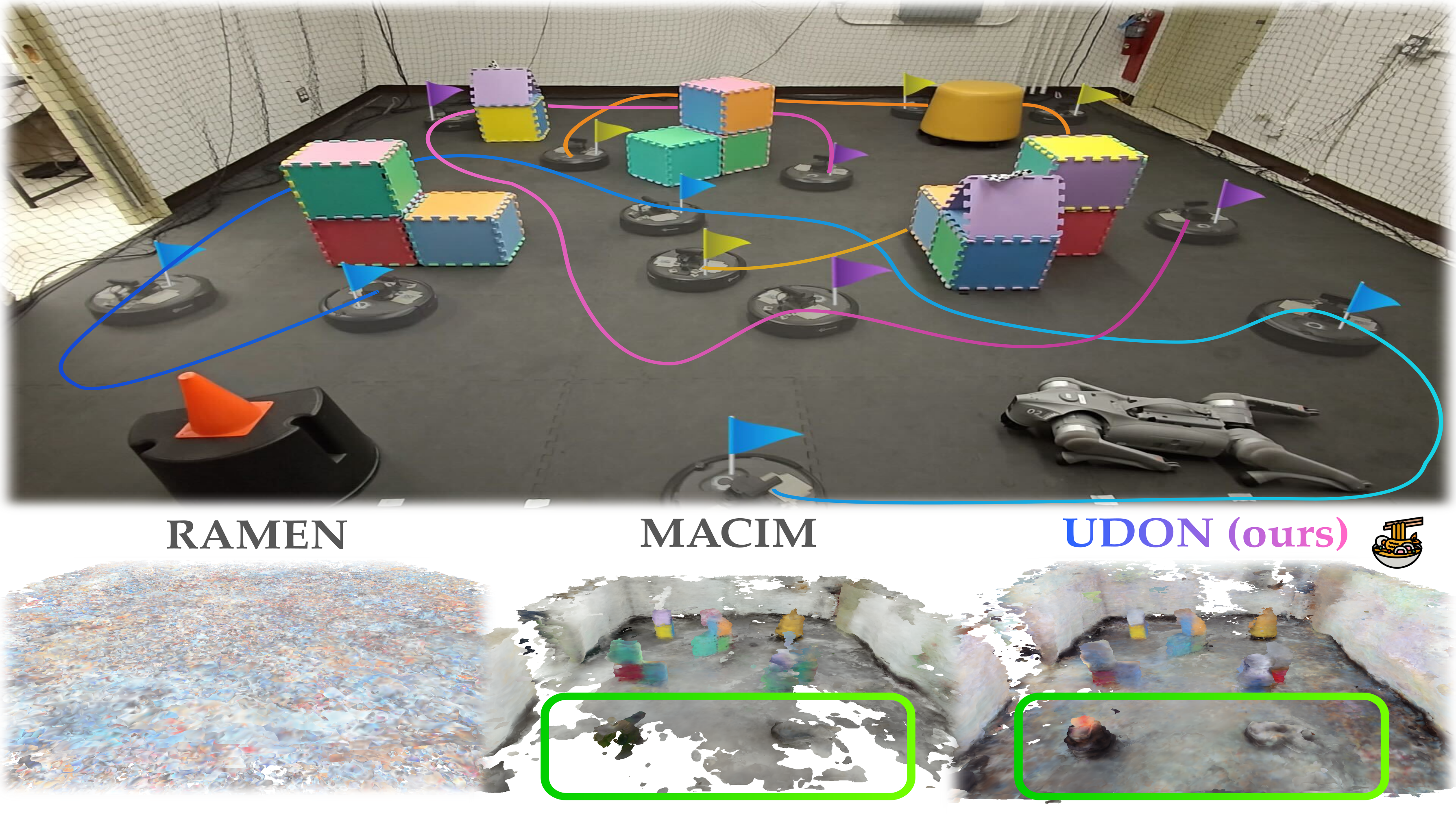
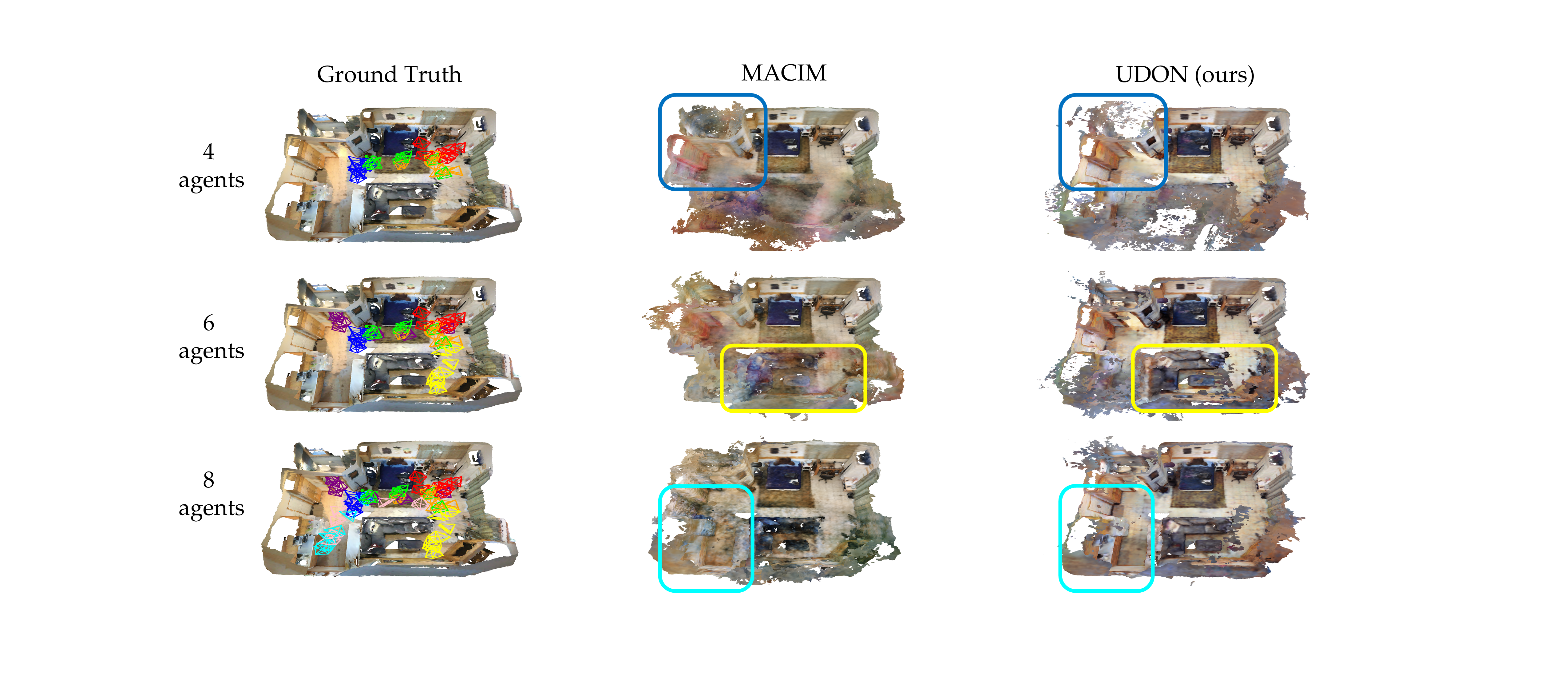
Neural maps cannot be merged as simply as point clouds. Consensus optimization must reconcile learned parameters, and stale disagreement penalties can destabilize training after communication drops. UDON replaces each agent’s aggregate dual variable with one variable per communication edge. Combined with uncertainty weighting, this avoids applying penalties from disconnected neighbors while preserving reliable local detail. The restored opening figure compares three robot trajectories and resulting maps.
II RELATED WORKS
Single-agent implicit mapping supplies the compact representation. Prior distributed methods use consensus ADMM, consistency losses, or uncertainty weighting; their tradeoffs include instability under long disconnections and loss of fine detail. UDON combines RAMEN’s update-frequency weighting with an edge-based formulation inspired by MESA. Its contribution is the adaptation and evaluation of this optimization structure for neural mapping.
III Preliminaries
Agents receive posed RGB-D images, maintain private observations, and exchange neural-map parameters with available neighbors. Standard consensus ADMM alternates a dual update that accumulates map disagreement with a local primal optimization balancing reconstruction and consensus. Each local minimization uses a fixed number of gradient steps. A single accumulated dual variable can retain influence from neighbors no longer communicating, motivating the revised formulation.
Equations 1–2
| (1) |
| (2) |
IV Method
The method combines a shared neural representation, a frequency-based reliability estimate, and pair-specific consensus updates. Algorithm 1 retains the full decentralized update sequence.
IV-A Neural Implicit Representation
Each agent uses a multiresolution hash grid with geometry and color decoders adapted from Co-SLAM. Decoders are pretrained on a NICE-SLAM apartment dataset and then frozen; only hash-grid parameters change during mapping. One-blob coordinate encoding and volumetric ray rendering produce color and depth. Training combines color/depth reconstruction, smoothness, and free-space losses. Shared fixed decoders help make corresponding grid parameters comparable across agents.
IV-B Frequency-based Uncertainty
A parameter’s count of nonzero-gradient updates acts as an observation-frequency proxy: more updates indicate more reliable coverage. Pairwise normalization turns those counts into diagonal consensus weights. Although the paper calls the count vector “uncertainty,” larger counts actually mean lower uncertainty; one prose sentence reverses that interpretation. The mechanism is a heuristic based on sampling frequency, not a calibrated estimate of geometric error or a posterior variance.
Equations 3–4d
| (3) |
| (4a) | |||
| (4b) | |||
| (4c) | |||
| (4d) | |||
IV-C Uncertainty-weighted Distributed Optimization
UDON stores a separate dual variable for every agent pair. It updates that variable only when the pair communicates and holds it fixed otherwise. Both dual penalties and weighted quadratic consensus terms in the next primal update use only active neighbors. This prevents a disconnected agent’s old penalty from continually dominating current reconstruction. The paper demonstrates improved empirical stability but does not supply a general convergence guarantee for this nonconvex online setting.
Equations 5–6
| (5) |
| (6) |
V EXPERIMENTAL RESULTS
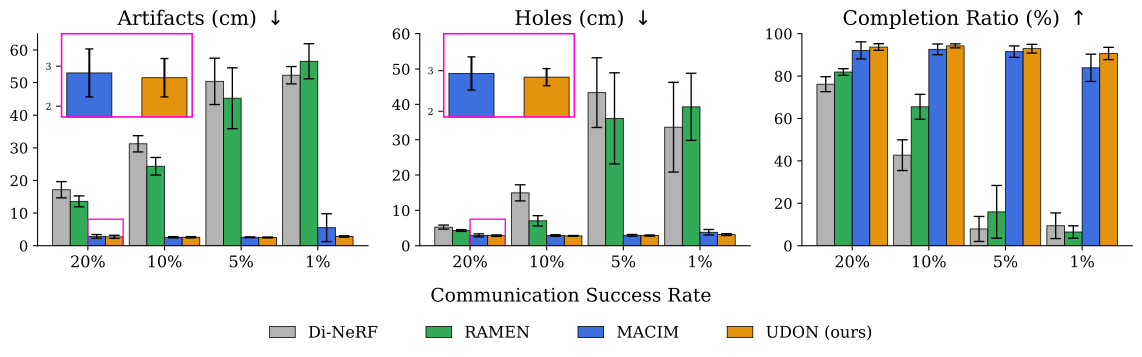
Comparisons use a common map representation on Replica, ScanNet, and a TurtleBot dataset, with three independent runs per setting. Communication attempts occur every mapping iteration and are randomly dropped to reach specified success rates; a 1% rate corresponds to about one successful neighbor update per 100 attempts. That probability is not itself a byte-bandwidth or latency measurement. Single-agent runtime is 5.3 frames per second and about 3.8 GB on an RTX 5090. Mesh metrics measure artifacts, missing coverage, and the fraction of ground truth within 5 cm of the reconstruction.
| Method | Metric | office1 | room1 | scene0000 | scene0169 |
| No Communication | Artifacts | 13.76 1.64 | 4.69 2.36 | 17.25 11.42 | 24.44 6.23 |
| Holes | 20.11 4.94 | 6.90 2.43 | 6.42 2.67 | 6.30 3.07 | |
| Completion Ratio (%) | 51.64 3.82 | 75.59 8.73 | 71.80 7.31 | 76.39 7.17 | |
| Di-NeRF [8] | Artifacts | 28.8511.57 | 63.295.75 | 52.272.65 | 44.08 9.72 |
| Holes | 16.9612.19 | 67.5225.92 | 33.5312.69 | 10.35 1.69 | |
| Completion Ratio (%) | 48.8719.58 | 4.493.24 | 9.416.06 | 49.42 5.26 | |
| MACIM [10] | Artifacts | 7.156.27 | 2.192.23 | 5.534.27 | 21.74 6.99 |
| Holes | 5.846.48 | 3.370.55 | 3.810.79 | 3.77 1.13 | |
| Completion Ratio (%) | 80.4811.09 | 87.493.66 | 83.896.42 | 83.12 4.78 | |
| RAMEN [9] | Artifacts | 44.3711.68 | 48.1210.80 | 56.545.38 | 35.89 3.37 |
| Holes | 33.5516.16 | 51.4636.18 | 39.299.50 | 27.59 7.13 | |
| Completion Ratio (%) | 24.9316.10 | 15.5213.08 | 6.462.93 | 14.46 6.62 | |
| UDON (ours) | Artifacts | 4.403.27 | 1.370.05 | 2.830.20 | 20.83 5.28 |
| Holes | 3.440.90 | 3.110.08 | 3.140.26 | 3.30 1.28 | |
| Completion Ratio (%) | 84.356.76 | 89.460.24 | 90.672.89 | 85.38 6.13 |
V-A Replica and ScanNet Datasets
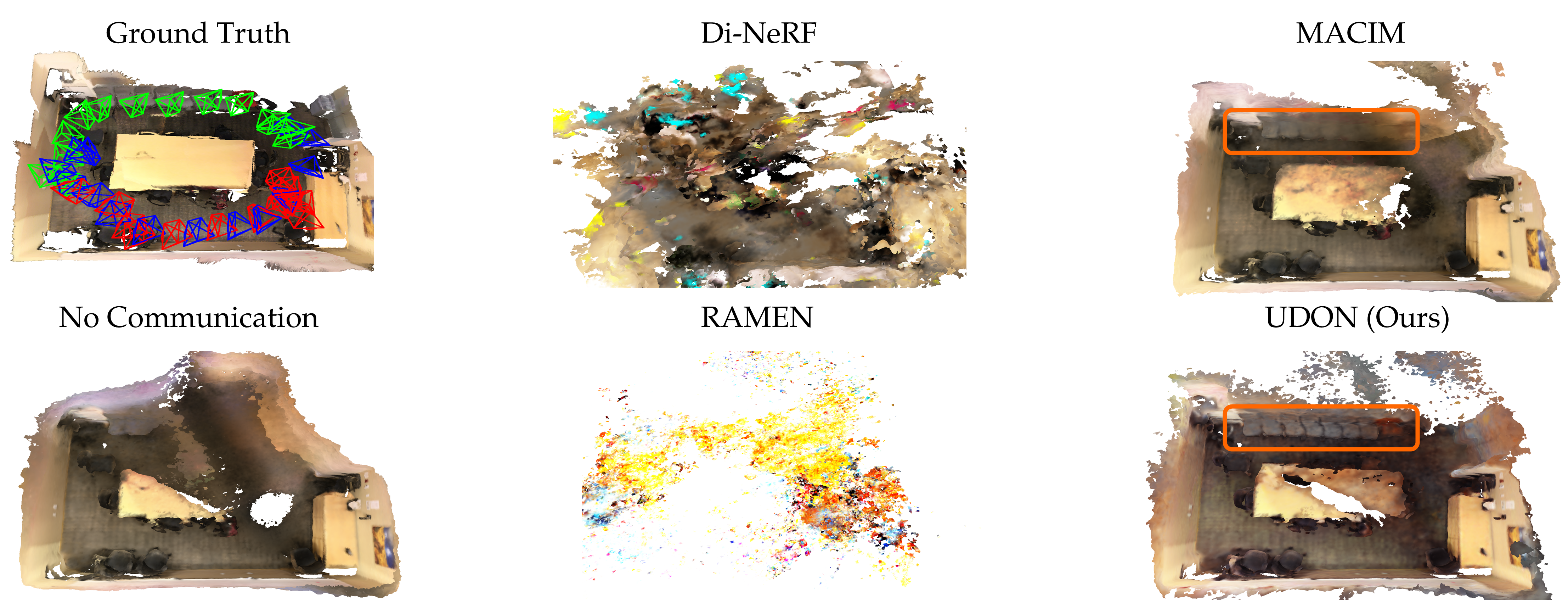
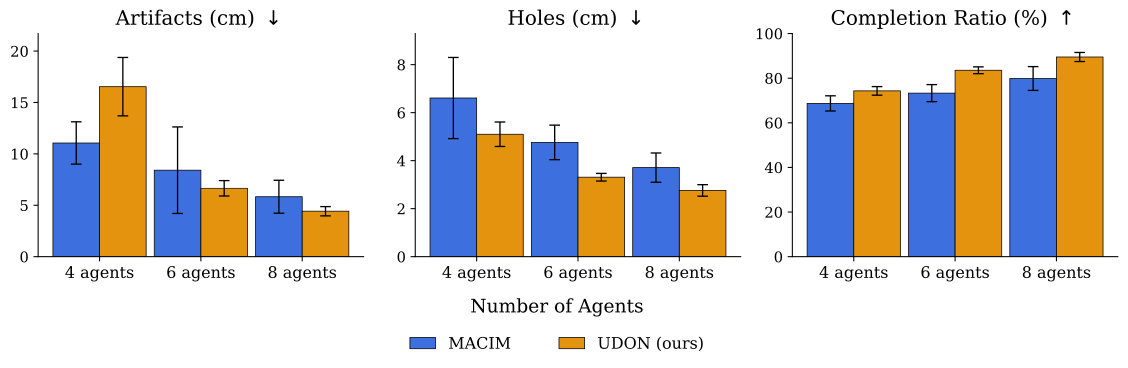
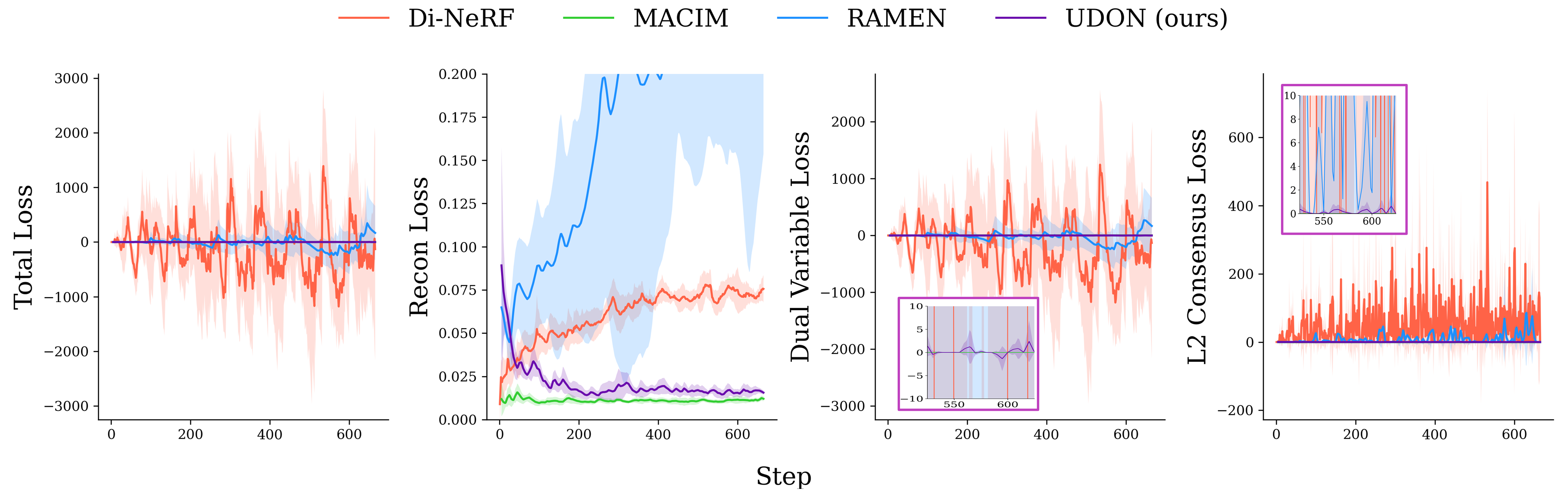
At 1% communication with three agents, UDON reconstructs two Replica and two ScanNet scenes more accurately than the listed baselines; Di-NeRF and RAMEN become unstable. A sweep from 20% to 1% on scene0000 shows graceful degradation relative to those methods. Increasing agents from four to eight at 5% improves coverage, though UDON has more artifacts than MACIM in the four-agent setting because of floaters in unobserved regions. Thus the figure caption’s blanket superiority claim has this explicit exception. Loss curves support the proposed mechanism: aggregate dual terms diverge while UDON keeps their influence bounded in the tested runs.
V-B Turtlebot Hardware Dataset
Three robot-collected scenes are segmented to simulate three agents at 5% communication. Ground-truth poses come from VICON, and a learned model enhances depth. UDON’s completion ratios are 78.75%, 83.64%, and 80.21%, versus 66.52%, 75.35%, and 65.69% for MACIM, alongside lower artifact and hole distances. This tests map fusion with obstructed robot viewpoints and simulated dropouts; it does not establish end-to-end decentralized tracking under measured radio failures.
| Method | Metric | exp1 | exp2 | exp3 |
| MACIM [10] | Artifacts | 6.91 0.80 | 5.92 0.70 | 5.64 1.25 |
| Holes | 5.64 0.80 | 4.36 0.16 | 5.61 0.38 | |
| Completion Ratio (%) | 66.52 3.54 | 75.35 0.67 | 65.69 3.16 | |
| UDON (ours) | Artifacts | 5.24 0.68 | 4.86 0.58 | 4.58 0.42 |
| Holes | 3.92 0.58 | 3.29 0.38 | 3.60 0.38 | |
| Completion Ratio (%) | 78.75 4.41 | 83.64 3.15 | 80.21 3.35 |
VI CONCLUSIONS
Pair-specific consensus and reliability weighting improve sparse-communication mapping in these indoor experiments. Large-scale maps with incrementally added submaps remain future work. Practical limits include supplied poses, fixed pretrained decoders, heuristic uncertainty, simulated communication probabilities, and evaluation on a small set of scenes.
Acknowledgments
The work acknowledges NSF support and GPU resources from the NVIDIA Academic Grant.