Overview
This edition follows the complete 15-page v1 manuscript dated August 30, 2025. The source credits “Galaxea Team”; the catalog’s ten named authors all appear in its contributor section. All 11 numbered figures and their subpanels, the numerical results table, three original equation displays, the noisy-action interpolation formula and 30 references are retained. Native PDF imagery and source SVG plots preserve the original detail.
At a glance
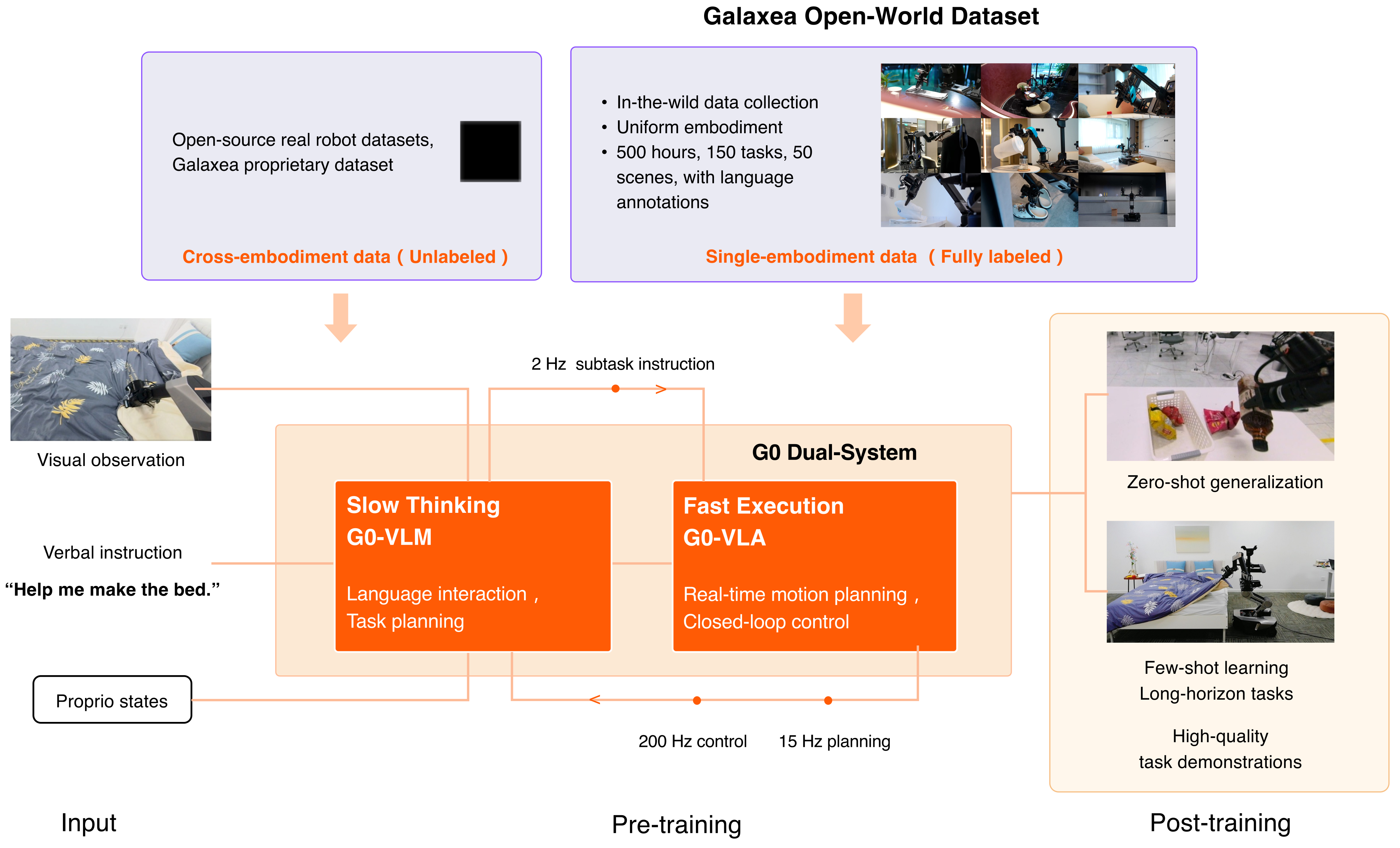
The Galaxea Open-World Dataset contains about 500 hours of demonstrations from one mobile bimanual platform across varied living and working spaces. G0 couples a slower vision-language planner with a faster vision-language-action executor. Its curriculum first learns discrete actions from mixed robot data, then continuous actions from the target embodiment, followed by task-specific fine-tuning. The four-task evaluation finds strong benefits from target-platform data; mixed-embodiment pretraining has uneven effects and can reduce whole-body performance.
1 Introduction
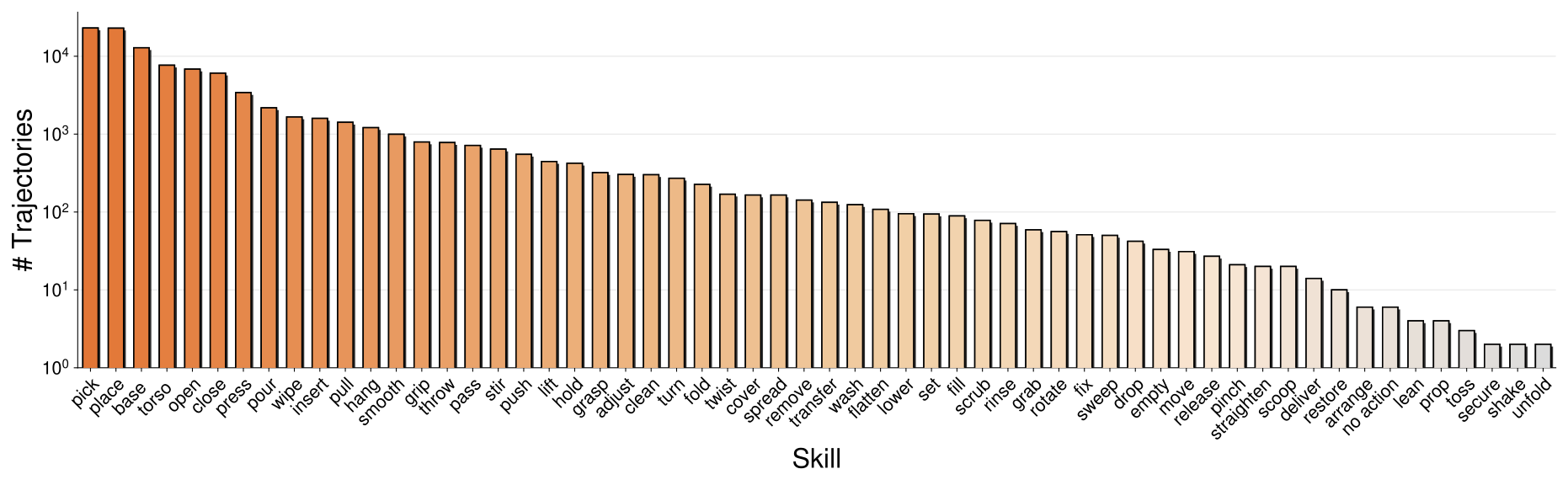
The motivation is to improve robot learning with consistent, realistically collected data and subtask-level language alignment. The paper reports 100,000 trajectories, 150 task categories, 50 scenes, over 1,600 objects and 58 skills on one platform. A common action space reduces heterogeneity while diverse scenes broaden experience.
The proposed curriculum is evaluated on four downstream tasks and two few-shot settings. Its evidence concerns adaptation within the Galaxea embodiment, not a general guarantee of transfer across arbitrary robots or unseen environments. The v1 manuscript announces a future dataset/model release; that historical statement is not a check of current release availability.
2 Related Work
G0 follows hierarchical task-and-motion planning and language-guided skill selection [2][3]. The slow-planner/fast-executor division is an architectural analogy to dual-process thinking, not a measured cognitive distinction. The executor combines action-token pretraining with flow-based generation, related to FAST, π0 and π0.5 [11][12][16]. Hierarchical VLA systems similarly separate task decomposition from control [18][19].
BridgeData, DROID, Open X-Embodiment and AgiBot World differ in scale, robot diversity and collection practices [21][22][1][24]. Galaxea emphasizes uniform hardware, actual work/living sites and consistent annotations. The paper’s broad criticism of earlier datasets is motivation rather than a quantitative, matched comparison proving higher scene diversity or less bias than every prior dataset.
3 Galaxea Open-World Dataset
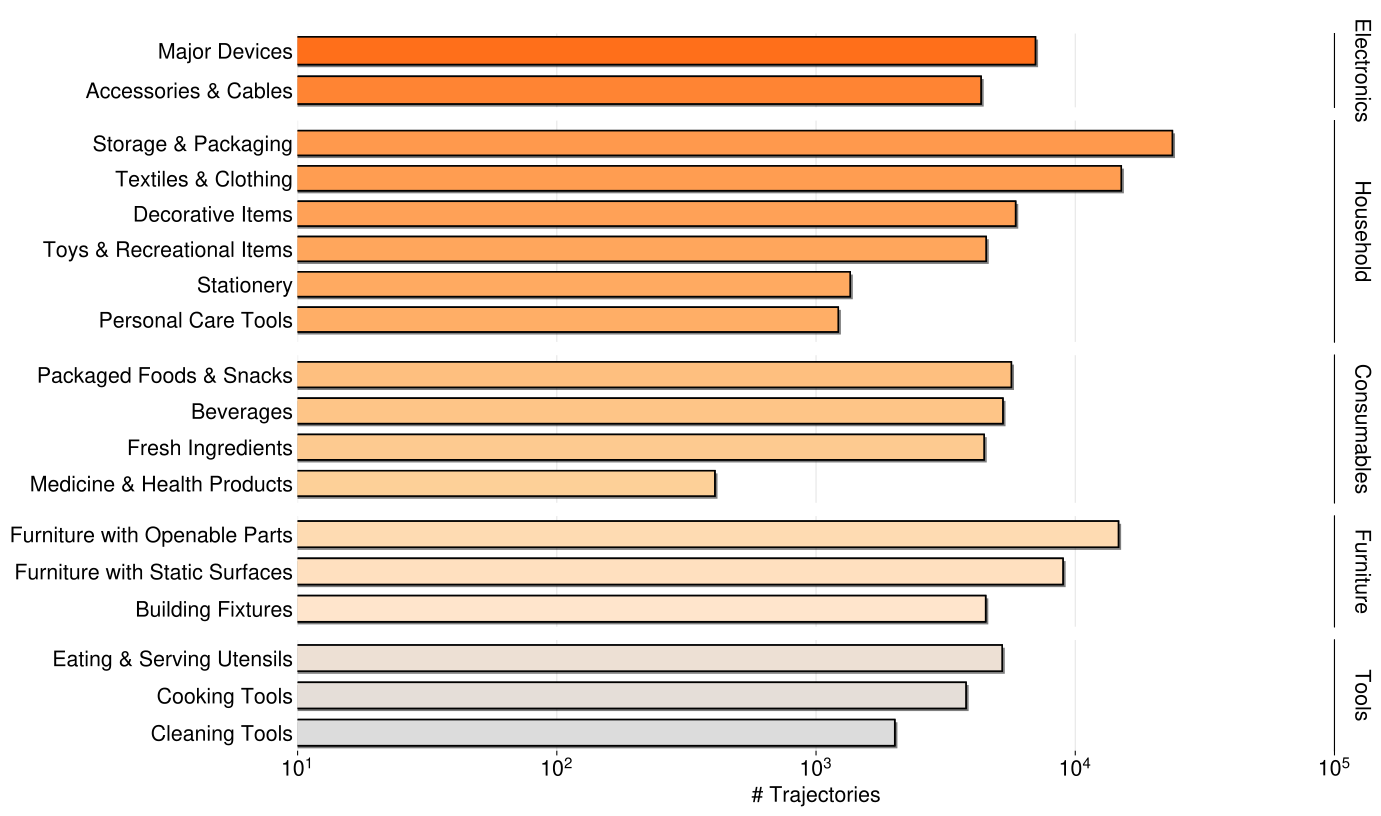
The released-dataset proposal comprises approximately 500 hours and 100,000 demonstrations spanning 150 task categories, 50 scenes, more than 1,600 objects and 58 operational skills. All are collected on Galaxea R1 Lite. These counts describe the overall collection; the main pretraining ablations use 200 or 400 hours of its target-platform data.
Data Collection Platform.
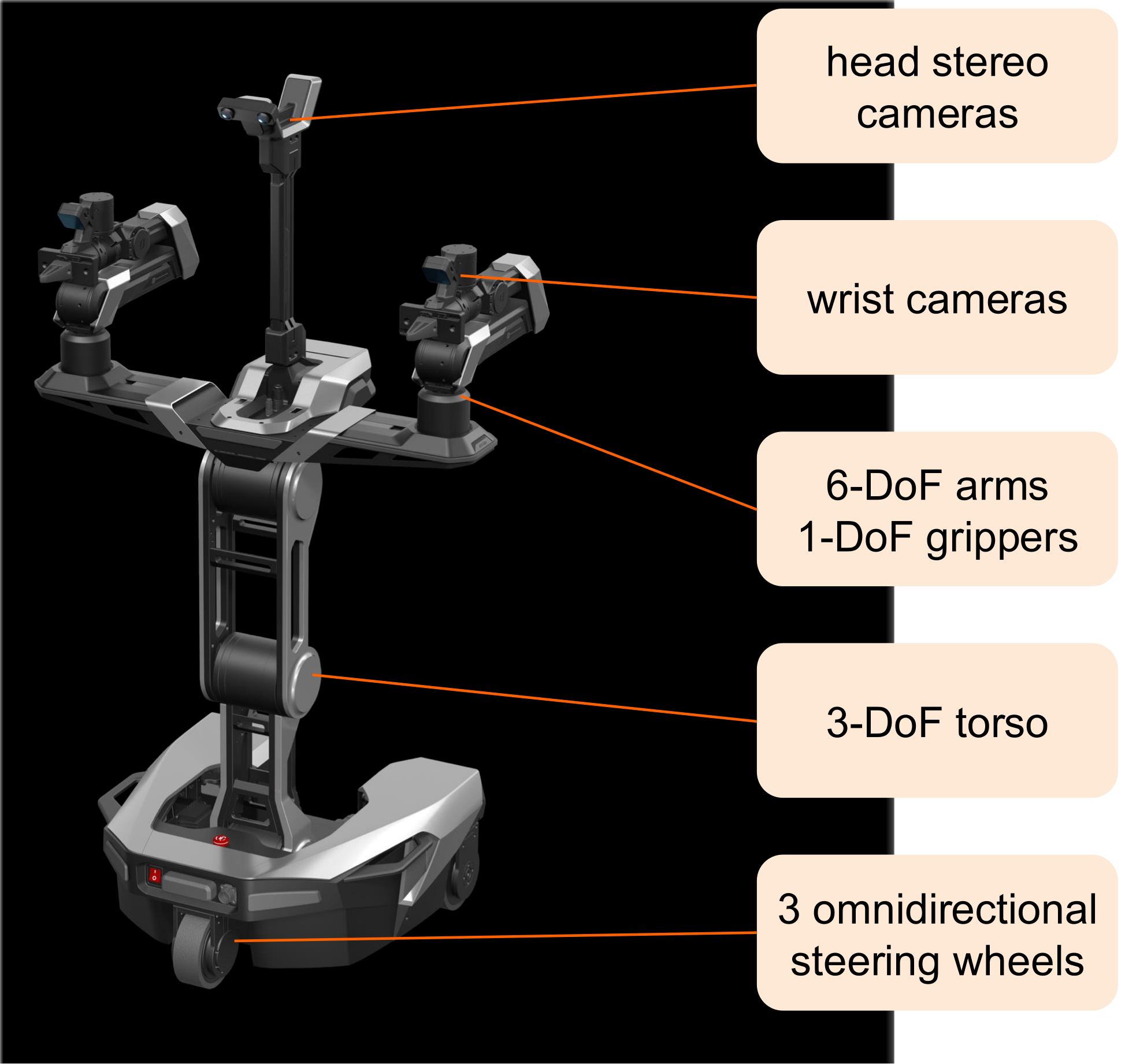
R1 Lite combines two six-DoF arms, a three-DoF torso, an omnidirectional wheeled base and parallel grippers; the paper describes 23 actuated degrees of freedom overall. It reports a 1.5m/s maximum base speed, 5kg payload capability and 60cm reach, with a stereo head camera and RGB-D wrist cameras. These are platform specifications in this source, not measured task-execution speeds or payload tests.
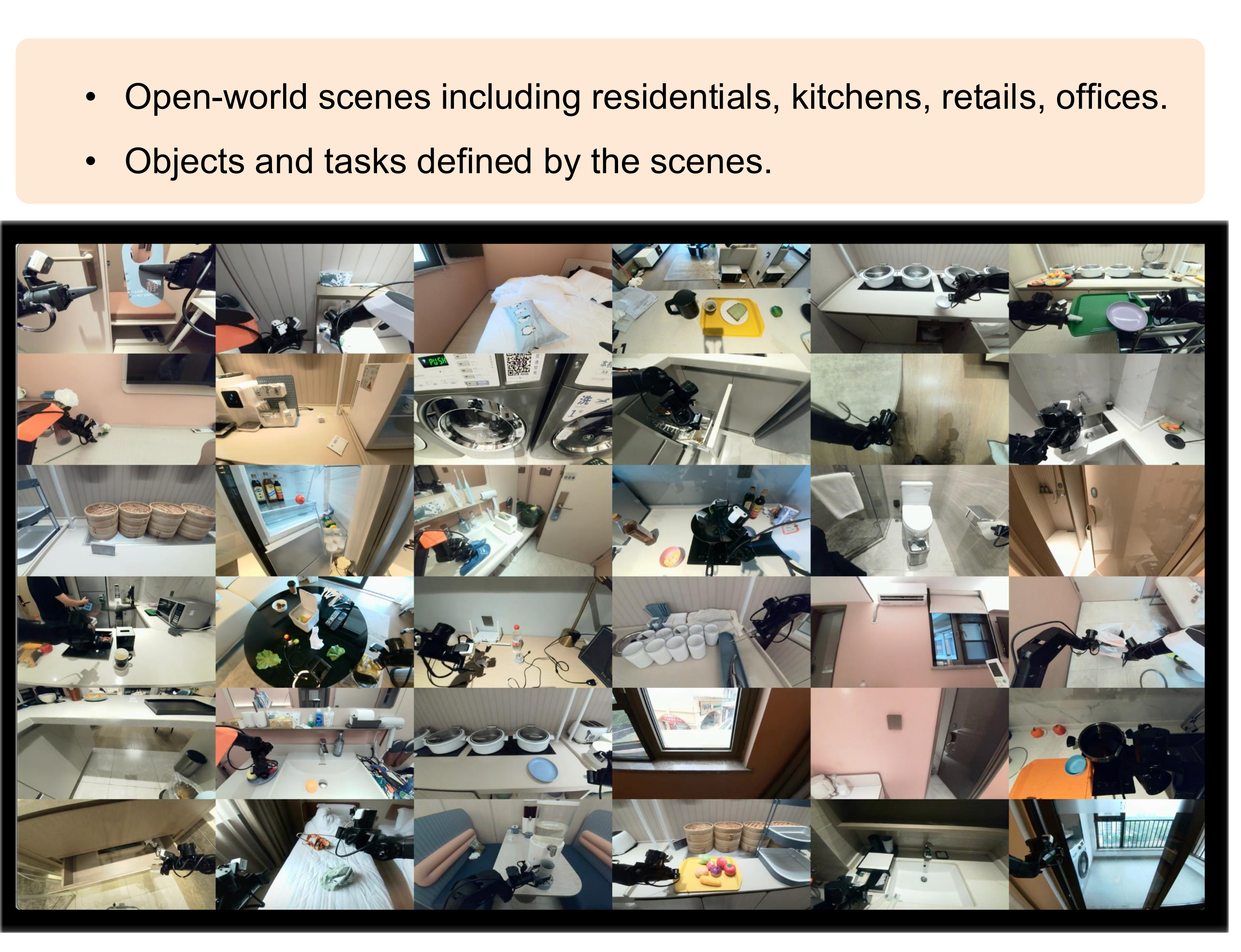
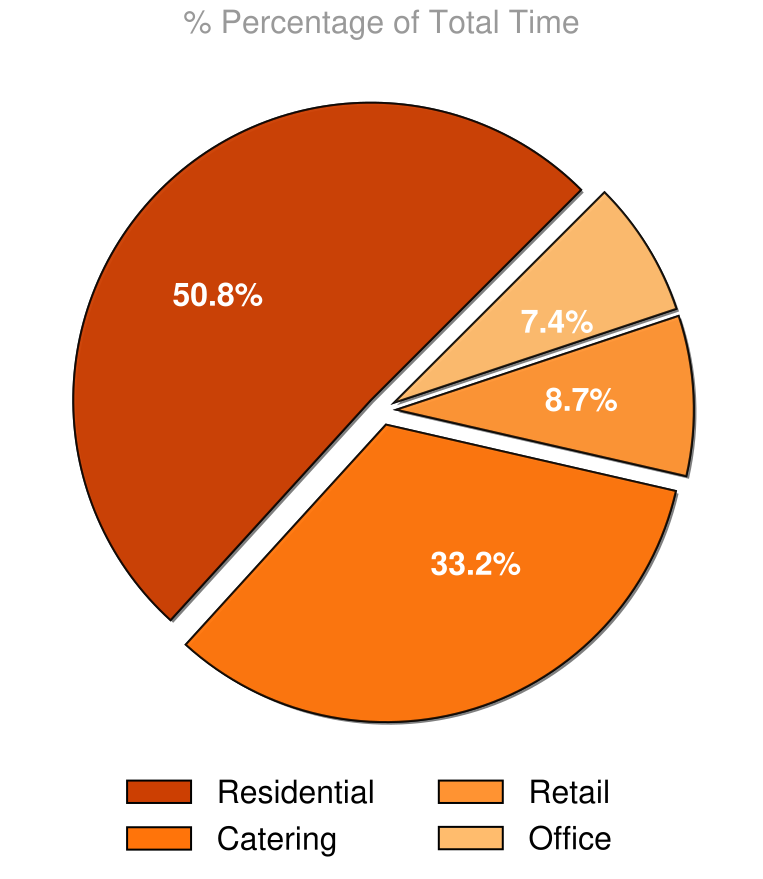
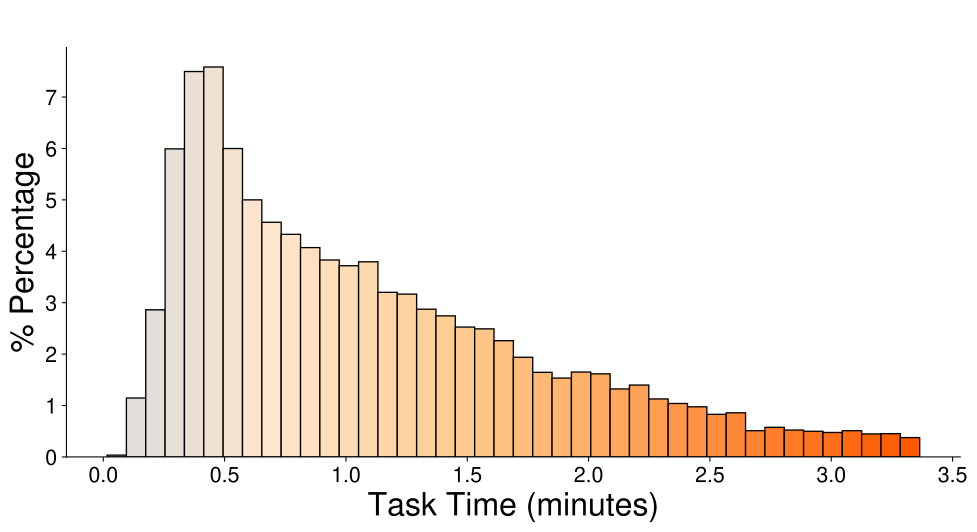
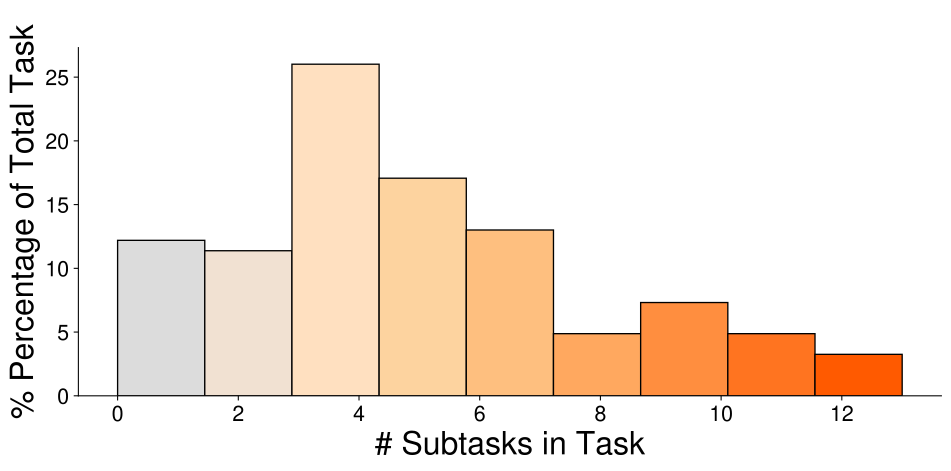
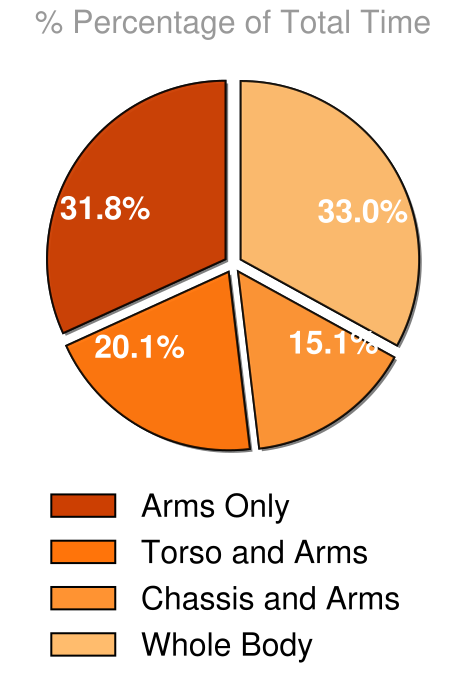
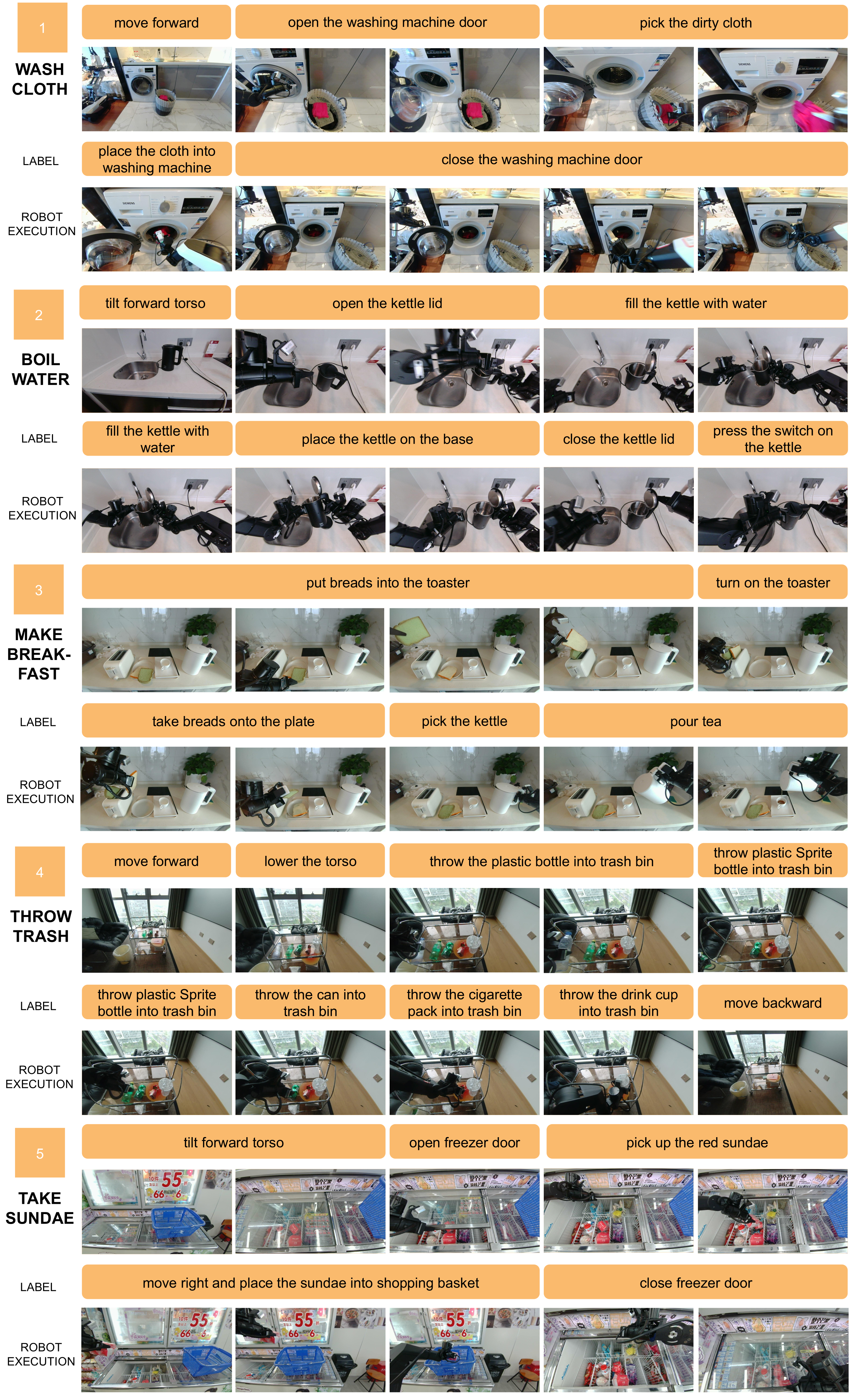
An isomorphic teleoperation interface maps operator motions to the same robot kinematics, reducing retargeting and reachability problems. Figures 2–6 retain the platform, collection scenes, every distribution plot and five fully annotated example sequences. Scene interaction time is about 50.8% residential, 33.2% catering, 8.7% retail and 7.4% office, with rounding. Skill and object frequencies are strongly uneven; diversity does not mean balanced coverage.
Collection Guidelines.
Collection prioritizes observable task cues, successful demonstrations and consistent language. The guidance suggests roughly 100 examples for simple tasks and a quality-first pilot before expanding complex ones. Objects are deliberately kept visible, so the dataset does not equally cover severe occlusion, recovery or failed demonstrations.
Environmental and Object Diversity.
Eleven physical sites provide 50 operational scenes across homes, catering, retail and offices. Objects come from ordinary suppliers; food and other impractical items may be high-fidelity replicas. The setting is physically realistic but still curated and teleoperated, rather than unrestricted autonomous activity.
Annotation Process.
Episodes are segmented into atomic subtasks and labeled through a standardized description schema. Episode- and clip-level checks reject operator mistakes and abnormal ROS topic frequencies. This improves alignment and consistency but narrows the distribution of failures. Annotation agreement, rejection rates and detailed boundary-error statistics are not reported.
Comparison with Existing Datasets.
The intended advantages are a common embodiment, subtask-level labels and varied real settings. The paper cites BridgeData, Open X-Embodiment and AgiBot World as reference points [28][1][24], but provides no comprehensive numerical dataset comparison table. The controlled policy experiments are the more direct evidence for the value of this particular collection.
4 Method
The planner and executor are trained separately. The executor progresses from token-based action modeling to continuous control; the planner is instruction-tuned on observations, subtask labels and synthesized conversations.
4.1 Dual System Overview
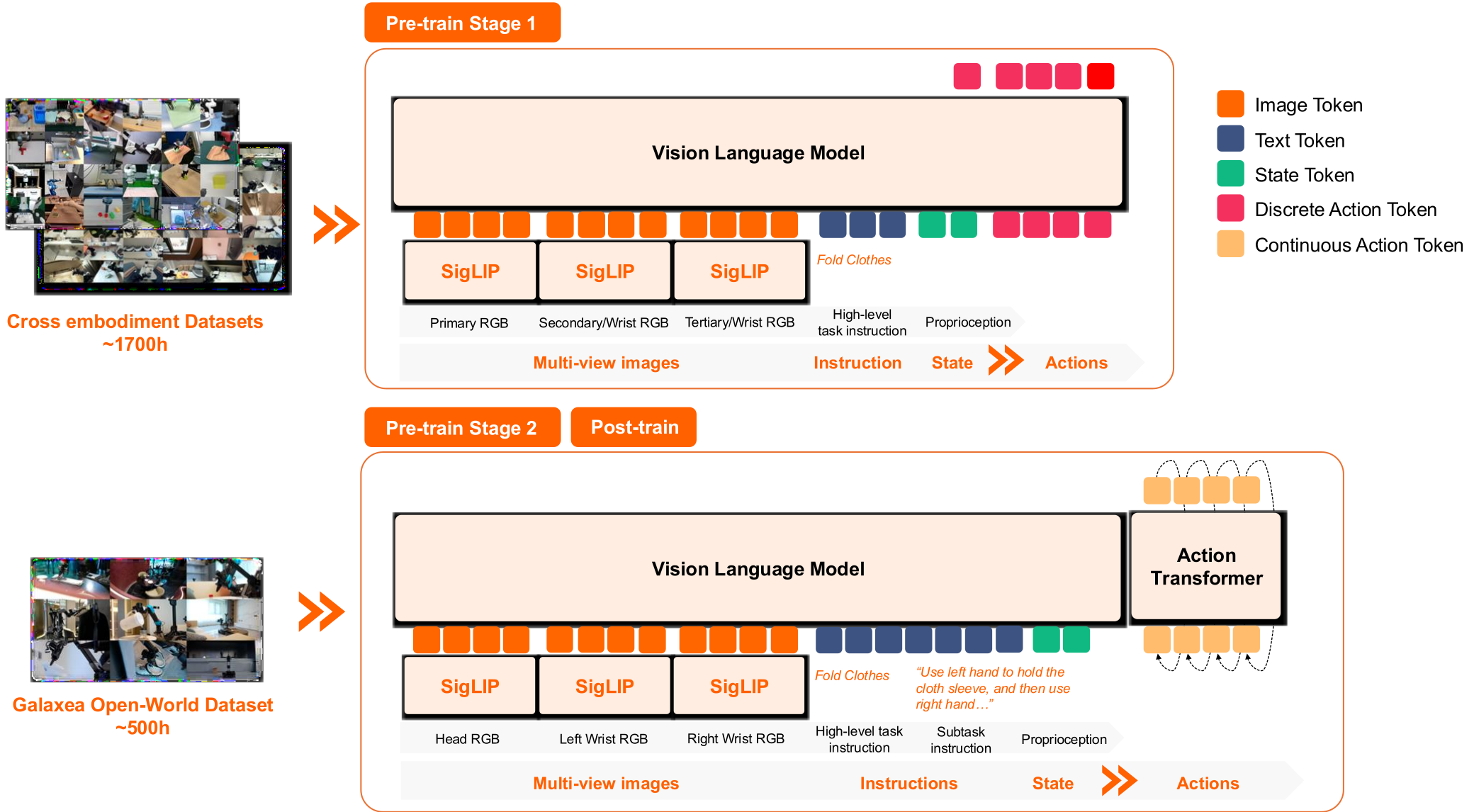
G0-VLA consumes three camera views, a subtask instruction and proprioception, then produces a future action chunk. A pretrained VLM embeds the observations and language, and a flow-matching action expert conditions on its key/value cache. G0-VLM uses high-level instructions and scene history to issue atomic commands.
Figure 1 labels approximately 2Hz subtask instructions, 15Hz action planning and 200Hz control. Those are different interface rates, not a demonstrated 200Hz VLM inference speed. The models run asynchronously. Detailed latency, hardware, chunk horizon and synchronization measurements are not supplied.
4.2 G0-VLA Pre-training Stage-1
Stage 1 updates the VLM component, initialized from PaLiGemma with a SigLIP image encoder, MLP projector and language transformer [29]. FAST converts continuous action chunks into discrete tokens, trained autoregressively with cross-entropy [11]. The original token-factorization formula is preserved.
The mixture is approximately 1,000 hours of Open X-Embodiment, 500 hours of Galaxea Open-World data and 200 hours of additional in-house recordings. “Unlabeled” in the overview means lacking fine-grained subtask annotations; these recordings still have action targets and high-level descriptions. This stage is therefore supervised action-token learning, not learning from videos without action supervision.
Only high-level labels are used for the 500-hour Galaxea portion at this stage. Because Stage 1 already includes target-platform data, comparing it with Stage 2 does not isolate the causal effect of other embodiments alone: data mix, label granularity, action objective and training history also change.
Equation
4.3 G0-VLA Pre-training Stage-2
Stage 2 attaches a newly initialized action expert to the pretrained VLM and trains continuous actions on the target robot. The maximum-likelihood objective and squared flow-matching loss are retained, together with the exact noisy-action interpolation formula. A consistent action space and subtask-aligned labels support precise language-conditioned behavior.
The prose does not fully specify every parameter-freezing or optimization choice. Optimizer, pretraining duration, complete action encoding and compute details are limited. These omissions constrain independent reproduction and a perfectly matched comparison with alternative training recipes.
Equations
4.4 VLA Post-training: Task-oriented Training
Post-training fine-tunes the executor with the same continuous-action objective on at most 100 trajectories per downstream task. Standard experiments use four epochs; the separate 20-demonstration experiments use ten. This tests data-efficient task adaptation rather than zero-shot execution of those benchmark tasks.
4.5 G0-VLM Training
The planner starts from Qwen2.5-VL [30]. Samples emphasize subtask endings and gripper-state transitions, and include the head image plus historical observations/actions sampled at one-second intervals. The exact history length and fine-tuned parameter size are not specified here.
DeepSeek-R1 generates human-style requests and verbal replies from task names, historical/current labels and the next subtask. It receives no images during this synthesis step; images are inputs to the planner being trained. The resulting language is synthetic rather than independently collected user dialogue. No isolated comparison establishes the effect of key-frame weighting or synthetic instruction generation.
5 Evaluating G0-VLA
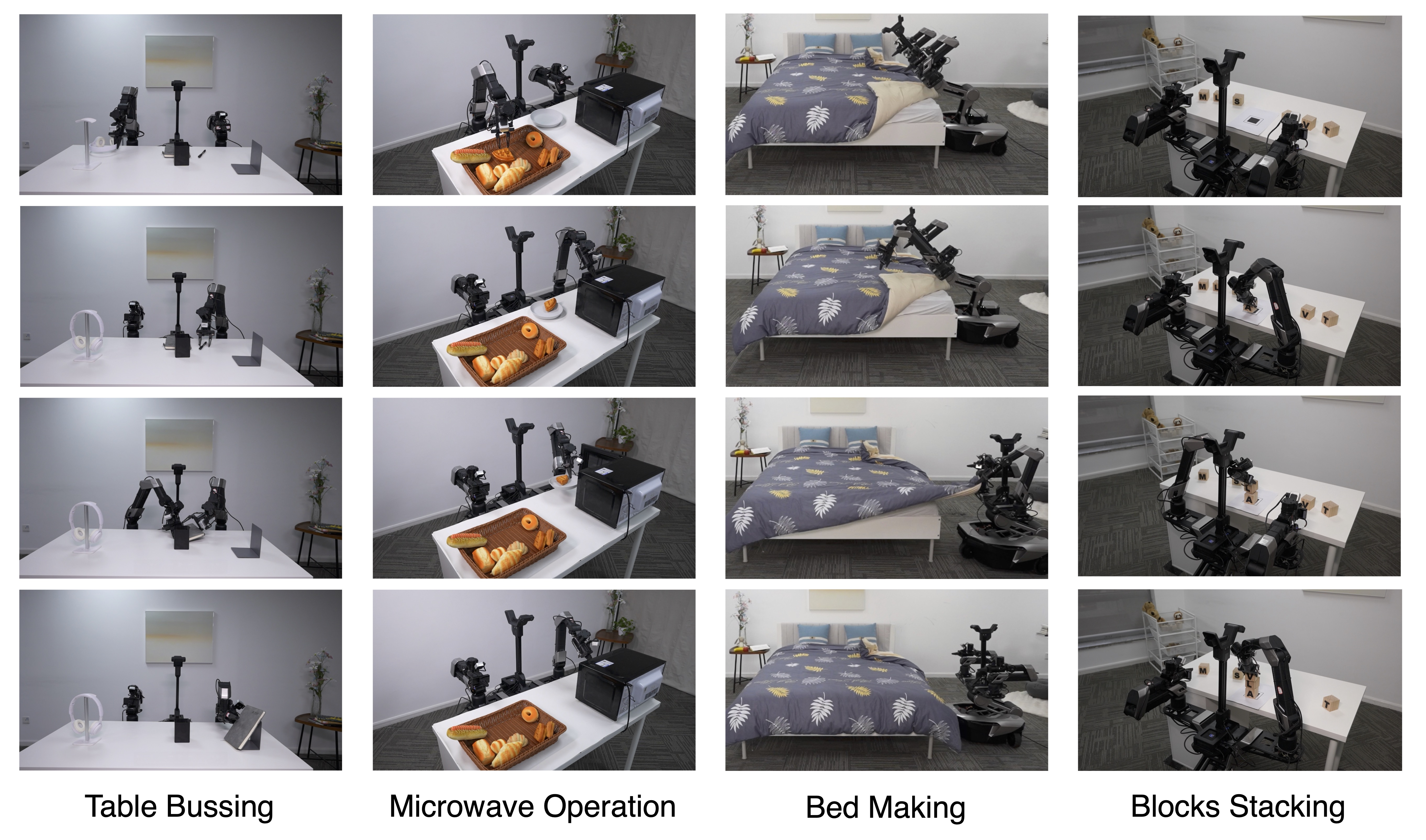
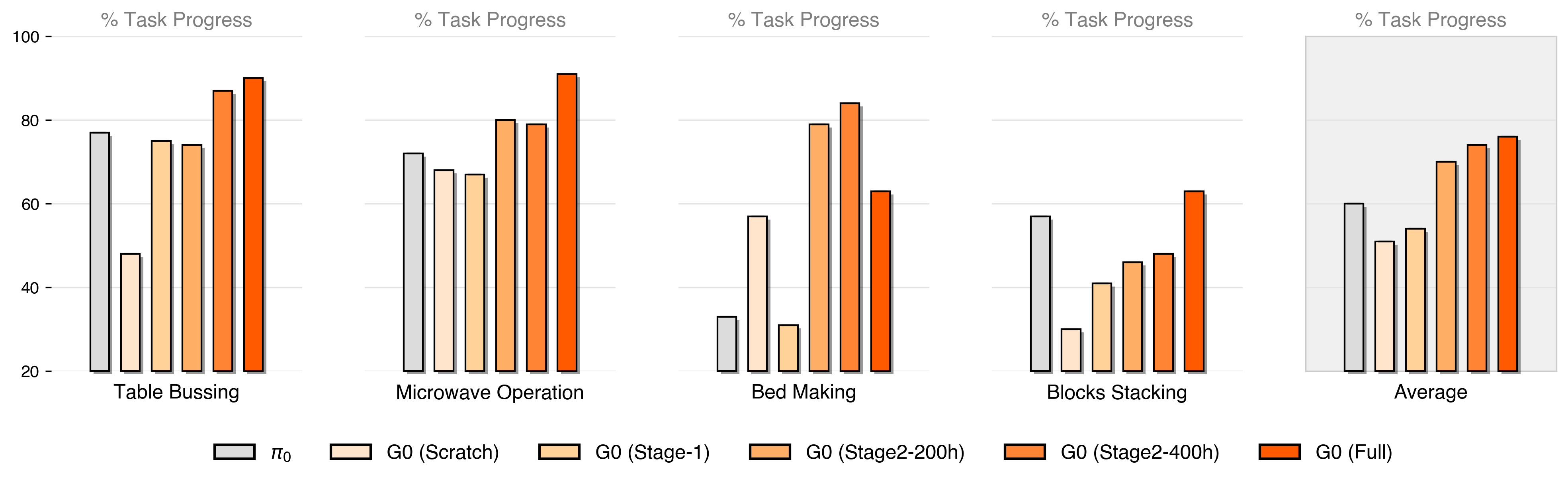
Four tasks probe different skills: table bussing, microwave operation, bed making and language-conditioned block stacking. Each test is run ten times and averaged using partial-progress rubrics from Appendix A. The plots report percentage task progress, not all-or-nothing task completion rates.
Standard post-training uses 100 trajectories per task, approximately 30–60 seconds each. The paper does not report confidence intervals, variation across training seeds or a complete split analysis for held-out collection sites, objects and task categories. The result supports these benchmark settings without establishing broad open-world robustness.
5.1 Pre-trained Weights
The six configurations are Stage 1 only, Stage 2 only with 200 or 400 hours, the full Stage 1→Stage 2 curriculum, a model with no action pretraining, and officially released π0 weights [12]. “Scratch” still starts from a pretrained VLM; it is not random initialization. All are fine-tuned for four epochs with the same reported downstream setting.
Figure 9 gives the full curriculum the highest average progress, approximately mid-70%, and strong table-bussing/microwave results. Stage-2-only training is better on overall bed-making progress: the 400-hour model is around the mid-80% range versus roughly low-60% for Full. The paper’s statement about Full’s superior object picking should not be read as dominance on the complete bed-making task. Values are approximate readings of unlabeled bars, not an omitted numerical table.
The 400-hour Stage-2 variant generally improves on 200 hours, while Stage 1 alone is the weakest pretrained setting on average. The experiment mixes changes in pretraining data and objective; it does not prove that all cross-embodiment data is harmful.
5.2 Few-shot Transfer
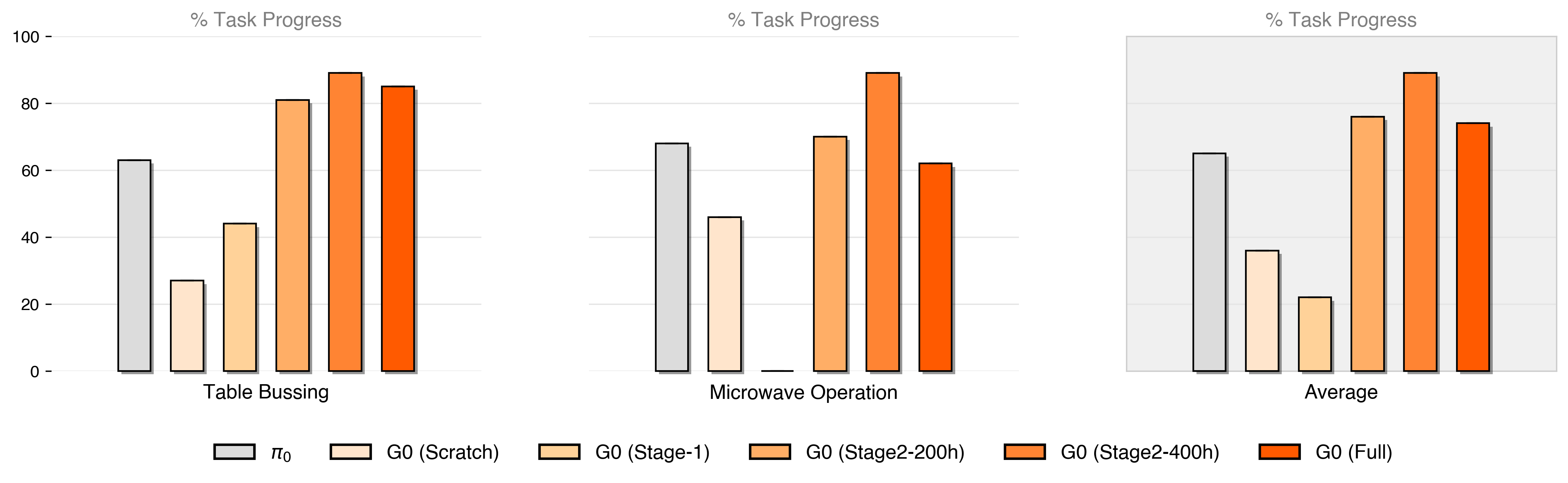
Few-shot tests use 20 demonstrations for table bussing and microwave operation, followed by ten fine-tuning epochs. Stage 2 at 400 hours reaches approximately 90% average progress, exceeding the full curriculum’s roughly 75% and the lower no-action-pretraining/Stage-1-only settings. The benefit is task adaptation on the same robot, not transfer to an unseen embodiment.
Figure 10’s caption calls the outcome a success rate, but its axes and the evaluation definition specify task progress. The edition retains that caption and clarifies the metric here. Smoother motions are described qualitatively; no dedicated smoothness statistic or significance test is provided.
5.3 Embodiment-specific Actions
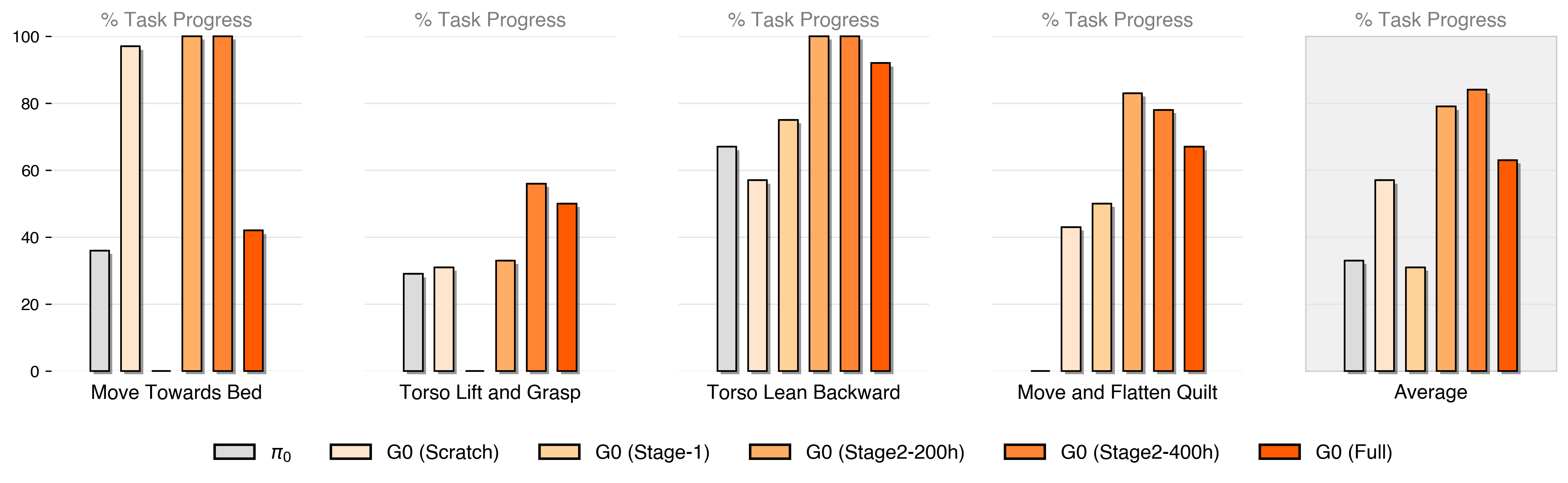
Bed making requires moving the base, raising the torso while grasping the quilt, leaning back and moving to flatten it. Figure 11 preserves all four skill scores. Stage-2-only models are especially strong at base/torso behaviors; the full curriculum loses ground despite its better four-task average.
The authors attribute this to embodiment mismatch in the mixed dataset. That is a plausible interpretation of the observed negative transfer, not an isolated causal test: Stage 1 changes several factors and includes Galaxea data itself. Some bar values fall below a model initialized only from the VLM, underscoring the need to inspect individual skills instead of only the aggregate.
6 Evaluating G0-VLM
The planner selects commands from supplied atomic-action options using standardized prompts with task instructions and examples. Table 1 evaluates instruction accuracy, not physical execution success or unrestricted language generation. It compares Gemini 2.5 Pro and several Qwen2.5-VL sizes with the fine-tuned G0-VLM.
G0-VLM scores 83.3%, 74.2%, 78.2% and 75.6% on table bussing, microwave operation, bed making and block building. Gemini scores 32.0%, 15.8%, 54.2% and 55.0%, respectively: absolute gains are 51.3, 58.4, 24.0 and 20.6 percentage points. Thus “over 50%” is not a uniform 50-point improvement on every task. The arithmetic average is 77.8% versus 39.3%, but no aggregate weighting protocol is specified.
The test-item counts, accuracy-labeling procedure, held-out split details and exact fine-tuned model size are not supplied. Standardizing prompts narrows output variation but does not remove every comparison confound. The table shows domain adaptation helps this constrained command-selection task; it is not an end-to-end dual-system completion benchmark.
| Model | Table bussing | Microwave operation | Make the bed | Build blocks |
| Gemini-2.5-pro | 32.0 | 15.8 | 54.2 | 55.0 |
| Qwen2.5-VL-72B | 26.3 | 16.8 | 48.1 | 21.7 |
| Qwen2.5-VL-32B | 21.3 | 14.8 | 54.2 | 21.0 |
| Qwen2.5-VL-7B | 26.3 | 17.2 | 46.9 | 24.7 |
| G0-VLM | 83.3 | 74.2 | 78.2 | 75.6 |
7 Conclusion
The paper contributes a consistent mobile-manipulation dataset and evidence that target-embodiment training can substantially improve action execution and planner alignment. Its main limitations are the small four-task evaluation, partial-progress metrics, incomplete reproduction/split details and uneven benefits from mixed pretraining. Claims of general state-of-the-art performance should be read within the tested settings and baselines.
8 Contributors
Dataset operation is credited to Tao Jiang, Jianning Cui and Xiao Liu. Policy training/evaluation credits Tianyuan Yuan, Yicheng Liu, Chenhao Lu, Shuiqi Cheng, Jianning Cui, Xiao Liu and Tao Jiang. Hang Zhao, Huazhe Xu and Jiyang Gao supervise the project. The team thanks Galaxea’s collection, hardware and marketing groups. These named contributors support the catalog’s individual attribution, while the source title page uses the collective Galaxea Team credit.
Appendix A Appendix / supplemental material
The supplementary material supplies the progress rubric for each of the four benchmark tasks. These definitions are essential to interpreting Figures 9–11.
A.1 Evaluation Details
Table bussing awards six points: one each for successful picks and placements across three operations. Microwave operation awards five: choosing the correct food, placing it on the plate, opening the door, inserting the plate and closing the door. The last step is not a measured heating-performance outcome.
Bed making awards four points: approaching the bed, raising the torso and grasping the quilt, leaning back, and moving to flatten the quilt. Block stacking awards six points, one for each pick and stack. A normalized progress score can be high despite failure to complete the entire task, so it should not be substituted for a binary success rate.