At a glance
This perspective argues that advances in AI must be adapted to robots’ physical interaction, limited data, safety requirements, and varied embodiments. Its research agenda combines representative datasets, simulation grounded in real observations, generative models, prior knowledge, and control theory with longer-term goals of continual learning and transfer.
The article synthesizes earlier work and proposes priorities; it introduces no new benchmark experiment or deployment guarantee. This edition follows the complete public author manuscript, whose internal title is “Which AI for robotics?”. The published title is “A roadmap for AI in robotics,” in Nature Machine Intelligence, June 2025.
Introduction
Deep learning’s growth reflects stronger compute, large digital datasets, and accessible software [1]. Robotics shares those opportunities but adds real-time action, partial observation, unpredictable surroundings, and the cost of physical failure. Success in games, image recognition, or language generation therefore does not directly establish dependable robot behavior.
The authors ask which learning methods fit particular robot designs, tasks, and environments, and where established estimation or control methods remain useful. Their roadmap is a set of research directions, rather than a predicted sequence or fixed timetable.
A brief historical review
Robot learning has pursued autonomy, dexterity, and adaptation for decades [2] [3] [4]. The review emphasizes learning from demonstrations and reinforcement learning as two complementary routes whose strengths depend on available supervision, task structure, and interaction costs.
Learning from demonstrations
Learning from demonstration derives behavior from recorded expert actions. Earlier work achieved manipulation, interception, and flight with relatively small datasets [6] [8] [9]. A persistent limitation is the need for competent demonstrators and repeated task-specific data collection.
Learning from imperfect demonstrations, active requests for expert help, and reusable prior experience can reduce that burden [10] [11] [13]. These are examples of improved data efficiency, not evidence that demonstrations cover arbitrary deployment conditions.
Reinforcement learning
Reinforcement learning acquires a policy through interaction and reward [17]. Simulation supports large numbers of trials before physical deployment and has contributed to locomotion and agile flight [18] [19] [20]. Exploration cost, scaling, reward design, and imperfect sim-to-real transfer remain central constraints.
Combining demonstration and reinforcement learning
Demonstrations can initialize or restrict reinforcement-learning search, and inverse reinforcement learning can infer a reward from demonstrated behavior [22] [23] [24]. Combining methods aims to use human knowledge efficiently while retaining improvement through interaction.
Potential applications and commercial deployment
The authors describe deployment opportunities in package handling, adaptive manufacturing, autonomous driving, and soft robotics. These examples motivate the agenda; they are not a comprehensive survey of commercial readiness.
Soft bodies and tactile skins are especially challenging because their sensors and dynamics are nonlinear, heterogeneous, and history-dependent. Learned perception and control may complement mechanics-based approaches, as illustrated by work on tactile gloves [26].
Short- and medium-term challenges
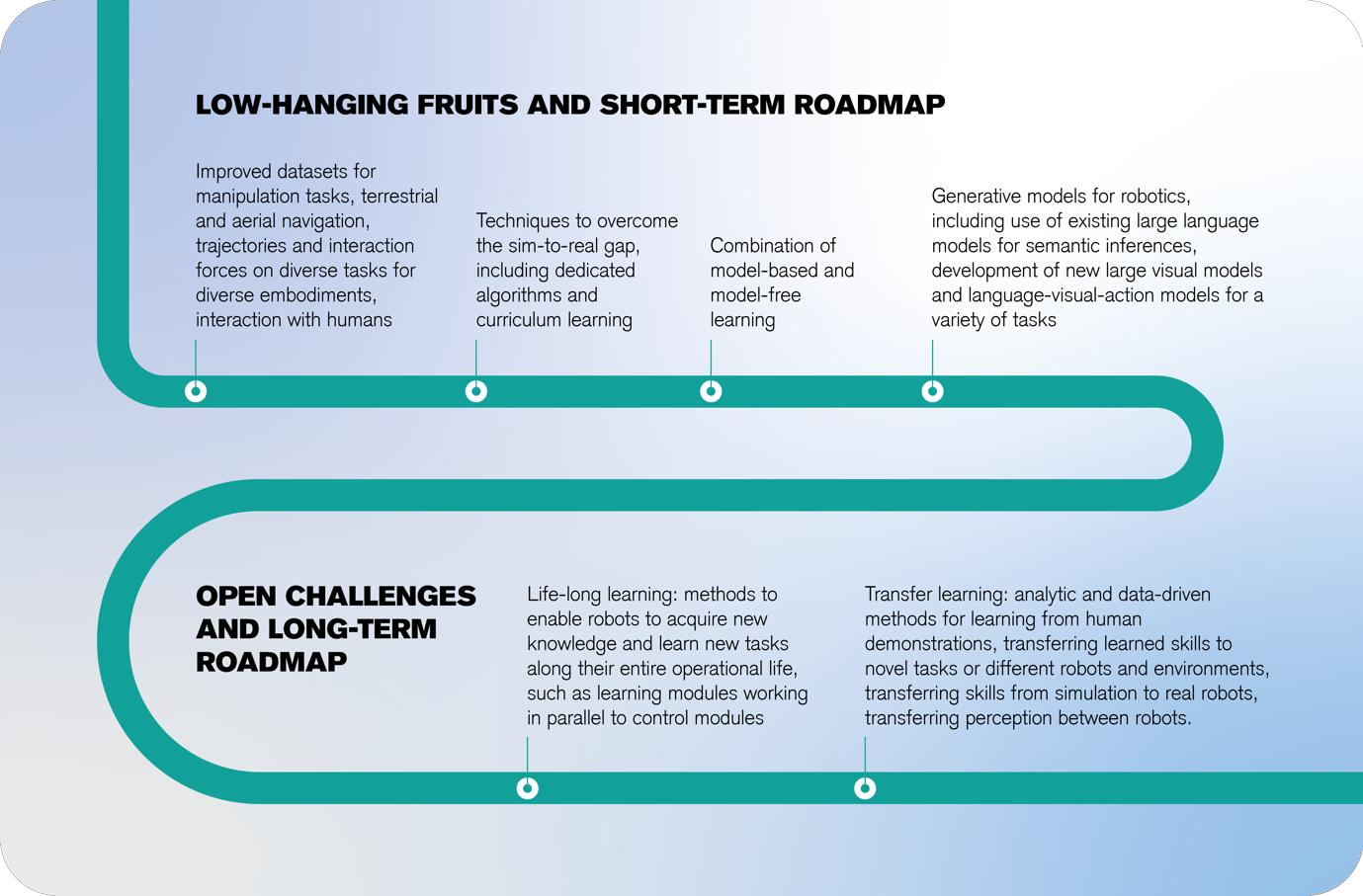
Figure 1 retains the complete roadmap. Nearer-term priorities include representative robot data, simulation transfer, control informed by prior knowledge, and generative models tailored to action. Longer-term priorities concern continual learning and transfer across tasks, environments, and robot bodies. The caption explicitly allows these directions to progress in parallel.
Representative datasets
Robot action data is expensive to generate and cannot be copied from internet text or images alone. Failed trials can damage hardware or endanger people. Shared efforts such as Dex-Net and Open X-Embodiment illustrate complementary approaches: task-specific simulation and pooled experience across robot platforms [27] [28].
Data diversity must cover actions, interaction forces, viewpoints, sensors, tasks, and embodiments. Human interaction adds privacy, consent, labeling, and reuse constraints. Carefully staged demonstration tasks are useful but cannot by themselves represent the variety of behavior encountered in homes.
From simulation to reality and back
Physics simulators make repeated learning and testing feasible, especially for locomotion and manipulation. Transfer can fail because robot models are simplified, environmental variation is missing, or contact and deformable-body physics is inaccurate [29] [30] [31].
The roadmap emphasizes closing the loop in both directions: transfer simulated learning to robots, then use real observations to improve models and adaptation [32] [33]. It proposes greater attention to real-to-simulation feedback without claiming that calibrated simulators remove all uncertainty.
Large generative models
Language models can make instructions more accessible and supply semantic heuristics for navigation. Vision-language and vision-language-action models can connect observations, descriptions, and action outputs [35] [37]. The authors ask what architectural structure and robot-specific training data will make these models useful for physical control.
Predicting likely images or plausible text is insufficient for verifying an executable plan. Data coverage, grounding from vision to action, prediction of consequences, and logical or geometric feasibility remain separate requirements. The paper points to structured planning as a source of useful checks [38].
Prior knowledge and control methods
The authors favor combining learned components with prior physical knowledge and control methods that offer guarantees under stated assumptions. Flight illustrates the argument: learned aerodynamic or perception models can complement controllers responsible for stability and disturbance response.
Examples include physical-parameter bounds, stability-related training constraints, model predictive control, and learned initializations refined by model-based planning [40] [41] [42] [45]. Human collaboration also requires reasoning about human actions and interpretations [39]. These cited techniques support the research direction; their individual guarantees do not automatically certify an entire robot.
Long-term challenges
The central long-term ambition is for robots to keep acquiring knowledge while reusing skills across changing circumstances [46]. Continual learning and transfer are linked: a robot’s tasks, surroundings, and hardware can all change during its operational life.
Lifelong learning
Continual learning must balance adaptation with preserving previously useful abilities. The paper raises questions about memory limits, selective forgetting, testing on unforeseen situations, and verification as behavior changes. It proposes learning alongside already validated control and drawing on neuroscience and developmental psychology.
Even a replacement gripper or motor can invalidate assumptions learned on the earlier platform. The challenge is to adapt useful knowledge without requiring exhaustive retraining or expert intervention after every change. The roadmap identifies this as unresolved, rather than presenting a general solution.
Transfer learning
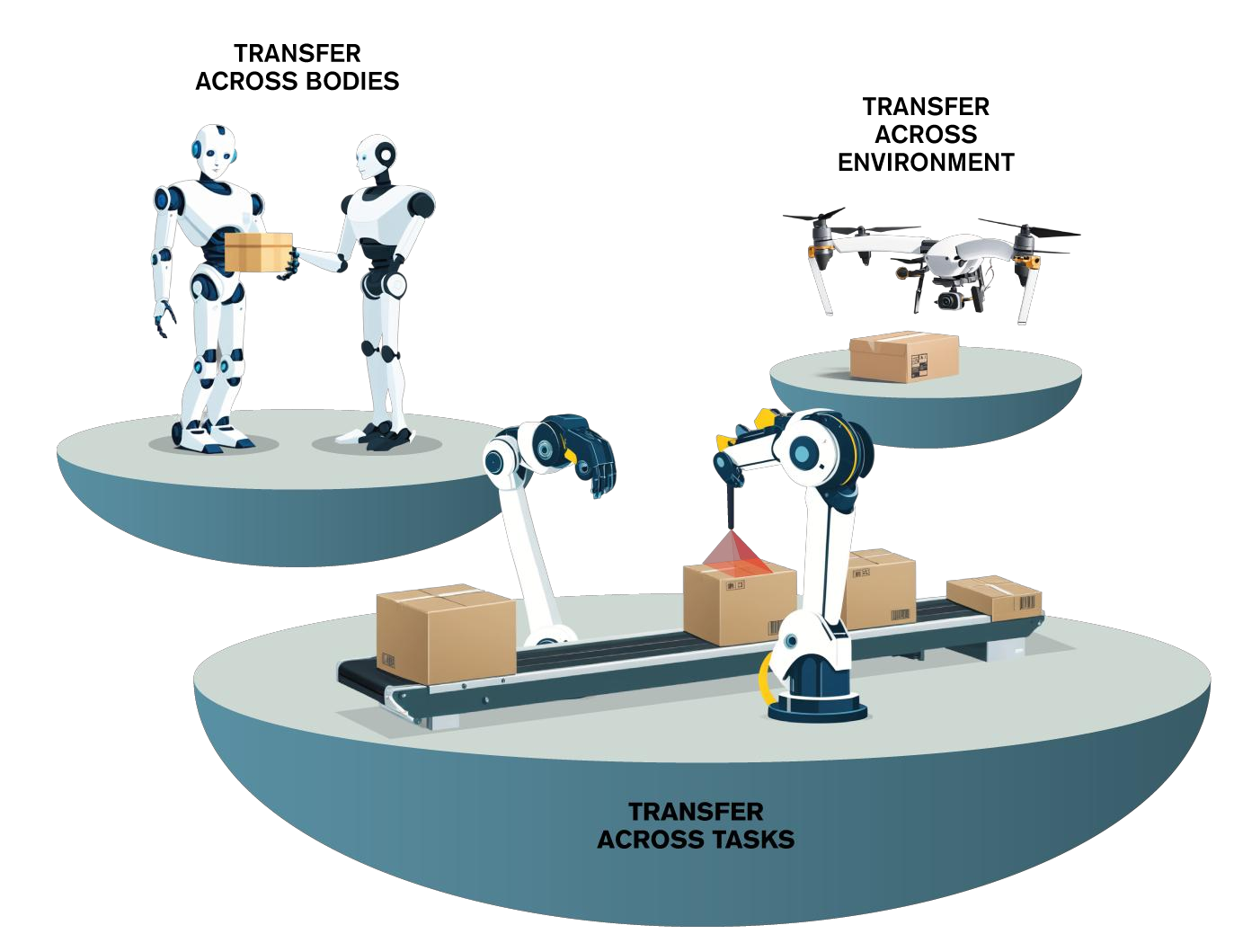
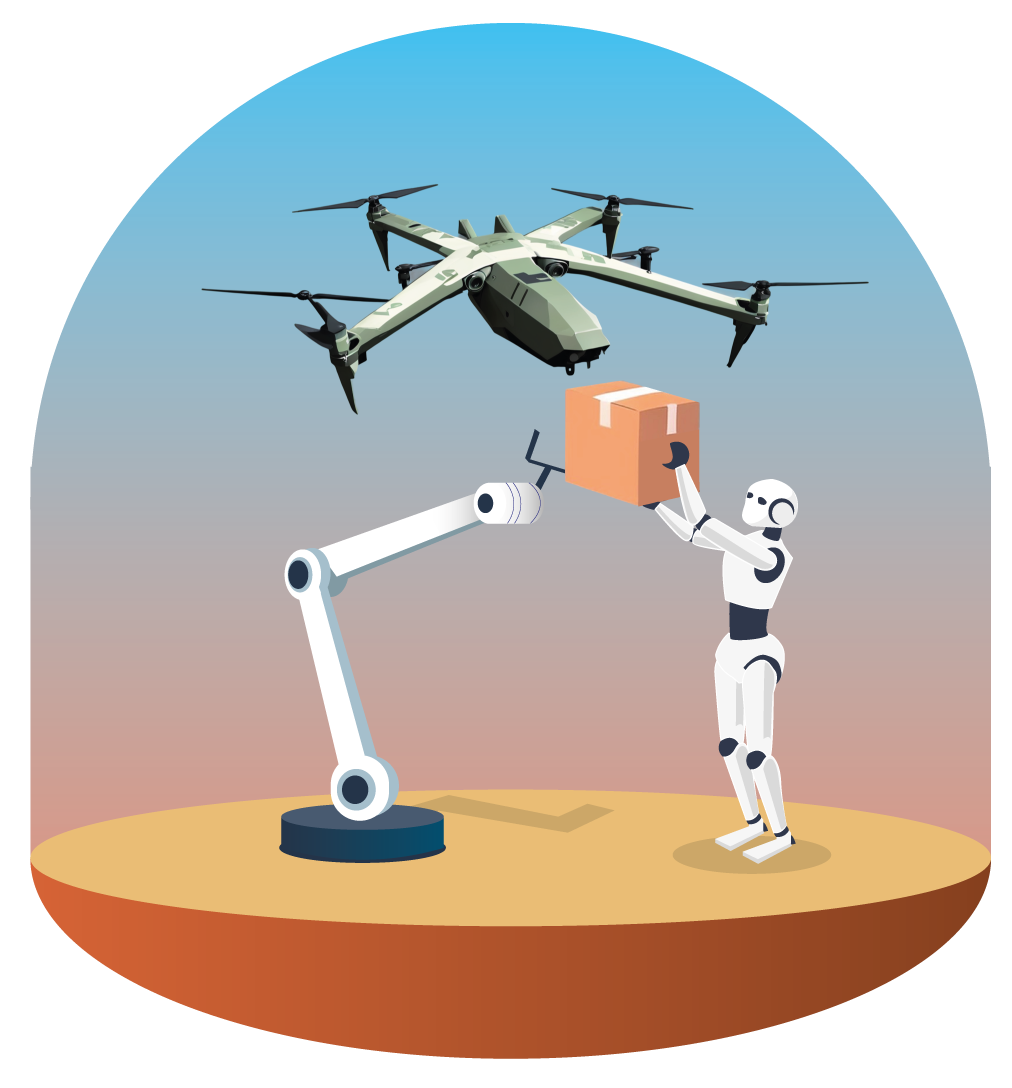
Figures 2 and 3 preserve the cross-body, cross-task, and cross-environment illustrations, including a drone handing a package to different manipulators. Their point is that shared task meaning can coexist with different sensors, viewpoints, kinematics, and actions.
Transfer requires deciding what knowledge remains relevant, how to use it while filling gaps in the new platform or setting, and when similarity is insufficient so new learning is needed. The figures are conceptual illustrations, not quantitative evaluations of a completed transfer algorithm.
Safe exploration
High-dimensional, partially observed environments make some real-world exploration necessary despite simulation. The research challenge is to gather useful experience while controlling risk to people, surroundings, and the robot throughout its working life.
Looking forward
Scalable deployment should require brief, intuitive guidance from domain experts rather than weeks of roboticist-led data collection and tuning for each new task. The authors connect this goal to reusable knowledge, efficient sensing and computation, and hardware that processes some data near the sensors.
Transparency, responsibility for failures, privacy, and avoidance of biased human models are part of the proposed design agenda. Sustainability includes energy-efficient computation, reusable data and algorithms, and potentially biodegradable hardware. These are recommendations and research aspirations, not measured outcomes or a guarantee of deployment within the paper’s suggested horizon.
Author contributions
Aude Billard led writing, editing, and image creation. All eleven authors contributed to the manuscript and approved its submission.
Competing interests
The authors report no competing interests.