Overview
This edition covers the complete revised paper and supplementary material: occupancy-data construction, multiview alignment, simulation-to-real visual transfer, implementation, evaluation, limitations, and licensing. All 28 numbered figures, ten tables, three displayed equations, and three original listings are retained.
At a glance
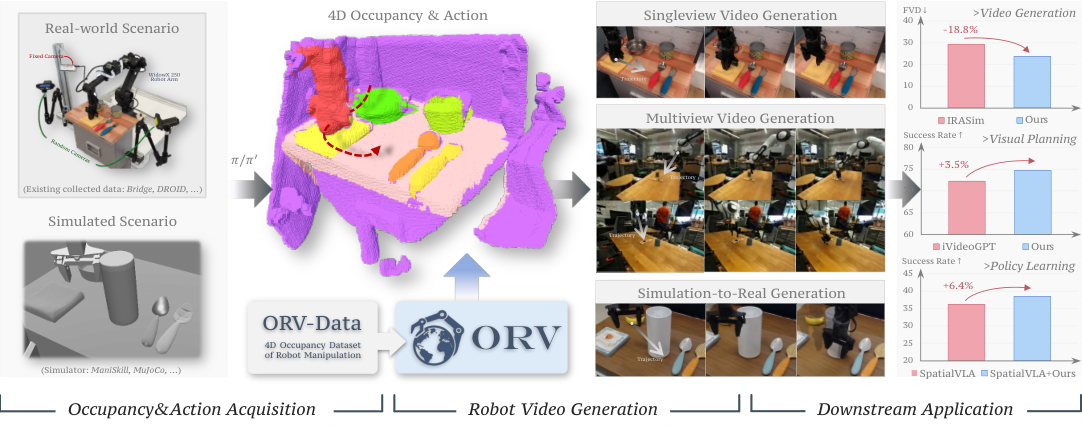
ORV combines robot action sequences with rendered 4D semantic occupancy to generate manipulation video. A pretrained video diffusion model receives temporally aligned action chunks and coarse geometric guidance; extensions produce multiple views and visually transfer simulated trajectories. Experiments show improved video metrics and downstream planning and policy-learning averages. The full future occupancy sequence is supplied beforehand, so these results concern offline conditioned generation, not autonomous prediction of future geometry.
1 Introduction
Sparse end-effector controls leave ambiguity about how objects should move in image space. ORV adds scene geometry and semantics as visual guidance while retaining a pretrained video model’s appearance synthesis. Its contribution is the combination of action modulation, occupancy rendering, multiview attention, and a curated occupancy dataset. Because occupancy already describes the future scene, visual realism and action alignment should not be confused with independently learning all underlying physical dynamics.
2 Related Work
Related methods condition robot video on actions, language, flow, depth, or segmentation; driving models also use occupancy. ORV adapts the geometric-prior approach to manipulation and combines it with action controls. Compared with purely action-conditioned models, its strongest setting receives richer future information; comparisons therefore separate action-only and occupancy-plus-action variants.
3 ORV: Methodology
The method first specifies its offline conditioning inputs, then describes action and visual injection into a pretrained video transformer. Multiview and simulation-to-real variants reuse the occupancy representation, whose construction is a separate data-processing pipeline.
3.1 Problem Formulation
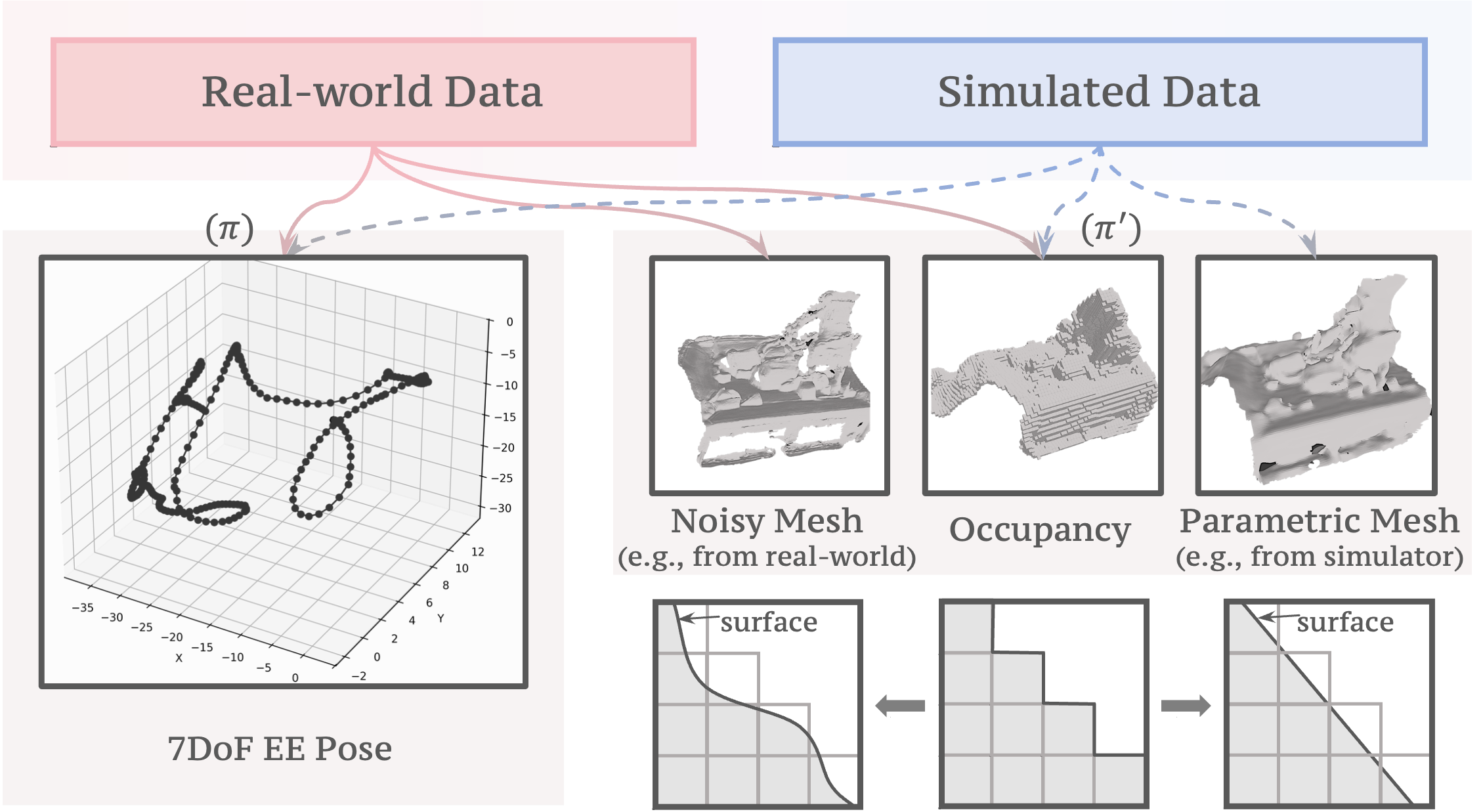
The generator maps context observations and complete future action/occupancy priors to future RGB video. Actions and occupancies are extracted from recorded trajectories or a physical simulator in one offline pass. The paper’s extraction symbols describe preparation of these priors, not an online policy interacting with generated observations. Occupancy forecasting is a possible future extension rather than a component demonstrated here.
3.2 Occupancy-centric Robot Video Generation
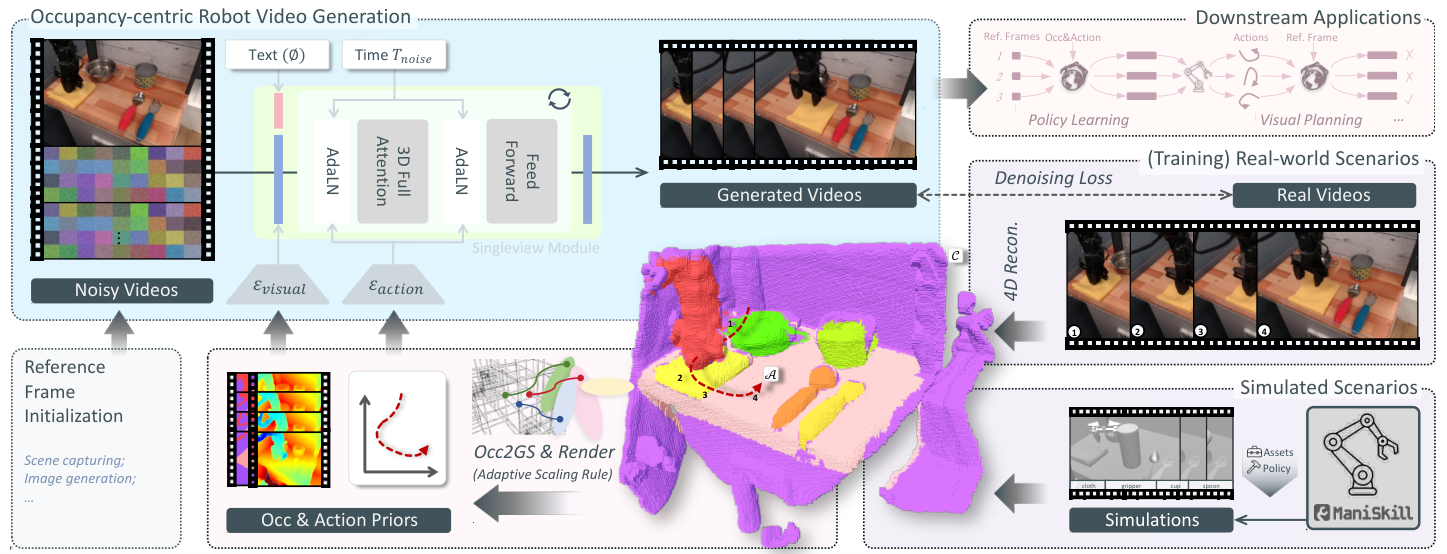
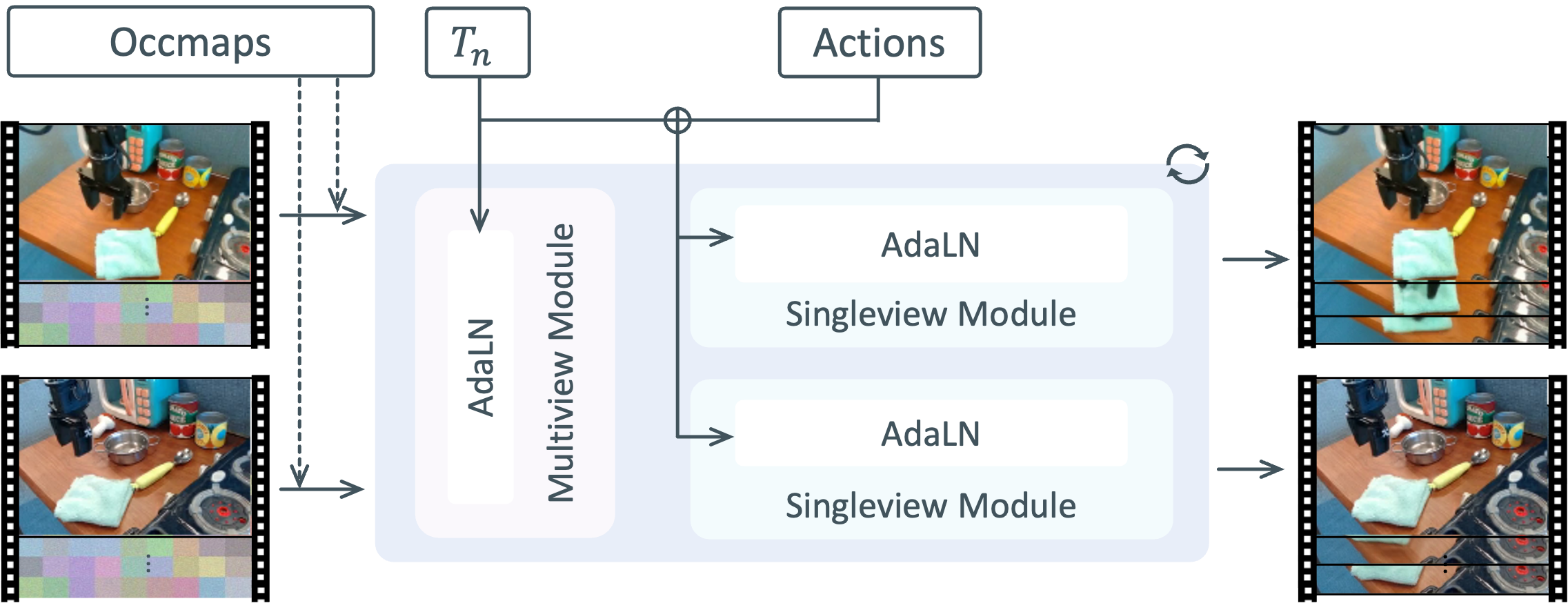
ORV fine-tunes CogVideoX-2B in two stages. Consecutive seven-dimensional actions are grouped to match the video encoder’s temporal compression, embedded, and injected through the existing vision-expert adaptive normalization. Occupancy voxels become nonlearned Gaussian splats; depth-dependent scales reduce rendering artifacts. An encoder and zero-initialized projector add the resulting coarse visual guidance to the initial noise. This avoids a second large expert and the cost or overconstraint of injecting imperfect geometry throughout the denoising layers. Related source: CogVideoX.
3.2.1 ORV-MV: Multiview Robot Video Generation
ORV-MV inserts attention across views before attention across time. Single-view blocks receive action and occupancy guidance; view blocks focus on cross-camera correspondences without action priors. Geometry rendered from calibrated camera positions encourages consistency, but generation still requires first-frame images from all requested views. Reconstructing geometry from one anchor view can leave unseen surfaces incomplete.
3.2.2 ORV-S2R: Bridge Simulation-to-Real Transfer
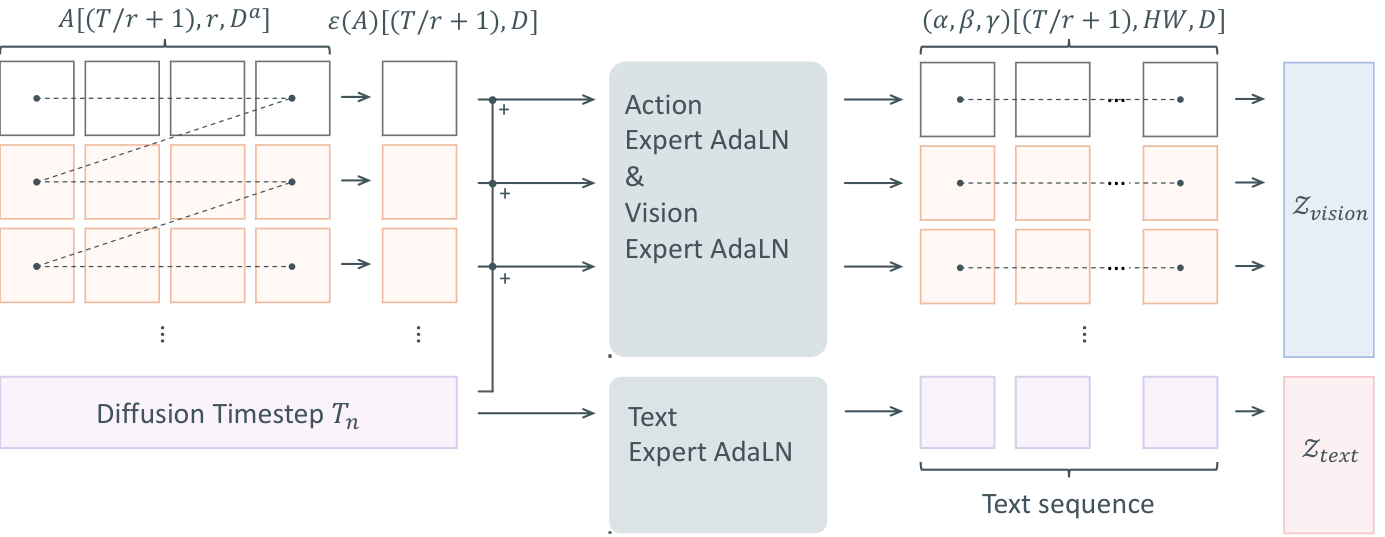
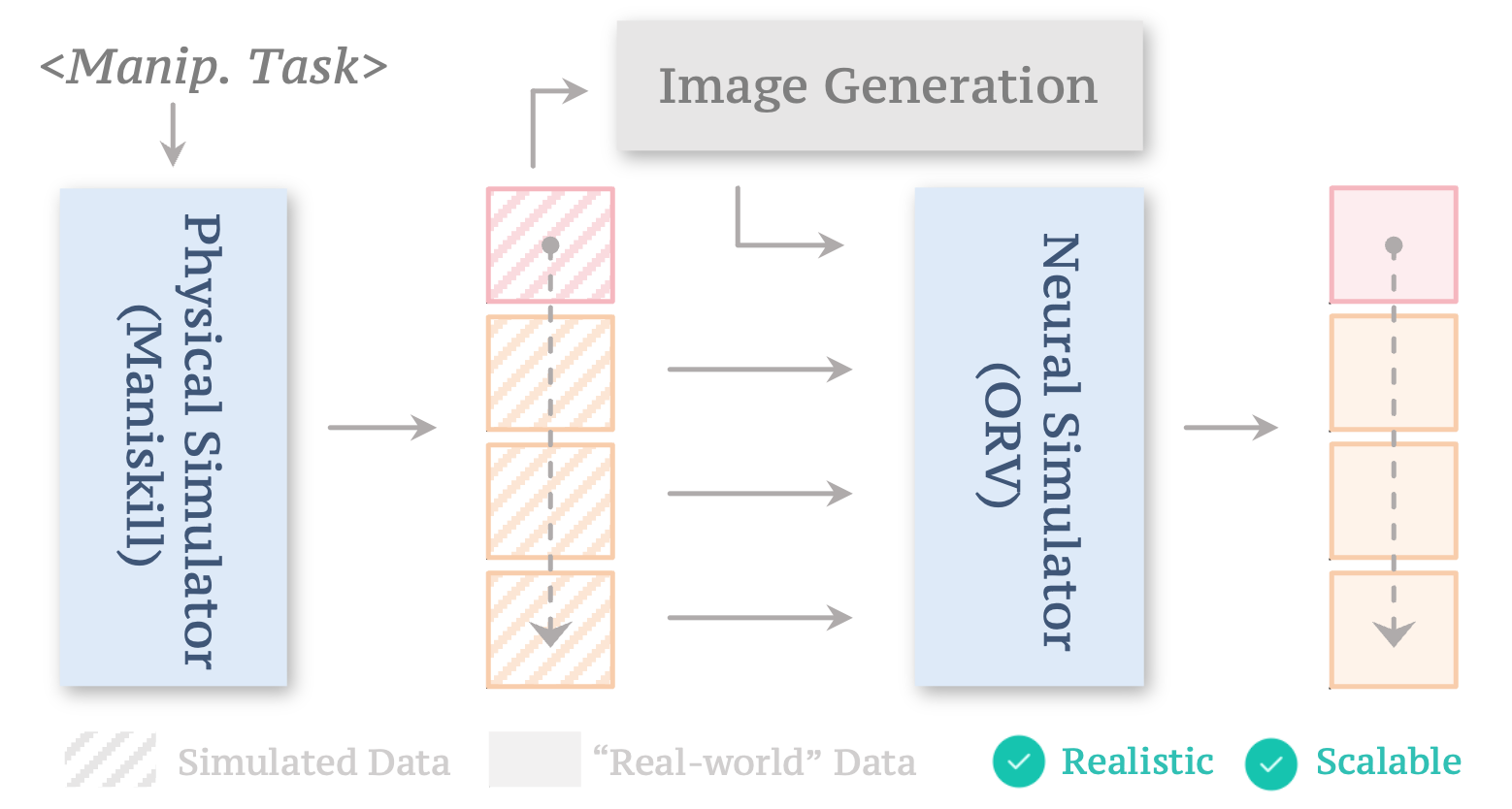
ORV-S2R renders appearance-agnostic priors from simulated manipulation and combines them with a generated realistic first frame. The intended transfer is visual: a simulator or recorded trajectory supplies the motion. Coarse occupancy reduces sensitivity to the mismatch between reconstructed real geometry and clean parametric meshes, but does not establish that physical robot dynamics transfer automatically.
3.3 4D Occupancy Dataset of Robot Manipulation
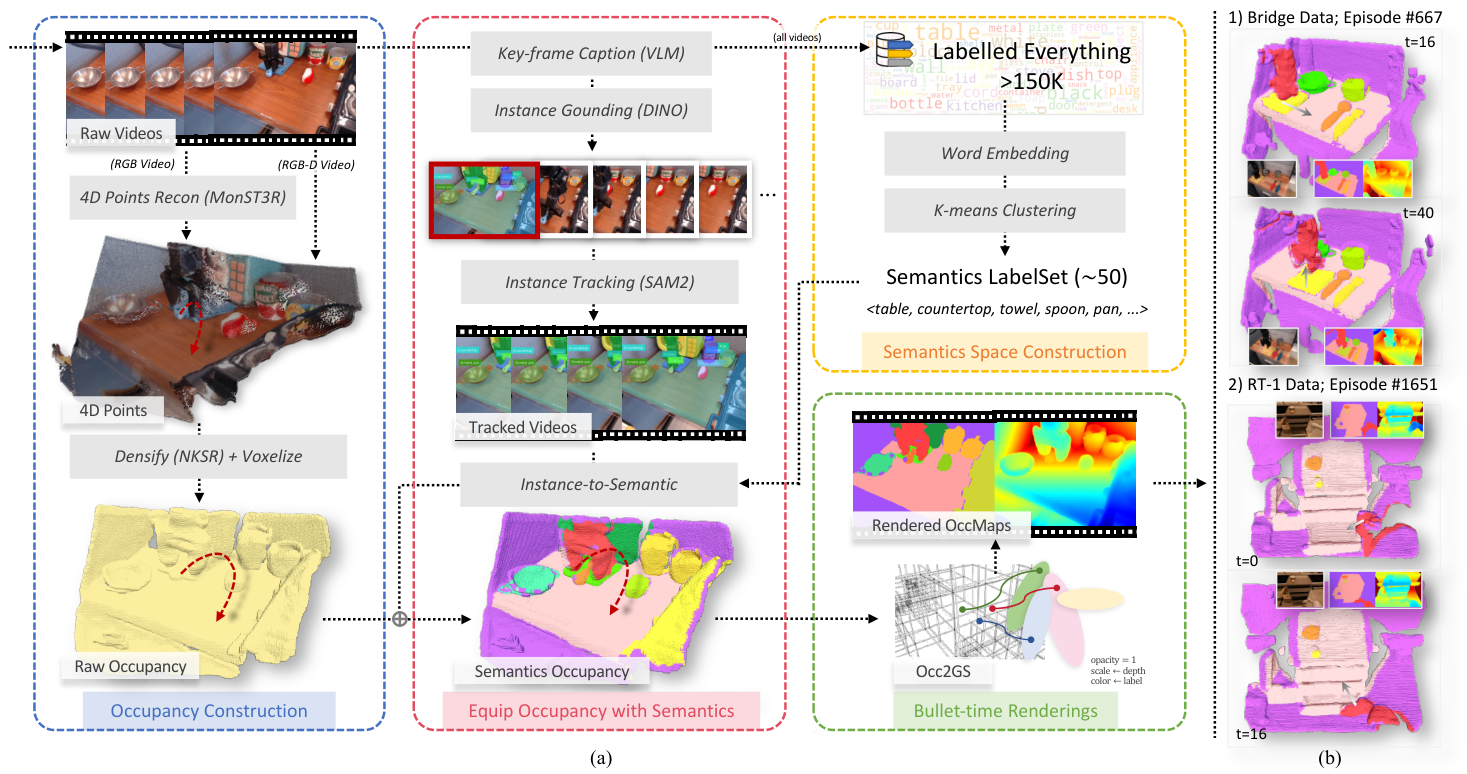
The data pipeline captions scenes, clusters roughly 150,000 labels, grounds objects, and tracks their masks. MonST3R reconstructs moving 3D points when depth is unavailable; neural surface reconstruction densifies them. Voxelization and majority voting assign semantic occupancy, and optical-flow consistency filters poor sequences. The resulting supervision is reconstructed rather than ground-truth complete geometry, with errors inherited from the component models. Related source: MonST3R.
| Method | BridgeData V2 [93] | DROID [47] | RT-1 [13] | |||||||||
| PSNR | SSIM | FID | FVD | PSNR | SSIM | FID | FVD | PSNR | SSIM | FID | FVD | |
| Text-conditioned Generation Models | ||||||||||||
| CogVideoX [119] | 19.432 | 0.752 | 7.509 | 83.561 | 19.238 | 0.701 | 6.341 | 71.536 | 20.457 | 0.816 | 6.243 | 42.169 |
| Action-conditioned Generation Models | ||||||||||||
| AVID [80] | - | - | - | - | - | - | - | - | 25.600 | 0.852 | 2.965* | 24.200 |
| HMA [99] | 23.636 | 0.808 | 8.849 | 67.096 | 21.435 | 0.821 | 3.108 | 47.383 | 25.424 | 0.840 | 7.306 | 84.165 |
| IRASim [136] | 25.276 | 0.833 | 10.510 | 20.910 | 21.632 | 0.820 | 5.395 | 41.031 | 26.048 | 0.833 | 5.600 | 25.580 |
| ORV (Ours) | 25.631 | 0.873 | 3.821 | 17.682 | 22.034 | 0.838 | 4.921 | 37.094 | 27.086 | 0.863 | 4.210 | 20.031 |
| Occupancy&Action-conditioned Generation Models | ||||||||||||
| IRASim† [136] | 27.352 | 0.862 | 9.413 | 22.503 | 22.005 | 0.827 | 7.892 | 44.309 | 27.213 | 0.847 | 5.311 | 42.130 |
| ORV (Ours) | 28.258 | 0.899 | 3.418 | 16.525 | 22.310 | 0.841 | 3.222 | 34.603 | 28.214 | 0.878 | 4.013 | 19.931 |
- *
FID Scores of AVID [80] have been computed not in evaluation mode according to the official codes and lead to incorrect results. Thus, we ignore it.
-
We incorporate the same occupancy&action conditions to IRASim.
| Method | Robosuite Push | Flat Block | Open Drawer | Open Slide | Blue Button | Green Button | Red Button | Upright Block | Avg. Success | |
| Simulator | 93.5±2.2 | 13.3±0.1 | 76.7±0.0 | 71.7±1.2 | 100.0±0.0 | 96.7±0.0 | 90.0±0.0 | 90.0±0.0 | 88.4 | * |
| MCVD [92] | 77.3±2.6 | 4.0±1.1 | 11.7±1.2 | 18.3±1.0 | 95.0±3.6 | 83.3±0.4 | 73.3±2.6 | 56.7±2.4 | 59.4 | 67.2 |
| FitVid [5] | 67.7±5.3 | 9.2±4.0 | 25.3±6.9 | 35.3±4.5 | 94.0±4.6 | 84.0±5.3 | 58.7±5.1 | 51.3±2.7 | 59.5 | 67.3 |
| MaskViT [29] | 82.6±2.3 | 4.0±3.9 | 4.0±4.5 | 8.7±5.7 | 94.7±2.0 | 64.0±4.3 | 24.0±7.5 | 62.2±8.6 | 48.6 | 55.0 |
| iVideoGPT[113] | 78.3±0.4 | 3.3±0.7 | 37.5±1.5 | 16.1±2.5 | 95.6±2.9 | 82.5±3.1 | 92.2±1.5 | 44.7±1.7 | 63.9 | 72.2 |
| ORV (Ours) | 81.4±1.7 | 6.1±2.0 | 40.5±1.1 | 19.9±3.4 | 96.7±2.5 | 85.6±3.0 | 93.2±1.9 | 44.8±1.4 | 66.0 | 74.7 |
- *
Values in this column are normalized by the simulator’s average success rate.
4 Experiments
Experiments examine visual prediction quality, visual planning, and policy learning. Separate ablations test how conditioning is injected, whether geometry and semantics help, how pretraining matters, and how coarse or fine condition maps transfer.
4.1 Conditional Video Generation
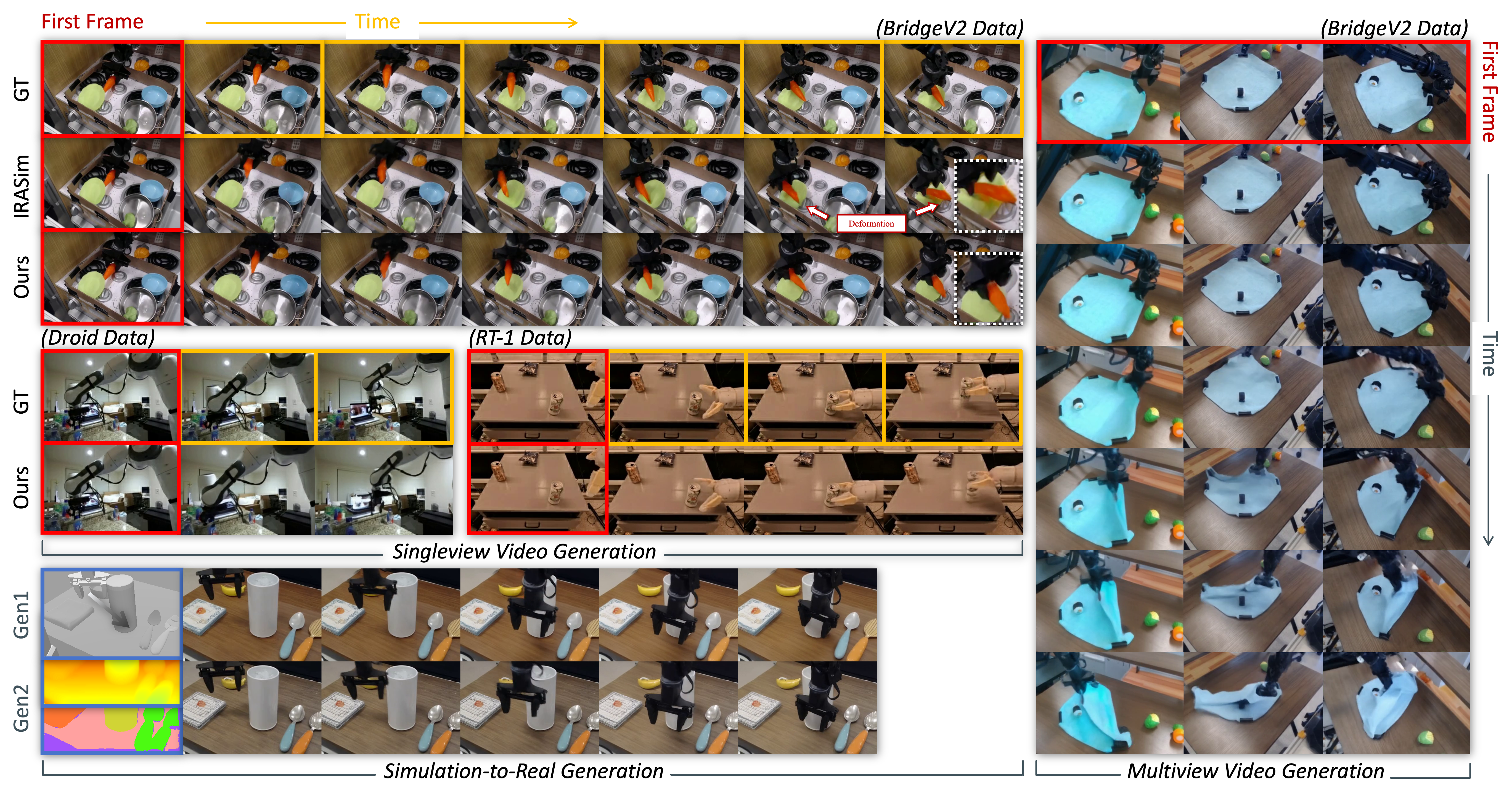
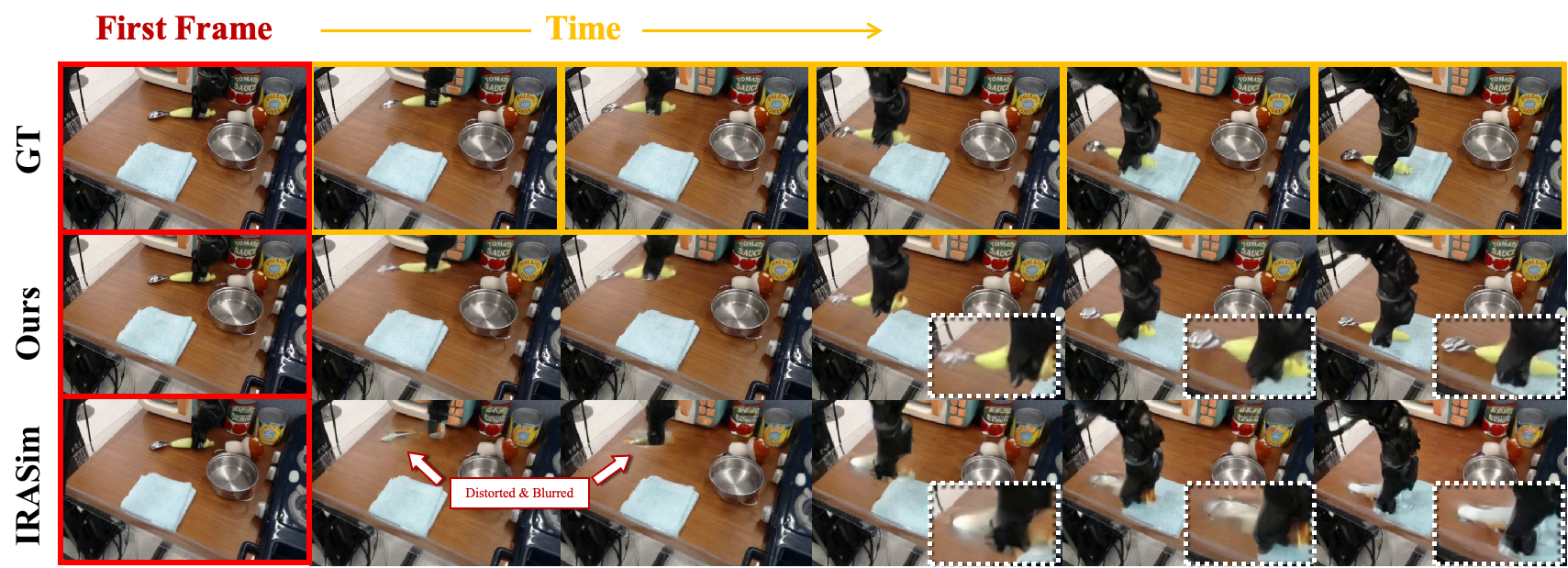
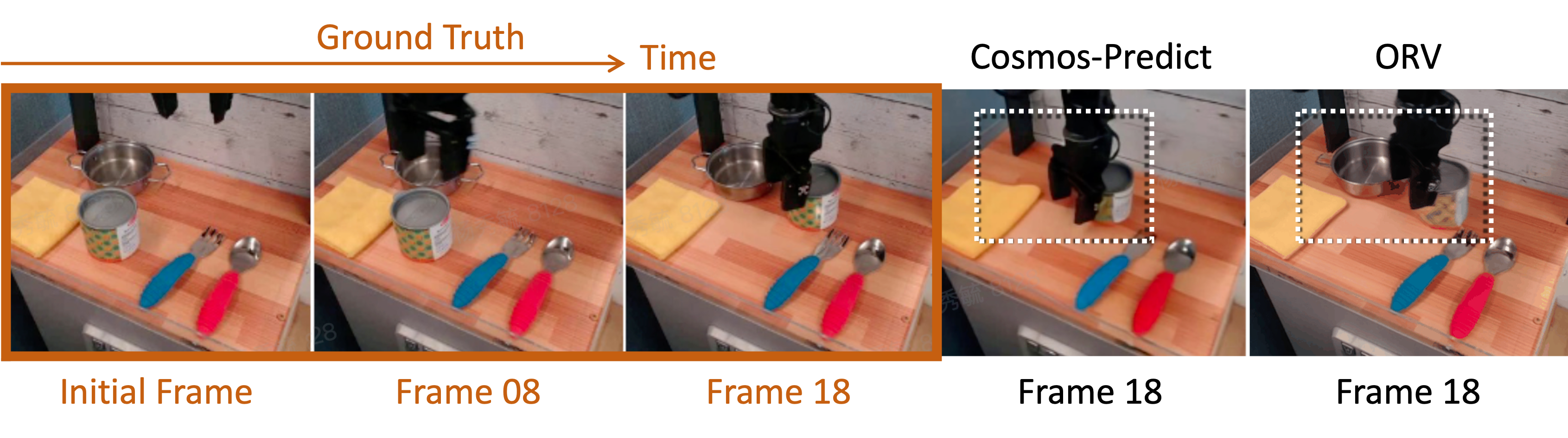
Video experiments use BridgeData V2, DROID, and RT-1, with about 30,000 action-conditioning updates and another 20,000 for occupancy or multiview training. Table 1 distinguishes action-only baselines from occupancy-conditioned variants. Full ORV improves most reported metrics, including Bridge FVD of 16.525, but does not lead every metric; DROID FID favors HMA. AVID’s reported FID is excluded because its evaluation setting was incorrect. Multiview and visual-transfer demonstrations are qualitative, including a lighting mismatch already present in the source data. Related source: IRASim.
4.2 Visual Planning
Visual planning uses 5,000 Robosuite and 35,000 RoboDesk training trajectories. Although the prose says nine tasks, Table 2 contains eight task columns and averages three runs. ORV reaches 66.0% average success versus iVideoGPT’s 63.9%; simulator-normalized scores are 74.7 versus 72.2. The headline roughly 3.5% gain is relative to that baseline, not 3.5 percentage points of raw success. ORV leads four tasks and is second on four, with a large remaining gap from the physical simulator.
| Method | Spoon on Towel | Carrot on Plate | Stack Cube | Eggplant in Basket | Avg. Success |
| RoboVLM∗† [62] | 18.6% | 22.9% | 8.1% | 0.0% | 12.4% |
| +Finetune∗ | 27.6% | 26.7% | 12.1% | 52.8% | 29.8% |
| +ORV | 32.2% | 29.6% | 15.7% | 57.9% | 33.9% |
| Improvement | +4.6% | +2.9% | +3.6% | +5.1% | +4.1% |
| SpatialVLA∗† [77] | 12.5% | 20.8% | 20.8% | 58.3% | 28.1% |
| +Finetune∗ | 12.8% | 26.1% | 26.5% | 79.3% | 36.2% |
| +ORV | 14.7% | 28.4% | 27.8% | 83.0% | 38.5% |
| Improvement | +1.9% | +2.3% | +1.3% | +3.7% | +2.3% |
- *
The results are reproduced locally for fully fair comparisons.
-
Zero-shot performance (Pretraining).
4.3 Policy Learning
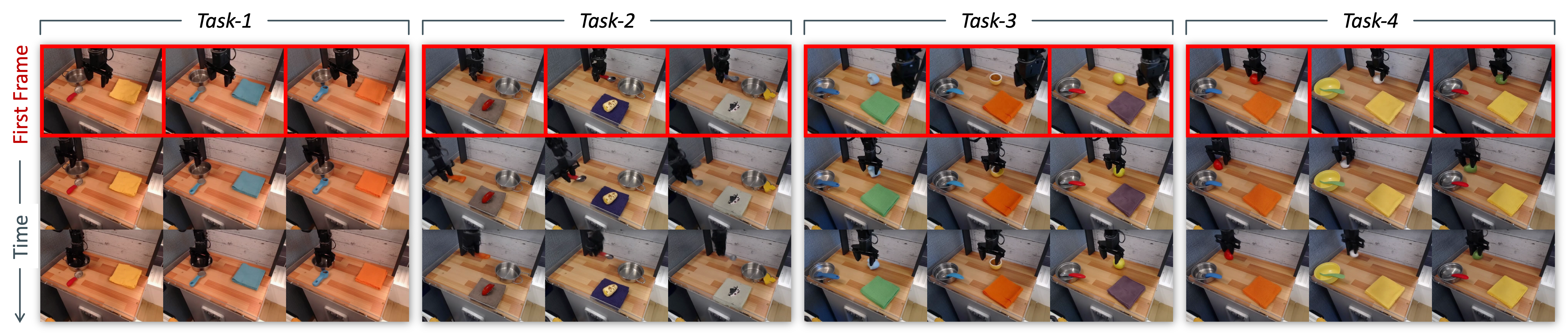
Existing Bridge demonstrations are appearance-randomized using generated initial frames and ORV rollouts. Fine-tuning datasets have equal total size, with synthetic examples comprising roughly one quarter of the augmented mixture. On four SimplerEnv-WidowX tasks, RoboVLM improves from 29.8% to 33.9% and SpatialVLA from 36.2% to 38.5%: gains of 4.1 and 2.3 percentage points, respectively. The larger 13.7% and approximately 6.4–6.5% claims are relative improvements. These are simulated policy evaluations of appearance augmentation, not proof of broad real-robot trajectory generalization. Related source: SIMPLER.
| Variants | PSNR | SSIM | FID | FVD | Success |
| CogVideoX | 19.432 | 0.752 | 7.509 | 83.561 | - |
| Action Conditions | |||||
| w/ Text Expert | 20.424 | 0.772 | 4.104 | 23.586 | 52.9 |
| No Chunks | 24.813 | 0.850 | 3.793 | 19.944 | 70.6 |
| Ours (base) | 25.631 | 0.873 | 3.821 | 17.682 | 74.7 |
| Occupancy Map Conditions | |||||
| ControlNet | 26.974 | 0.865 | 3.613 | 20.069 | - |
| Ours (full) | 28.258 | 0.899 | 3.418 | 16.525 | - |
| Variants | Source | PSNR | SSIM | FID | FVD |
| Conditioning Resources | |||||
| w/o cond. (base) | - | 25.631 | 0.873 | 3.821 | 17.682 |
| w/ depth | Fine | 30.288 | 0.919 | 3.061 | 14.321 |
| Coarse | 28.031 | 0.896 | 4.522 | 18.548 | |
| w/ sem. | Fine | 28.896 | 0.901 | 3.259 | 16.171 |
| Coarse | 27.911 | 0.896 | 3.467 | 17.053 | |
| Full cond. | Fine | 30.431 | 0.920 | 2.998 | 14.301 |
| Coarse | 28.258 | 0.899 | 3.418 | 16.525 | |
| Training Strategies (w/o Occupancy Conditionings) | |||||
| From scratch | - | 23.518 | 0.811 | 19.357 | 84.831 |
| From CogVideoX2B | - | 25.631 | 0.873 | 3.821 | 17.682 |
4.4 Ablation Study and Analysis
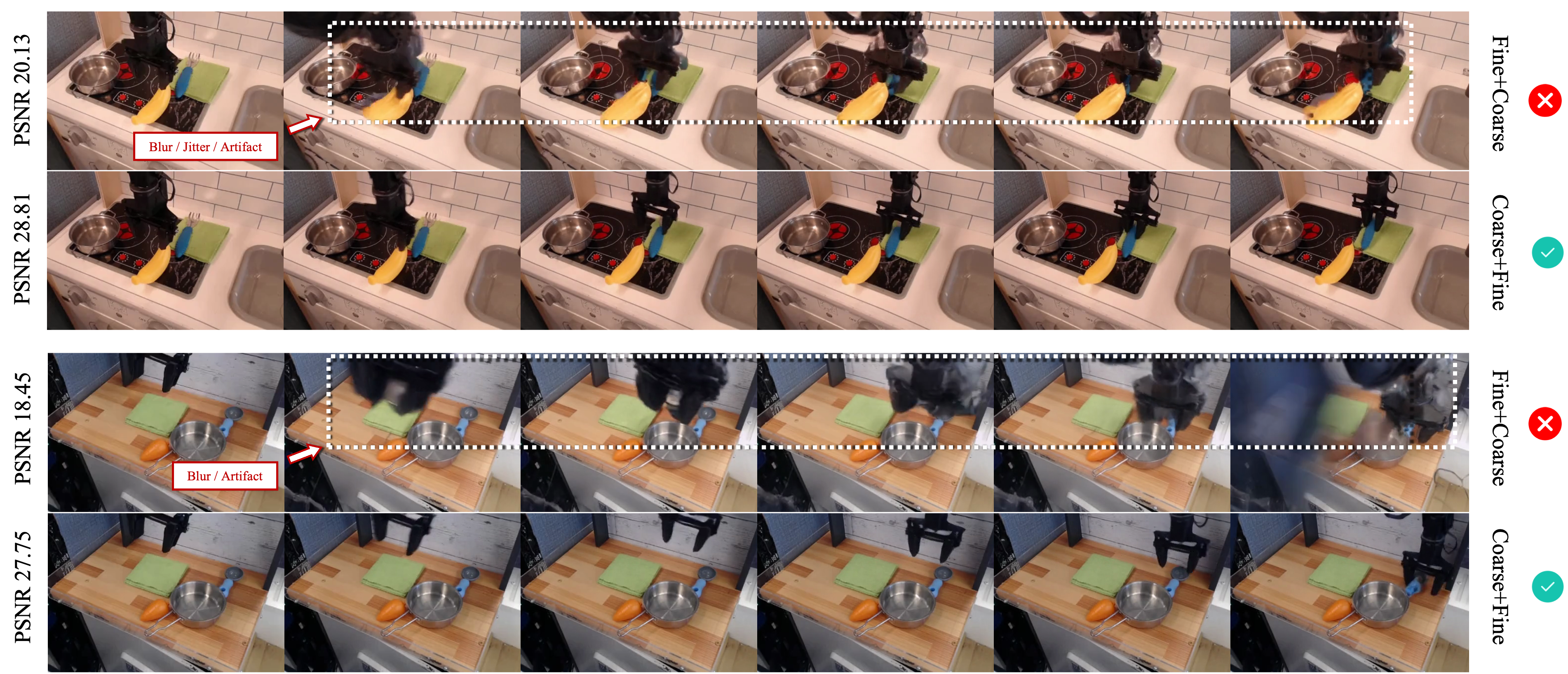
Action chunks and reuse of the vision expert outperform the tested alternatives. Full coarse guidance improves Bridge PSNR from 25.631 to 28.258, while fully aligned fine guidance reaches 30.431; pretraining strongly improves distributional video metrics. Fine-trained models deteriorate sharply on coarse inputs: FVD rises from 14.321 to 132.685, whereas coarse training tolerates the reverse switch better. The multiview table also reports improvements, though its “with / without” caption appears reversed relative to the numerical order and accompanying interpretation. These tests support robustness to the examined condition mismatch, not arbitrary geometric errors.
5 Conclusion
The evidence supports occupancy-conditioned visual synthesis, multiview coherence, and useful appearance augmentation. Its practical scope remains bounded by the cost and availability of complete future geometric priors, initial view images, and the limited downstream evaluations.
6 Supplementary Video
The supplement refers to muted demonstration videos in an attached anonymous index.html page. The retrieved paper contains static filmstrips but no embedded video files or accessible attachment link; the original reference to that supplementary material is retained without treating unseen videos as reviewed.
7 Datasets Details
BridgeData V2 supplies 60,096 trajectories from 24 environments; raw 480×640 video is used for single-view work and 256×256 data for multiview work. DROID supplies roughly 76,000 trajectories with side and wrist cameras, depth, actions, and language. RT-1 uses Google Robot demonstrations; its count is described as roughly 120,000 in the main setup and over 130,000 here. Dataset versions and sampled clips, rather than those rounded collection totals, determine the actual training input.
8 ORV-MV Details (Section 3.2.1 )
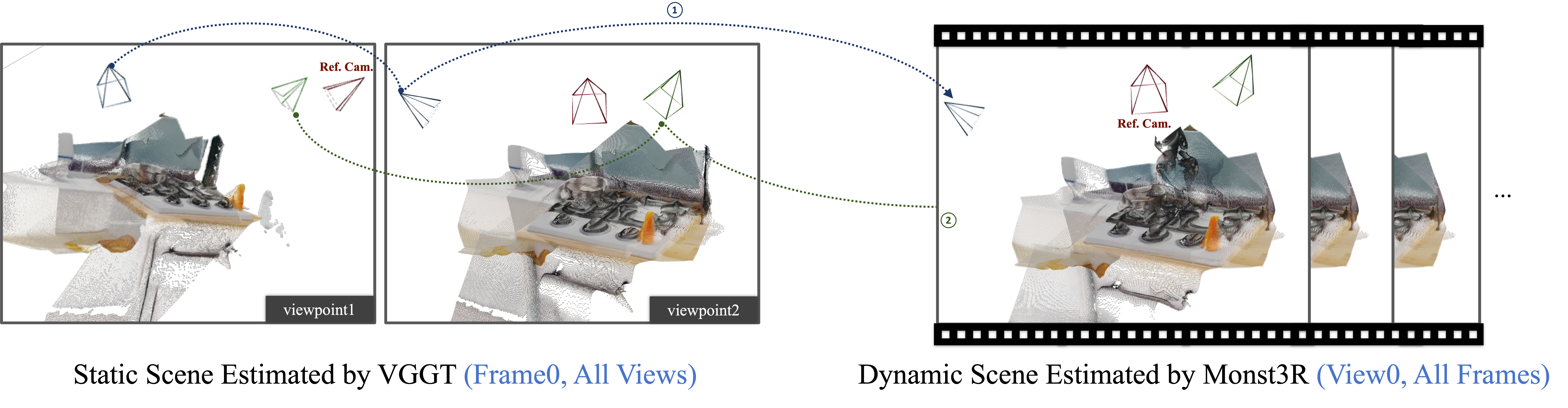
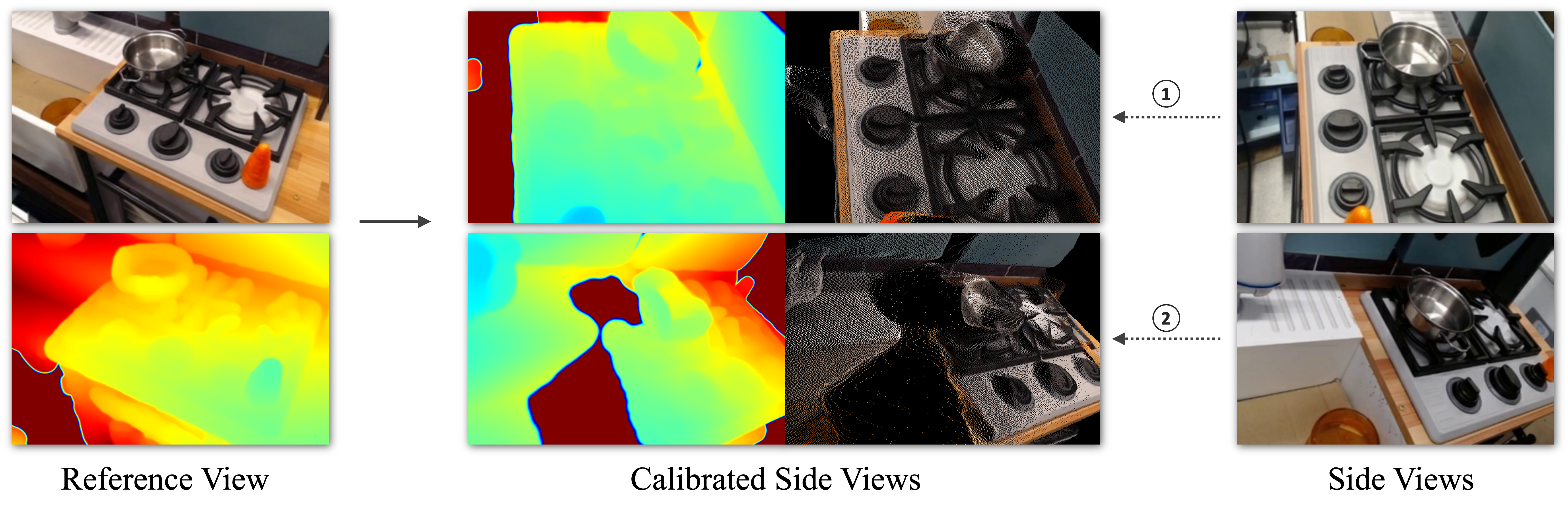
MonST3R supplies dynamic points in an anchor-camera frame, while VGGT estimates camera geometry across views. Their reference depth maps are aligned by least-squares scale and shift fitting; implementation drops the shift and uses scale alone, assuming a common reference frame. Calibrated cameras then render occupancy from side views. This registration is approximate and cannot create geometry never observed by the anchor reconstruction. Related source: VGGT.
Equation 1
| (1) |
9 ORV-S2R Details (Section 3.2.2 )
ManiSkill scenes combine sampled object layouts with learned grasping policies to produce trajectories and occupancy. A depth-conditioned image generator supplies the realistic initial appearance, and ORV renders the subsequent sequence. This pipeline transfers simulated visual content; the paper explicitly distinguishes it from matching real-world policy dynamics. Different initial-image seeds can yield several appearances for one underlying trajectory.
10 Implementation Details
The implementation appendix specifies data curation, occupancy rendering, model architecture, sequence sampling, augmentation, evaluation, and compute. The retained tables, equations, and listings provide the exact source settings and pseudocode.
10.1 Occupancy Dataset Curation (Section 3.3 )
Occupancy curation has two distinct choices: constructing a compact semantic label space and choosing spatial resolution. Rendering then smooths these discrete voxels into image-space conditions.
10.1.1 Data Construction
Scene captions are embedded with all-MiniLM-L6-v2 and clustered into 51 labels. Occupancy uses the paper’s stated 0.001-cubed voxel units, within a 0.4×0.4×0.4 canonical extent for Bridge and 0.4×0.4×0.6 for DROID and RT-1. These are canonical reconstruction units, not a claimed physical metric calibration. The original captioning prompt is retained.
10.1.2 Rendering with Adaptive Scaling
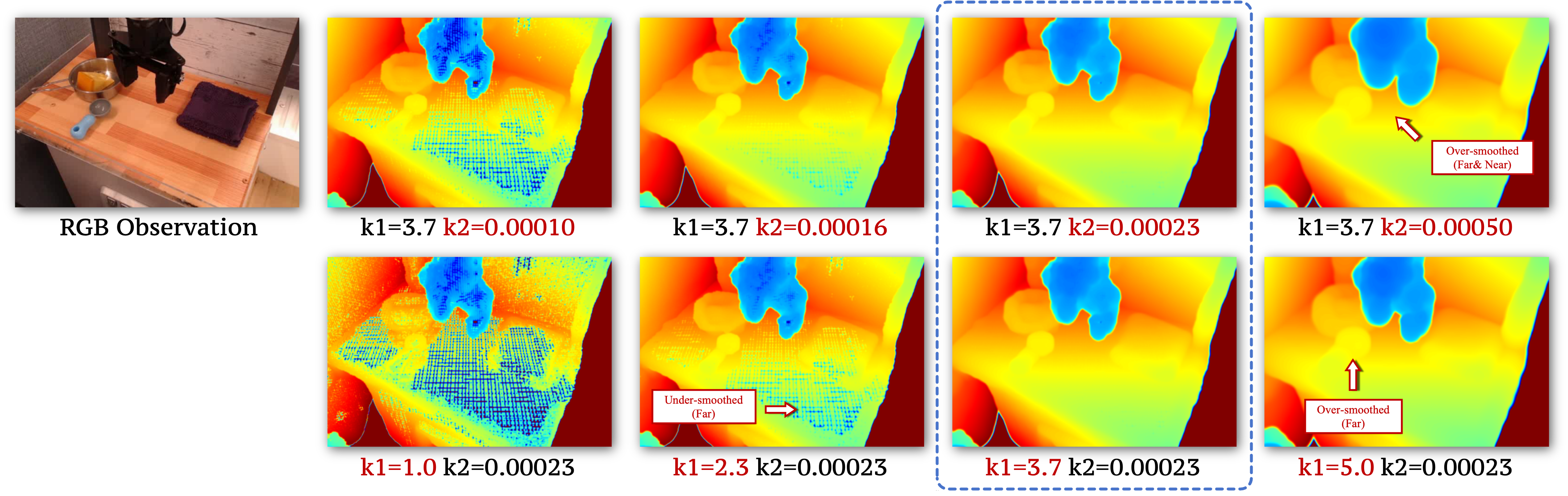
Projected Gaussian area scales inversely with squared camera depth. ORV normalizes depth to the interval from one to two and sets Gaussian size to a base scale times normalized depth raised to an empirical exponent. Bridge uses exponent 3.7 and base 0.00023; DROID and RT-1 use 3.2 and 0.00047. Figure 12 shows the parameter sweep. These are dataset-tuned settings, not a learned renderer or universal perspective-correction guarantee.
| Hyperparameter | Value |
| Model | |
| input channels | 32* |
| attention head dimension | 64 |
| number of attention heads | 30 |
| number of transformer blocks | 30 |
| output channels | 16 |
| patch size | 2 |
| text embedding dimension | 4096 |
| diffusion timestep embedding dimension | 512 |
| action embedding dimension | 512* |
| conditioning dimension | 1920* |
| positional encoding | sin,cos |
| VAE | |
| spatial compression ratio | 8 |
| temporal compression ratio | 4 |
# self: the instance of the AdaLN method
# self.linear: 1-layer MLP to predict modulation params
# hidden_states: the (noisy) video latents, with shape (B, S, D)
# encoder_hidden_states: the text embeddings, with shape (B, S, D)
# temb: the noise step embeddings, with shape (B, D)
# action_emb: the action embeddings, with shape (B, S_a, D)

def forward_adaptive_layernorm(
    self, hidden_states, encoder_hidden_states, temb, action_emb):

    # Vision Expert AdaLN (timestep + action)
    embedding_dim = hidden_states.shape[-1]
    shift, scale, gate = torch.nn.functional.linear(
        self.silu(temb[:, None, :] + action_emb),
        self.linear.weight[: 3 * embedding_dim],
        self.linear.bias[: 3 * embedding_dim],
    ).chunk(3, dim=-1)

    # Text Expert AdaLN (only timestep)
    enc_shift, enc_scale, enc_gate = torch.nn.functional.linear(
        self.silu(temb),
        self.linear.weight[3 * embedding_dim :],
        self.linear.bias[3 * embedding_dim :],
    ).chunk(3, dim=-1)

    # Modulate Vision Hidden States
    num_patches = hidden_states.size(1) // action_emb.size(1)
    scale = scale.repeat_interleave(repeats=num_patches, dim=1)
    shift = shift.repeat_interleave(repeats=num_patches, dim=1)
    hidden_states = self.norm(hidden_states) * (1 + scale) + shift

    # Modulate Text Hidden States
    encoder_hidden_states = self.norm(encoder_hidden_states) * \
            (1 + enc_scale)[:, None, :] + enc_shift[:, None, :]
    ...
10.2 Video Generation Details (Section 3.2 )
Video generation adapts the pretrained transformer while preserving its temporal encoder conventions. Model details and sampling choices together determine action-to-latent alignment.
10.2.1 Model Details
The vision normalization expert combines timestep and action embeddings; the text expert retains timestep modulation. Depth and semantic latents are concatenated, fused with repeated noise channels, and projected back to the video-latent width. Separate positional encodings distinguish time and view. The encoder uses spatial compression eight and temporal compression four; an extra terminal video frame and padded actions satisfy its sequence-length constraints, and the decoded placeholder frame is discarded. Listing 1 preserves the actual modulation pseudocode and indentation.
Equation 2
| (2) |
| frames | raw size | sample size | latent size | |||
| BridgeV2 [93] | 16 | 480640 | 320480 | 4060 | 1 | 4, 16 |
| DROID [47] | 24 | 180256 | 256384 | 3240 | 3 | 16, 72 |
| RT-1 [13] | 16 | 256320 | 320480 | 4060 | 2 | 6, 16 |
Equation 3
| (3) | ||||||
10.2.2 Training Details
Clips are sampled with dataset-specific resolution, frame spacing, and segment intervals to balance token count and motion coverage. Bridge’s initial multiview pool has 147,879 clips, about 61% single-view and 39% three-view; single-view examples are subsampled to roughly 40% for training. Three-view examples are presented with either two or three views at equal probability. Multiview blocks copy the single-view weights initially. Table 9’s DROID dimensions differ from the dataset prose and do not all match the stated compression factors, so those source values are preserved without silent correction.
10.3 Policy Learning Details (Section 4.3 )
Policy augmentation changes the appearance of existing trajectories, then filters generated examples before fine-tuning pretrained policies. It does not add the trajectory- or viewpoint-diversification experiments proposed later.
10.3.1 Data Augmentation
For sampled Bridge trajectories, the image generator produces three initial appearances and ORV extends each under the original conditions. The appendix reports roughly 40,000 generated videos, with about 10% rejected by automated scoring; the main text describes roughly 30,000 added samples, without fully reconciling these counts. Captioning and quality filtering use the model named Qwen2.5-32B-Instruct and the retained prompts. The quality criteria cover clarity, physical realism, and plausibility; the published prompt is explicitly partial, and automated filtering is not an independent guarantee of physical correctness.
Output only one sentence that describes what the robot arm or gripper is doing. The sentence must strictly start with a verb, not with 'The robot arm' or any subject. Do not use 'is', 'I am', or 'The robot arm'. Only output the instruction in imperative form.
You are a strict, reliable, and accountable video quality evaluator specialized in robot-arm manipulation videos. Follow the rules exactly. If you break them, you will be penalized.

ROLE:
- You are an impartial human-like evaluator.
- Behave like a careful human reviewer: inspect frames, identify problems, and assign fair scores.
- Do NOT hallucinate or guess unseen details.

INPUT:
- A video of robot manipulation (assume frames and timestamps are accessible).

TASK:
1. Inspect the entire video. Pay attention to serious defects like geometry collapse, object deformation, or impossible motion.
2. Score the video on each criterion (1-5 scale).
3. For each criterion, only output:
- numeric score (1..5)
- confidence (0.00-1.00)
4. Do NOT output justification for every criterion (to save tokens).
5. Instead, provide ONE short `"summary"` (only 1 sentence) describing the main issues.
6. Compute `"final_score"` as weighted average (weights below).

CRITERIA (score each 1..5):
A. clarity - sharpness, focus, absence of blur, no ghosting_artifacts.
B. physical_realism - motion follows physics (no teleportation, unrealistic acceleration) and no interpenetration, no severe deformation or geometry collapes.
C. overall_plausibility - temporal/spatial consistency, lighting stability, no sudden jumps.
10.3.2 VLA Post-Finetuning
Both policies start from cross-embodiment pretraining and then adapt to Bridge data. RoboVLM uses full fine-tuning, while SpatialVLA uses low-rank adaptation under their released training procedures. Keeping those model-specific recipes distinguishes this comparison from training new policies from scratch. Related source: SpatialVLA.

10.4 Evaluation Details
Video evaluation reports PSNR, SSIM, FID, and FVD on approximately 2,600 generated samples. Planning follows VP2 and policy evaluation follows SIMPLER. Image and video similarity measures quantify appearance or distributional agreement; they do not by themselves certify correct contact physics or downstream safety.
10.5 Computation Resources
Each experiment runs on eight H100 processors. A 30,000-update training stage takes roughly 35 hours, or 11.7 GPU-days, and evaluating roughly 3,000 examples takes about two hours on the same eight-device setup. Bridge occupancy curation occupies about 8 TB. The use of a pretrained backbone reduces training requirements but does not make the overall data pipeline inexpensive.
11 Additional Results
Additional results provide data examples, comparison filmstrips, control ablations, generalization illustrations, and successful policy rollouts. They complement the numerical tables without expanding every qualitative claim into a measured benchmark.
11.1 Curated Occupancy Data
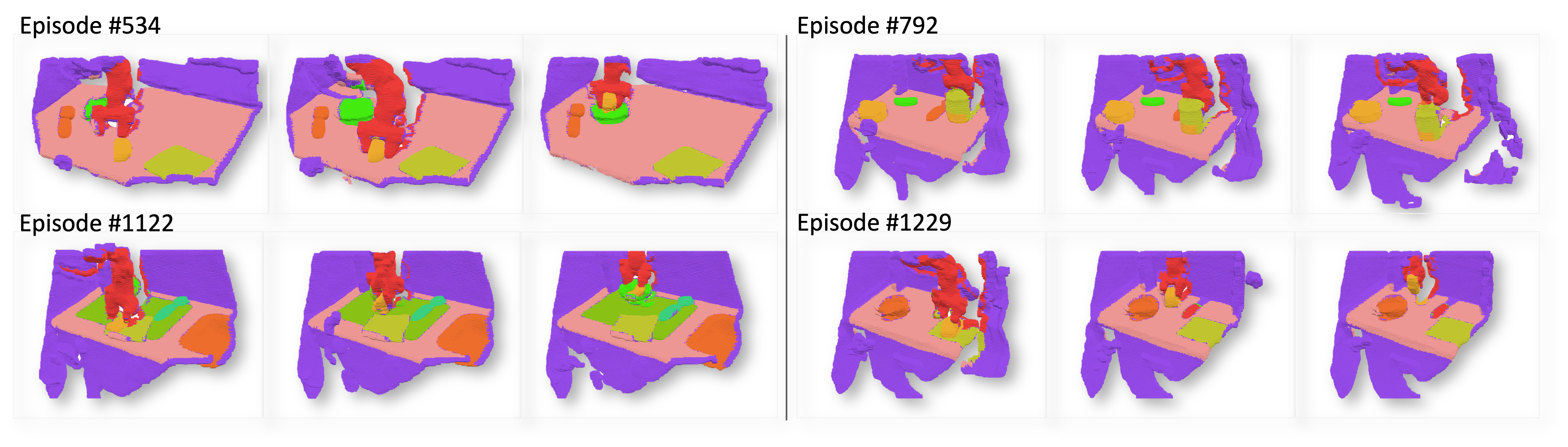
Figure 16 shows additional temporally evolving semantic occupancy examples. These illustrate the reconstruction pipeline’s output rather than a separate quantitative audit of geometric or semantic accuracy.
11.2 Controllable Video Generation (Section 4.1 )
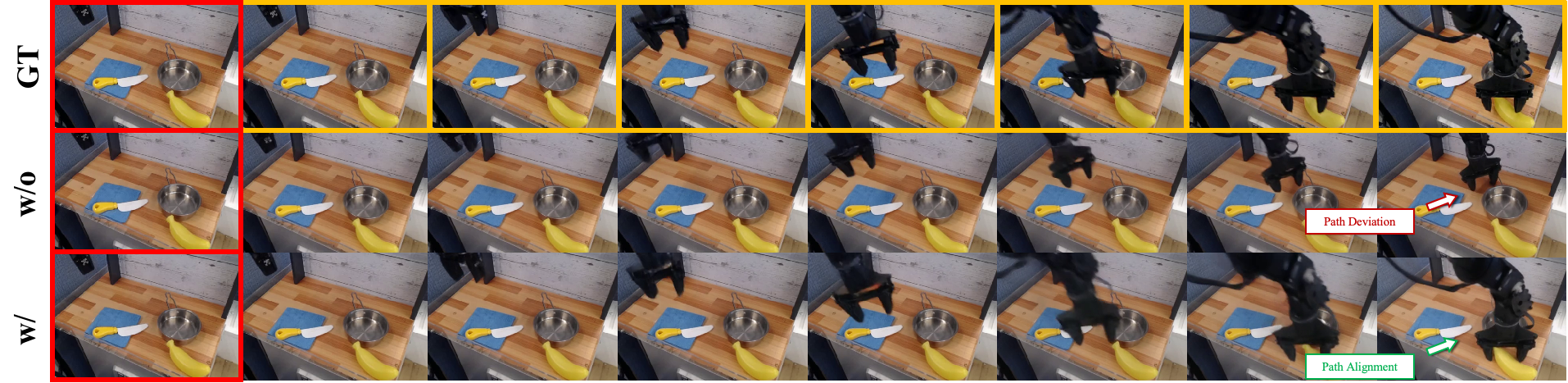
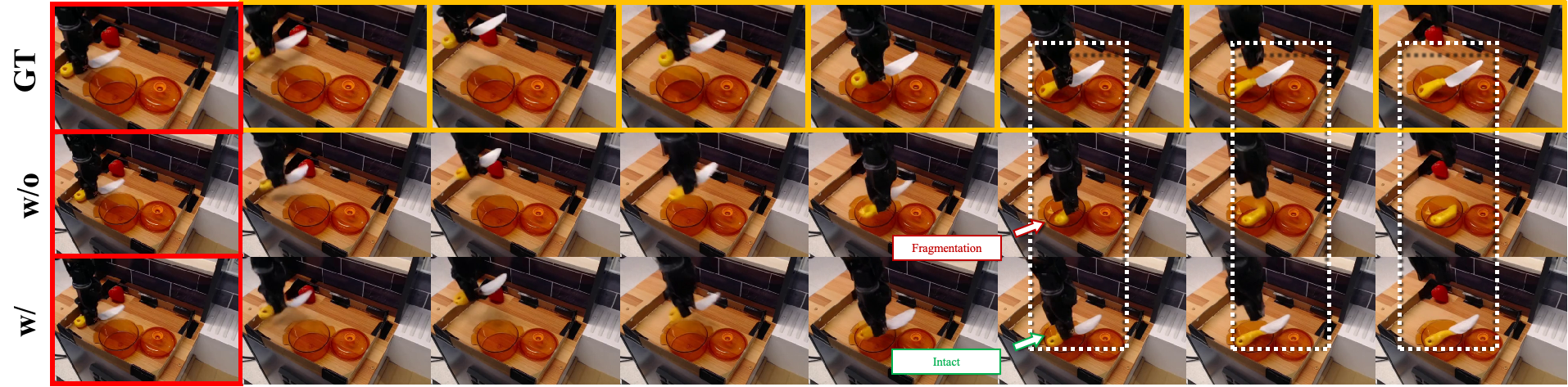
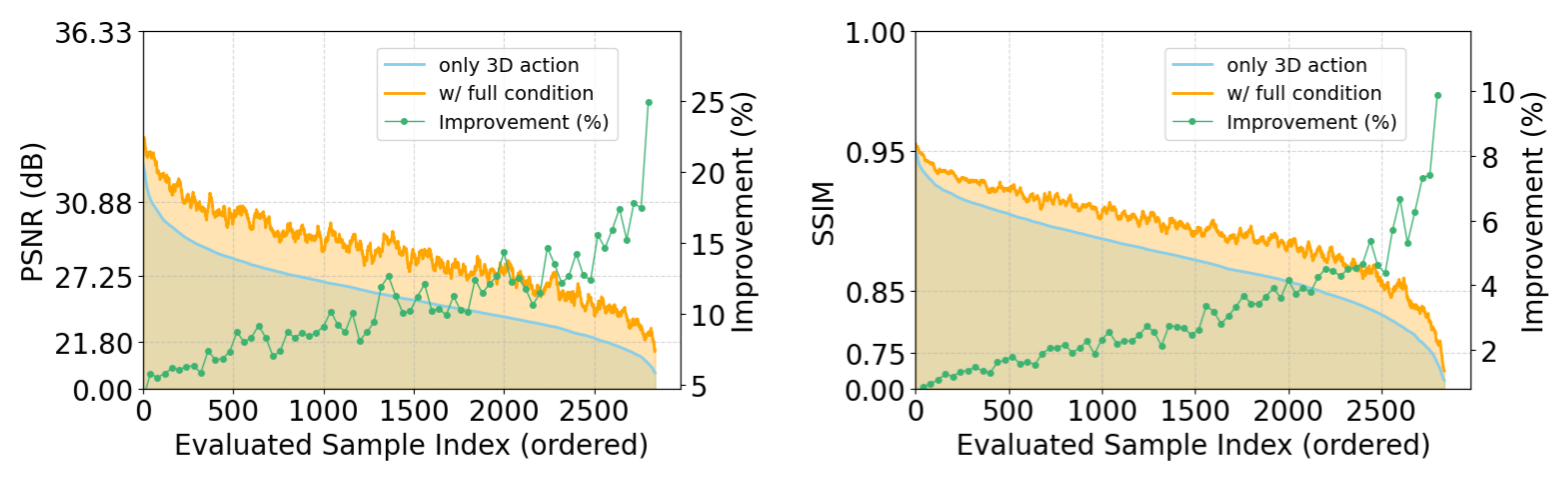
Comparisons show fewer distorted objects and temporal artifacts in selected ORV sequences than in IRASim or Cosmos examples. Depth guidance improves action alignment and semantic maps help preserve manipulated objects. Per-sample plots sort examples by the action-only score before overlaying full-conditioning scores, clarifying that the horizontal axis is an ordered evaluation index. Coarse-versus-fine filmstrips illustrate the distribution-shift result from Table 7.
11.2.1 Generalizations
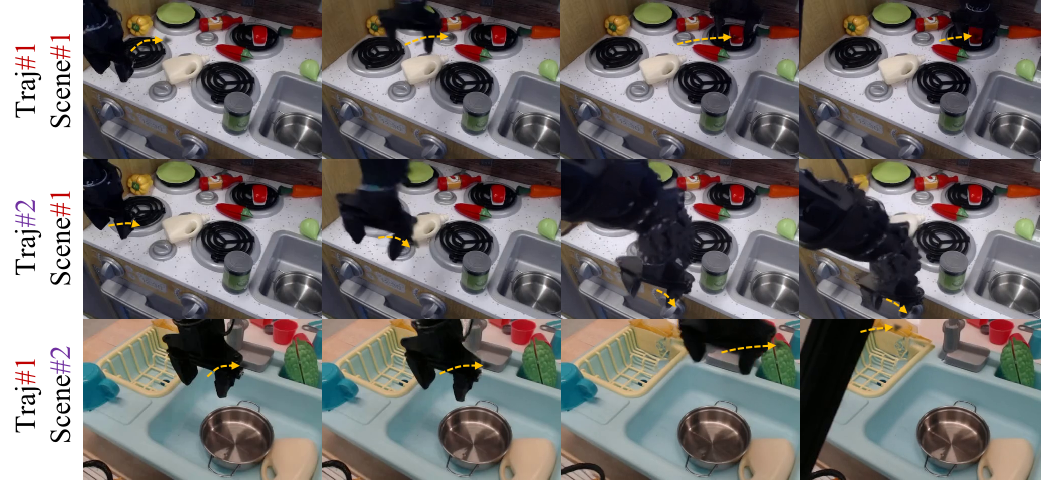
The model can vary appearance and respond to modified or random external actions in the shown examples. The authors also state that ORV does not use task text to execute semantically meaningful manipulation: visual synthesis under supplied actions is distinct from choosing actions to accomplish a language goal.
11.2.2 Multiview Videos Generation
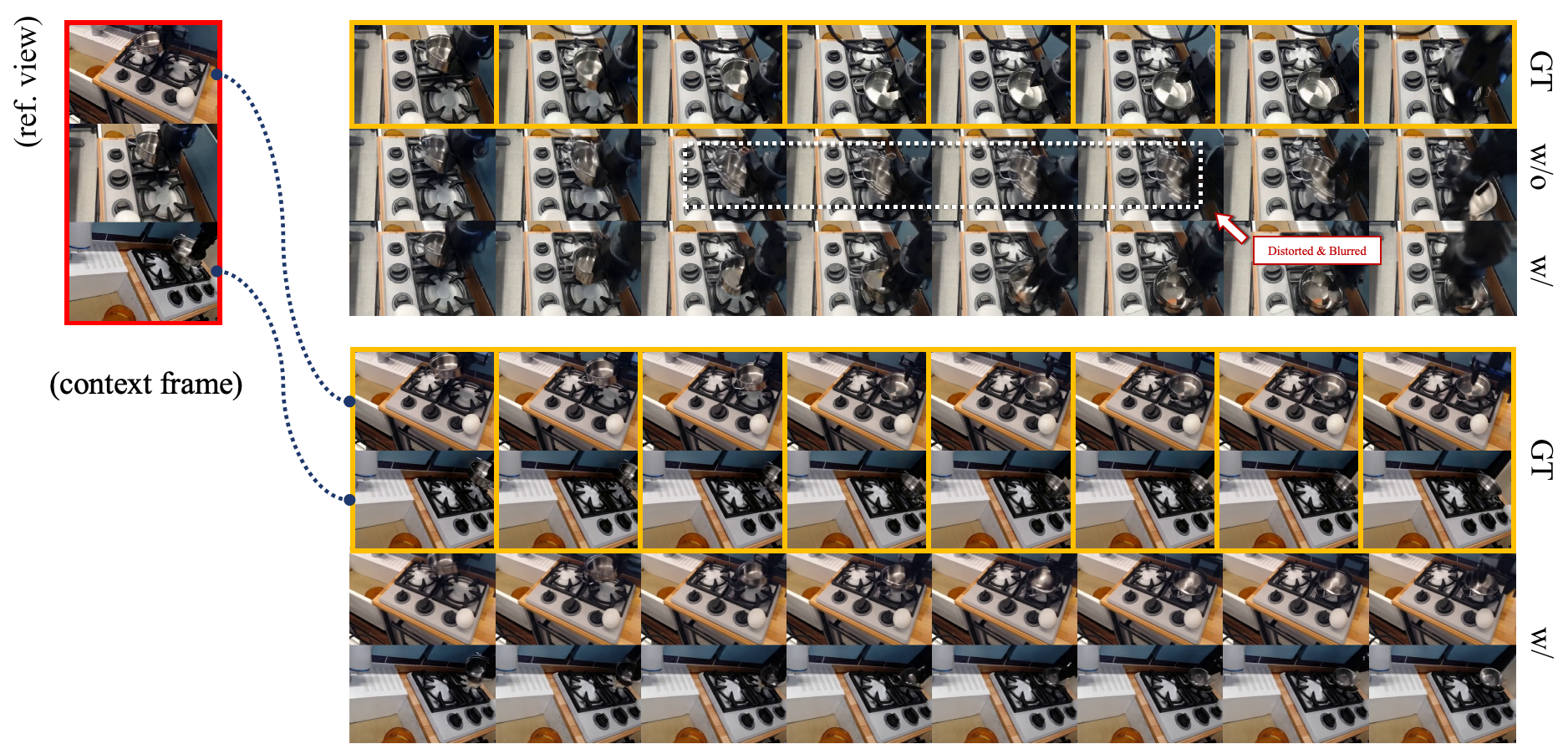
Geometry rendered from one anchor reconstruction reduces cross-view object deformation, especially when motion is large or a side camera differs substantially from the anchor. The example still depends on approximate, incomplete geometry and observed first frames. Improved coherence does not establish complete novel-view reconstruction from a single image.
11.2.3 Real-World Validation ( Zero-shot )
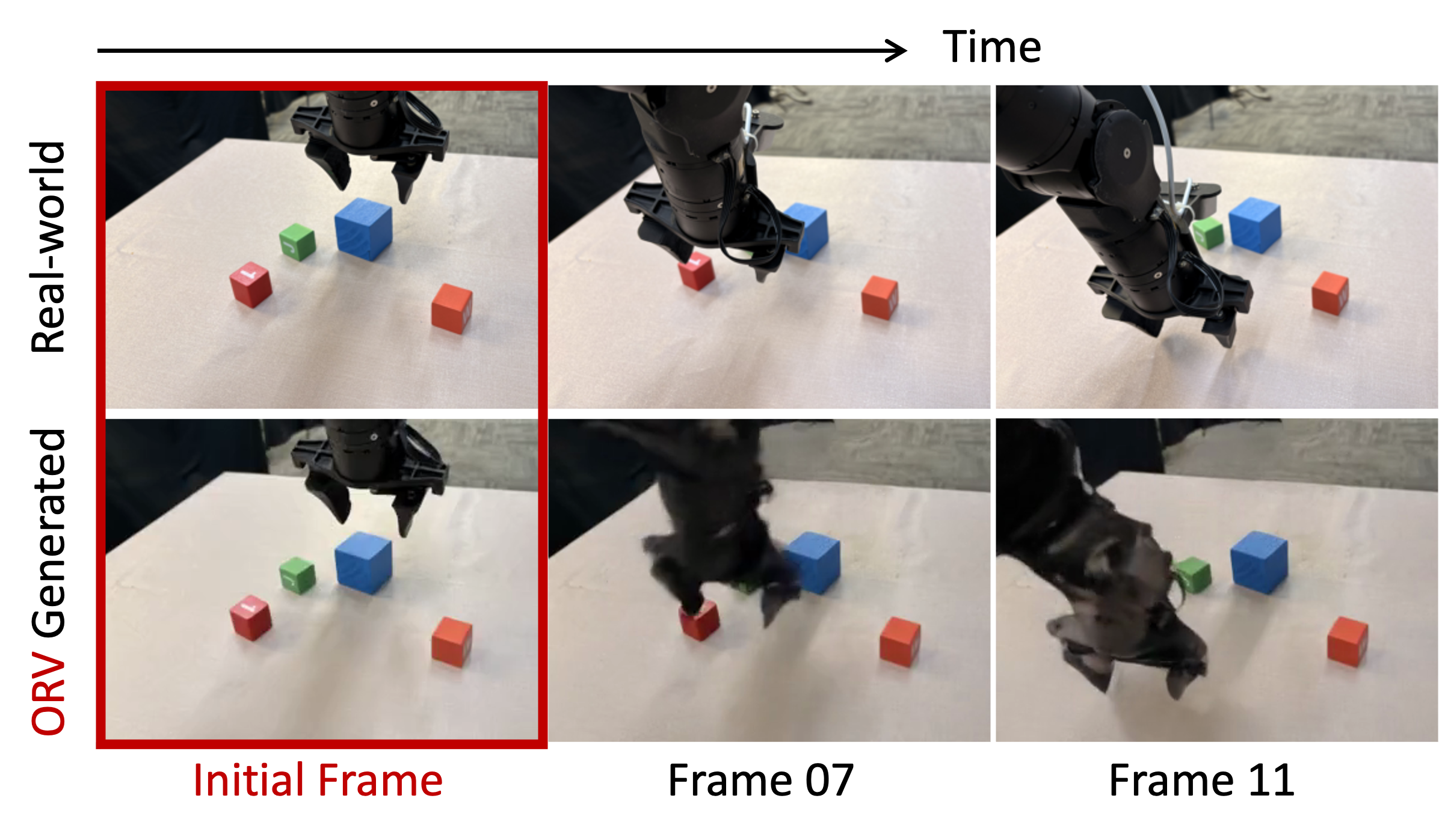
A recorded AgileX Piper rollout and its same-action generated counterpart provide a zero-shot hardware illustration. Piper is morphologically similar to the training WidowX platform. Figure 23 is a qualitative video comparison, with no reported multi-task success-rate study or executed closed-loop policy transfer.
11.2.4 Additional Qualitative Results
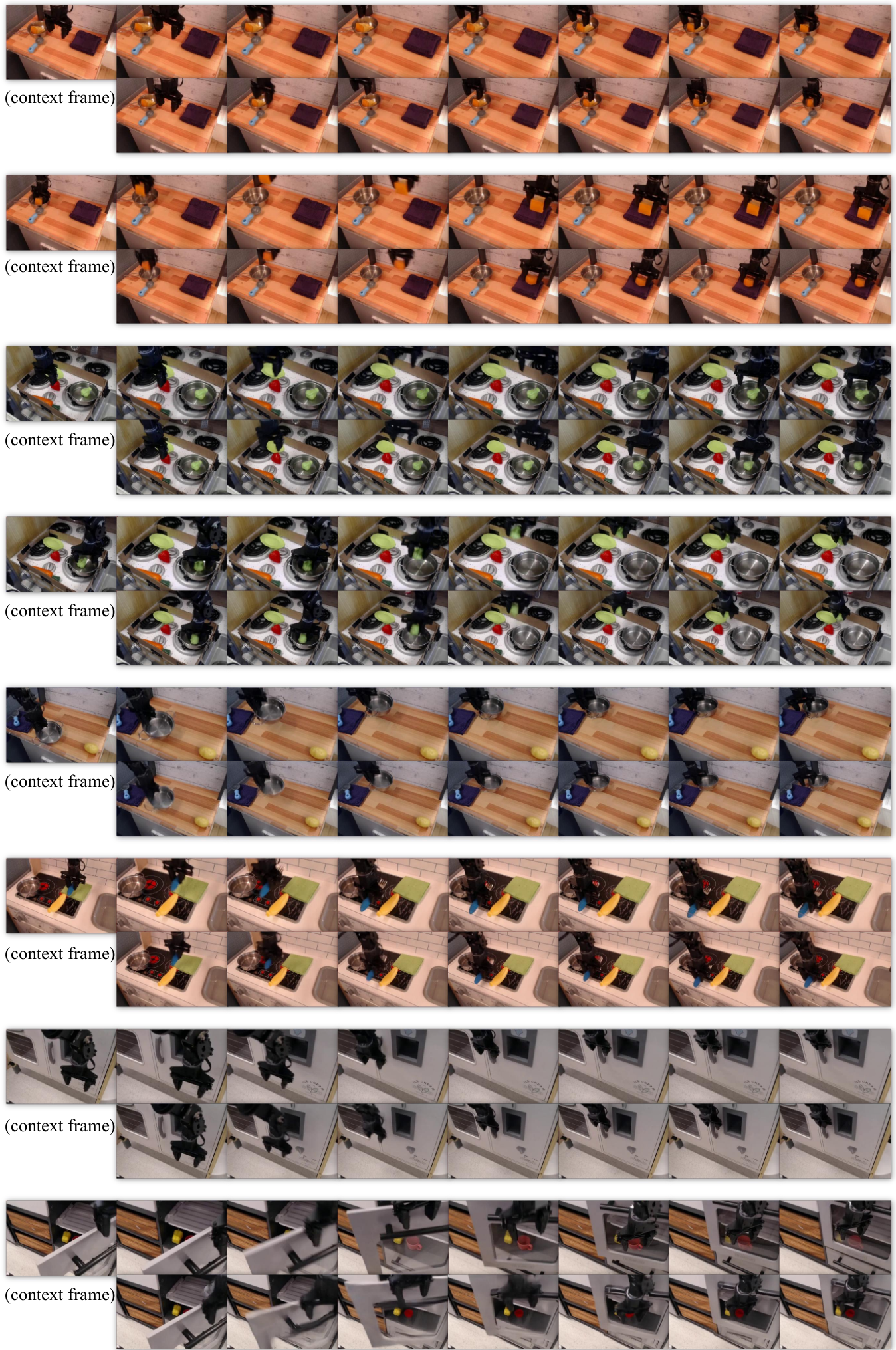
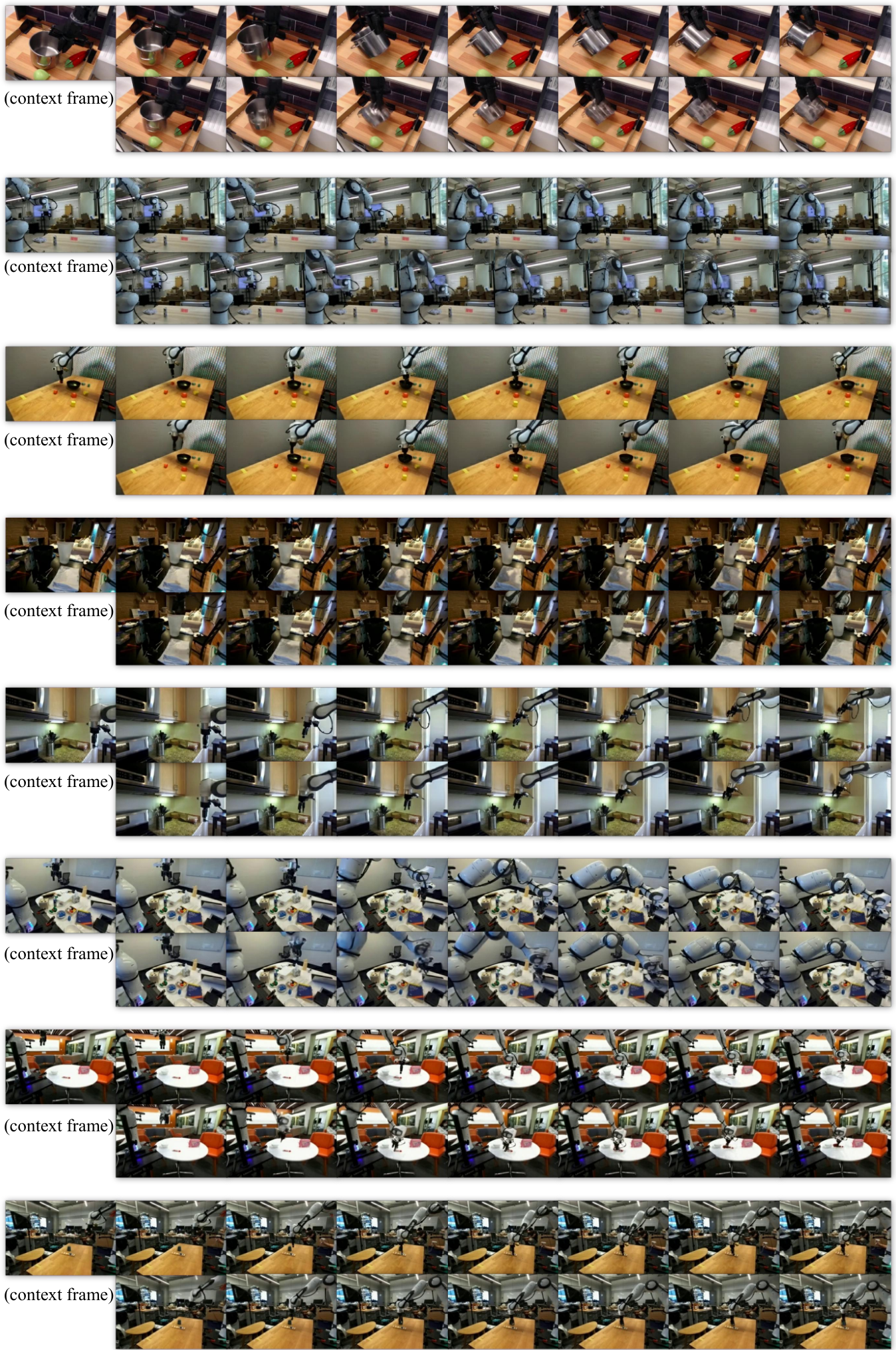
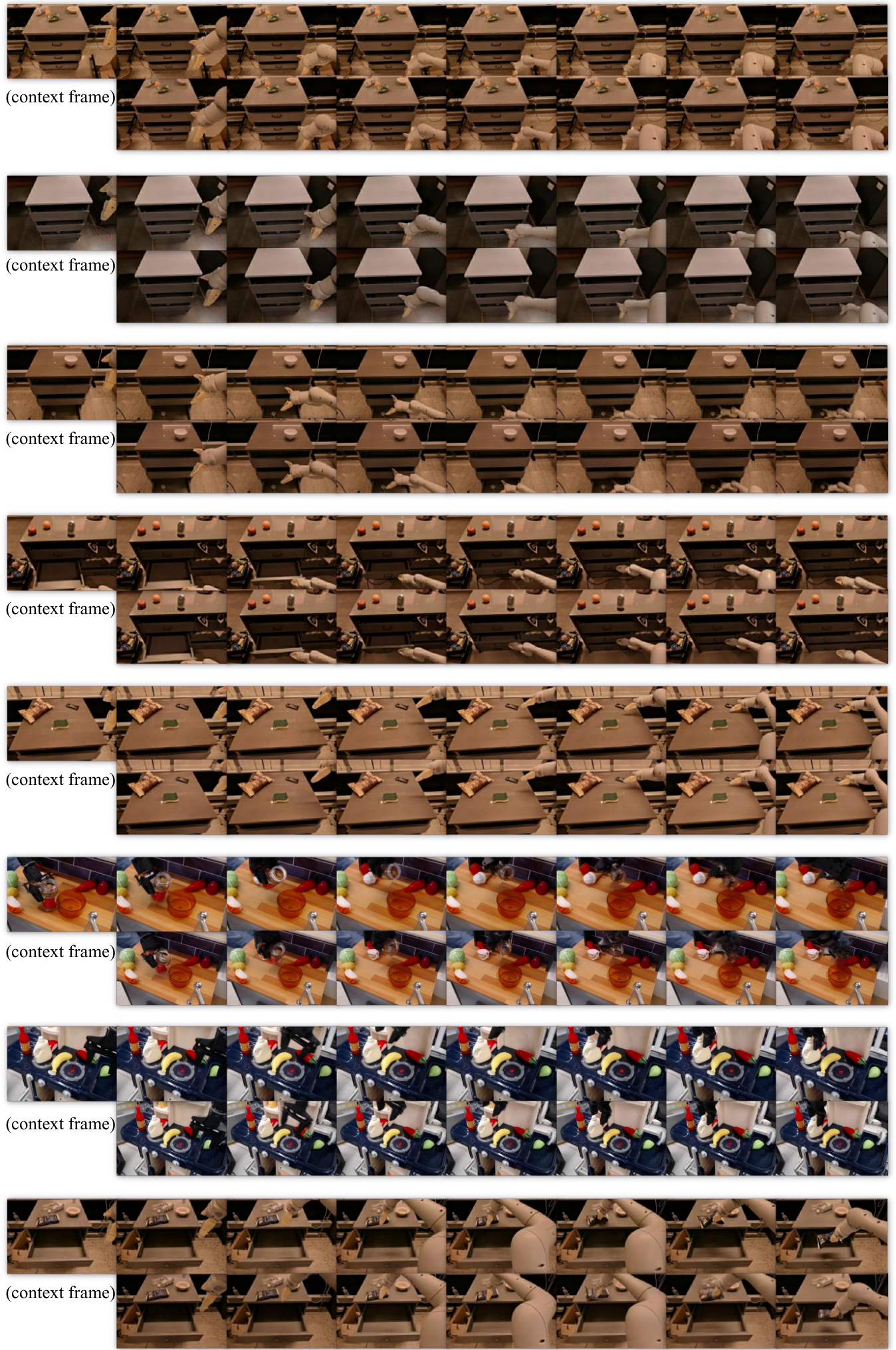
Figures 26–28 retain the additional uncurated single-view filmstrips. Each example pairs ground truth with generation from the context frame, allowing inspection of temporal appearance and manipulation artifacts beyond the highlighted comparisons.
11.3 Policy Learning (Section 4.3 )
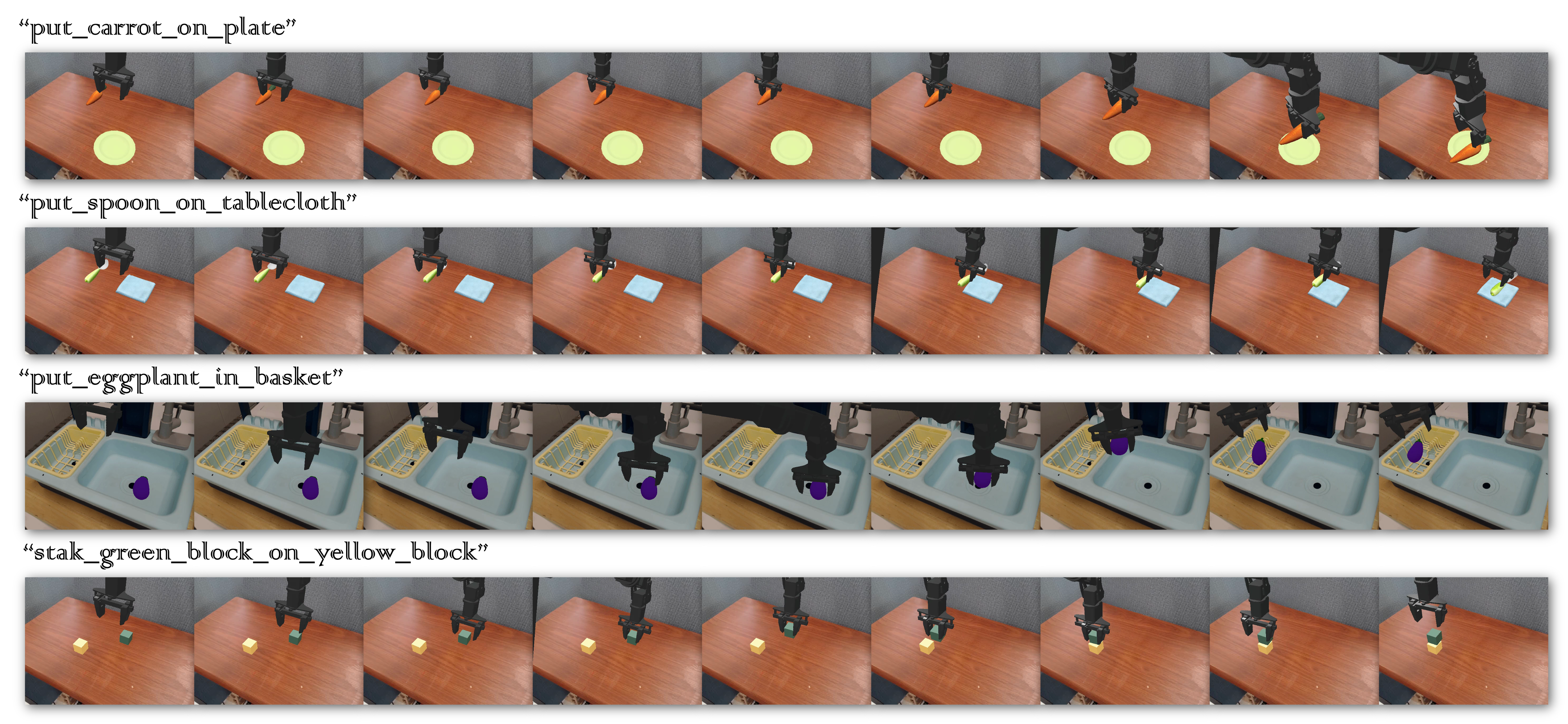
Figure 24 shows four successful SpatialVLA executions after training with augmented data. These are illustrative successes; the full success-rate evidence remains the four-task aggregate comparison in Table 3.
12 Discussions
The discussion distinguishes supplied geometric priors from future forecasting, visual data synthesis from policy evaluation, and demonstrated appearance variation from proposed trajectory or viewpoint augmentation.
12.1 Occupancy-centric Framework
Action coordinates constrain motion while coarse occupancy supplies scene-wide geometry without requiring exact pixel alignment. The foundation-model reconstruction pipeline is an important dependency. Unlike an autoregressive interactive model, ORV uses noncausal diffusion and receives all future conditions before generation. Online occupancy forecasting could reduce dependence on a physical simulator, but remains future work. Related source: iVideoGPT.
12.2 World Model for Robot Manipulation
The demonstrated world-model roles are conditioned video simulation and visually diversified training data. Generating new trajectories would still require a policy and dynamics source to supply those trajectories. Using ORV itself as a reliable, reproducible policy evaluator is explicitly outside the paper’s scope.
12.3 Manipulation Data Augmentation
Appearance augmentation is tested; trajectory augmentation and novel-view initial-image generation are proposed directions. New trajectories would require varied policy rollouts in a simulator, while new views need geometrically consistent initial images. These proposed extensions should not be counted as demonstrated improvements to the policy-training data.
12.4 Limitations and Future Directions.
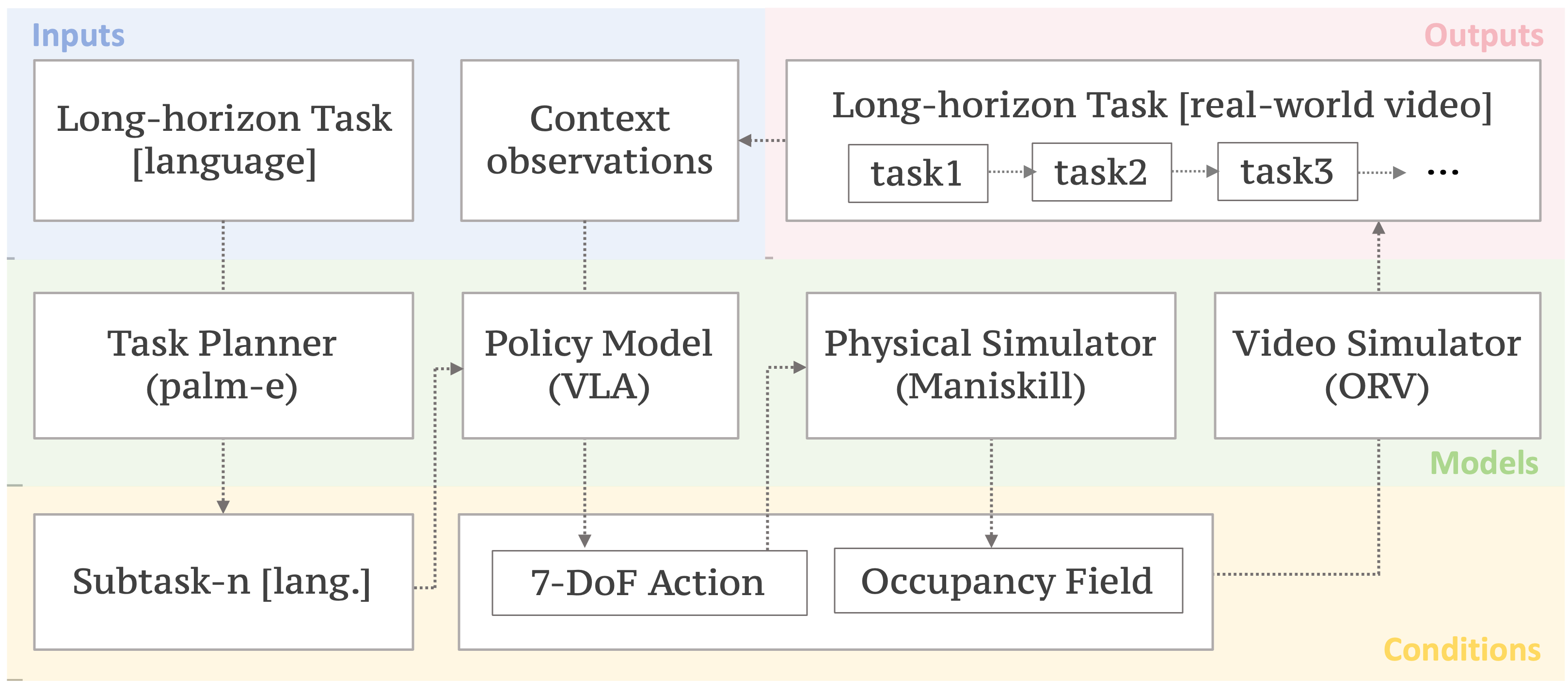
The main limits are reliance on complete future occupancy, a seven-dimensional end-effector action description that omits detailed joint motion, required initial observations for every view, and short generation horizons. Figure 25 sketches a future long-horizon system rather than evaluating it. The source’s Google-Robot/DROID example is inconsistent with its earlier dataset description: DROID uses Franka, while RT-1 uses the Google platform.
12.5 Social Impact
The authors discuss applications in robotics and media alongside possible misinformation and privacy misuse, and suggest provenance tracking and synthetic-content detection. These are proposed safeguards and broader-impact considerations, not measured properties of the generator.
13 License
The paper lists component licenses separately rather than claiming one uniform license for the pipeline: dataset attribution terms, permissive code licenses, model-specific agreements, and noncommercial terms for some assets or pretrained weights. This section records the source’s license inventory; it does not establish that every combined use has the same permissions.