At a glance
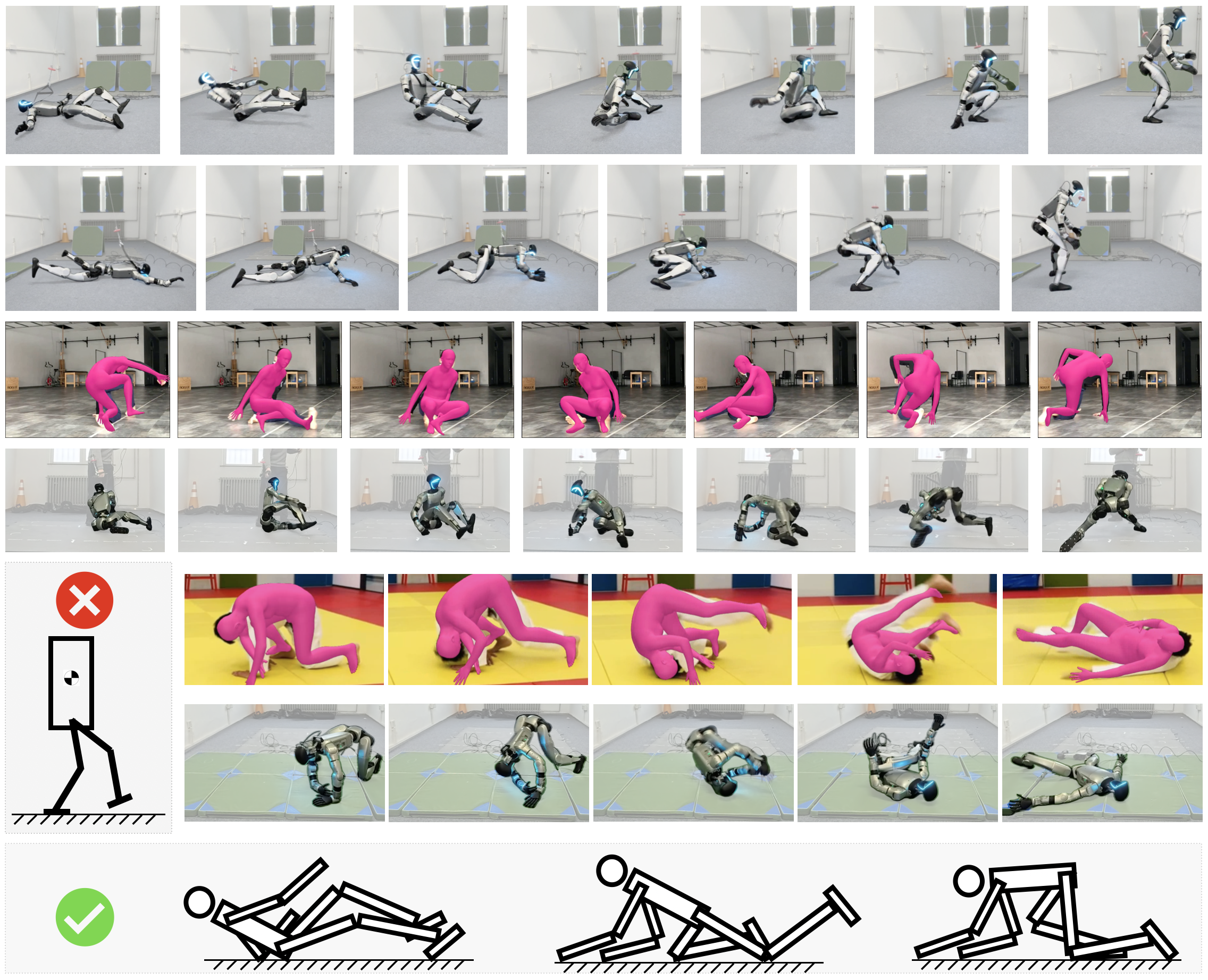
Embrace Contacts trains a Unitree G1 humanoid to follow sparse future motion targets while using its hands, knees, hips, thighs, and torso for ground contact. A Transformer encodes future keyframes, and three critics separately learn task, regularization, and safety rewards before their normalized advantages are mixed.
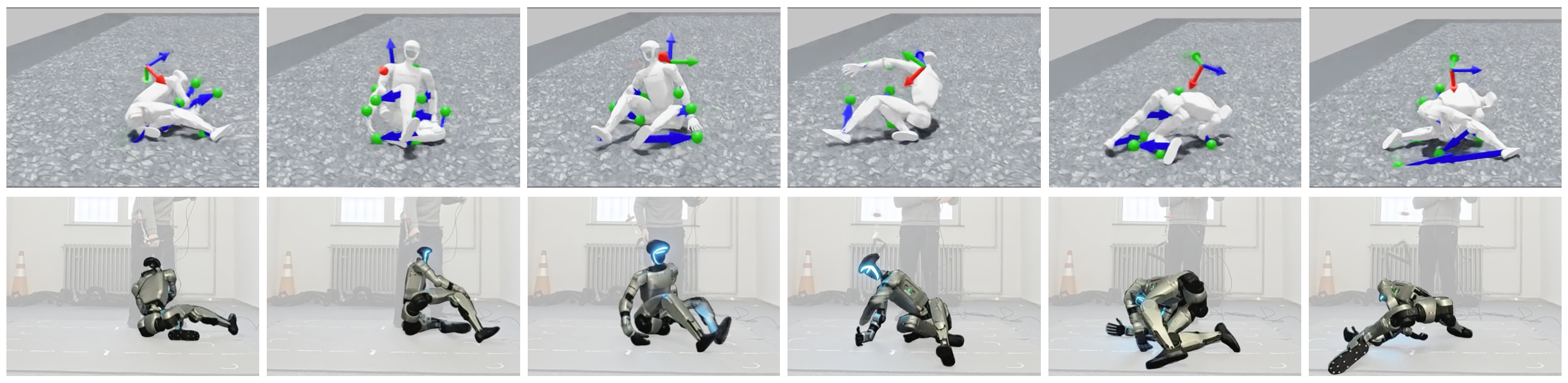
In randomized simulation, the complete method achieves 94.30% success for getting up and 98.25% for ground interactions. Hardware demonstrations show transfer without external motion capture, but the paper does not report corresponding numerical hardware success rates. The selected motion set and replayed commands establish a focused proof of concept rather than a general whole-body controller.
1 Introduction
Whole-body humanoid control should accommodate lying down, kneeling, getting up, and transitions that contact the floor with more than the feet. Such motions challenge both the command interface and the simulation-to-hardware training pipeline. The central question is whether a learned controller can execute these contacts without a predefined contact schedule.
1.1 Challenges in Motion Command Interface
Velocity commands become ambiguous when the torso rolls or pitches through large angles, while tightly tracking every human motion frame can demand physically infeasible robot configurations. Human and robot kinematics differ, and broad datasets such as AMASS emphasize standing motions. The proposed interface supplies future body poses, joint positions, and link positions in a robot-relative frame, using selected ground-contact motions as references.
1.2 Challenges in Producing a Deployable Humanoid Control Policy
Rigid-body simulators approximate collisions, and model-based contact planning becomes harder as additional body parts touch the environment. This work tests whether simplified collision geometry plus domain randomization can still support real ground-contact behavior. Its main components are a variable-length keyframe encoder, separate treatment of sparse task and dense regularization signals, and replay of relative motion commands without ongoing global odometry feedback.
2 Related Works
The paper connects humanoid control, motion-command design, and simulation-trained locomotion. Its distinguishing emphasis is contact sequences involving multiple body parts and large torso rotations.
Humanoid Whole-Body Control
Model-based whole-body controllers and many learned policies concentrate on locomotion with a limited set of expected contacts. WoCoCo, OmniH2O, and concurrent getting-up controllers broaden this setting. The present evaluation focuses on physically imperfect human references and unexpected full-body floor contacts, rather than claiming that prior work never considered such interactions.
General Motion Interface for Humanoid
Locomotion goals plus upper-body targets simplify control but restrict detailed whole-body motion. Dense imitation, as in DeepMimic and related systems, can overconstrain an infeasible reference. Future-frame interfaces such as RobotKeyframing and MaskedMimic relax the high-level update rate. This work instead emphasizes replayable robot-relative keyframes without external global pose tracking.
Sim-to-Real for Legged Robots
GPU simulation and simplified collision models have enabled robust locomotion and parkour. The question here is whether those approximations remain useful for ground motions with unplanned body contact, including a mismatch between simulated rigid hands and real deformable hands. Hardware demonstrations provide evidence for the tested motions, not arbitrary surfaces or contact conditions.
3 Methods and Implementations
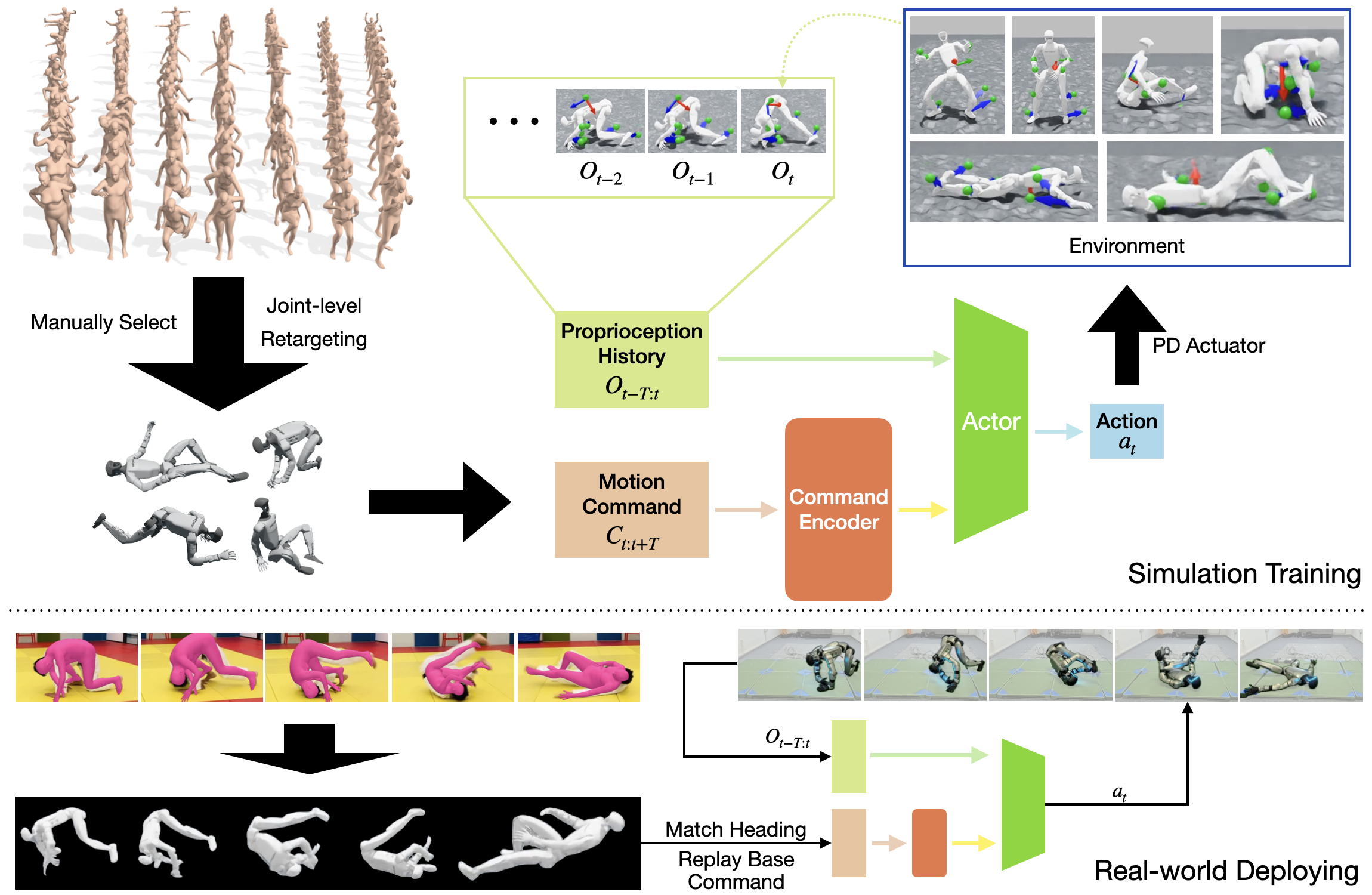
The pipeline retargets selected human motions, trains a low-level joint controller in simulation, and records commands from successful simulated rollouts for hardware replay.
3.1 Pipeline Overview
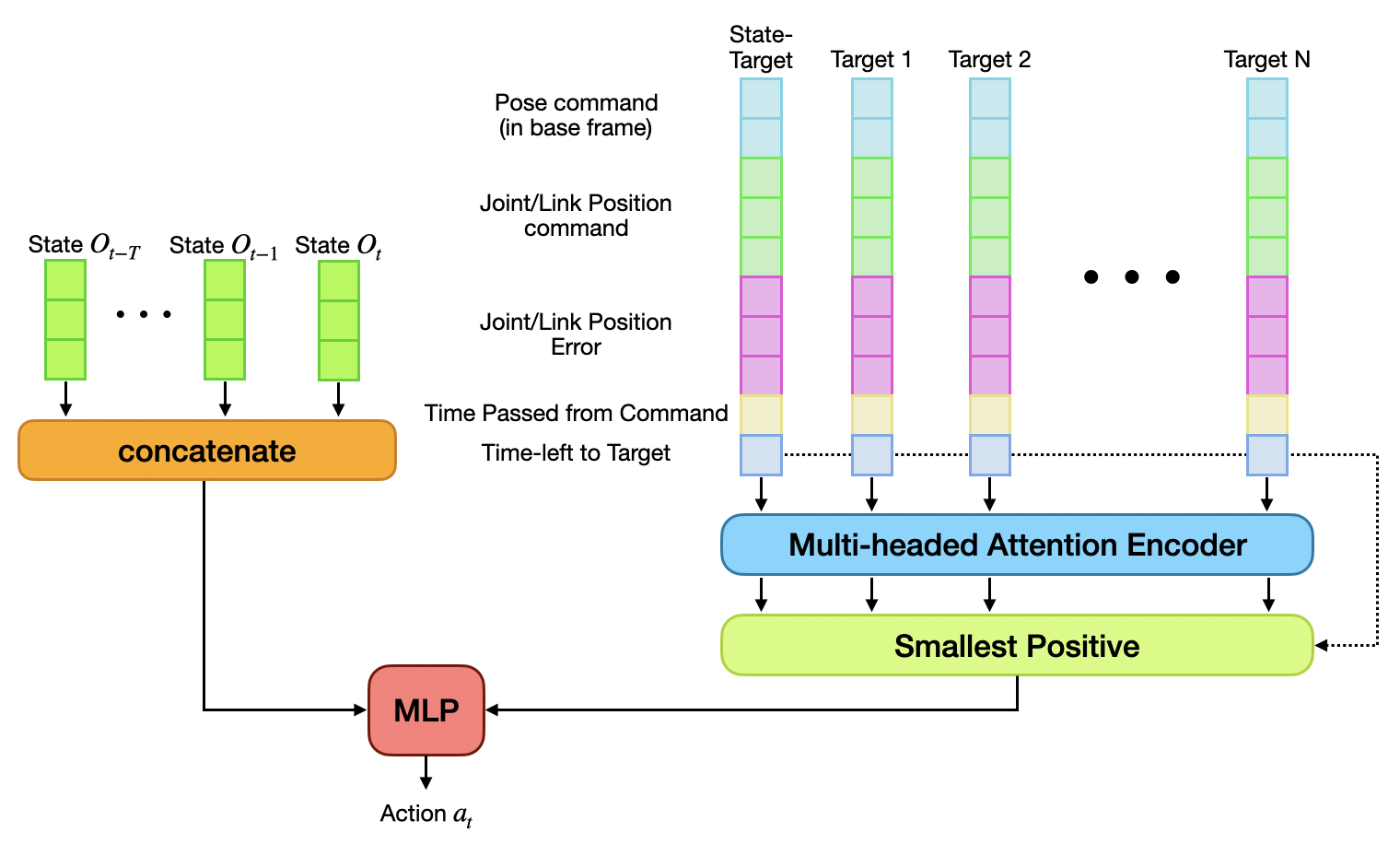
Motion references use SMPL human poses retargeted to the robot. Each target frame contains a base transform relative to the robot frame when commands are refreshed, joint and link positions, tracking errors, elapsed time, and time remaining. The command encoder’s output and a history of proprioception feed an MLP actor; a PD controller converts its joint-position targets to motor torques. The controller is rewarded for reaching selected future frames, leaving freedom between them.
3.2 Addressing the Data Challenges
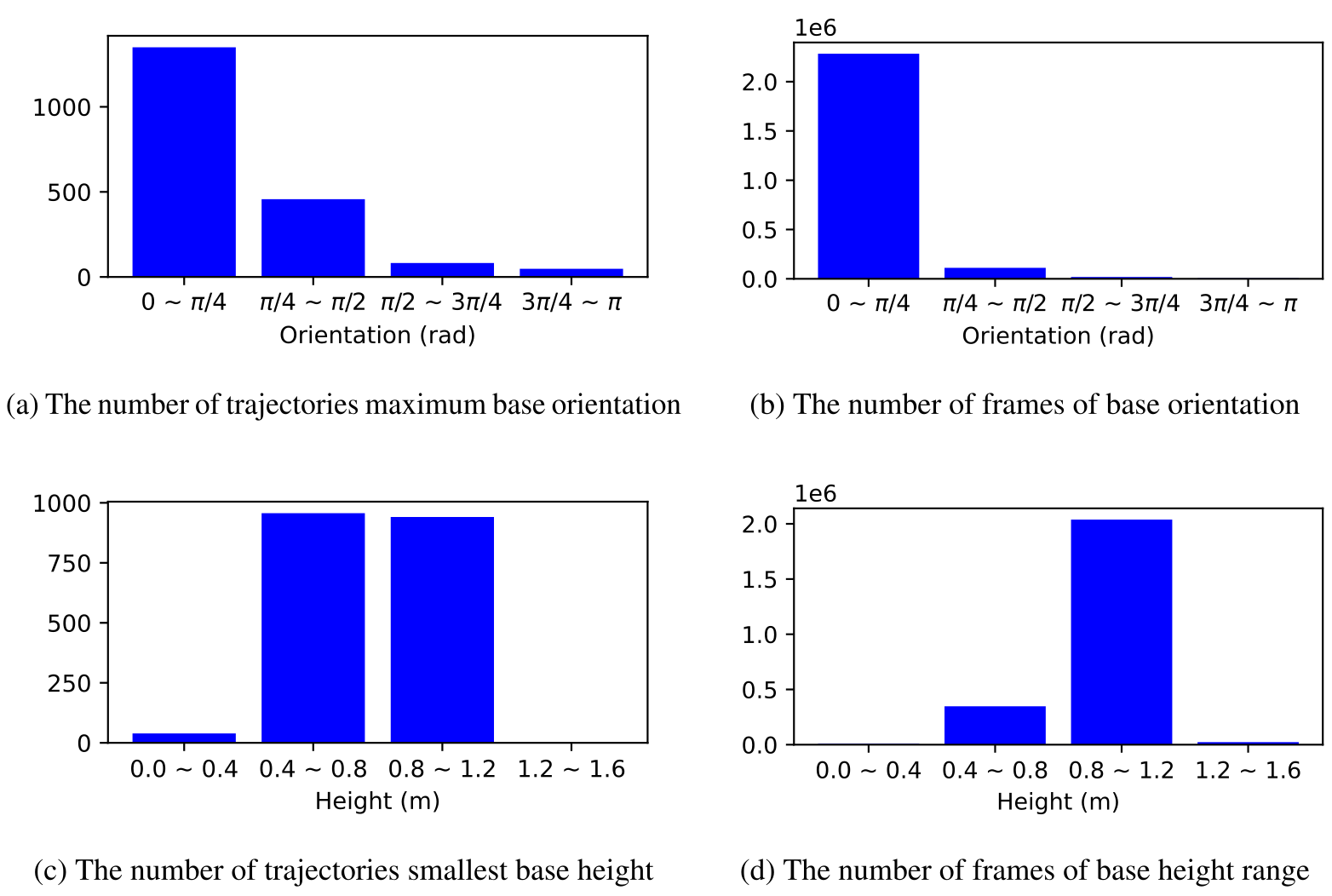
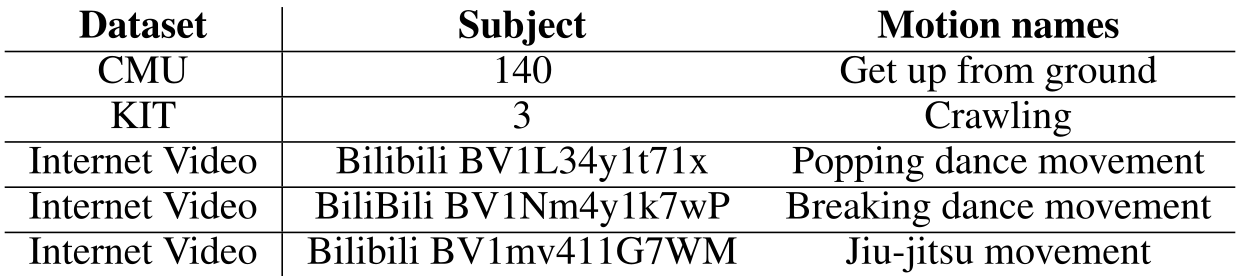
The extreme-action set combines selected AMASS motions with Internet videos reconstructed using 4D-Human. The appendix lists five source entries: getting up, crawling, popping, breaking, and jiu-jitsu. Selection compensates for the dominance of upright postures in the broad dataset.
Retargeting does not ensure physical feasibility: a reference can float above or penetrate the ground. The training termination bounds allow up to 0.5 m position error and 1.0 rad orientation error before ending an episode. These tolerances permit feasible alternatives to exact tracking; they do not make the original reference physically valid.
3.3 Network Design and Model Training
A Transformer encodes the available future targets. The actor uses the embedding with the smallest positive time-to-target, concatenated with proprioceptive history. Joint and link errors are refreshed in real time in the robot’s local frame. The appendix’s deployed network has one attention head, two encoder layers, and a 29-dimensional joint-position action.
Task rewards are evaluated when the target frame is due, whereas action-rate, acceleration, and joint-limit penalties are dense. Simply adding these signals can create abrupt corrections near a keyframe. The method therefore augments PPO with separately learned reward critics and advantage mixing.
3.4 Advantage Mixing for Sparse Task Rewards
Three critics estimate returns for task, regularization, and safety reward groups. Following multi-critic reinforcement learning, each is trained separately, then its generalized advantage estimate is normalized using its own batch mean and standard deviation. A weighted sum of these normalized advantages drives the shared actor.
The published equations are retained exactly. Equation 1 prints the first group’s reward r⁽¹⁾ for every critic, although the accompanying text specifies each critic’s own group; the summation indexing in Equation 2 is also generic despite the stated three critics. The implementation description and appendix weights [0.7, 0.1, 0.2] clarify the intended three-group design.
Equations


3.5 Real-world Deployment
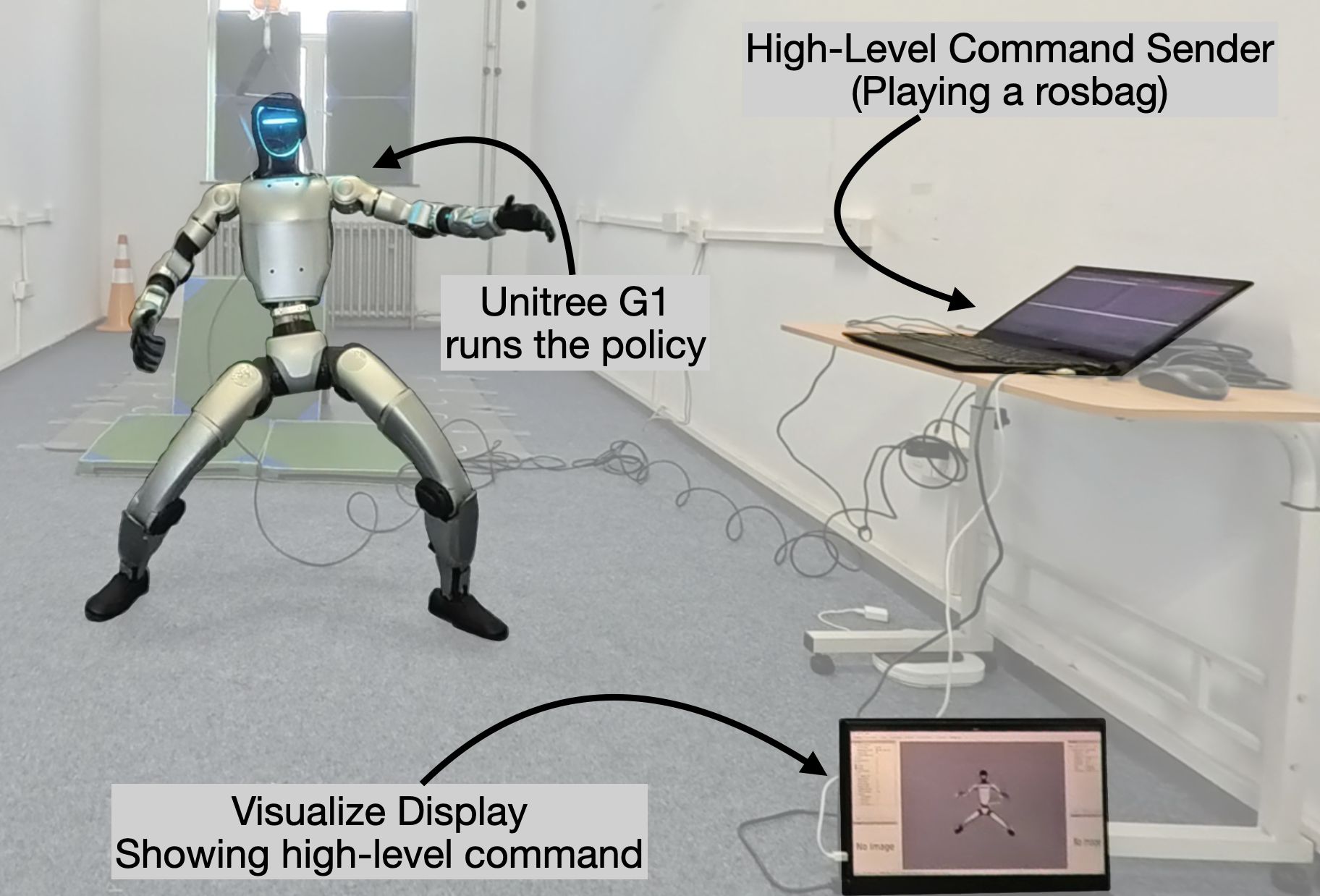
The policy and forward kinematics run onboard the G1 using ONNX, with ROS2 communication and a separate laptop sending recorded high-level commands. Before deployment, the trained controller executes each motion in simulation; joint, link, and base targets are recorded and replayed on hardware.
The high-level base trajectory is replayed without correcting its drift against external motion capture. The low-level policy still receives proprioceptive feedback and updates local tracking errors. Thus open-loop command replay does not mean open-loop motor control.
4 Experiments
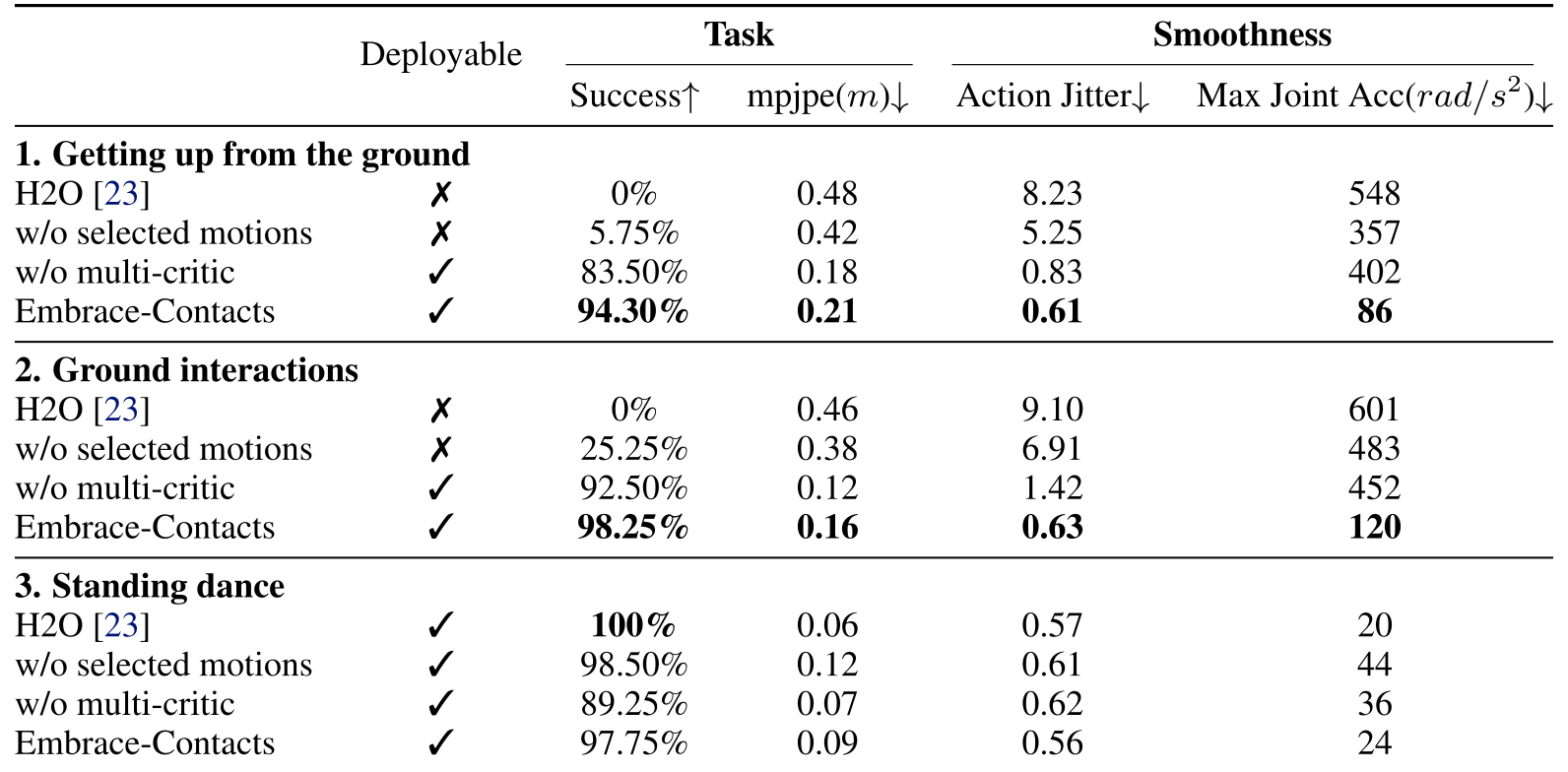
Evaluation covers getting up, ground interactions, and standing dance. Quantitative tests use 1,000 simulated robots with uniformly sampled domain-randomization parameters, repeated ten times. Hardware sequences demonstrate all three categories; success is judged by completing the command sequence without unexpected head contact, with additional torso-deviation termination for getting up.
The complete method reaches 94.30%, 98.25%, and 97.75% simulated success across these categories. H2O scores 0%, 0%, and 100%, respectively. The complete method therefore improves the two ground-contact categories while not leading standing-dance success. The table’s deployability checkmarks are separate from these simulation percentages.
4.1 Importance of using an Extreme-Action dataset
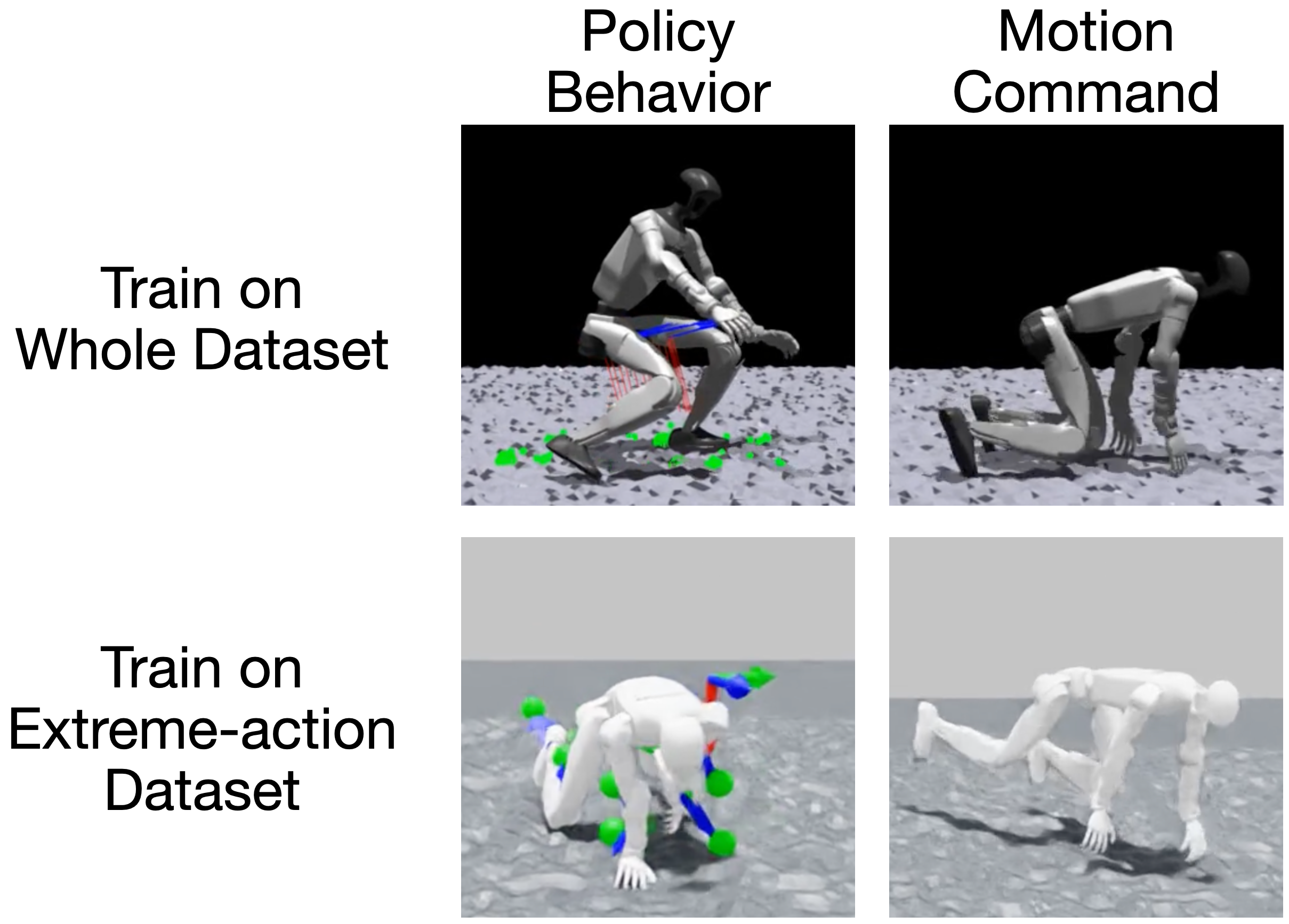
Training on the full AMASS dataset produces a policy that tends to squat rather than place its hands on the ground. With the selected motions, getting-up success increases from 5.75% to 94.30%, and ground-interaction success from 25.25% to 98.25%. Standing-dance success is slightly lower, 97.75% versus 98.50%. This is a targeted distribution change; broad motion generalization is not established.
4.2 Effectiveness of Multi-Critic
Compared with a single scalar reward, advantage mixing raises getting-up success from 83.50% to 94.30% and ground-interaction success from 92.50% to 98.25%. Maximum joint acceleration falls from 402 to 86 and from 452 to 120 rad/s². Action jitter also falls in every category.
Tracking accuracy does not uniformly improve: mean per-joint position error increases from 0.18 to 0.21 m for getting up and from 0.12 to 0.16 m for ground interaction. The result supports a tradeoff between exact reference tracking, completion, and smoothness, rather than dominance on every metric.
4.3 Importance of Adding Future Motion as Command
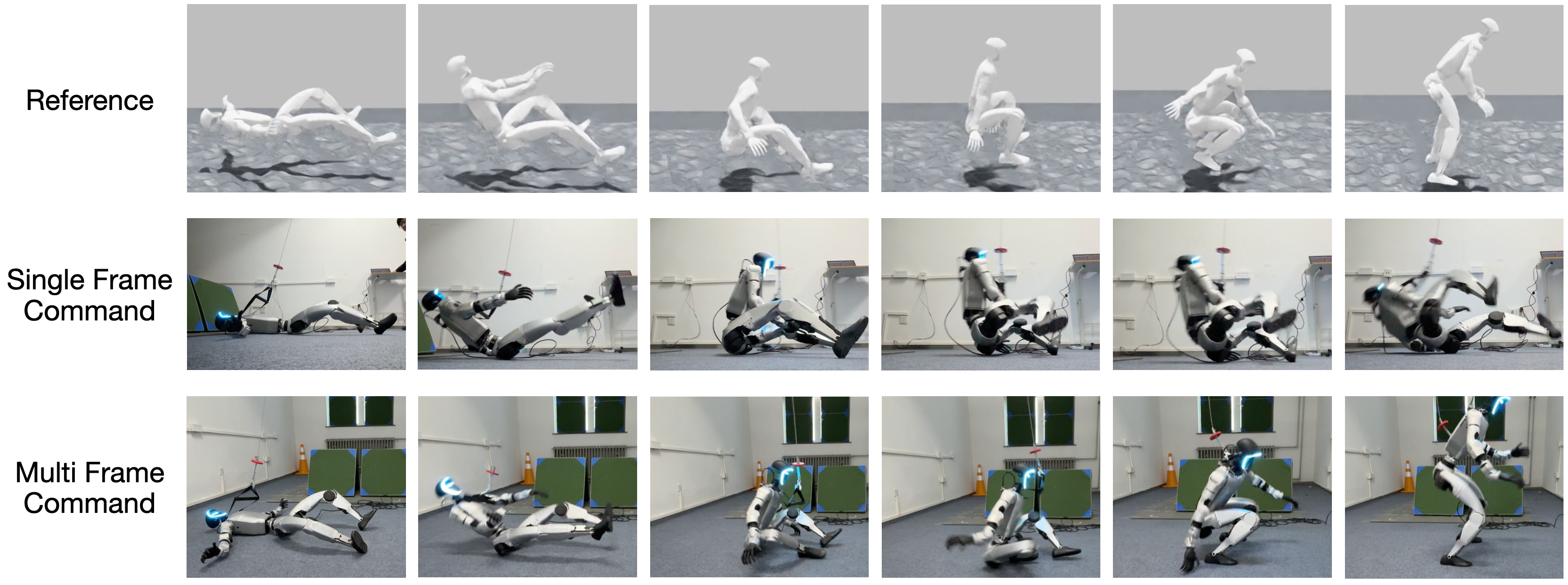
The real-world comparison shows a single-target policy maintaining local tracking but failing to complete a getting-up motion. Multiple future frames give the controller information about the intended transition. The figure provides a qualitative example; this section does not report a separate aggregate success-rate ablation for the number of future frames.
5 Conclusion and limitations
Simulation-trained control can execute selected full-body ground-contact motions on hardware despite imperfect retargeting and collision models. Sparse future targets and separately normalized reward advantages make this focused set of motions more practical.
A general controller still needs more diverse high-quality references or better human-to-robot adaptation. Integration with a learned high-level command generator, including abstractions for leg commands, remains future work. The study does not demonstrate arbitrary contact-rich tasks, manipulation, or broad unseen-motion generalization.
6 Appendix
The supplement gives additional training curves, simulator settings, data sources, reward formulas, network and optimization parameters, and onboard deployment details. The project page hosts the accompanying real-time demonstration videos.
A More Results
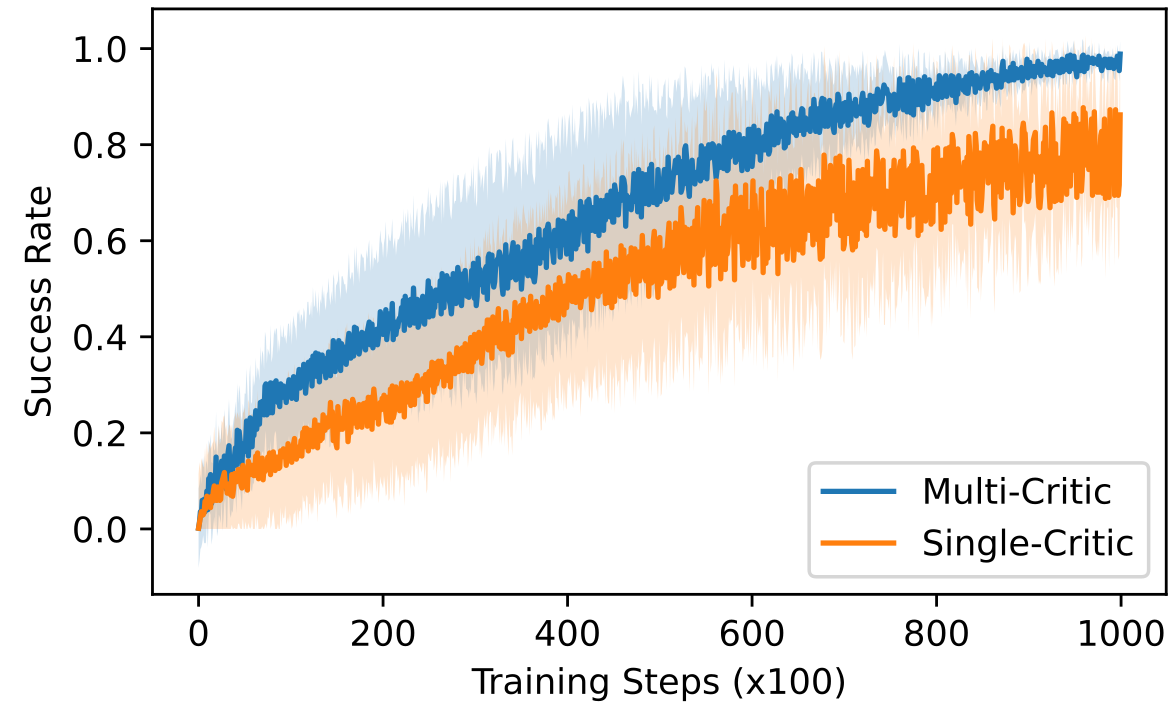
The training curve compares single- and multi-critic policies on four difficult contact motions. The multi-critic curve rises faster and reaches a higher displayed success rate. The figure does not define its shaded-band statistic or provide independent-seed counts, so it does not by itself quantify statistical significance.
B Simulation Details
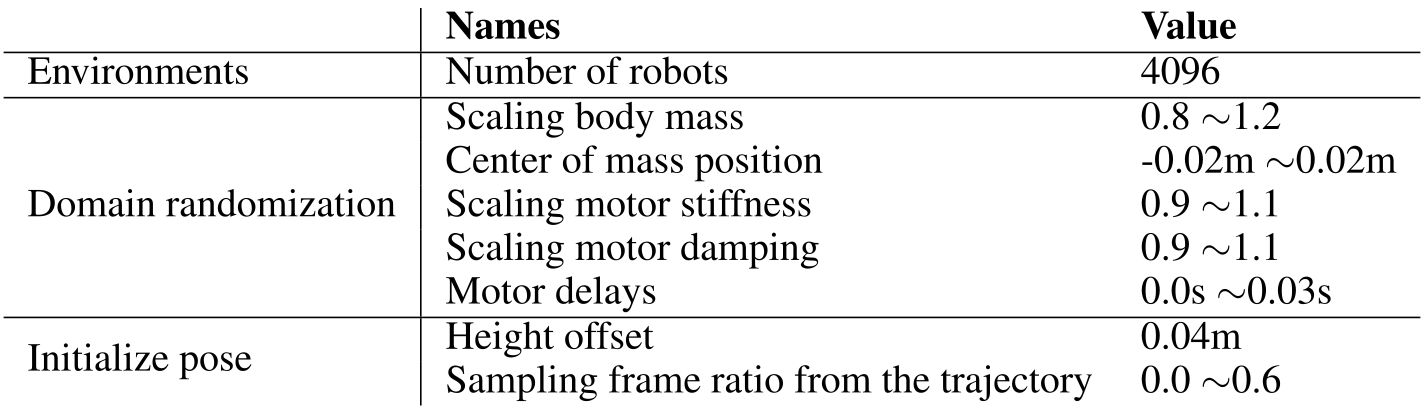
Initial joint positions come from a retargeted reference. References are shifted upward to avoid ground penetration, then given an additional spawn offset. The text says this is typically 0.06 m, whereas Table 2 lists 0.04 m; both source values are preserved. Initial frames are sampled from the first 60% of a trajectory to expose recovery states.
Each rollout samples one motion and supplies five future frames spaced by a presampled interval, at t+tᵢₙₜ through t+5tᵢₙₜ. Base targets are expressed relative to the robot frame at time t. Domain randomization varies body mass, center of mass, motor stiffness and damping, and motor delay according to Table 2.
C Training Details
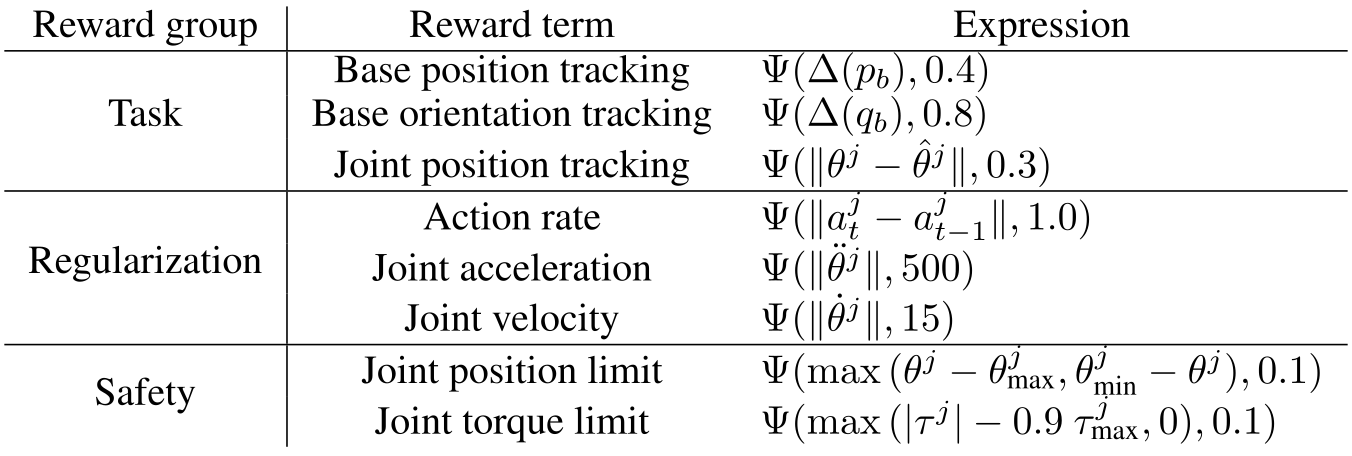
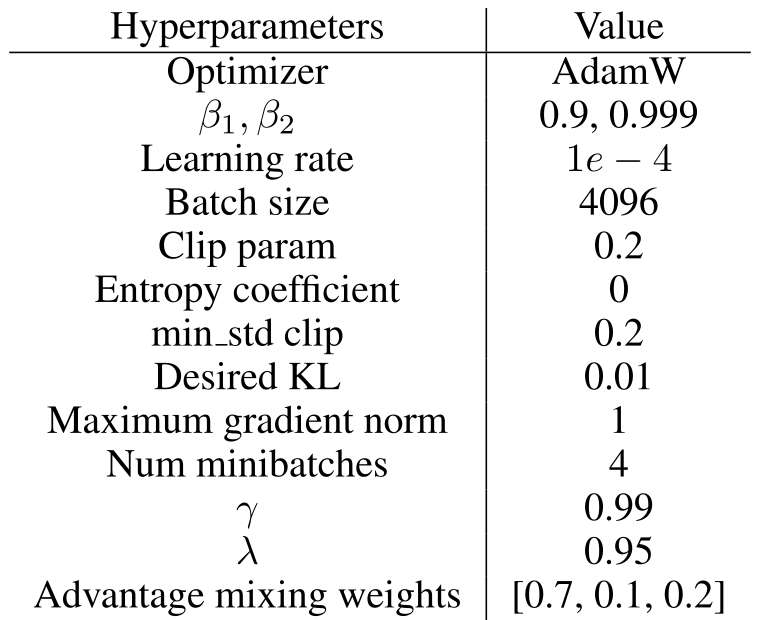
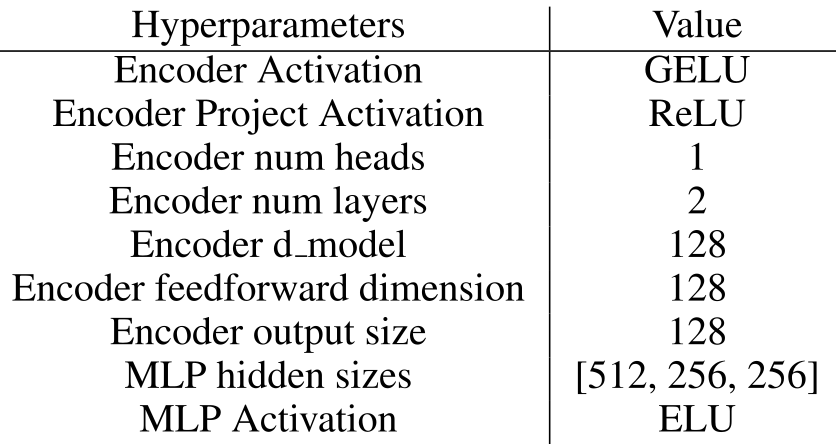
Training uses 4,096 parallel robots for about 72 hours on an NVIDIA 4090D GPU, with IsaacLab and a modified rsl_rl implementation. The selected source motions, reward groups, optimizer settings, and architecture are retained in Tables 3–6. The Transformer embedding is followed by MLP hidden layers [512, 256, 256], producing targets for 29 joints.
Reward terms are multiplied within each group. The single-critic comparison forms a weighted sum of those group rewards; the multi-critic method instead normalizes their estimated advantages separately. The source calls Ψ a Gaussian kernel but prints exp(−a/b²), without an a² numerator, and the joint-position-limit formula lacks an explicit zero clamp. These expressions remain unchanged rather than silently imposing a different reward function.
Equation

D Deployment and Real-World Experiment Details
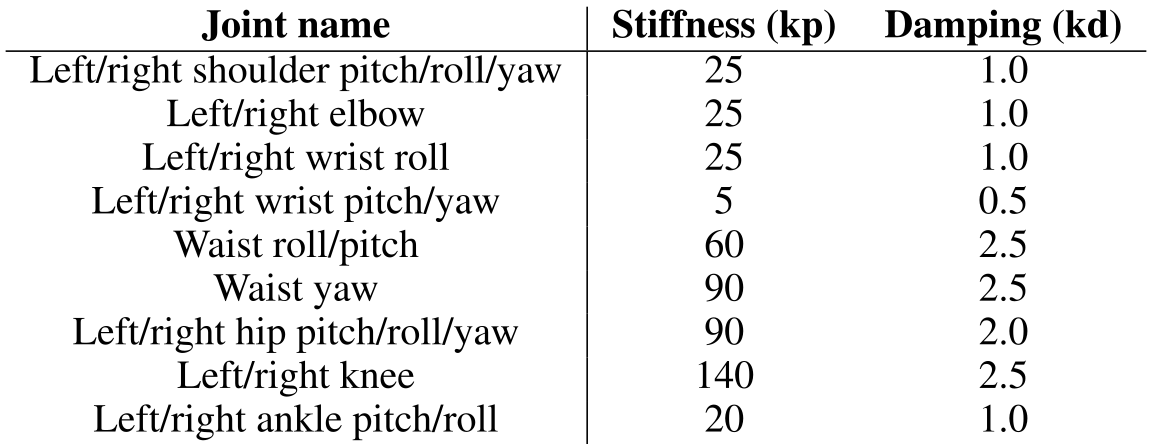
The ONNX policy runs at 50 Hz on Jetson Orin NX; the G1’s built-in PD controller runs at 1,000 Hz using the same stiffness and damping gains as simulation. PyTorch Kinematics supplies the forward-kinematics computation, exported through ONNX. Table 7 preserves every joint-group gain.
An Intel i5 laptop sends high-level commands and visualizes them. Those commands are recorded from the trained policy’s simulated motion rather than sent directly from the human SMPL file. Base-pose differences between simulation and hardware are ignored during replay. Hardware success is assessed without external motion capture by sequence completion, head contact, and the specified getting-up termination condition; no hardware trial count or numerical success rate is supplied.
E Data distribution analysis
The four histograms count trajectories and frames by maximum base rotation and minimum base height. Most references remain upright and above 0.4 m, explaining why unbalanced sampling underexposes ground contact. The analysis motivates the curated set, but does not show that this small set covers the full distribution of feasible humanoid motions.