At a glance
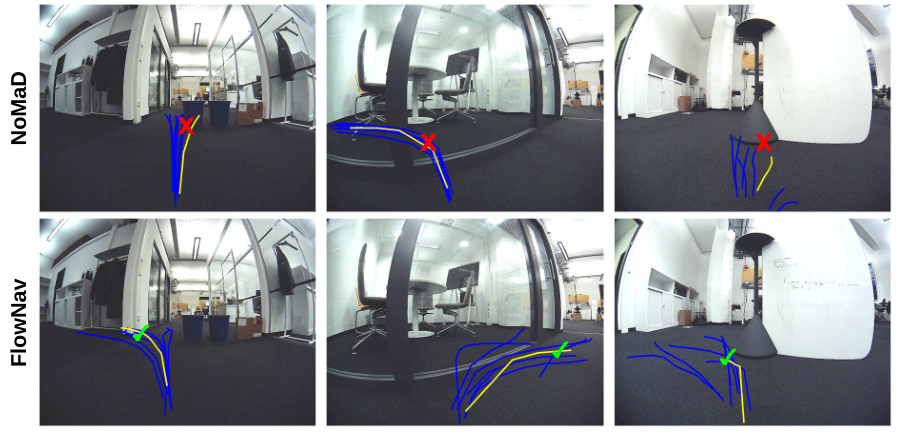
FlowNav combines conditional flow matching for waypoint generation with visual features from a pretrained monocular depth model. It adapts NoMaD’s shared goal-navigation/exploration architecture and trains on mixed robot-navigation data. TurtleBot4 experiments report fewer collisions and good performance with fewer generative integration steps than the diffusion baseline. The evidence supports these two changes in four indoor environments; the policy still makes collisions and does not provide a collision-avoidance guarantee.
I Introduction
Image-conditioned navigation must infer useful geometry and generate control actions quickly. FlowNav addresses these separately: a depth-model encoder adds geometric priors, while a learned velocity field transports Gaussian samples into waypoint trajectories. The motivation is to reduce the iterative inference burden of diffusion without losing multimodal actions. The model takes monocular RGB observations at deployment, so the depth prior does not require a physical depth sensor. Cross-embodiment refers to the heterogeneous training corpus; the reported physical evaluation uses one robot platform.
II Related Work
II-A Classical Navigation
Classical navigation combines mapping/localization with path planning. The paper contrasts their environment-dependent tuning with learned visual policies, but does not experimentally compare FlowNav against a classical planning stack. Its results therefore concern the selected learned baseline rather than demonstrating that maps or geometric planning are generally inferior.
II-B Learning-based Navigation
Prior visual policies learn actions from observation histories and goal images, sometimes normalizing action coordinates to combine multiple robot platforms. Other systems add language, image synthesis, or augmentation. FlowNav follows image-goal navigation and adds features from a depth foundation model; language grounding and reinforcement-learning navigation are outside its scope.
II-C Diffusion-based Navigation Models
NoMaD [10] uses goal masking to share one policy between directed navigation and undirected exploration, while diffusion generates multimodal waypoint sequences. FlowNav retains that organization and replaces the denoising process with flow matching. The intended advantage is satisfactory actions with fewer inference steps, not a lower cost for every network evaluation. Earlier approaches such as ViNT and GNM motivate the design but are not directly re-evaluated in the experiments.
III Overview
III-A Problem Formulation
A policy receives the current frontal camera image and a recent image history, optionally with a goal image, and samples a horizon of future two-dimensional waypoints. The learned distribution supports different possible exploratory routes. Robot-specific control subsequently converts these normalized waypoints into executable motion.
III-B Navigation with Goal Masked Diffusion (NoMaD)
The baseline conditions a noise-prediction U-Net on visual context and repeatedly denoises Gaussian action samples. Its observation and goal encoders feed a four-layer, four-head transformer. FlowNav changes the action objective and adds depth tokens to this shared context, enabling an ablation that separately tests the action generator and perception prior.
Equations 1–2
| (1) |
| (2) |
IV Methodology
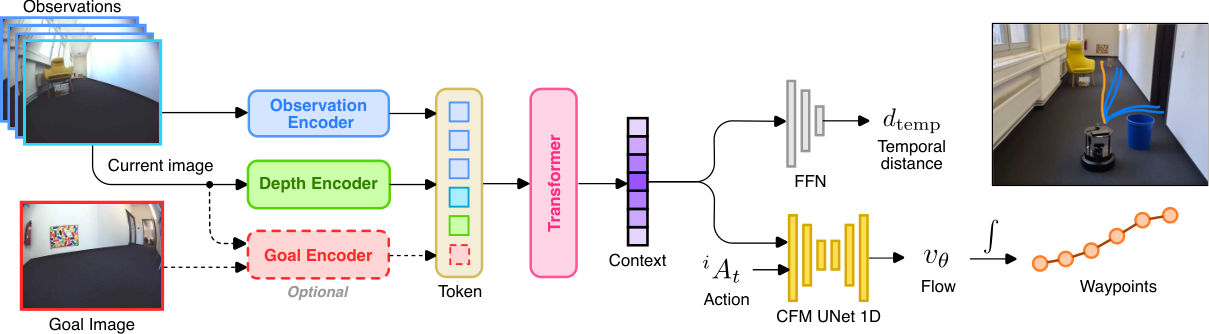
The architecture combines observation, optional goal, and depth-model tokens, then uses the resulting context for both temporal-distance prediction and flow-based waypoint sampling.
IV-A FlowNav Architecture
One EfficientNet-B0 encodes each observation; a second encodes the current image concatenated with the goal image. Goal tokens are masked for exploration. The current image also passes through the ViT-small DINOv2 encoder of Depth Anything V2 [40], producing 384-dimensional features. Adaptive pooling to 64 positions, flattening, and an MLP convert these into depth tokens. A four-layer, four-head transformer integrates all tokens. One MLP predicts temporal distance to the goal, while a one-dimensional conditional U-Net predicts action-space velocity. The system uses depth-pretrained features rather than explicitly reconstructing a metric depth map or checking collision geometry.
IV-B Flow Matching Objective
Flow matching learns a time-varying vector field that transports a simple noise distribution to the target action distribution. The marginal vector field is difficult to supervise directly. Conditional flow matching instead samples endpoint pairs and regresses a tractable conditional velocity; the cited theory [16, 17] gives the same parameter gradient as the marginal objective under its assumptions. FlowNav uses independent noise/data coupling and zero path variance: an intermediate sample is the linear interpolation of its endpoints, with target velocity equal to the data endpoint minus the noise endpoint. Straight training interpolants motivate few-step inference, although the learned marginal flow need not be an exact straight trajectory.
Equations 3–9
| (3) |
| (4) |
| (5) |
| (6) |
| (7) |
| (8) |
| (9) |
IV-C FlowNav Policy
At a random training time, the U-Net predicts the velocity from a Gaussian action sequence toward the demonstrated waypoint sequence, conditioned on visual context. Its squared-error loss is added to a weighted temporal-distance regression loss. At inference, Gaussian samples are integrated from time zero to one with first-order Euler updates; the number of updates is the inference-step budget. Output waypoints are unnormalized for the robot controller. Goal-directed operation requires a previously collected topological image map, with temporal-distance estimates used to relate observations and map nodes. Goal-masked exploration produces multimodal local routes and can collect that map. Thus the image-only policy is not evidence of map-free long-range goal navigation.
Equations 10–15
| (10) |
| (11) |
| (12) | ||||
| (13) |
| (14) |
| (15) |
V Experiments
V-A Implementation Details
The comparison trains plain NoMaD, depth-augmented NoMaD, FlowNav without depth, and full FlowNav on the same splits. The prediction horizon is eight waypoints, and the observation-history parameter is three. Training uses an H100, batch size 512, AdamW, and initial learning rate 10⁻⁴. The baseline cosine schedule made flow training unstable, so alternative schedules were explored; half-cosine warmup and one-cycle training performed similarly. Full FlowNav is trained for 30 epochs, while the depth-free version works best at 17. Different selected schedules/epoch counts should be considered when interpreting the architectural ablation.
V-B Datasets
Training combines Go Stanford, RECON, Tartan Drive, SACSoN, and SCAND, providing indoor/outdoor data from different robots. Random trajectory segments provide observation context and future image goals. Actions are normalized as in earlier cross-robot navigation work. The authors retrain the baseline on this same subset, supporting a controlled comparison but using less data than the original released NoMaD model.
V-C Deployment
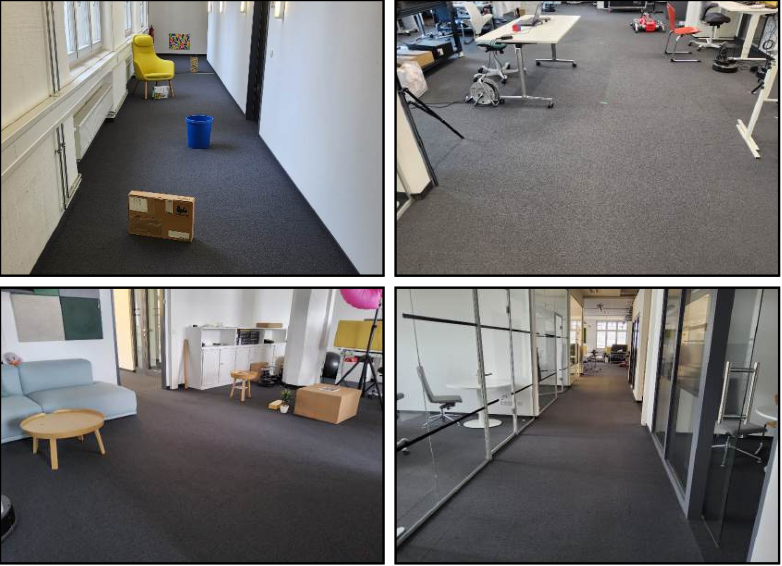
All physical tests use a TurtleBot4 with a 15 Hz wide-angle camera, ROS 2 Humble communication, and inference on an RTX A500 laptop GPU. Four indoor environments include gentle/tight turns, boxes, chairs, table legs, glass, and clutter. These conditions test several perception difficulties but do not establish outdoor deployment, new physical embodiments, or performance on a broad independently sampled set of buildings.
V-D Experimental Results
Navigation is measured by goal-reaching success and minor collisions per run. A frontal collision or becoming stuck for more than ten seconds counts as a major unrecoverable collision. Exploration follows a closed route and records collisions. The paper does not give the number of runs behind each reported fraction or confidence intervals, limiting assessment of statistical uncertainty.
V-D 1 Baseline Comparison
With ten inference steps, NoMaD reaches the goal in 80% of reported trials with 0.7 minor collisions per run; adding depth raises success to 90% and reduces collisions to 0.6. Both FlowNav variants report 100% success, but depth reduces navigation collisions from 0.7 to 0.2. In exploration, collisions per run are 5.0 for NoMaD, 1.5 with depth, 4.5 for depth-free FlowNav, and 1.0 for full FlowNav. The large exploration benefit from depth in both generators supports the perception contribution. Full FlowNav remains imperfect: perfect reported goal success coexists with nonzero collisions.
V-D 2 Qualitative Results
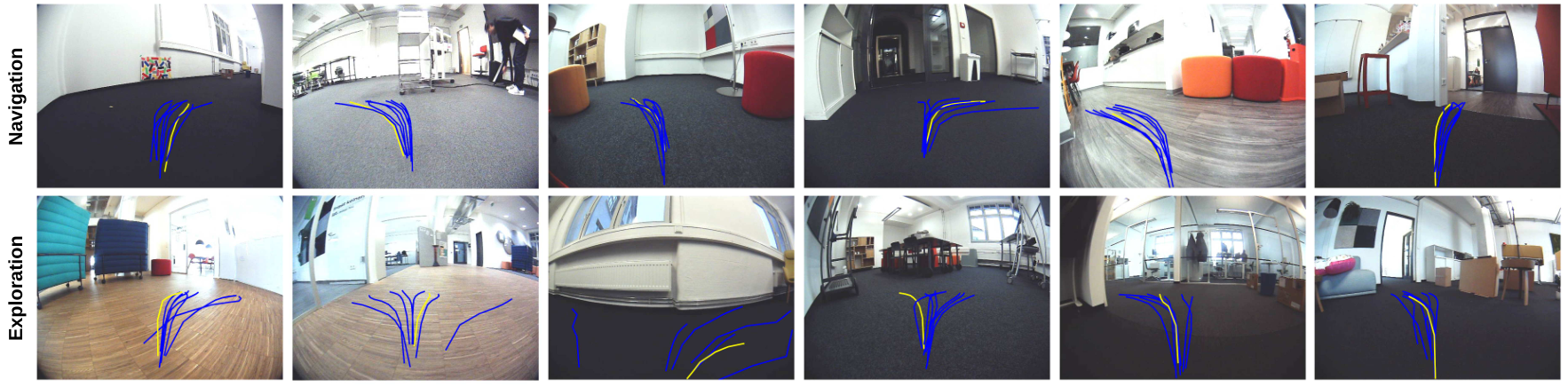
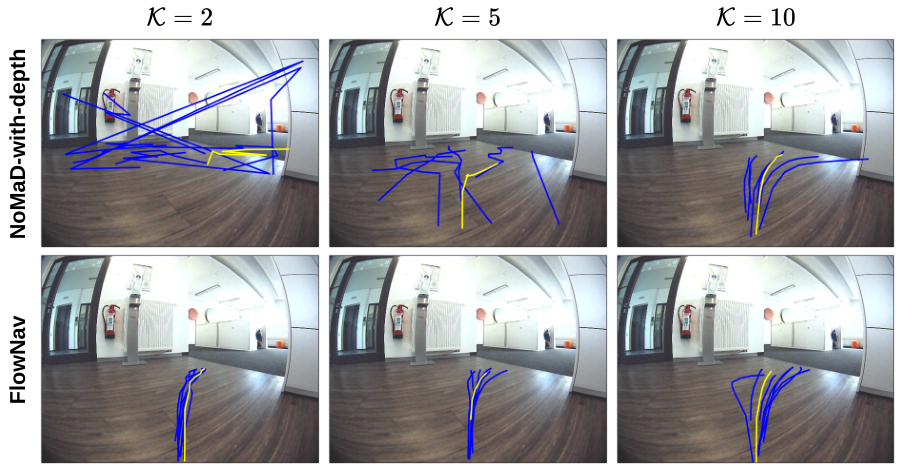
Rollouts show multiple sampled trajectories, with a randomly selected yellow trajectory executed. Goal conditioning concentrates trajectories toward a destination; goal masking permits distinct exploratory directions. These examples illustrate the learned distribution, but random sample execution supplies no explicit safety filter or optimal-route selection.
V-D 3 Training Data Ablation
The original pretrained NoMaD model averages three exploration collisions per run, improving on the five from the retrained subset baseline but remaining above depth-augmented NoMaD’s 1.5 and FlowNav’s one. This suggests that both training-data scale and depth features influence the result. It is an exploration-only check, not a complete matched-data replication of every benchmark.
V-D 4 Inference Steps Ablation
The step-count ablation uses simpler routes with soft turns and no inserted obstacles. At two steps, depth-augmented NoMaD has zero navigation success, whereas FlowNav reaches 75%; at five steps, the rates are 25% and 100%; at ten, both reach 100%. The corresponding FlowNav navigation collision counts are 0.25, zero, and zero. In exploration, FlowNav succeeds at all three budgets while the baseline improves from zero to 75% to 100%. The evidence supports fewer flow steps in these simplified settings; it does not show that two-step performance matches ten-step diffusion in the original cluttered environments.
V-D 5 Inference Time
Reported action inference times for NoMaD are 17.2, 26.7, and 44.8 ms at two, five, and ten steps; FlowNav takes 19, 26.4, and 48.6 ms. Costs at equal step counts are similar, with FlowNav sometimes slower. The speed advantage comes from using fewer steps: two-step FlowNav is about 2.4× faster than the table’s ten-step NoMaD result, while the simplified navigation success rates are 75% and 100%, respectively. The table labels NoMaD generically although the performance step ablation uses its depth variant, and it reports action inference rather than a measured complete sensing-to-control latency.
VI Conclusions
FlowNav’s strongest evidence is the combination of fewer collisions with depth-pretrained features and effective few-step flow sampling. Limits are the single physical robot, four indoor environments, unspecified run counts/uncertainty, residual collisions, different chosen training schedules, and a simplified inference-step test. Goal navigation still relies on a collected topological map. Future proposals include reinforcement learning for route selection and learned implicit representations to replace that map; neither is demonstrated here.
Acknowledgments
The authors acknowledge computing resources from NHR@FAU under BayernKI and support from the Körber European Science Prize.