At a glance
Playful DoggyBot equips a Unitree Go2 with a passive mouth-like gripper and learns to approach, jump toward, and catch a small ball. A recurrent policy converts proprioception, a compact target position, and an operator-selected speed into joint targets, while a separate onboard detector estimates the ball’s location.
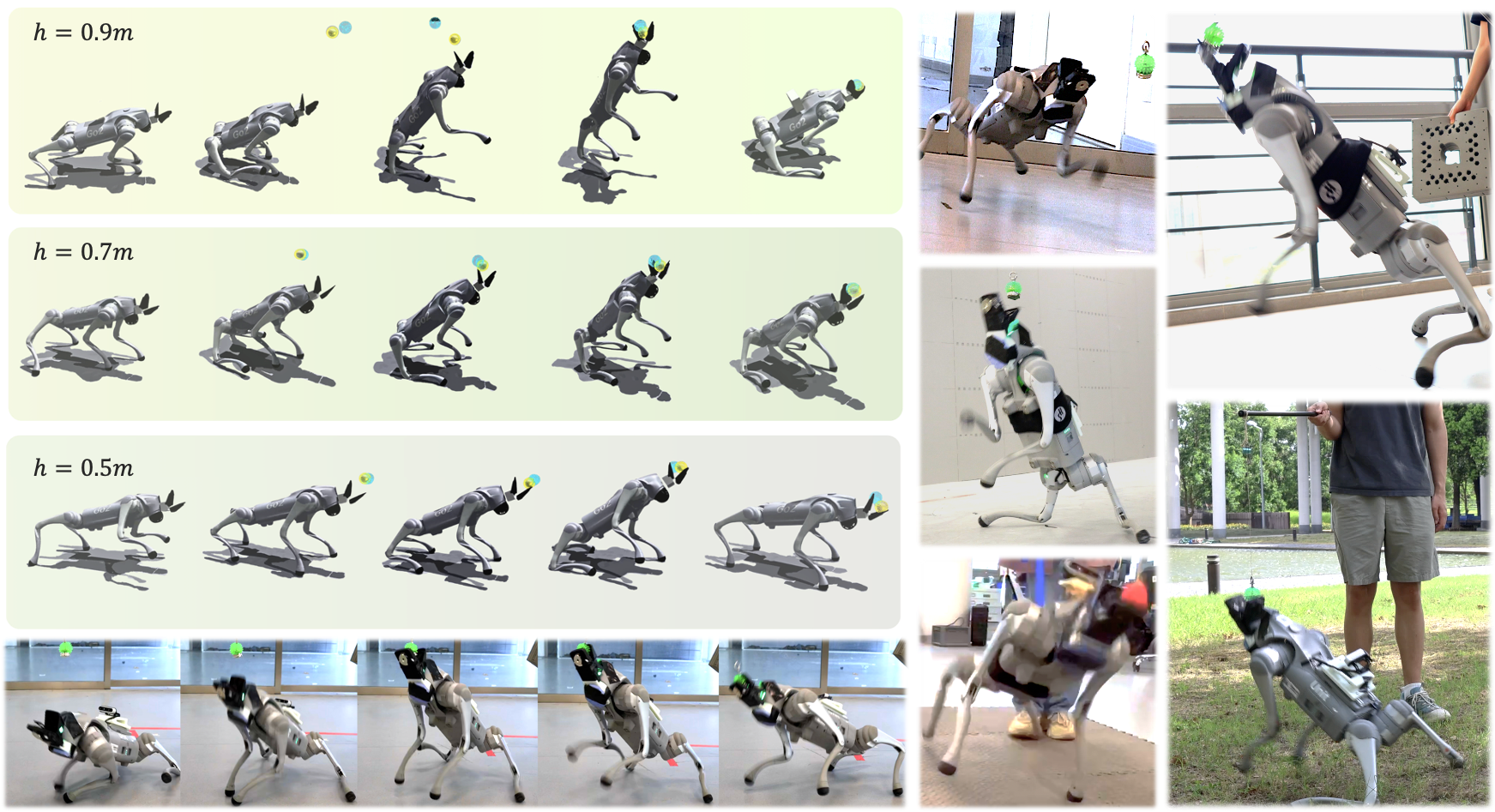
The system demonstrates pursuit of a human-moved suspended ball at up to 3 m/s and catches at up to 0.8 m in the real world. The highest catches are occasional: at 0.8 m, GRU and Transformer policies succeed in one and two of ten trials, respectively. The reported 1.05 m maximum is a simulation demonstration, distinct from the tabulated simulation tests at 0.5, 0.7, and 0.9 m.
Task overview
The restored front-page figure shows simulated height-dependent gaits, a physical catching sequence, and indoor/outdoor demonstrations. Targets are suspended or human-held; this is not a validated free-flight interception benchmark.
I INTRODUCTION
Catching a ball no larger than about five centimeters requires its center to enter a gripper region below 25 cm². Simply jumping higher can strike an edge and knock the object away. Motion blur, depth misalignment, and delay become important: at 1.5 m/s, a 50 ms timing error corresponds to 7.5 cm of motion.
The study combines separate perception and control rates, a reward that changes from approach speed to near-target precision, a height curriculum, and network memory. The contribution is the complete dynamic catching system and an analysis of its sensitivity to height, sensing uncertainty, and training diversity.
II RELATED WORK
The work combines agile learned locomotion with a simple gripper, emphasizing accurate contact during motion.
II-A Legged Agile Locomotion
Model-based systems demonstrate running, jumping, and parkour but require detailed modeling. Learned controllers extend terrain robustness and dynamic skill repertoires; Robot Parkour Learning and Extreme Parkour provide related locomotion and reward ideas. Here the target is accurate end-effector contact rather than obstacle clearance.
II-B Quadrupedal Manipulation
Legged manipulation may use an arm, a leg, or a front gripper. Event-based catching uses a larger capture device and predicted interception location; Helpful DoggyBot combines movement and slower object retrieval. This system studies continuous pursuit and precise contact using onboard sensing and computation.
III METHOD
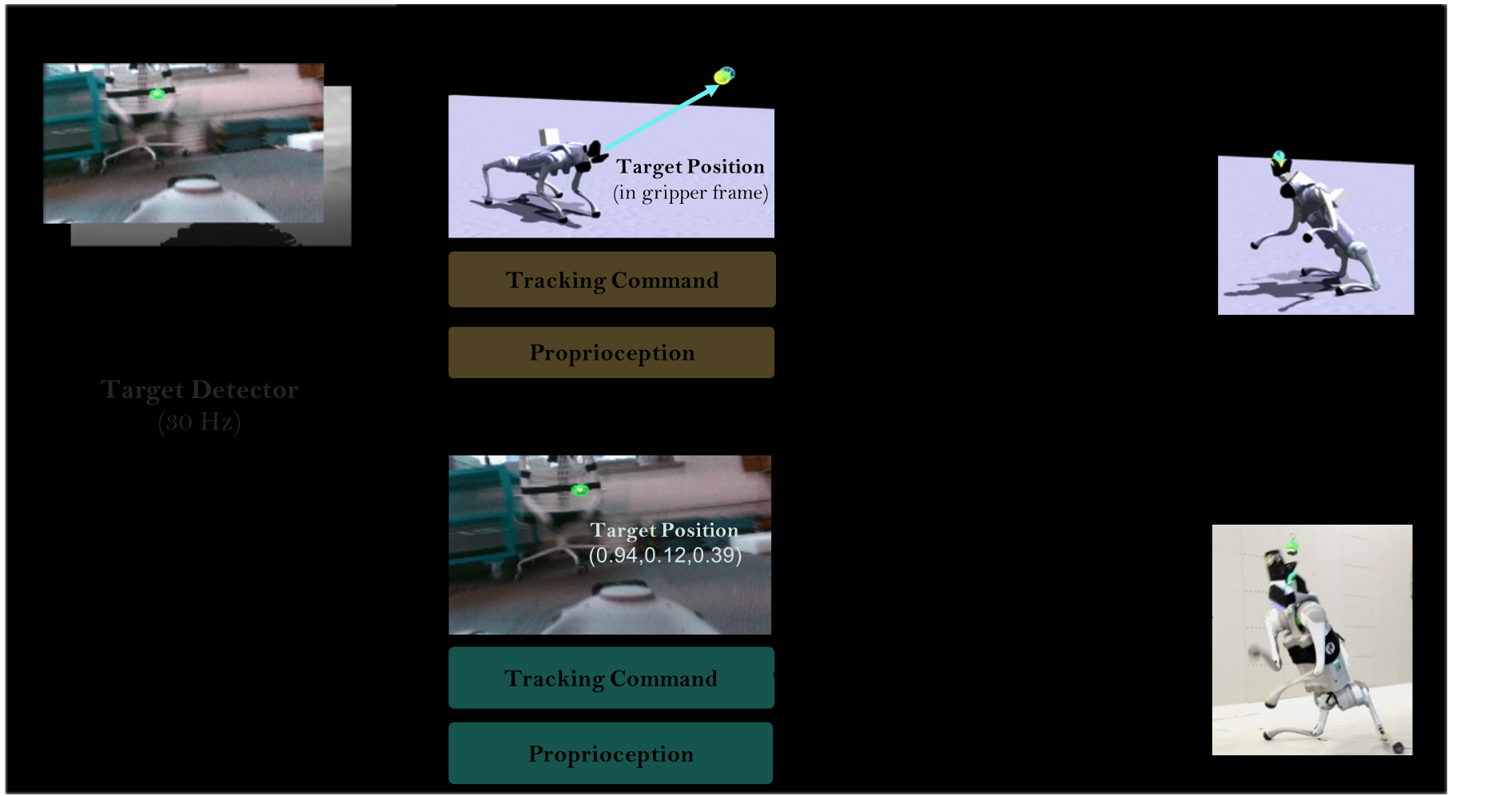
The control policy receives proprioception, target coordinates, and a commanded speed. It emits joint-angle targets at 50 Hz; a motor PD controller applies torques. The 30 Hz perception pipeline supplies compact object coordinates rather than depth images, allowing latency/noise to be modeled independently during training.
The operator supplies desired speed; the policy learns to move toward the object. Separating perception avoids rendering full depth observations in simulation and follows the idea of goal-point locomotion commands.
III-A Goal Oriented Reward
Far from the target, the reward encourages velocity projected toward it, capped by the commanded speed. Within a horizontal-distance threshold, an exponential position reward takes over. A yaw term favors facing the goal, and a binary catch reward distinguishes successful contact. Mechanical-energy regularization discourages wasteful motion.
The source describes precision in the gripper frame, but its equation explanation calls x the robot-base position; the formula is retained rather than silently resolving that notation inconsistency. Likewise, adding one to the near-target reward does not by itself guarantee it exceeds an arbitrary velocity reward without a suitable command range.
Training begins with low targets and gradually allocates episodes to higher ones after successful catches and stable landings. Jump exploration can stall beneath the object when distance reward outweighs the sparse catch incentive, so reward balance and curriculum matter. Numerical threshold/scaling and full reward-weight details are not all provided in the paper.
Equations 1–2
| (1) |
| (2) |
III-B Collision Shape and Grasping System in Simulation
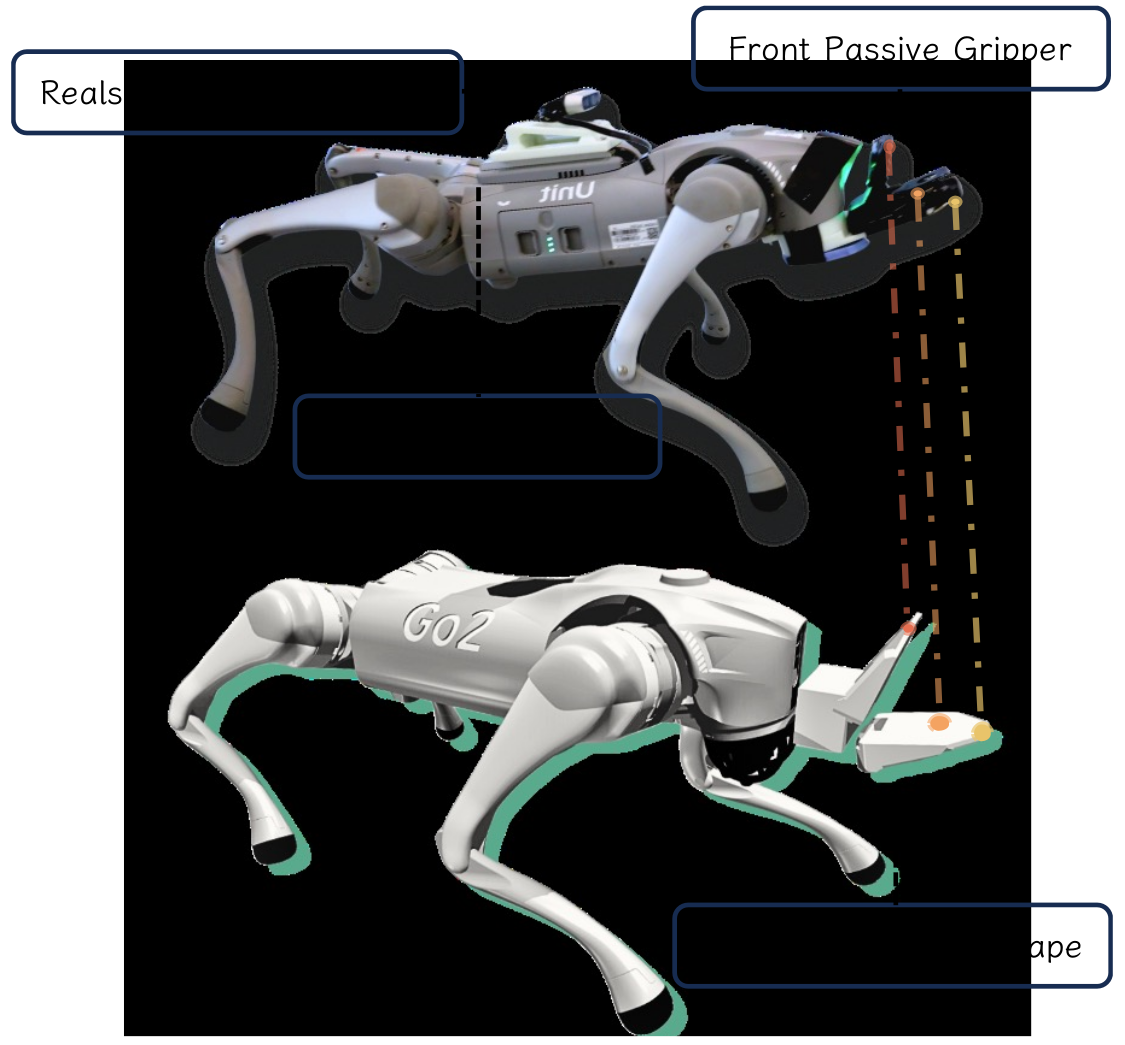
The simulation approximates the passive magnetic gripper with collision geometry and external forces rather than actively simulating closing jaws.
Collision Shape Setup
A physical impact triggers the real gripper to close. In simulation, a distance-gated PD force couples the ball and gripper once the ball is close to the mouth center. Equation 3 retains this force law, with grasp gains Kp = 150 and Kd = 2; the ball receives the opposite force. The approximation is task-specific and is not a detailed mechanical model of magnetic capture.
Equation 3
| (3) | ||||
Ball Flying Away vs. Not Flying Away
Additional correction prevents the simulated ball from immediately bouncing out of the mouth. A separate restoring controller returns balls displaced by other robot-body collisions toward their original position, approximating a hanging target. Early training returns the ball quickly, then more slowly. These interventions help learning but also change the contact and recovery dynamics being simulated.
III-C System Pipeline
Deployment combines target localization, a memory-equipped policy, and joint-level feedback control.
Target localization
A back-mounted RGB-D camera supplies color and depth at 30 Hz. Color thresholding in HSV space and the largest contour locate the ball; median contour depth, camera intrinsics, and extrinsics convert it to the gripper frame. A detection bit indicates visibility. Simulation imitates camera field of view and withholds target position when it is outside that view.
Motion blur can misalign color contours and depth so the median falls on the background. Large inter-frame distance jumps are filtered. This lightweight, color-specific detector supports the demonstrated ball task; arbitrary-object perception is only explored later.
Inference Network
A GRU stores information across missing detections and delayed observations, followed by a three-layer MLP producing control outputs. Memory helps when the ball leaves view during a jump.
Deployment
ROS 2 and DDS connect sensors, policy, and robot. The 50 Hz policy feeds a PD motor controller with Kp = 35 and Kd = 0.6, while detection runs at 30 Hz. The source reports termination for unsafe joint angles or angular velocity above 55 degrees/s; that unit/value is preserved as reported, not interpreted as a verified general operating limit.
Equation 4
| (4) |
IV EXPERIMENTS
Experiments compare feedforward MLP, recurrent GRU, and Transformer policies; vary target height, position noise, and the number of training heights; and test whether supplying absolute target height helps. The study reports selected best-performing checkpoints rather than aggregate learning-seed uncertainty.
IV-A Experiment Setup
The twelve-joint Go2 plus gripper weighs about 15 kg, with a roughly 30 cm standing base height and 70 cm body length. An onboard Jetson Orin NX runs the policy, and a RealSense D435i provides observations. Strong magnets allow the passive gripper to close rapidly on contact.
IV-B Simulation Experiments
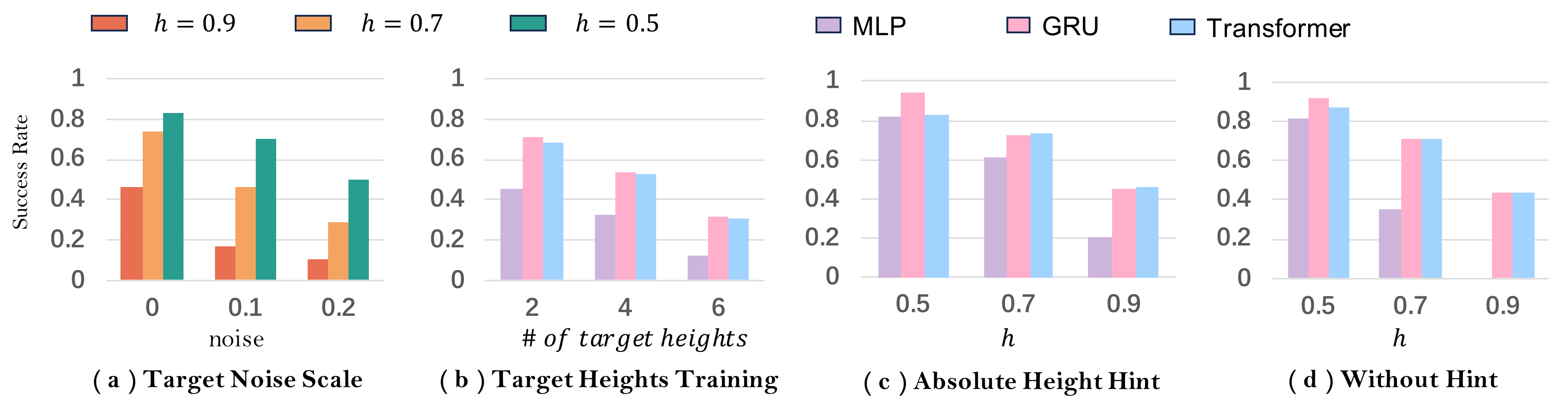
The complete comparisons and success-rate table are retained. Simulation uses a 30 Nm joint-torque limit to avoid unrealistically strong jumps. Figure 4 also shows that larger injected target-position noise reduces catching success.
| Success Rate | ||||||
| Policy | (Simulation) | (Real-World) | ||||
| Backbone | 0.5m | 0.7m | 0.9m | 0.5m | 0.7m | 0.8m |
| MLP | 0.819 | 0.354 | 0.000 | - | - | - |
| GRU | 0.922 | 0.708 | 0.433 | 9/10 | 3/10 | 1/10 |
| Transformer | 0.870 | 0.711 | 0.437 | 8/10 | 3/10 | 2/10 |
IV-B 1 Success rate
Success requires catching and landing without falling, allowing up to three attempts in which the front legs leave the ground. Reported rates therefore are not first-jump success probabilities.
At 0.5 m, MLP/GRU/Transformer success is 81.9%/92.2%/87.0%; at 0.7 m it is 35.4%/70.8%/71.1%; at 0.9 m it is 0%/43.3%/43.7%. Memory is especially useful for the higher jumps. GRU and Transformer perform similarly in these selected checkpoints; the authors observed that Transformer training sometimes escapes the no-jump local optimum more readily.
IV-B 2 Curriculum Learning
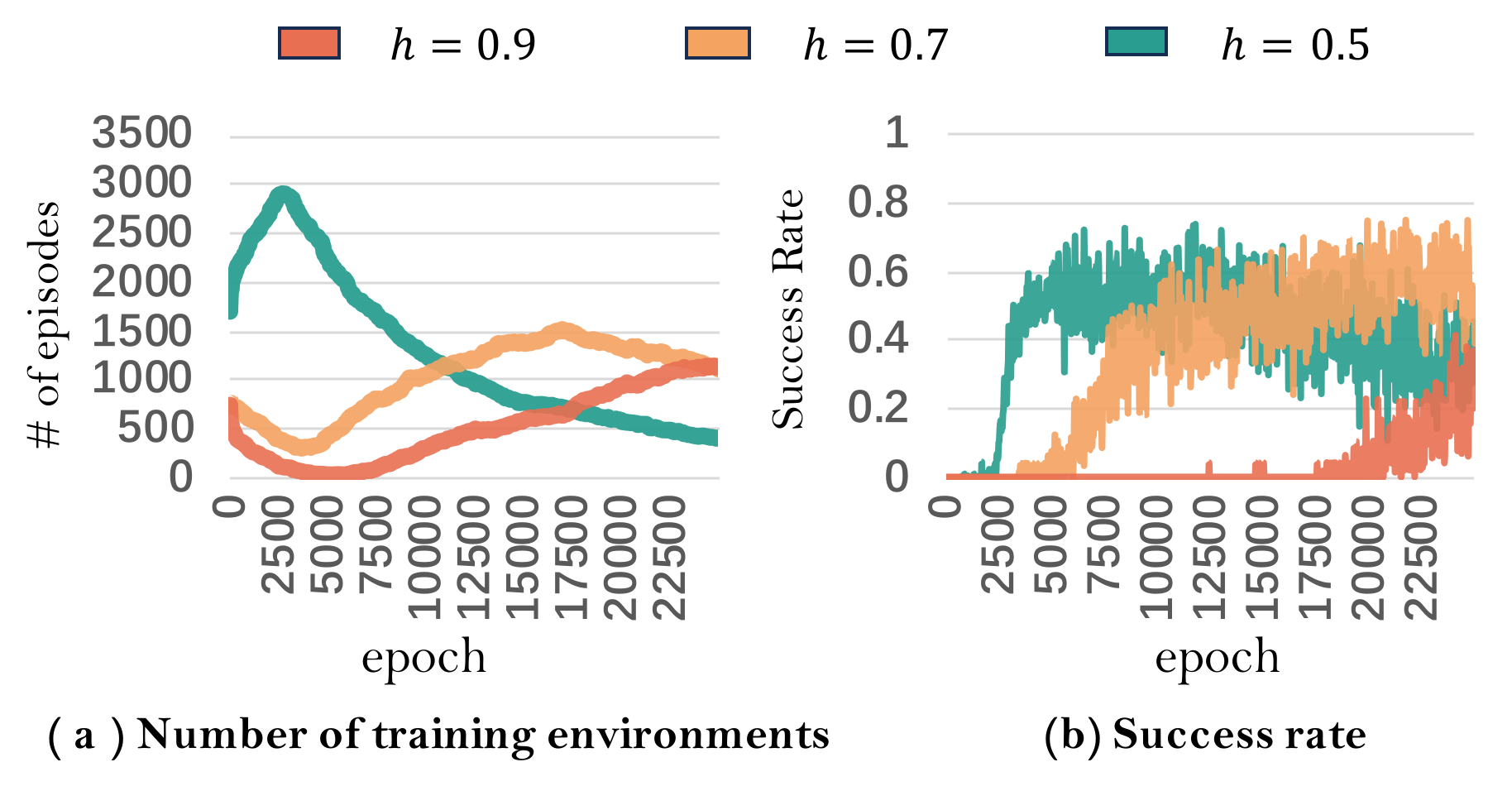
A curriculum allocates 4,096 parallel environments among target heights. As the range expands, fewer episodes remain at earlier heights, and their success can decline. Figure 5 illustrates this redistribution; Figure 4(b) similarly shows lower average success when training covers more heights.
Supplying absolute target height mainly helps the memoryless MLP above 0.7 m, while recurrent/Transformer policies change little. The authors propose pitch-induced ambiguity in relative coordinates and interference between height-specific gaits as explanations, but do not isolate either mechanism experimentally.
IV-C Real-World Experiments
Each physical policy/height combination has ten trials. At 0.5 m, GRU succeeds 9/10 and Transformer 8/10; at 0.7 m both achieve 3/10; at 0.8 m they achieve 1/10 and 2/10. The source’s prose rounds the highest-height result to 10%, but the table shows both values. Ten trials provide limited precision, and no confidence intervals are reported.
Noise and latency contribute to the gap from simulation. The best physical policy uses simulated observation delays sampled from 30–80 ms. Indoor floors, grass, and uneven stone paths support qualitative demonstrations of pursuit and catching; the paper reports tracking a human-moved suspended ball at up to 3 m/s, without a matching per-speed catch-success evaluation.
V CONCLUSION, LIMITATION and FUTURE WORK
The system demonstrates that a simple gripper and learned whole-body motion can make precise dynamic contact, but high-target reliability remains low. Hardware limits, contact-model differences, sensing noise, and latency constrain transfer. Broader height curricula can also reduce performance at previously learned heights.
A preliminary Grounding DINO and Mobile SAM pipeline tracks a wider range of objects at 8 ± 2 Hz on the Jetson. The authors judge this too slow for sufficiently accurate jumping catches. Integrating general object understanding and improving high-speed sensing are future directions, not established arbitrary-object catching performance.
ACKNOWLEDGMENT
Support came from Shanghai Qi Zhi Institute, ONR, and the Shanghai Frontiers Science Center of Human-centered Artificial Intelligence, with experimental support from ShanghaiTech’s computer-science and communication facility. The authors acknowledge technical support and research discussions.