At a glance
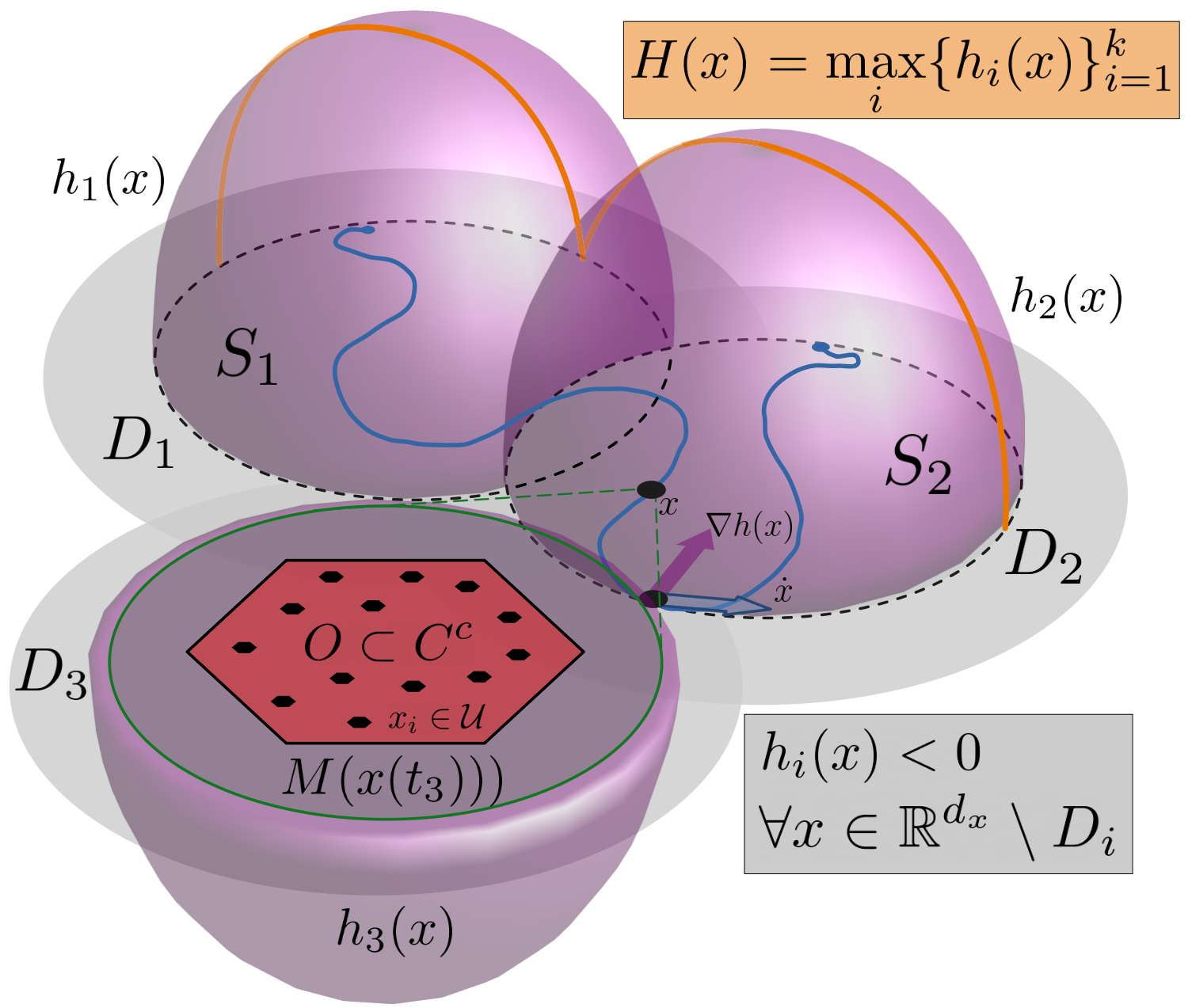
Local control barrier functions (CBFs) learned from successive sensor scans can be combined into an expanding safe region. Compactly supported radial basis functions make each local barrier negative outside its valid domain, enabling composition by a pointwise maximum. Safety follows under local validity, a support-buffer condition, and feasibility of the composed safety filter; two simulated systems illustrate the construction.
I Introduction
Learning a barrier from all accumulated data becomes expensive as exploration continues. This method instead fits a local CBF for each newly observed region and combines the results, extending demonstration-based barrier learning [1] using nonsmooth CBF composition [5]. The dynamics are known; the static environment is initially unknown. Sensor geometry is augmented by a safe oracle controller to account for dynamics and actuator limits. This differs from assuming that distance to an obstacle is itself a valid barrier.
II Background
A CBF is positive inside its safe set, zero on its boundary, and negative outside. Its derivative condition requires an admissible control that prevents the barrier from decreasing too quickly. The resulting quadratic program (QP) minimally changes a reference action while enforcing that condition [8]. Forward invariance requires the stated regularity and feasibility assumptions and a safe initial state.
Equations 1a–2
| (1a) | ||||
| (1b) | ||||
| (1c) | ||||
| (1d) | ||||
| (2) | ||||
II-A Learning CBFs from Data
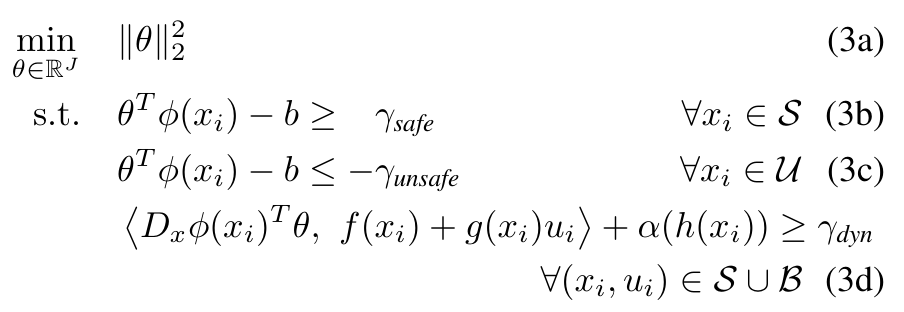
Safe demonstrations, unsafe samples, and boundary data constrain a parameterized barrier: safe states must have positive margin, unsafe states negative margin, and demonstrated controls must satisfy a derivative margin. Equation 3 minimizes the squared parameter norm for a linear-in-parameters model. Extending finite-sample constraints to an entire domain requires sufficiently dense samples and suitable Lipschitz bounds; sample-wise success alone is not a safety certificate.
Equation 3a–d
II-B Compactly Supported Radial Basis Functions
Ordinary radial basis functions can behave incorrectly beyond the training domain, falsely marking unseen states as safe. Compactly supported radial basis functions vanish beyond a chosen radius. With a negative offset, a learned barrier becomes negative outside its supports. The proposed sufficient condition keeps every positively weighted center at least one support radius inside its valid domain.
III Safe Exploration via Incremental Composition of CBFs
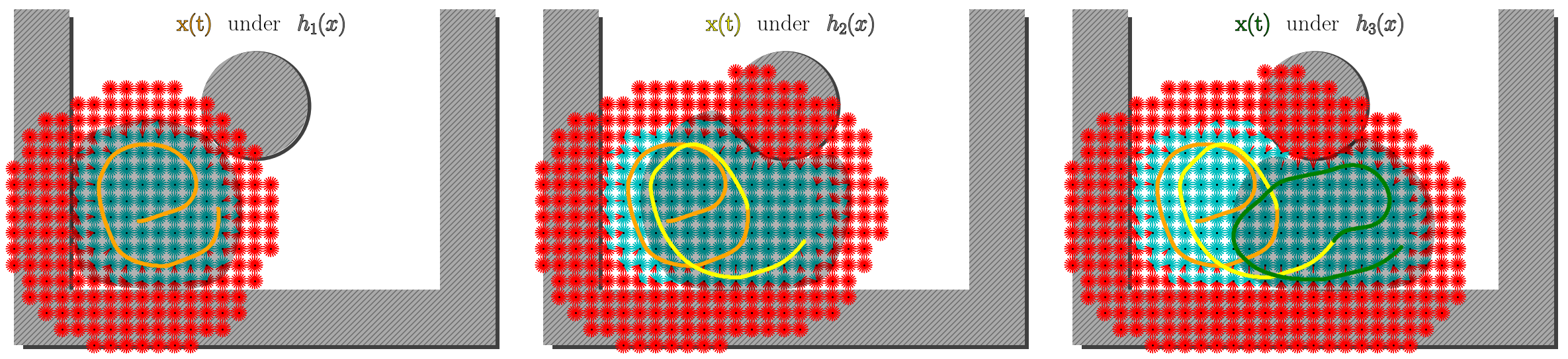
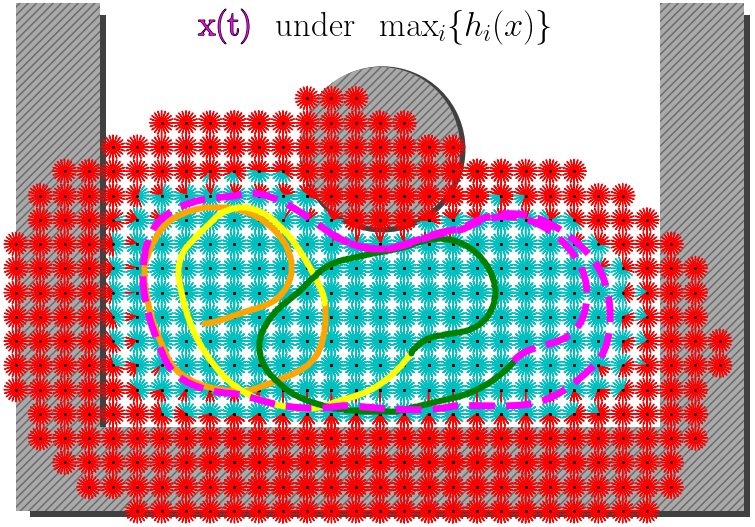
Exploration alternates between moving toward the boundary of the known safe union, taking another sensor scan, learning a local barrier, and merging it with the current maximum. The preserved four-step procedure specifies the update. Failed learning or an infeasible transition need not force entry into unknown space: the agent can remain in its current certified region and retry.
III-A Obtaining Expert Demonstrations Online
Idealized LiDAR identifies observed free geometry, but cannot directly certify states involving heading or velocity. A safe oracle, such as Hamilton–Jacobi (HJ) reachability or model predictive control (MPC), supplies dynamically feasible demonstrations within the scan. Negative samples include obstacles and a shell near the scan boundary. An alternative dual-norm condition can eliminate demonstrated controls, but yields a nonconvex learning problem and does not by itself resolve unobserved state variables.
III-B Composing Locally-Valid CBFs
The maximum of local barriers represents the union of their safe sets. The theorem requires each barrier to be locally valid and globally negative outside its domain, plus persistent feasibility of derivative constraints for all almost-active barriers. Compact support and the center-buffer condition establish the required outside behavior. A shell of one support radius gives a sufficient construction; experiments use a thinner shell, which is not covered by that sufficient condition without further verification.
Equation 4
| (4) |
IV Case Studies
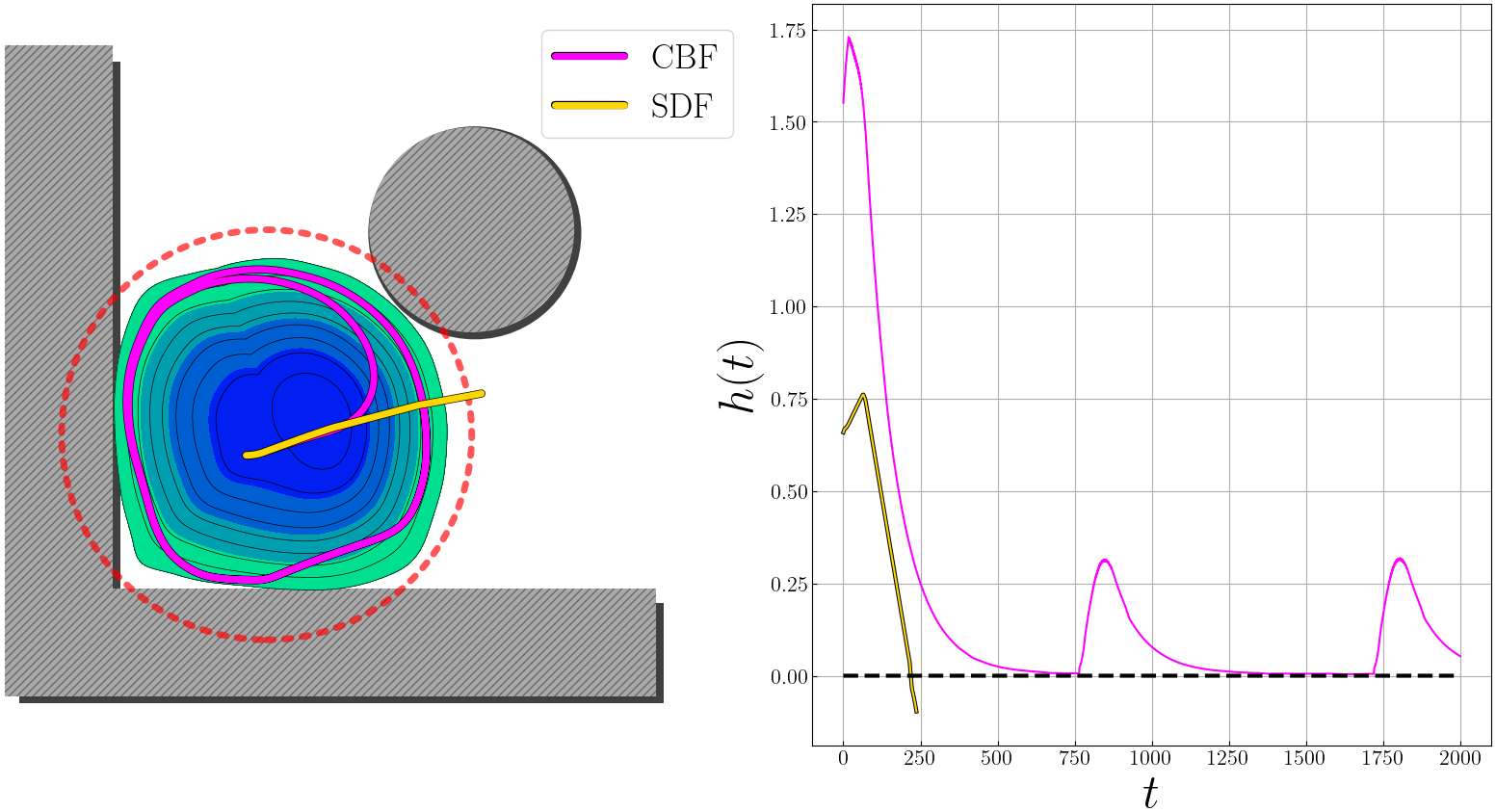
A fixed-speed Dubins car explores a walled environment with a central obstacle under bounded turning control. The learned barrier accounts for orientation and keeps the simulated trajectory safe. A first-order signed-distance barrier fails because its derivative cannot influence heading; higher-order barriers could address this issue. Learning a local barrier alongside the HJ oracle takes 3.55 seconds versus 2.45 seconds for the oracle alone, a reported 45% overhead.
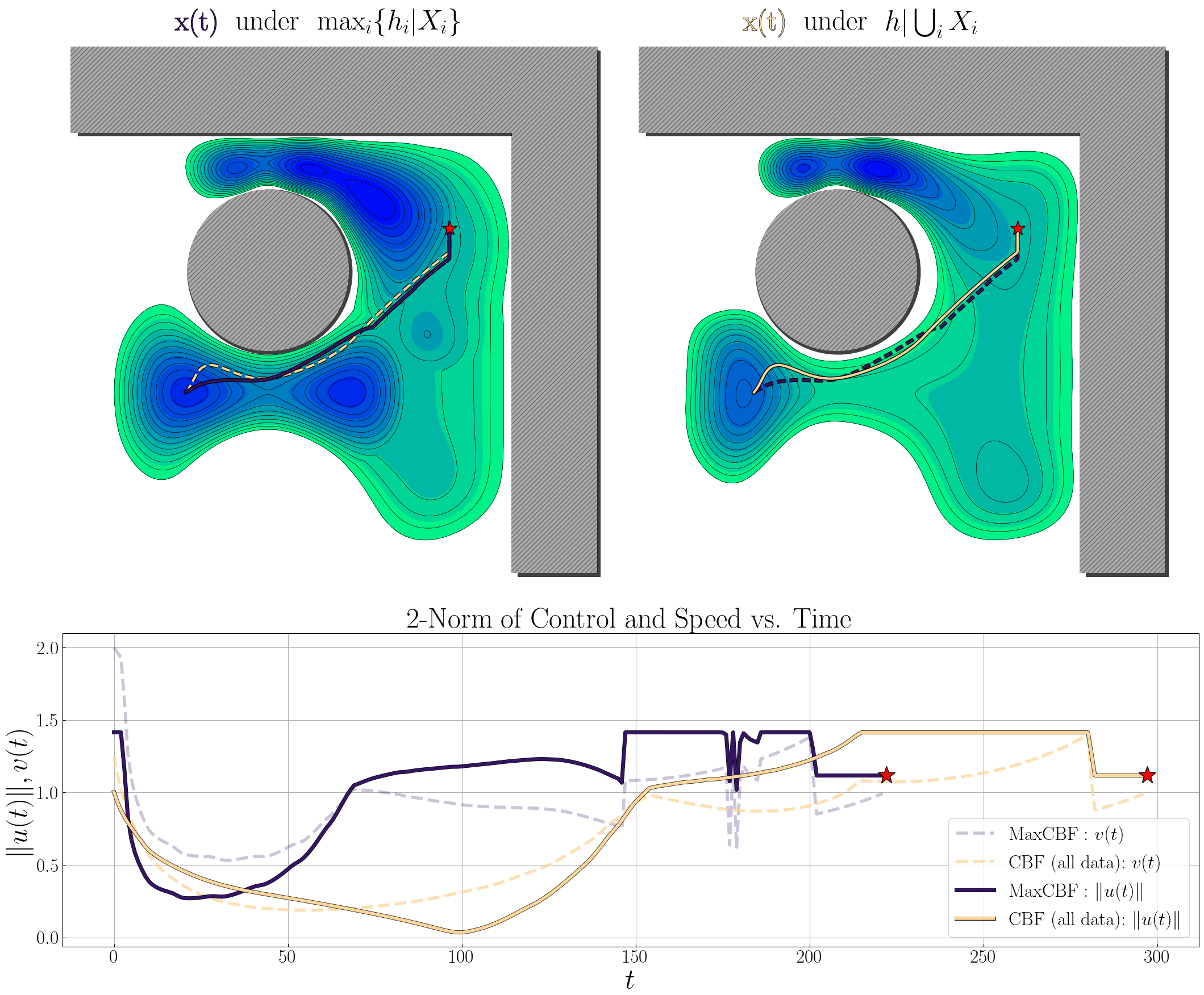
For a planar nonlinear system, four incrementally learned local barriers take 5.2 seconds versus 14.9 seconds for one globally trained barrier. The composed model also admits a larger safe region in this example. These are two simulated case studies, not a broad empirical safety or scalability guarantee.
V Conclusion
Compact support makes local learned barriers composable while controlling their behavior in unobserved regions. The remaining practical difficulty is certification: Lipschitz bounds can be too large to verify the required local conditions. Extending the approach to richer dynamics, efficient sampling, and less conservative certification remains open.