Overview
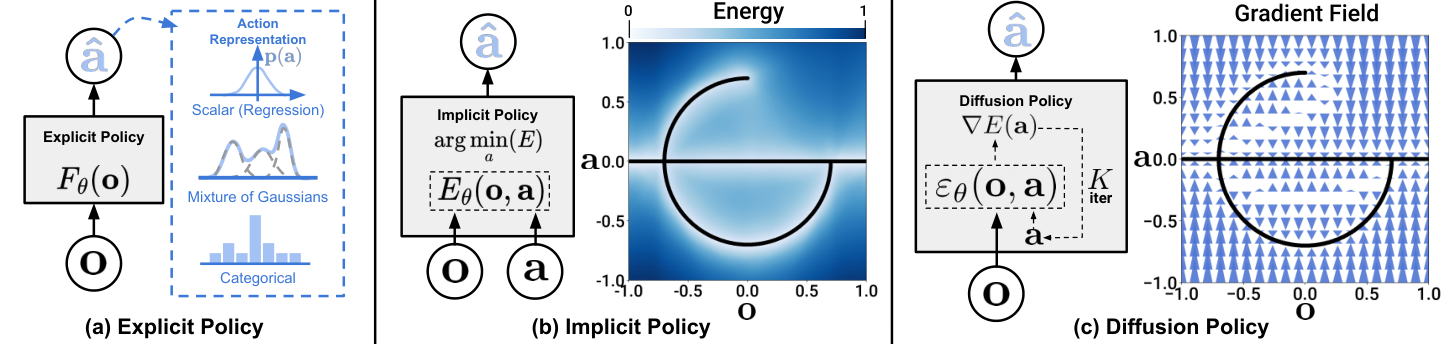
Figure 1 contrasts direct action prediction, energy-based optimization, and iterative action denoising. The edition follows the extended arXiv revision v5, including the bimanual experiments and appendices.
At a glance
Diffusion Policy learns to denoise future robot actions conditioned on recent observations. Predicting an action sequence and repeatedly executing only a prefix combines temporally consistent behavior with feedback. Across the reported manipulation benchmarks, the best diffusion variants improve over the best baseline by an average of 46.9% relative, not 46.9 percentage points. Real robot studies cover pushing, mug reorientation, sauce manipulation, and three bimanual skills. The advantages come with iterative-inference cost and the data limitations of behavior cloning.
1 Introduction
Robot demonstrations contain multiple valid actions, correlated motion, and precise contact requirements. Instead of selecting a fixed number of action modes, Diffusion Policy learns a conditional denoising field over an entire action sequence. Its main design choices are receding-horizon execution, conditioning on encoded images without generating future observations, and either a temporal convolutional network or a diffusion transformer. This extended version adds control-theoretic analysis, visual-encoder ablations, and bimanual experiments to the conference paper.
2 Diffusion Policy Formulation
The policy is a conditional denoising diffusion probabilistic model: training learns to remove noise from demonstrated actions, and inference starts from noise to sample an observation-conditioned action sequence.
2.1 Denoising Diffusion Probabilistic Models
Start with Gaussian noise and repeatedly apply a learned noise predictor. The update combines denoising, scaling, and optional stochastic noise according to the diffusion schedule. The paper interprets the update as a noisy gradient step on an energy landscape; the preserved equations specify that relationship and its coefficients.
Equations 1–2
| (1) |
| (2) |
2.2 DDPM Training
Training samples a demonstration, diffusion step, and noise realization, then minimizes mean squared error between the sampled noise and the network prediction. This avoids explicitly normalizing an energy model. The denoising objective is related to a variational bound on the divergence between data and model distributions. [21]
Equation 3
| (3) |
2.3 Diffusion for Visuomotor Policy Learning
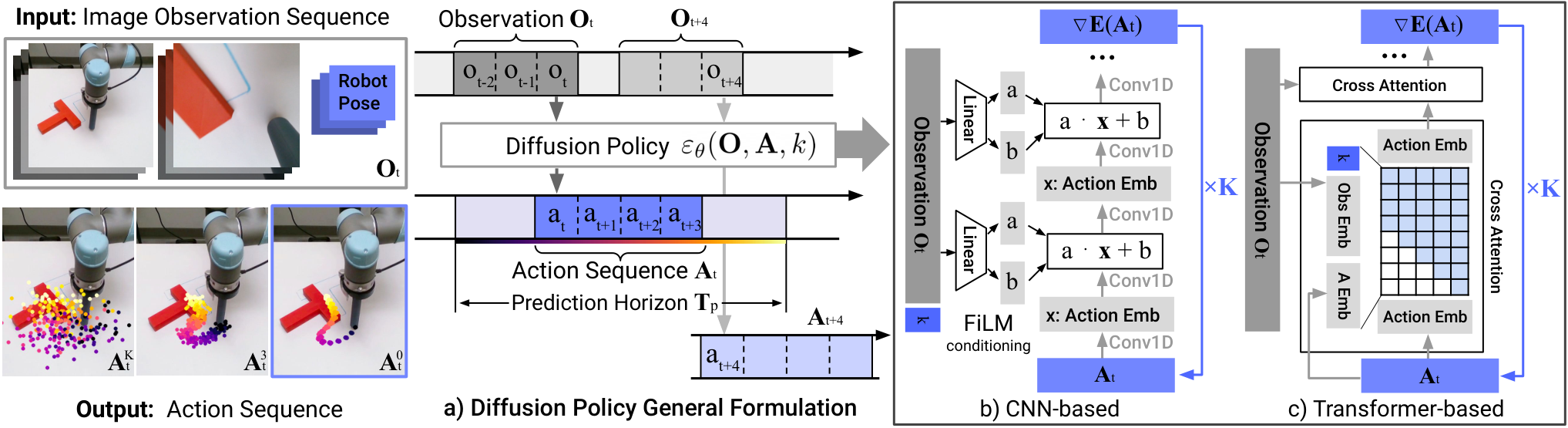
At each planning step, the policy observes the latest To frames, predicts Tp future actions, executes Ta of them, then replans. This separates prediction horizon from open-loop execution duration. The diffusion model learns actions conditioned on observations, rather than a joint distribution over actions and future states. Images can therefore be encoded once per inference call and reused through all denoising iterations. Warm-starting from the previous prediction is also compatible with receding-horizon control.
Equations 4–5
| (4) |
| (5) |
3 Key Design Decisions
The important choices are the action denoiser, visual encoder, noise schedule, and inference sampler. Their suitability depends on action frequency, data quantity, and control latency.
3.1 Network Architecture Options
The convolutional denoiser uses temporal convolutions and FiLM observation conditioning. It is relatively robust to hyperparameters but can oversmooth rapidly changing actions. The transformer predicts noise for action tokens using causal action attention and cross-attention to observations; it often performs better on difficult state-based tasks but needs more tuning. The authors recommend beginning with the convolutional model and trying the transformer when temporal complexity or fast changes limit performance.
3.2 Visual Encoder
Each camera view has a separate image encoder; embeddings from the observation window are concatenated. The default ResNet-18 is trained jointly with the policy. Spatial softmax pooling preserves localization information, and GroupNorm replaces BatchNorm to work reliably with exponential moving-average training.
3.3 Noise Schedule
The noise schedule controls how different temporal frequencies of the action signal are learned. The tested tasks favor the squared-cosine schedule from improved denoising diffusion probabilistic models.
3.4 Accelerating Inference for Real-time Control
DDIM allows fewer denoising steps at inference than during training. This section reports 100 training steps and 10 inference steps, giving approximately 0.1 seconds of inference latency on a GeForce RTX 3080. Appendix A.4 instead specifies 16 real-world inference steps; both statements are retained as a source discrepancy. These are model-inference measurements, not a guarantee for arbitrary high-rate control. [52]
4 Intriguing Properties of Diffusion Policy
The following analyses explain observed multimodality, position-control performance, temporal consistency, and stable training. They combine experiments with mechanistic interpretations rather than proving universal advantages.
4.1 Model Multi-Modal Action Distributions
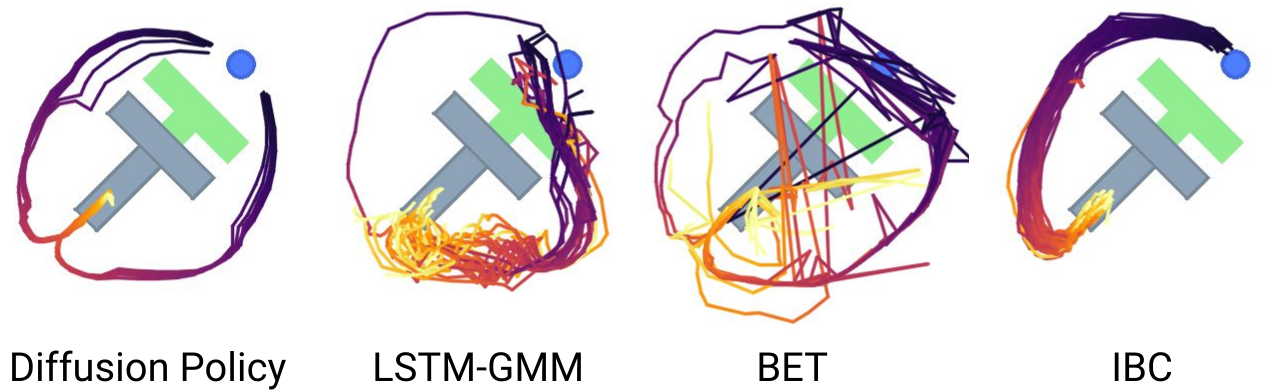
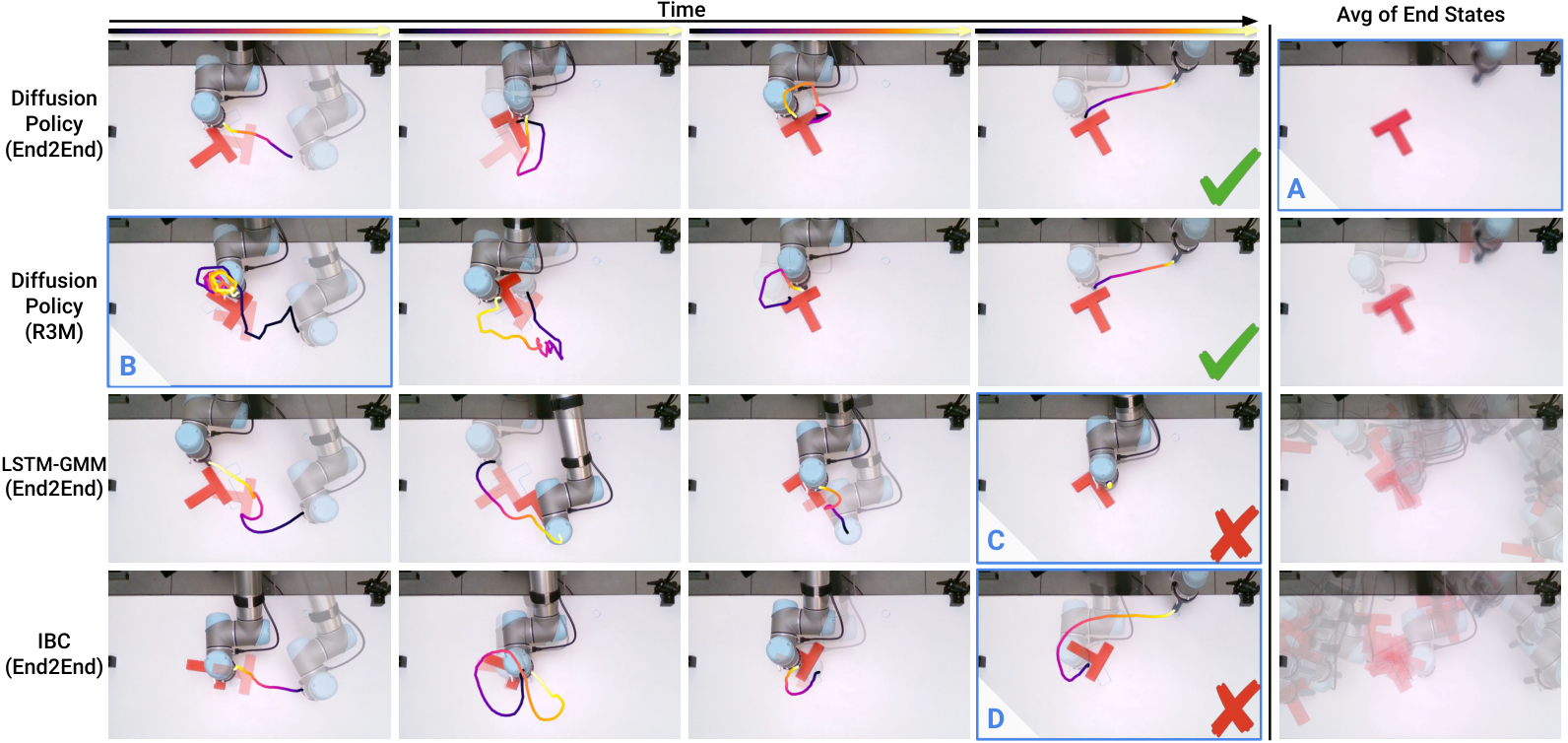
Random initialization and stochastic denoising can reach different valid action modes. In the illustrated Push-T state, the policy approaches from either side while committing to one route within a rollout. The comparison is a selected-state demonstration of multimodality, not a complete measure of distribution coverage.
4.2 Synergy with Position Control
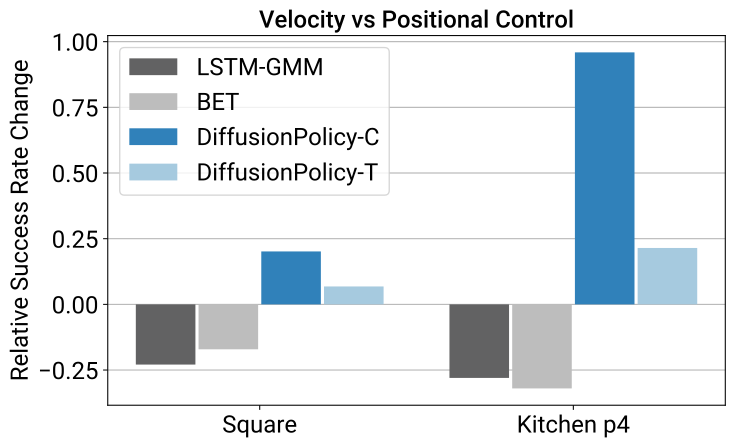
Position commands improve Diffusion Policy in the tested ablations, whereas the evaluated recurrent and transformer baselines favor velocity commands. The authors hypothesize that diffusion handles positional multimodality better, while position control accumulates less integration error across a predicted sequence. These mechanisms are explanations proposed for the measured result.
4.3 Benefits of Action-Sequence Prediction
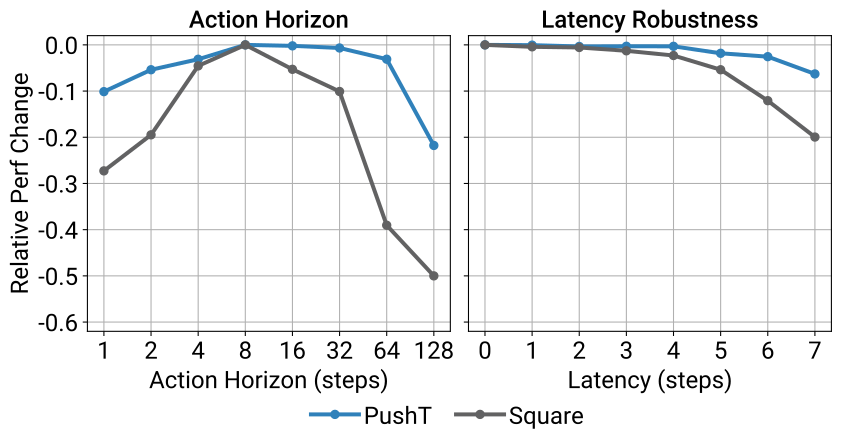
Predicting a sequence jointly discourages switching between incompatible modes on consecutive steps. It also represents pauses in context: a stationary interval can be followed by purposeful motion instead of becoming an absorbing behavior. Executing too long a prefix reduces responsiveness, so sequence prediction still requires frequent replanning.
4.4 Training Stability
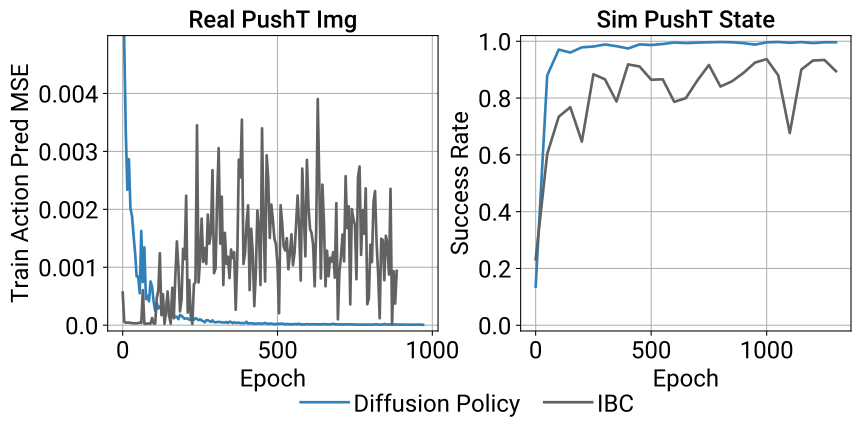
Implicit behavior cloning estimates an energy-model normalization term using negative samples, a source of instability in the tested baseline. Diffusion instead learns the score, which is independent of that normalization constant. The preserved derivation explains why neither its training nor action inference needs to evaluate the normalizer. The observed stability also makes checkpoint selection easier on hardware.
Equations 6–8
| (6) |
| (7) |
| (8) |
4.5 Connections to Control Theory
For a linear system demonstrated by a linear feedback controller, the ideal one-step denoiser recovers that controller, and DDIM converges to its action. Predicting multiple future actions additionally requires the task-relevant closed-loop dynamics. This is a limiting-case sanity check under linearity and optimal-denoiser assumptions; nonlinear plants or policies can again require multimodal predictions.
Equations 9
| (9) |

| Lift | Can | Square | Transport | ToolHang | Push-T | |||||
| ph | mh | ph | mh | ph | mh | ph | mh | ph | ph | |
| LSTM-GMM | 1.00/0.96 | 1.00/0.93 | 1.00/0.91 | 1.00/0.81 | 0.95/0.73 | 0.86/0.59 | 0.76/0.47 | 0.62/0.20 | 0.67/0.31 | 0.67/0.61 |
| IBC | 0.79/0.41 | 0.15/0.02 | 0.00/0.00 | 0.01/0.01 | 0.00/0.00 | 0.00/0.00 | 0.00/0.00 | 0.00/0.00 | 0.00/0.00 | 0.90/0.84 |
| BET | 1.00/0.96 | 1.00/0.99 | 1.00/0.89 | 1.00/0.90 | 0.76/0.52 | 0.68/0.43 | 0.38/0.14 | 0.21/0.06 | 0.58/0.20 | 0.79/0.70 |
| DiffusionPolicy-C | 1.00/0.98 | 1.00/0.97 | 1.00/0.96 | 1.00/0.96 | 1.00/0.93 | 0.97/0.82 | 0.94/0.82 | 0.68/0.46 | 0.50/0.30 | 0.95/0.91 |
| DiffusionPolicy-T | 1.00/1.00 | 1.00/1.00 | 1.00/1.00 | 1.00/0.94 | 1.00/0.89 | 0.95/0.81 | 1.00/0.84 | 0.62/0.35 | 1.00/0.87 | 0.95/0.79 |
| Lift | Can | Square | Transport | ToolHang | Push-T | |||||
| ph | mh | ph | mh | ph | mh | ph | mh | ph | ph | |
| LSTM-GMM | 1.00/0.96 | 1.00/0.95 | 1.00/0.88 | 0.98/0.90 | 0.82/0.59 | 0.64/0.38 | 0.88/0.62 | 0.44/0.24 | 0.68/0.49 | 0.69/0.54 |
| IBC | 0.94/0.73 | 0.39/0.05 | 0.08/0.01 | 0.00/0.00 | 0.03/0.00 | 0.00/0.00 | 0.00/0.00 | 0.00/0.00 | 0.00/0.00 | 0.75/0.64 |
| DiffusionPolicy-C | 1.00/1.00 | 1.00/1.00 | 1.00/0.97 | 1.00/0.96 | 0.98/0.92 | 0.98/0.84 | 1.00/0.93 | 0.89/0.69 | 0.95/0.73 | 0.91/0.84 |
| DiffusionPolicy-T | 1.00/1.00 | 1.00/0.99 | 1.00/0.98 | 1.00/0.98 | 1.00/0.90 | 0.94/0.80 | 0.98/0.81 | 0.73/0.50 | 0.76/0.47 | 0.78/0.66 |
5 Evaluation
The benchmark suite spans robomimic manipulation, Push-T, multimodal block pushing, and Franka Kitchen, with both state and visual inputs where available. The tables retain both the best-checkpoint and late-checkpoint-average results. Relative improvements and their aggregation are defined in Appendix B.2.
5.1 Simulation Environments and datasets
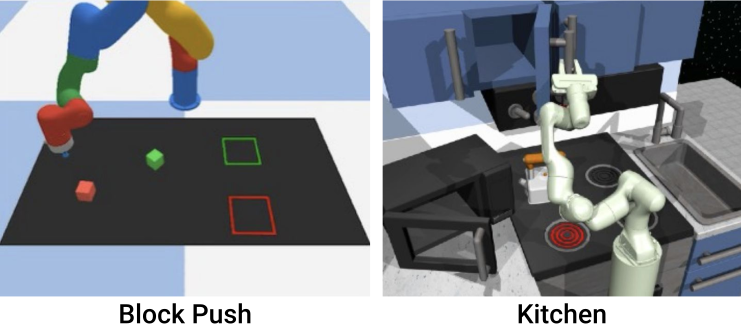
Robomimic contributes five tasks, with proficient-human and mixed-proficiency variants. Push-T requires precise contact-rich planar manipulation. Block pushing tests alternative assignments and ordering of two blocks using scripted demonstrations; Kitchen tests variable ordering of four subgoals among seven objects. The prose says Kitchen has 566 demonstrations, while Table 3 lists 656; this edition preserves that inconsistency rather than selecting an unsupported value.
| Task | # Rob | # Obj | ActD | #PH | #MH | Steps | Img? | HiPrec |
| Simulation Benchmark | ||||||||
| Lift | 1 | 1 | 7 | 200 | 300 | 400 | Yes | No |
| Can | 1 | 1 | 7 | 200 | 300 | 400 | Yes | No |
| Square | 1 | 1 | 7 | 200 | 300 | 400 | Yes | Yes |
| Transport | 2 | 3 | 14 | 200 | 300 | 700 | Yes | No |
| ToolHang | 1 | 2 | 7 | 200 | 0 | 700 | Yes | Yes |
| Push-T | 1 | 1 | 2 | 200 | 0 | 300 | Yes | Yes |
| BlockPush | 1 | 2 | 2 | 0 | 0 | 350 | No | No |
| Kitchen | 1 | 7 | 9 | 656 | 0 | 280 | No | No |
| Realworld Benchmark | ||||||||
| Push-T | 1 | 1 | 2 | 136 | 0 | 600 | Yes | Yes |
| 6DoF Pour | 1 | liquid | 6 | 90 | 0 | 600 | Yes | No |
| Peri Spread | 1 | liquid | 6 | 90 | 0 | 600 | Yes | No |
| Mug Flip | 1 | 1 | 7 | 250 | 0 | 600 | Yes | No |
5.2 Evaluation Methodology
Reported late-training performance averages the last ten saved checkpoints across three training seeds. The intended 50 environment initializations were reduced to 22 for robomimic by an evaluation-code bug; the authors state that compared methods used the same protocol. Best-checkpoint averages are also reported where earlier benchmarks used them. State policies train for 4,500 epochs and image policies for 3,000. Diffusion uses position control and baselines use their better-performing velocity controls, so the headline comparison includes those action-space choices.
5.3 Key Findings
The diffusion variants lead the reported comparisons, including short-horizon route choice and long-horizon subgoal ordering. The reported gains are 32% relative on completing both BlockPush targets and 213% on four Kitchen subtasks. Executing eight predicted steps balances consistency and reaction time in most tested tasks. Simulated-latency ablations retain peak performance through four delayed steps; that result is task- and controller-specific.
5.4 Ablation Study
On the robomimic square task, frozen pretrained encoders perform poorly relative to end-to-end training or fine-tuning. Training a vision transformer from scratch reaches 22% success, while fine-tuning its CLIP-pretrained version at a smaller learning rate reaches 98%. ResNet and transformer peak results are close on this task. The limited comparison does not establish a generally best vision architecture or pretraining recipe.
| Archicture & | From | Pretrained | |
| Prertain Datset | Scatch | frozen | finetuning |
| Resnet18 (in21) | 0.94 | 0.58 | 0.92 |
| Resnet34 (in21) | 0.92 | 0.40 | 0.94 |
| ViT-base (clip) | 0.22 | 0.70 | 0.98 |
6 Realworld Evaluation
Four single-arm tasks on two stations test precise pushing, rotations, non-rigid material, pauses, and periodic motion. The convolutional policy with a jointly trained visual encoder performs best among the tested variants. Qualitative perturbation demonstrations are distinct from the standard success-rate evaluations.
6.1 Realworld Push-T Task
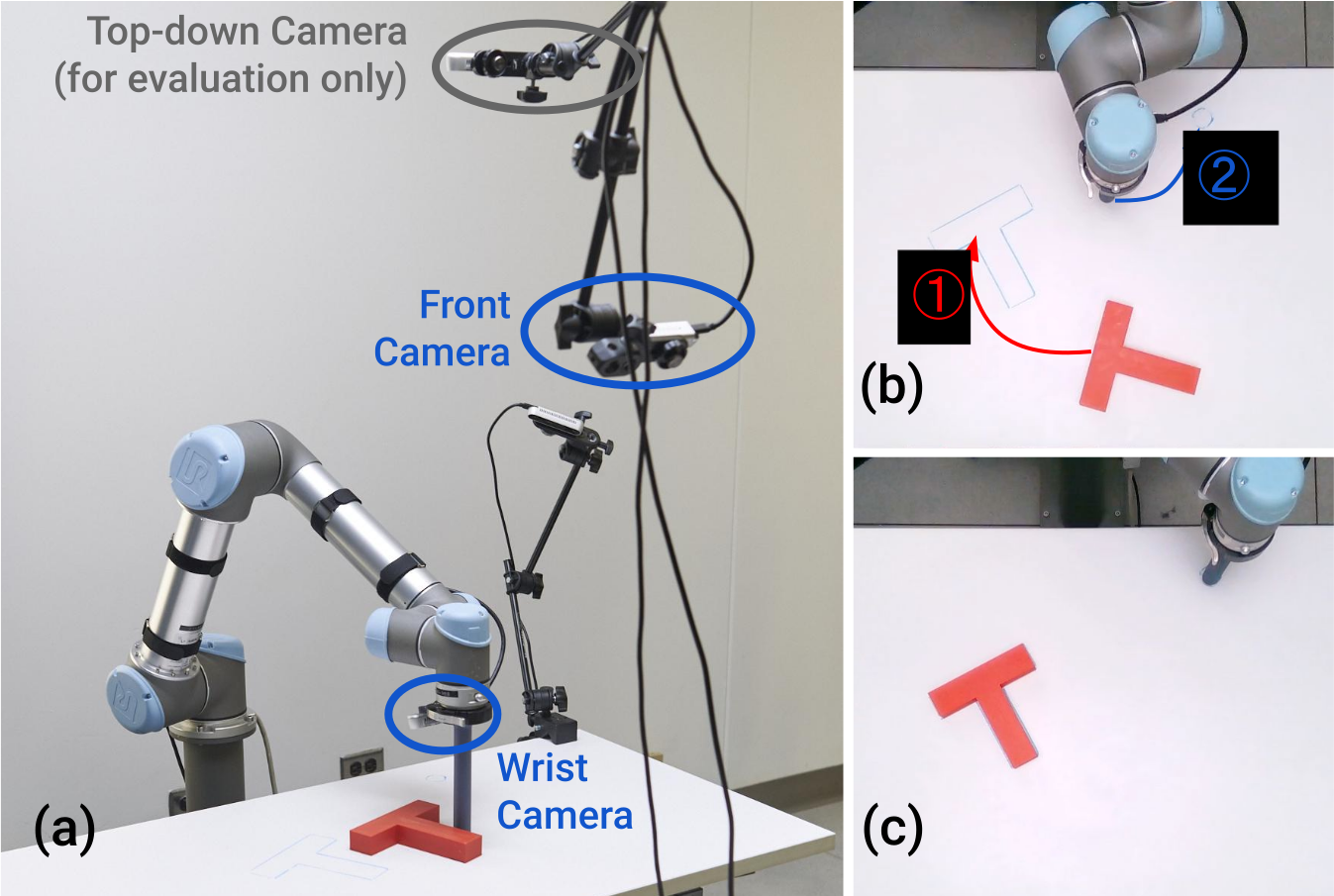
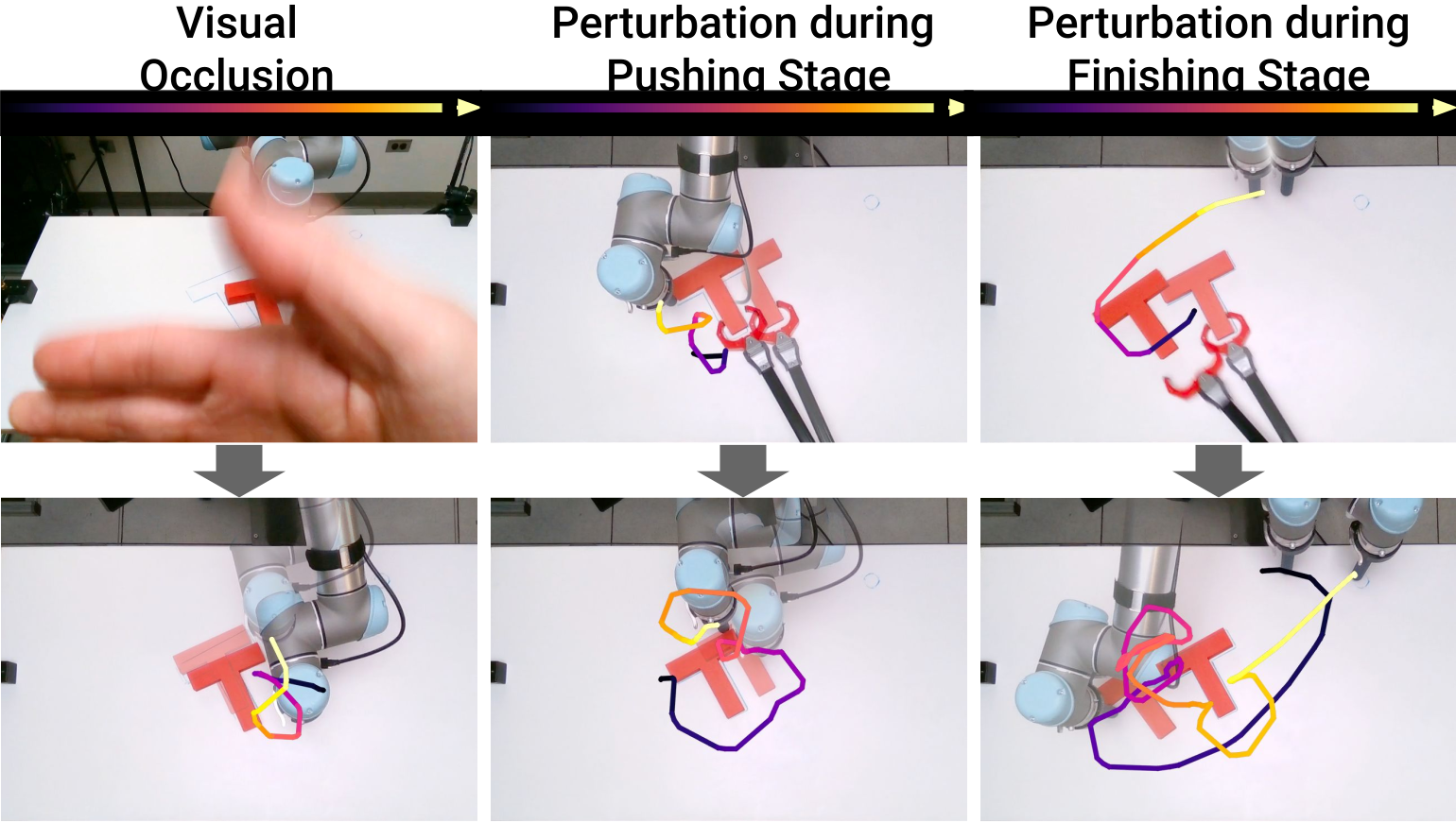
Real Push-T requires aligning the block and then moving the end effector to an end zone. Evaluation uses final overlap rather than the maximum reached during the episode. On 20 matched initial conditions, the best diffusion policy succeeds in 95% of trials with mean overlap 0.80, versus human demonstrations at 0.84; the best implicit and recurrent baselines achieve 0% and 20% success. Commands at 10 Hz are interpolated to 125 Hz. A separate demonstration shows recovery from camera occlusion and block displacement, without estimating a perturbation success rate.
| Human | LSTM-GMM | Diffusion Policy | |
| Succ % | 1.0 | 0.0 | 0.9 |
| Pour | Spread | |||
| IoU | Succ | Coverage | Succ % | |
| Human | 0.79 | 1.00 | 0.79 | 1.00 |
| LSTM-GMM | 0.06 | 0.00 | 0.27 | 0.00 |
| Diffusion Policy | 0.74 | 0.79 | 0.77 | 1.00 |
6.2 Mug Flipping Task
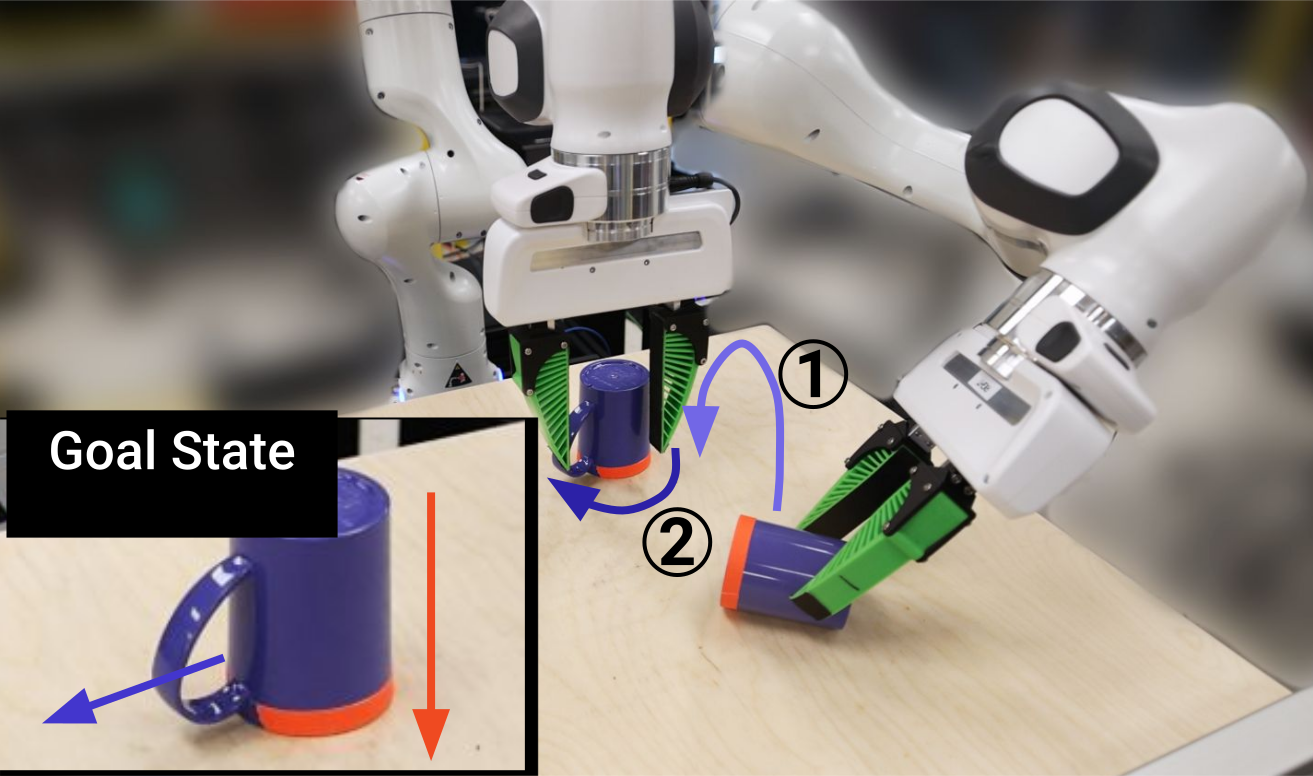
The policy must turn a mug lip-down and align its handle, combining alternative grasps and pushes. Diffusion succeeds in 18 of 20 trials and qualitatively recovers using repeated pushes or regrasping. The recurrent baseline fails to grasp in all 20 tests, but it was trained on a subset of the diffusion policy’s data; the comparison therefore does not isolate policy architecture alone.
6.3 Sauce Pouring and Spreading
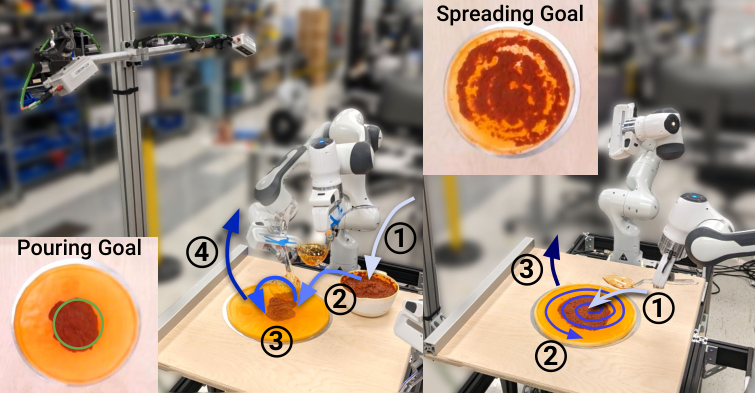
Pouring tests waiting for viscous sauce, centering a ladle, and terminating; spreading combines cyclic coverage with feedback. Diffusion obtains pouring overlap 0.74 versus 0.79 for human demonstrations and spreading coverage 0.77 versus 0.79. The recurrent baseline commonly stays at the bowl or lifts before contacting the sauce. The appendix supplies the evaluation protocol, including the use of the larger coverage estimate from two projected camera views.
7 Realworld Bimanual Tasks
The extension applies the same policy design to two arms. Most additional engineering supports teleoperation and coordinated control rather than task-specific network changes. Results nevertheless vary substantially across skills.
7.1 Observation and Action Spaces
Observations contain actual and desired poses and gripper widths for both arms, plus two scene cameras and two wrist cameras. Actions specify both desired end-effector poses and gripper widths.
7.2 Teleoperation
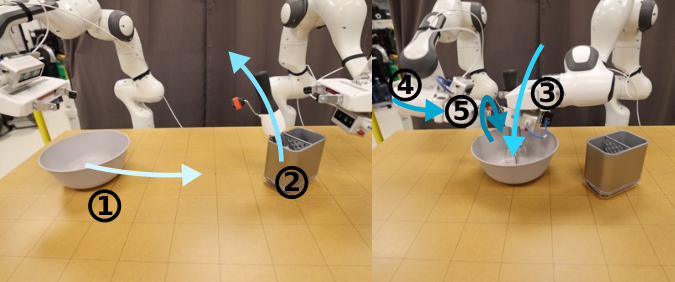
Two simultaneous SpaceMouse devices were difficult for the operator. The authors instead use two virtual-reality hand controllers or two haptic devices with bilateral position coupling. Haptic feedback is particularly useful for the contact-sensitive egg-beater skill.
7.3 Bimanual Egg Beater
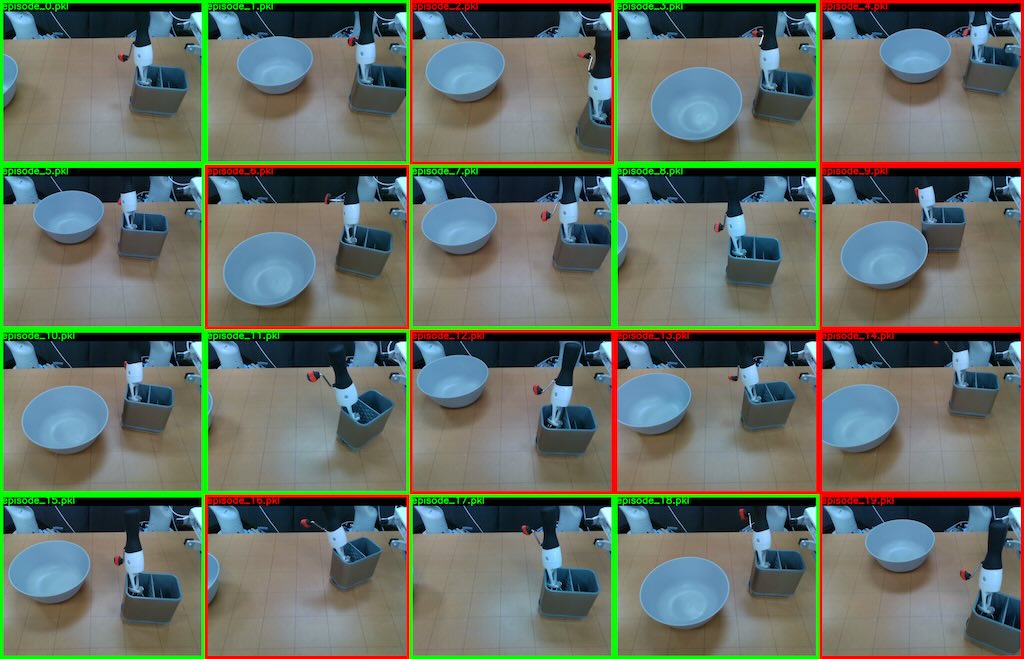
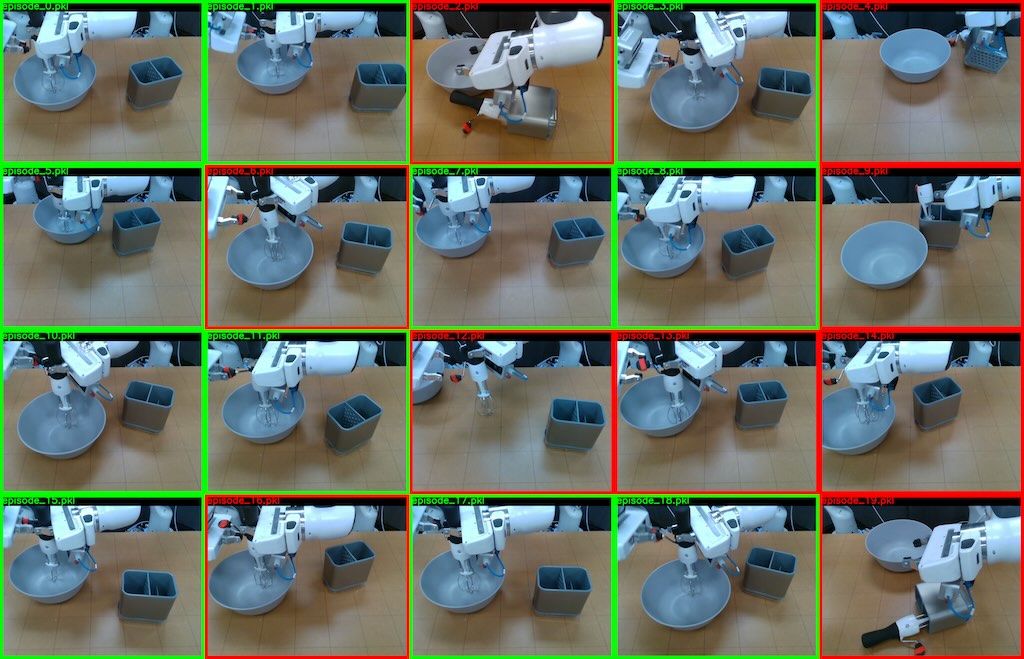
The egg-beater policy succeeds in 55% of 20 trials after 210 demonstrations. Failures include unfamiliar initial placement, missed handle grasps, and losing the crank handle. In a separate small teleoperation comparison, the same expert completes 0 of 10 demonstrations without haptic feedback and 10 of 10 with it. This illustrates demonstration-collection difficulty rather than a randomized study of operators.
7.4 Bimanual Mat Unrolling
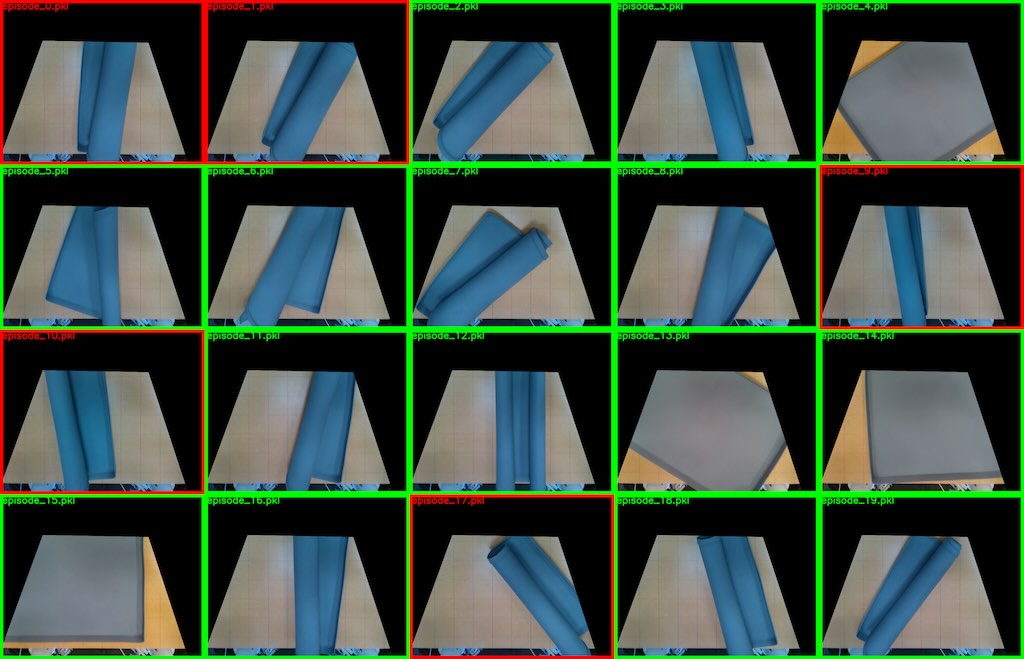
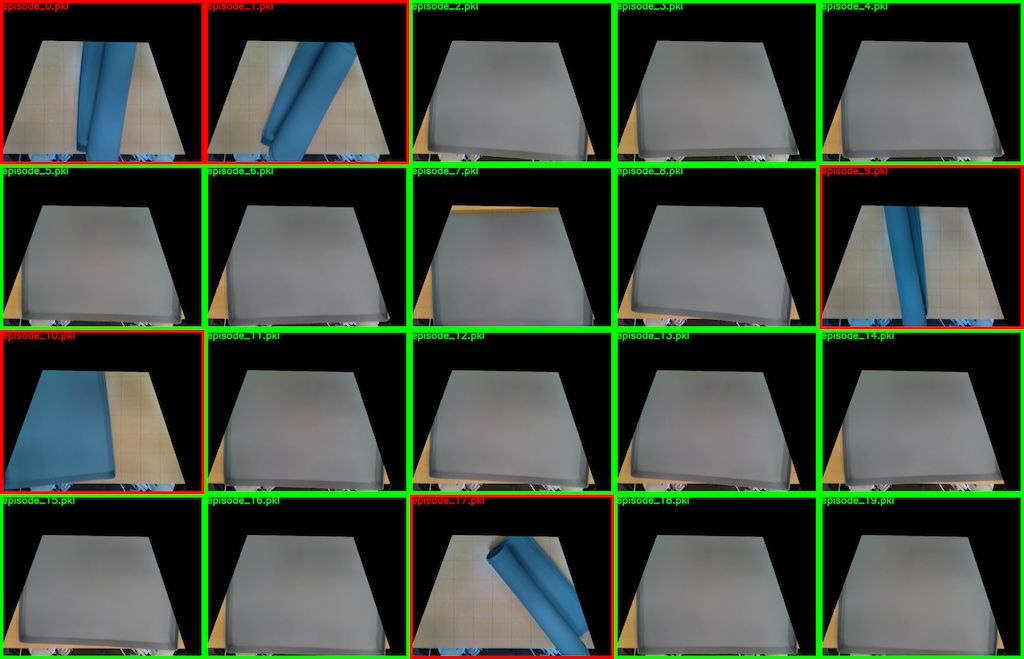
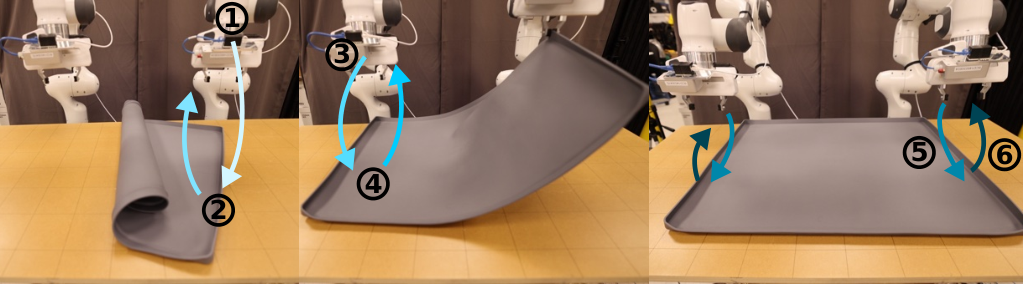
After 162 demonstrations, mat unrolling succeeds in 75% of 20 trials, choosing leftward or rightward unrolling from the initial state. Missed initial grasps often lead to repeated unsuccessful motion instead of recovery. The appendix retains every evaluation’s initial and final state.
7.5 Bimanual Shirt Folding.
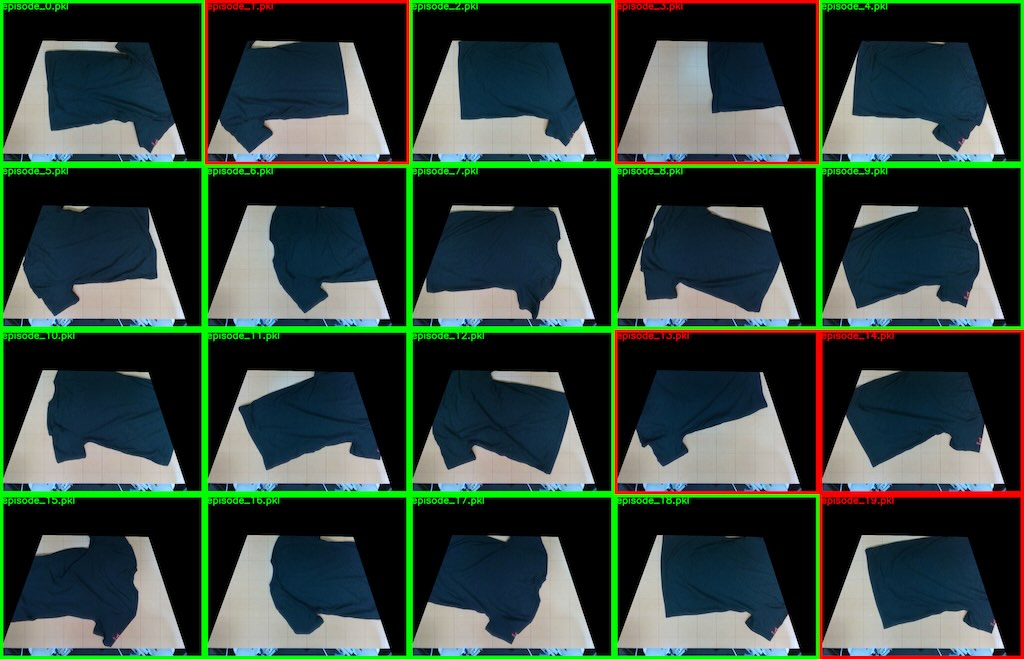
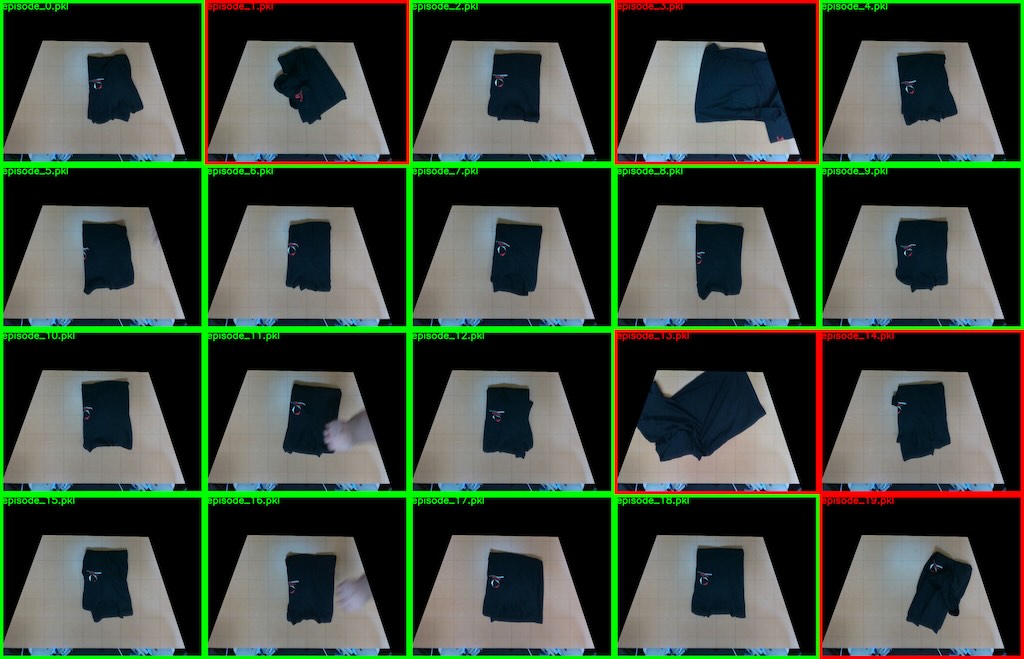
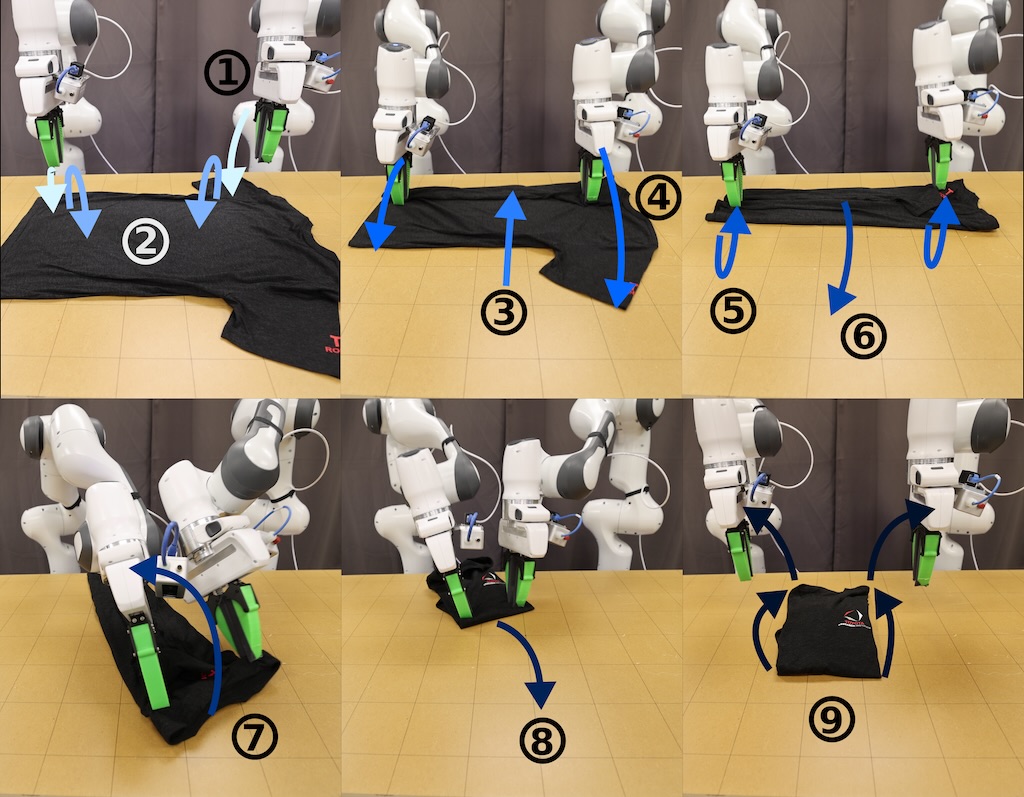
Shirt folding succeeds in 75% of 20 trials after 284 demonstrations. The multi-step sequence requires close coordination and collision avoidance in the low-level controller. Failures involve missed sleeve or collar grasps and continued adjustment after folding. The initial and final rollout panels remain available for inspecting these outcomes.
8 Related Work
Explicit policies predict actions directly, using regression, discretization, or mixtures to represent alternatives. Implicit policies optimize a learned energy, gaining distributional flexibility but facing normalization and sampling difficulties. Diffusion contributes an alternative distributional policy with high-dimensional sequence prediction. Compared with diffusion planning and reinforcement-learning work, this paper focuses on behavior-cloned visuomotor control and the action-space, feedback, and latency choices needed on physical robots.
9 Limitations and Future Work
The method inherits behavior cloning’s dependence on adequate demonstrations and does not automatically learn from unsuccessful or suboptimal behavior. Iterative denoising also costs more compute and adds latency relative to simple direct policies. Action sequences partially mask that latency but may be insufficient for fast feedback tasks. Reinforcement learning and accelerated diffusion sampling are proposed directions, not capabilities established here.
10 Conclusion
The evidence supports diffusion as an effective policy representation for these manipulation datasets and hardware setups. Its performance depends on the complete control design: action chunks, position control, visual conditioning, and execution feedback. Demonstration quality, robot capabilities, model architecture, and pretraining remain important; distributional expressivity alone does not remove those constraints.
11 Acknowledgement
The authors acknowledge colleagues and hardware support, and funding from Toyota Research Institute and the US National Science Foundation. The conclusions are the authors’ rather than official sponsor positions.
Appendix A Diffusion Policy Implementation Details
The implementation details below retain the original normalization, rotation, augmentation, and hyperparameter choices needed to reproduce the experiments.
A.1 Normalization
Scale each non-rotational action dimension to the interval [-1, 1], matching clipping during denoising. Standardizing by mean and variance can otherwise make some actions unreachable. Near-constant dimensions are centered without scaling to avoid numerical problems; rotation representations are left unchanged.
A.2 Rotation Representation
Velocity actions use three-dimensional axis-angle rotations, with small commands reducing exposure to discontinuities. Position-controlled tasks use the continuous six-dimensional rotation representation. [70]
A.3 Image Augmentation
Training uses random image crops; inference uses a fixed center crop of the same size. The preserved hyperparameter tables specify each task’s image and crop resolution.
A.4 Hyperparameters
Convolutional hyperparameters transfer more consistently across tasks; transformer dropout, weight decay, and size require more care. Push-T is an exception to the usual FiLM conditioning rule: its reported convolutional simulation result uses inpainting. Simulation uses 100 denoising steps at both training and inference; this appendix specifies 16 inference steps for real-world DDIM, versus 10 in Section 3.4. State and image batch sizes are 256 and 64, with cosine learning-rate decay and warmup.
| H-Param | Ctrl | To | Ta | Tp | ImgRes | CropRes | #D-Params | #V-Params | Lr | WDecay | D-Iters Train | D-Iters Eval |
| Lift | Pos | 2 | 8 | 16 | 2x84x84 | 2x76x76 | 256 | 22 | 1e-4 | 1e-6 | 100 | 100 |
| Can | Pos | 2 | 8 | 16 | 2x84x84 | 2x76x76 | 256 | 22 | 1e-4 | 1e-6 | 100 | 100 |
| Square | Pos | 2 | 8 | 16 | 2x84x84 | 2x76x76 | 256 | 22 | 1e-4 | 1e-6 | 100 | 100 |
| Transport | Pos | 2 | 8 | 16 | 4x84x85 | 4x76x76 | 264 | 45 | 1e-4 | 1e-6 | 100 | 100 |
| ToolHang | Pos | 2 | 8 | 16 | 2x240x240 | 2x216x216 | 256 | 22 | 1e-4 | 1e-6 | 100 | 100 |
| Push-T | Pos | 2 | 8 | 16 | 1x96x96 | 1x84x84 | 256 | 22 | 1e-4 | 1e-6 | 100 | 100 |
| Block Push | Pos | 3 | 1 | 12 | N/A | N/A | 256 | 0 | 1e-4 | 1e-6 | 100 | 100 |
| Kitchen | Pos | 2 | 8 | 16 | N/A | N/A | 256 | 0 | 1e-4 | 1e-6 | 100 | 100 |
| Real Push-T | Pos | 2 | 6 | 16 | 2x320x240 | 2x288x216 | 67 | 22 | 1e-4 | 1e-6 | 100 | 16 |
| Real Pour | Pos | 2 | 8 | 16 | 2x320x240 | 2x288x216 | 67 | 22 | 1e-4 | 1e-6 | 100 | 16 |
| Real Spread | Pos | 2 | 8 | 16 | 2x320x240 | 2x288x216 | 67 | 22 | 1e-4 | 1e-6 | 100 | 16 |
| Real Mug Flip | Pos | 2 | 8 | 16 | 2x320x240 | 2x288x216 | 67 | 22 | 1e-4 | 1e-6 | 100 | 16 |
| H-Param | Ctrl | To | Ta | Tp | #D-params | #V-params | #Layers | Emb Dim | Attn Drp | Lr | WDecay | D-Iters Train | D-Iters Eval |
| Lift | Pos | 2 | 8 | 10 | 9 | 22 | 8 | 256 | 0.3 | 1e-4 | 1e-3 | 100 | 100 |
| Can | Pos | 2 | 8 | 10 | 9 | 22 | 8 | 256 | 0.3 | 1e-4 | 1e-3 | 100 | 100 |
| Square | Pos | 2 | 8 | 10 | 9 | 22 | 8 | 256 | 0.3 | 1e-4 | 1e-3 | 100 | 100 |
| Transport | Pos | 2 | 8 | 10 | 9 | 45 | 8 | 256 | 0.3 | 1e-4 | 1e-3 | 100 | 100 |
| ToolHang | Pos | 2 | 8 | 10 | 9 | 22 | 8 | 256 | 0.3 | 1e-4 | 1e-3 | 100 | 100 |
| Push-T | Pos | 2 | 8 | 16 | 9 | 22 | 8 | 256 | 0.01 | 1e-4 | 1e-1 | 100 | 100 |
| Block Push | Vel | 3 | 1 | 5 | 9 | 0 | 8 | 256 | 0.3 | 1e-4 | 1e-3 | 100 | 100 |
| Kitchen | Pos | 4 | 8 | 16 | 80 | 0 | 8 | 768 | 0.1 | 1e-4 | 1e-3 | 100 | 100 |
| Real Push-T | Pos | 2 | 6 | 16 | 80 | 22 | 8 | 768 | 0.3 | 1e-4 | 1e-3 | 100 | 16 |
A.5 Data Efficiency
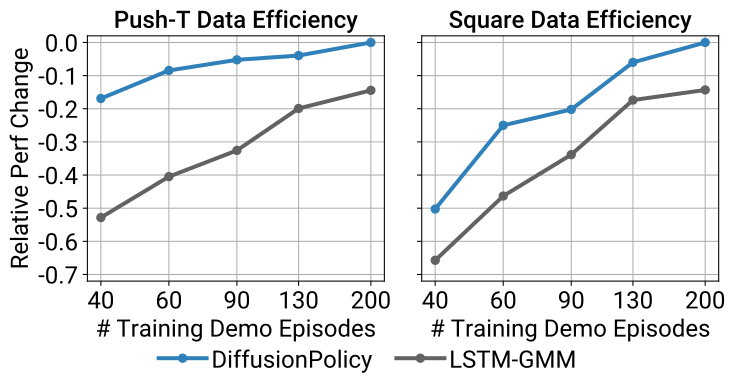
The reported data-size ablation favors Diffusion Policy over the recurrent Gaussian-mixture baseline at every tested training-set size. It does not establish performance without demonstrations or outside the evaluated data distributions.
Appendix B Additional Ablation Results
The additional ablations clarify the role of observation history and the exact calculation behind the headline performance gain.
B.1 Observation Horizon
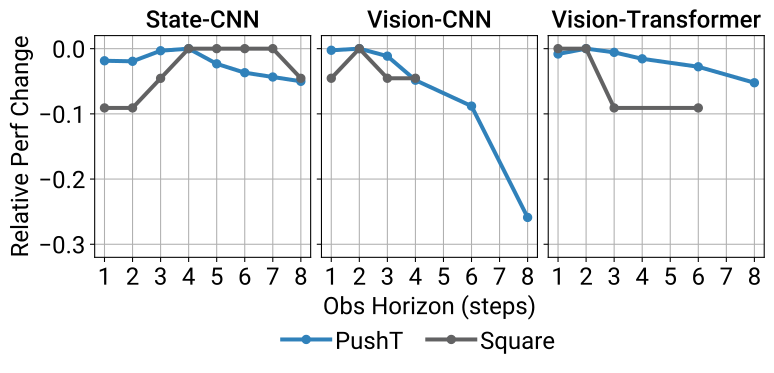
State-based policies are relatively insensitive to the tested observation horizons. Longer image histories can reduce performance, especially for the convolutional model. A two-step observation horizon works well across most of these experiments.
B.2 Performance Improvement Calculation
For each included task, select the best baseline and the better diffusion backbone, then compute (diffusion - baseline) / baseline. Average these taskwise relative gains, excluding the mixed-human variants, to obtain 0.46858, rounded to 46.9%. This is a best-variant, equally weighted relative improvement; it is neither a pooled success-rate difference nor the gain of one fixed policy configuration.
Appendix C Realworld Task Details
The real-world protocols specify demonstration counts, checkpoint selection, initial-condition matching, and termination rules.
C.1 Push-T
The Push-T protocol evaluates final block alignment together with completion of the end-zone movement.
C.1.1 Demonstrations
A practiced operator records 136 demonstrations, varying initial states by pushing or tossing the block. These demonstrations represent a proficient operator rather than a distribution of novice behavior.
C.1.2 Evaluation
Each method trains for 12 hours. Evaluation normally uses the last checkpoint; implicit behavior cloning instead uses the checkpoint with minimum training action error. Each method starts from the same 20 initial conditions, aligned using top-camera overlays. Episodes end after 0.5 seconds in the end zone or at 60 seconds, and overlap is measured in top-camera pixels.
C.2 Sauce Pouring and Spreading
Sauce-task evaluation varies the dough and bowl positions and measures overlap or coverage after policy termination.
C.2.1 Demonstrations
The appendix states 50 demonstrations per sauce task with 90% used for training; Table 3 instead lists 90 proficient demonstrations for each. Both source values remain visible. Initial placements and sauce shapes vary, and some rotational teleoperation commands are discarded to avoid unintended scooping or spilling.
C.2.2 Evaluation
Diffusion and recurrent policies train for 1,000 epochs and use their final checkpoints. Evaluation matches random object positions, but not the exact initial sauce shape, while holding sauce quantity fixed. Episodes end after lifting away for 0.5 seconds or an operator safety stop. Each camera image is projected onto the table, and the larger of the two coverage estimates is reported.
Appendix D Realworld Setup Details
The low-level robot controllers enforce limits and interpolate commands; those safeguards are part of the experimental system rather than learned guarantees of the policy.
D.0.1 UR5 robot station
The UR5 accepts position targets at 125 Hz, interpolated from 10 Hz human or policy commands. The controller limits speed to 0.43 m/s and confines the end effector near the table plane. Two of five cameras provide policy images, downsampled to 320 by 240 at 10 Hz; demonstrations use a SpaceMouse.
D.1 Franka Robot Station
The Franka station uses a constrained differential-kinematics controller to convert desired end-effector poses to joint motion. It can impose collision, joint, and workspace limits. Haptic teleoperation uses a separate torque controller, while policy inference uses the non-haptic controller. The source describes a 200 Hz haptic optimization and roughly 1 kHz mid-level control, with 10 Hz policy commands and interpolated targets. Camera images are downsampled to 320 by 240.
D.2 Initial and Final States of Bimanual Tasks
All 20 initial and final states are retained for each of the three bimanual tasks. Green and red outlines denote successful and failed rollouts. Mat and shirt images use planar projections for visibility. The source’s introductory sentence says four tasks, but the displayed panels cover mat unrolling, egg beating, and shirt folding.