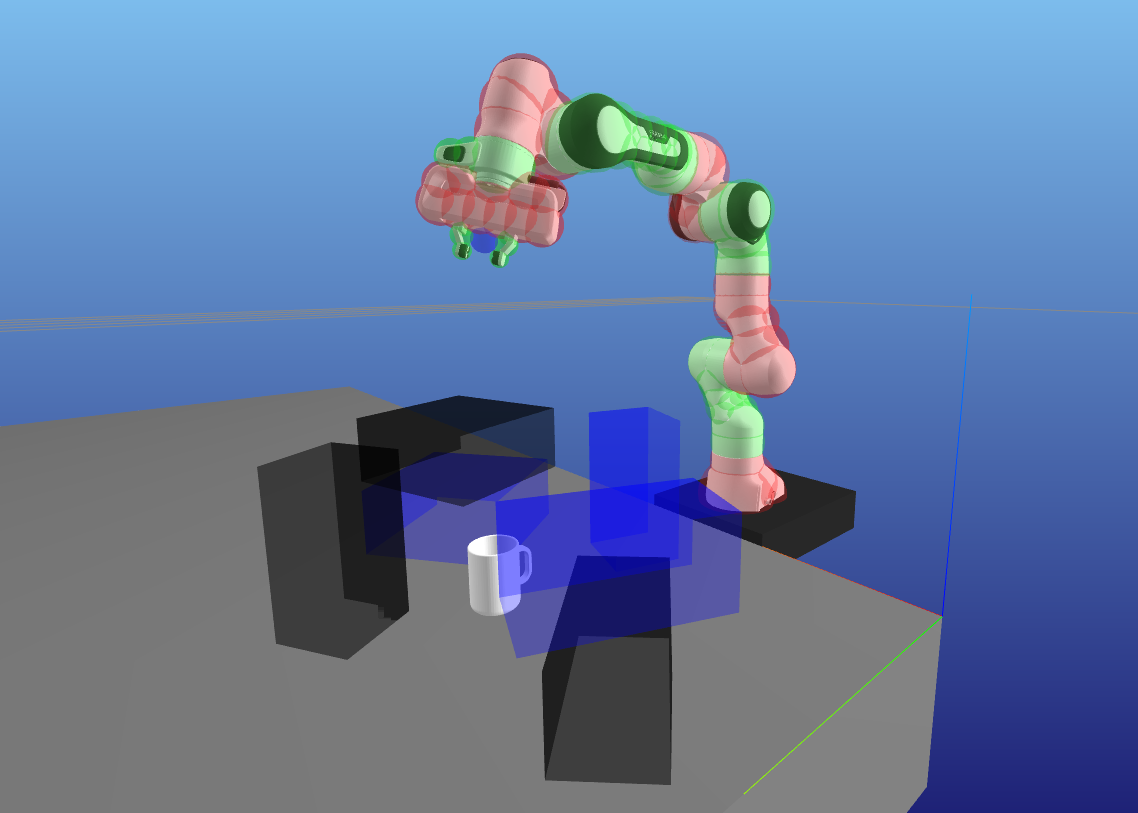
PBDS combines task-space motion rules into one acceleration policy while respecting non-Euclidean geometry. It separates metrics that define task behavior from weights that prioritize tasks, permits velocity-dependent priorities, and encodes constraints through metric curvature. The combination reduces to weighted least squares. Sphere examples and a Franka mug-grasping demonstration illustrate the approach; the reported implementation runs at 300–500 Hz.
I Introduction
Reactive controllers must combine attraction, damping, collision avoidance, and other goals on spaces such as joint configurations, rotations, or a sphere. Repulsive potentials can create unwanted minima, while a coordinate-dependent geometric construction can produce different physical behavior under a change of chart.
PBDS pulls task dynamics back to the robot through well-defined bundle constructions. Its key design choice is to separate a position-dependent behavior metric from a position/velocity-dependent task-weighting pseudometric. This lets the designer change priority without also changing the intrinsic task dynamics. The paper compares this with the specific GDS/RMP formulation of RMPflow. [17]
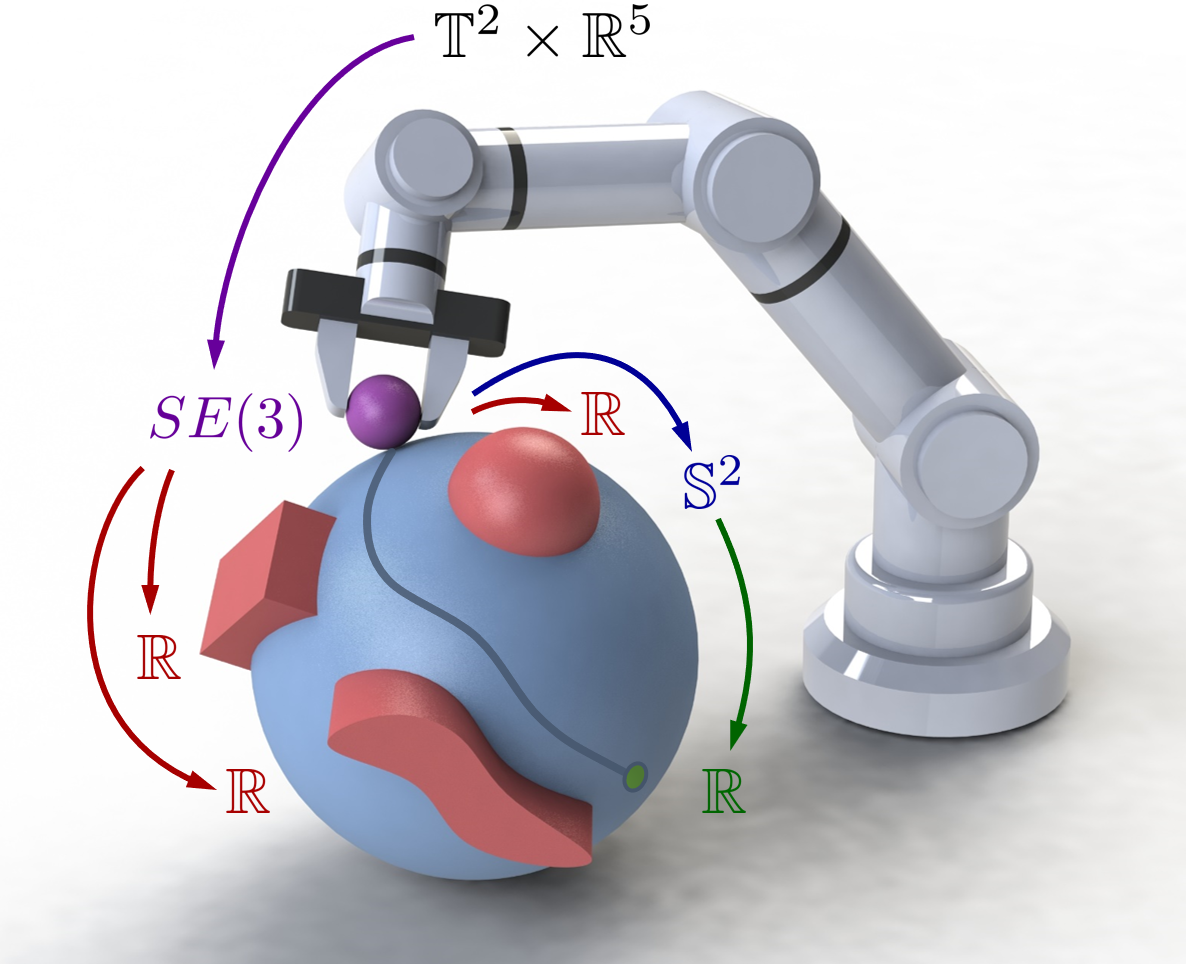
Fig. 1: Example tree of PBDS task mappings designed to move a ball along the surface of a sphere to a goal while avoiding obstacles. Depicted are manifolds representing: (black) joint configuration for a 7-DoF robot arm with two fully revolute joints, (purple) ball pose, (red) distances to obstacles, (blue) position on the sphere, and (green) distance to the goal. Note that damping can be defined on , , and/or as desired.
II Geometric Preliminaries
A manifold represents configurations, its tangent bundle represents velocities, and its cotangent bundle naturally represents forces. A Riemannian metric defines lengths and converts forces to accelerations; a connection adds the curvature terms needed to define acceleration independently of coordinates. Local equations use Christoffel symbols, but the resulting objects must agree when charts change.
Equations 1
(1)
Fig. 2: Commutative diagram of the key manifolds used to form a pullback bundle dynamical system. Note that the pullback bundle is an -vector bundle over the robot configuration manifold .
III Pullback Bundle Dynamical Systems
Each task supplies a smooth map from robot configuration to a task manifold, a behavior metric, a potential, and dissipative forces. Pullback connections, metrics, and force operators express these task dynamics over robot configurations. Local auxiliary curves define desired task accelerations without requiring an invertible task map.
A weighted least-squares problem selects the robot acceleration that best matches all task accelerations. Nonzero task weights must be positive definite, and the combined active-task Jacobian must have full robot-coordinate rank. These assumptions make the local normal matrix invertible and yield a unique smooth policy. Separate weights can depend on velocity or deactivate tasks.
The stated stability theorem additionally requires strictly dissipative active forces and a proper combined potential. It gives compact invariant energy sublevels and convergence to an equilibrium set. This is not a guarantee that every initialization reaches the intended goal: undesired saddle or maximum equilibria can remain. The appendix explains the restricted-sublevel version when global properness is unavailable.
TABLE I: Simple task design summary for running example of a robot on a sphere surface navigating to a goal point while avoiding obstacles. Note that each obstacle has an avoidance tasks (hence the indices ). For the damping task, the overbars denote representations in ambient Euclidean space, which are easily pulled back through standard embedding maps to induce corresponding objects on and (see Appx. A.II for details).
Equations 2–9
(2)
(3)
(4)
(5)
(6)
(7)
(8)
(9)
Fig. 3: Tree of manifolds and task maps in a multi-task PBDS policy. At the root is the robot configuration manifold, and task manifolds are at the leaves. This structure can be exploited to parallelize computation of contributions from independent tasks and reuse computation from parent nodes.
IV Comparison to Riemannian Motion Policies on Geometric Dynamical Systems
The comparison examines coordinate invariance, the use of velocity-dependent metrics, and constraint design.
IV-A Geometric Consistency
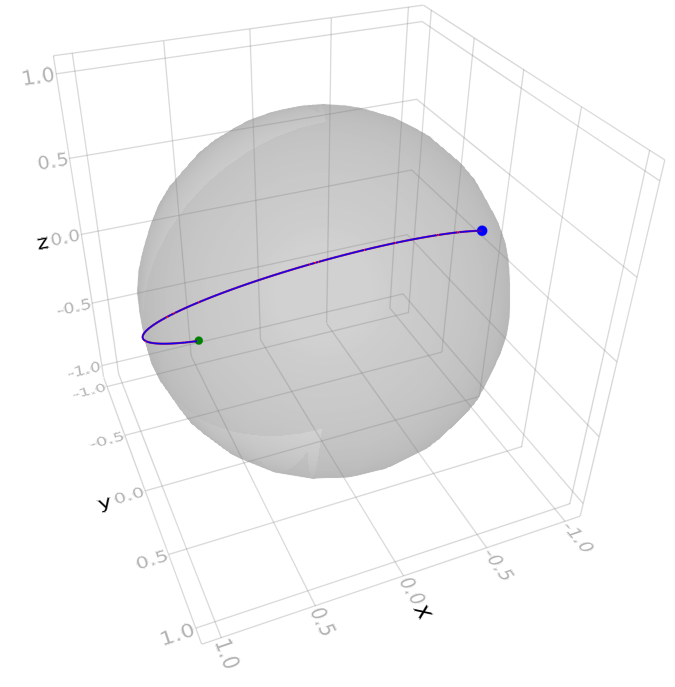
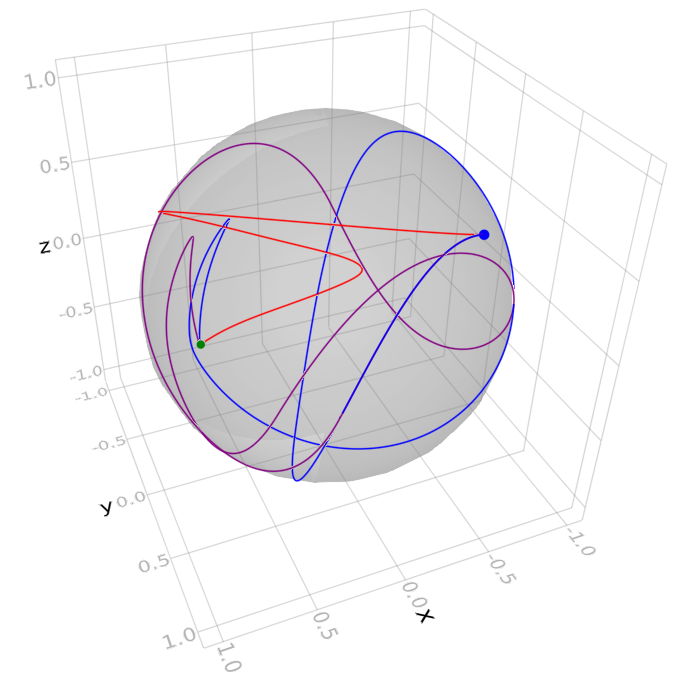
The paper derives the compared GDS formulation from tangent-bundle dynamics and identifies a horizontal projection whose result depends on the chosen chart. Under a coordinate change, omitted metric terms generally reappear. Sphere experiments show differing GDS paths under alternative chart choices, while PBDS gives consistent physical trajectories. The claim concerns this specified formulation and construction.
Equation 10
(10)
Fig. 4: Commutative diagram for a PBDS system applied to a task map between tangent bundles.Equation 11
(11)
IV-B Task Prioritization and Velocity-Dependent Metrics
Using one velocity-dependent metric for both task behavior and priority can change effective inertia as well as force. Near a constraint, that can make acceleration away from the constraint difficult too. PBDS instead uses position-dependent behavior metrics and separate velocity-dependent weights. Appendix D derives a more elaborate tangent-bundle alternative, mainly to explain these design tradeoffs.
Equations
IV-C Metric-based Constraints
A constraint task maps configuration to positive distance from a boundary. An exponentially growing metric produces curvature that slows motion toward that boundary without adding a competing repulsive potential. A distance-and-velocity weight deactivates the task when it is irrelevant; smooth approximations are needed to retain the smooth-policy assumptions.
The prose specifies activation while approaching the boundary, where distance decreases. The displayed equation (13) prints the opposite velocity sign; the source equation is retained, so an implementation should reconcile that discrepancy. Avoiding spurious potential minima does not remove all possible equilibrium traps or certify arbitrary unsatisfiable task combinations.
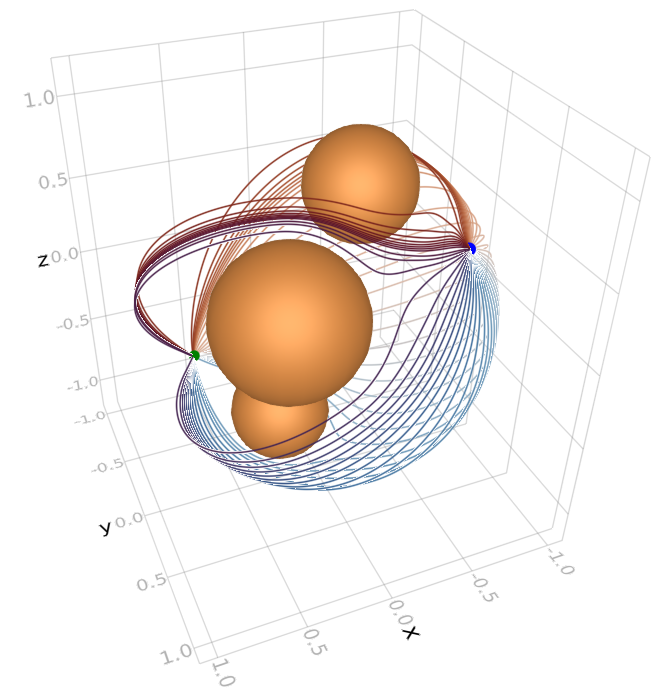
(c)PBDS attractor and obstacle avoidance policy on
Fig. 5: (a) and (b) show a geometric consistency test using a point attractor on and three schemes for choice of chart: (Red) Always using south pole stereographic projection, (Blue) always using north pole stereographic projection, (Purple) switching stereographic projections depending on the sphere hemisphere. The blue and green dots show the start and goal points, respectively. Note that using PBDS, all coordinate choices result in the same trajectory. (c) shows resulting trajectories from a PBDS attractor policy with obstacles added, where the curve colors represent different starting velocity directions.
V Implementation and Arm Experiments
The PBDS.jl implementation handles coordinate transitions and reuses task-map calculations in a tree. Algorithm 1 gives the policy evaluation steps. A seven-joint Franka Panda reaches through changing clutter to grasp a mug, combining attraction, obstacle and joint-limit tasks, and damping on sphere/circle task spaces. Policy outputs run at a reported 300–500 Hz; the experiment is a demonstration rather than a large statistical benchmark.
PBDS provides a modular geometric language for reactive motion, separating task geometry from task priority. The stated results depend on rank, smoothness, dissipation, and potential assumptions. Velocity, acceleration, and actuator limits, as well as discrete mesh task spaces, are proposed extensions rather than general guarantees of the present method.
Appendix A Further Experimental Details and PBDS Design Strategies
The appendix documents the grasping task design. Joint limits make the Panda configuration model Euclidean; conservative sphere sets approximate link collision geometry.
I Task Set for Grasping a Mug
Tasks include joint damping; distance-toggled damping around the mug and along its rim; joint-limit, obstacle, and self-collision constraints; and approach/alignment/grasp attractors. A two-state machine delays grasping while the mug moves or the end effector is still approaching. Simultaneously active attractors are designed to be nonconflicting.
Fig. 6: Example experimental scenario for Franka Panda arm reaching through clutter to grasp a mug. The blue and black boxes are obstacles, and the green and red spheres on the arm represent the collisions for different robot links.
II Tasks on 𝕊 n
Sphere tasks can be designed in their ambient Euclidean embedding and pulled back into north/south stereographic charts. The retained formulas give embeddings, transitions, and induced metrics, potentials, forces, and weights. This avoids treating one planar chart as globally valid on a sphere.
Equations 14–15
(14)
(15)
Fig. 7: Commutative diagram for the two stereographic charts of and its embedding in Euclidean space. (Here we omit the subsets which are the domains of the respective chart maps ).
III Distance-Toggled Tasks
Adding a distance coordinate to a task map lets its weight switch behavior on and off according to proximity. This is used both to skip unnecessary collision calculations and to activate appropriate damping or attraction near the mug.
The suggested recipe starts with an identity-map damping task to cover every robot direction, then adds metric-only distance constraints, and finally adds nonconflicting attractors. This supports the rank and dissipation assumptions and avoids competing repulsive potentials. The authors explicitly distinguish absence of spurious potential minima from guaranteed goal completion at every initial state.
Shared task-map prefixes make repeated Jacobian and derivative calculations wasteful. Leaf nodes compute weighted curvature, force, and Jacobian terms; intermediate nodes transform and combine them; the root solves for acceleration. The appendix expands a two-level tree to show that the recursive result matches the direct summed policy. All recurrence equations and the task-tree diagram are retained.
Equations 16–17
(16)
(17)
Fig. 8: Task map tree for an example multi-task PBDS.Equations 18–19
(18)
(19)
Appendix C Mathematical Details for Pullback Bundle Dynamical Systems
This appendix constructs the pullback objects, establishes coordinate consistency and policy well-posedness, and presents the stated stability proof.
Equation 20
(20)
I Constructions on the Pullback Bundle
Because a pullback bundle is not itself the task tangent bundle, the connection, acceleration, metric, force, and gradient operators are built explicitly. The connection coefficients are checked against chart-transition rules. Compatibility of the pulled-back metric and connection supplies the energy differentiation identity used later. The sharp/flat maps convert covectors and vectors, while dissipative forces retain their sign property under pullback.
Equations 21–35
(21)
(22)
(23)
(24)
(25)
(26)
(27)
(28)
(29)
(30)
(31)
(32)
(33)
(34)
(35)
II Local Pullback Bundle Dynamical Systems
At each robot state and velocity, a short auxiliary curve defines local task-bundle dynamics. Such a curve exists in a local chart. Its derivative at the initial point depends only on that state and velocity, not on the arbitrary continuation of the curve, so the desired task-acceleration operator is well defined even with redundancy.
Equations 36
(36)
III Multi-Task Pullback Bundle Dynamical Systems
Vertical projections map robot and desired task accelerations into comparable spaces. The resulting optimization is a weighted quadratic least-squares problem. Positive active weights and a full-rank combined Jacobian make its normal matrix positive definite. A transversality argument discusses generic rank when sufficiently many tasks are available; practical designs still need the rank condition to hold.
The paper sums task kinetic energies and potentials, then uses metric–connection compatibility to cancel conservative terms. Strict dissipation yields decreasing energy away from zero velocity. Properness gives compact invariant sublevels and forward completeness, and LaSalle’s principle identifies the stated limiting equilibrium set.
If properness holds only on a restricted sublevel, so does the conclusion. Equilibria at attractor-potential maxima or saddles may remain, even without unwanted local minima; the authors suggest small perturbations to escape such cases. The preserved derivation records the exact conditions and claim.
Equations 47–49
(47)
(48)
(49)
Appendix D Mathematical Details for PBDS Policies on Tangent Bundle Tasks
Extending PBDS from configuration tasks to tangent-bundle tasks introduces extra velocity coordinates and jerk terms. The appendix explores a constrained construction that still produces acceleration commands. Its coordinate-swapping step requires appropriate parallelizable embedded manifolds, a restriction that excludes the sphere example in this form.
I Enforcing Velocity Constraints
An admissible curve in the tangent bundle must have its position derivative equal its represented velocity. An augmented task map and a subbundle constraint enforce that relation. A permutation enables a globally defined vertical projection to remove the jerk components, and a modified connection keeps evolution within the required subbundle.
Equations 50
(50)
II Multi-Task Acceleration Policy Optimization
The modified local dynamics and projected task accelerations form another weighted least-squares acceleration policy. The detailed Jacobians, curvature terms, and final expression are retained. The appendix states that analogous well-posedness and stability results could be developed but leaves their proofs outside its scope; these are not an additional completed theorem for every velocity-dependent task.
Equations 51–53
(51)
(52)
(53)
28 references
[1]
O. Khatib, “Real-time obstacle avoidance for manipulators and mobile robots,”
in Proc. IEEE Conf. on Robotics and Automation, 1985.
[2]
P. Khosla and R. Volpe, “Superquadric artificial potentials for obstacle
avoidance and approach,” in Proc. IEEE Conf. on Robotics and
Automation, 1988.
[4]
S. M. Khansari-Zadeh and A. Billard, “A dynamical system approach to realtime
obstacle avoidance,” Autonomous Robots, vol. 32, no. 4, pp.
433–454, 2012.
[5]
A. J. Ijspeert, J. Nakanishi, H. Hoffmann, P. Pastor, and S. Schaal,
“Dynamical Movement Primitives: Learning attractor models for motor
behaviors,” Neural Computation, vol. 25, no. 2, pp. 328–373, 2013.
[6]
N. Ratliff, M. Toussaint, and S. Schaal, “Understanding the geometry of
workspace obstacles in motion optimization,” in Proc. IEEE Conf. on
Robotics and Automation, 2015.
[7]
J. Agirrebeitia, R. Avilés, I. F. de Bustos, and G. Ajuria, “A new APF
strategy for path planning in environments with obstacles,” Mechanism
and Machine Theory, vol. 40, no. 6, pp. 645–658, 2005.
[8]
J. Schulman, J. Ho, A. Lee, I. Awwal, H. Bradlow, and P. Abbeel, “Finding
locally optimal, collision-free trajectories with sequential convex
optimization,” in Robotics: Science and Systems, 2013.
[9]
S. Kuindersma, R. Deits, M. Fallon, A. Valenzuela, H. Dai, F. Permenter,
T. Koolen, P. Marion, and R. Tedrake, “Optimization-based locomotion
planning, estimation, and control design for the Atlas humanoid robot,”
Autonomous Robots, vol. 40, no. 3, pp. 429–455, 2015.
[10]
W. Merkt, V. Ivan, and S. Vijaykumar, “Continuous-time collision avoidance for
trajectory optimization in dynamic environments,” in IEEE/RSJ Int. Conf. on Intelligent Robots & Systems, 2019.
[11]
E. Rimon and D. E. Koditschek, “Exact robot navigation wsing artificial
potentia functions,” IEEE Transactions on Robotics and Automation,
vol. 8, no. 5, pp. 501–518, 1992.
[12]
J.-O. Kim and P. K. Khosla, “Real-time obstacle avoidance using harmonic
potential functions,” IEEE Transactions on Robotics and Automation,
vol. 8, no. 3, pp. 338–349, 1992.
[13]
L. Huber, A. Billard, and J.-J. Slotine, “Avoidance of convex and concave
obstacles with convergence ensured through contraction,” IEEE
Robotics and Automation Letters, vol. 4, no. 2, pp. 1462–1469, 2019.
[14]
Y. Koren and J. Borenstein, “Potential field methods and their inherent
limitations for mobile robot navigation,” in Proc. IEEE Conf. on
Robotics and Automation, 1991.
[15]
D. H. Kim, “Escaping route method for a trap situation in local path
planning,” Int. Journal of Control, Automation and Systems,
vol. 7, no. 3, pp. 495–500, 2009.
[17]
C.-A. Cheng, M. Mukadam, J. Issac, S. Birchfield, D. Fox, B. Boots, and
N. Ratliff, “RMPflow: A computational graph for automatic motion policy
generation,” in Workshop on Algorithmic Foundations of Robotics,
2018.
[18]
J. Mainprice, N. Ratliff, M. Toussaint, and S. Schaal. (2020) An interior point
method solving motion planning problems with narrow passages. Available at
https://arxiv.org/abs/2007.04842.
[21]
M. A. Rana, A. Li, H. Ravichandar, M. Mukadam, S. Chernova, D. Fox, B. Boots,
and N. Ratliff, “Learning reactive motion policies in multiple task spaces
from human demonstrations,” in Conf. on Robot Learning, 2020.
[25]
A. Li, C.-A. Cheng, B. Boots, and M. Egerstedt, “Stable, concurrent controller
composition for multi-objective robotic tasks,” in Proc. IEEE Conf. on Decision and Control, 2019.
[26]
M. Mukadam, C.-A. Cheng, D. Fox, B. Boots, and N. Ratliff, “Riemannian
Motion Policy fusion through learnable Lyapunov function reshaping,”
in Conf. on Robot Learning, 2020.
[27]
T. Koolen and R. Deits, “Julia for robotics: Simulation and real-time
control in a high-level programming language,” in Proc. IEEE Conf. on Robotics and Automation, 2019.