Overview
This preliminary report finds evidence that attention features span multiple heads and layers, and that where attention moves information is coupled to what it moves. Multitoken transcoders provide useful partial explanations, but explaining how attention patterns themselves form remains the central unresolved problem [1].
Factoring the Problem
The research separates six questions: superposition across heads, QK/OV coupling, the dimensionality of OV and QK behavior, representations across layers, and the nonlinear formation of attention patterns. Different experiments address different subsets of these questions.
Approaches
The team first tried a broad replacement-layer approach, then turned to narrower experiments after optimization and evaluation difficulties. The following methods therefore provide complementary, incomplete evidence.
Attention Replacement Layer
A wide attention replacement layer learns to reproduce an original layer while penalizing QK and OV complexity. Nuclear-norm-based regularization theoretically favors separate simple skip-trigram heads while allowing higher-rank induction mechanisms [2] [3]. Some interpretable heads emerge, but optimization, scaling, and the absence of a clear comparison metric prevent a clean solution.
Equation
Multitoken Transcoders
An MTC encodes source-position features, moves them using learned linear combinations of existing heads’ attention patterns, and decodes at destinations. Training combines reconstruction and sparsity losses. A 100,000-feature MTC on an 18-layer transformer yields interpretable induction, surprise, and context features. It inherits attention patterns rather than explaining their formation. Context-wide feature selection can be acausal early in training, though a large enough selection budget avoids binding later.
Attention Superposition
Binding each MTC feature to one attention head worsens sparsity by roughly 2–4 times at matched reconstruction error and produces less coherent features. This supports, without conclusively proving, attention representations distributed across heads.
QK/OV Coupling
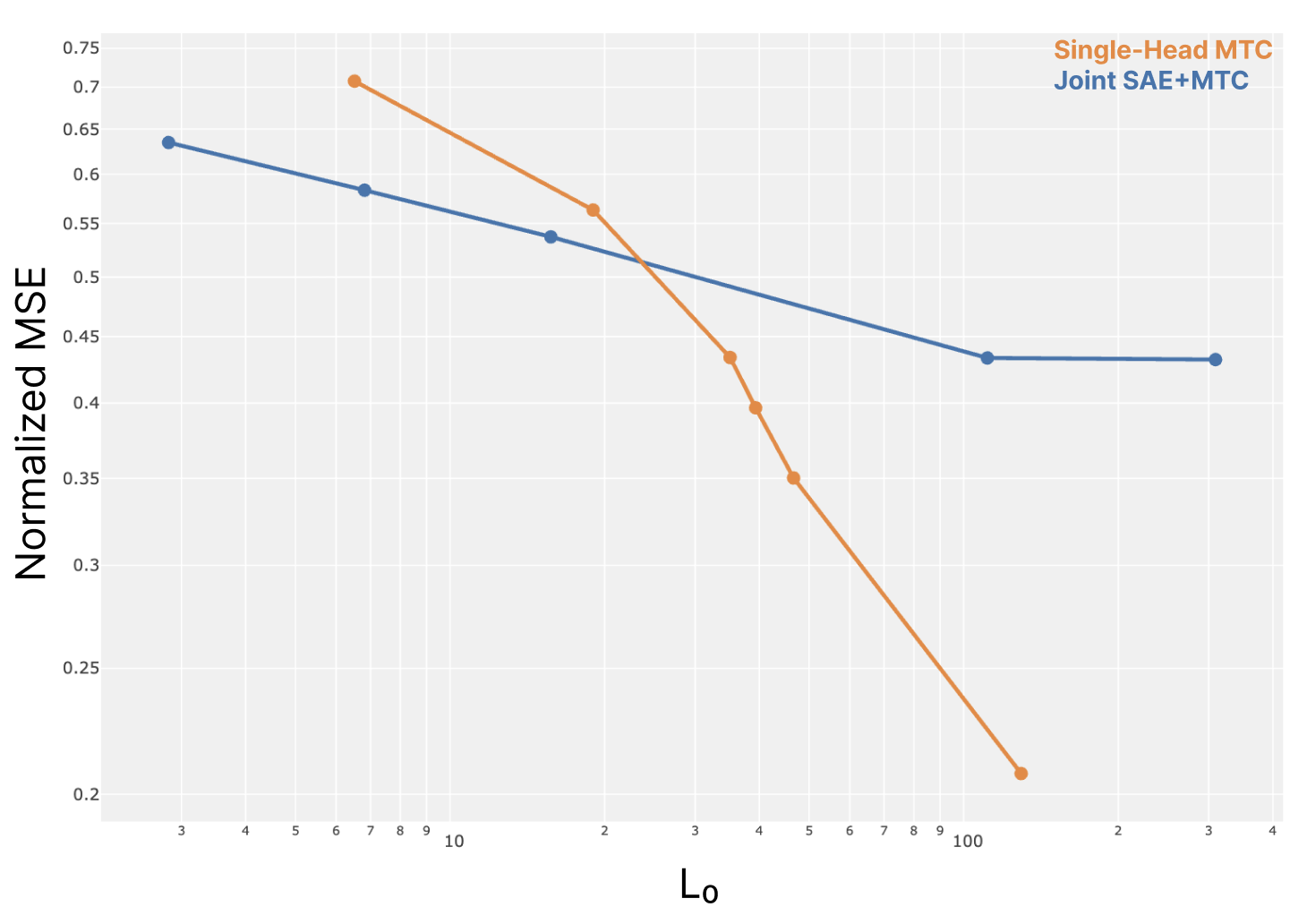
Comparisons against moving ordinary SAE features through attention favor jointly learning content and movement. Features are cleaner and performance is usually better, although one baseline does better in the very sparse, high-error regime. The baselines have different advantages, so the evidence for QK/OV coupling is qualified.
Multidimensional OV
Clustering features by their head-loading vectors gives a smooth, approximately power-law distribution of cluster sizes. There is no clear separation between one-dimensional and high-dimensional OV behaviors. The initial analysis is limited to a single layer.
Attention Value SAE’s
Attention-value SAEs reconstruct concatenated value vectors from several heads, allowing tests that span layers without directly modeling complete attention operations.
Cross-Layer Representations
Jointly reconstructing values from layers 4 and 10 of an 18-layer model outperforms two separate dictionaries: roughly half the L0 at matched normalized MSE, or about 0.3 better normalized MSE at matched L0. This supports shared attention representations across layers.
Multidimensional OV
The two-layer value-SAE analysis again finds a continuous distribution of head-loading cluster sizes. The lack of sharply preferred OV dimensions therefore persists beyond the single-layer MTC experiment.
Attention Output SAEs
Attention-output SAEs can add layer and token localization to CLT attribution graphs [4] [7]. Their features are interpretable but often provide less new information than expected, lack fixed head assignments, and do not explain attention-pattern formation. A cross-layer design with strictly causal residual features and weakly causal attention-output features improves reconstruction and somewhat simplifies graphs.
Attention Pattern Formation
QK diagonalization learns paired query-side and key-side features whose products reconstruct attention scores. Rank-one experiments find interpretable induction features but struggle to fit patterns efficiently: most other features die or cancel. More features do not reliably improve performance. The team is exploring higher-rank components, with architectural and optimization explanations both still possible.
Conclusion and Outlook
The strongest progress concerns attention superposition and jointly describing content with movement. Future work targets pattern formation, multitoken cross-layer transcoders, variable-dimensional features, and renewed replacement-layer designs. These proposals are research directions rather than completed capabilities.