Overview
This is the original MMLU benchmark paper’s complete v 3 edition, published at ICLR 2021. The results describe the models and protocols evaluated in 2020–2021, not current model capability. All 57 example questions, plots, task descriptions and appendix analyses are retained.
At a glance
Intuition. Think of MMLU as a test suite with 57 subject-specific modules. A high overall score can hide a failing module, just as a software suite can pass mostly easy tests while missing a critical subsystem. Four-choice questions have a 25% guessing baseline; scores need that context.
Reading the math. Accuracy is the fraction of answers that are correct. Calibration asks a different question: among answers assigned 80% confidence, are about 80% actually correct? A model can improve accuracy while remaining overconfident. Compare subject scores and confidence errors alongside the headline average; examination performance alone does not establish reliable reasoning in other settings.
MMLU tests pretrained language models on 57 subjects spanning elementary school through professional examinations. Its multiple-choice format probes both factual knowledge and problem solving. The original evaluation finds that large GPT-3 and UnifiedQA exceed chance but have uneven subject performance, weak calculation skills and poor confidence calibration. Aggregate accuracy therefore conceals important gaps.
1 Introduction
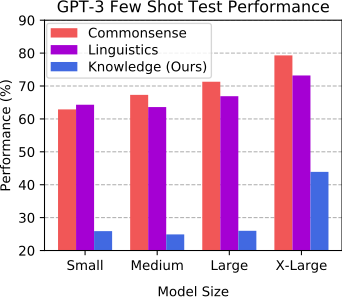
The motivation is a gap between rapidly saturated linguistic/commonsense benchmarks and the broader knowledge present in pretraining corpora. MMLU tests zero-shot, few-shot or transfer performance across academic and professional domains. In the original GPT-3 comparison, the 175B model reaches 43.9% few-shot accuracy while smaller variants remain near the 25% chance baseline. The goal is diagnostic breadth, not a claim that answering examination questions completely measures understanding.
2 Related Work
The paper contrasts pretraining-based knowledge evaluation with task-specific fine-tuning and narrower commonsense or reading-comprehension benchmarks.
Pretraining.
Pretraining exposes models to broad subject matter, while few-shot evaluation removes the need to assemble a large supervised training set for every subject. This reduces dependence on benchmark-specific training artifacts; it does not by itself eliminate shortcuts, prompt sensitivity or pretraining contamination.
Benchmarks.
Many earlier tests emphasize everyday commonsense or linguistic comprehension. MMLU adds specialized topics that humans normally study. Multiple-choice accuracy is straightforward to measure compared with open-ended generation, but restricts evaluation to recognition among supplied options.
3 A Multitask Test
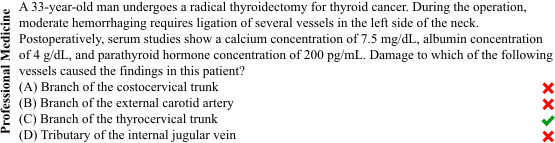
Students manually collected 15,908 questions from freely available examination, course and textbook-related sources. The split contains five development examples per subject (285 total),1,540 validation questions and 14,079 test questions, with at least 100 test items per subject. Validation may guide hyperparameters; the fixed development examples supply few-shot demonstrations.
Unspecialized Mechanical Turk respondents scored 34.5%. The 89.8% expert-level reference combines 95th-percentile exam statistics with educated guesses where unavailable; it is an estimate, not a controlled panel of experts taking every item. Subject scope and difficulty vary.
3.1 Humanities
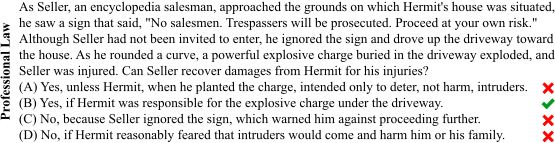
Humanities questions cover law, history, philosophy and moral reasoning. Legal items require applying rules to detailed scenarios; philosophy includes logic and arguments. Moral Scenarios draws on the ETHICS dataset and its judgments of common intuitions. Performance here is evidence about these questions, not a complete assessment of ethical behavior or safe legal practice.
3.2 Social Science
Social sciences include economics, psychology, geography, politics and security studies. Questions mix factual, qualitative and quantitative reasoning. Their breadth tests whether pretraining reaches specialized topics beyond common everyday text.

3.3 Science, Technology, Engineering, and Mathematics (STEM)
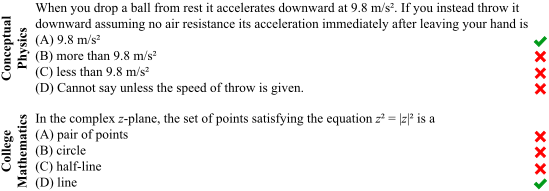
STEM spans conceptual physics, computing and mathematics from elementary calculations to abstract college problems. Expressions use LaTeX or text symbols. The text-only format tests knowledge and procedures that can be expressed in language, without testing laboratory or physical interaction skills.
3.4 Other
The Other group includes medicine, business, accounting, marketing and global facts. These categories broaden coverage beyond the three main disciplines; their grouping is a dataset convention, not a homogeneous ability.
4 Experiments
The experiments separate evaluation protocol, model scale, domain performance and calibration.
| Model | Humanities | Social Science | STEM | Other | Average |
| Random Baseline | 25.0 | 25.0 | 25.0 | 25.0 | 25.0 |
| RoBERTa | 27.9 | 28.8 | 27.0 | 27.7 | 27.9 |
| ALBERT | 27.2 | 25.7 | 27.7 | 27.9 | 27.1 |
| GPT-2 | 32.8 | 33.3 | 30.2 | 33.1 | 32.4 |
| UnifiedQA | 45.6 | 56.6 | 40.2 | 54.6 | 48.9 |
| GPT-3 Small (few-shot) | 24.4 | 30.9 | 26.0 | 24.1 | 25.9 |
| GPT-3 Medium (few-shot) | 26.1 | 21.6 | 25.6 | 25.5 | 24.9 |
| GPT-3 Large (few-shot) | 27.1 | 25.6 | 24.3 | 26.5 | 26.0 |
| GPT-3 X-Large (few-shot) | 40.8 | 50.4 | 36.7 | 48.8 | 43.9 |
4.1 Setup
GPT-3 is evaluated through prompts; UnifiedQA is evaluated by transfer from its prior question-answering training. Smaller fine-tuned baselines are reported separately.
Assessment and Models.
The source labels four GPT-3 API variants as 2.7B,6.7B,13B and 175B parameters. UnifiedQA uses the T5 backbone and prior supervised QA training; the predicted class is chosen by token overlap with its generated answer. RoBERTa, ALBERT and GPT-2 additionally fine-tune on UnifiedQA multiple-choice data and MMLU development/validation data. These are different training/evaluation regimes, so comparisons do not isolate model size.
Few-Shot Prompt.
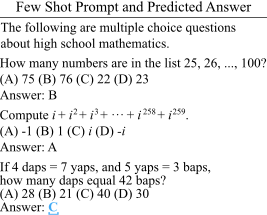
GPT-3 receives a subject header and up to five fixed answered examples, followed by the new question ending in “Answer:”. Prediction uses the largest probability among the A/B/C/D tokens. The choices, demonstration count and exact formatting are part of the protocol; this is not free-form reasoning or unrestricted answer generation.
4.2 Results
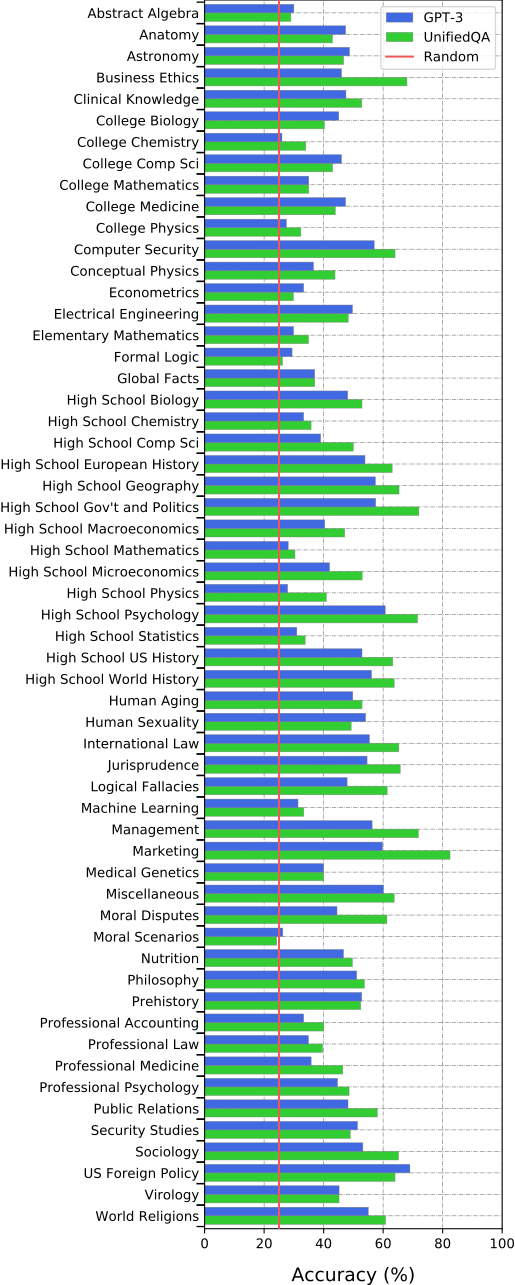
Table 1 and Figures 6–11 retain the broad-discipline scores, all subject results, demonstration-count trend and confidence analyses.
Model Size and Accuracy.
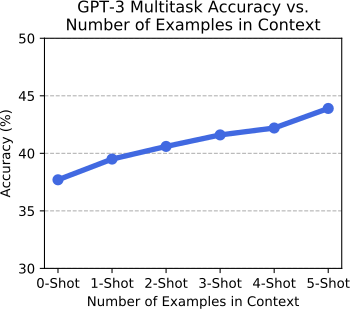
The 175B GPT-3 scores 43.9% few-shot and about 37.7% zero-shot;11B UnifiedQA transfer reaches 48.9%. UnifiedQA’s supervised QA history is a material difference, so this is not a matched architecture/parameter-efficiency experiment. Table 1 reports weighted accuracy; its aggregate should be read alongside the subject distribution.
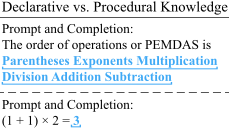
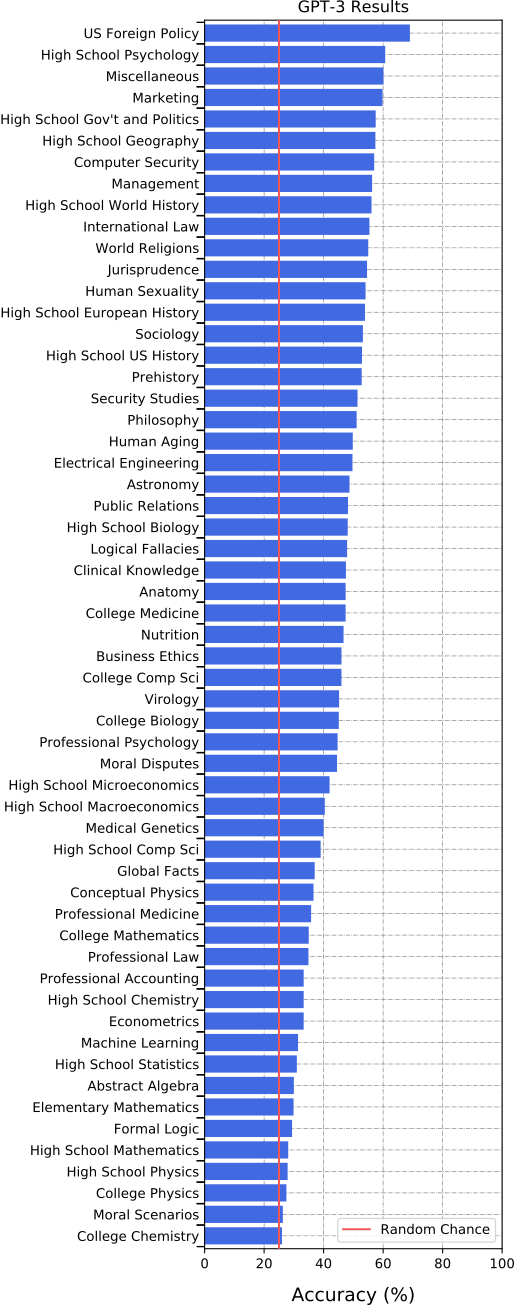
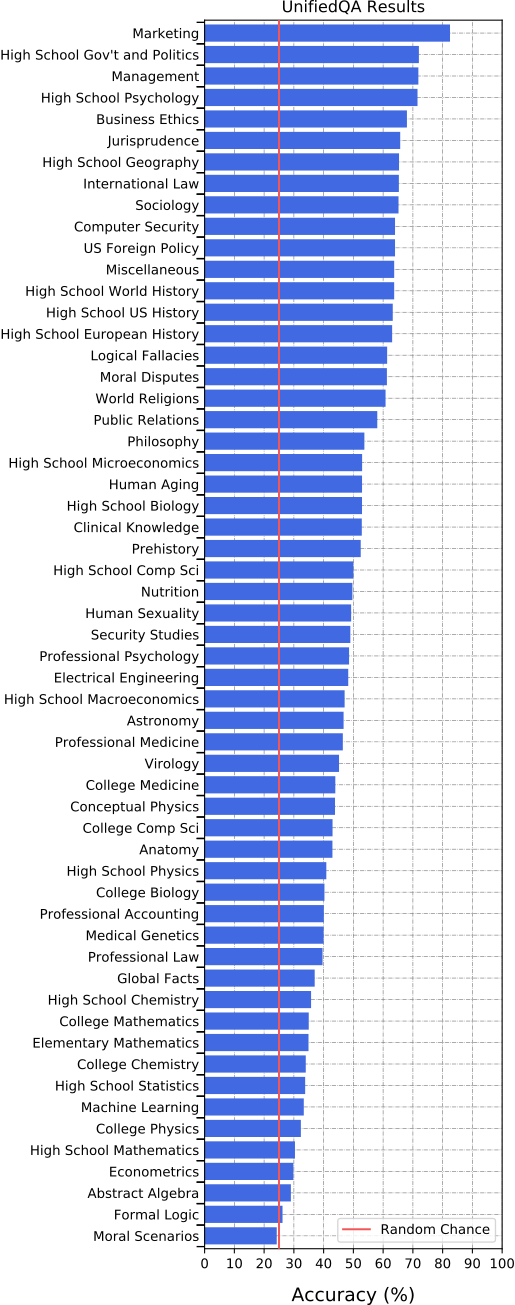
GPT-3 ranges from 69% on US Foreign Policy to 26% on College Chemistry; UnifiedQA reaches 82.5% on Marketing. Calculation-heavy subjects are especially weak. Knowing the PEMDAS rule does not ensure applying it, and strong performance on some advanced verbal subjects coexists with poor elementary arithmetic.
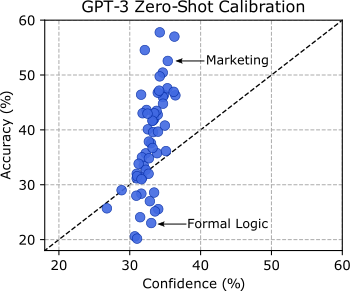
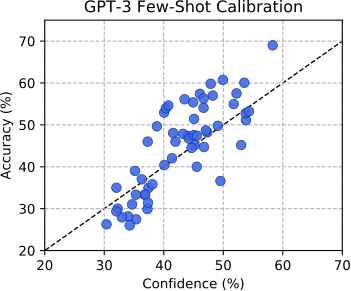
Subject-average confidence can differ from accuracy by 24 percentage points in zero-shot evaluation. Elementary Mathematics has 19.4% zero-shot RMS calibration error. Few-shot prompting improves calibration somewhat, but still leaves gaps up to 14 points. These figures characterize the tested models and prompts.
5 Discussion
The benchmark intentionally evaluates text-only knowledge; multimodal perception and interaction require additional tests. Its pretraining-and-transfer methodology uses the Internet as a broad learning resource rather than demanding a large subject-specific question bank. That change does not prove the absence of artifacts or leakage.
Weak law, morality and calculation scores motivate better knowledge acquisition, but those tests are partial proxies for broader alignment or expertise. In one limited intervention, RoBERTa trained on about 2,000 extra law questions scores 32.8%; continued pretraining on 1.6M legal case summaries raises this to 36.1%. This small-model result does not establish that domain pretraining generally fails. The discussion’s scaling/data predictions are historical hypotheses rather than findings about future model limits.
6 Conclusion
MMLU contributes a broad, reproducible multiple-choice diagnostic. Its original models show uneven knowledge, calculation failures and miscalibration despite above-chance aggregate accuracy. The useful interpretation is a profile of measured capabilities under a stated protocol, with the benchmark’s text-only scope and proxy limitations kept explicit.
Acknowledgements
The authors acknowledge feedback from six colleagues and support through NSF and Open Philanthropy fellowships and an NSF Frontier award.
Appendix A Additional Analysis
The appendix sorts all 57 subject scores, tests demonstration count and calibration, and examines smaller fine-tuned models, individual errors and input formatting. Figures 10 and 11 respectively show demonstration count and few-shot calibration; some original prose cross-references conflate their numbers.
A.1 Analysis with More Fine-Tuned Models
Fine-tuned RoBERTa-base, ALBERT-xxlarge and GPT-2 achieve 27.9%,27.1% and 32.4% overall. The 60M UnifiedQA variant reaches 29.3%, while 3B UnifiedQA reaches 43.7%. These comparisons suggest that pretraining and QA fine-tuning matter alongside scale, but vary architecture, data and parameter count simultaneously and do not isolate a single cause.
A.2 Error Analysis
A qualitative example assigns 97.5% confidence to 23 chromosomes where the keyed answer is 46. The wrong answer would fit chromosome pairs, illustrating a confident response to a slightly different question. This is an example of a failure mode, not a quantitative accounting of all errors.
A.3 Format Sensitivity
UnifiedQA lowercases and normalizes questions and choices using the exact retained input template. Removing the final </s> token lowers accuracy by several points; GPT-3 is less sensitive in the tested formats. Format choices therefore belong in reproducibility reports.
QUESTION1 \\n (A) CHOICE1 (B) CHOICE2 (C) CHOICE3 (D) CHOICE4</s>
Appendix B Test Details
The remaining appendix records every task, representative question and the paper’s contamination diagnostic.
B.1 Task Descriptions and Examples
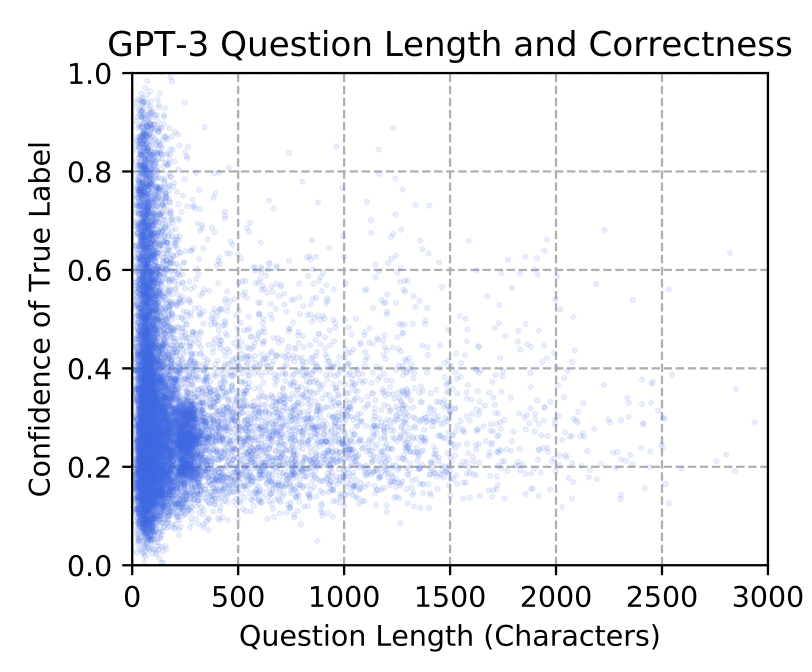
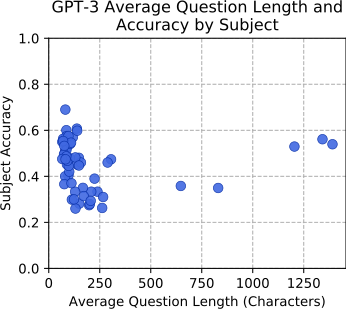
Table 2 enumerates all 57 tasks and their concepts. Figures 14–70 retain one complete example per task, including answer choices, mathematical expressions and the source’s bold keyed answer. Figure 12 shows that question length is not a reliable difficulty proxy; among questions exceeding 280 characters, true-label confidence has a slightly positive association with length.
B.2 Exact Question and Answer Contamination
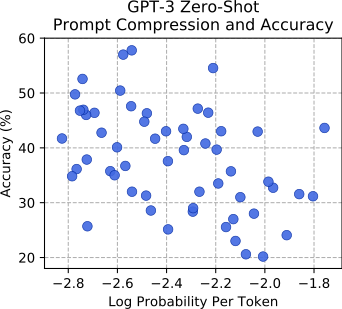
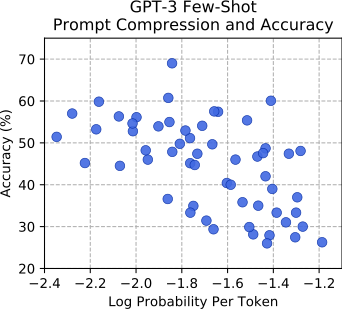
The authors look for the low-entropy/high-accuracy pattern expected from exact memorization. Across tasks, mean question log-probability correlates negatively with accuracy (r=−.43 zero-shot,−.56 few-shot), and many source questions separate answers onto other pages. This is indirect evidence, not a dataset-overlap audit or proof that no items were memorized. The discussion promises source lists to help future filtering; related pretraining knowledge is expected and differs from exact question-answer leakage.
| Task | Tested Concepts | Supercategory |
| Abstract Algebra | Groups, rings, fields, vector spaces, … | STEM |
| Anatomy | Central nervous system, circulatory system, … | STEM |
| Astronomy | Solar system, galaxies, asteroids, … | STEM |
| Business Ethics | Corporate responsibility, stakeholders, regulation, … | Other |
| Clinical Knowledge | Spot diagnosis, joints, abdominal examination, … | Other |
| College Biology | Cellular structure, molecular biology, ecology, … | STEM |
| College Chemistry | Analytical, organic, inorganic, physical, … | STEM |
| College Computer Science | Algorithms, systems, graphs, recursion, … | STEM |
| College Mathematics | Differential equations, real analysis, combinatorics, … | STEM |
| College Medicine | Introductory biochemistry, sociology, reasoning, … | Other |
| College Physics | Electromagnetism, thermodynamics, special relativity, … | STEM |
| Computer Security | Cryptography, malware, side channels, fuzzing, … | STEM |
| Conceptual Physics | Newton’s laws, rotational motion, gravity, sound, … | STEM |
| Econometrics | Volatility, long-run relationships, forecasting, … | Social Sciences |
| Electrical Engineering | Circuits, power systems, electrical drives, … | STEM |
| Elementary Mathematics | Word problems, multiplication, remainders, rounding, … | STEM |
| Formal Logic | Propositions, predicate logic, first-order logic, … | Humanities |
| Global Facts | Extreme poverty, literacy rates, life expectancy, … | Other |
| High School Biology | Natural selection, heredity, cell cycle, Krebs cycle, … | STEM |
| High School Chemistry | Chemical reactions, ions, acids and bases, … | STEM |
| High School Computer Science | Arrays, conditionals, iteration, inheritance, … | STEM |
| High School European History | Renaissance, reformation, industrialization, … | Humanities |
| High School Geography | Population migration, rural land-use, urban processes, … | Social Sciences |
| High School Gov’t and Politics | Branches of government, civil liberties, political ideologies, … | Social Sciences |
| High School Macroeconomics | Economic indicators, national income, international trade, … | Social Sciences |
| High School Mathematics | Pre-algebra, algebra, trigonometry, calculus, … | STEM |
| High School Microeconomics | Supply and demand, imperfect competition, market failure, … | Social Sciences |
| High School Physics | Kinematics, energy, torque, fluid pressure, … | STEM |
| High School Psychology | Behavior, personality, emotions, learning, … | Social Sciences |
| High School Statistics | Random variables, sampling distributions, chi-square tests, … | STEM |
| High School US History | Civil War, the Great Depression, The Great Society, … | Humanities |
| High School World History | Ottoman empire, economic imperialism, World War I, … | Humanities |
| Human Aging | Senescence, dementia, longevity, personality changes, … | Other |
| Human Sexuality | Pregnancy, sexual differentiation, sexual orientation, … | Social Sciences |
| International Law | Human rights, sovereignty, law of the sea, use of force, … | Humanities |
| Jurisprudence | Natural law, classical legal positivism, legal realism, … | Humanities |
| Logical Fallacies | No true Scotsman, base rate fallacy, composition fallacy, … | Humanities |
| Machine Learning | SVMs, VC dimension, deep learning architectures, … | STEM |
| Management | Organizing, communication, organizational structure, … | Other |
| Marketing | Segmentation, pricing, market research, … | Other |
| Medical Genetics | Genes and cancer, common chromosome disorders, … | Other |
| Miscellaneous | Agriculture, Fermi estimation, pop culture, … | Other |
| Moral Disputes | Freedom of speech, addiction, the death penalty, … | Humanities |
| Moral Scenarios | Detecting physical violence, stealing, externalities, … | Humanities |
| Nutrition | Metabolism, water-soluble vitamins, diabetes, … | Other |
| Philosophy | Skepticism, phronesis, skepticism, Singer’s Drowning Child, … | Humanities |
| Prehistory | Neanderthals, Mesoamerica, extinction, stone tools, … | Humanities |
| Professional Accounting | Auditing, reporting, regulation, valuation, … | Other |
| Professional Law | Torts, criminal law, contracts, property, evidence, … | Humanities |
| Professional Medicine | Diagnosis, pharmacotherapy, disease prevention, … | Other |
| Professional Psychology | Diagnosis, biology and behavior, lifespan development, … | Social Sciences |
| Public Relations | Media theory, crisis management, intelligence gathering, … | Social Sciences |
| Security Studies | Environmental security, terrorism, weapons of mass destruction, … | Social Sciences |
| Sociology | Socialization, cities and community, inequality and wealth, … | Social Sciences |
| US Foreign Policy | Soft power, Cold War foreign policy, isolationism, … | Social Sciences |
| Virology | Epidemiology, coronaviruses, retroviruses, herpesviruses, … | Other |
| World Religions | Judaism, Christianity, Islam, Buddhism, Jainism, … | Humanities |
Find all in such that is a field.
(A) 0 (B) 1 (C) 2 (D) 3
What is the embryological origin of the hyoid bone?
(A) The first pharyngeal arch
(B) The first and second pharyngeal arches
(C) The second pharyngeal arch
(D) The second and third pharyngeal arches
Why isn’t there a planet where the asteroid belt is located?
(A) A planet once formed here but it was broken apart by a catastrophic collision.
(B) There was not enough material in this part of the solar nebula to form a planet.
(C) There was too much rocky material to form a terrestrial planet but not enough gaseous material to form a jovian planet.
(D) Resonance with Jupiter prevented material from collecting together to form a planet.
Three contrasting tactics that CSO’s can engage in to meet their aims are which typically involves research and communication, , which may involve physically attacking a company’s operations or , often involving some form of .
(A) Non-violent direct action, Violent direct action, Indirect action, Boycott
(B) Indirect action, Instrumental action, Non-violent direct action, Information campaign
(C) Indirect action, Violent direct action, Non-violent direct-action Boycott.
(D) Non-violent direct action, Instrumental action, Indirect action, Information campaign
How many attempts should you make to cannulate a patient before passing the job on to a senior colleague?
(A) 4 (B) 3 (C) 2 (D) 1
In a given population, 1 out of every 400 people has a cancer caused by a completely recessive allele, b. Assuming the population is in Hardy-Weinberg equilibrium, which of the following is the expected proportion of individuals who carry the b allele but are not expected to develop the cancer?
(A) 1/400 (B) 19/400 (C) 20/400 (D) 38/400
Which of the following statements about the lanthanide elements is NOT true?
(A) The most common oxidation state for the lanthanide elements is +3.
(B) Lanthanide complexes often have high coordination numbers (> 6).
(C) All of the lanthanide elements react with aqueous acid to liberate hydrogen.
(D) The atomic radii of the lanthanide elements increase across the period from La to Lu.
Consider a computer design in which multiple processors, each with a private cache memory, share global memory using a single bus. This bus is the critical system resource. Each processor can execute one instruction every 500 nanoseconds as long as memory references are satisfied by its local cache. When a cache miss occurs, the processor is delayed for an additional 2,000 nanoseconds. During half of this additional delay, the bus is dedicated to serving the cache miss. During the other half, the processor cannot continue, but the bus is free to service requests from other processors. On average, each instruction requires 2 memory references. On average, cache misses occur on 1 percent of references. What proportion of the capacity of the bus would a single processor consume, ignoring delays due to competition from other processors?
(A) 1/50 (B) 1/27 (C) 1/25 (D) 2/27
Let be a real matrix. Which of the following statements must be true?
I. All of the entries of are nonnegative.
II. The determinant of is nonnegative.
III. If A has two distinct eigenvalues, then has two distinct eigenvalues.
(A) I only (B) II only (C) III only (D) II and III only
In a genetic test of a newborn, a rare genetic disorder is found that has X-linked recessive transmission. Which of the following statements is likely true regarding the pedigree of this disorder?
(A) All descendants on the maternal side will have the disorder.
(B) Females will be approximately twice as affected as males in this family.
(C) All daughters of an affected male will be affected.
(D) There will be equal distribution of males and females affected.
One end of a Nichrome wire of length 2L and cross-sectional area A is attached to an end of another Nichrome wire of length L and cross- sectional area 2A. If the free end of the longer wire is at an electric potential of 8.0 volts, and the free end of the shorter wire is at an electric potential of 1.0 volt, the potential at the junction of the two wires is most nearly equal to
(A) 2.4 V
(B) 3.3 V
(C) 4.5 V
(D) 5.7 V
Why is it that anti-virus scanners would not have found an exploitation of Heartbleed?
(A) It’s a vacuous question: Heartbleed only reads outside a buffer, so there is no possible exploit
(B) Anti-virus scanners tend to look for viruses and other malicious
(C) Heartbleed attacks the anti-virus scanner itself
(D) Anti-virus scanners tend to look for viruses and other malicious code, but Heartbleed exploits steal secrets without injecting any code
A model airplane flies slower when flying into the wind and faster with wind at its back. When launched at right angles to the wind, a cross wind, its groundspeed compared with flying in still air is
(A) the same (B) greater (C) less (D) either greater or less depending on wind speed
Consider the following AR(1) model with the disturbances having zero mean and unit variance
The (unconditional) mean of will be given by
(A) 0.2 (B) 0.4 (C) 0.5 (D) 0.33
A point pole has a strength of weber. The force in newtons on a point pole of weber placed at a distance of 10 cm from it will be
(A) 15 N. (B) 20 N. (C) 7.5 N. (D) 3.75 N.
A total of 30 players will play basketball at a park. There will be exactly 5 players on each team. Which statement correctly explains how to find the number of teams needed?
(A) Add 5 to 30 to find 35 teams.
(B) Divide 30 by 5 to find 6 teams.
(C) Multiply 30 and 5 to find 150 teams.
(D) Subtract 5 from 30 to find 25 teams.
Determine whether the statements are logically equivalent or contradictory. If neither, determine whether they are consistent or inconsistent.
and
(A) Logically equivalent
(B) Contradictory
(C) Neither logically equivalent nor contradictory, but consistent
(D) Inconsistent
As of 2017, how many of the world’s 1-year-old children today have been vaccinated against some disease?
(A) 80%
(B) 60%
(C) 40%
(D) 20%
Homologous structures are often cited as evidence for the process of natural selection. All of the following are examples of homologous structures EXCEPT
(A) the wings of a bird and the wings of a bat
(B) the flippers of a whale and the arms of a man
(C) the pectoral fins of a porpoise and the flippers of a seal
(D) the forelegs of an insect and the forelimbs of a dog
From the solubility rules, which of the following is true?
(A) All chlorides, bromides, and iodides are soluble
(B) All sulfates are soluble
(C) All hydroxides are soluble
(D) All ammonium-containing compounds are soluble
A list of numbers has n elements, indexed from 1 to n. The following algorithm is intended to display the number of elements in the list that have a value greater than 100. The algorithm uses the variables count and position. Steps 3 and 4 are missing.
Step 1: Set count to 0 and position to 1.
Step 2: If the value of the element at index position is greater
than 100, increase the value of count by 1.
Step 3: (missing step)
Step 4: (missing step)
Step 5: Display the value of count.
Which of the following could be used to replace steps 3 and 4 so that the algorithm works as intended?
(A) Step 3: Increase the value of position by 1.
Step 4: Repeat steps 2 and 3 until the value of count is greater than 100.
(B) Step 3: Increase the value of position by 1.
Step 4: Repeat steps 2 and 3 until t he value of position is greater than n.
(C) Step 3: Repeat step 2 until the value of count is greater than 100.
Step 4: Increase the value of position by 1.
(D) Step 3: Repeat step 2 until the value of position is greater than n.
Step 4: Increase the value of count by 1.
This question refers to the following information.
Albeit the king’s Majesty justly and rightfully is and ought to be the supreme head of the Church of England, and so is recognized by the clergy of this realm in their convocations, yet nevertheless, for corroboration and confirmation thereof, and for increase of virtue in Christ’s religion within this realm of England, and to repress and extirpate all errors, heresies, and other enormities and abuses heretofore used in the same, be it enacted, by authority of this present Parliament, that the king, our sovereign lord, his heirs and successors, kings of this realm, shall be taken, accepted, and reputed the only supreme head in earth of the Church of England, called Anglicans Ecclesia; and shall have and enjoy, annexed and united to the imperial crown of this realm, as well the title and style thereof, as all honors, dignities, preeminences, jurisdictions, privileges, authorities, immunities, profits, and commodities to the said dignity of the supreme head of the same Church belonging and appertaining; and that our said sovereign lord, his heirs and successors, kings of this realm, shall have full power and authority from time to time to visit, repress, redress, record, order, correct, restrain, and amend all such errors, heresies, abuses, offenses, contempts, and enormities, whatsoever they be, which by any manner of spiritual authority or jurisdiction ought or may lawfully be reformed, repressed, ordered, redressed, corrected, restrained, or amended, most to the pleasure of Almighty God, the increase of virtue in Christ’s religion, and for the conservation of the peace, unity, and tranquility of this realm; any usage, foreign land, foreign authority, prescription, or any other thing or things to the contrary hereof notwithstanding.
English Parliament, Act of Supremacy, 1534
From the passage, one may infer that the English Parliament wished to argue that the Act of Supremacy would
(A) give the English king a new position of authority
(B) give the position of head of the Church of England to Henry VIII alone and exclude his heirs
(C) establish Calvinism as the one true theology in England
(D) end various forms of corruption plaguing the Church in England
During the third stage of the demographic transition model, which of the following is true?
(A) Birth rates increase and population growth rate is less rapid.
(B) Birth rates decline and population growth rate is less rapid.
(C) Birth rates increase and population growth rate increases.
(D) Birth rates decrease and population growth rate increases.
Which of the following best states an argument made by James Madison in The Federalist number 10?
(A) Honest politicians can prevent factions from developing.
(B) Factions are more likely to occur in large republics than in small ones.
(C) The negative effects of factionalism can be reduced by a republican government.
(D) Free elections are the people’s best defense against factionalism.
Which of the following is not included in the U.S. GDP?
(A) The U.S. military opens a new base in a foreign country with 1000 U.S. personnel.
(B) Japanese consumers buy thousands of CDs produced in the United States.
(C) An American pop singer performs a sold-out concert in Paris.
(D) A French theatrical production tours dozens of American cities.
Joe was in charge of lights for a dance. The red light blinks every two seconds, the yellow light every three seconds, and the blue light every five seconds. If we include the very beginning and very end of the dance, how many times during a seven minute dance will all the lights come on at the same time? (Assume that all three lights blink simultaneously at the very beginning of the dance.)
(A) 3
(B) 15
(C) 6
(D) 5
If the government subsidizes producers in a perfectly competitive market, then
(A) the demand for the product will increase
(B) the demand for the product will decrease
(C) the consumer surplus will increase
(D) the consumer surplus will decrease
A point charge, Q = +1 mC, is fixed at the origin. How much work is required to move a charge, Q = +8 µC, from the point (0, 4 meters) to the point (3 meters, 0)?
(A) 3.5 J
(B) 6.0 J
(C) 22.5 J
(D) 40 J
While swimming in the ocean, Ivan is frightened by a dark shadow in the water even before he has the chance to identify what the shadow is. The synaptic connections taking place during this incident of fright are best described by which of the following?
(A) Messages are sent from the thalamus directly to the amygdala.
(B) Messages are sent from the thalamus to the “what” and “where” pathways.
(C) Messages are sent from the parasympathetic nervous system to the cerebral cortex.
(D) Messages are sent from the frontal lobes to the pituitary gland.
Jonathan obtained a score of 80 on a statistics exam, placing him at the 90th percentile. Suppose five points are added to everyone’s score. Jonathan’s new score will be at the
(A) 80th percentile.
(B) 85th percentile.
(C) 90th percentile.
(D) 95th percentile.
This question refers to the following information.
“Society in every state is a blessing, but government even in its best state is but a necessary evil; in its worst state an intolerable one; for when we suffer, or are exposed to the same miseries by a government, which we might expect in a country without government, our calamity is heightened by reflecting that we furnish the means by which we suffer. Government, like dress, is the badge of lost innocence; the palaces of kings are built on the ruins of the bowers of paradise. For were the impulses of conscience clear, uniform, and irresistibly obeyed, man would need no other lawgiver; but that not being the case, he finds it necessary to surrender up a part of his property to furnish means for the protection of the rest; and this he is induced to do by the same prudence which in every other case advises him out of two evils to choose the least. Wherefore, security being the true design and end of government, it unanswerably follows that whatever form thereof appears most likely to ensure it to us, with the least expense and greatest benefit, is preferable to all others.”
Thomas Paine, Common Sense, 1776
Which of the following “miseries” alluded to above were most condemned by Anti-Federalists of the post-Revolutionary era?
(A) Organized response to Bacon’s Rebellion.
(B) Federal response to Shays’s Rebellion.
(C) Federal response to the Whiskey Rebellion.
(D) Federal response to Pontiac’s Rebellion.
This question refers to the following information.
“The real grievance of the worker is the insecurity of his existence; he is not sure that he will always have work, he is not sure that he will always be healthy, and he foresees that he will one day be old and unfit to work. If he falls into poverty, even if only through a prolonged illness, he is then completely helpless, left to his own devices, and society does not currently recognize any real obligation towards him beyond the usual help for the poor, even if he has been working all the time ever so faithfully and diligently. The usual help for the poor, however, leaves a lot to be desired, especially in large cities, where it is very much worse than in the country.”
Otto von Bismarck, 1884
Otto von Bismarck likely made this speech in reaction to which of the following issues?
(A) Social acceptance of child labor.
(B) Declining life expectancy in Germany.
(C) Criticisms of German trade tariffs.
(D) Negative effects attributed to industrial capitalism.
All other things being equal, which of the following persons is more likely to show osteoporosis?
(A) An older Hispanic American woman
(B) An older African American woman
(C) An older Asian American woman
(D) An older Native American woman
Morning sickness is typically a problem:
(A) during the first trimester
(B) during the second trimester
(C) during the third trimester
(D) all through the pregnancy
Would a reservation to the definition of torture in the ICCPR be acceptable in contemporary practice?
(A) This is an acceptable reservation if the reserving country’s legislation employs a different definition
(B) This is an unacceptable reservation because it contravenes the object and purpose of the ICCPR
(C) This is an unacceptable reservation because the definition of torture in the ICCPR is consistent with customary international law
(D) This is an acceptable reservation because under general international law States have the right to enter reservations to treaties
Which position does Rawls claim is the least likely to be adopted by the POP (people in the original position)?
(A) The POP would choose equality above liberty.
(B) The POP would opt for the ‘maximin’ strategy.
(C) The POP would opt for the ‘difference principle.’
(D) The POP would reject the ‘system of natural liberty.’
John Stuart Mill: Each person’s happiness is a good to that person, and the general happiness, therefore, a good to the aggregate of all persons.
(A) Fallacy of Composition
(B) Fallacy of Division
(C) Gambler’s Fallacy
(D) Equivocation
A 6-sided die is rolled 15 times and the results are: side 1 comes up 0 times; side 2: 1 time; side 3: 2 times; side 4: 3 times; side 5: 4 times; side 6: 5 times. Based on these results, what is the probability of side 3 coming up when using Add-1 Smoothing?
(A) 2/15 (B) 1/7 (C) 3/16 (D) 1/5
According to Lewin, Lippet and White’s 1939 experiment, which form of leadership produced the most work from participants?
(A) Laissez-faire
(B) Democratic
(C) Authoritarian
(D) A mix of laissez-faire and democratic
The single group within society that is most vulnerable to reference group influence is:
(A) The older consumer who feels somewhat left out of things.
(B) The married women, many of whom feel a need for stability in their lives.
(C) New immigrants who really want to assimilate into their new culture.
(D) Children, who base most of their buying decisions on outside influences.
Which of the following conditions does not show multifactorial inheritance?
(A) Pyloric stenosis
(B) Schizophrenia
(C) Spina bifida (neural tube defects)
(D) Marfan syndrome
If each of the following meals provides the same number of calories, which meal requires the most land to produce the food?
(A) Red beans and rice
(B) Steak and a baked potato
(C) Corn tortilla and refried beans
(D) Lentil soup and brown bread
In response to Sandel’s “social justice” argument, Kamm argues that
(A) even if we were able to enhance ourselves or others, we would not thereby be obligated to do so.
(B) there is a difference between (i) choosing that one have a certain trait and (ii) being responsible for bearing the costs of that choice.
(C) having the option to enhance will lead to fewer instances of people who require the assistance of others.
(D) all of the above
For which of these two scenarios does the main character (who uses I/me/my) do something clearly morally wrong?
Scenario 1 | I drive very fast when I’m on a racetrack.
Scenario 2 | I drive very fast when I’m in the suburbs.
(A) Wrong, Wrong
(B) Wrong, Not wrong
(C) Not wrong, Wrong
(D) Not wrong, Not wrong
Which of the following is the most plausible explanation for the protective effect of dietary fibre against cancer of the colon?
(A) Propionic acid, formed during colonic fibre fermentation inhibits liver fatty acid synthesis
(B) Butyric acid, formed during colonic fibre fermentation stimulates "silencing" of the SLC5A8 tumour suppressor gene
(C) Butyric acid, formed during colonic fibre fermentation stimulates anti-oxidant defences in the colon
(D) None of these options are correct
According to Moore’s “ideal utilitarianism,” the right action is the one that brings about the greatest amount of:
(A) pleasure.
(B) happiness.
(C) good.
(D) virtue.
Researchers now believe that the decline of the Maya was caused chiefly by:
(A) a cataclysm of some kind, such as an earthquake, volcano, or tsunami.
(B) ecological degradation resulting from slash-and-burn farming techniques.
(C) endless wars between neighboring Mayan city-states.
(D) practices of interbreeding that led to a steep rise in congenital disorders.
Krete is an unmarried taxpayer with income exclusively from wages. By December 31, year 1, Krete’s employer has withheld $16,000 in federal income taxes and Krete has made no estimated tax payments. On April 15, year 2, Krete timely filed for an extension request to file her individual tax return, and paid $300 of additional taxes. Krete’s year 1 tax liability was $16,500 when she timely filed her return on April 30, year 2, and paid the remaining tax liability balance. What amount would be subject to the penalty for underpayment of estimated taxes?
(A) $0
(B) $500
(C) $1,650
(D) $16,500
The night before his bar examination, the examinee’s next-door neighbor was having a party. The music from the neighbor’s home was so loud that the examinee couldn’t fall asleep. The examinee called the neighbor and asked her to please keep the noise down. The neighbor then abruptly hung up. Angered, the examinee went into his closet and got a gun. He went outside and fired a bullet through the neighbor’s living room window. Not intending to shoot anyone, the examinee fired his gun at such an angle that the bullet would hit the ceiling. He merely wanted to cause some damage to the neighbor’s home to relieve his angry rage. The bullet, however, ricocheted off the ceiling and struck a partygoer in the back, killing him. The jurisdiction makes it a misdemeanor to discharge a firearm in public. The examinee will most likely be found guilty for which of the following crimes in connection to the death of the partygoer?
(A) Murder.
(B) Involuntary manslaughter.
(C) Voluntary manslaughter.
(D) Discharge of a firearm in public.
A 63-year-old man is brought to the emergency department because of a 4-day history of increasingly severe left leg pain and swelling of his left calf. He also has a 1-month history of increasingly severe upper midthoracic back pain. During this time, he has had a 9-kg (20-lb) weight loss despite no change in appetite. He has no history of major medical illness. His only medication is ibuprofen. He is 180 cm (5 ft 11 in) tall and weighs 82 kg (180 lb); BMI is 25 kg/m2 . His vital signs are within normal limits. On examination, lower extremity pulses are palpable bilaterally. The remainder of the physical examination shows no abnormalities. An x-ray of the thoracic spine shows no abnormalities. A CT scan of the abdomen shows a 3-cm mass in the body of the pancreas; there are liver metastases and encasement of the superior mesenteric artery. Ultrasonography of the left lower extremity shows a femoropopliteal venous clot. Which of the following is the most likely cause of this patient’s symptoms?
(A) Carcinoid syndrome
(B) Hypercoagulability from advanced malignancy
(C) Multiple endocrine neoplasia
(D) Splenic artery aneurysm and embolic disease of the left lower extremity
The technique that is most likely to produce an immediate improvement in the behavior of a child who hits others and rips up schoolbooks is
(A) a combination of reinforcement for appropriate behavior and mild punishment for inappropriate behavior
(B) differential positive reinforcement
(C) loss of privileges for misbehaving
(D) shaping
You work for a utility company that is building a biomass plant in the community. Your employer asks you to give a series of community talks about the plant and future operations. You visit the plant several hours before you are due to give a speech that has been prepared by your immediate supervisor. During the tour of the plant, you discover several claims in the speech are not true. What do you do?
(A) Write and deliver a new speech that you know is entirely correct.
(B) Cancel all speeches until you and your supervisor can get the information straight.
(C) Deliver the speech as prepared and discuss the inaccuracies with your supervisor afterward.
(D) Address the inaccuracies with your supervisor immediately and make the necessary corrections before giving the speech.
The Chemical Weapons Convention (CWC) prohibited the possession or deployment of chemical weapons; however it failed to implement stipulations that would require signatories to declare their existing stocks of chemical weapons, to identify facilities that were once involved in chemical production, or to announce when their existing stocks would be destroyed.
(A) The Chemical Weapons Convention (CWC) prohibited the possession or deployment of chemical weapons; however it failed to implement stipulations that would require signatories to declare their existing stocks of chemical weapons, to identify facilities that were once involved in chemical production, or to announce when their existing stocks would be destroyed.
(B) The CWC made some important developments regarding the use and possession of chemical weapons and the destruction of existing stockpiles. However, the treaty failed to establish an independent body empowered with the capacity to check treaty compliance. Lack of supra-state authority has undermined the ability to enforce those developments. Given the anarchical nature of international society it may be in the national security interest to retain stocks.
(C) Chemical weapons continue to exert a determining influence on international society. As early as the 1970s military strategists were convinced of the deterrence effects chemical weapons could have, comparable to the second strike survival logic of nuclear deterrence. The preferences of strategists resulted in continued manufacture and stockpiling of weapons creating an international crisis of stability.
(D) While the CWC has been ratified by the majority of international society, some nations with a large chemical capability at their disposal have yet to enter into the treaty. However, to some analysts the destructive military potential would be limited, having a moderate effect on a well-equipped army in conventional warfare. Chemical arsenal essentially falls under the category of the "poor mans" weaponry, being simplistic and inexpensive whilst having limited military utility. However, the concern remains of the prospective impact a terrorist chemical attack could have on civilian populations.
Which of the following statements most closely corresponds with differential association theory?
(A) If all of your friends jumped off a bridge, I suppose you would too.
(B) You should be proud to be a part of this organization.
(C) If the door is closed, try the window.
(D) Once a thief, always a thief.
An observational study in diabetics assesses the role of an increased plasma fibrinogen level on the risk of cardiac events. 130 diabetic patients are followed for 5 years to assess the development of acute coronary syndrome. In the group of 60 patients with a normal baseline plasma fibrinogen level, 20 develop acute coronary syndrome and 40 do not. In the group of 70 patients with a high baseline plasma fibrinogen level, 40 develop acute coronary syndrome and 30 do not. Which of the following is the best estimate of relative risk in patients with a high baseline plasma fibrinogen level compared to patients with a normal baseline plasma fibrinogen level?
(A) (40/30)/(20/40)
(B) (40*40)/(20*30)
(C) (40*70)/(20*60)
(D) (40/70)/(20/60)
The Great Cloud Sutra prophesied the imminent arrival of which person?
(A) Maitreya (Milo)
(B) The Buddha
(C) Zhou Dunyi
(D) Wang Yangming