RMPflow combines reactive acceleration policies defined in different task spaces into one robot policy. Each local policy supplies a direction-dependent importance matrix, and a computational tree transforms and combines these quantities consistently. The paper derives sufficient stability conditions, demonstrates curvature effects, and evaluates cluttered reaching. Its physical robot demonstrations use an earlier simplified controller that omits curvature terms and compensates with damping and slower motion.
1 Introduction
Obstacle avoidance naturally changes the geometry of useful motion: heading toward an obstacle should matter more than moving away from it. RMPflow extends Riemannian Motion Policies (RMPs) with a recursive computation that accounts for both robot kinematics and task-space geometry. Position- and velocity-dependent metrics encode how competing behaviors should be combined. The framework builds on earlier RMPs[16] and operational-space control [10].
2 Motion Generation and Control
The robot configuration lies on a manifold, while task maps describe quantities such as end-effector position, orientation, or obstacle distance. Motion generation chooses a configuration-space trajectory whose mapped behavior meets these task objectives.
Notation
Bold symbols denote coordinate representations; position, velocity, and acceleration describe the state and motion. The notation distinguishes positive-semidefinite from positive-definite matrices and uses transposed conventions for gradients and Jacobians.
2.1 Motion Policies and the Geometry of Motion
A motion policy returns acceleration from the current position and velocity, so it continuously reacts to disturbances. The development assumes a feedback-linearized system; physical inertia can instead enter a torque-based formulation. Unlike constant-inertia task controllers, RMPflow allows velocity-dependent task geometry.
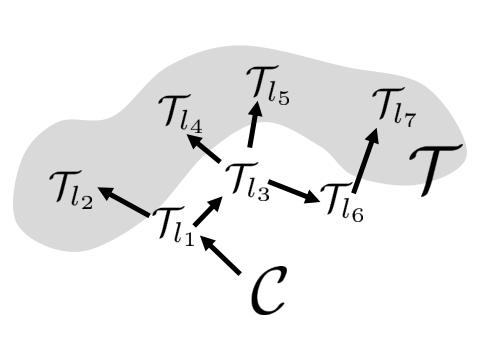
A forward pass sends states through task maps; a backward pass combines local policies into a root policy. Shared branches avoid recomputing transformations for every subtask.
3.1 Structured Task Maps
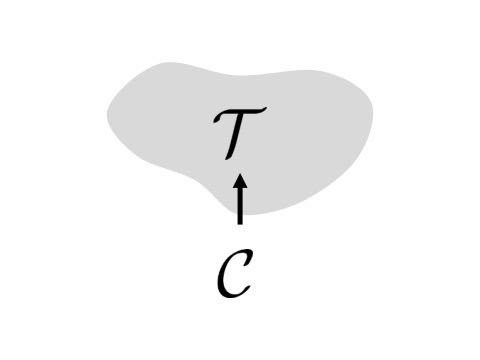
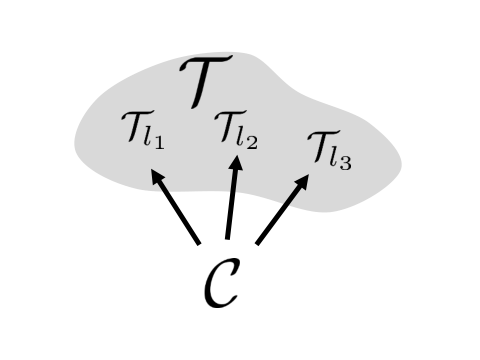
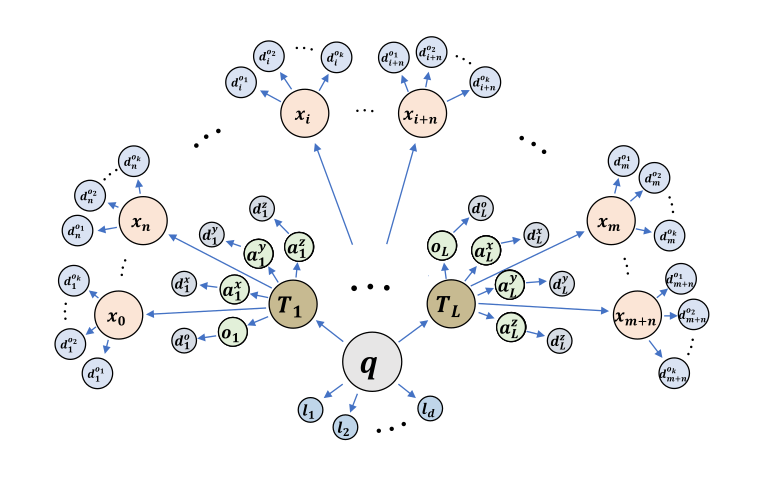
Task maps form a tree whose leaves represent individual objectives. Intermediate nodes can share kinematics, body points, and distance calculations. This organization separates the design of local behaviors from their coordinated execution.
An RMP’s canonical form pairs a desired acceleration with a positive-semidefinite importance matrix. Its natural form stores the matrix-weighted acceleration as a force-like quantity. These matrices and forces describe policy priorities and need not equal physical inertias or forces.
Each tree node stores its state and natural-form policy. Edges carry differentiable task maps, the root represents the robot configuration, and leaves hold the subtask policies.
Pushforward maps positions and velocities to child spaces. Pullback adds their force and matrix contributions, including the Jacobian-derivative correction required for consistent acceleration transformations. Resolve uses the Moore–Penrose pseudoinverse to obtain an acceleration. The combined policy minimizes a metric-weighted acceleration mismatch, allowing different directions and velocities to receive different priorities.
Equations 1–2
(1)
(2)
3.5 Algorithm: Motion Policy Generation
At each control step, RMPflow pushes the robot state to all leaves, evaluates their policies, pulls natural-form quantities back to the root, and resolves the root acceleration. Keeping policies unresolved until the root avoids repeated inversions. The paper gives linear scaling in the number of subtasks for its tree computation, versus the stated naive recomputation strategy.
The examples combine obstacle avoidance, target attraction, orientation control, and policies derived from value functions.
3.6.1 Collision/joint limit avoidance
A one-dimensional obstacle-distance policy increases its importance near an obstacle and when moving toward it. Its metric can switch off when moving away. Position and velocity derivatives of the metric contribute curvature terms that generate repulsion and shape the combined motion.
3.6.2 Target attractors
A target attractor combines a smooth distance-like potential, damping, and the curvature correction associated with its metric. Compatible choices make it a geometric dynamical system.
3.6.3 Orientations
Orientation can be controlled through local points or axes attached to a link. RMP transformations preserve the resulting geometric behavior across coordinate choices.
Value-function-derived metrics can import information from planning, potentially helping escape local minima. Such policies belong to the broader RMP framework but need not satisfy the geometric-system stability conditions proved here.
The analysis establishes closure under policy combination, sufficient conditions for stability, and a coordinate-free interpretation. These guarantees apply to structured geometric dynamical systems, a specified subset of all possible RMPs.
Setup
The analysis assumes sufficiently smooth manifolds and maps, first using a single coordinate chart and later giving the geometric formulation.
A geometric dynamical system (GDS) contains a metric, a lower-bounded potential, damping, and curvature terms. Velocity dependence makes the effective inertia differ from the metric and can make it asymmetric. Nonsingular effective inertia defines a unique acceleration; configuration-only metrics recover simple mechanical systems.
Equation 3
(3)
4.2 Closure
Structured GDSs record how a metric factorizes through task maps. Pullback preserves this class: metrics and damping pull back through Jacobians, while potentials add after composition. Nonsingular root inertia is sufficient to resolve the resulting robot dynamics, even when some leaf systems are degenerate.
Equation 4
(4)
4.3 Stability
The combined kinetic-plus-potential energy decreases at the damping rate. Under the stated definiteness and nondegeneracy conditions, the paper derives convergence to stationary points of the combined potential. Its practical sufficient condition constrains how each velocity-dependent metric changes with velocity. Convergence to a stationary set does not establish arrival at the desired goal or avoidance of every local minimum.
4.4 Invariance
Velocity-dependent metrics live naturally on the tangent bundle containing both configuration and velocity. The authors construct a compatible asymmetric affine connection and identify RMPflow with geometric pullback of connections, metrics, and forces. For velocity-independent metrics, this reduces to the Levi-Civita connection and the factorization no longer affects the dynamics.
4.5 Related Approaches
Constant task metrics recover operational-space control; configuration-dependent metrics connect to mechanical energy shaping. Velocity-dependent metrics extend both cases. The recursion also resembles forward dynamics based on Newton–Euler methods, while allowing task spaces beyond physical rigid-body coordinates.
5 Experiments
The evaluation separates controlled geometric examples, quantitative simulated reaching, and qualitative integrated demonstrations on two physical dual-arm robots.
5.1 Controlled Experiments
Low-dimensional examples isolate the effects of acceleration-transform corrections and metric curvature.
(a)
(b)
(c)
(d)
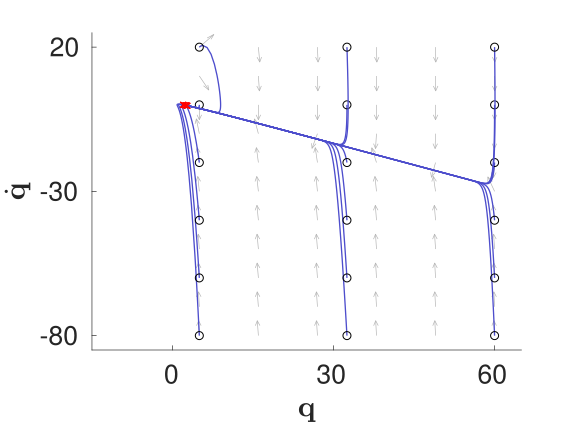
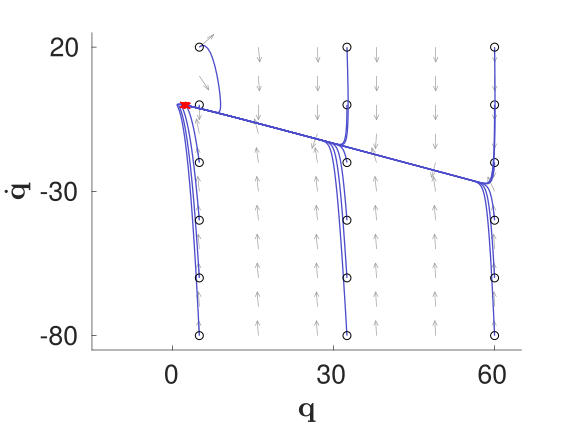
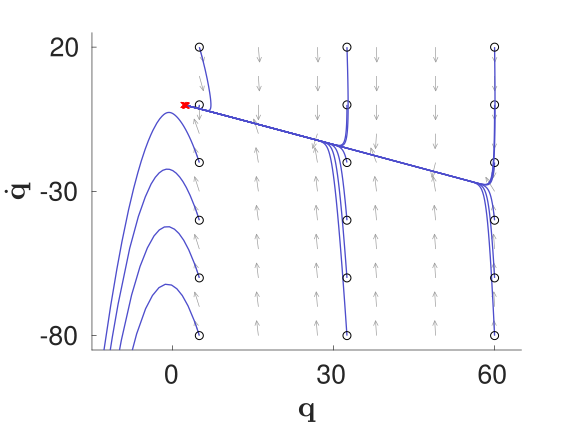
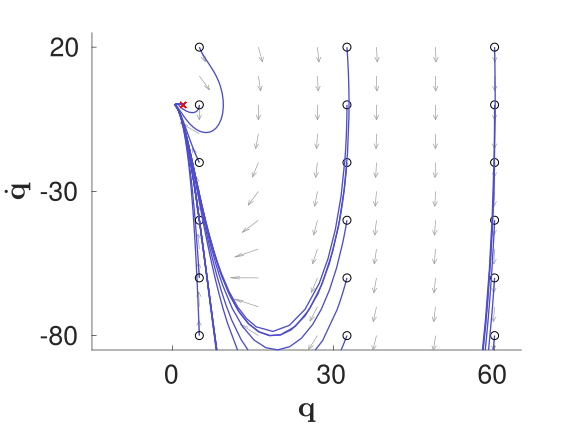
Figure 2: Phase portraits (gray) and integral curves (blue; from black circles to red crosses) of 1D example. (a) Desired behavior. (b) With curvature terms. (c) Without curvature terms. (d) Without curvature terms but with nonlinear damping.
5.1.1 1D Example
A reciprocal-coordinate example shows that the complete pullback reproduces the intended phase portrait. Removing its Jacobian-derivative term changes behavior and can destabilize it. Additional nonlinear damping restores stability in the demonstrated case but does not restore coordinate-consistent behavior.
(a)
(b)
(c)
(d)
(e)
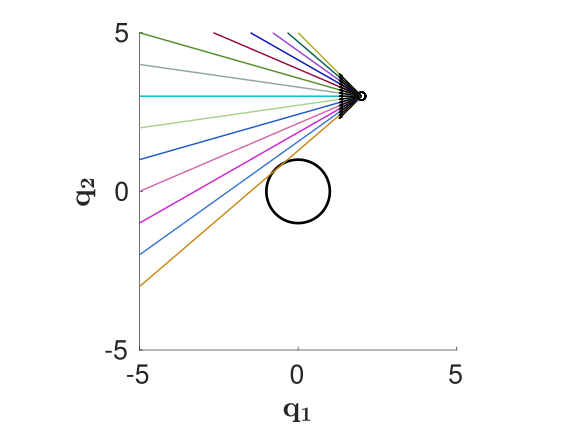
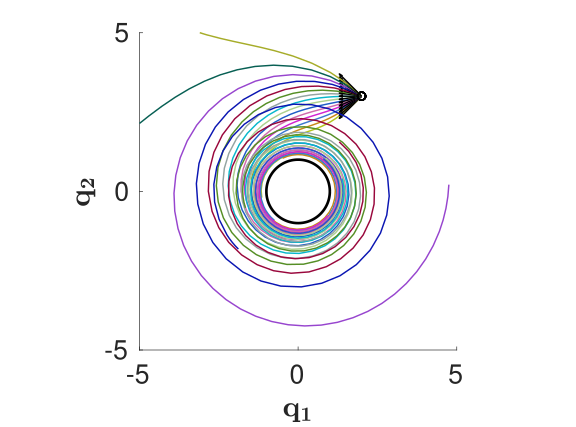
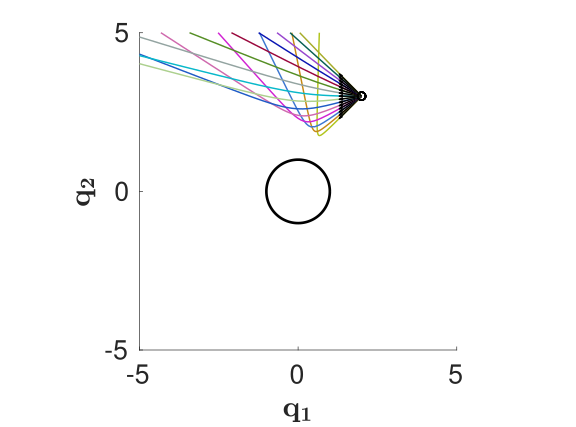
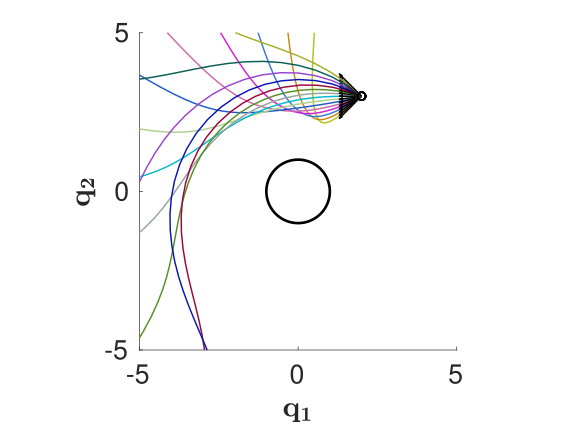
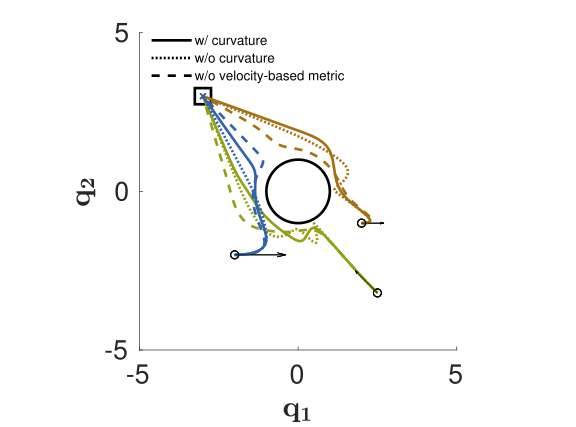
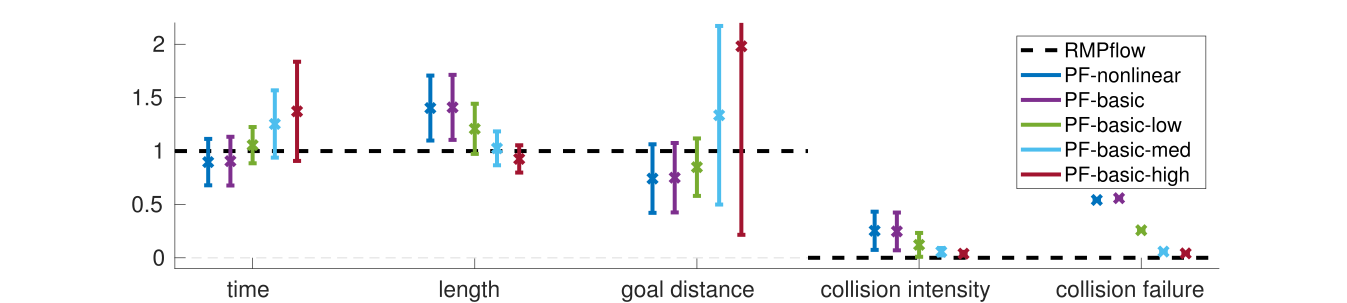
Figure 3: 2D example; initial positions (small circle) and velocities (arrows). (a-d) Obstacle (circle) avoidance: (a) w/o curvature terms and w/o potential. (b) w/ curvature terms and w/o potential. (c) w/o curvature terms and w/ potential. (d) w/ curvature terms and w/ potential. (e) Combined obstacle avoidance and goal (square) reaching.Figure 4: Results for reaching experiments. Though some methods achieve a shorter goal distance than RMPflow in successful trials, they end up in collision in most the trials.
For obstacle-distance metrics, curvature alone bends trajectories around an obstacle; omitting it produces straight motion. Combined with an attractor, curvature reduces oscillation near the obstacle. Velocity gating lets the policy leave the obstacle more readily than a position-only metric.
simulated worlds
real-world experiments
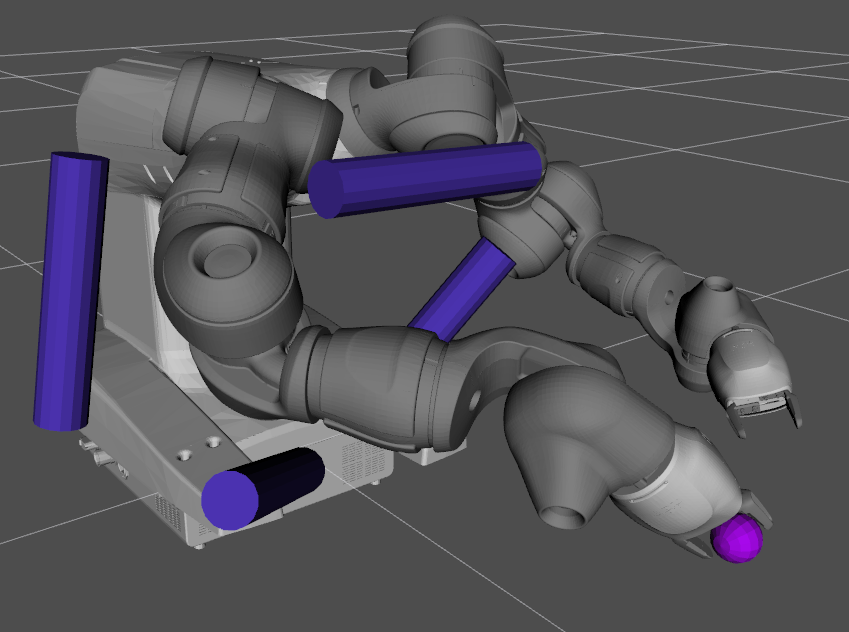
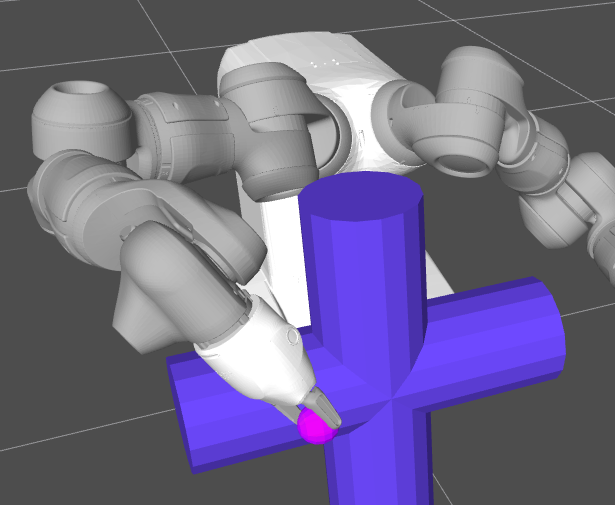
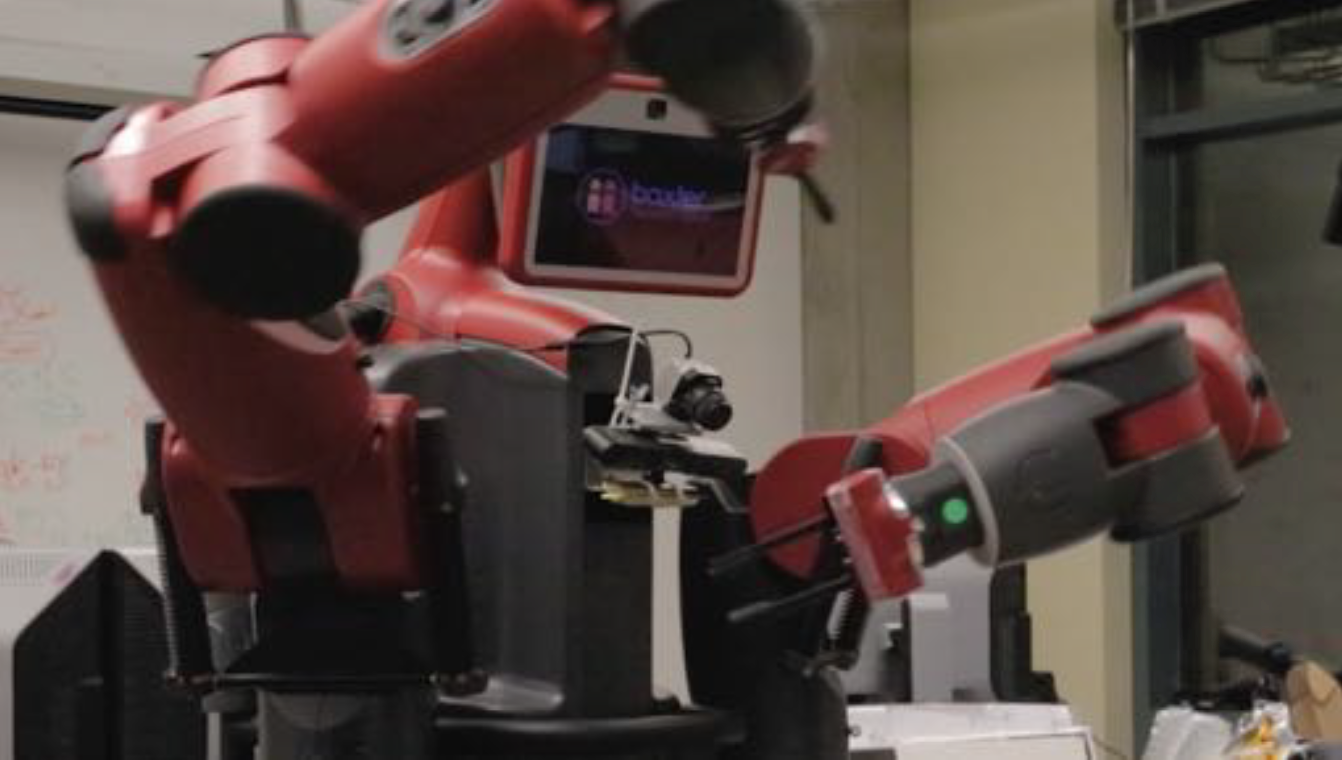
Figure 5: Two of the six simulated worlds in the reaching experiments (left), and
the two physical dual-arm
platforms in the full system experiment (right).
5.2 System Experiments
System experiments test cluttered reaching and connect reactive control to visual tracking.
5.2.1 Reaching-through-clutter Experiments
On 120 simulated reaching trials per variant, RMPflow is compared with constant and nonlinear isotropic potential-field baselines, including stronger avoidance and posture weights. RMPflow has no observed collisions and offers a better trade-off among convergence time, path length, and final distance. Some baselines appear faster or closer because they pass through obstacles. These are empirical results in the specified environments, not a general planning-completeness guarantee.
5.2.2 System Integration for Real-Time Reactive Motion Generation
ABB YuMi and Rethink Baxter demonstrations combine reactive control with DART object tracking [34]. Tasks include cluttered pick-and-place, cabinet manipulation under human perturbation, and guided arm motion. Appendix F clarifies that this early physical implementation omits curvature terms and relies on extra damping and lower speeds.
6 Conclusion
RMPflow provides a reusable way to combine carefully designed local policies with consistent geometric transformations. Its benefits depend on the chosen metrics, potentials, and damping. Learning those components is proposed as future work; the paper does not demonstrate an automatically learned general-purpose controller.
Appendices
The appendices give proofs, controller constructions, and detailed evaluation and integration protocols.
Appendix A Geometric Dynamical Systems
This appendix extends the GDS definition to singular cases and relates its curvature terms to mechanics.
Singular effective inertia defines a family of candidate dynamics rather than a unique acceleration. Existence still matters; the RMPflow closure argument only requires the final root inertia to be nonsingular.
Equation 5
(5)
A.3 Geodesic and Stability
With no potential or damping, the metric kinetic energy stays constant. The authors use this conservation property to describe geodesic motion, allowing semidefinite metrics when a valid differential equation exists.
A.4 Curvature Term and Coriolis Force
The position-curvature force can be written using Christoffel symbols in a Coriolis-like form. The retained derivation connects the GDS expression with familiar mechanical notation.
The proofs establish closure, energy decay, the sufficient metric condition, and the coordinate-free construction.
B.1 Proof of Theorem 4.1
The proof expands both direct pullback and the structured GDS equation and matches their force and inertia terms. Two lemmas transform the velocity and position curvature contributions. Configuration-only metrics remove dependence on factorization; separately propagating the equations shows why only root nondegeneracy is required.
Equations 6–7
(6)
(7)
B.2 Proof of Proposition 1
Differentiating metric kinetic energy introduces terms from both position and velocity dependence. The curvature identities cancel those contributions against the dynamics, leaving the negative damping quadratic form as the total-energy derivative.
Equations
B.3 Proof of Theorem 4.2
For the specified metric family, the velocity-derivative sign condition makes the inertia correction positive semidefinite. Combined with positive-definite root metric and damping, this supplies the invertibility and dissipation conditions used by the stability result.
Equation
B.4 Notation for Coordinate-Free Analysis
The notation distinguishes the configuration manifold, its tangent bundle, and the double tangent bundle. Local coordinates track the position, velocity, and tangent directions needed to express affine connections.
B.5 Proof of Theorem 4.3
The proof constructs Christoffel coefficients satisfying the required asymmetric conditions and checks metric compatibility. It then projects the connection’s acceleration expression to recover the GDS curvature terms.
Equations 8–9
(8)
(9)
B.6 Proof of Theorem 4.4
The pullback connection is compatible with the pulled-back metric and yields the structured GDS equation. In general it differs from the connection formed directly from that metric; velocity independence restores symmetry and makes the constructions agree.
Equations 10
(10)
Appendix C Relationship between RMPflow and Recursive Newton-Euler Algorithms
Classical forward dynamics propagates states, accumulates inertial and Coriolis terms, and solves for acceleration. RMPflow follows the same pattern but combines force and inertia in one backward pass. Choosing rigid-body inertias recovers the mechanical case; abstract task metrics support more general behavior.
Appendix D Designing Reactive Motion Policies for Manipulation
The controller constructions translate hand-designed acceleration fields into GDSs. This requires compatible potentials, metrics, damping, and curvature corrections rather than an arbitrary weighted sum of accelerations.
Figure 6: This figure depicts
the tree of task maps used in the experiments.
See Section D.1 for details.
D.1 Task map and its Tree Structure
The implemented tree maps configurations to link frames, origins and axes, body control points, obstacle distances, and joint-limit spaces. It favors parallel link computations over fully recursive kinematic reuse.
D.2 Example: 1D Velocity-Dependent Metrics
For a separable one-dimensional metric, the velocity factor must satisfy the theorem’s derivative sign condition. The position-curvature force points toward decreasing spatial metric weight, explaining its role in slowing approach to an obstacle.
Equations 11–16
(11)
(12)
(13)
(14)
(15)
(16)
D.3 Collision Avoidance Controllers
The collision controller uses a distance-dependent weight within a finite influence radius and a smooth velocity gate that vanishes when moving away. Its pullback produces directionally selective curvature forces. These slow approach and encourage motion along distance contours while allowing repulsive potentials to add further separation.
Equations 17–19
(17)
(18)
(19)
D.4 Attractors
Attractor metrics can prioritize precision near a goal while allowing more compliance in directions useful for avoiding obstacles farther away.
Notation
The attractor derivation restricts the metric to position dependence, so its metric and effective inertia coincide.
Desired acceleration is split into potential, damping, and curvature components. A proposed acceleration field becomes a GDS only when multiplying its potential gradient and damping by the chosen metric yields a valid potential gradient and positive damping.
Equations 20–21
(20)
(21)
D.4.2 Motion policy candidates
Soft-normalized target directions avoid discontinuity at the goal. The appendix gives both an integrability argument for a commonly used attractor and an explicit smooth radial potential, with numerically stable formulas.
Equations 22–25
(22)
(23)
(24)
(25)
D.4.3 Metric options
Two admissible metric families are presented: a uniform radial weight and an anisotropic metric that emphasizes the target direction far away and becomes more isotropic nearby. A positive baseline fills otherwise weak directions.
Equations 26–27
(26)
(27)
D.4.4 Compatibility between metrics and potentials
For radial potentials, the Jacobian of the metric-weighted gradient is symmetric under the given constructions. This proves the existence of a compatible potential without requiring its closed-form expression.
Equations 28–29
(28)
(29)
D.4.5 Compatibility between metrics and damping
The transformed damping must be positive definite. Choosing damping and metric matrices with the same eigenvectors is a convenient sufficient construction.
Equation
D.4.6 Effects of the curvature term
For the uniformly weighted metric, curvature can be expressed with a Householder reflection and acts to align motion toward the goal while adding drag. The more complex stretched metric can use differentiation tools.
The earlier RMP attractor lacks the metric-curvature correction. Adding it recovers the analyzed GDS form; omitting it can undermine stability, particularly at higher velocities.
Joint-limit policies increase the importance of selected joint directions near limits. Their curvature-consistent combination is equivalent to smoothly rescaling columns of the task Jacobians.
Adding a diagonal joint-limit policy yields a reweighted least-squares combination of task accelerations. As a joint-limit weight grows, the corresponding scaled Jacobian column shrinks, reducing that degree of freedom’s contribution to other tasks.
Equations 30–32
(30)
(31)
(32)
D.5.2 A class of velocity-dependent joint limit metrics
The joint metric grows near a limit only when velocity points toward it. Smooth upper- and lower-limit gates implement this directional logic. The derivative calculation verifies the sufficient velocity-metric condition within the allowed joint interval.
Equations 33–38
(33)
(34)
(35)
(36)
(37)
(38)
D.5.3 Motion policies for joint-limit avoidance
A joint-limit policy combines its curvature acceleration with attraction and damping. The combination rescales this corrective acceleration more strongly as a joint approaches its boundary in the dangerous direction.
Equation 39
(39)
Appendix E Details of the Reaching-through-clutter Experiments
The quantitative evaluation uses a simulated YuMi reaching through cylindrical obstacles.
E.1 Experimental method
Each method runs six obstacle environments with 20 targets each: three use four smaller obstacles and three use two larger obstacles. The same targets are reused across methods. Baselines share the relevant attraction and avoidance terms but use isotropic metrics; PF-nonlinear omits its nonconstant-metric curvature. Additional PF-basic settings scale avoidance and posture weights to (3, 10), (5, 50), and (10, 100).
E.2 Performance measures
Reported bars are means with one standard deviation over 120 trials. Time measures convergence to either the target or a best-effort local minimum, with a five-second timeout. Other measures are configuration-space path length, final achievable goal distance, collision duration conditional on a collision, and the fraction of trials with any collision. Targets are not guaranteed feasible.
E.3 Discussion
RMPflow records zero collisions in this experiment. Strengthening baseline avoidance reduces collisions but slows motion and worsens goal approach; weak baselines sometimes gain apparent speed by penetrating obstacles. Similar performance of the two isotropic baselines supports the importance of directional metrics in this comparison, without isolating every design difference.
E.3.1 Summary:
The experiment illustrates why scalar weights cannot fully describe how attraction, posture, and collision avoidance should compromise in different directions. RMPflow’s directional metrics make those priorities more explicit.
Appendix F Details of integrated system
The physical system uses depth sensing and DART tracking, with state machines selecting behaviors and transitions. Baxter also uses a voxelized ambient-world model and locally smoothed nearest-obstacle queries. Arms run separate controllers while sharing their current states. Crucially, the demonstrated early implementation ignores curvature terms, uses sufficient damping and slower speeds, and reports cross-robot consistency only anecdotally; it is not a quantitative validation of the complete curvature-aware controller.
36 references
(1)Rimon, E., Koditschek, D.: The construction of analytic diffeomorphisms for exact robot navigation on star worlds. Transactions of the American Mathematical Society 327(1), 71–116 (1991)
(2)Ratliff, N., Toussaint, M., Schaal, S.: Understanding the geometry of workspace obstacles in motion optimization. In: IEEE International Conference on Robotics and Automation (ICRA) (2015)
(3)Ivan, V., Zarubin, D., Toussaint, M., Komura, T., Vijayakumar, S.: Topology-based representations for motion planning and generalization in dynamic environments with interactions. International Journal of Robotics Research (IJRR) 32(9-10), 1151–1163 (2013)
(4)Watterson, M., Liu, S., Sun, K., Smith, T., Kumar, V.: Trajectory optimization on manifolds with applications to SO(3) and R3XS2. In: Robotics: Science and Systems (RSS) (2018)
(7)Karaman, S., Frazzoli, E.: Sampling-based algorithms for optimal motion planning. International Journal of Robotics Research (IJRR) 30(7), 846–894 (2011),http://arxiv.org/abs/1105.1186
(8)Gammell, J.D., Srinivasa, S.S., Barfoot, T.D.: Batch Informed Trees (BIT*): Sampling-based optimal planning via the heuristically guided search of implicit random geometric graphs. In: IEEE International Conference on Robotics and Automation (ICRA) (2015)
(10)Khatib, O.: A unified approach for motion and force control of robot manipulators: The operational space formulation. IEEE Journal on Robotics and Automation 3(1), 43–53 (1987)
(11)Peters, J., Mistry, M., Udwadia, F.E., Nakanishi, J., Schaal, S.: A unifying framework for robot control with redundant DOFs. Autonomous Robots 1, 1–12 (2008)
(12)Udwadia, F.E.: A new perspective on the tracking control of nonlinear structural and mechanical systems. Proceedings of the Royal Society of London A: Mathematical, Physical and Engineering Sciences 459(2035), 1783–1800 (2003),http://rspa.royalsocietypublishing.org/content/459/2035/1783
(14)Mukadam, M., Cheng, C.A., Yan, X., Boots, B.: Approximately optimal continuous-time motion planning and control via probabilistic inference. In: IEEE International Conference on Robotics and Automation (ICRA) (2017)
(15)Bullo, F., Lewis, A.D.: Geometric control of mechanical systems: modeling, analysis, and design for simple mechanical control systems, vol. 49. Springer Science & Business Media (2004)
(18)Albu-Schaffer, A., Hirzinger, G.: Cartesian impedance control techniques for torque controlled light-weight robots. In: IEEE International Conference on Robotics and Automation (ICRA). vol. 1, pp. 657–663 (2002)
(19)Sentis, L., Khatib, O.: A whole-body control framework for humanoids operating in human environments. In: IEEE International Conference on Robotics and Automation (ICRA). pp. 2641–2648 (2006)
(21)Erez, T., Lowrey, K., Tassa, Y., Kumar, V., Kolev, S., Todorov, E.: An integrated system for real-time model-predictive control of humanoid robots. In: IEEE/RAS International Conference on Humanoid Robots (2013)
(23)Liegeois, A.: Automatic supervisory control of the configuration and behaviour of multibody mechanisms. IEEE Transactions on Systems, Man and Cybernetics 7(12), 868–871 (1977)
(26)Dong, J., Mukadam, M., Dellaert, F., Boots, B.: Motion planning as probabilistic inference using Gaussian processes and factor graphs. In: Robotics: Science and Systems (RSS) (2016)
(27)Nakanishi, J., Cory, R., Mistry, M., Peters, J., Schaal, S.: Operational space control: A theoretical and empirical comparison. International Journal of Robotics Research (IJRR) 6, 737–757 (2008)
(28)Platt, R., Abdallah, M.E., Wampler, C.W.: Multiple-priority impedance control. In: IEEE International Conference on Robotics and Automation (ICRA). pp. 6033–6038. Citeseer (2011)